
Revision Notes
AQA GCSE Business: Globalisation and Legislation (8132) – Revision Notes
Condensed revision notes on globalisation, exchange rates and employment, health and safety and consumer law for AQA GCSE Business 8132, 3.2.4-3.2.5.
- Subject
- Business
- Level
- GCSE
- Topic
- Influences on business
- Author
- Marlbridge Academic Team
- Updated
- Reviewed by
- Salman Ahmad (what this means)
Aligned to AQA GCSE Business (8132), For first teaching from September 2017. Official specification .
Syllabus page (what it covers and how it is assessed): AQA GCSE Business.
Syllabus points this page covers
8132
- 3.2.4 Globalisation
- 3.2.5 Legislation
Found an error? Report a correction.
Need help with this topic? Request a free trial class for GCSE Business (8132).
These notes condense AQA GCSE Business (8132) sections 3.2.4 Globalisation and 3.2.5 Legislation, from 3.2 Influences on business. For full explanations and worked examples, read the study guide first. Then test yourself with the practice questions. The specification gives no tier labels for these sections. Related pages: course hub | printable checklist | free diagnostics | technology and ethical considerations
3.2.4 Globalisation
Key definitions
| Term | Meaning |
|---|---|
| Globalisation | Standard definition: the growing connection of the world’s economies and markets, so goods, services, money and ideas cross borders more easily |
| Exchange rate | How much of one currency buys a unit of another |
| Stronger pound | Each pound buys more foreign currency |
| Weaker pound | Each pound buys less foreign currency |
| Exporter | A business that sells goods or services to customers abroad |
| Importer | A business that buys goods or services from suppliers abroad |
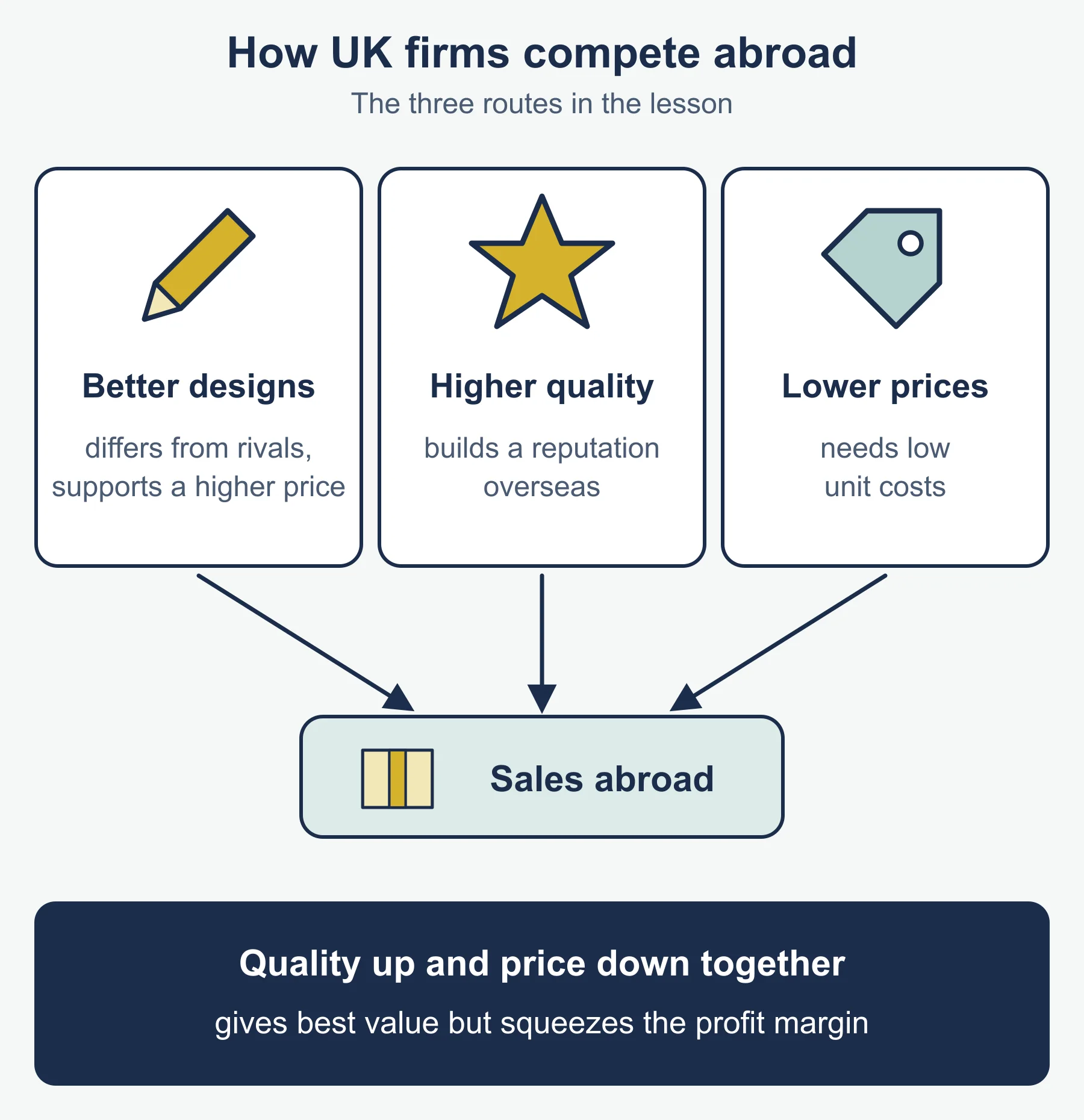
How UK businesses compete internationally
The specification lists two bullets: better designs, and higher quality products at lower prices. Splitting them into design, quality and price for analysis:
- better designs (differentiation; can support a higher price)
- higher quality products
- lower prices (needs low unit costs)
Quality and price together mean good value, but this squeezes profit margin.
Benefits and drawbacks of globalisation
| Benefits | Drawbacks |
|---|---|
| Bigger market through exports | More overseas rivals in the UK market |
| Cheaper components and products | Longer supply chains and transport costs |
| Larger output can lower unit costs | Exchange rate risk |
| New ideas, skills and suppliers | Cultural, language and legal differences |
| Less reliance on the UK economy | Reputation risk from unethical overseas suppliers |
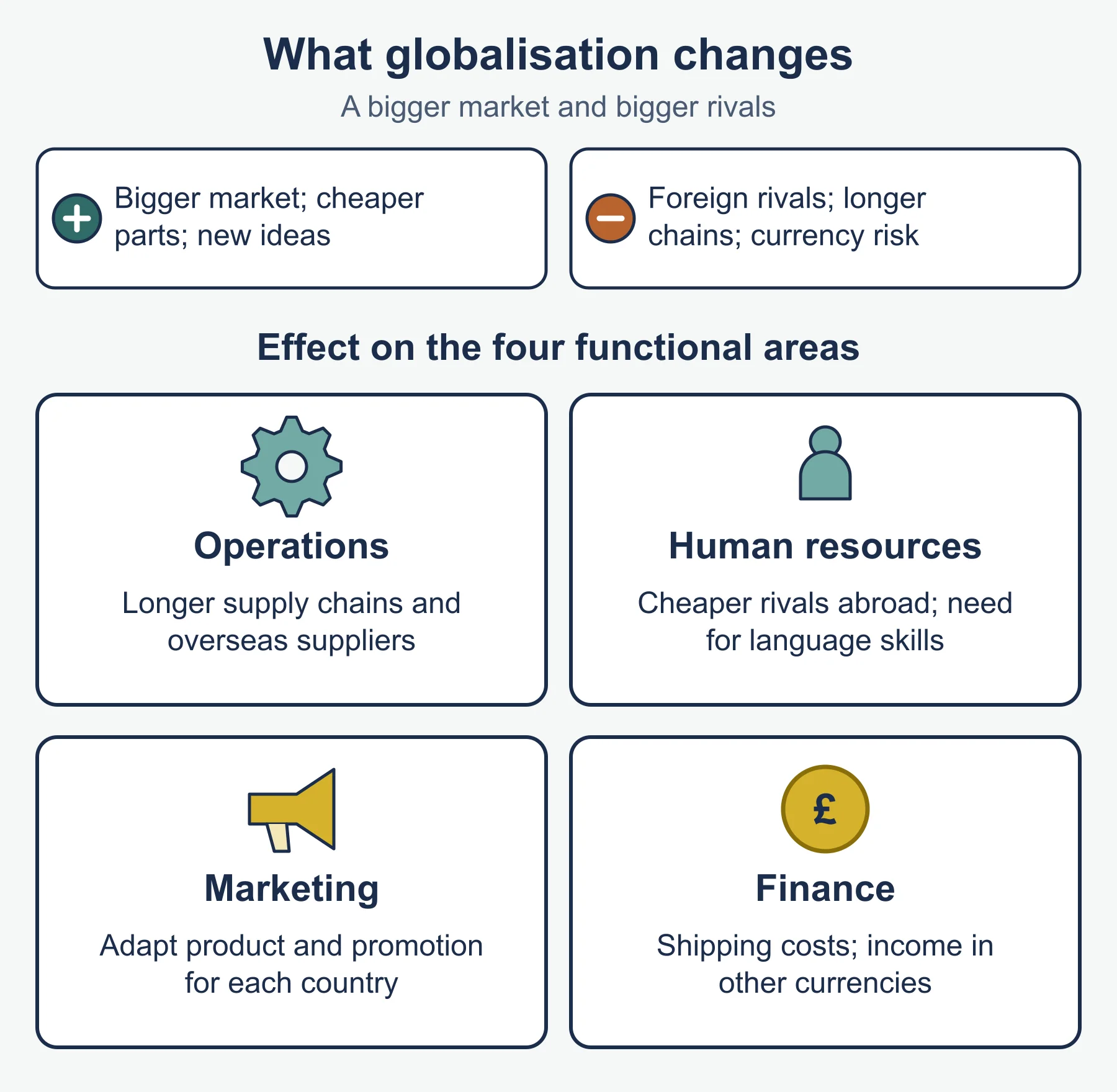
Impact on the four functional areas
| Area | Example effect |
|---|---|
| Operations | Overseas sourcing, longer supply chains |
| Human resources | Competition on labour costs; need for language skills |
| Marketing | Adapting products and promotion for other countries |
| Finance | Shipping costs, foreign income, currency risk |
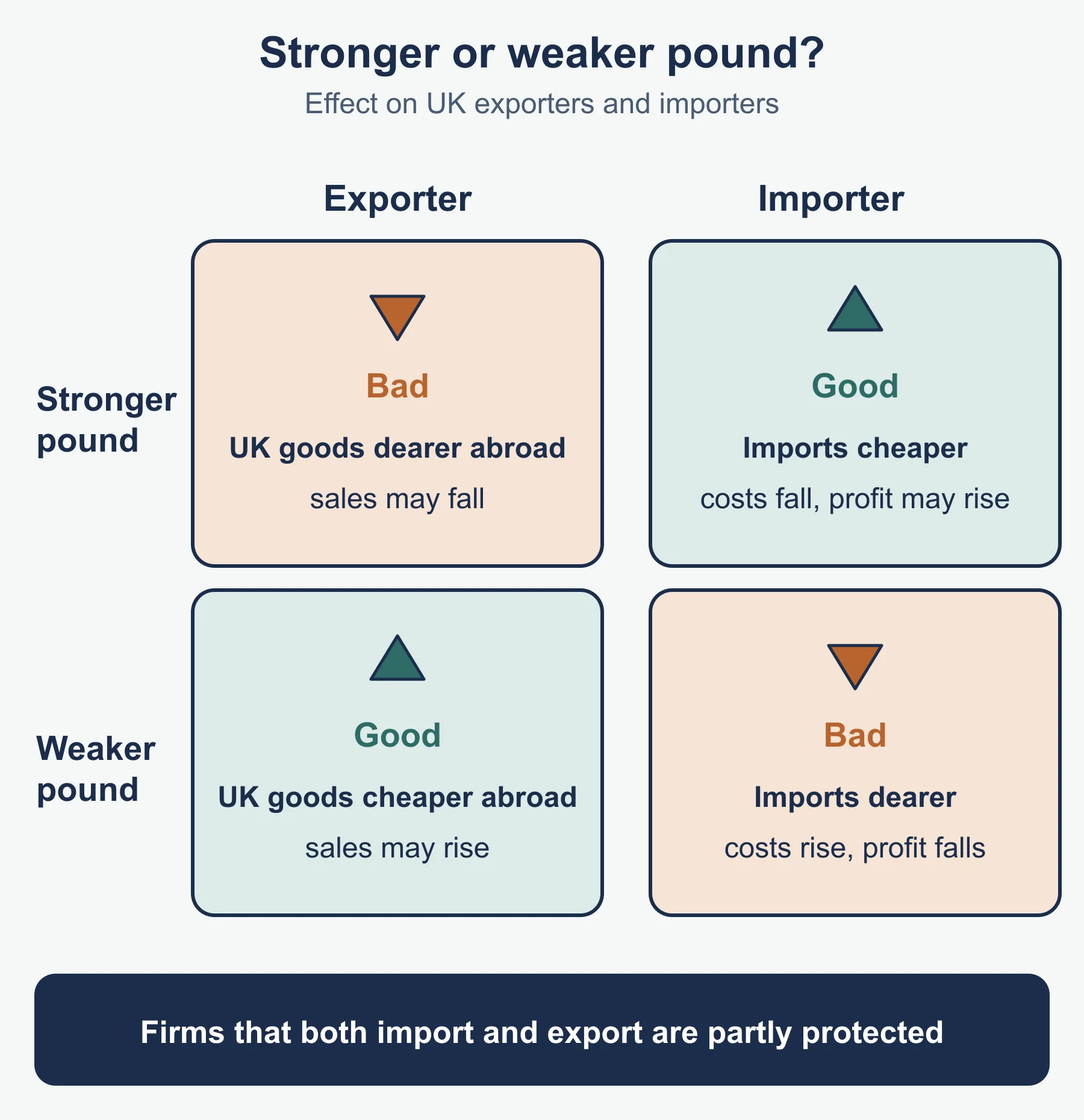
Exchange rates: direction of effect
| Exporter | Importer | |
|---|---|---|
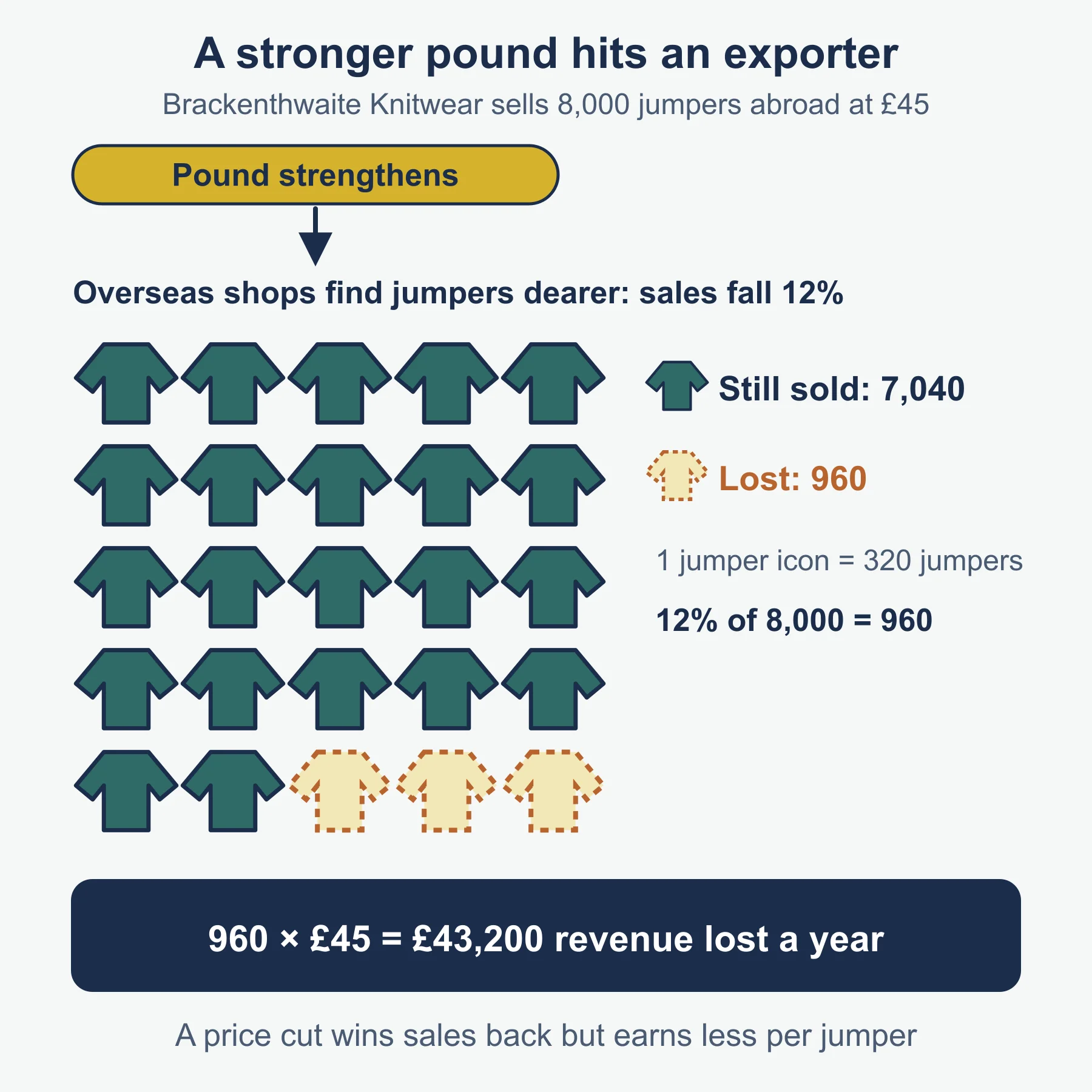
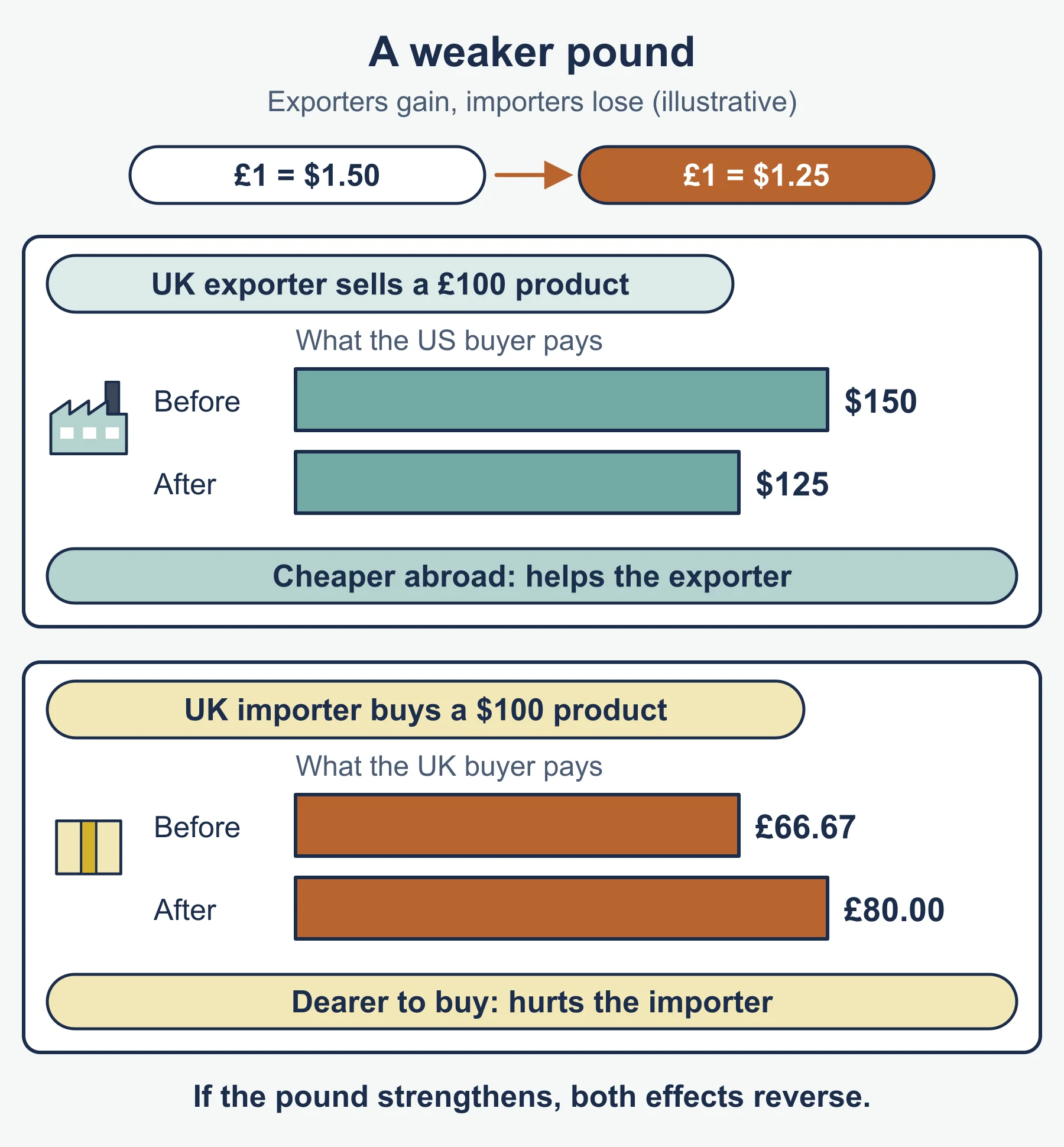
| Stronger pound | Exports dearer abroad, sales may fall or profit per item falls | Imports cheaper, costs fall, profit may rise |
| Weaker pound | Exports cheaper abroad, sales may rise | Imports dearer, costs rise, profit falls unless prices rise |
You will not be asked to calculate exchange rate conversions. A firm that both imports and exports is partly protected.
Method in steps: an exchange rate question
- Say whether the business imports, exports or does both.
- Say whether the pound is stronger or weaker.
- State the effect on price or cost, then on sales, then on profit.
- Use any figures from the case study to size the effect.
- For evaluation, say what the firm could do and what could limit the effect.
Worked reminder
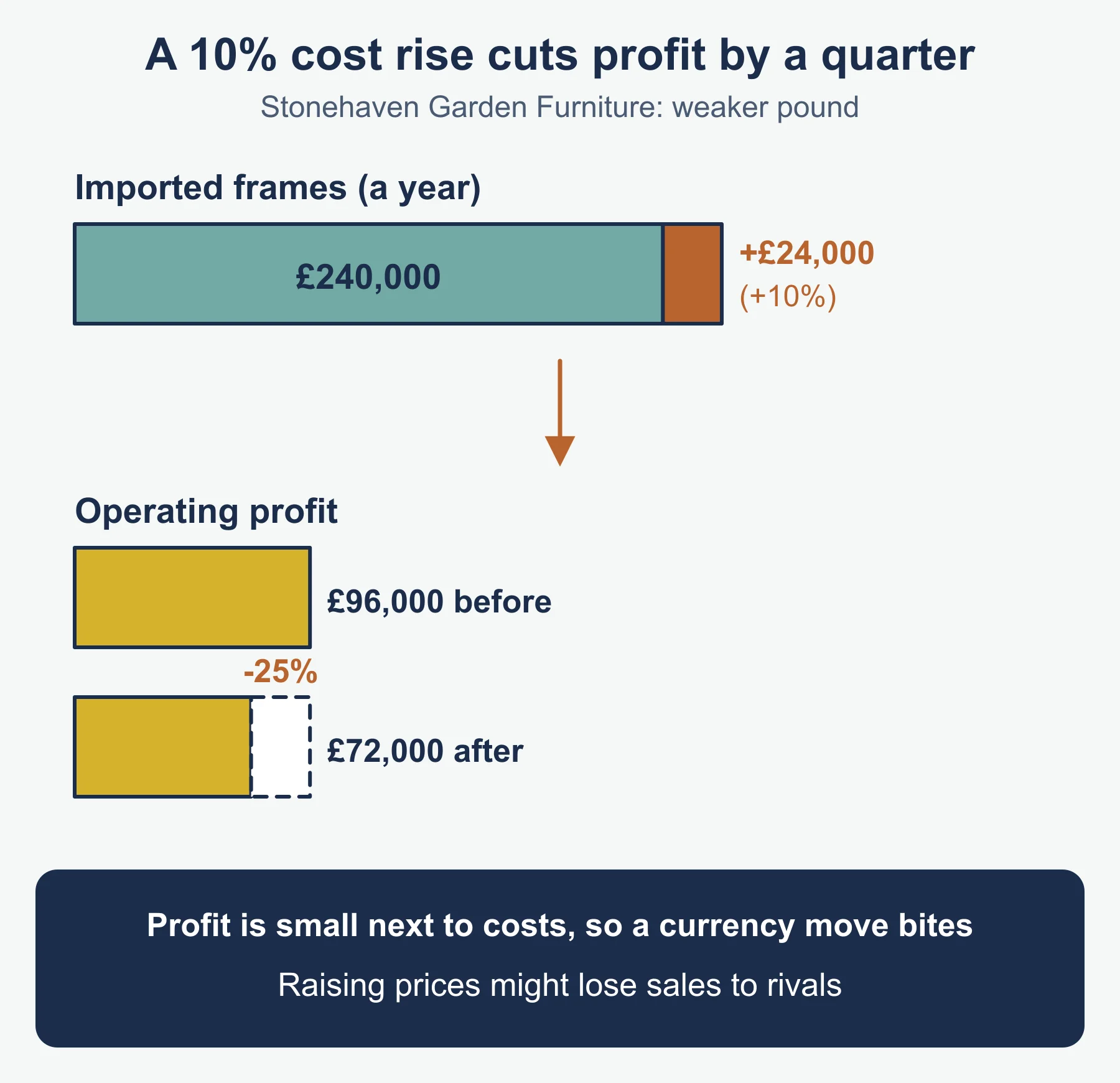
A firm imports parts costing £150,000 a year and the cost rises 4%. Extra cost = £6,000. If profit was £40,000 it falls to £34,000, which is a 15% fall.
3.2.5 Legislation
Only brief knowledge of each law is needed. Put most effort into the effects on the business.
Four examples of impact the specification gives
| Heading | What to discuss |
|---|---|
| Cost | Wages, equipment, training, adaptations, record keeping |
| Training needs | Managers and staff must know what the law requires |
| Recruitment | Fair selection, hiring plans, attracting staff |
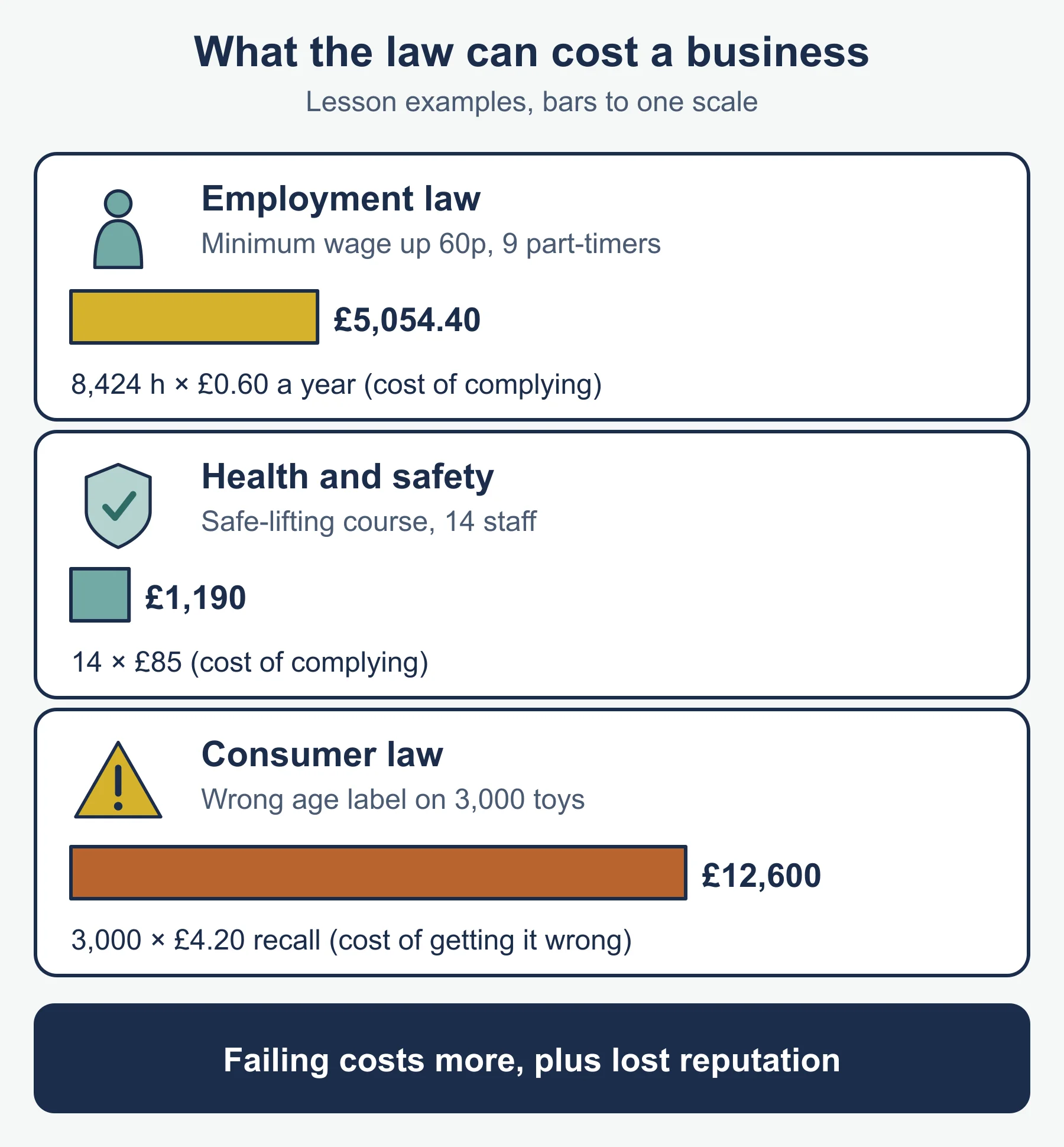
| Consequences of failure | Penalties, compensation, legal costs, reputation, lost sales |
The laws in the specification
| Area | Law named | Brief meaning (general terms) |
|---|---|---|
| Employment law | National minimum wage/living wage | Legal minimum hourly pay; rates change, so check current ones |
| Employment law | The Equality Act (2010) | Unfair treatment because of characteristics such as age, sex, race, disability or religion is unlawful in areas such as hiring, pay and promotion |
| Health and safety law | Health and Safety at Work Act (1974) | Employers must keep the workplace reasonably safe; employees must take care |
| Consumer law | Trade descriptions | What is said about a product must be accurate and not misleading |
Effects by law
- Minimum wage: higher wage bill, possible price rises or fewer hours, better motivation and lower staff turnover.
- Equality Act: fair recruitment procedures, training for managers, possible workplace adaptations, a wider pool of talent.
- Health and safety: spending on equipment and training against fewer accidents, less absence, better morale and reputation.
- Consumer law: checks on labels and adverts, quality control, refunds or recalls if wrong, trust from customers.
Benefits of a safe working environment
- fewer accidents and less absence
- better motivation and loyalty
- a stronger reputation, which helps recruitment
- avoiding compensation and legal action
Worked reminder
8 staff each work 15 hours a week for 52 weeks. The legal rate rises by 40p. Hours = 8 x 15 x 52 = 6,240. Extra cost = 6,240 x £0.40 = £2,496 a year.
Distinctions to remember
- Importer versus exporter: a stronger pound helps one and hurts the other.
- Cost of compliance versus cost of failure: the second is usually larger and less certain.
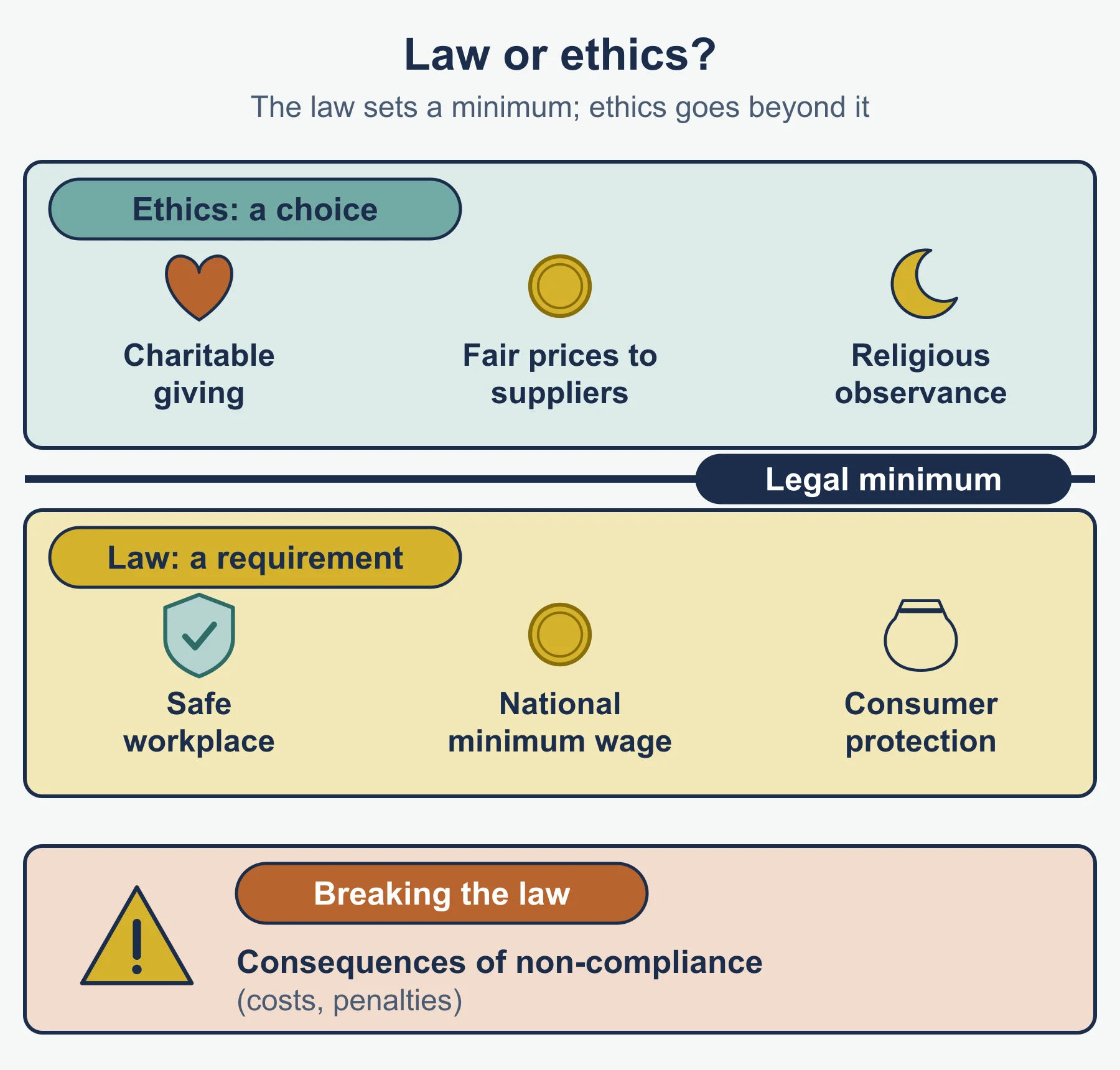
- Law versus ethics: law is the minimum a business must do. Ethical behaviour can go beyond it.
Impact of legislation on the four functional areas
| Area | Example effect |
|---|---|
| Operations | Safer processes, quality checks so products match their descriptions |
| Human resources | Pay rates, fair recruitment, training in safety and equality |
| Marketing | Honest claims in adverts, packaging and online listings |
| Finance | Cost of compliance, and the cost of penalties, refunds or compensation if the firm fails |
Consequences of failure (general terms)
- financial penalties and compensation claims
- legal costs and management time
- forced changes to how the business operates
- bad publicity, lost customers and difficulty recruiting
- do not quote figures for fines unless the case study gives them
Case-study skills
Building an analysis paragraph
- Point: state the effect, for example “a weaker pound raises the cost of imported parts”.
- Link: tie it to the business in the stem, using its name, product or figures.
- Explain: follow the chain, from cost to price to sales to profit.
- Consequence: say what it means for the business, for example lower profit or a need to raise prices.
Building an evaluation
Weigh both sides. For each, ask how big the effect is, how soon it happens and whether it lasts. Then give a reasoned judgement that answers the question set. A judgement that appears in the final line but is not supported by the earlier points earns little.
Command words in practice
General exam guidance, not taken from the AQA specification text (the specification does not define command words).
| Command word | What to do |
|---|---|
| State, identify, define | Short answer, no explanation |
| Calculate | Show the working and give units |
| Explain, analyse | Give a reason, then follow the chain of consequences |
| Evaluate, justify | Weigh both sides and reach a judgement. Support it with evidence from the case |
| Recommend | Choose an option and give reasons that fit the business’s situation |
Worked reminder: weighing a cost
A shop spends £600 on safety training for its staff. If the training avoids one accident costing £4,000 in absence cover and lost sales, the net saving is £3,400. A real answer also notes that the accident might never have happened, so the benefit is uncertain, while the training cost is certain.
Quick self-test
- Name the ways the specification says UK businesses compete internationally: the design idea and the quality-and-price idea.
- Give one benefit and one drawback of globalisation for a UK business.
- A UK exporter faces a stronger pound. Explain the likely effect on sales.
- A UK importer faces a weaker pound. Explain the likely effect on profit.
- A firm imports goods for £90,000 a year and the cost rises by 5%. Calculate the extra cost.
- Name the law that covers equality at work in the specification, and its year.
- Name the health and safety law in the specification, and its year.
- Give two benefits to a business of a safe working environment.
- Give two consequences for a business of failing to follow consumer law.
- 5 staff each work 20 hours a week for 52 weeks. The legal rate rises by 50p. Calculate the extra annual wage cost.
Answers
- Better designs, and higher quality products at lower prices.
- Benefit, for example a larger market through exports. Drawback, for example more overseas competitors in the UK market.
- UK goods become dearer for overseas buyers, so sales may fall, or the firm cuts its price and earns less per item.
- Imports cost more, so costs rise and profit falls unless the firm raises its prices.
- 5% of £90,000 = £4,500.
- The Equality Act, 2010.
- The Health and Safety at Work Act, 1974.
- Any two: fewer accidents, less absence, better motivation, stronger reputation, avoiding compensation.
- Any two: penalties, refunds or recalls, legal costs, damaged reputation, lost sales.
- Hours = 5 x 20 x 52 = 5,200. Extra cost = 5,200 x £0.50 = £2,600.
Where marks are usually lost
- Saying a stronger pound is good or bad without saying for whom.
- Trying to convert currencies, which the specification says is not needed.
- Naming a law but not explaining its effect on the business.
- Giving only costs of legislation and ignoring benefits, or the reverse.
- Not using figures or details from the case study.
- Treating the minimum wage as a fixed number. Rates change.
- Writing a list of points for an evaluation question with no judgement.
- Mixing up exports and imports.
Frequently asked questions
How does a stronger pound affect UK exporters and importers? A stronger pound makes UK exports dearer abroad, so an exporter’s sales or profit per item may fall. It makes imports cheaper, so an importer’s costs fall.
Which laws are named in AQA GCSE Business section 3.2.5? The national minimum wage and living wage, the Equality Act (2010), the Health and Safety at Work Act (1974) and consumer law on trade descriptions.
How do UK businesses compete internationally according to the specification? Through better designs, and through higher quality products at lower prices.
What is the difference between law and ethics in GCSE Business? Law is the minimum a business must do. Ethical behaviour can go beyond the law, for example by paying more than the legal minimum wage.
Official syllabus
AQA GCSE Business (8132), specification for first teaching from September 2017, published by AQA: sections 3.2.4 and 3.2.5.
Get free revision emails (optional)
Occasional emails with practice questions, worked explanations and links to free resources for the qualification and subjects you choose. No spam, and you can unsubscribe from any email. The free tools on this site never need an email.
Related resources
-
Practice questions
AQA GCSE Business: Technology and Ethical/Environmental Considerations — Practice Questions
Original practice questions with worked answers on e-commerce, digital communication and ethics and environment trade-offs for AQA GCSE Business (8132).
Business · AQA · GCSE
Try questions -
Revision notes
AQA GCSE Business: Technology and Ethical/Environmental Considerations — Revision Notes
Condensed recall notes on e-commerce, digital communication, and ethics/environment/sustainability trade-offs for AQA GCSE Business (8132), 3.2.1 and 3.2.2.
Business · AQA · GCSE
Revise topic -
Study guides
AQA GCSE Business: Technology and Ethical/Environmental Considerations (8132)
E-commerce, digital communication and the trade-offs between ethics, sustainability and profit, covering sections 3.2.1 and 3.2.2 of AQA GCSE Business (8132).
Business · AQA · GCSE
Read guide
Related articles
-
teaching
A Level tuition in Dubai: Cambridge or Pearson Edexcel International A Level?
Schools in Dubai and Abu Dhabi teach either Cambridge International AS & A Level or Pearson Edexcel International A Level. How the two are structured, why it matters for tuition, and how online classes from Lahore work.
9 October 2026
-
curriculum guides
Choosing subjects at IGCSE and A Level
How subject choices at 14 and 16 affect university options later, and how to keep pathways open without overloading a timetable.
28 July 2026
Studying this with a teacher
Working through Business GCSE?
This page is free and stays free. If you would rather be taught it, Marlbridge runs Business classes one-to-one and in small groups of up to 15, online in your own time zone. The first trial class is free. WhatsApp replies within an hour (8am–11pm Pakistan time, every day); email the same day.
AQA Business teachers at Marlbridge
