
Revision Notes
AQA GCSE Economics: Fiscal policy, the budget and monetary policy (8136) – Revision Notes
Condensed AQA GCSE Economics revision notes for 3.2.3.1 and 3.2.3.2: fiscal policy, balanced budgets, surpluses and deficits, and monetary policy.
- Subject
- Economics
- Level
- GCSE
- Topic
- Fiscal policy and the government budget; monetary policy and the Bank of England
- Author
- Marlbridge Academic Team
- Updated
- Reviewed by
- Salman Ahmad (what this means)
Aligned to AQA GCSE Economics (8136), For first teaching from September 2017. Official specification .
Syllabus page (what it covers and how it is assessed): AQA GCSE Economics.
Syllabus points this page covers
8136
- 3.2.3.1 Fiscal policy
- 3.2.3.2 Monetary policy
Found an error? Report a correction.
Need help with this topic? Request a free trial class for GCSE Economics (8136).
These notes condense sections 3.2.3.1 Fiscal policy and 3.2.3.2 Monetary policy of the AQA GCSE Economics (8136) specification for first teaching from September 2017. The specification has no tiers. How interest rates affect saving, borrowing and spending is in the interest rates revision notes, and the sources of tax revenue in the UK government revenue and tax revision notes. Course links: AQA GCSE Economics hub, checklist and free diagnostics. Worked-example figures are invented unless a real UK fact is stated.
Part A: Fiscal policy (3.2.3.1)
Key terms
| Term | Meaning |
|---|---|
| Fiscal policy | Changes in government spending and taxation used to influence the economy and meet the government’s objectives |
| The Budget | The government’s yearly plan for taxation and spending, presented in the UK by the Chancellor of the Exchequer |
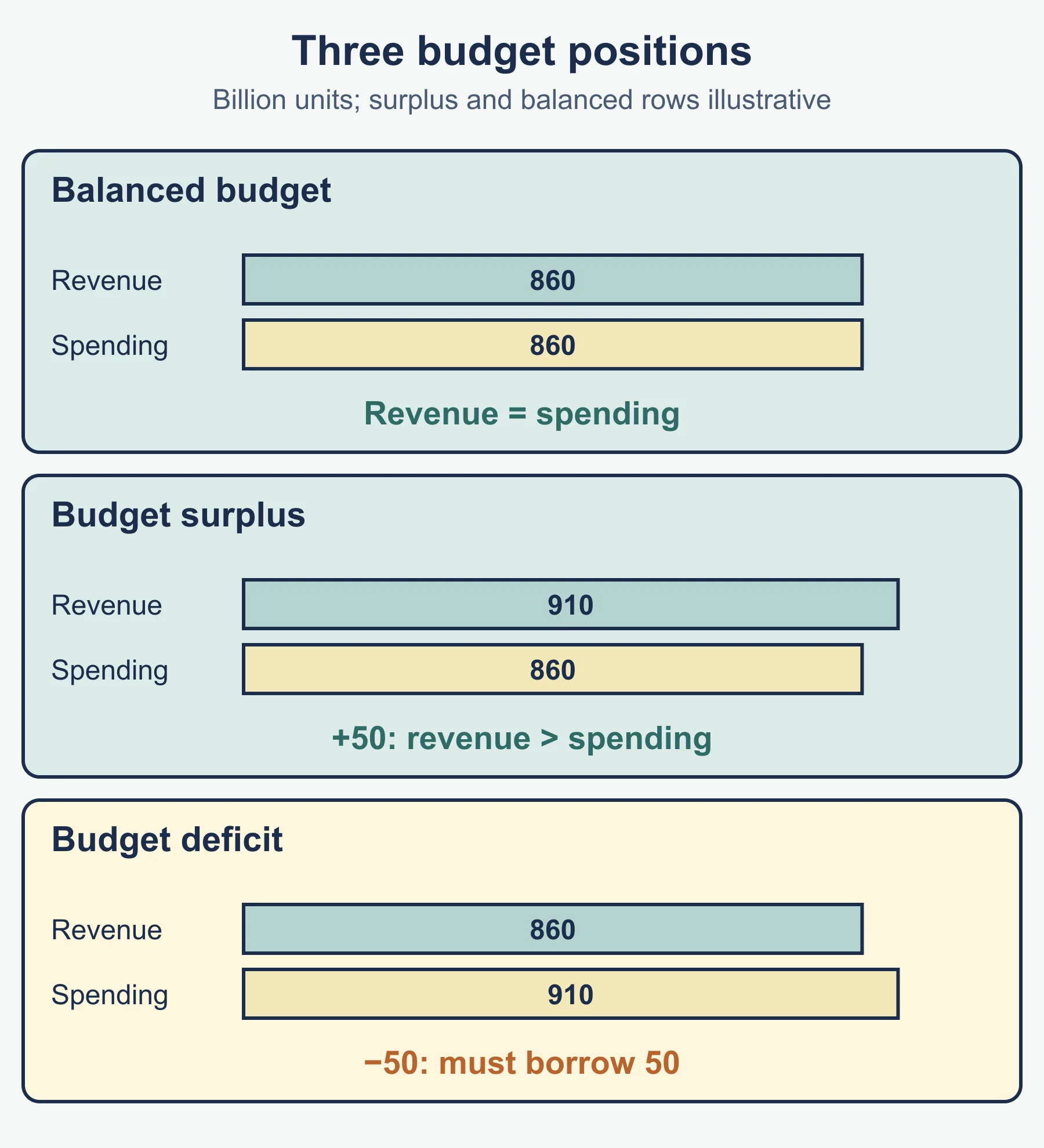
| Balanced budget | Government revenue equals government spending |
| Budget surplus | Revenue is greater than spending |
| Budget deficit | Spending is greater than revenue, so the government must borrow |
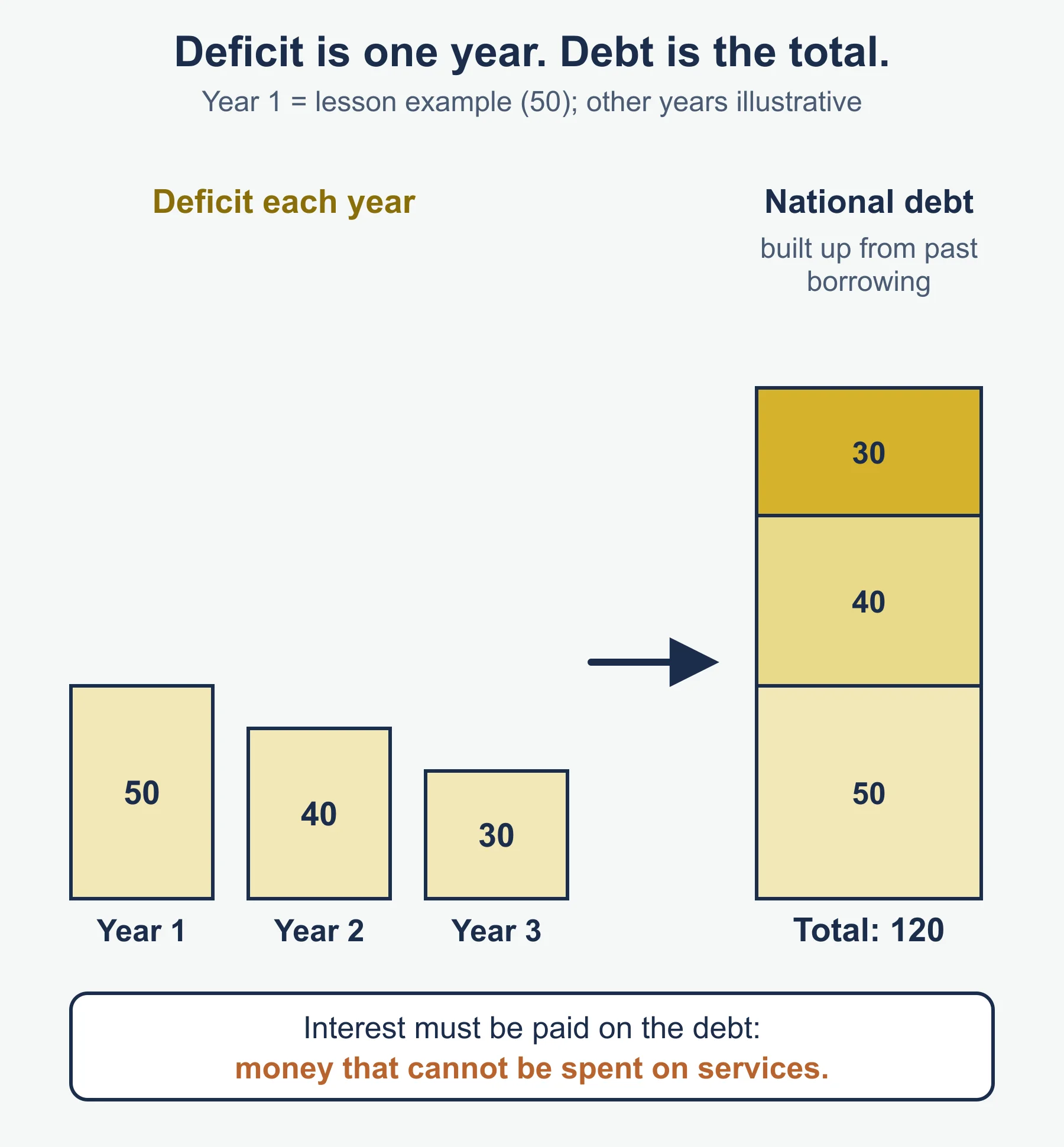
| National debt | The total the government owes from all past borrowing |
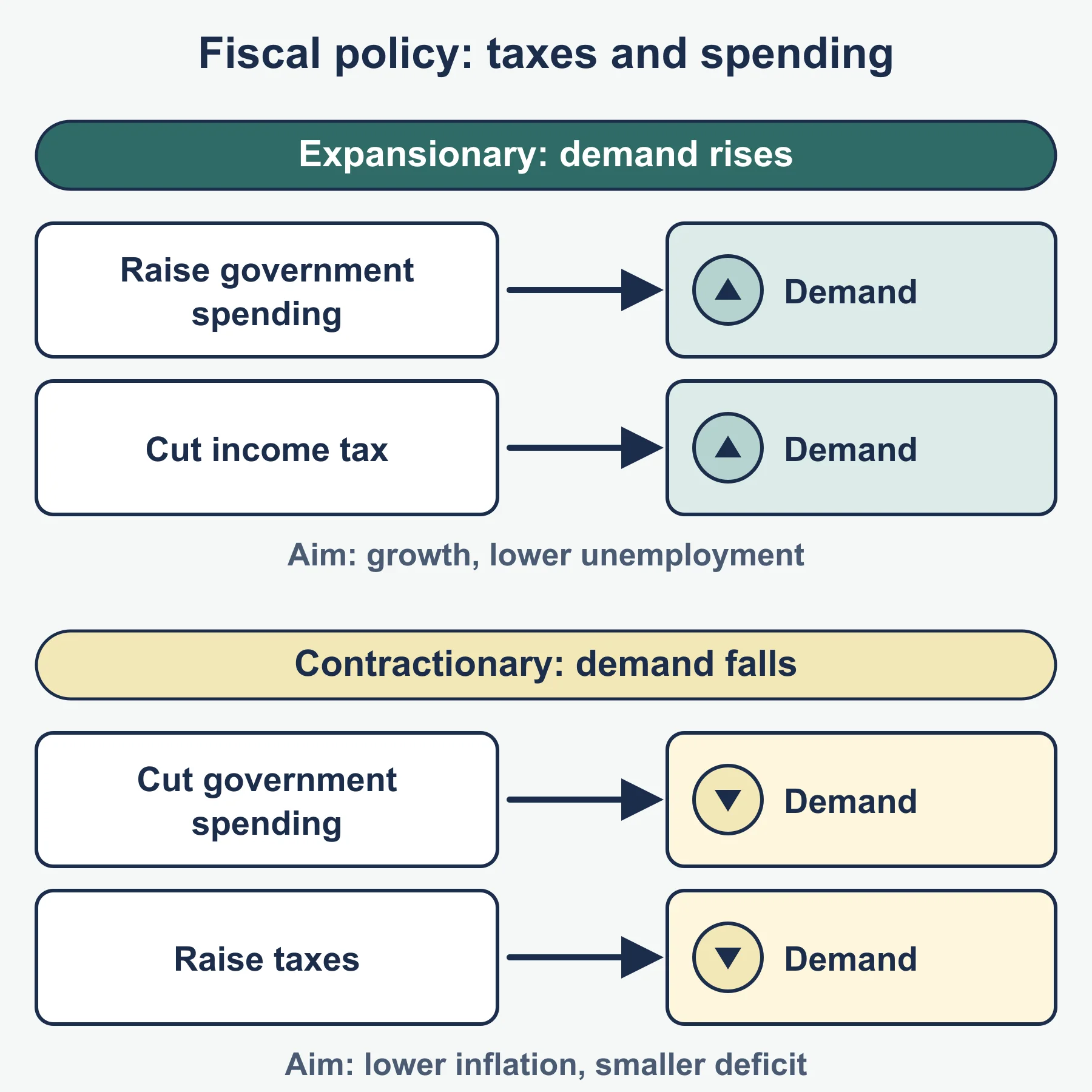
| Expansionary fiscal policy | Higher spending and/or lower taxes, to raise total demand |
| Contractionary fiscal policy | Lower spending and/or higher taxes, to reduce total demand |
How fiscal policy affects income and spending
- Government spending is itself part of total spending. Spending on roads, schools or hospitals creates income for firms and their workers, who then spend part of it.
- Lower income tax leaves households with more disposable income, so consumer spending rises.
- Lower taxes on business profits leave firms more to invest.
- Higher VAT raises prices, so households can buy less with the same income.
- Some effects happen without new decisions: in a recession, tax revenue falls and benefit spending rises, which supports spending.
Using fiscal policy to meet objectives
| Aim | Fiscal action | Possible conflict |
|---|---|---|
| Growth and lower unemployment | Raise spending, cut taxes | Inflation, more imports, a bigger deficit |
| Lower inflation | Cut spending, raise taxes | Slower growth, job losses |
| Better current account | Cut demand, so fewer imports | Slower growth |
| Less inequality | Progressive taxes, benefits, public services | Weaker incentives, cost |
| Long-run growth | Spending on education, training and infrastructure | Takes years; must be funded now |
UK example. In 2020 the government spent very heavily on support during the pandemic, including the furlough scheme that paid part of the wages of workers who could not work. Borrowing rose to its highest level since the Second World War.
Consequences of a surplus and a deficit
| Budget deficit | Budget surplus |
|---|---|
| Government borrows, so the national debt rises | Can repay debt, so future interest payments fall |
| More of future budgets goes on debt interest instead of services | May mean taxes are high or services have been cut |
| Lenders may demand higher interest if debt grows too large | Can take spending power out of the economy and slow growth |
| May be useful in a recession to support demand and jobs | Gives room to borrow in a future recession |
| Future taxes may need to rise |
Calculations you must be able to do
1. Budget position. Spending £1,100bn, revenue £1,040bn. Deficit = 1,100 − 1,040 = £60bn. As a share of GDP of £2,400bn: 60 ÷ 2,400 × 100 = 2.5%.
2. Debt. The national debt was £2,000bn. After the £60bn deficit it is £2,060bn. If the average interest rate on the debt is 3%, yearly debt interest is 0.03 × 2,060 = £61.8bn.
3. Effect of a tax change on a household. A worker earns £30,000, of which £17,430 is taxed at 20%: tax = £3,486. If the rate falls to 19%: tax = £3,311.70. Disposable income rises by £174.30 a year.
Limits of fiscal policy
- Time lags: budgets are set once or twice a year, and spending projects take time to start.
- Borrowing and debt: expansionary policy can push up debt and interest costs.
- Incentives: high tax rates may discourage work and enterprise.
- Imports: some extra spending leaks abroad.
- Opportunity cost: money spent on one area cannot be spent on another.
Part B: Monetary policy (3.2.3.2)
Key terms
| Term | Meaning |
|---|---|
| Monetary policy | Changes in interest rates (and the supply of money) by the central bank to influence spending in the economy |
| Bank of England | The UK’s central bank |
| Monetary Policy Committee (MPC) | The nine-member Bank of England committee that votes on Bank Rate, about eight times a year |
| Bank Rate | The interest rate the Bank of England pays on banks’ reserves; it influences the rates banks charge and pay |
| Inflation target | The government sets a CPI inflation target of 2% for the Bank of England |
The Bank of England has set interest rates independently of the government since 1997. If CPI inflation is more than 1 percentage point above or below the 2% target, the Governor must write an open letter to the Chancellor explaining why and what the Bank will do.
How monetary policy controls inflation
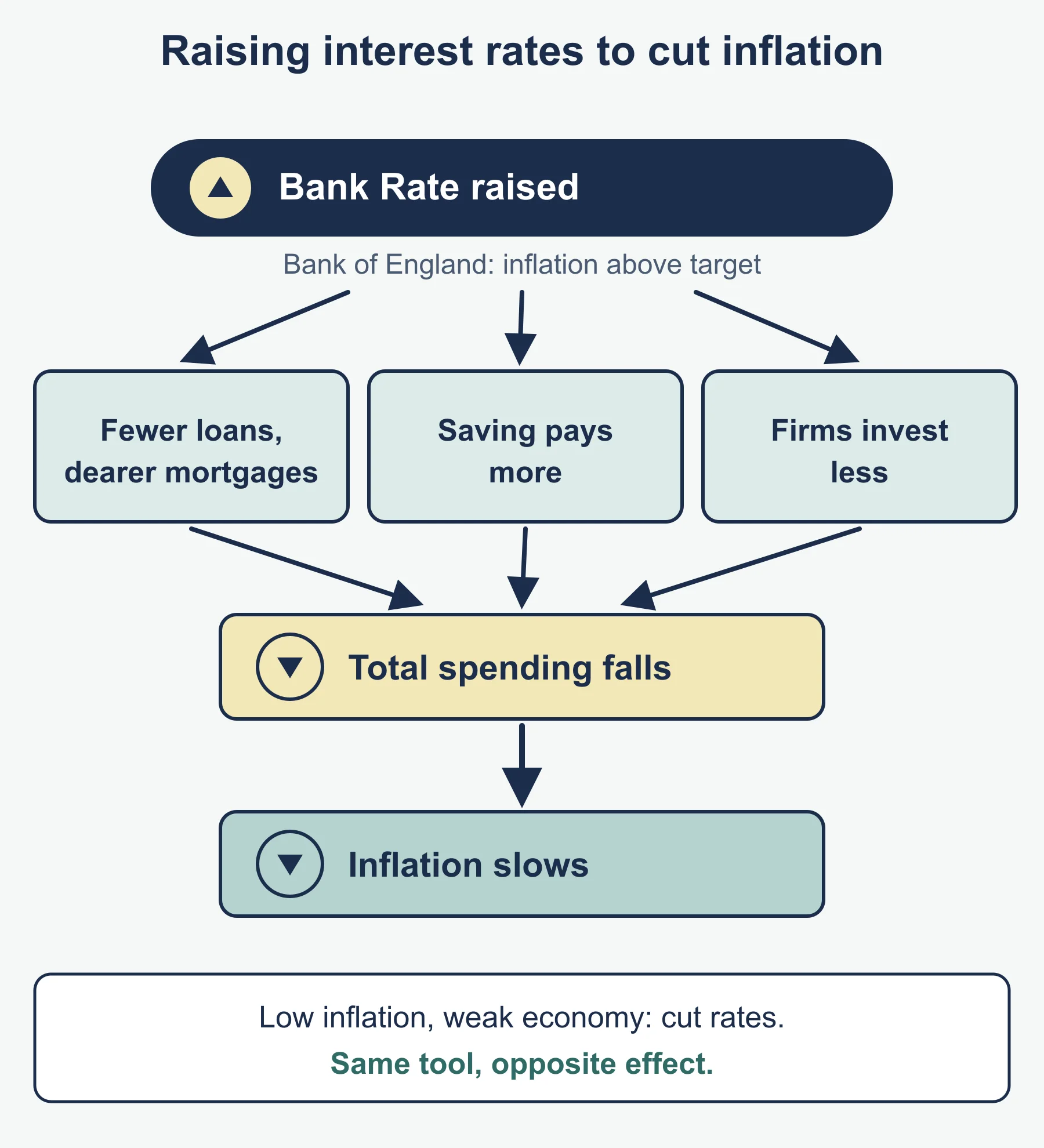
A rise in Bank Rate leads to:
- Banks raising interest rates on loans, mortgages and savings.
- Borrowing becoming dearer and saving more rewarding.
- Households with variable-rate mortgages having less to spend.
- Firms investing less, as projects funded by loans cost more.
- The pound tending to rise, as UK savings attract foreign money, so imports become cheaper and exports dearer.
- Lower total demand, so less pressure on prices, and inflation falls back towards 2%.
UK example. Bank Rate was cut to 0.1% in March 2020. As inflation rose, the MPC raised it in a series of steps to 5.25% by August 2023.
Using monetary policy for other objectives
- Growth and jobs: cutting interest rates makes borrowing cheaper, so spending and investment rise, output grows and firms hire.
- Conflict: extra demand may push up inflation and draw in imports, worsening the current account.
- Balance of payments: higher interest rates reduce spending on imports, but a stronger pound makes exports dearer.
- Since 2009 the Bank has also used quantitative easing (creating money to buy bonds) when rates were already very low. You only need to know that interest rates are the main tool.
Calculations you must be able to do
1. Effect on a borrower. An interest-only mortgage of £150,000 at 4% costs 0.04 × 150,000 = £6,000 a year. At 5% it costs £7,500. The household has £1,500 a year less to spend.
2. Effect on a saver. £10,000 saved at 2% earns £200 a year. At 4% it earns £400.
3. Real interest rate. If a savings account pays 5% and inflation is 3%, the real interest rate is about 5 − 3 = 2%.
Limits of monetary policy
- It can take a year or two for a change in interest rates to have its full effect.
- If confidence is very low, people may not borrow even when rates are low.
- Banks may not pass the full change on to customers.
- One interest rate applies to the whole UK, even if regions are in different positions.
- It works best on demand-pull inflation. It cannot reduce world energy or food prices.
- Low rates hurt savers; high rates hurt borrowers.
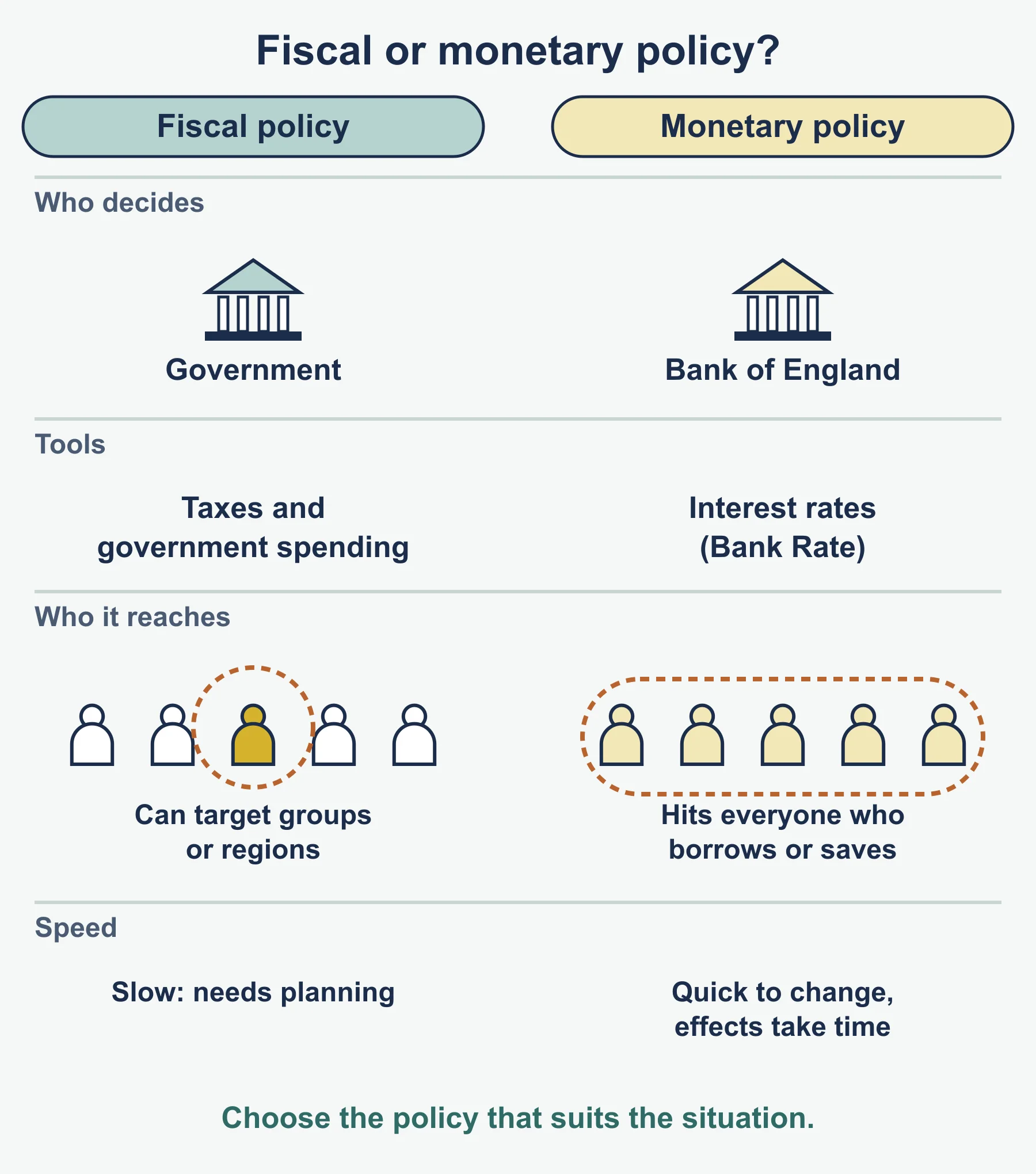
Fiscal and monetary policy compared
| Fiscal policy | Monetary policy | |
|---|---|---|
| Who decides | The government (Chancellor and HM Treasury) | The Bank of England’s MPC |
| Tools | Government spending and taxes | Bank Rate (and quantitative easing) |
| Main use | Growth, jobs, redistribution, public services | Keeping inflation at the 2% target |
| Can target | Particular groups, regions or industries | The whole economy at once |
| Speed | Changes made in the Budget; projects slow to start | Can be changed at any MPC meeting; effect takes time |
Exam traps
- The budget deficit is about government finances. The current account deficit is about trade with the rest of the world.
- The deficit is one year’s gap; the debt is the total built up. A smaller deficit still adds to the debt.
- Monetary policy in the UK is set by the Bank of England, not the government.
- Interest rates are a monetary tool, not a fiscal one.
- Always give the chain of effects, not just “rates rise, so inflation falls”.
Quick self-test
- Define fiscal policy.
- What is a balanced budget?
- Spending is £950bn and revenue £980bn. What is the budget position?
- Give two consequences of a budget deficit.
- Describe one expansionary fiscal policy and one possible drawback.
- Define monetary policy and say who carries it out in the UK.
- What is the UK inflation target?
- Explain, step by step, how a cut in interest rates could reduce unemployment.
- A £200,000 interest-only mortgage moves from 3% to 4.5%. By how much do yearly payments rise?
- Give two limits of monetary policy.
Answers
- Changes in government spending and taxation to influence the economy and meet objectives.
- One where government revenue equals government spending.
- Revenue is greater, so there is a budget surplus of £30bn.
- Any two: the national debt rises, more is spent on debt interest, future taxes may rise, lenders may charge more; it can support demand in a recession.
- For example, cutting income tax raises disposable income and spending; drawbacks include a bigger deficit, inflation or more imports.
- Changes in interest rates to influence spending; in the UK the Bank of England’s Monetary Policy Committee sets Bank Rate.
- 2% CPI inflation.
- Borrowing becomes cheaper, so households spend and firms invest more; demand for goods rises, so firms need more workers.
- 3% = £6,000, 4.5% = £9,000, so payments rise by £3,000 a year.
- Any two: time lags, low confidence, banks not passing changes on, one rate for the whole country, less effective on cost-push inflation.
Where marks are usually lost
- Calling interest rates “fiscal policy”.
- Confusing the budget deficit with the national debt, or with the current account.
- Saying the government sets UK interest rates.
- Giving a policy with no conflict or drawback in an evaluation question.
Frequently asked questions
What is the difference between a budget deficit and the national debt? A budget deficit is one year’s gap when government spending is greater than revenue. The national debt is the total the government owes from all past borrowing, so even a smaller deficit still adds to the debt.
Who sets interest rates in the UK? The Bank of England’s nine-member Monetary Policy Committee sets Bank Rate, independently of the government since 1997.
How does a rise in interest rates reduce inflation? Borrowing becomes dearer and saving more rewarding, so households and firms spend and invest less, the pound tends to rise, and lower total demand reduces pressure on prices.
What are the limits of monetary policy? Time lags of a year or two, low confidence, banks not passing changes on, one rate for the whole UK, and little effect on cost-push inflation from world energy or food prices.
What is expansionary fiscal policy? Expansionary fiscal policy is higher government spending or lower taxes to raise total demand, which can boost growth and jobs but may raise inflation and borrowing.
Official syllabus
AQA GCSE Economics (8136) specification, for first teaching from September 2017 (Version 1.0), published by AQA: sections 3.2.3.1 Fiscal policy and 3.2.3.2 Monetary policy.
Get free revision emails (optional)
Occasional emails with practice questions, worked explanations and links to free resources for the qualification and subjects you choose. No spam, and you can unsubscribe from any email. The free tools on this site never need an email.
Related resources
-
Study guides
AQA GCSE Economics: Fiscal policy, the budget and monetary policy (8136)
Study guide to AQA GCSE Economics 8136 3.2.3.1 and 3.2.3.2: fiscal policy, balanced budgets, surpluses, deficits and monetary policy via interest rates.
Economics · AQA · GCSE
Read guide -
Practice questions
AQA GCSE Economics: Fiscal policy, the budget and monetary policy (8136) – Practice Questions
Eleven original practice questions with worked answers for AQA GCSE Economics 8136 3.2.3.1 and 3.2.3.2: fiscal policy, budget balances and interest rates.
Economics · AQA · GCSE
Try questions -
Study guides
AQA GCSE Economics: Free trade, the EU and globalisation (8136)
Study guide to AQA GCSE Economics 8136 sections 3.2.4.3 and 3.2.4.4: free trade, trade agreements such as the EU, and globalisation's gains, costs and ethics.
Economics · AQA · GCSE
Read guide
Related articles
-
teaching
A Level tuition in Dubai: Cambridge or Pearson Edexcel International A Level?
Schools in Dubai and Abu Dhabi teach either Cambridge International AS & A Level or Pearson Edexcel International A Level. How the two are structured, why it matters for tuition, and how online classes from Lahore work.
9 October 2026
-
curriculum guides
Choosing subjects at IGCSE and A Level
How subject choices at 14 and 16 affect university options later, and how to keep pathways open without overloading a timetable.
28 July 2026
Studying this with a teacher
Working through Economics GCSE?
This page is free and stays free. If you would rather be taught it, Marlbridge runs Economics classes one-to-one and in small groups of up to 15, online in your own time zone. The first trial class is free. WhatsApp replies within an hour (8am–11pm Pakistan time, every day); email the same day.
AQA Economics teachers at Marlbridge
