
Study Guides
AQA GCSE Economics: Fiscal policy, the budget and monetary policy (8136)
Study guide to AQA GCSE Economics 8136 3.2.3.1 and 3.2.3.2: fiscal policy, balanced budgets, surpluses, deficits and monetary policy via interest rates.
- Subject
- Economics
- Level
- GCSE
- Topic
- Fiscal policy and the government budget; monetary policy and the Bank of England
- Author
- Marlbridge Academic Team
- Updated
- Reviewed by
- Salman Ahmad (what this means)
Aligned to AQA GCSE Economics (8136), For first teaching from September 2017. Official specification .
Syllabus page (what it covers and how it is assessed): AQA GCSE Economics.
Syllabus points this page covers
8136
- 3.2.3.1 Fiscal policy
- 3.2.3.2 Monetary policy
Found an error? Report a correction.
Need help with this topic? Request a free trial class for GCSE Economics (8136).
Fiscal policy is the use of government spending and taxation to influence the economy. Monetary policy is the use of interest rates (and the supply of money) to influence the economy; in the UK it is carried out by the Bank of England. AQA GCSE Economics (8136) sections 3.2.3.1 and 3.2.3.2 ask you to explain how each policy changes income and spending, how each can be used to reach the government’s objectives, and what a balanced budget, a surplus and a deficit mean.
Both sections are in 3.2 How the economy works, assessed on Paper 2, with no tiers. Countries and numbers are invented unless a real UK fact is stated. Pair this guide with the revision notes and the practice questions. Background on taxes and spending is in the government revenue and spending guide, and on interest rates in the interest rates guide. Course links: AQA GCSE Economics hub, checklist and free diagnostics.
Syllabus coverage
| Specification point | What you must be able to do |
|---|---|
| 3.2.3.1 Fiscal policy | Explain how fiscal policy affects levels of income and expenditure in the economy |
| 3.2.3.1 Fiscal policy and objectives | Explain how fiscal policy can be used to achieve government objectives |
| 3.2.3.1 The government budget | Explain a balanced budget and the consequences of a budget surplus and a budget deficit |
| 3.2.3.2 Monetary policy | Explain what monetary policy is |
| 3.2.3.2 Controlling inflation | Explain how monetary policy can be used to control inflation |
| 3.2.3.2 Other objectives | Explain how monetary policy can be used to achieve other objectives |
What is fiscal policy?
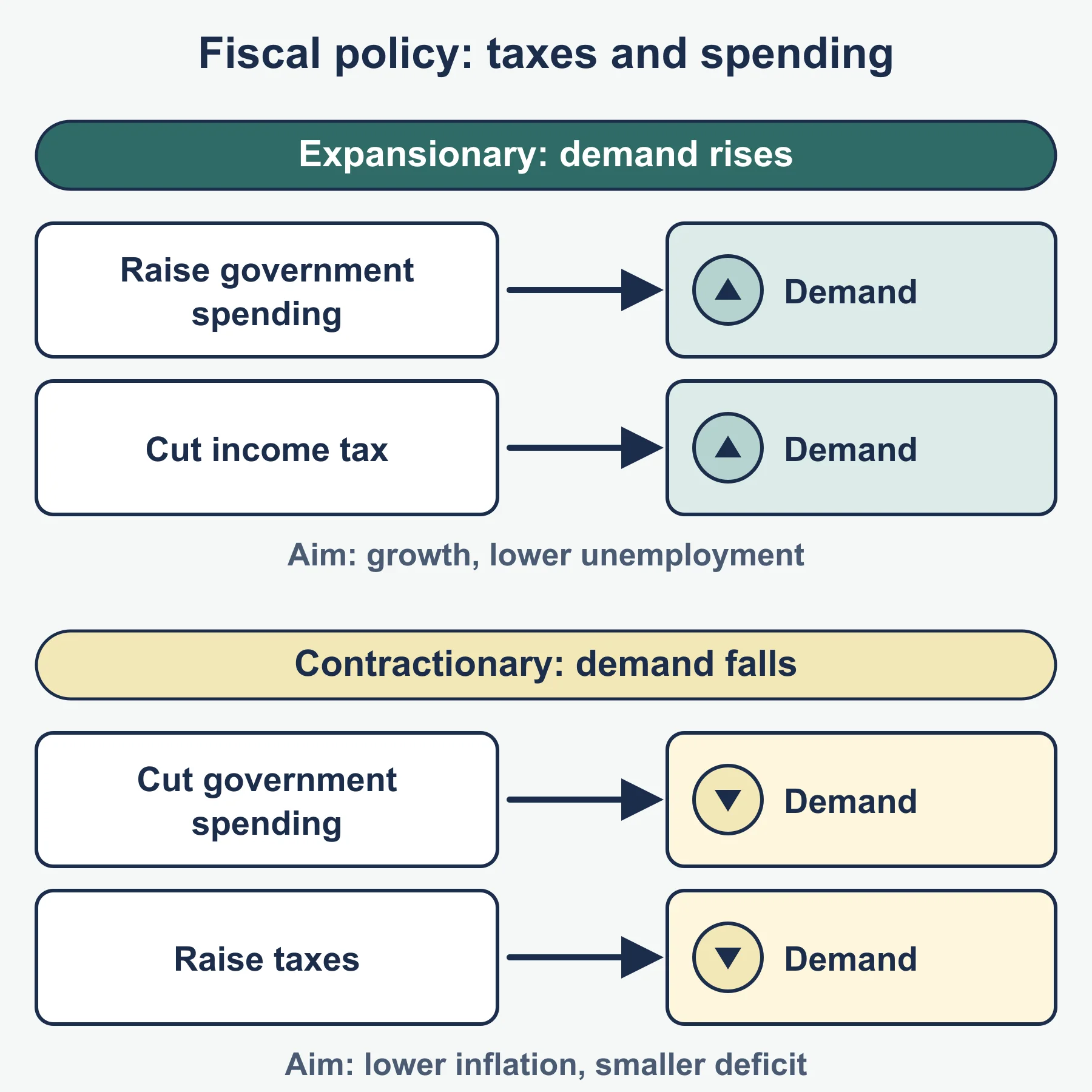
Fiscal policy uses two tools: government spending (on health, education, defence, benefits and infrastructure) and taxation (income tax, VAT, corporation tax and others). Changing either alters the total amount of spending in the economy.
| Change | Effect on spending | Typical aim |
|---|---|---|
| Raise government spending | Higher demand directly, and households receive more income | More growth, lower unemployment |
| Cut income tax | Households have more disposable income to spend | More growth, lower unemployment |
| Cut government spending | Lower demand | Lower inflation, smaller deficit |
| Raise taxes | Less disposable income, so less spending | Lower inflation, smaller deficit |
Expansionary fiscal policy (more spending or lower taxes) raises demand. Contractionary fiscal policy (less spending or higher taxes) reduces it.
How does fiscal policy help achieve the government’s objectives?
- Unemployment and growth: in a downturn, extra spending on projects such as roads creates jobs directly, and workers spend their wages, raising demand further.
- Inflation: if demand is rising too fast, higher taxes reduce spending and ease the pressure on prices.
- Distribution of income: progressive taxes and benefits narrow the gap between rich and poor.
- Externalities and the environment: taxes on harmful goods and subsidies for beneficial ones change behaviour.
Fiscal policy has limits. Changes to taxes and spending take time to plan and pass. Higher spending may have to be financed by borrowing. Tax cuts may be saved rather than spent.
What is a balanced budget, a surplus and a deficit?
| Term | Meaning |
|---|---|
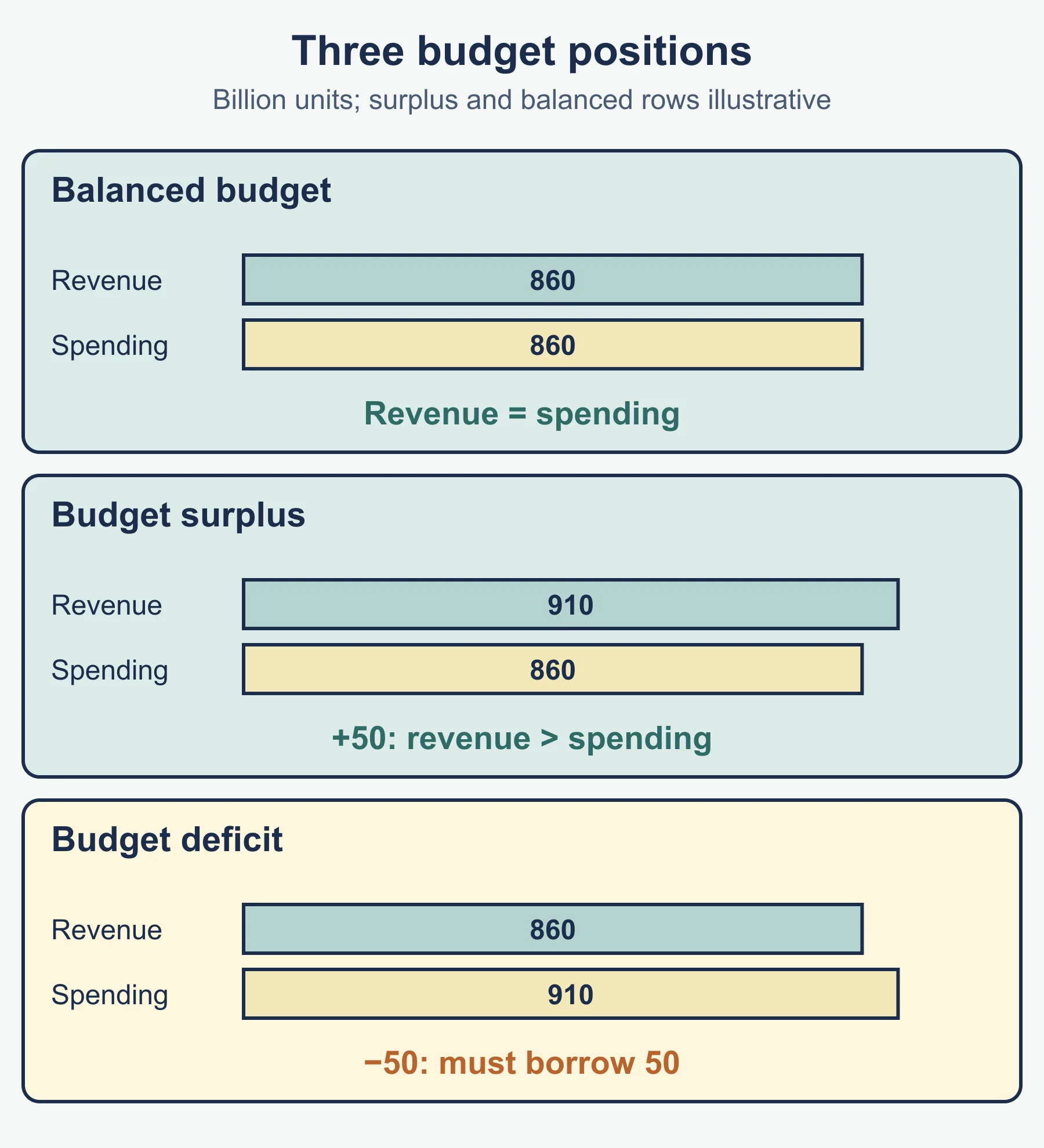
| Balanced budget | Government spending equals government revenue |
| Budget surplus | Revenue is greater than spending |
| Budget deficit | Spending is greater than revenue, so the government must borrow |
Worked example (illustrative)
Country F’s government collects 860 billion units in revenue and spends 910 billion units. Budget balance = 860 − 910 = −50, a deficit of 50 billion units that must be borrowed.
Consequences of a deficit
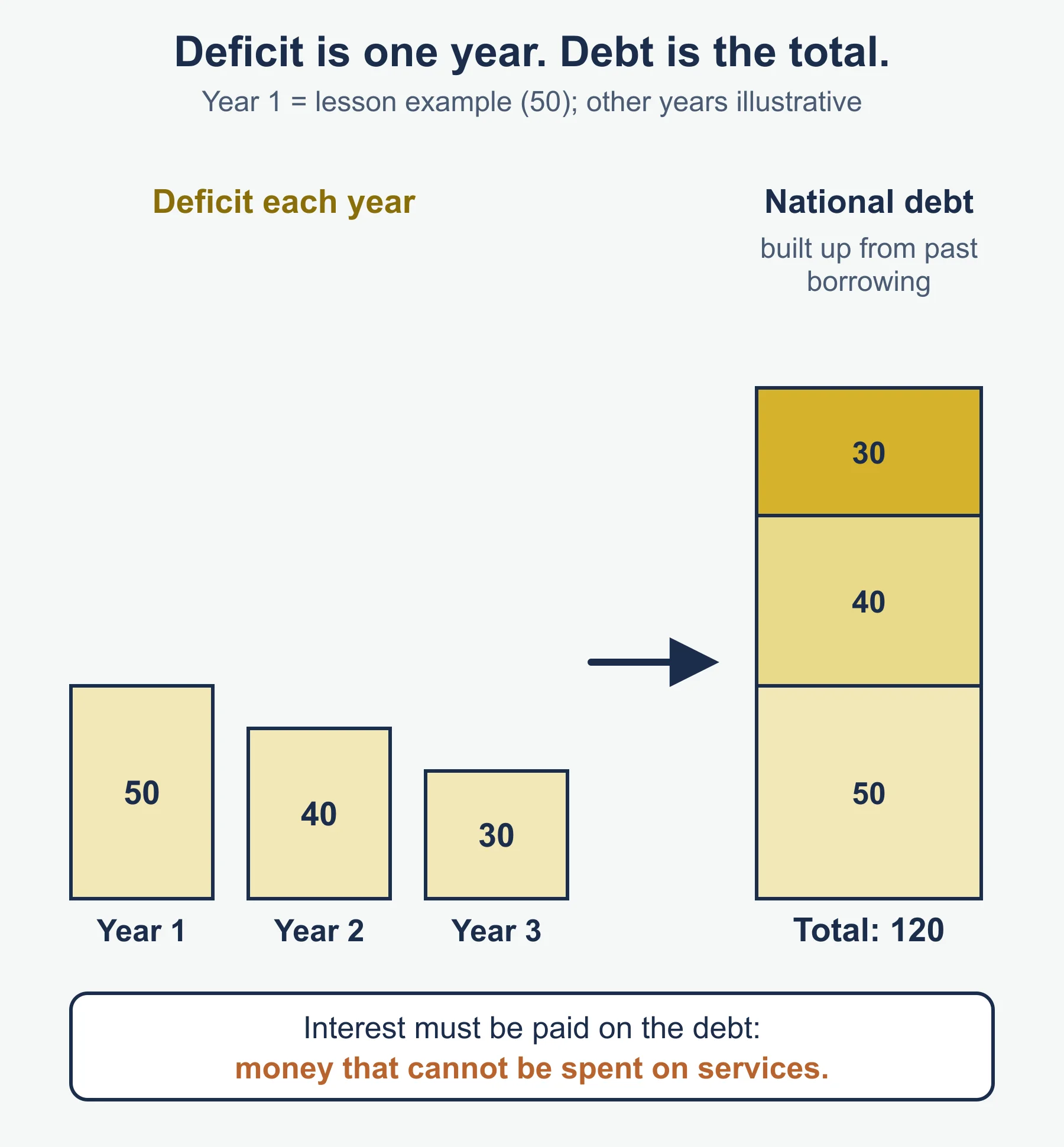
- Borrowing adds to the national debt, and interest must be paid on it, money that cannot be spent on services.
- In a downturn a deficit can support demand and jobs.
- A long-running deficit may require future tax rises or spending cuts.
Consequences of a surplus
- The government can repay debt or save for the future.
- But a surplus means taking more out of the economy in tax than is spent, which reduces demand and could slow growth.
What is monetary policy?
Monetary policy changes the cost and availability of money to influence spending. The main tool is the interest rate. In the UK, the Bank of England’s Monetary Policy Committee sets the Bank Rate, which affects the interest rates banks charge borrowers and pay savers. The government sets the Bank of England an inflation target measured by the Consumer Price Index.
How does monetary policy control inflation?
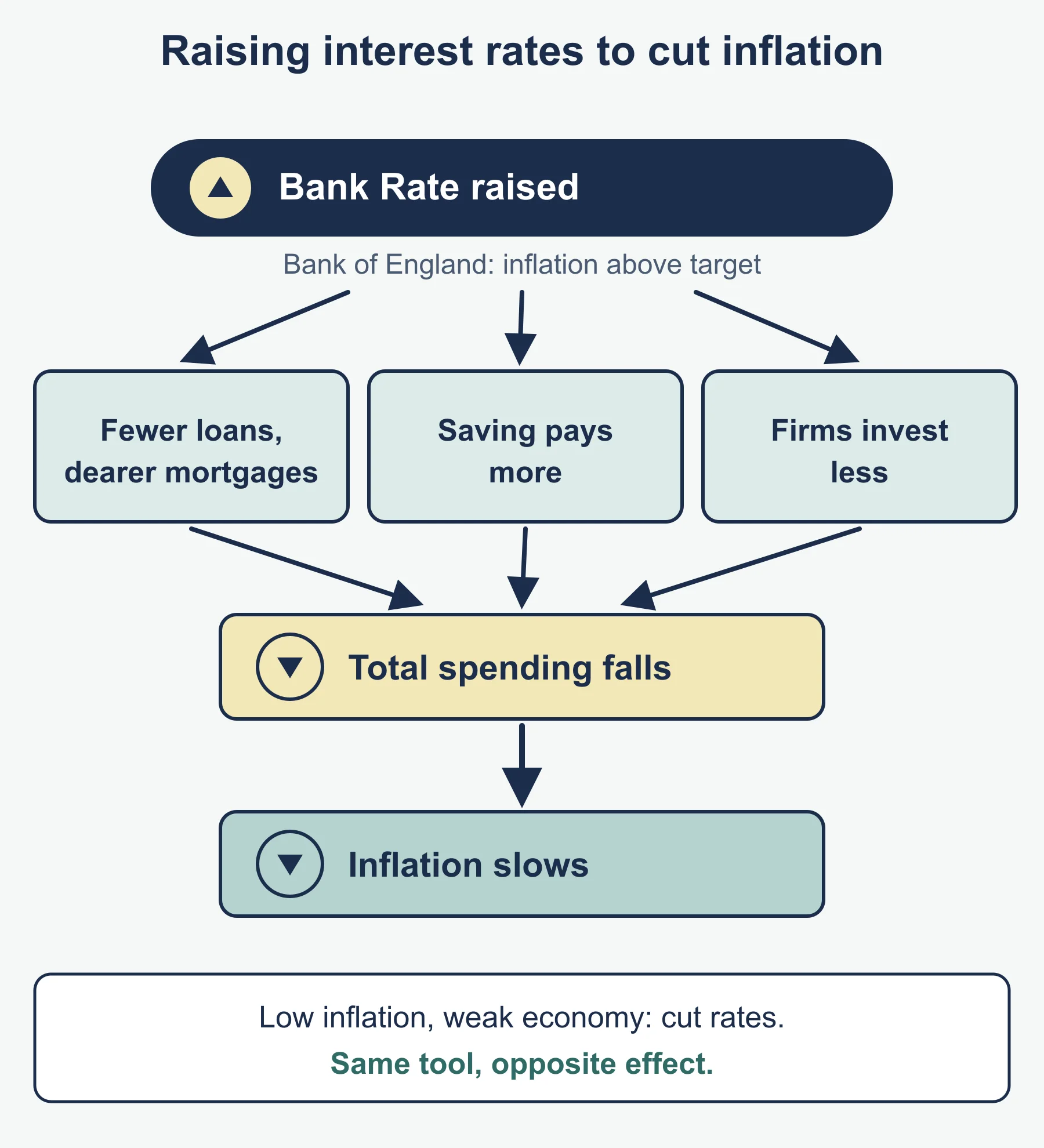
If inflation is above target, the Bank of England can raise interest rates:
- Borrowing becomes more expensive, so households take out fewer loans and mortgages cost more.
- Saving becomes more attractive, so people spend less.
- Firms invest less because loans cost more.
- Total spending falls, so there is less upward pressure on prices and inflation slows.
If inflation is low and the economy is weak, the Bank can cut interest rates to encourage borrowing and spending.
How can monetary policy help other objectives?
- Growth and employment: lower interest rates raise spending and investment, so firms produce more and hire more workers.
- Balance of payments: higher interest rates reduce spending on imports. Interest rates can also affect the exchange rate, which changes the prices of exports and imports.
The same tool can help one objective and harm another. Raising rates to control inflation can slow growth and increase unemployment, which is a classic conflict between objectives.
Fiscal or monetary policy: which is better?
| Fiscal policy | Monetary policy | |
|---|---|---|
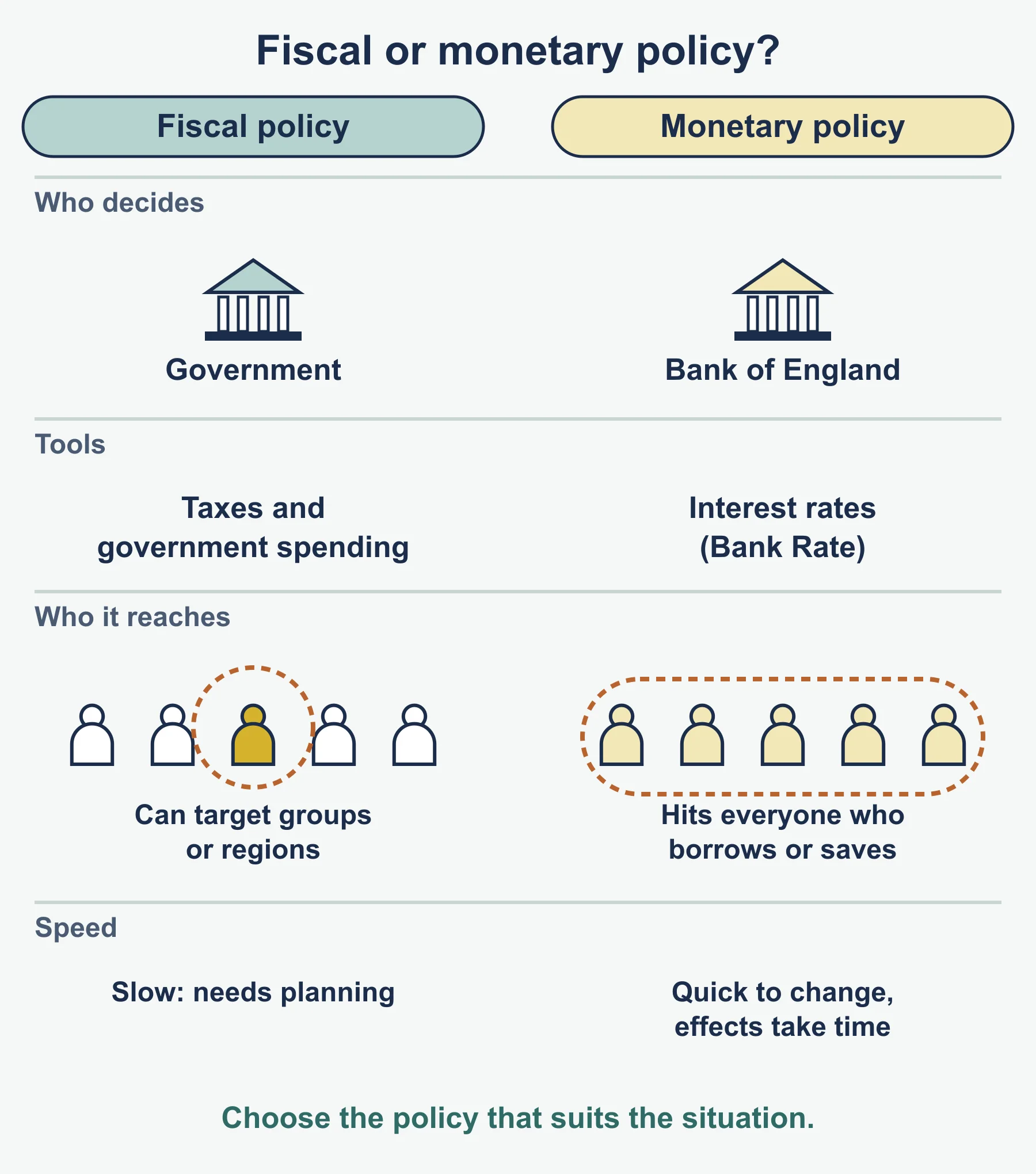
| Who decides | The government | The Bank of England (in the UK) |
| Main tools | Taxes and government spending | Interest rates |
| Speed | Slow to change; needs planning | Can be changed quickly, though effects take time |
| Targeting | Can target particular groups or regions | Affects everyone who borrows or saves |
| Main risk | Higher borrowing and debt | Hurts borrowers; may not work if confidence is low |
In evaluation, say which policy suits the situation. For example, a targeted spending programme may help a region with high unemployment, while an interest-rate rise is a faster way to cool inflation across the whole economy.
Common errors
- Confusing fiscal policy (taxes and spending) with monetary policy (interest rates).
- Saying the government sets UK interest rates; the Bank of England does.
- Confusing the budget deficit (one year) with the national debt (the total built up over time).
- Describing a policy’s intended effect without showing the chain of reasoning.
- Forgetting that a policy aimed at one objective can harm another.
Frequently asked questions
Is a budget deficit the same as national debt? No. The deficit is the gap between spending and revenue in one year; the debt is the total amount the government owes from past borrowing.
Why do higher interest rates reduce inflation? They make borrowing dearer and saving more rewarding, so spending falls and firms have less room to raise prices.
Can fiscal policy reduce inequality? Yes. Progressive taxes and benefits for low-income households redistribute income.
Which policy works faster? Interest rates can be changed at short notice, while tax and spending changes take longer to plan, although both take time to affect the economy fully.
Official syllabus
AQA GCSE Economics (8136) specification, for first teaching from September 2017, published by AQA: sections 3.2.3.1 Fiscal policy and 3.2.3.2 Monetary policy.
Get free revision emails (optional)
Occasional emails with practice questions, worked explanations and links to free resources for the qualification and subjects you choose. No spam, and you can unsubscribe from any email. The free tools on this site never need an email.
Related resources
-
Practice questions
AQA GCSE Economics: Fiscal policy, the budget and monetary policy (8136) – Practice Questions
Eleven original practice questions with worked answers for AQA GCSE Economics 8136 3.2.3.1 and 3.2.3.2: fiscal policy, budget balances and interest rates.
Economics · AQA · GCSE
Try questions -
Revision notes
AQA GCSE Economics: Fiscal policy, the budget and monetary policy (8136) – Revision Notes
Condensed AQA GCSE Economics revision notes for 3.2.3.1 and 3.2.3.2: fiscal policy, balanced budgets, surpluses and deficits, and monetary policy.
Economics · AQA · GCSE
Revise topic -
Study guides
AQA GCSE Economics: Free trade, the EU and globalisation (8136)
Study guide to AQA GCSE Economics 8136 sections 3.2.4.3 and 3.2.4.4: free trade, trade agreements such as the EU, and globalisation's gains, costs and ethics.
Economics · AQA · GCSE
Read guide
Related articles
-
teaching
A Level tuition in Dubai: Cambridge or Pearson Edexcel International A Level?
Schools in Dubai and Abu Dhabi teach either Cambridge International AS & A Level or Pearson Edexcel International A Level. How the two are structured, why it matters for tuition, and how online classes from Lahore work.
9 October 2026
-
curriculum guides
Choosing subjects at IGCSE and A Level
How subject choices at 14 and 16 affect university options later, and how to keep pathways open without overloading a timetable.
28 July 2026
Studying this with a teacher
Working through Economics GCSE?
This page is free and stays free. If you would rather be taught it, Marlbridge runs Economics classes one-to-one and in small groups of up to 15, online in your own time zone. The first trial class is free. WhatsApp replies within an hour (8am–11pm Pakistan time, every day); email the same day.
AQA Economics teachers at Marlbridge
