
Revision Notes
AQA GCSE Economics: Supply-side policies and policies for externalities (8136) – Revision Notes
Condensed AQA GCSE Economics revision notes for 3.2.3.3 and 3.2.3.4: supply-side policies, their pros and cons, and policies to correct externalities.
- Subject
- Economics
- Level
- GCSE
- Topic
- Supply-side policies; government policies to correct positive and negative externalities
- Author
- Marlbridge Academic Team
- Updated
- Reviewed by
- Salman Ahmad (what this means)
Aligned to AQA GCSE Economics (8136), For first teaching from September 2017. Official specification .
Syllabus page (what it covers and how it is assessed): AQA GCSE Economics.
Syllabus points this page covers
8136
- 3.2.3.3 Supply-side policies
- 3.2.3.4 Policies to correct positive and negative externalities
Found an error? Report a correction.
Need help with this topic? Request a free trial class for GCSE Economics (8136).
These notes condense sections 3.2.3.3 Supply-side policies and 3.2.3.4 Policies to correct positive and negative externalities of the AQA GCSE Economics (8136) specification for first teaching from September 2017. The specification has no tiers. What externalities are, and social versus private costs, is covered in the market failure revision notes; this page focuses on the government’s policy choices. Productivity is in the productivity revision notes. Course links: AQA GCSE Economics hub, checklist and free diagnostics. Worked-example figures are invented unless a real UK fact is stated.
Part A: Supply-side policies (3.2.3.3)
What they are
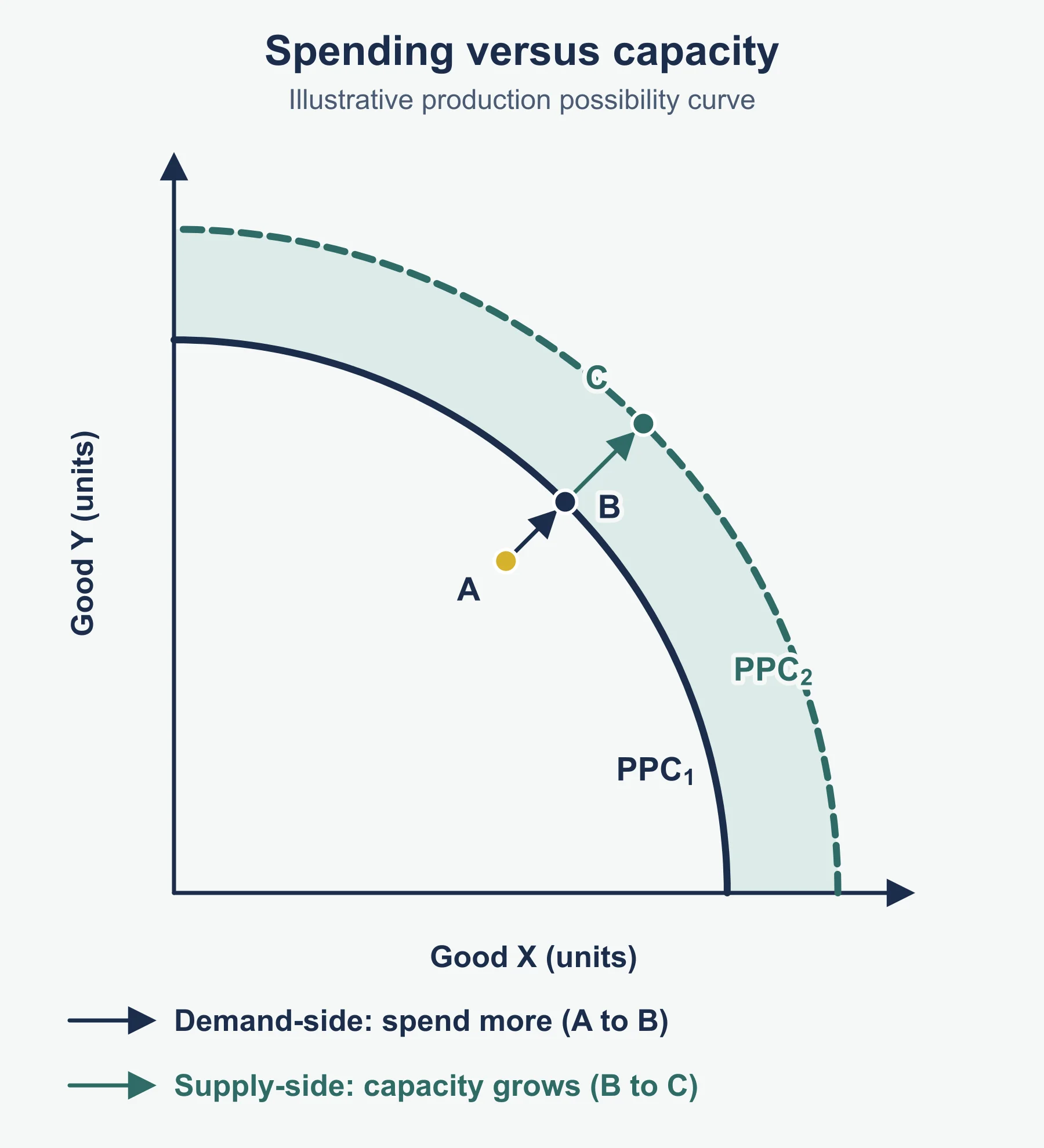
Supply-side policies aim to raise the productive capacity of the economy: the quantity of goods and services it can produce. They work by improving the quantity or quality of the factors of production, or by making markets work more efficiently. Fiscal and monetary policy mainly change demand; supply-side policies change what the economy is able to supply.
The policies the specification names
| Policy | How it works | UK example |
|---|---|---|
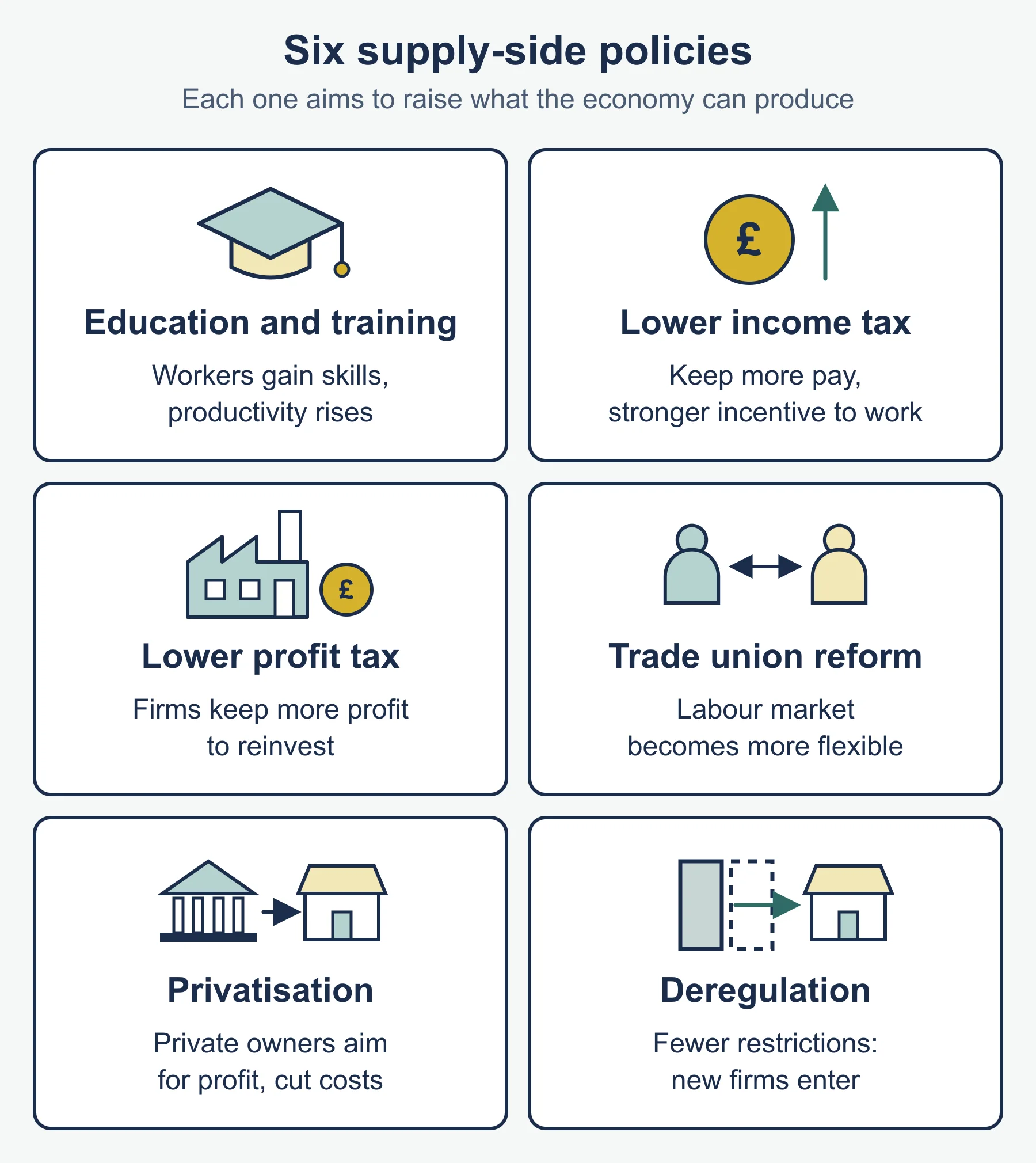
| Investment in education and training | A more skilled workforce is more productive and can move into growing industries | Apprenticeships, funded partly by the apprenticeship levy on large employers since 2017 |
| Lower direct taxes (such as income tax) | Workers keep more of each extra pound earned, so there is more incentive to work, work longer or take a better job | Cuts in income tax rates |
| Lower taxes on business profits (corporation tax) | Firms keep more profit to invest; the UK becomes more attractive to foreign firms | The main rate fell from 28% in 2010 to 19% by 2017 (it rose again to 25% in 2023) |
| Trade union reform | Limits on union power make the labour market more flexible and reduce days lost to strikes | 1980s laws requiring secret ballots before strike action |
| Privatisation | State-owned firms are sold to private owners, who have a profit motive to cut costs and improve services | BT (1984), British Gas (1986), Royal Mail (2013) |
| Deregulation | Removing rules that restrict competition, so new firms can enter | Bus services outside London (1986), and financial services in the 1980s |
Other examples include infrastructure (roads, rail, broadband) and policies to encourage new businesses, but learn the six above first.
Using supply-side policies to meet objectives
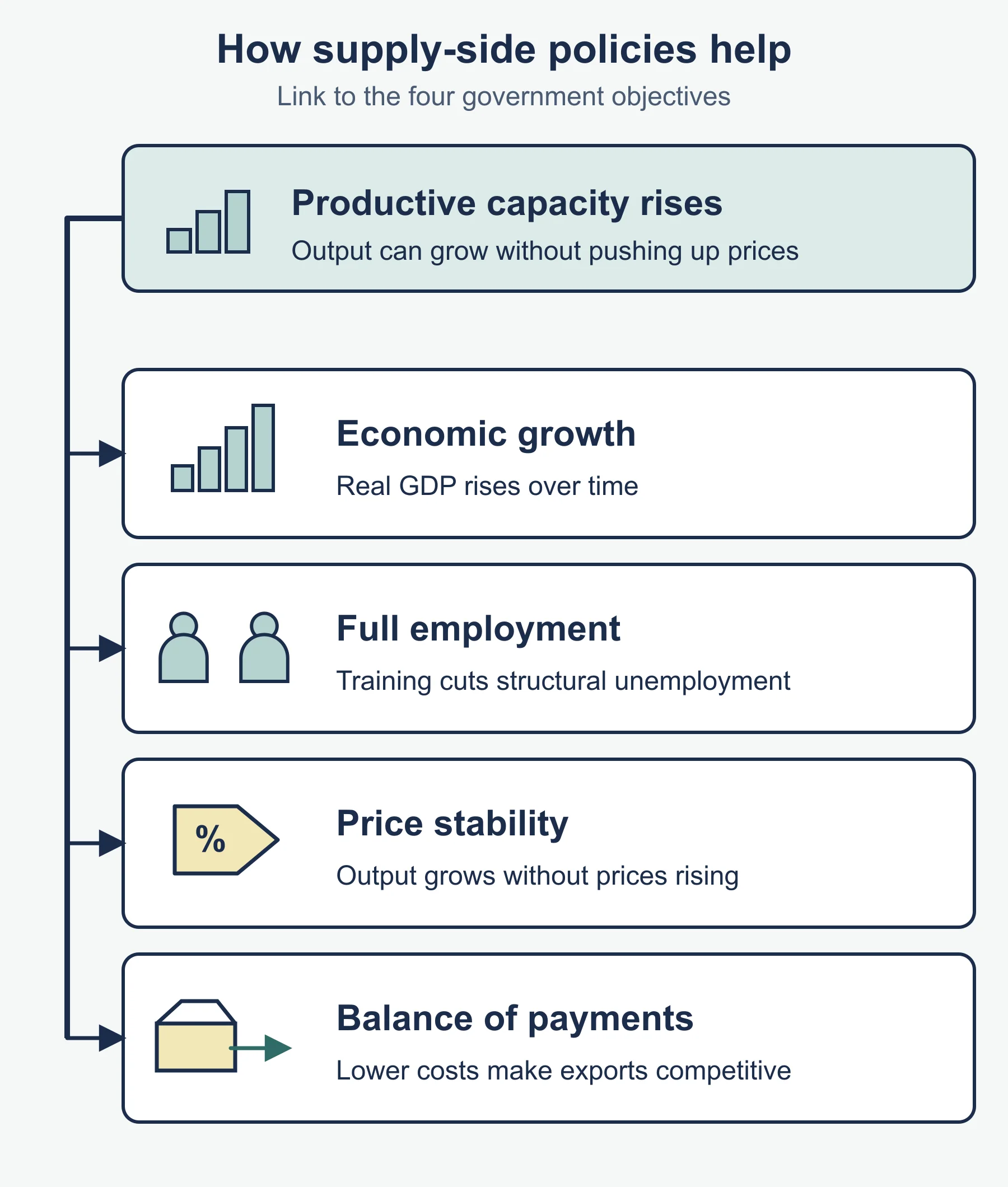
- Growth: more productive capacity lets output grow over the long run.
- Price stability: if capacity grows as fast as demand, growth need not cause inflation; lower costs also ease cost-push inflation.
- Employment: training reduces structural unemployment by matching skills to vacancies.
- Balance of payments: more productive firms are more competitive at home and abroad, so exports rise.
Advantages and disadvantages
| Advantages | Disadvantages |
|---|---|
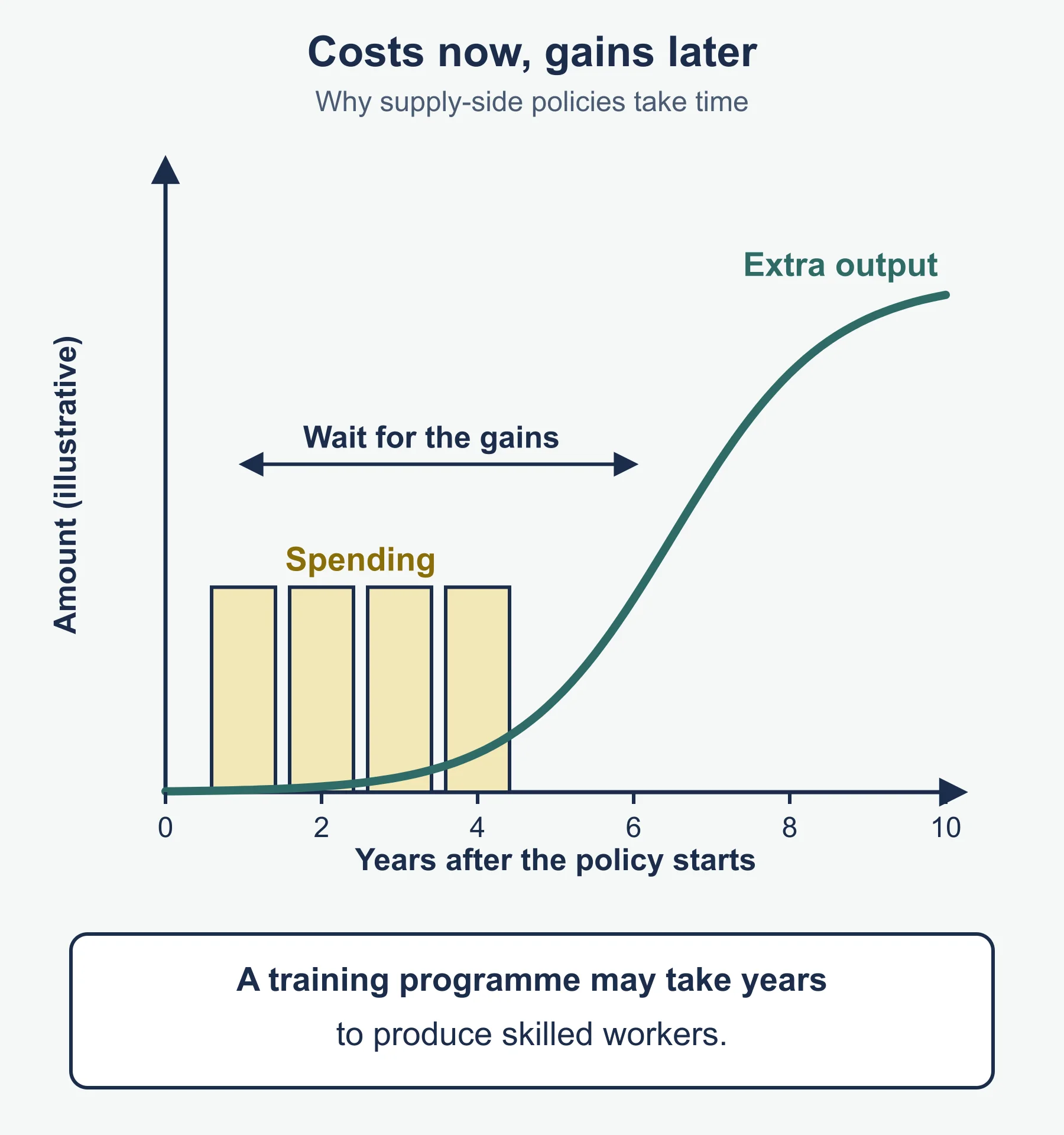
| Can help several objectives at once, without the usual conflicts | Take a long time to work (training a workforce takes years) |
| Raise long-run growth and living standards | Can be expensive for the government, or reduce tax revenue |
| Make UK firms more competitive | Results are uncertain: lower taxes may not lead to more work or investment |
| Reduce structural unemployment | Some (tax cuts for high earners, weaker unions, privatisation) may widen inequality or reduce job security |
| Privatised firms may become private monopolies that need regulation |
Calculation: productivity
A factory produces 2,400 units a week with 60 workers, so output per worker is 2,400 ÷ 60 = 40 units. After a training scheme the same 60 workers produce 2,760 units: 2,760 ÷ 60 = 46 units. Productivity rose by 6 ÷ 40 × 100 = 15%.
Part B: Policies to correct externalities (3.2.3.4)
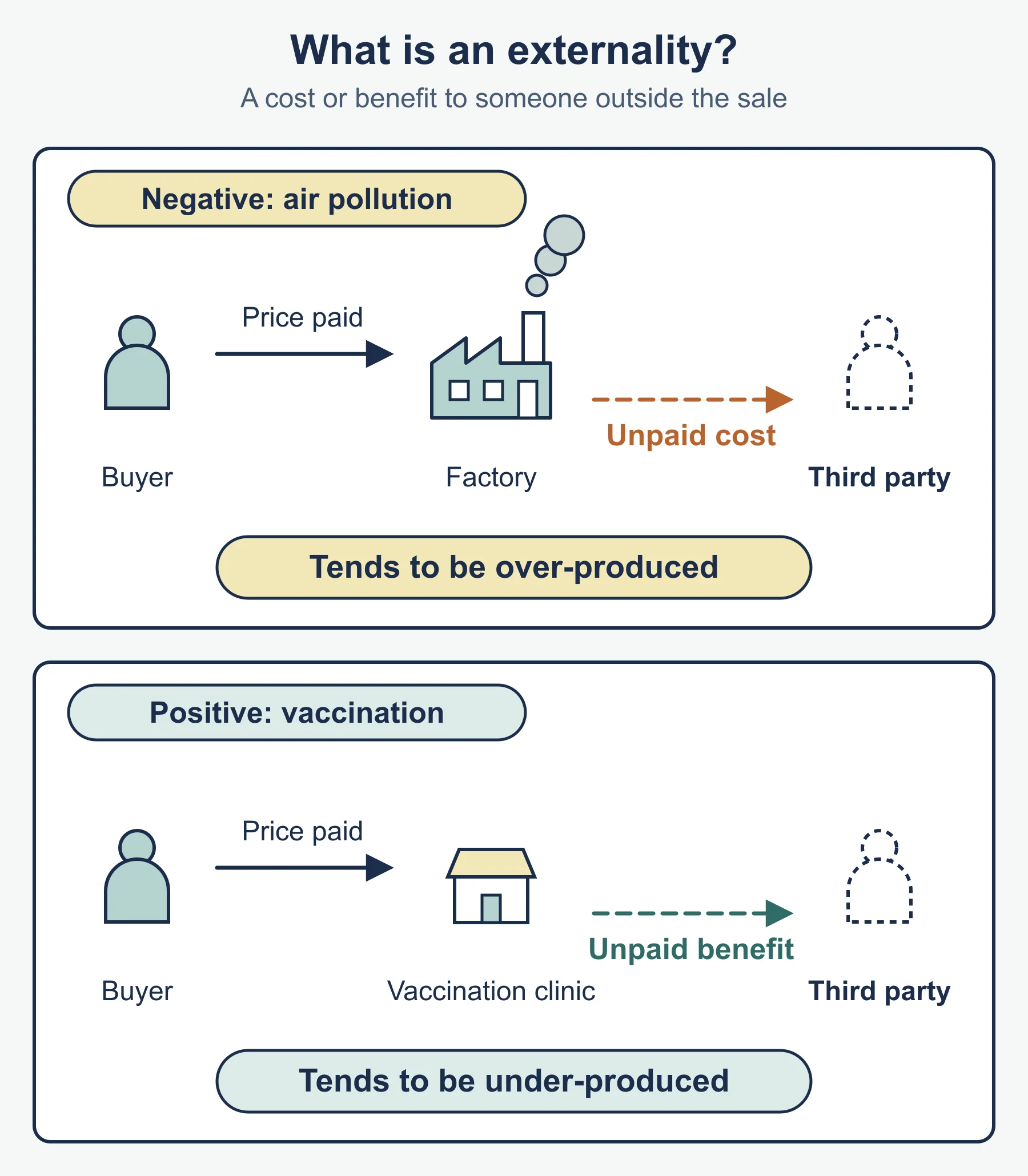
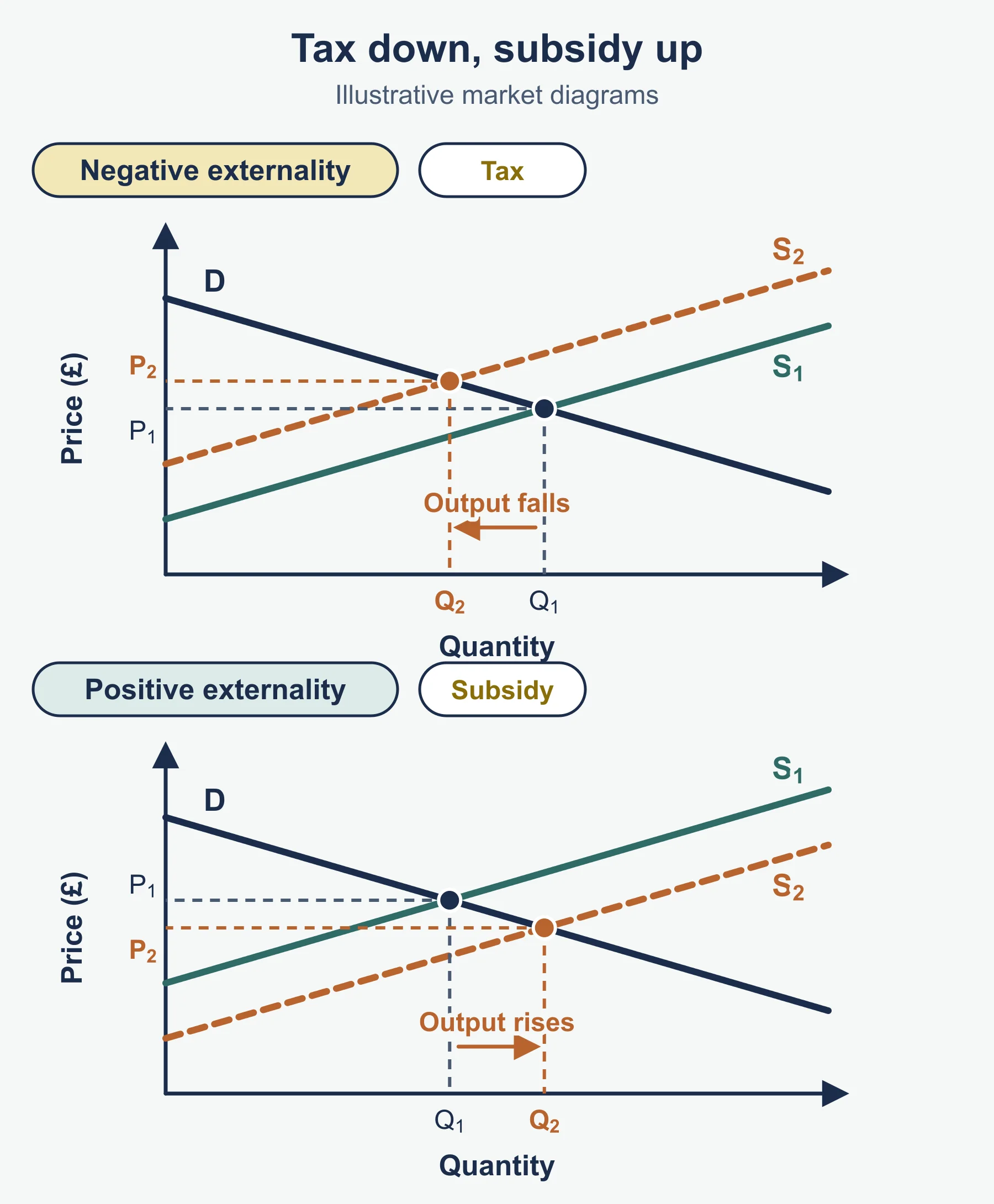
Reminder: an externality is a cost or benefit to a third party. With a negative externality the good is over-produced or over-consumed, because the price ignores the external cost. With a positive externality it is under-produced or under-consumed, because the price ignores the external benefit.
Policies for negative externalities
| Policy | How it works | UK example |
|---|---|---|
| Indirect tax | Raises the price, so less is bought; the tax should ideally equal the external cost | Soft Drinks Industry Levy on sugary drinks (2018), landfill tax, duties on tobacco and alcohol |
| Regulation and legislation | Limits or bans the harmful activity, backed by fines | Ban on smoking in enclosed public places (England, 2007), vehicle emission standards |
| Charges | Make people pay to use something that harms others | The London congestion charge (2003), charges for single-use carrier bags |
| Information and education | Changes behaviour by showing the harm | Health warnings on cigarette packets, anti-drink-driving campaigns |
| Pollution permits | Firms must hold a permit for each tonne emitted; permits can be traded | The UK Emissions Trading Scheme |
Policies for positive externalities
| Policy | How it works | UK example |
|---|---|---|
| Subsidy | Lowers the cost to producers or the price to consumers, so more is produced and used | Grants towards insulation or renewable energy |
| Direct provision by the state | The government provides the good free or cheaply, funded by taxes | State schools, NHS vaccinations |
| Regulation | Makes people consume the good | Compulsory education to age 16 (with education or training to 18 in England) |
| Information and education | Encourages people to use the good | Campaigns encouraging vaccination and healthy eating |
Calculations
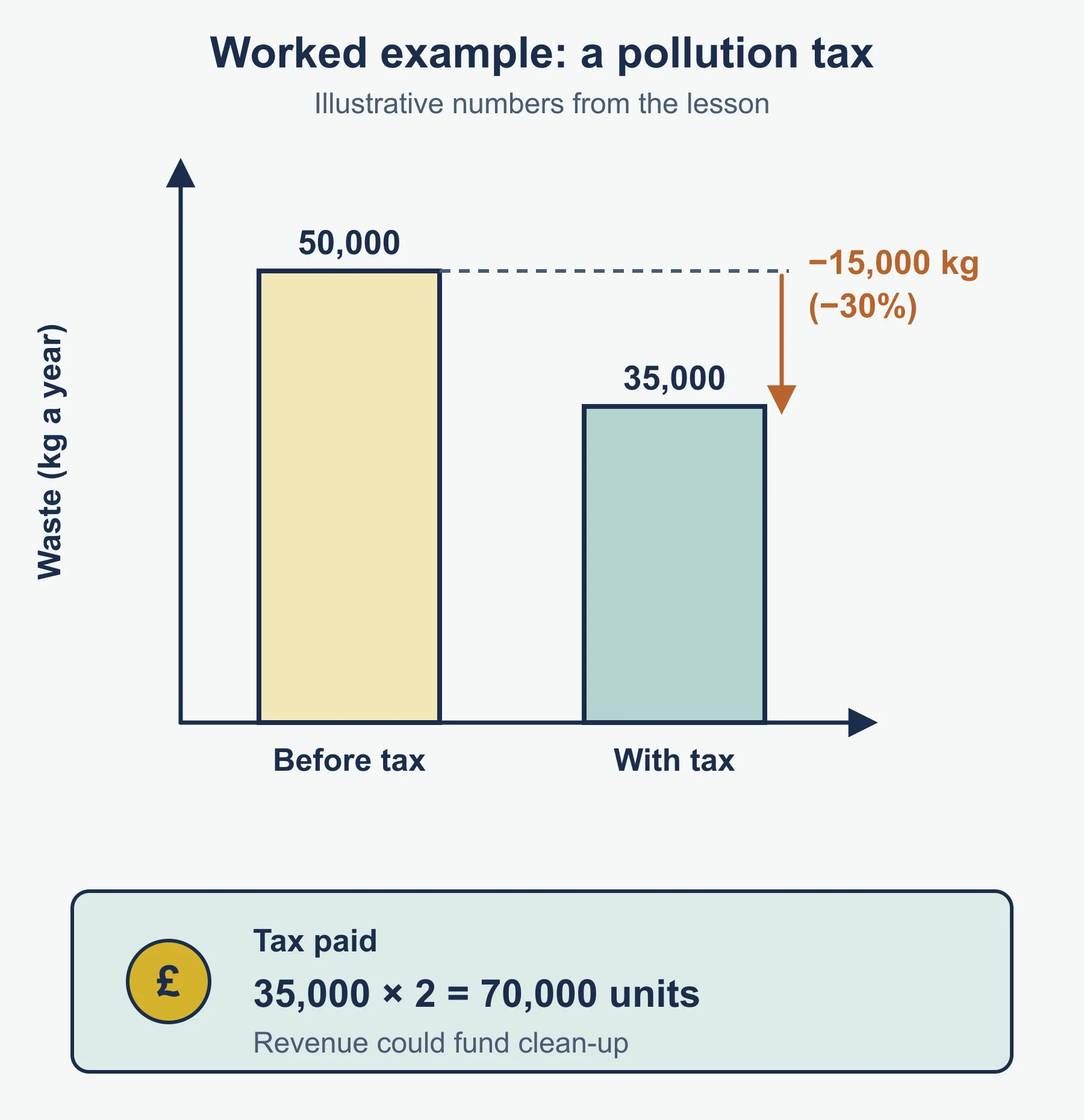
1. Effect of a tax. Before a £3 per-unit tax a good sells at £10 and 5,000 units are bought. After the tax the price is £12 and 4,000 units are bought.
- Tax revenue = 3 × 4,000 = £12,000.
- Consumers pay £2 more per unit, so they bear £2 of the £3 tax; producers bear the other £1 (they now receive £12 − £3 = £9).
- Quantity fell by 1,000 units, a fall of 20%.
2. Setting the tax. Private cost is £20 per unit and the external cost is £8 per unit, so the social cost is £28. A tax of £8 per unit makes the price reflect the full social cost.
3. Cost of a subsidy. A subsidy of £50 per unit on 3,000 units costs the government 50 × 3,000 = £150,000. That money has an opportunity cost.
Evaluating the policies
| Policy | Strengths | Weaknesses |
|---|---|---|
| Tax | Raises revenue; makes the polluter pay; consumers keep a choice | External cost is hard to measure; little effect if demand is price inelastic; can be regressive |
| Regulation | Clear and quick; can ban very harmful activities | Needs inspection and enforcement; no revenue; one rule may not suit every firm |
| Subsidy | Encourages good behaviour | Costs taxpayers; hard to set the right amount; firms may come to depend on it |
| State provision | Everyone can use the good | Costly; may be less efficient without competition |
| Information | Cheap; respects free choice | Slow; people may ignore it |
A strong answer says which policy suits which case: a ban for something very dangerous, a tax where some use is acceptable but should be reduced, a subsidy where society gains from more use.
Exam traps
- A tax does not stop all of an activity. It reduces it to (ideally) the level society prefers.
- A tax on a good with price-inelastic demand (such as cigarettes) raises revenue but cuts quantity only a little.
- Supply-side policies are long-run policies. Do not offer them as a quick fix for a recession.
- Privatisation and deregulation are different: one changes ownership, the other removes rules.
- Lower direct taxes are a supply-side policy because of the incentive effect; lower taxes to raise spending are fiscal policy. Say which effect you mean.
Quick self-test
- Define supply-side policies.
- Name the five supply-side policies listed in the specification (privatisation and deregulation counted together).
- Explain how training helps to reduce unemployment.
- Give two disadvantages of supply-side policies.
- Output rises from 1,800 to 2,070 units with 45 workers. Find the change in productivity.
- Give two policies to reduce a negative externality.
- Give two policies to increase consumption of a good with positive externalities.
- A £2 tax per unit is placed on a good; 6,000 units are then sold. How much revenue is raised?
- Why might a tax on cigarettes not cut smoking by much?
- Give one reason regulation might fail.
Answers
- Policies that aim to raise the productive capacity of the economy by improving the factors of production or making markets work better.
- Investment in education and training, lower direct taxes, lower taxes on business profits, trade union reform, privatisation and deregulation.
- It gives workers the skills that growing industries need, which reduces structural unemployment.
- Any two: slow to work, costly, uncertain results, may widen inequality, privatised firms may become monopolies.
- 40 to 46 units per worker, a 15% rise.
- Any two: indirect taxes, regulation or bans, charges, information campaigns, tradable pollution permits.
- Any two: subsidies, state provision, regulation making it compulsory, information campaigns.
- 2 × 6,000 = £12,000.
- Demand is price inelastic because smoking is addictive, so a higher price reduces quantity only a little.
- It needs inspection and enforcement, firms may break the rules if fines are small, or the rule may be set at the wrong level.
Where marks are usually lost
- Describing a supply-side policy with no link to productivity or capacity.
- Listing policies for externalities without saying how each changes price or quantity.
- Saying a tax “solves” pollution without discussing elasticity, measurement or fairness.
- Ignoring the cost to the government of subsidies and state provision.
Frequently asked questions
What supply-side policies are named in the AQA GCSE Economics specification? Investment in education and training, lower direct taxes, lower taxes on business profits, trade union reform, and privatisation and deregulation.
What is the difference between privatisation and deregulation? Privatisation changes ownership, selling state-owned firms to private owners. Deregulation removes rules that restrict competition.
Are supply-side policies a quick fix for a recession? No. They are long-run policies that take time to raise productive capacity.
Why might a tax on cigarettes not cut smoking by much? Demand is price inelastic because smoking is addictive, so a higher price reduces quantity only a little, though it raises revenue.
What policies can increase consumption of goods with positive externalities? Subsidies, direct provision by the state, regulation that makes consumption compulsory, and information and education campaigns.
Official syllabus
AQA GCSE Economics (8136) specification, for first teaching from September 2017 (Version 1.0), published by AQA: sections 3.2.3.3 Supply-side policies and 3.2.3.4 Policies to correct positive and negative externalities.
Get free revision emails (optional)
Occasional emails with practice questions, worked explanations and links to free resources for the qualification and subjects you choose. No spam, and you can unsubscribe from any email. The free tools on this site never need an email.
Related resources
-
Study guides
AQA GCSE Economics: Supply-side policies and policies for externalities (8136)
Study guide to AQA GCSE Economics 8136 3.2.3.3 and 3.2.3.4: supply-side policies, their pros and cons, and taxes, subsidies and rules for externalities.
Economics · AQA · GCSE
Read guide -
Practice questions
AQA GCSE Economics: Supply-side policies and policies for externalities (8136) – Practice Questions
Eleven original practice questions with worked answers for AQA GCSE Economics 8136 sections 3.2.3.3 and 3.2.3.4: supply-side policies and externality policies.
Economics · AQA · GCSE
Try questions -
Study guides
AQA GCSE Economics: The labour market: wage determination, differentials and gross and net pay (8136)
Study guide to the labour market for AQA GCSE Economics (8136): wage determination, wage differentials, gross and net pay, with worked examples.
Economics · AQA · GCSE
Read guide
Related articles
-
teaching
A Level tuition in Dubai: Cambridge or Pearson Edexcel International A Level?
Schools in Dubai and Abu Dhabi teach either Cambridge International AS & A Level or Pearson Edexcel International A Level. How the two are structured, why it matters for tuition, and how online classes from Lahore work.
9 October 2026
-
curriculum guides
Choosing subjects at IGCSE and A Level
How subject choices at 14 and 16 affect university options later, and how to keep pathways open without overloading a timetable.
28 July 2026
Studying this with a teacher
Working through Economics GCSE?
This page is free and stays free. If you would rather be taught it, Marlbridge runs Economics classes one-to-one and in small groups of up to 15, online in your own time zone. The first trial class is free. WhatsApp replies within an hour (8am–11pm Pakistan time, every day); email the same day.
AQA Economics teachers at Marlbridge
