
Study Guides
AQA GCSE Economics: Supply-side policies and policies for externalities (8136)
Study guide to AQA GCSE Economics 8136 3.2.3.3 and 3.2.3.4: supply-side policies, their pros and cons, and taxes, subsidies and rules for externalities.
- Subject
- Economics
- Level
- GCSE
- Topic
- Supply-side policies; government policies to correct positive and negative externalities
- Author
- Marlbridge Academic Team
- Updated
- Reviewed by
- Salman Ahmad (what this means)
Aligned to AQA GCSE Economics (8136), For first teaching from September 2017. Official specification .
Syllabus page (what it covers and how it is assessed): AQA GCSE Economics.
Syllabus points this page covers
8136
- 3.2.3.3 Supply-side policies
- 3.2.3.4 Policies to correct positive and negative externalities
Found an error? Report a correction.
Need help with this topic? Request a free trial class for GCSE Economics (8136).
Supply-side policies are government measures that increase the economy’s productive capacity by improving the quantity, quality or efficiency of labour, capital and markets. Policies to correct externalities use taxes, subsidies, regulation and information to change how much of a good is produced or consumed when its effects on third parties are ignored by the market. AQA GCSE Economics (8136) sections 3.2.3.3 and 3.2.3.4 expect you to explain the named supply-side policies, weigh their advantages and disadvantages, link them to government objectives, and explain the policies that target positive and negative externalities.
Both sections are in 3.2 How the economy works, assessed on Paper 2, with no tiers. Examples and numbers are invented to illustrate the ideas. Pair this guide with the revision notes and the practice questions. The demand-side policies are in the fiscal and monetary policy guide. Course links: AQA GCSE Economics hub, checklist and free diagnostics.
Syllabus coverage
| Specification point | What you must be able to do |
|---|---|
| 3.2.3.3 Supply-side policies | Explain investment in education and training, lower direct taxes, lower taxes on business profits, trade union reform and privatisation/deregulation |
| 3.2.3.3 Advantages and disadvantages | Weigh the benefits and drawbacks of supply-side policies |
| 3.2.3.3 Objectives | Explain how supply-side policies help achieve government objectives |
| 3.2.3.4 Externalities | Explain government policies designed to influence positive and negative externalities |
What are supply-side policies?
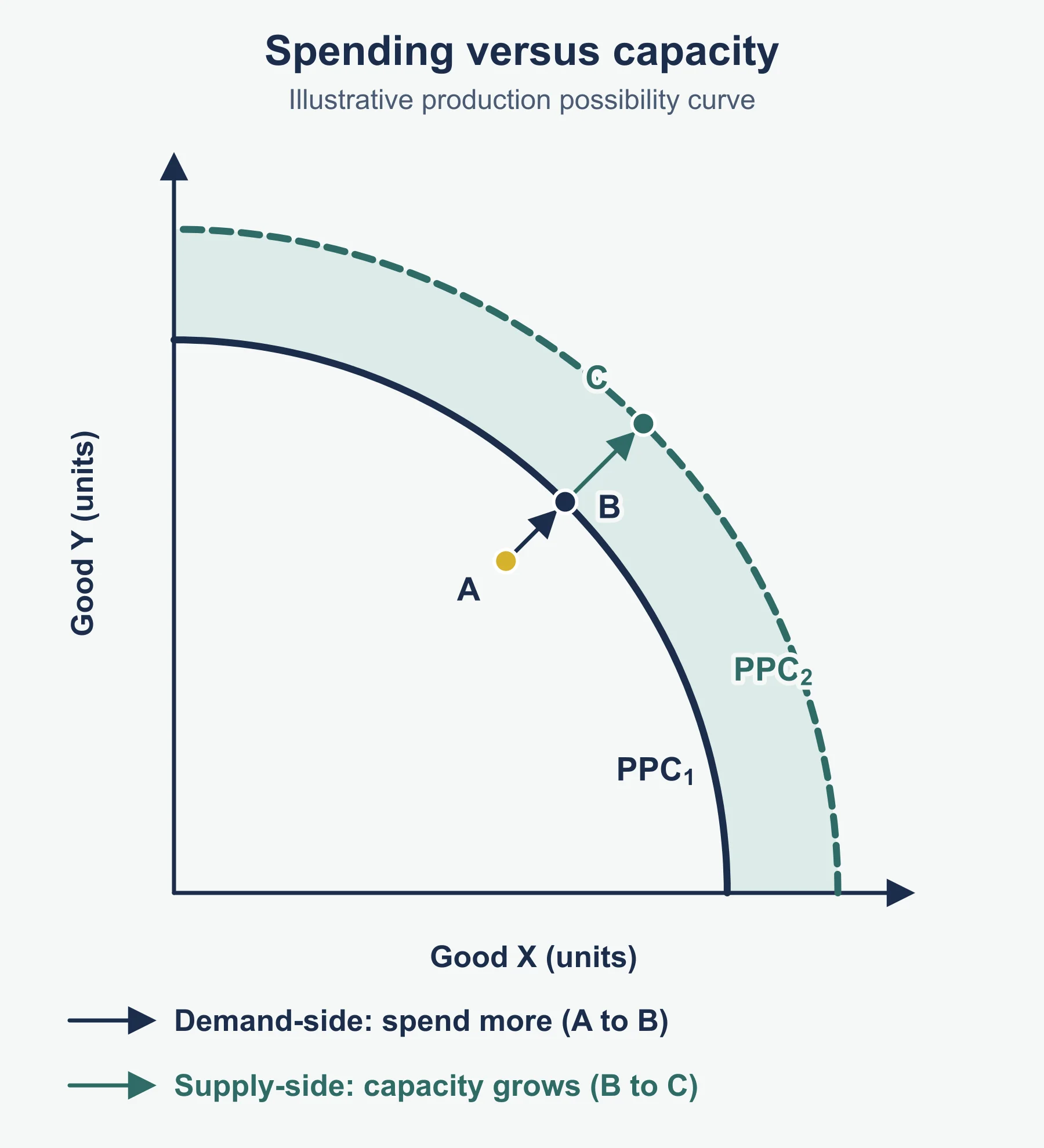
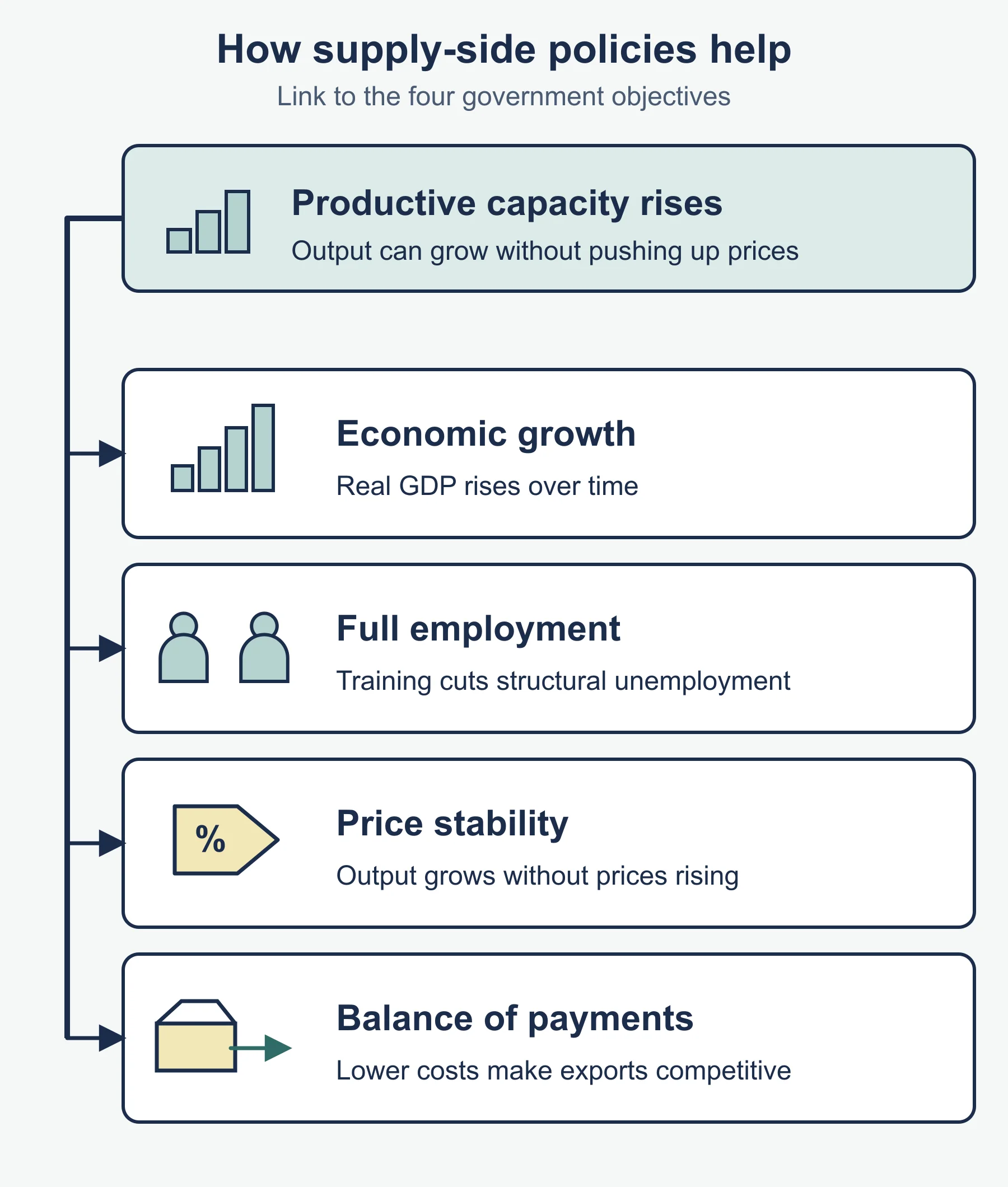
Demand-side policies (fiscal and monetary policy) change how much is spent in the economy. Supply-side policies change how much the economy is able to produce. If productive capacity grows, output can rise without pushing up prices, so supply-side policies can help growth, employment, price stability and the balance of payments at the same time.
What are the main supply-side policies?
| Policy | How it works | Example of effect |
|---|---|---|
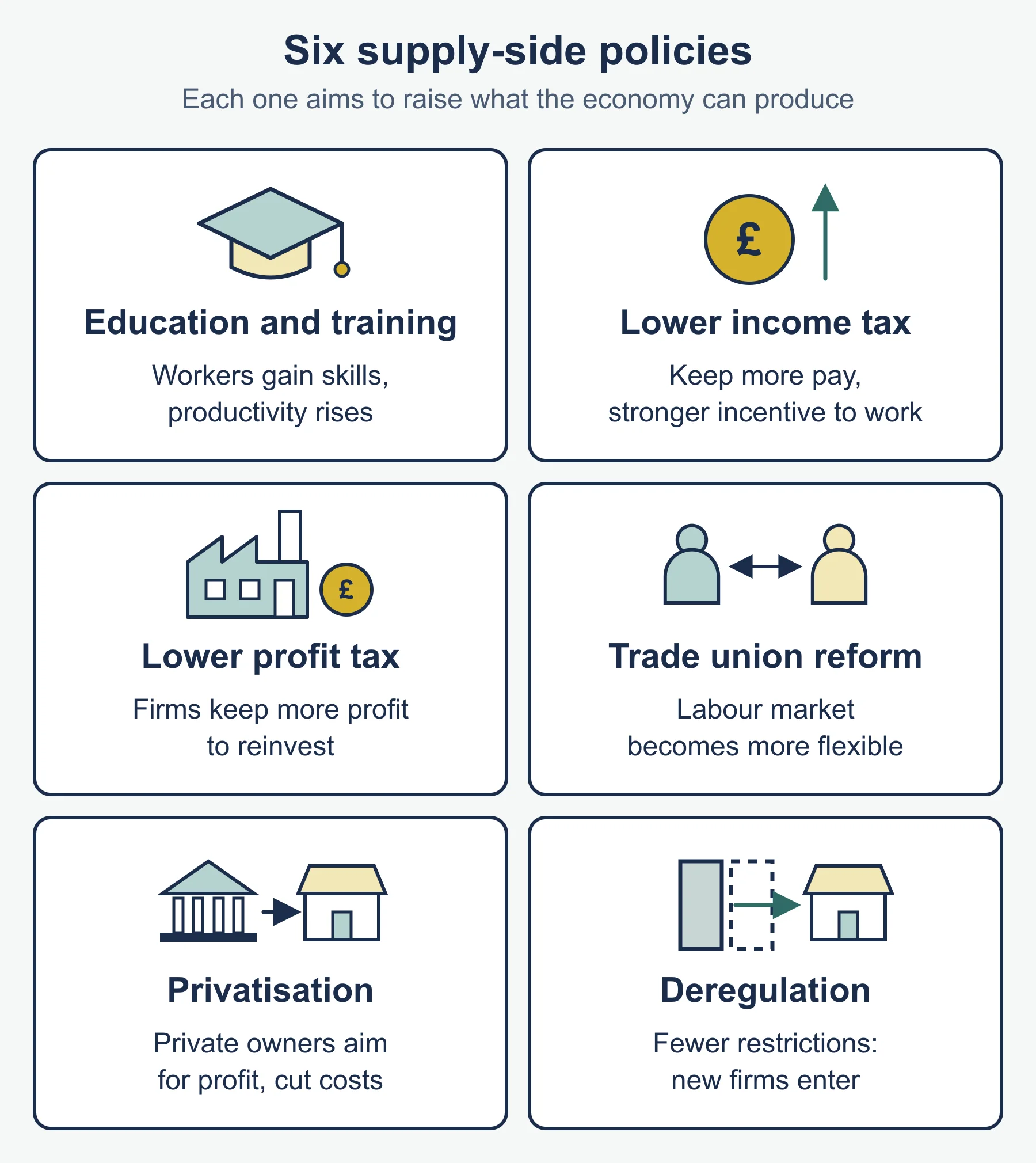
| Investment in education and training | Raises workers’ skills and productivity | Workers can move into growing industries, reducing structural unemployment |
| Lower direct taxes (such as income tax) | Workers keep more of each pound earned, so there is a stronger incentive to work or work longer | More people join the labour force |
| Lower taxes on business profits (corporation tax) | Firms keep more profit to reinvest; the country becomes more attractive to foreign firms | More investment in machinery and new factories |
| Trade union reform | Limits on union powers make the labour market more flexible | Firms find it easier to adjust wages and hire workers |
| Privatisation | State-owned firms are sold to private owners who aim for profit | Pressure to cut costs and improve efficiency |
| Deregulation | Removing rules that restrict competition | New firms enter, so prices fall and quality rises |
What are the advantages and disadvantages of supply-side policies?
Advantages
- They raise long-run growth without causing inflation, because capacity rises alongside demand.
- They can reduce structural unemployment by matching skills to jobs.
- More productive firms are more competitive internationally, which helps exports and the balance of payments.
Disadvantages
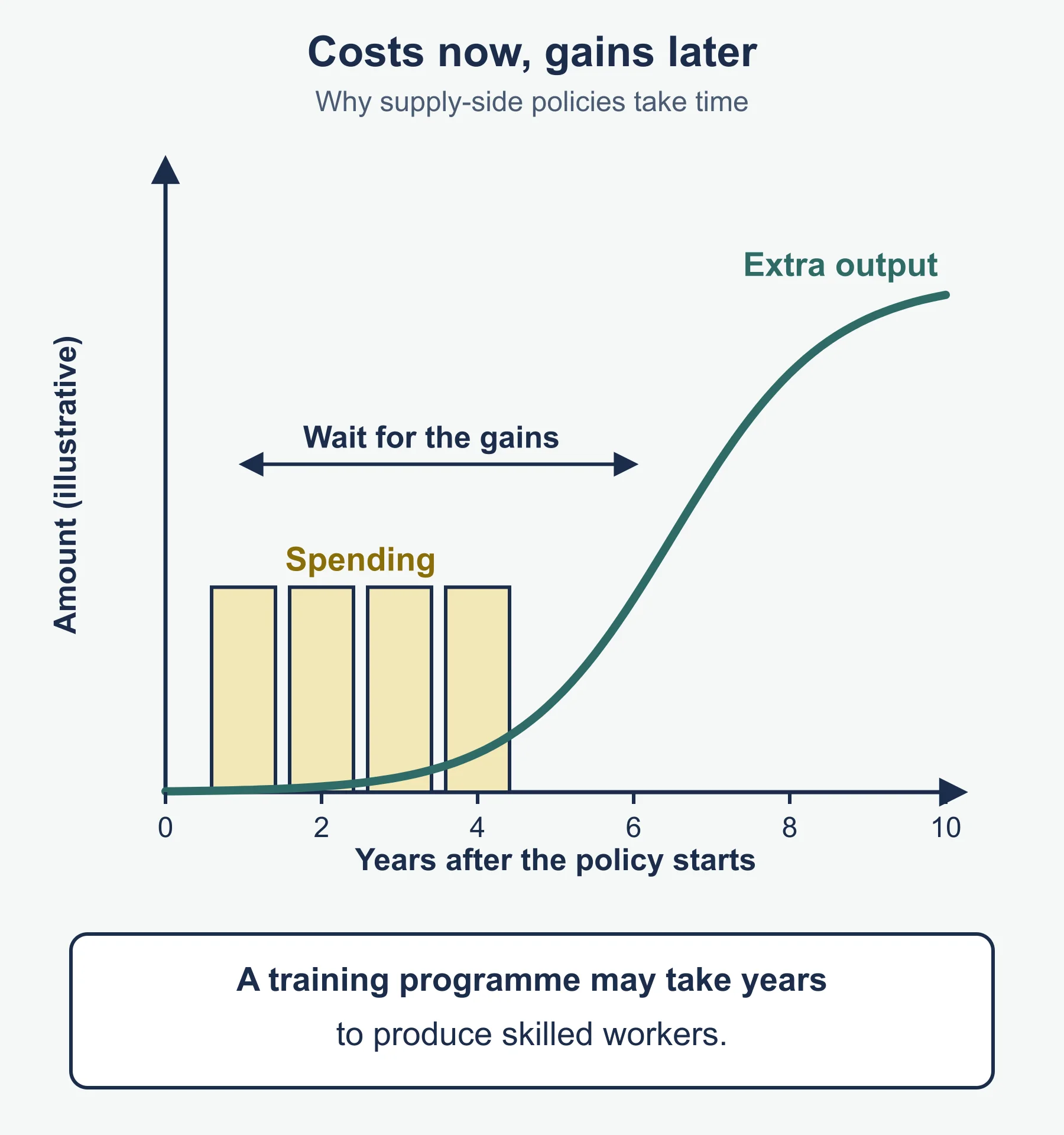
- They take a long time to work: a training programme may take years to produce skilled workers.
- Many are expensive, for example spending on education, or reduce tax revenue, for example lower taxes.
- Some may increase inequality: lower income tax gives the largest cash gain to high earners, and trade union reform may weaken workers’ bargaining power.
- Privatised firms may cut jobs or raise prices if competition is weak.
How do supply-side policies help government objectives?
| Objective | Link |
|---|---|
| Economic growth | Greater productive capacity raises real GDP over time |
| Full employment | Training reduces structural unemployment; lower taxes increase the incentive to work |
| Price stability | Output can grow without excess demand pushing prices up |
| Balance of payments | Lower costs and higher quality make exports more competitive |
What are externalities?
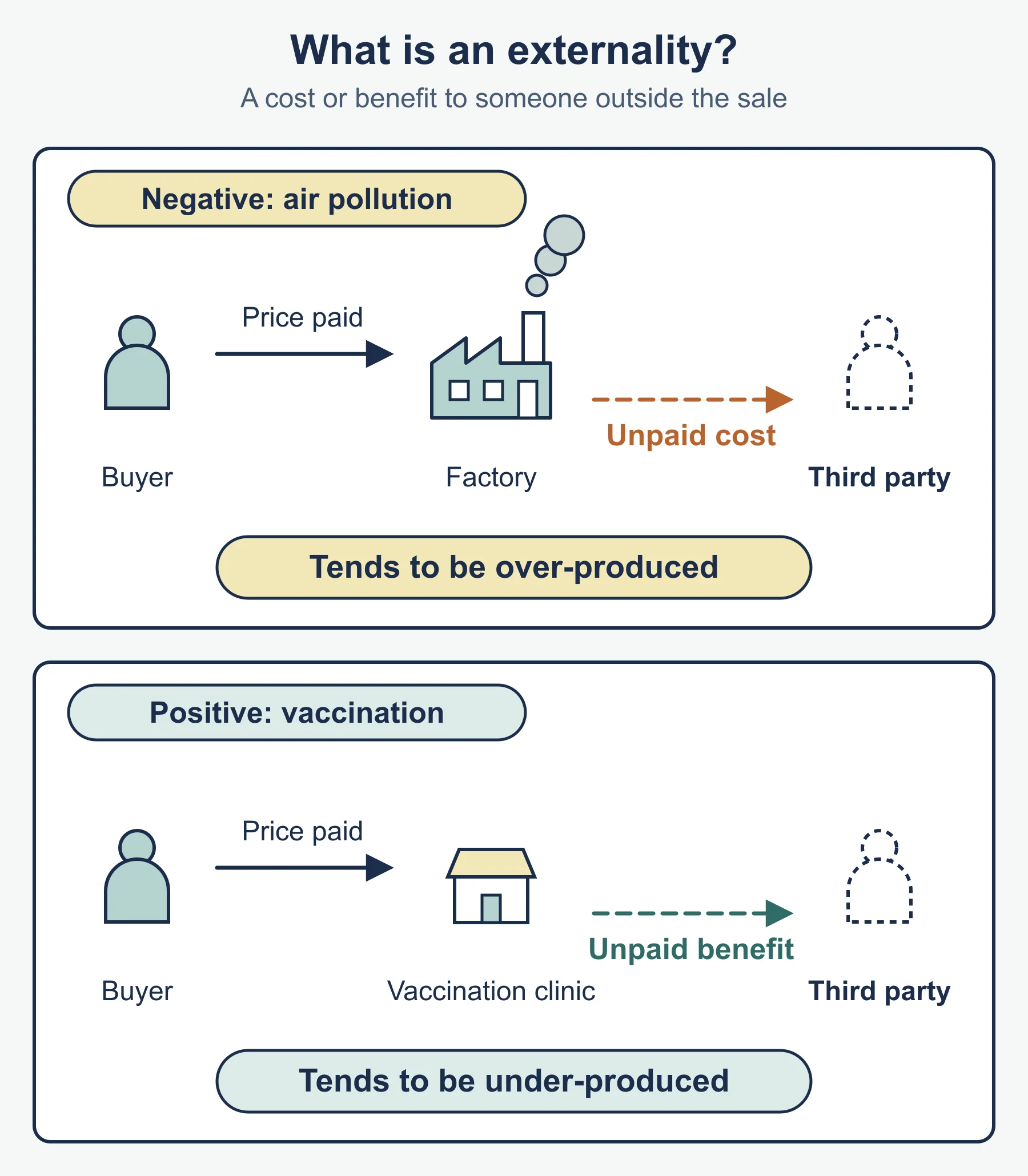
An externality is a cost or benefit to a third party that is not reflected in the market price. It is the difference between social costs or benefits and private costs or benefits.
- Negative externality: a cost to third parties, such as air pollution from a factory or noise from late-night venues.
- Positive externality: a benefit to third parties, such as fewer infections when people are vaccinated, or a more skilled workforce when people are educated.
Without intervention, goods with negative externalities tend to be over-produced or over-consumed, and goods with positive externalities tend to be under-produced or under-consumed.
Which policies correct negative externalities?
| Policy | How it works | Limitation |
|---|---|---|
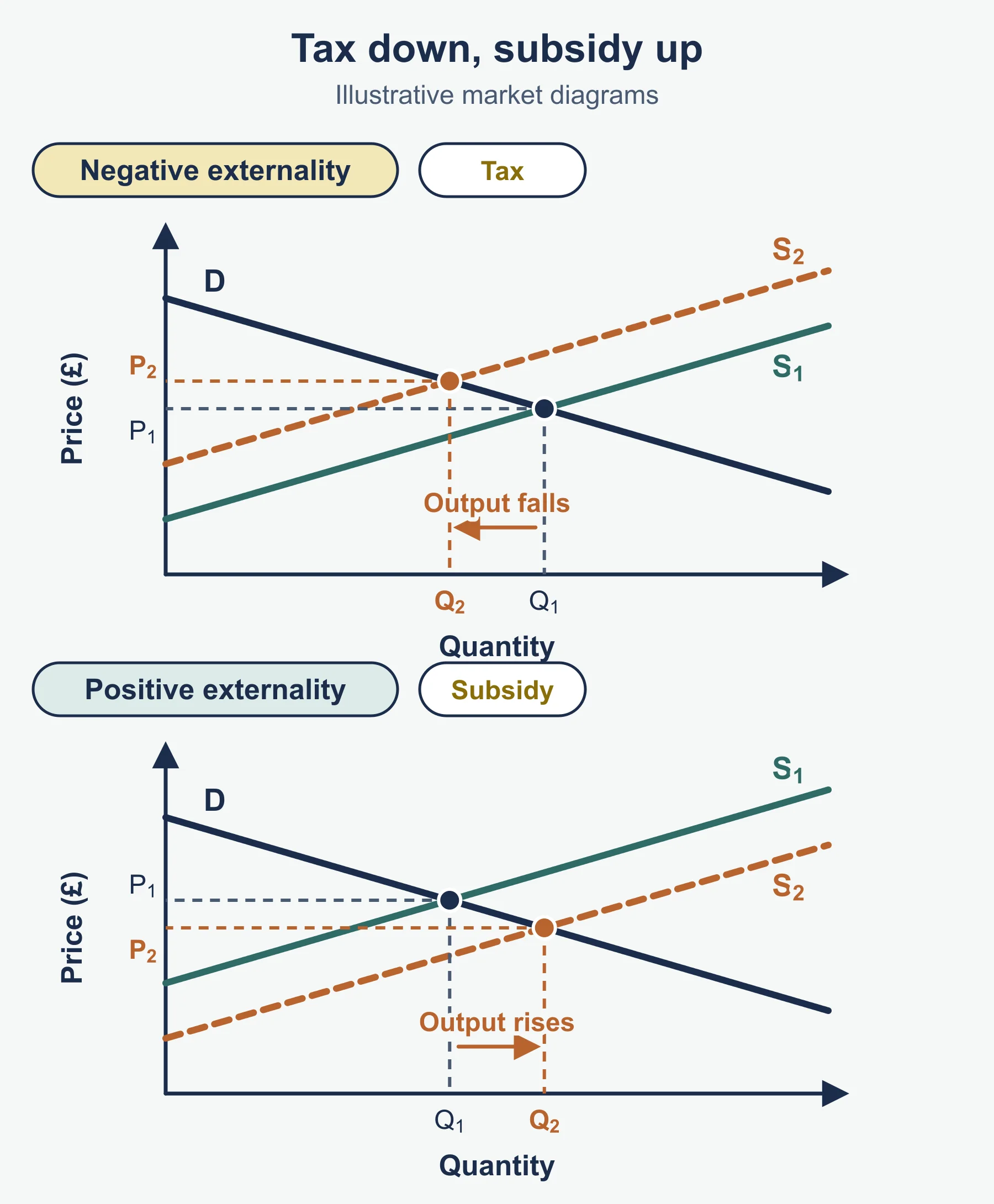
| Indirect tax | Raises the price, so less is bought and produced | Hard to set at the right level; can be regressive |
| Regulation and legislation | Bans or limits the activity, for example emission limits | Needs monitoring; fines may be too low to deter |
| Provision of information | Campaigns warn people of harm, such as on smoking | People may ignore the message |
Worked example: a pollution tax (illustrative)
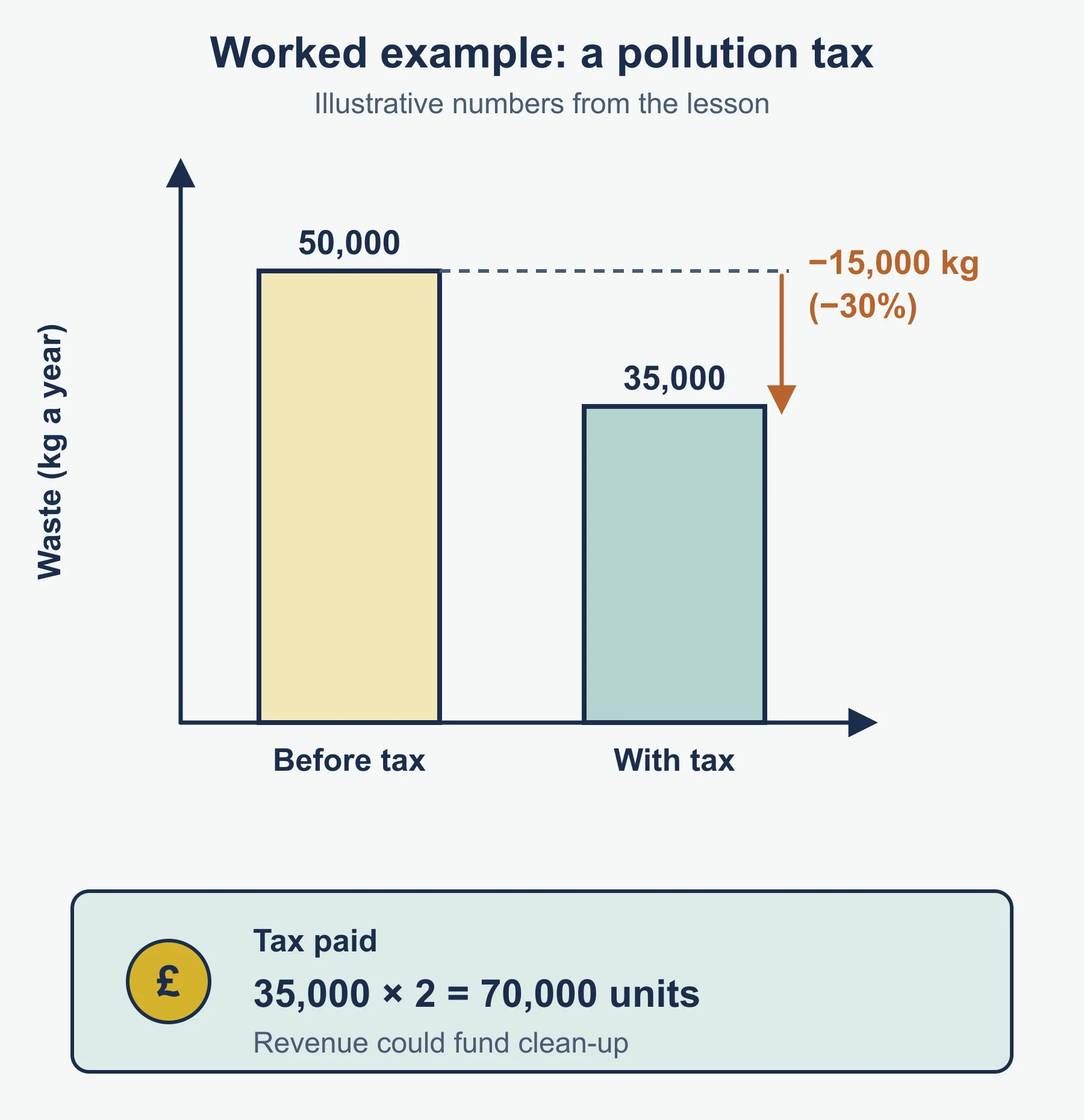
A plastics firm pays a tax of 2 units per kilogram of waste. It produced 50,000 kg of waste a year and now produces 35,000 kg. Tax paid = 35,000 × 2 = 70,000 units. Waste has fallen by (50,000 − 35,000) ÷ 50,000 × 100 = 30%. The tax has reduced the externality and raised revenue that could fund clean-up.
Which policies correct positive externalities?
| Policy | How it works | Limitation |
|---|---|---|
| Subsidy | Lowers the cost to producers or the price to consumers, so more is produced and consumed | Costs the government money; firms may become dependent |
| State provision | The government provides the good free at the point of use, such as education or vaccinations | Expensive; financed by taxes |
| Provision of information | Campaigns encourage take-up, such as healthy eating | Effect may be small |
How do you evaluate these policies?
Judge each policy by asking: how big is the effect, how long does it take, what does it cost, and who gains or loses? For example, a tax on sugary drinks may cut consumption but takes a larger share of income from poorer households, which conflicts with reducing inequality. A subsidy for electric cars encourages a cleaner choice but mostly benefits people who can afford new cars.
Common errors
- Calling an interest-rate cut a supply-side policy; it is monetary policy.
- Naming a policy without explaining how it raises productive capacity.
- Describing pollution as a cost to the firm; an externality falls on third parties.
- Recommending a tax for a positive externality, or a subsidy for a negative one.
- Ignoring the time lag and cost when evaluating supply-side measures.
Frequently asked questions
What is the difference between supply-side and demand-side policy? Demand-side policy changes total spending; supply-side policy changes how much the economy can produce.
Why can supply-side policies reduce inflation? They raise capacity, so output can rise to meet demand without firms needing to raise prices.
Which policy best corrects a negative externality? It depends: a tax keeps the choice with consumers and raises revenue, while regulation gives more certain results where the harm is severe.
Why are vaccinations an example of a positive externality? Vaccinated people are less likely to pass on infections, so others benefit even though they did not pay.
Official syllabus
AQA GCSE Economics (8136) specification, for first teaching from September 2017, published by AQA: sections 3.2.3.3 Supply-side policies and 3.2.3.4 Policies to correct positive and negative externalities.
Get free revision emails (optional)
Occasional emails with practice questions, worked explanations and links to free resources for the qualification and subjects you choose. No spam, and you can unsubscribe from any email. The free tools on this site never need an email.
Related resources
-
Practice questions
AQA GCSE Economics: Supply-side policies and policies for externalities (8136) – Practice Questions
Eleven original practice questions with worked answers for AQA GCSE Economics 8136 sections 3.2.3.3 and 3.2.3.4: supply-side policies and externality policies.
Economics · AQA · GCSE
Try questions -
Revision notes
AQA GCSE Economics: Supply-side policies and policies for externalities (8136) – Revision Notes
Condensed AQA GCSE Economics revision notes for 3.2.3.3 and 3.2.3.4: supply-side policies, their pros and cons, and policies to correct externalities.
Economics · AQA · GCSE
Revise topic -
Study guides
AQA GCSE Economics: The labour market: wage determination, differentials and gross and net pay (8136)
Study guide to the labour market for AQA GCSE Economics (8136): wage determination, wage differentials, gross and net pay, with worked examples.
Economics · AQA · GCSE
Read guide
Related articles
-
teaching
A Level tuition in Dubai: Cambridge or Pearson Edexcel International A Level?
Schools in Dubai and Abu Dhabi teach either Cambridge International AS & A Level or Pearson Edexcel International A Level. How the two are structured, why it matters for tuition, and how online classes from Lahore work.
9 October 2026
-
curriculum guides
Choosing subjects at IGCSE and A Level
How subject choices at 14 and 16 affect university options later, and how to keep pathways open without overloading a timetable.
28 July 2026
Studying this with a teacher
Working through Economics GCSE?
This page is free and stays free. If you would rather be taught it, Marlbridge runs Economics classes one-to-one and in small groups of up to 15, online in your own time zone. The first trial class is free. WhatsApp replies within an hour (8am–11pm Pakistan time, every day); email the same day.
AQA Economics teachers at Marlbridge
