
Revision Notes
AQA GCSE English Language (8700): Spoken Standard English – Revision Notes
AQA GCSE English Language 8700 spoken Standard English recall: AO9, the general criteria, dialect versus accent, non-standard forms, traps and a self-test.
- Subject
- English
- Level
- GCSE
- Topic
- Topic 3: Spoken language
- Author
- Marlbridge Academic Team
- Updated
- Reviewed by
- Ammar Bilal (what this means)
Aligned to AQA GCSE English (8700), For first teaching 2015. Official specification .
Syllabus page (what it covers and how it is assessed): AQA GCSE English Language.
Found an error? Report a correction.
Need help with this topic? Request a free trial class for GCSE English Language (8700).
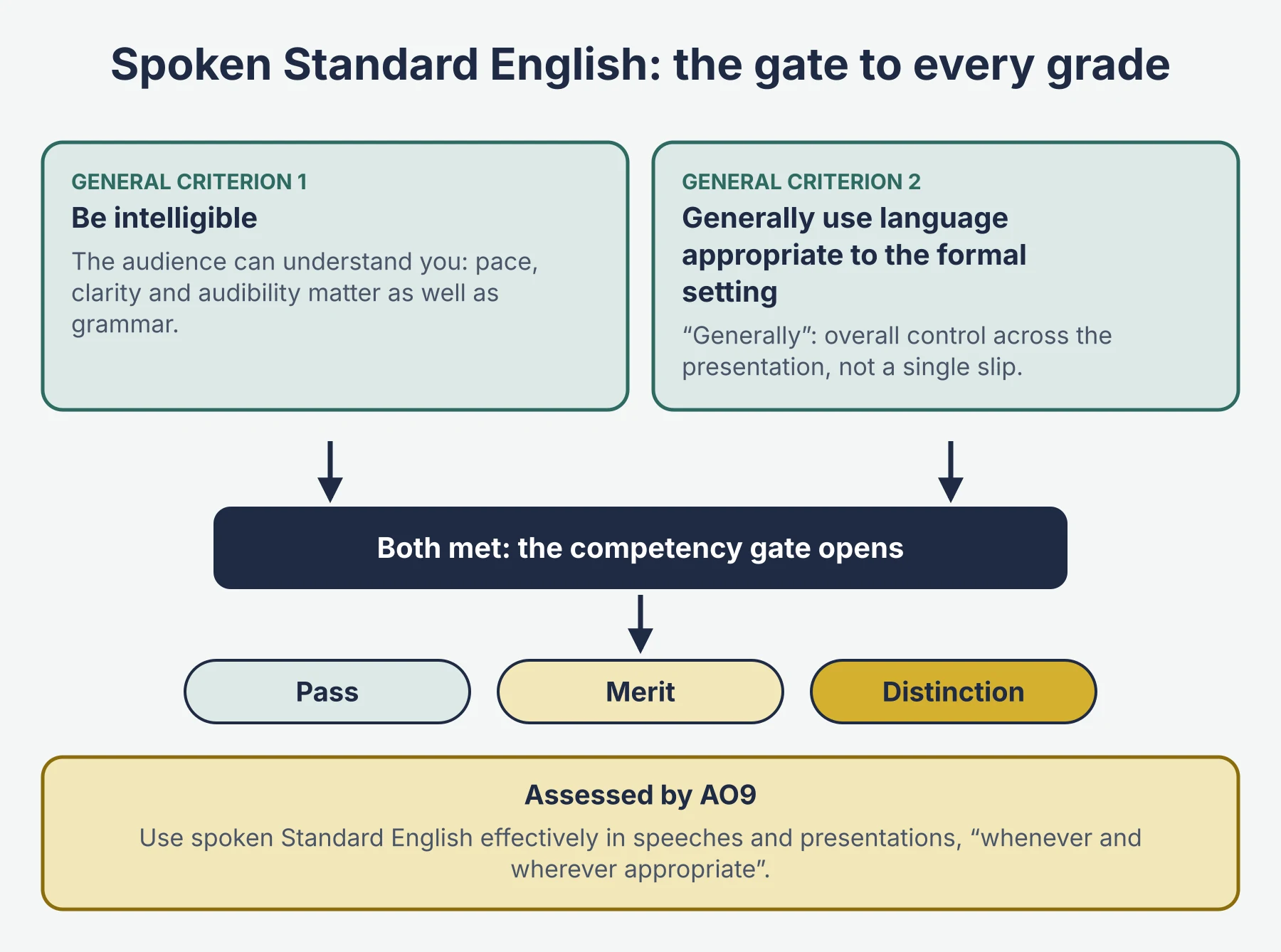
These notes condense spoken Standard English, the third strand of 3.1.3 Spoken language in AQA GCSE English Language (8700): “expressing ideas using Standard English whenever and wherever appropriate”. It is assessed by AO9: use spoken Standard English effectively in speeches and presentations.
Related: spoken Standard English study guide | spoken Standard English practice questions | spoken language revision notes
The strand in one paragraph
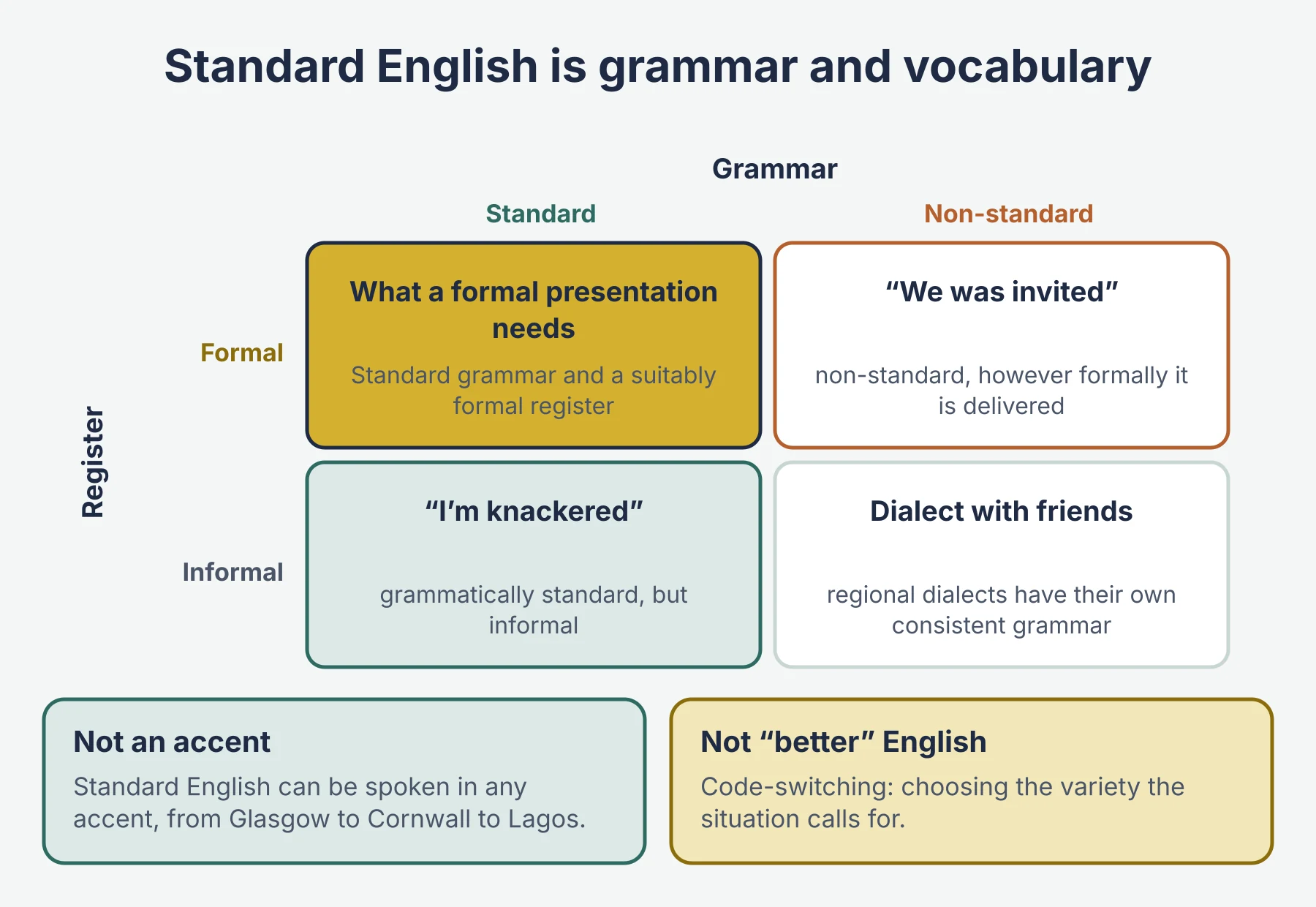
Standard English is a dialect defined by grammar and vocabulary, not accent. In a formal presentation you are expected to use it: to be intelligible and generally to use language appropriate to the formal setting. Keep your accent, drop non-standard grammar and slang, avoid hypercorrection, and keep control in the questions as well as the talk.
The general criteria (every grade)
To be awarded Pass, Merit or Distinction, a learner must:
- be audible; and
- use spoken Standard English, which for this assessment means:
- be intelligible;
- generally use language appropriate to the formal setting.
Competency basis: if these are not met, no grade above Not Classified can be awarded.
Key terms
| Term | Meaning |
|---|---|
| Standard English | The dialect used in most published writing and formal public speech |
| Dialect | A variety of a language with its own grammar and vocabulary |
| Accent | The way words are pronounced |
| Register | Level of formality |
| Non-standard form | A grammatical form found in some dialects but not in Standard English |
| Slang | Informal vocabulary, often specific to a group and quick to change |
| Code-switching | Moving between varieties to suit the situation |
| Hypercorrection | An error made by trying too hard to sound correct |
| Intelligible | Able to be understood by the audience |
| Filler | A word or sound used to fill a pause (“like”, “um”, “basically”) |
Three distinctions to know
| Pair | Difference |
|---|---|
| Standard English and accent | Standard English is grammar and vocabulary; accent is pronunciation. Any accent can speak Standard English. |
| Standard English and formality | “I’m shattered” is standard but informal; “they was” is non-standard however formally it is said. |
| Standard English and “correct” English | Dialects have consistent grammar of their own; the skill is choosing what suits the setting. |
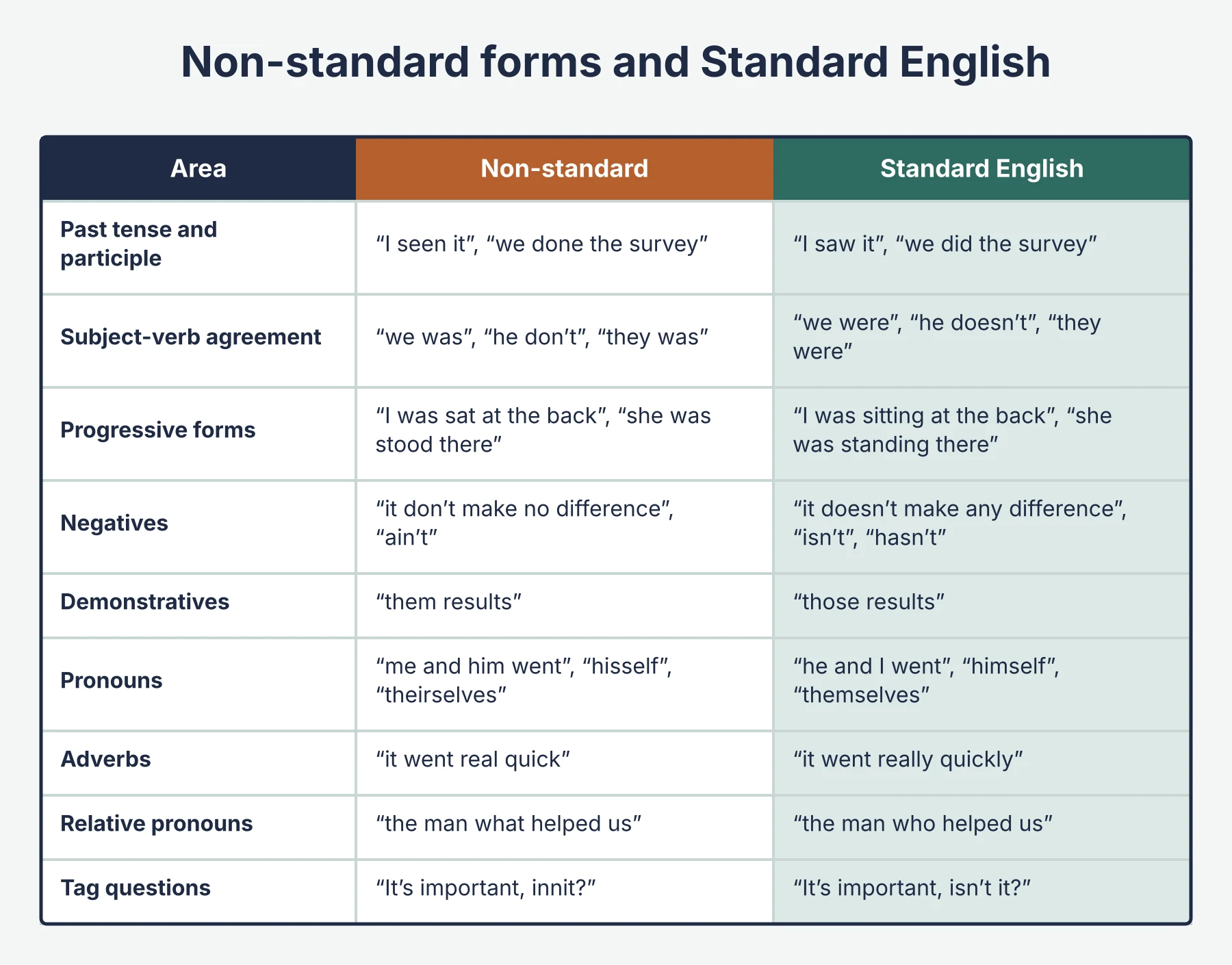
Non-standard to Standard: quick reference
| Non-standard | Standard |
|---|---|
| I seen / I done | I saw / I did |
| we was / they was | we were / they were |
| he don’t / she don’t | he doesn’t / she doesn’t |
| I was sat / she was stood | I was sitting / she was standing |
| it don’t make no difference | it doesn’t make any difference |
| ain’t | isn’t / aren’t / hasn’t / haven’t |
| them people | those people |
| me and him went | he and I went |
| hisself / theirselves | himself / themselves |
| real quick | really quickly |
| the woman what called | the woman who called |
| innit | isn’t it (or rephrase) |
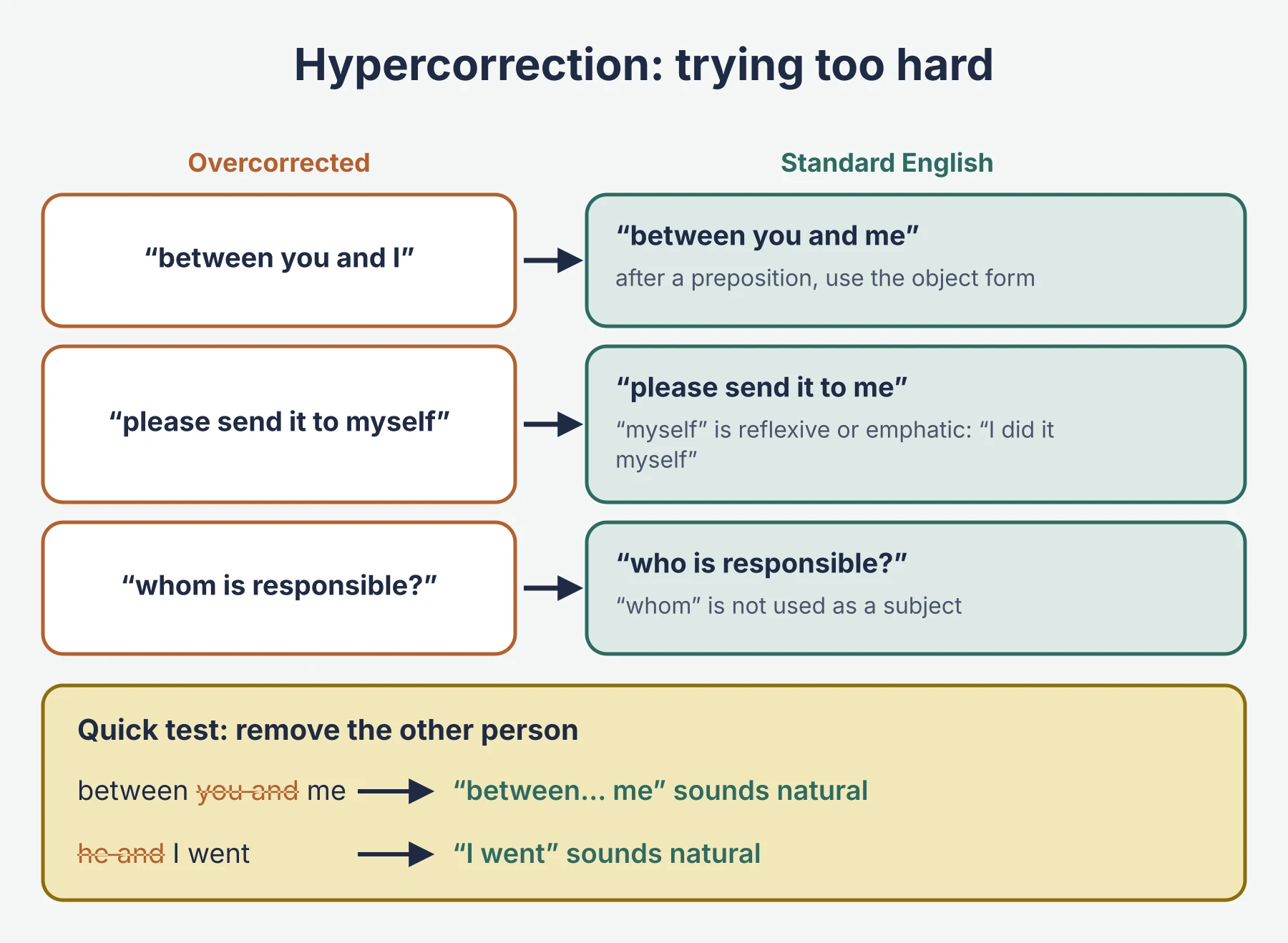
Hypercorrection traps
| Hypercorrect | Standard |
|---|---|
| between you and I | between you and me |
| send it to myself | send it to me |
| whom is speaking? | who is speaking? |
Test: remove the other person. “He invited I” is clearly wrong, so “He invited my friend and me” is right.
Acceptable in formal spoken Standard English
- Contractions in moderation (“it’s”, “we’ll”).
- Discourse markers that organise speech (“Right, let’s begin”).
- Occasional self-correction.
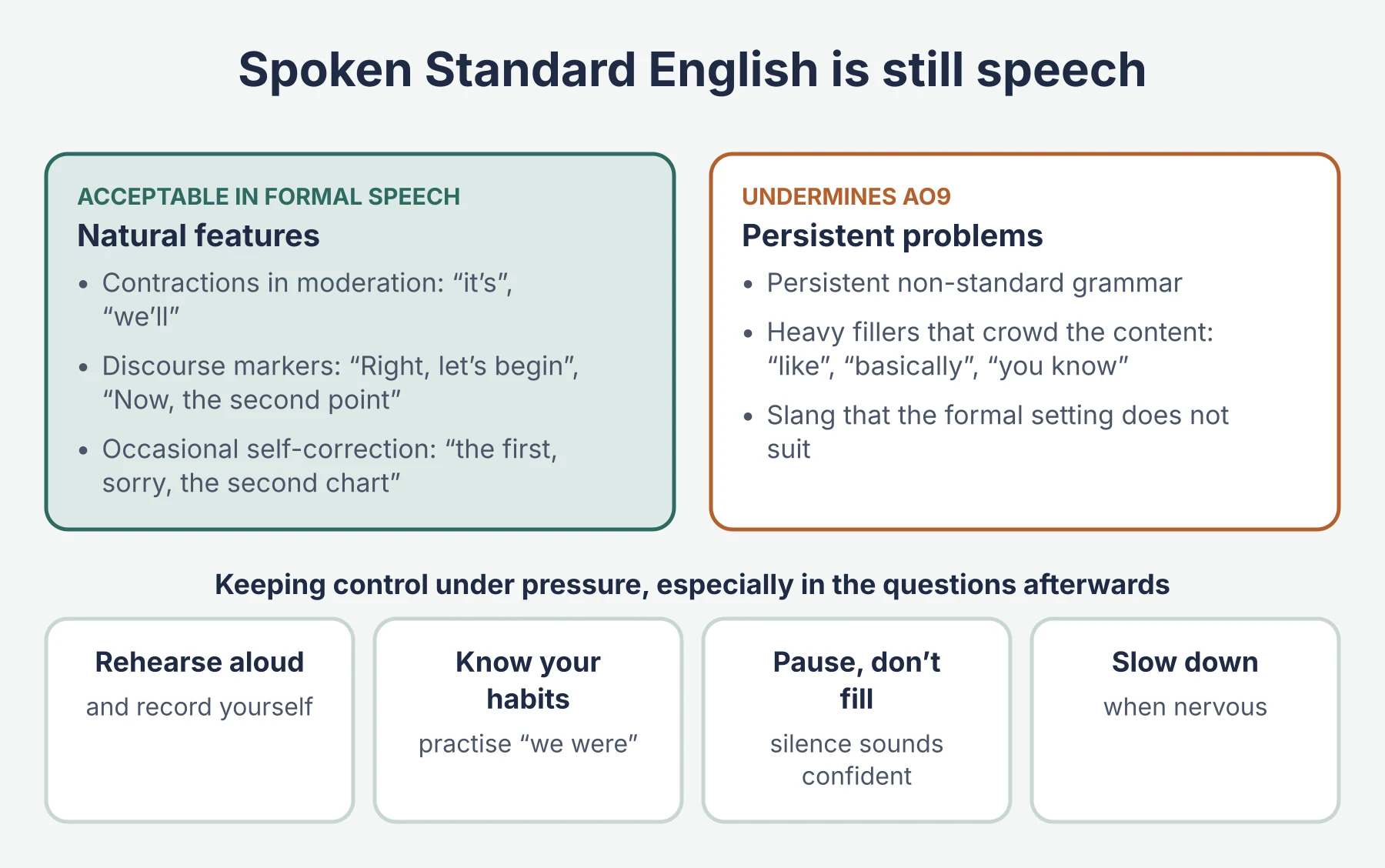
Undermines AO9
- Persistent non-standard grammar.
- Slang the setting does not suit.
- Heavy fillers that crowd out content.
- Unexplained dialect vocabulary that part of the audience may not know.
- Speaking too fast to be intelligible.
Traps
- Thinking you must lose your accent.
- Using long words to sound formal while keeping non-standard grammar.
- “Between you and I” and other hypercorrections.
- Relaxing into non-standard forms in the question session.
- Filling every pause with “like” or “basically”.
Quick self-test
- Which assessment objective covers spoken Standard English?
- Quote the specification’s wording for this strand.
- What two things does spoken Standard English mean for the general criteria?
- Is Standard English an accent? Explain.
- Correct: “We was gonna do it but the bus never come.”
- Correct: “Them figures don’t prove nothing.”
- Correct the hypercorrection: “The results surprised my partner and I.”
- Is “I’m shattered” Standard English? Is it formal?
- What is code-switching?
- Why might a dialect word affect intelligibility?
- Give a natural feature of speech that is acceptable in a formal presentation.
- Why can missing the general criteria affect every grade?
Answers
- AO9.
- “Expressing ideas using Standard English whenever and wherever appropriate.”
- Being intelligible, and generally using language appropriate to the formal setting.
- No. It is a dialect defined by grammar and vocabulary; it can be spoken in any accent.
- “We were going to do it, but the bus did not come” (or “didn’t come”).
- “Those figures do not prove anything” (or “don’t prove anything”).
- “The results surprised my partner and me.”
- Its grammar is standard, but “shattered” is informal, so it is not formal.
- Moving between varieties of language, such as dialect and Standard English, to suit the situation.
- Part of the audience may not know the word, so they may not understand the point.
- For example: contractions in moderation, or discourse markers such as “Right, let’s begin”.
- The endorsement is graded on a competency basis; the general criteria apply to Pass, Merit and Distinction.
Official syllabus
AQA GCSE English Language (8700) specification, for GCSE exams June 2017 onwards: 3.1.3 Spoken language (spoken Standard English), section 4.4 Non-exam assessment (general criteria), and assessment objective AO9.
Related resources
-
Study guides
AQA GCSE English Language (8700): Spoken language – Study Guide
How to plan, deliver and respond to a formal presentation and use spoken Standard English for the separate AQA GCSE English Language 8700 endorsement.
English · AQA · GCSE
Read guide -
Practice questions
AQA GCSE English Language Spoken Language Endorsement: Practice Questions
Original AQA GCSE English Language (8700) spoken language tasks: presentation planning, Standard English rewrites and grading sample talks against AO7–AO9.
English · AQA · GCSE
Try questions -
Revision notes
AQA GCSE English Language Spoken Language Endorsement: Revision Notes
Revision notes on AQA GCSE English Language (8700) spoken language: the compulsory presentation, AO7–AO9, Pass/Merit/Distinction criteria and the 3.1.3 content.
English · AQA · GCSE
Revise topic
Get free revision emails (optional)
Occasional emails with practice questions, worked explanations and links to free resources for the qualification and subjects you choose. No spam, and you can unsubscribe from any email. The free tools on this site never need an email.