
Study Guides
AQA GCSE English Language (8700): Spoken Standard English
AQA GCSE English Language 8700 guide to spoken Standard English: what it is, dialect versus accent, common non-standard forms, register choices and AO9.
- Subject
- English
- Level
- GCSE
- Topic
- Topic 3: Spoken language
- Author
- Marlbridge Academic Team
- Updated
- Reviewed by
- Ammar Bilal (what this means)
Aligned to AQA GCSE English (8700), For first teaching 2015. Official specification .
Syllabus page (what it covers and how it is assessed): AQA GCSE English Language.
Found an error? Report a correction.
Need help with this topic? Request a free trial class for GCSE English Language (8700).
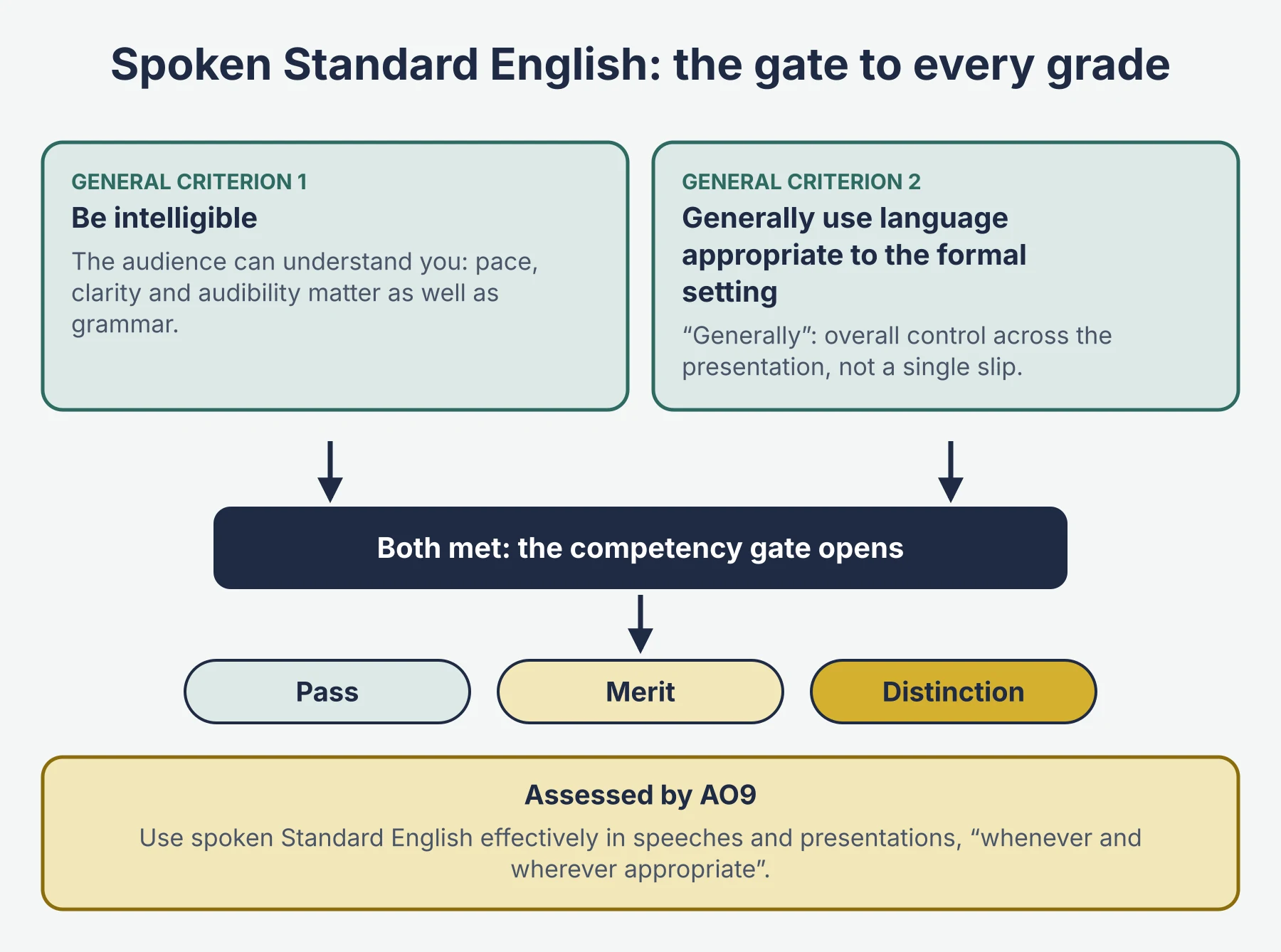
Spoken Standard English is the third strand of 3.1.3 Spoken language in AQA GCSE English Language (8700). The specification puts it in one line: “expressing ideas using Standard English whenever and wherever appropriate”. It is assessed by AO9: use spoken Standard English effectively in speeches and presentations. The spoken language study guide lists the most common slips; this page explains what Standard English actually is, why “whenever and wherever appropriate” is the key phrase, and how to control it under the pressure of a live presentation. For recall, use the spoken Standard English revision notes, and to practise, use the spoken Standard English practice questions.
What the assessment requires
Spoken Standard English appears in the general criteria that every grade requires. The specification says that, for the purposes of the spoken language assessment, using spoken Standard English means that a learner must:
- be intelligible; and
- generally use language appropriate to the formal setting of the presentation.
Two words deserve attention. “Intelligible” means the audience can understand you: pace, clarity and audibility matter as well as grammar. “Generally” means the requirement is about overall control across the presentation, not a single slip. Because the endorsement is graded on a competency basis, these general criteria must be met for any of Pass, Merit or Distinction to be awarded.
What Standard English is, and is not
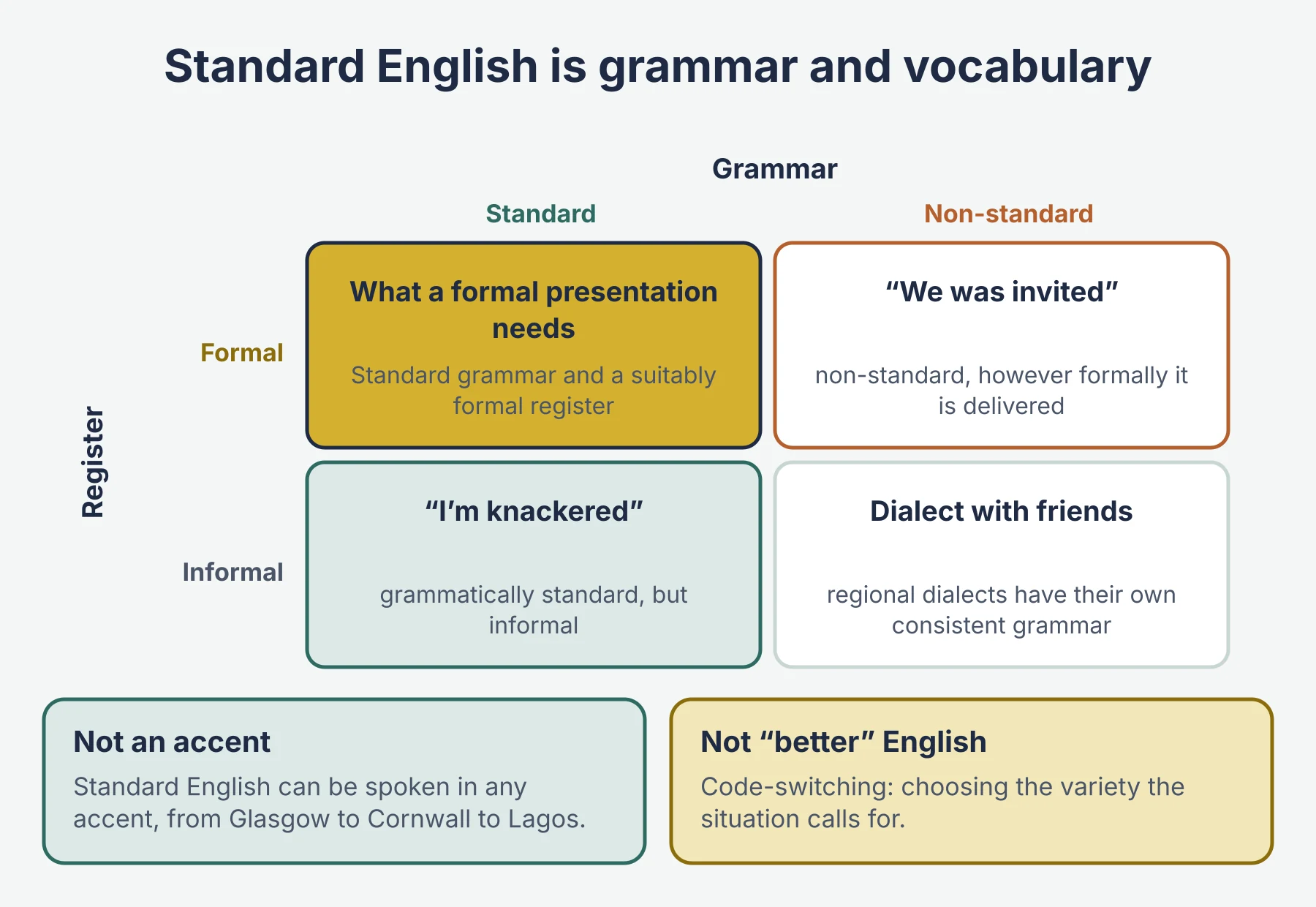
Standard English is one dialect of English: the variety used in most published writing, in education and in formal public speech. It is defined by its grammar and vocabulary, not by pronunciation.
- It is not an accent. Standard English can be spoken in any accent, from Glasgow to Cornwall to Lagos. Keeping your accent is entirely compatible with AO9.
- It is not the same as formality. “I’m knackered” is grammatically standard but informal; “We was invited” is non-standard, however formally it is delivered. A formal presentation needs both Standard English grammar and a suitably formal register.
- It is not “better” English. Regional dialects have their own consistent grammar. The point is choosing the variety the situation calls for, which is what “whenever and wherever appropriate” means.
This ability to move between varieties is sometimes called code-switching. You might use dialect forms with friends and Standard English in a presentation; the skill being assessed is knowing when each is appropriate.
Common non-standard forms in speech
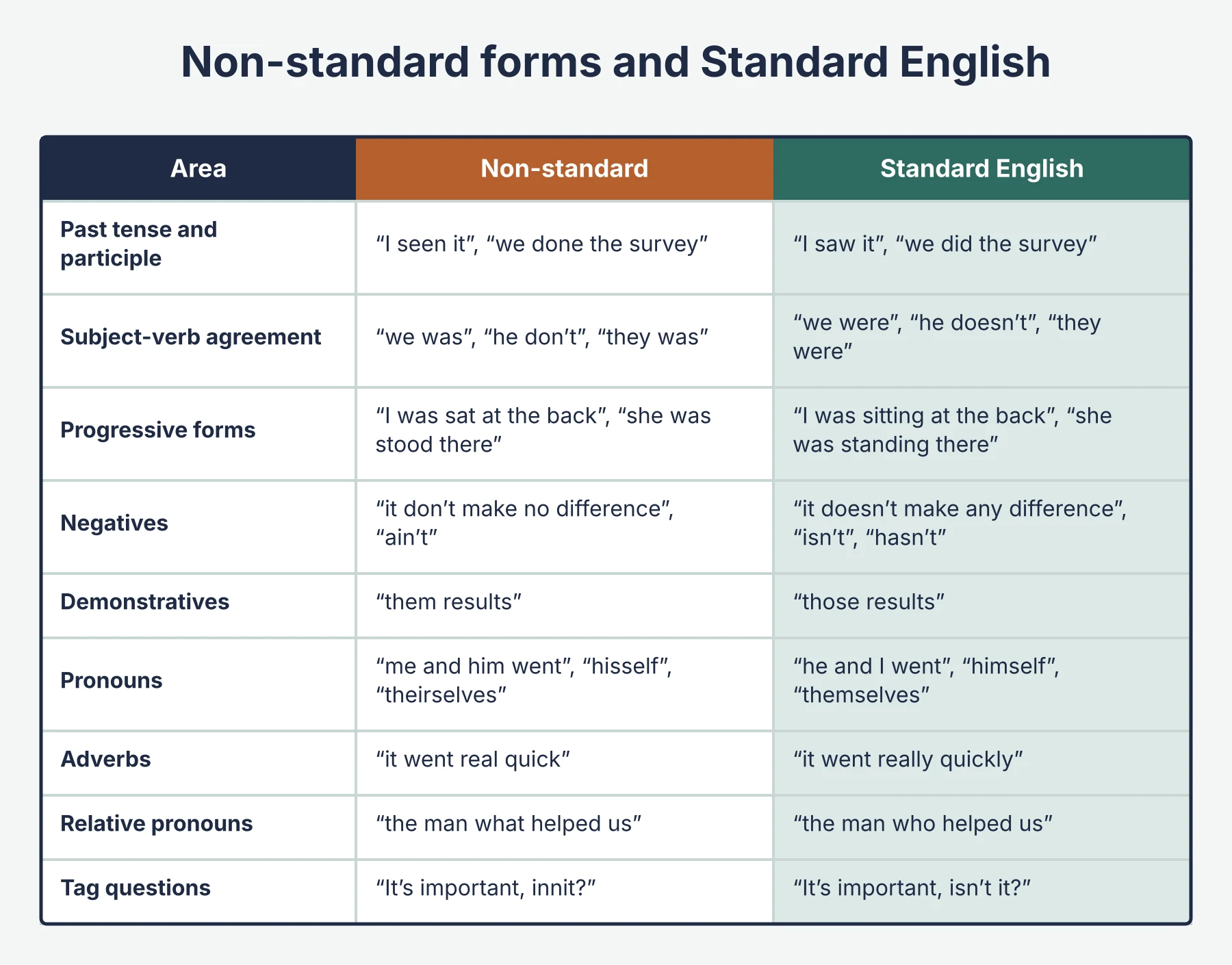
The forms below are widespread in many dialects of English. In a formal presentation, use the Standard English equivalent.
| Area | Non-standard (examples) | Standard English |
|---|---|---|
| Past tense and participle | “I seen it”, “we done the survey” | “I saw it”, “we did the survey” |
| Subject-verb agreement | “we was”, “he don’t”, “they was” | “we were”, “he doesn’t”, “they were” |
| Progressive forms | “I was sat at the back”, “she was stood there” | “I was sitting at the back”, “she was standing there” |
| Negatives | “it don’t make no difference”, “ain’t” | “it doesn’t make any difference”, “isn’t”, “hasn’t” |
| Demonstratives | “them results” | “those results” |
| Pronouns | “me and him went”, “hisself”, “theirselves” | “he and I went”, “himself”, “themselves” |
| Adverbs | “it went real quick” | “it went really quickly” |
| Relative pronouns | “the man what helped us” | “the man who helped us” |
| Tag questions | “It’s important, innit?” | “It’s important, isn’t it?” |
Hypercorrection: the opposite error
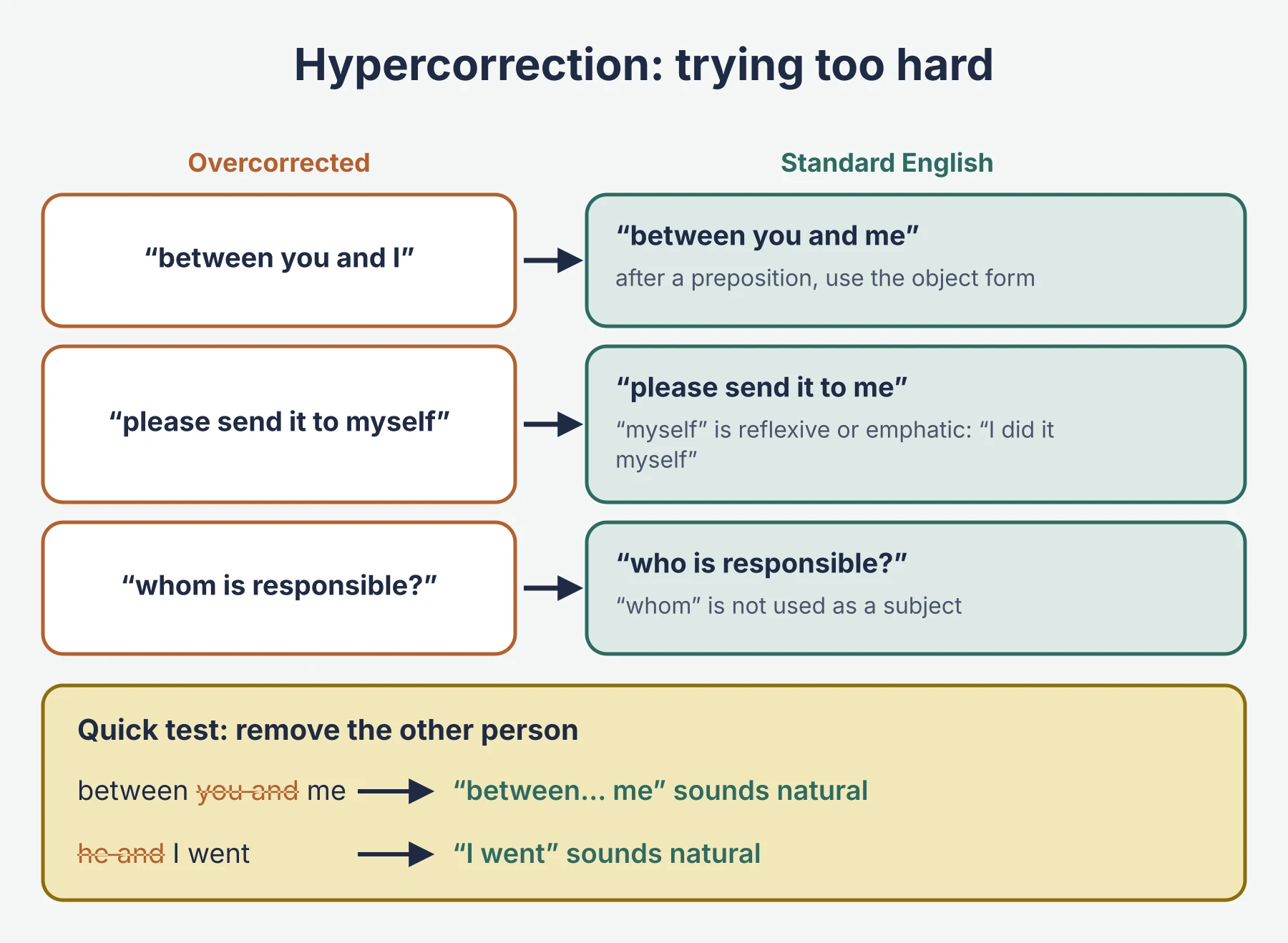
Speakers trying hard to sound formal sometimes overcorrect, producing forms that are not Standard English either:
- “between you and I” should be “between you and me” (after a preposition, use the object form);
- “please send it to myself” should be “please send it to me” (“myself” is for reflexive or emphatic use: “I did it myself”);
- “whom” used as a subject (“whom is responsible?”) should be “who”.
A quick test for pronouns is to remove the other person: “between… me” is natural; so is “he and I went” once you check “I went”.
Dialect vocabulary and slang
Standard English also concerns vocabulary. Regional words such as “bairn” (child) or “mardy” (sulky) are dialect vocabulary, and slang is informal vocabulary that changes quickly and is often limited to one group. Either may puzzle part of an audience, which affects intelligibility. In a formal presentation, use the widely understood equivalent, or explain the word deliberately if it is part of your topic: a talk about regional dialects might quote dialect words on purpose, which is entirely appropriate.
Spoken Standard English is still speech
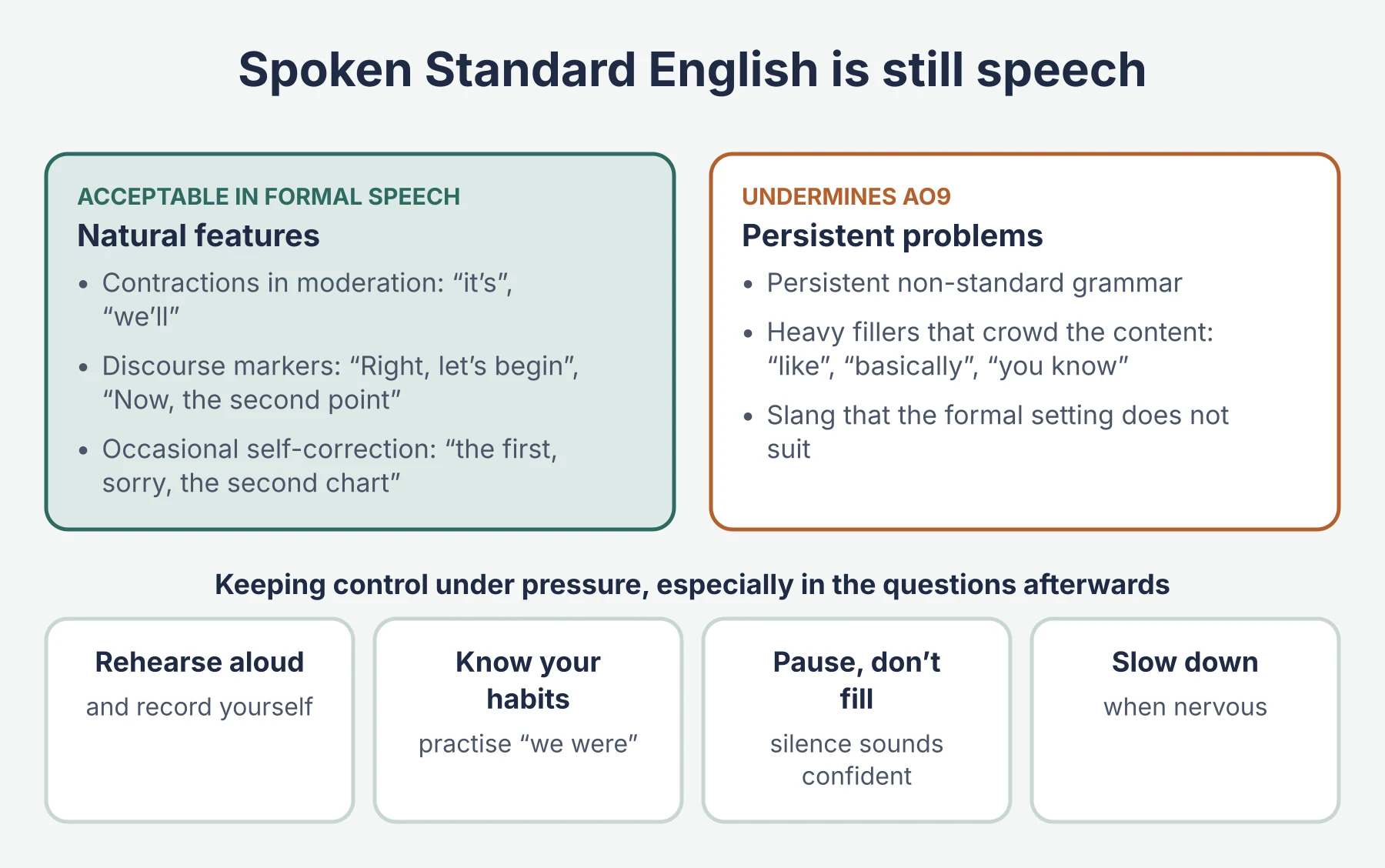
Spoken Standard English does not mean speaking like a textbook. Natural features of formal speech are acceptable:
- contractions such as “it’s” and “we’ll”, in moderation;
- discourse markers that organise speech (“Right, let’s begin”, “Now, the second point”);
- occasional self-correction (“the first, sorry, the second chart”), which every speaker produces.
What undermines AO9 is persistent non-standard grammar, heavy fillers (“like”, “basically”, “you know”) that crowd the content, or slang that the formal setting does not suit.
Keeping control under pressure
Most slips happen not in the prepared talk but in the questions afterwards, when you are thinking on your feet.
- Rehearse aloud, and record yourself; non-standard forms are hard to notice in your own speech until you hear them.
- Know your habitual forms. If you usually say “we was”, practise sentences with “we were” until they feel natural.
- Use pauses instead of fillers. A short silence sounds confident; “like… basically” does not.
- Slow down when nervous, which improves both intelligibility and accuracy.
Worked example: revising a spoken passage
Original transcript (invented):
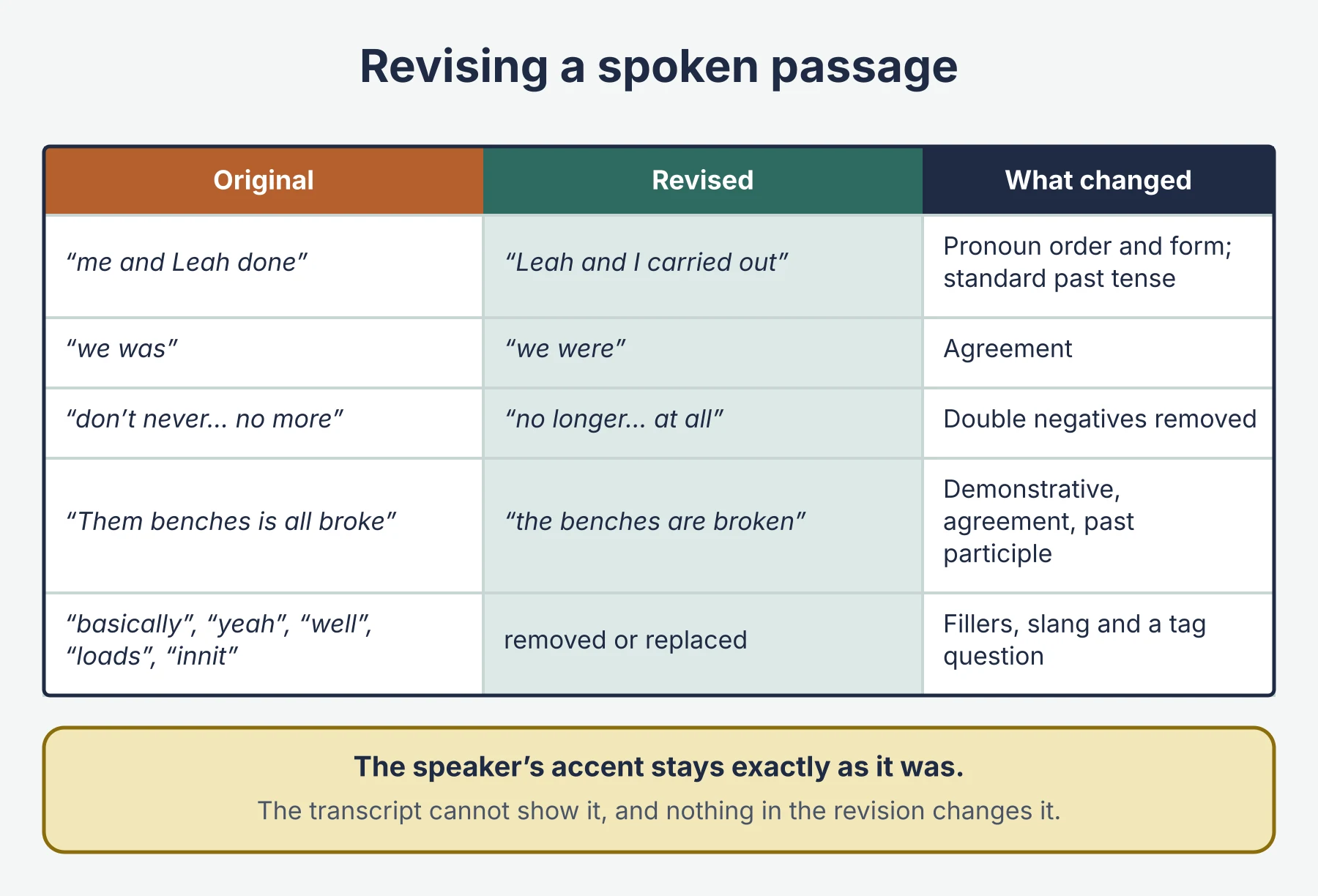
“So basically me and Leah done a survey, yeah, and we was well surprised, ’cause loads of people said they don’t never use the park no more. Them benches is all broke, innit.”
Revised for a formal presentation:
“Leah and I carried out a survey, and we were surprised by the results. Many people told us that they no longer use the park at all. One reason they gave is that the benches are broken.”
What changed:
- “me and Leah done” became “Leah and I carried out” (pronoun order and form; standard past tense);
- “we was” became “we were” (agreement);
- “don’t never… no more” became “no longer… at all” (double negatives removed);
- “Them benches is all broke” became “the benches are broken” (demonstrative, agreement, past participle);
- “basically”, “yeah”, “well”, “loads”, “innit” were removed or replaced (fillers, slang and a tag question);
- the speaker’s accent, which the transcript cannot show, stays exactly as it was.
Common mistakes
- Believing you must change your accent, and sounding stilted as a result.
- Confusing formality with Standard English, and thinking long words fix non-standard grammar.
- Hypercorrecting with “between you and I” or “myself”.
- Relaxing in the question session, where non-standard forms return.
- Fillers that make a presentation hard to follow.
- Using dialect words unexplained, so part of the audience misses the point.
Related: presenting information and ideas study guide | responding to spoken language study guide | spoken language revision notes
Official syllabus
AQA GCSE English Language (8700) specification, for GCSE exams June 2017 onwards: 3.1.3 Spoken language (spoken Standard English), section 4.4 Non-exam assessment (general criteria), and assessment objective AO9.
Related resources
-
Practice questions
AQA GCSE English Language (8700): Spoken Standard English – Practice Questions
Original AQA GCSE English Language 8700 spoken Standard English practice: correcting non-standard forms, hypercorrection, register and transcripts.
English · AQA · GCSE
Try questions -
Revision notes
AQA GCSE English Language (8700): Spoken Standard English – Revision Notes
AQA GCSE English Language 8700 spoken Standard English recall: AO9, the general criteria, dialect versus accent, non-standard forms, traps and a self-test.
English · AQA · GCSE
Revise topic -
Study guides
AQA GCSE English Language (8700): Spoken language – Study Guide
How to plan, deliver and respond to a formal presentation and use spoken Standard English for the separate AQA GCSE English Language 8700 endorsement.
English · AQA · GCSE
Read guide
Get free revision emails (optional)
Occasional emails with practice questions, worked explanations and links to free resources for the qualification and subjects you choose. No spam, and you can unsubscribe from any email. The free tools on this site never need an email.