
Revision Notes
AQA GCSE English Language (8700): Responding to Spoken Language – Revision Notes
AQA GCSE English Language 8700 recall notes on responding to questions and feedback: AO8 criteria, question types, answer shapes, traps and a self-test.
- Subject
- English
- Level
- GCSE
- Topic
- Topic 3: Spoken language
- Author
- Marlbridge Academic Team
- Updated
- Reviewed by
- Ammar Bilal (what this means)
Aligned to AQA GCSE English (8700), For first teaching 2015. Official specification .
Syllabus page (what it covers and how it is assessed): AQA GCSE English Language.
Found an error? Report a correction.
Need help with this topic? Request a free trial class for GCSE English Language (8700).
These notes condense responding to spoken language, the second strand of 3.1.3 Spoken language in AQA GCSE English Language (8700): “listening to and responding appropriately to any questions and feedback”. It is assessed by AO8: listen and respond appropriately to spoken language, including to questions and feedback on presentations.
Related: responding study guide | responding practice questions | spoken language revision notes
The strand in one paragraph
Listen to the whole question, find its core, ask for clarification if you need it, then answer directly with a reason and an example, in the same formal register as your talk. When challenged, concede what is fair before responding. At the top grade, see what lies behind the question and add new ideas or information.
What the specification says
- Questions and feedback come “as part of, or following, the presentation”.
- Students must “listen to and respond appropriately to questions and feedback”.
- The assessment also describes “asking questions themselves to elicit clarification”.
The criteria for responding
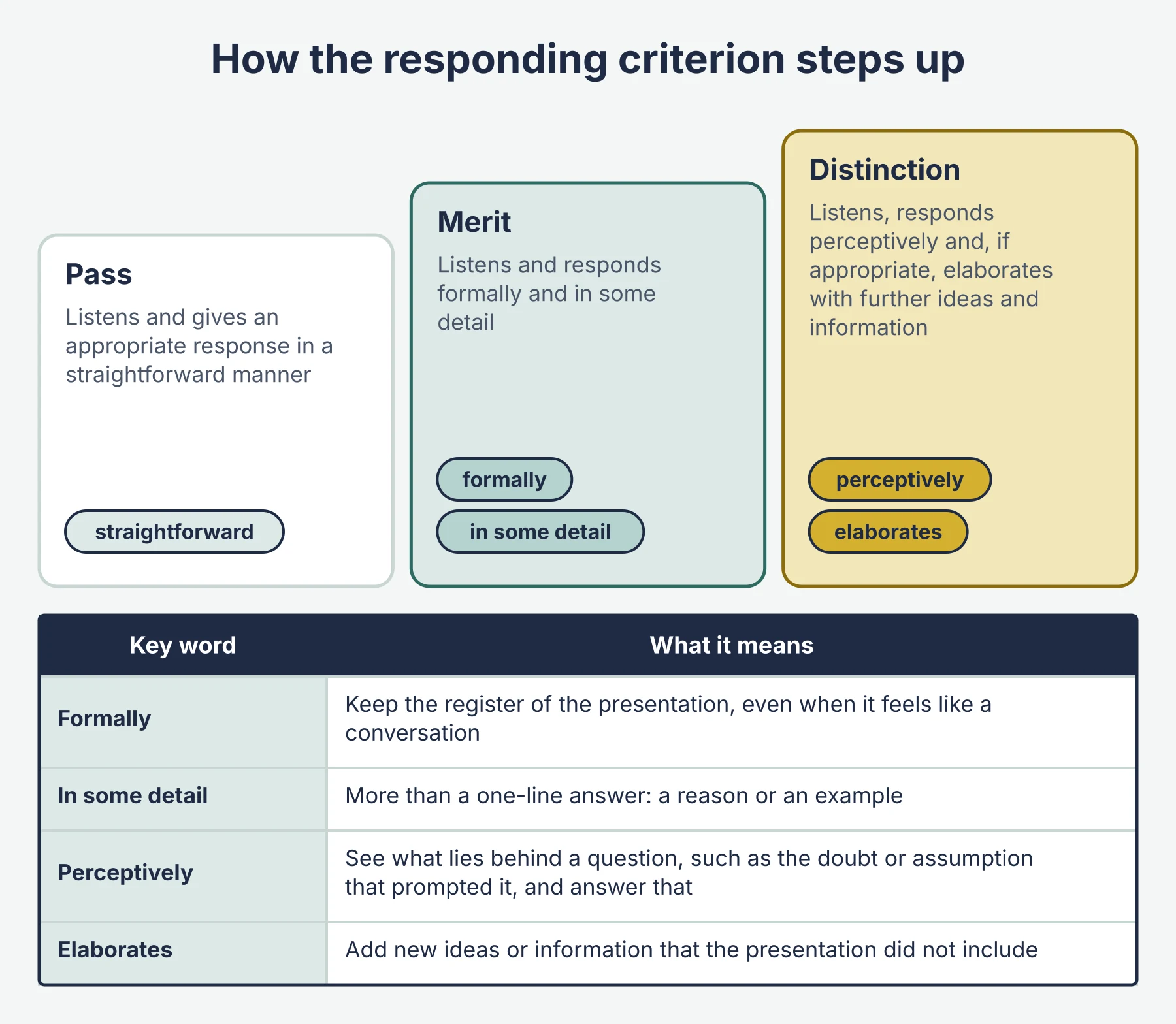
| Grade | Wording to remember |
|---|---|
| Pass | Listens and provides an appropriate response in a straightforward manner |
| Merit | Listens and responds formally and in some detail |
| Distinction | Listens, responds perceptively and, if appropriate, elaborates with further ideas and information |
Competency basis: every criterion for a grade must be met, so a strong talk with weak answers cannot reach the top grade.
Key terms
| Term | Meaning |
|---|---|
| AO8 | Listen and respond appropriately to spoken language, including questions and feedback |
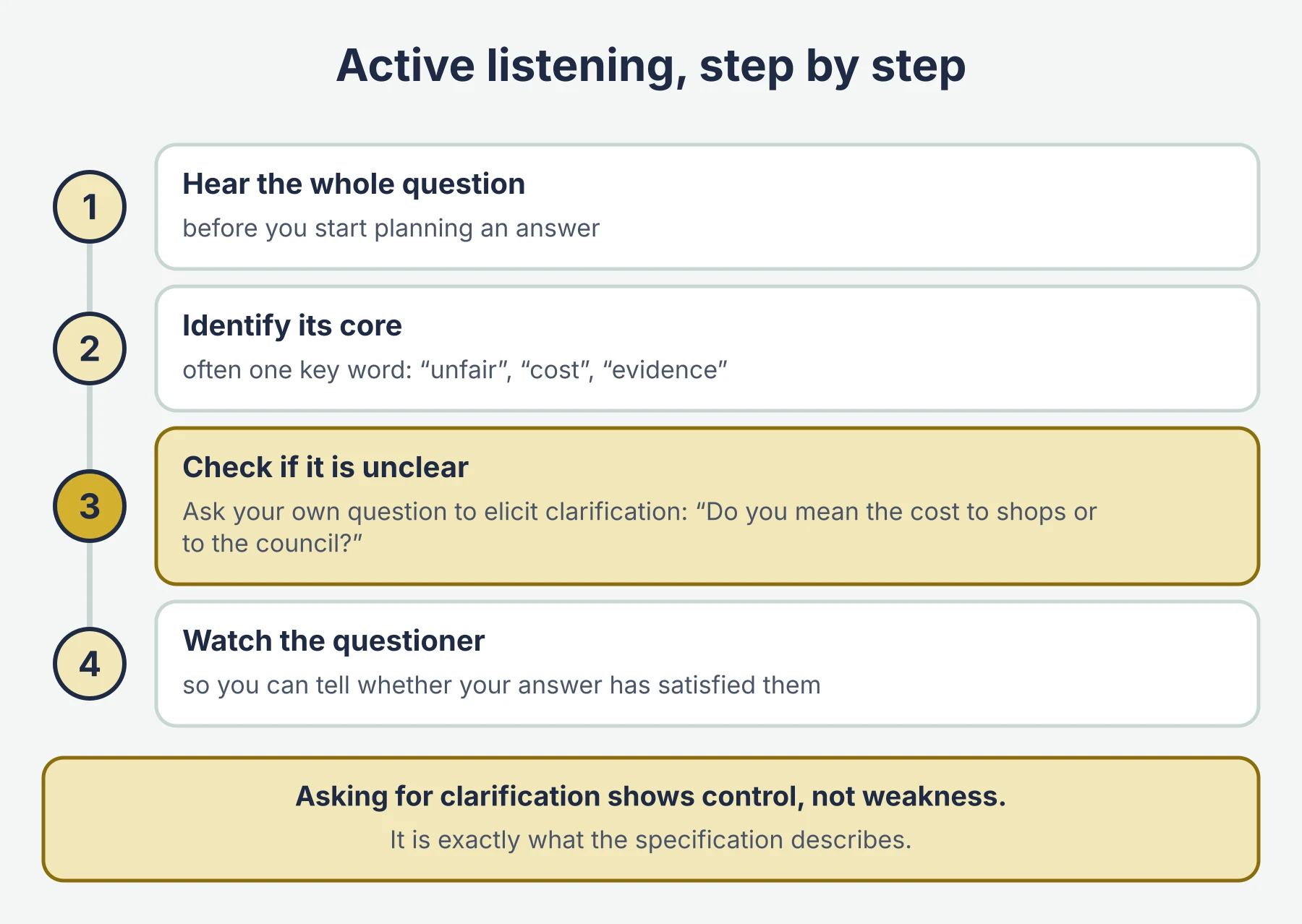
| Active listening | Hearing the whole question, finding its core, checking understanding |
| Clarification question | A question you ask to make sure you understand what was asked |
| Formal response | An answer that keeps the register of the presentation |
| In some detail | An answer with at least a reason or an example |
| Perceptive | Seeing the concern or assumption behind a question |
| Elaborate | Add new ideas or information beyond the presentation |
| Concession | Accepting that part of a challenge is fair |
| Holding phrase | A formal phrase that gives thinking time |
Question types
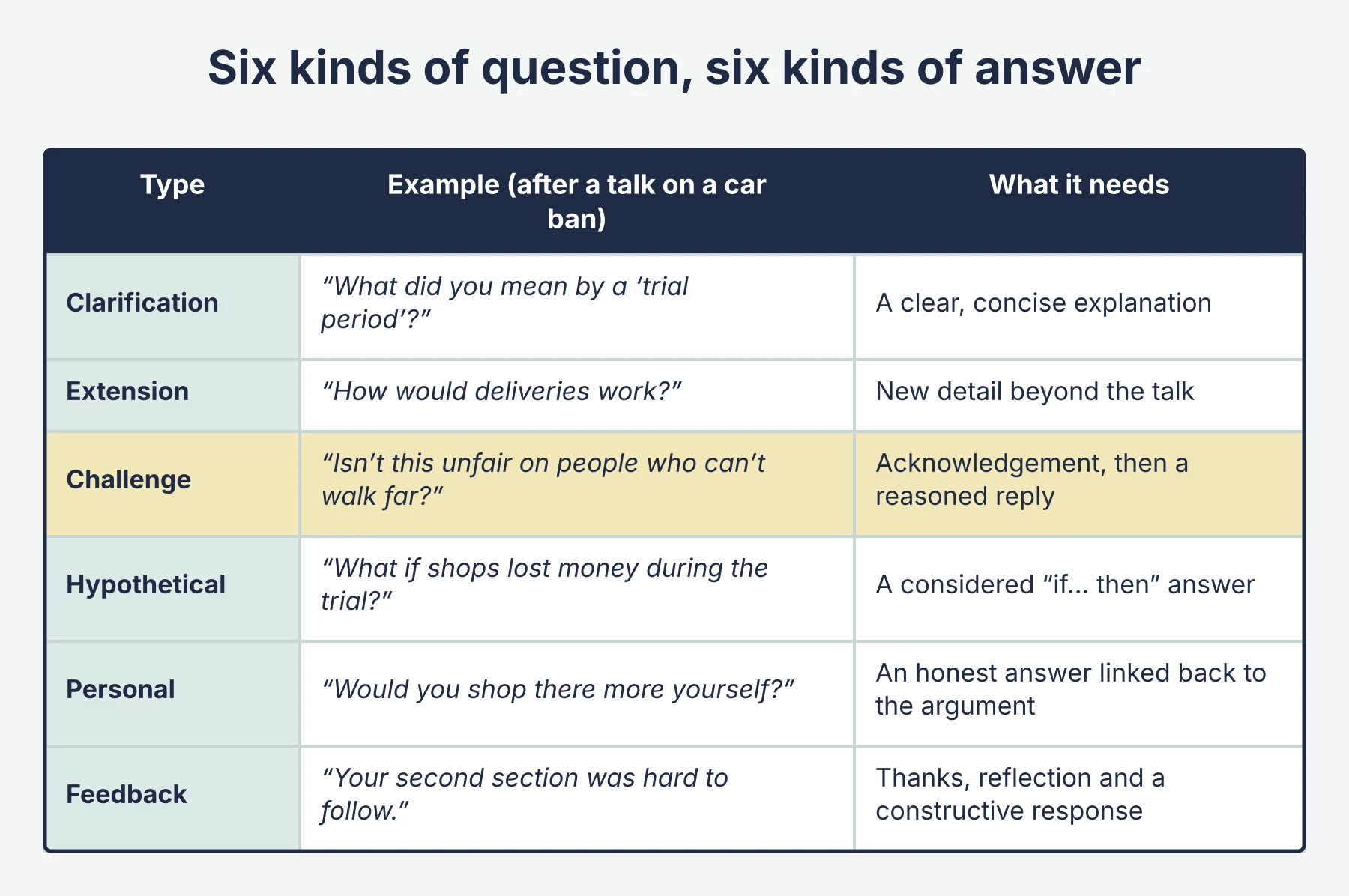
| Type | Needs |
|---|---|
| Clarification | A clear, concise restatement or definition |
| Extension | New detail beyond the talk |
| Challenge | Acknowledge, concede, respond, restate |
| Hypothetical | A reasoned “if… then” answer |
| Personal | An honest answer linked back to the argument |
| Feedback | Thanks, understanding, constructive response |
Answer shapes
Standard:   answer -> reason -> example -> link back
Challenge:  acknowledge -> concede -> respond -> restate
Feedback:   thank -> show understanding -> respond or improve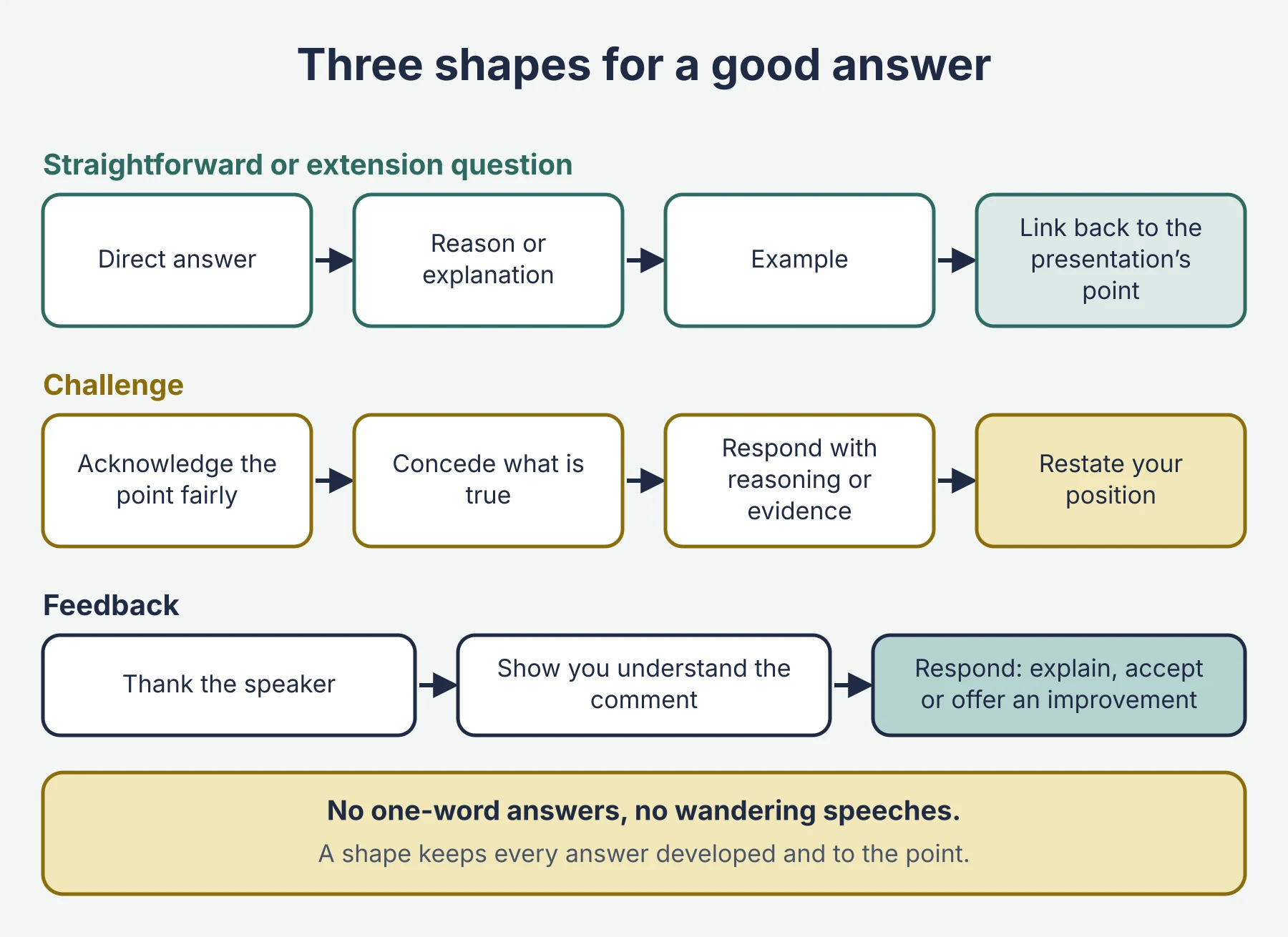
Clarification phrases
- “Do you mean… or…?”
- “Are you asking about the cost to families or to the school?”
- “Could you say a little more about what you mean by ‘fair’?”
Holding phrases
- “That’s an interesting question; let me think about the most important part of it.”
- “There are two sides to that, so I’ll take them in turn.”
Moving up a grade
| From | To | Change |
|---|---|---|
| Straightforward | Formal and in some detail | Keep the register; add a reason and an example |
| In some detail | Perceptive with elaboration | Address the concern behind the question; add information not in the talk |
Preparation checklist
- Reserve material: one extra example, one counter-argument, one source.
- A list of likely challenges, each with a first sentence drafted.
- A practice session with unexpected questions.
- Two holding phrases and two clarification phrases ready.
One question, two answers (original)
Question: “Wouldn’t a longer lunch break just mean more time for trouble?”
- In some detail: “I don’t think so, because clubs could run in the extra time, so students would be busy.”
- Perceptive, with elaboration: “That worry is really about supervision, so the plan only works if staff and older students run activities. Clubs would also give students somewhere to be, which could make corridors quieter rather than busier.”
Traps
- Planning the answer before the question ends.
- Yes or no with no development.
- Defensiveness or dismissing a challenge.
- Slipping into casual speech after the talk.
- Repeating the presentation word for word.
- Guessing at an unclear question instead of asking.
- Saying “OK” to feedback without engaging.
Quick self-test
- Which assessment objective covers responding?
- Quote the specification’s wording for this strand.
- What does the specification say students may ask, and why?
- What is the Merit criterion for responding?
- What two things does the Distinction criterion add?
- Give the answer shape for a challenge.
- What is a holding phrase? Give one example.
- Why can a strong presentation with weak answers not reach Distinction?
- Name three types of question you might be asked.
- How should you respond to critical feedback?
- What is reserve material?
- Write a clarification question for: “Is that realistic?”
Answers
- AO8.
- “Listening to and responding appropriately to any questions and feedback.”
- Their own questions to elicit clarification, so that they understand what was asked before answering.
- Listens to questions or feedback, responding formally and in some detail.
- Responding perceptively and, if appropriate, elaborating with further ideas and information.
- Acknowledge, concede, respond, restate.
- A formal phrase that gives thinking time; for example, “That’s an interesting question; let me think about the most important part of it.”
- Grading is on a competency basis, so every criterion for Distinction, including responding, must be met.
- Any three: clarification, extension, challenge, hypothetical, personal, feedback.
- Thank the speaker, show you understand the point, then explain, accept or suggest an improvement.
- Extra examples, arguments or sources prepared but not used in the talk, kept for questions.
- For example: “Do you mean realistic in terms of cost, or in terms of whether people would support it?”
Official syllabus
AQA GCSE English Language (8700) specification, for GCSE exams June 2017 onwards: 3.1.3 Spoken language (responding to spoken language), section 4.4 Non-exam assessment, and assessment objective AO8.
Related resources
-
Study guides
AQA GCSE English Language (8700): Spoken Standard English
AQA GCSE English Language 8700 guide to spoken Standard English: what it is, dialect versus accent, common non-standard forms, register choices and AO9.
English · AQA · GCSE
Read guide -
Practice questions
AQA GCSE English Language (8700): Spoken Standard English – Practice Questions
Original AQA GCSE English Language 8700 spoken Standard English practice: correcting non-standard forms, hypercorrection, register and transcripts.
English · AQA · GCSE
Try questions -
Revision notes
AQA GCSE English Language (8700): Spoken Standard English – Revision Notes
AQA GCSE English Language 8700 spoken Standard English recall: AO9, the general criteria, dialect versus accent, non-standard forms, traps and a self-test.
English · AQA · GCSE
Revise topic
Get free revision emails (optional)
Occasional emails with practice questions, worked explanations and links to free resources for the qualification and subjects you choose. No spam, and you can unsubscribe from any email. The free tools on this site never need an email.