
Study Guides
AQA GCSE English Language (8700): Responding to Spoken Language
AQA GCSE English Language 8700 guide to responding to questions and feedback after a presentation: active listening, answer shapes and the AO8 grade criteria.
- Subject
- English
- Level
- GCSE
- Topic
- Topic 3: Spoken language
- Author
- Marlbridge Academic Team
- Updated
- Reviewed by
- Ammar Bilal (what this means)
Aligned to AQA GCSE English (8700), For first teaching 2015. Official specification .
Syllabus page (what it covers and how it is assessed): AQA GCSE English Language.
Found an error? Report a correction.
Need help with this topic? Request a free trial class for GCSE English Language (8700).
Responding to spoken language is the second strand of 3.1.3 Spoken language in AQA GCSE English Language (8700). The specification’s wording is brief: “listening to and responding appropriately to any questions and feedback”. Its description of the assessment adds a detail that is easy to miss: students respond “appropriately to questions and to feedback, asking questions themselves to elicit clarification”. The strand is assessed by AO8: listen and respond appropriately to spoken language, including to questions and feedback on presentations. For recall, use the responding revision notes, and to practise, use the responding practice questions.
Where it happens
Questions and feedback come “as part of, or following, the presentation”. In a debate or dialogue they may be woven through; after a talk they usually follow it. Either way, this part of the assessment cannot be scripted, which is why it shows real understanding of your topic.
What the criteria reward
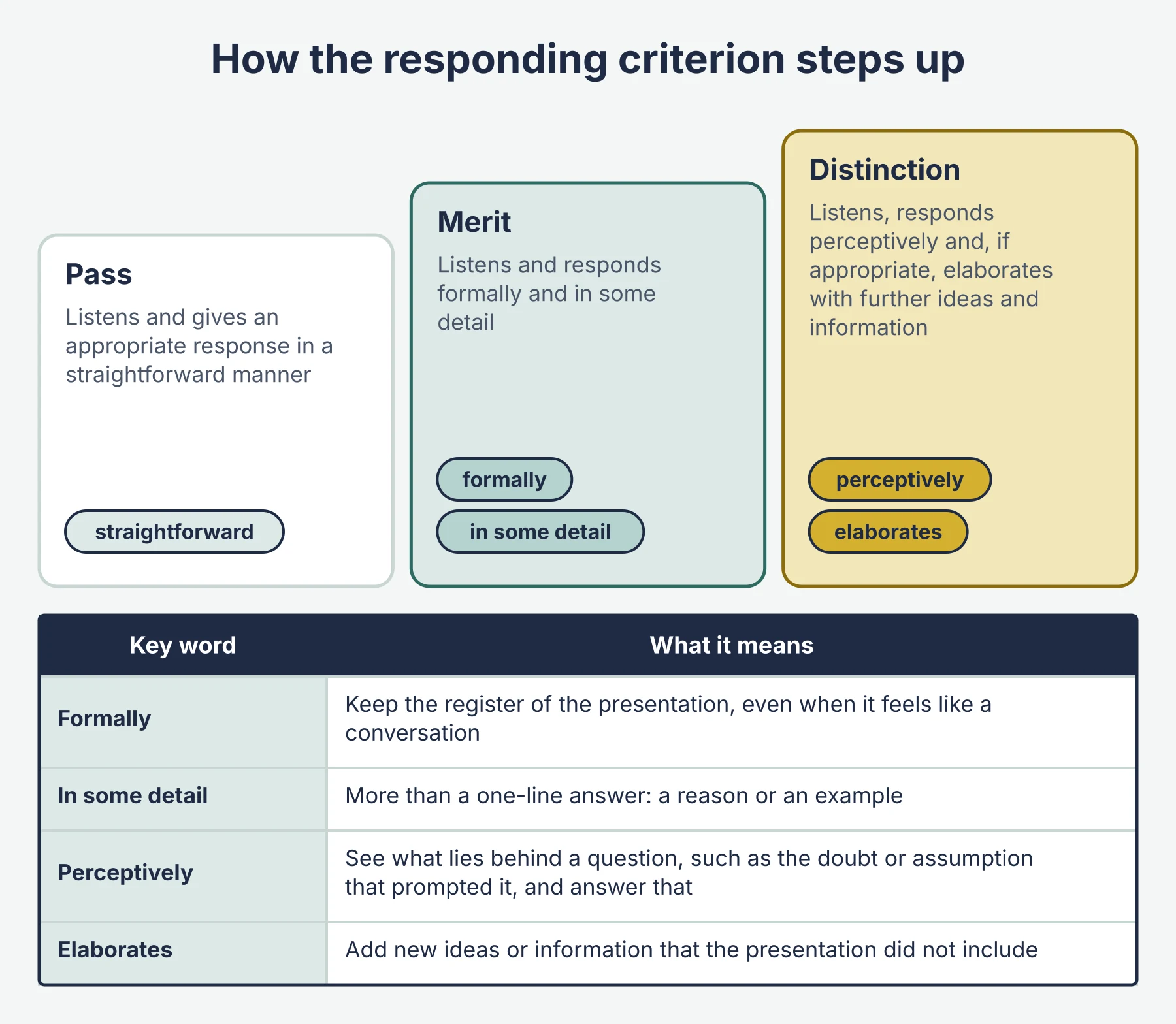
The endorsement is graded on a competency basis: every criterion for a grade must be met. The listening and responding criterion steps up like this:
| Grade | Criterion for responding |
|---|---|
| Pass | Listens to questions or feedback and provides an appropriate response in a straightforward manner |
| Merit | Listens to questions or feedback, responding formally and in some detail |
| Distinction | Listens to questions or feedback, responds perceptively and, if appropriate, elaborates with further ideas and information |
Three words carry the difference. Formally means keeping the register of the presentation even when the exchange feels like a conversation. In some detail means more than a one-line answer: a reason or an example. Perceptively means seeing what lies behind a question, such as the doubt or assumption that prompted it, and answering that. Elaborates means adding new ideas or information that the presentation did not include.
Kinds of questions and feedback
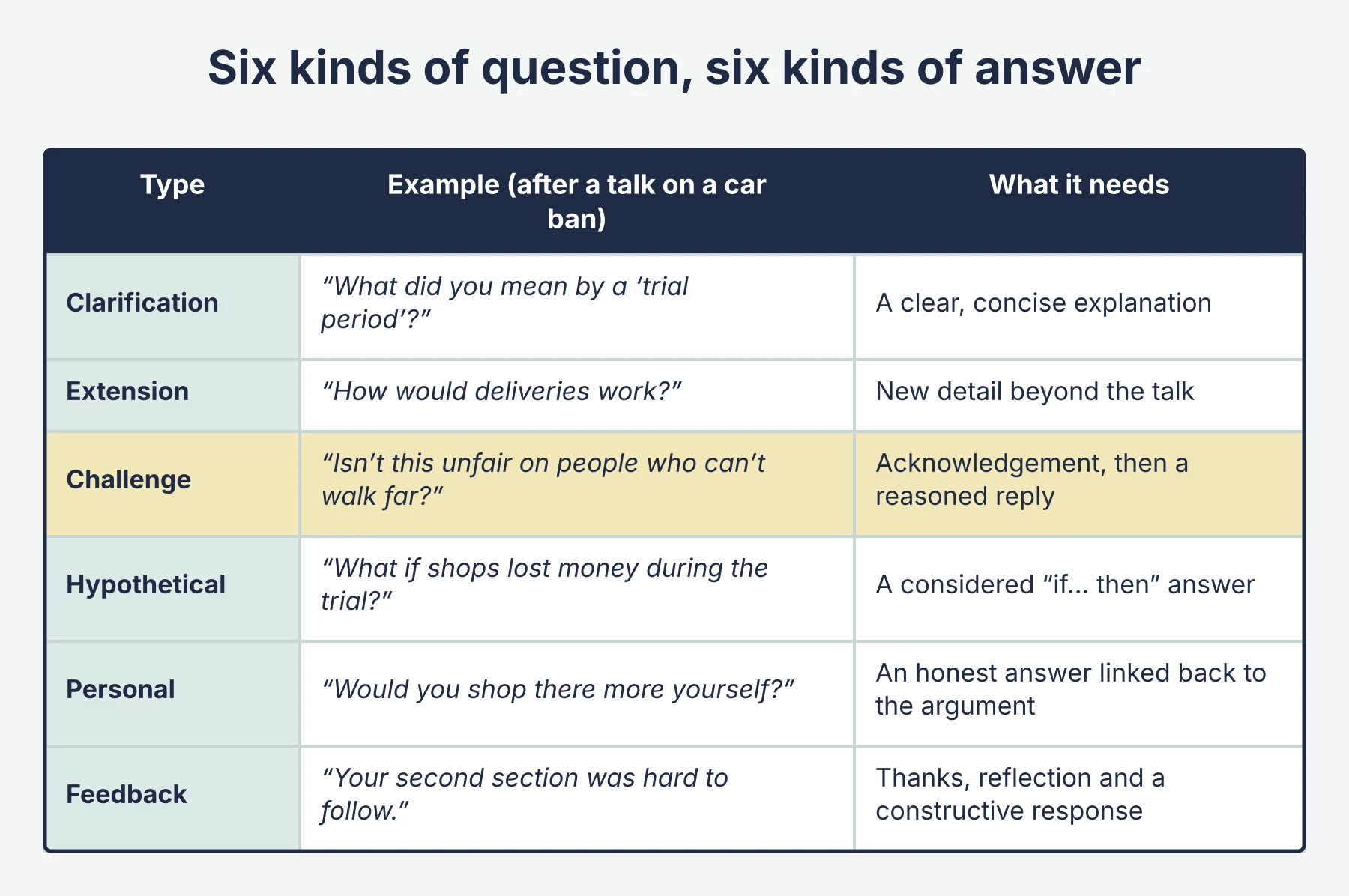
Recognising the type of question tells you what kind of answer it needs.
| Type | Example (original, after a talk on banning cars from a high street) | What it needs |
|---|---|---|
| Clarification | “What did you mean by a ‘trial period’?” | A clear, concise explanation |
| Extension | “How would deliveries work?” | New detail beyond the talk |
| Challenge | “Isn’t this unfair on people who can’t walk far?” | Acknowledgement, then a reasoned reply |
| Hypothetical | “What if shops lost money during the trial?” | A considered “if… then” answer |
| Personal | “Would you shop there more yourself?” | An honest answer linked back to the argument |
| Feedback | “Your second section was hard to follow.” | Thanks, reflection and a constructive response |
Active listening
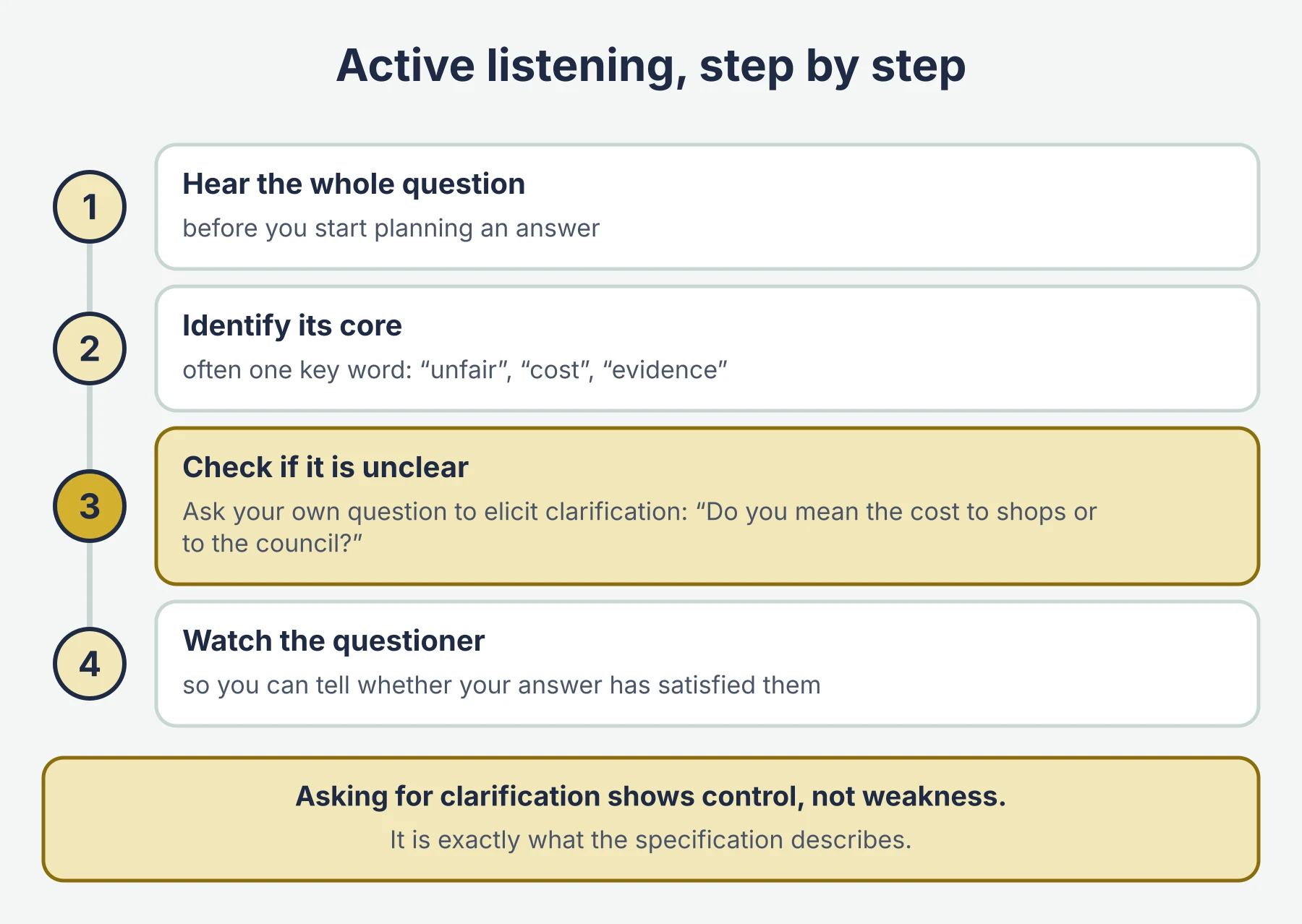
Active listening is the “listens” part of every criterion. It means:
- hearing the whole question before planning an answer;
- identifying its core: often one key word (“unfair”, “cost”, “evidence”);
- checking if it is unclear, by asking your own question to elicit clarification: “Do you mean the cost to shops or to the council?” This is exactly what the specification describes, and it shows control rather than weakness;
- watching the questioner, so you can tell whether your answer has satisfied them.
Shapes for good answers
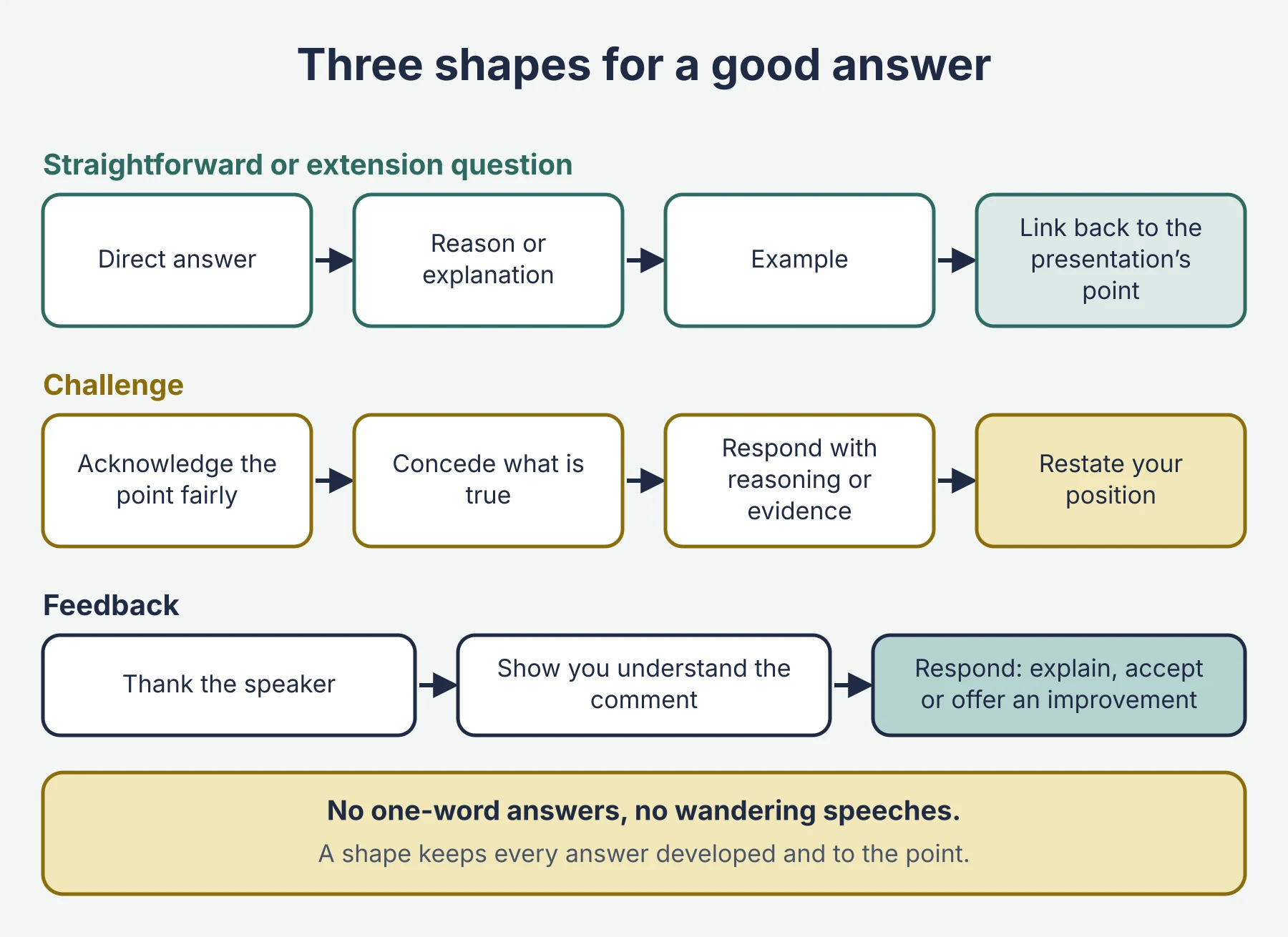
For a straightforward or extension question:
Direct answer -> reason or explanation -> example -> link back to the presentation's pointFor a challenge:
Acknowledge the point fairly -> concede what is true -> respond with reasoning or evidence -> restate your positionFor feedback:
Thank the speaker -> show you understand the comment -> respond (explain, accept or offer an improvement)These shapes stop you from giving one-word answers on the one hand and wandering speeches on the other.
Worked example: three answers to one challenge
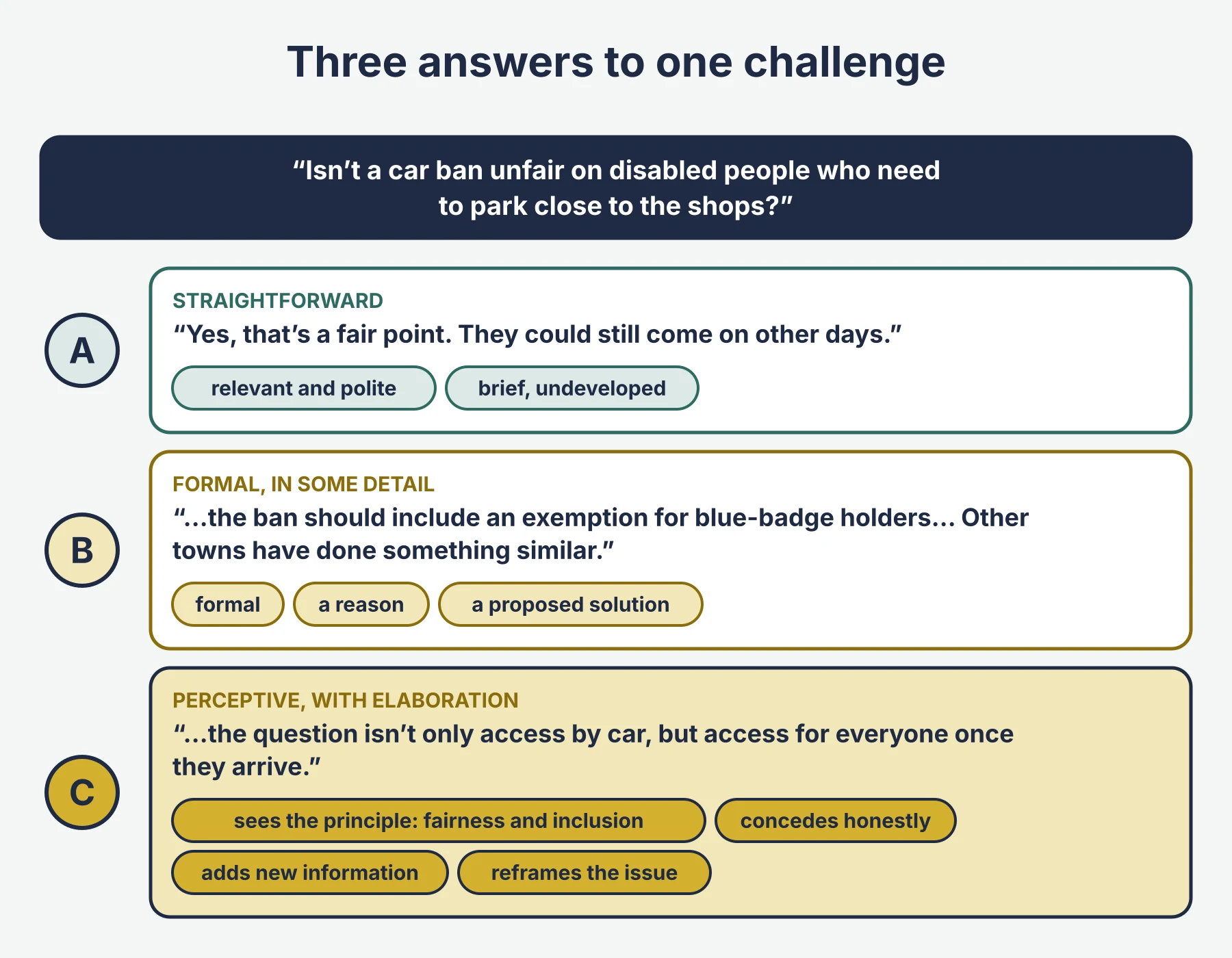
Question (original): “Isn’t a car ban unfair on disabled people who need to park close to the shops?”
Answer A (straightforward):
“Yes, that’s a fair point. They could still come on other days.”
Comment: relevant and polite, but brief and undeveloped: it fits a straightforward response.
Answer B (formal and in some detail):
“That’s an important point. I think the ban should include an exemption for blue-badge holders, so that they can still park on the side streets nearest the shops. Other towns have done something similar.”
Comment: formal, with a reason and a proposed solution; this is a response “in some detail”.
Answer C (perceptive, with elaboration):
“You’re right that a ban could make the high street less accessible, and that would undermine the whole point, which is to make it a place for everyone. So I’d want disabled residents involved in planning the trial, not just consulted afterwards. Beyond parking, a ban could actually help some disabled people: wheelchair users I spoke to said that cars parked on the pavement are one of their biggest problems. So the question isn’t only access by car, but access for everyone once they arrive.”
Comment: it sees the principle behind the question (fairness and inclusion), concedes honestly, and elaborates with further ideas and information that the presentation did not include, reframing the issue. That is what “perceptively” looks like in practice.
Preparing for questions you cannot predict
- Know more than you present. Keep reserve material: an extra example, a counter-argument you left out, a source.
- List likely challenges to your view and draft the first sentence of each reply.
- Practise with a partner who asks unexpected questions, including hostile ones.
- Prepare a holding phrase that keeps the register formal while you think: “That’s a question I’d like to think about carefully.”
Common mistakes
- Answering a question that was not asked, because you started planning before the questioner finished.
- One-word or yes/no answers with no development.
- Defensiveness when challenged, or dismissing the question.
- Dropping the register, slipping into casual speech once the “talk” part is over.
- Repeating the presentation instead of adding something new.
- Not asking for clarification when a question is unclear, and guessing instead.
- Ignoring feedback, or simply saying “OK” without engaging with it.
Technique for the criteria
- Pause briefly before answering; it shows you have listened.
- Use the questioner’s key word in the first sentence of your answer.
- Give at least one reason and one example in every answer.
- When challenged, concede something genuine before responding.
- Look for the chance to add new information: it is the clearest sign of elaboration.
Related: presenting information and ideas study guide | spoken Standard English study guide | spoken language study guide
Official syllabus
AQA GCSE English Language (8700) specification, for GCSE exams June 2017 onwards: 3.1.3 Spoken language (responding to spoken language), section 4.4 Non-exam assessment, and assessment objective AO8.
Related resources
-
Practice questions
AQA GCSE English Language (8700): Responding to Spoken Language – Practice Questions
Original AQA GCSE English Language 8700 practice on answering questions and feedback after a talk: question types, model replies and the AO8 criteria.
English · AQA · GCSE
Try questions -
Revision notes
AQA GCSE English Language (8700): Responding to Spoken Language – Revision Notes
AQA GCSE English Language 8700 recall notes on responding to questions and feedback: AO8 criteria, question types, answer shapes, traps and a self-test.
English · AQA · GCSE
Revise topic -
Study guides
AQA GCSE English Language (8700): Spoken Standard English
AQA GCSE English Language 8700 guide to spoken Standard English: what it is, dialect versus accent, common non-standard forms, register choices and AO9.
English · AQA · GCSE
Read guide
Get free revision emails (optional)
Occasional emails with practice questions, worked explanations and links to free resources for the qualification and subjects you choose. No spam, and you can unsubscribe from any email. The free tools on this site never need an email.