
Revision Notes
AQA GCSE English Language (8700): Presenting Information and Ideas – Revision Notes
AQA GCSE English Language 8700 presenting recall notes: presentation requirements, AO7 criteria by grade, topic choice, spoken structure and a self-test.
- Subject
- English
- Level
- GCSE
- Topic
- Topic 3: Spoken language
- Author
- Marlbridge Academic Team
- Updated
- Reviewed by
- Ammar Bilal (what this means)
Aligned to AQA GCSE English (8700), For first teaching 2015. Official specification .
Syllabus page (what it covers and how it is assessed): AQA GCSE English Language.
Found an error? Report a correction.
Need help with this topic? Request a free trial class for GCSE English Language (8700).
These notes condense presenting information and ideas, the first strand of 3.1.3 Spoken language in AQA GCSE English Language (8700): selecting and organising information and ideas effectively and persuasively for prepared spoken presentations; planning for different purposes and audiences; making presentations and speeches. It is assessed by AO7: demonstrate presentation skills in a formal setting.
Related: presenting study guide | presenting practice questions | spoken language revision notes
The strand in one paragraph
Choose a topic with enough depth for challenging ideas, select only the information your listeners need, organise it in a visible shape with spoken signposts, adapt it to the audience and purpose, and prepare thoroughly: the specification warns that lack of preparation is likely to block the higher grades.
Requirements to remember
| Requirement | Detail |
|---|---|
| Status | Compulsory; reported separately; 0% of the GCSE grade |
| Grades | Pass, Merit, Distinction or Not Classified |
| Topic | Specific, identified in advance and agreed with the teacher |
| Length | As a guide, no more than ten minutes |
| Register | Formal |
| Forms allowed | Talks, debates, speeches, dialogues and others |
| Aids | Notes or slides allowed, not required |
| Teacher-only audience | Must be designed for a potentially wider audience, for example a television interview |
| Questions | Responding to questions and feedback is part of the assessment |
The criteria for presenting
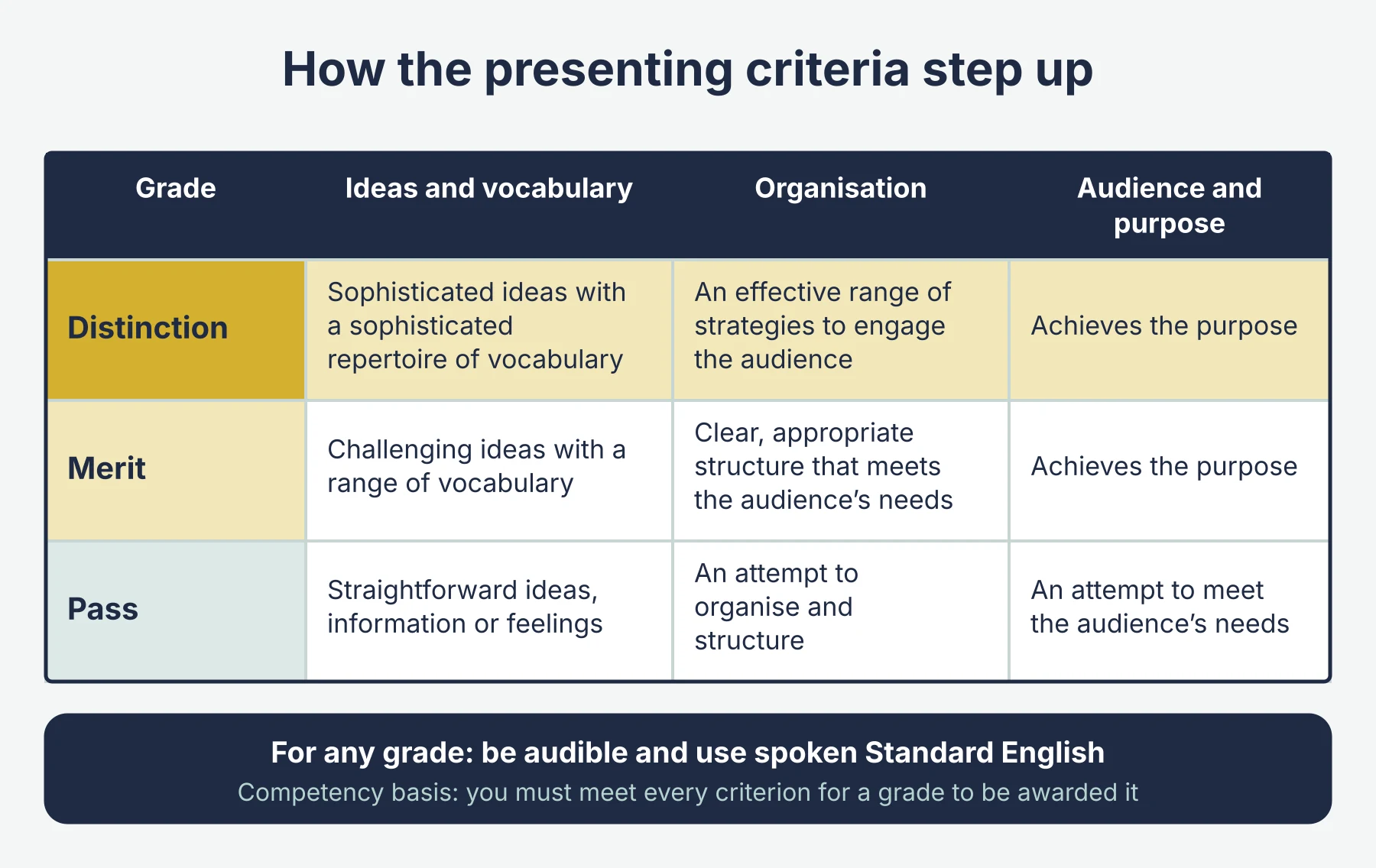
General criteria for every grade: be audible; use spoken Standard English (be intelligible and generally use language appropriate to the formal setting).
| Pass | Merit | Distinction | |
|---|---|---|---|
| Ideas | Straightforward | Challenging, with a range of vocabulary | Sophisticated, with a sophisticated repertoire of vocabulary |
| Structure | An attempt to organise and structure | Clear and appropriate to the audience’s needs | An effective range of strategies to engage the audience |
| Audience and purpose | An attempt to meet the audience’s needs | Achieves the purpose | Achieves the purpose |
Competency basis: every criterion in a grade must be met for that grade to be awarded.
Key terms
| Term | Meaning |
|---|---|
| AO7 | Demonstrate presentation skills in a formal setting |
| Formal setting | Speaking to an audience beyond close friends, with a serious purpose |
| Signposting | Spoken phrases that show the structure (“my second point…”) |
| Hook | An opening that wins attention |
| Cue cards | Small cards with keywords only, not a script |
| Purpose | Inform, explain, argue or persuade |
| Holistic assessment | One overall grade, with no marks |
| Competency | All criteria for a grade must be met |
Turning a subject into a topic with depth
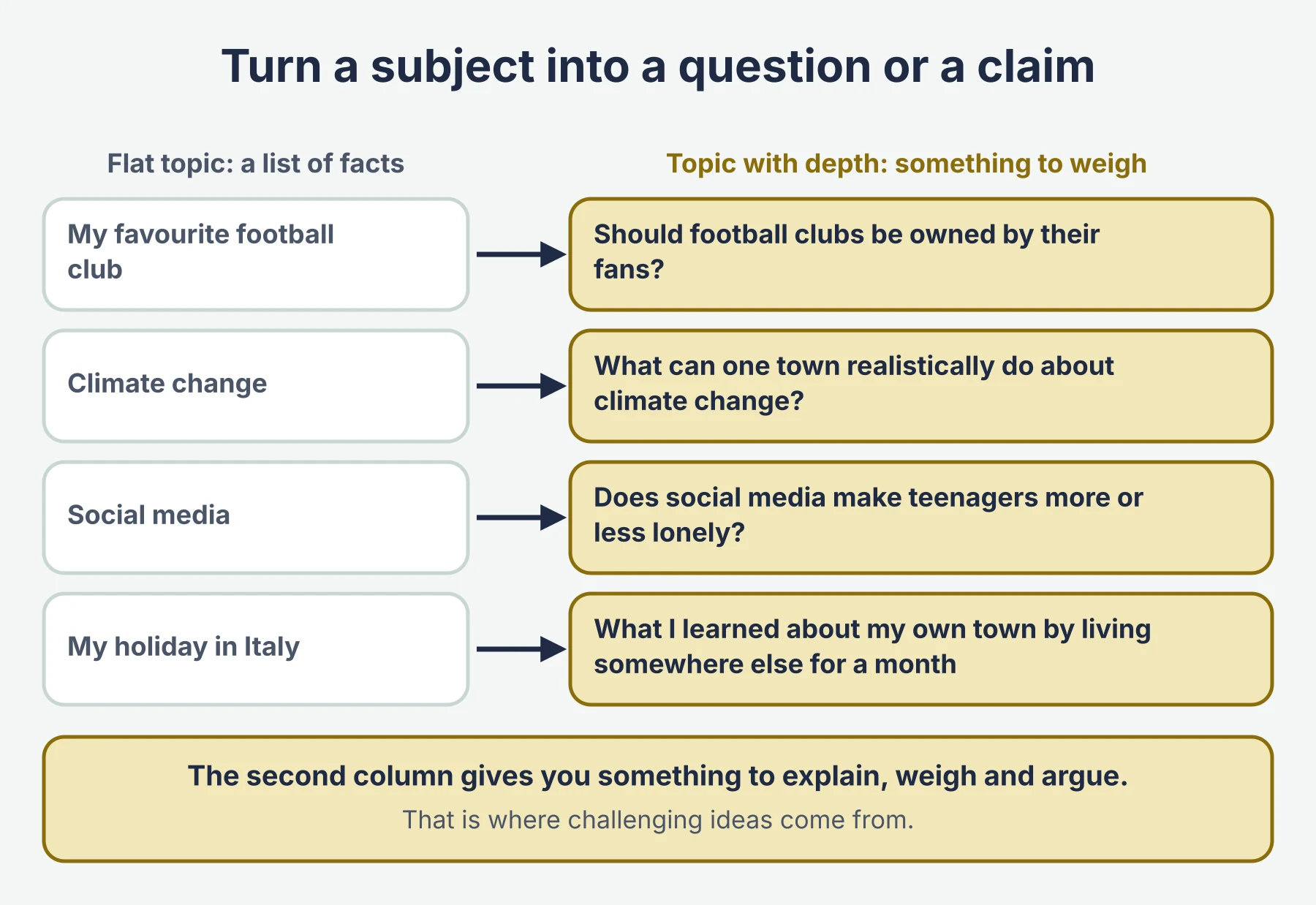
- Make it a question (“Should…?”, “Does…?”, “What can…?”).
- Make it specific to a place, group or decision.
- Make sure it has more than one side or something to explain beyond the obvious.
Selection test for every piece of information
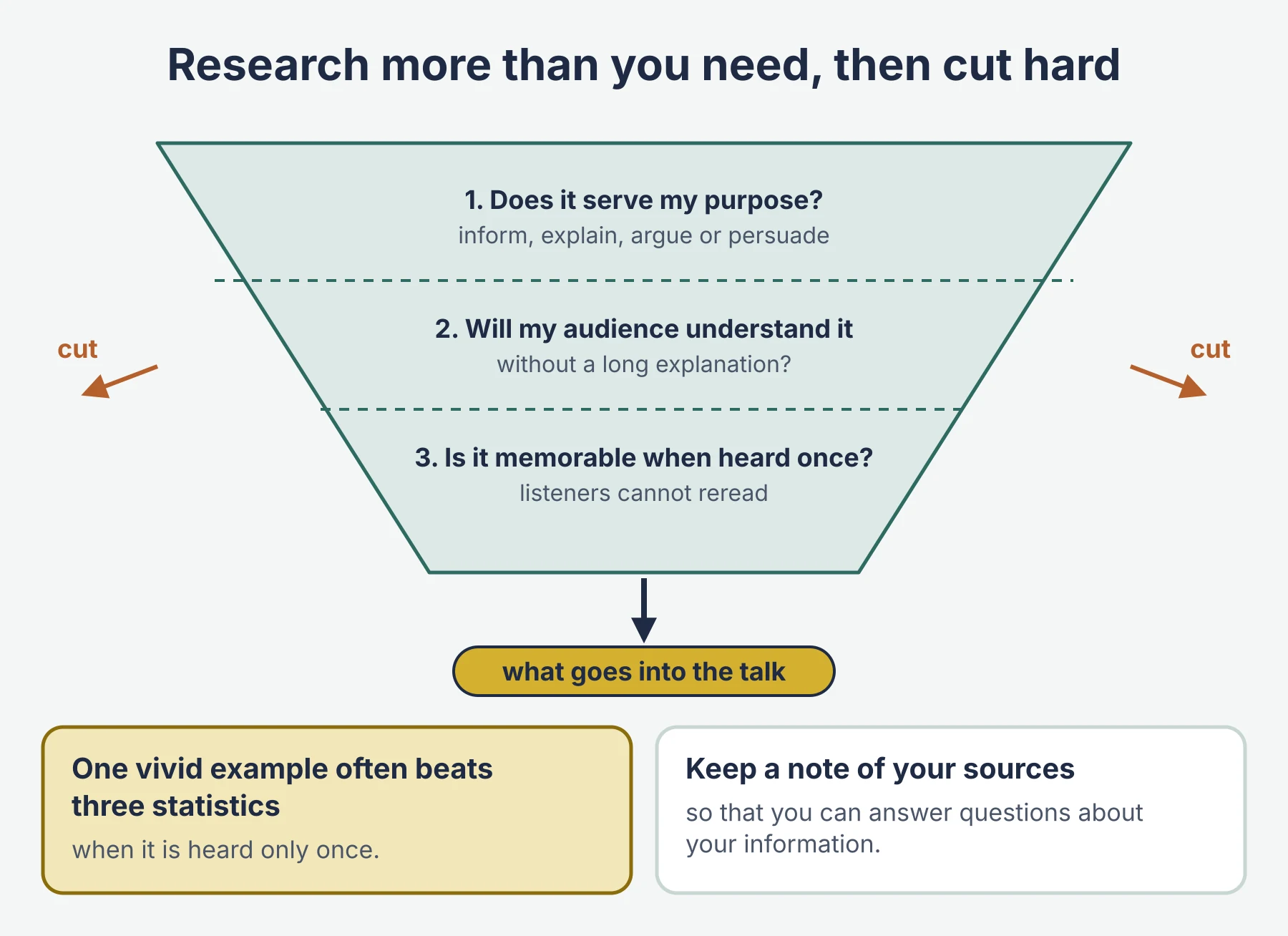
- Does it serve the purpose?
- Will the audience understand it on one hearing?
- Is it memorable when heard, not read?
Spoken structures
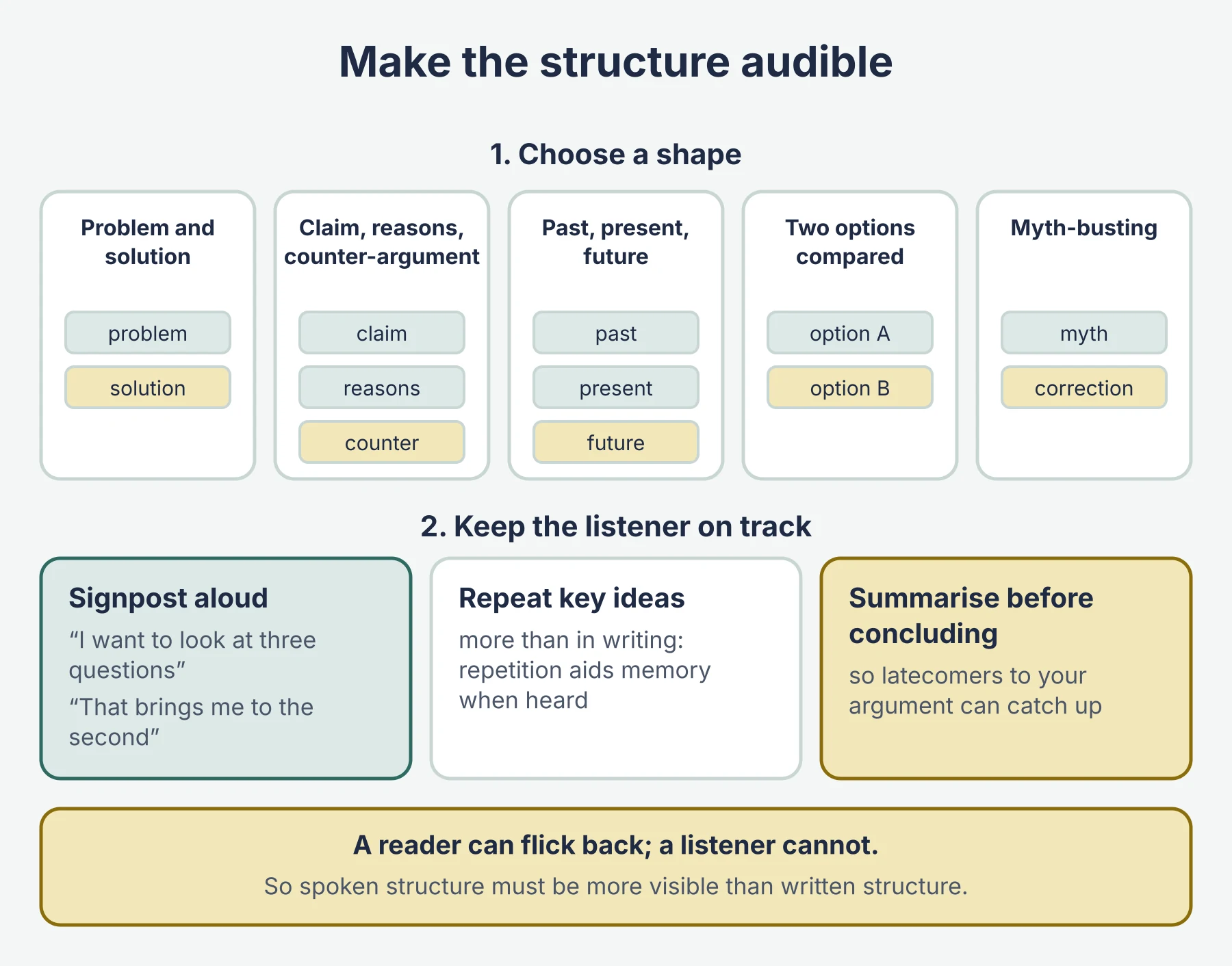
| Shape | Best for |
|---|---|
| Problem and solution | Proposals and campaigns |
| Claim, reasons, counter-argument | Persuasive speeches and debates |
| Past, present, future | Explaining change |
| Two options compared | Weighing a decision |
| Myth-busting | Correcting common misunderstandings |
Making structure audible
- Preview: “I’ll cover three things.”
- Transition: “That brings me to…”
- Recap: “So far we’ve seen…”
- Close: return to the opening image or question.
Written style versus spoken style
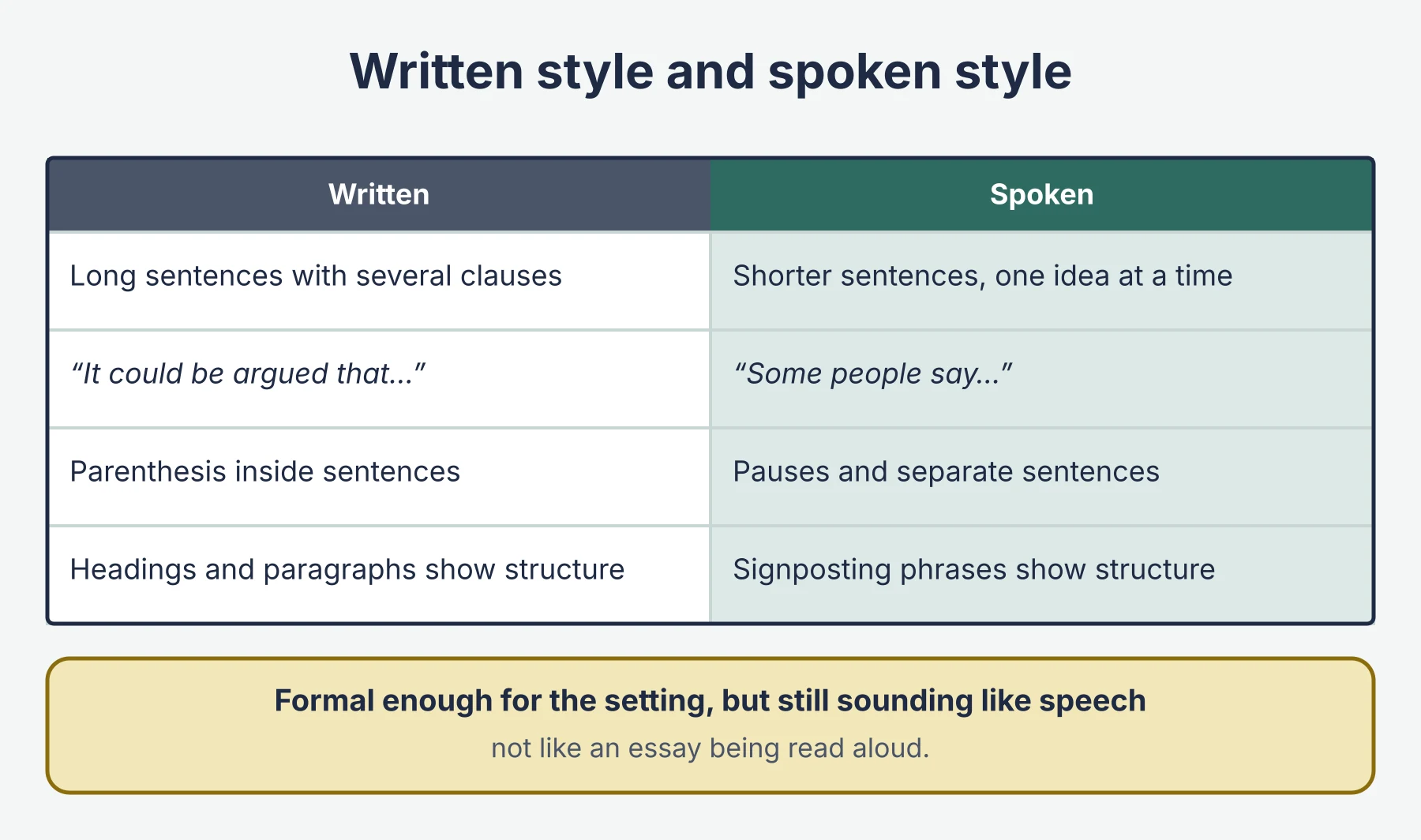
- Shorter sentences, one idea at a time.
- More repetition of key ideas.
- Pauses in place of parenthesis.
- Formal, but natural: not an essay read aloud.
Visual aids: use or lose
- Use a slide for one image, a single key figure or a short quotation the audience needs to see.
- Lose slides that repeat your words: listeners read them instead of listening.
- Notes: keywords on cue cards, numbered, so that a dropped card does not derail the talk.
Traps
- A flat, list-like topic that limits ideas to “straightforward”.
- Reading a full script.
- No signposts, so listeners get lost.
- Slides full of text.
- Too much material for the time.
- Treating a teacher-only audience as an audience of one.
- Little rehearsal, which the specification links to lower grades.
Quick self-test
- Which assessment objective covers presenting?
- As a guide, what is the maximum length of the presentation?
- Name three forms the presentation may take.
- Who must agree the topic?
- What are the two general criteria every grade requires?
- What word describes ideas at Merit, and at Distinction?
- What does “competency basis” mean?
- How should a teacher-only presentation be designed?
- Give two signposting phrases.
- Why does spoken structure need to be more visible than written structure?
- Turn “Pets” into a topic with depth.
- Are slides required?
Answers
- AO7.
- No more than ten minutes.
- Any three: talks, debates, speeches, dialogues.
- The teacher, in advance, with the student.
- Being audible, and using spoken Standard English (intelligible, generally appropriate to the formal setting).
- Merit: challenging. Distinction: sophisticated.
- A student must meet every criterion for a grade to be awarded it.
- So that it could have a wider audience, for example as a television interview.
- For example: “My first point is…”; “That brings me to…”; “To sum up…”.
- Listeners cannot go back and reread, so they rely on spoken signals to follow the shape.
- For example: “Should landlords be allowed to ban pets from rented homes?”
- No. Notes or slides may be used, but they are not a requirement.
Official syllabus
AQA GCSE English Language (8700) specification, for GCSE exams June 2017 onwards: 3.1.3 Spoken language (presenting information and ideas), section 4.4 Non-exam assessment, and assessment objective AO7.
Related resources
-
Study guides
AQA GCSE English Language (8700): Responding to Spoken Language
AQA GCSE English Language 8700 guide to responding to questions and feedback after a presentation: active listening, answer shapes and the AO8 grade criteria.
English · AQA · GCSE
Read guide -
Practice questions
AQA GCSE English Language (8700): Responding to Spoken Language – Practice Questions
Original AQA GCSE English Language 8700 practice on answering questions and feedback after a talk: question types, model replies and the AO8 criteria.
English · AQA · GCSE
Try questions -
Revision notes
AQA GCSE English Language (8700): Responding to Spoken Language – Revision Notes
AQA GCSE English Language 8700 recall notes on responding to questions and feedback: AO8 criteria, question types, answer shapes, traps and a self-test.
English · AQA · GCSE
Revise topic
Get free revision emails (optional)
Occasional emails with practice questions, worked explanations and links to free resources for the qualification and subjects you choose. No spam, and you can unsubscribe from any email. The free tools on this site never need an email.