
Study Guides
AQA GCSE English Language (8700): Presenting Information and Ideas
AQA GCSE English Language 8700 spoken language guide to presenting: choosing a topic, selecting and organising ideas, spoken style and the AO7 criteria.
- Subject
- English
- Level
- GCSE
- Topic
- Topic 3: Spoken language
- Author
- Marlbridge Academic Team
- Updated
- Reviewed by
- Ammar Bilal (what this means)
Aligned to AQA GCSE English (8700), For first teaching 2015. Official specification .
Syllabus page (what it covers and how it is assessed): AQA GCSE English Language.
Found an error? Report a correction.
Need help with this topic? Request a free trial class for GCSE English Language (8700).
Presenting information and ideas is the first strand of 3.1.3 Spoken language in AQA GCSE English Language (8700). The specification describes it as “selecting and organising information and ideas effectively and persuasively for prepared spoken presentations; planning effectively for different purposes and audiences; making presentations and speeches”. It is assessed by AO7: demonstrate presentation skills in a formal setting. The spoken language study guide gives an overview of all three strands; this page goes deeper into the presentation itself. For recall, use the presenting revision notes, and to practise, use the presenting practice questions.
The requirements, from the specification
The spoken language endorsement is compulsory, separately reported (Pass, Merit, Distinction or Not Classified) and carries no weight in the GCSE grade. The specification sets these requirements for the presentation:
- it is a prepared spoken presentation on a specific topic, identified in advance and agreed with your teacher;
- as a guide, it should last no more than ten minutes;
- it must be formal, but may take many forms, including talks, debates, speeches and dialogues;
- it must be planned and organised; the specification warns that lack of preparation is likely to prevent access to the higher grades;
- you may use pre-prepared notes or slides, but this is not a requirement;
- if the audience is only the teacher, the presentation must be designed so that it could have a wider audience, for example by replicating a television interview.
Your teacher will explain your school’s arrangements for timing and recording.
What the criteria reward
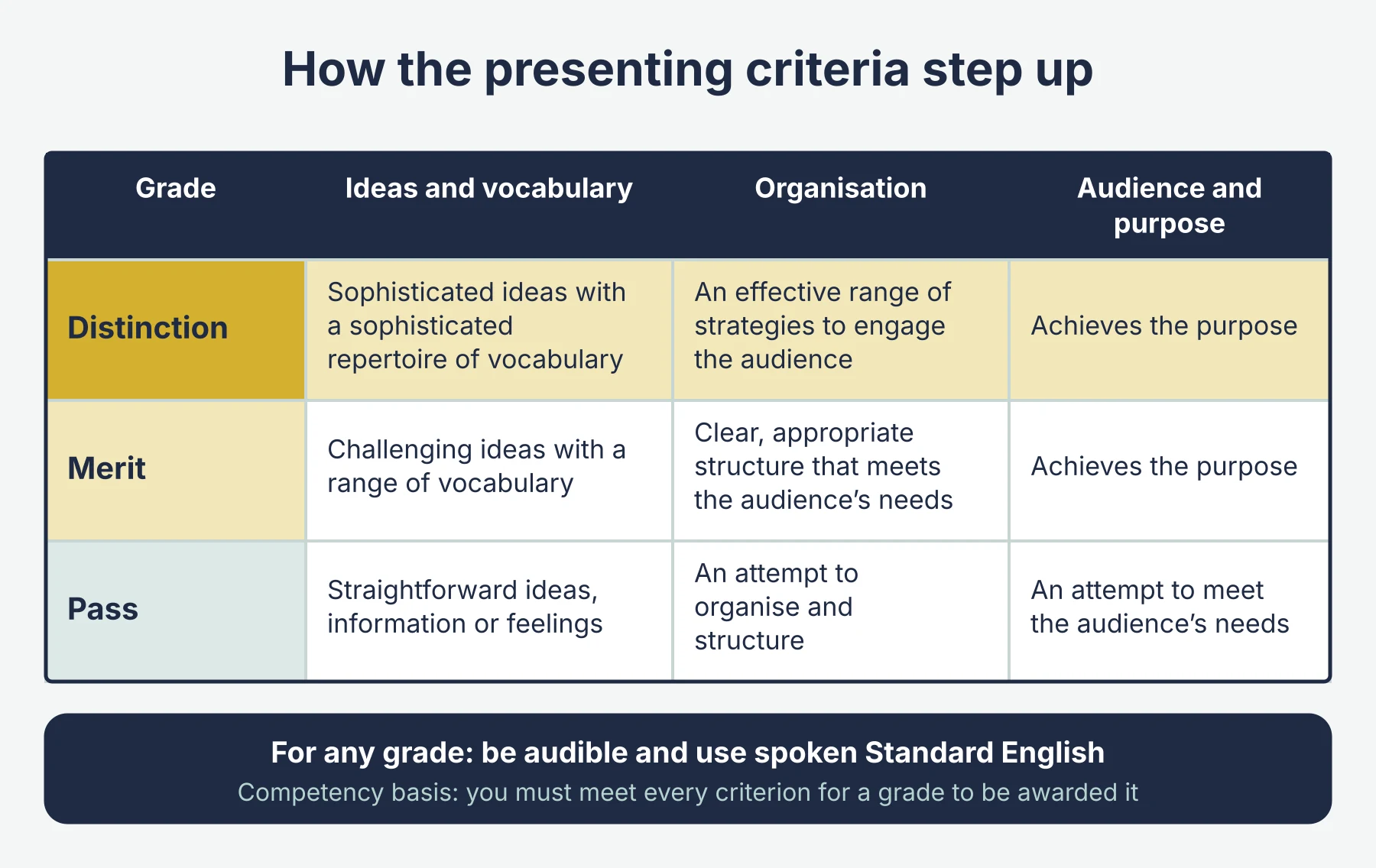
The presentation is assessed holistically, on a competency basis: you must meet every criterion for a grade to be awarded it. To reach any grade you must be audible and use spoken Standard English. Beyond that, the criteria for presenting step up as follows:
| Grade | Ideas and vocabulary | Organisation | Audience and purpose |
|---|---|---|---|
| Pass | Expresses straightforward ideas, information or feelings | Makes an attempt to organise and structure the presentation | Makes an attempt to meet the needs of the audience |
| Merit | Expresses challenging ideas, information or feelings using a range of vocabulary | Organises and structures the presentation clearly and appropriately to meet the needs of the audience | Achieves the purpose of the presentation |
| Distinction | Expresses sophisticated ideas, information or feelings using a sophisticated repertoire of vocabulary | Organises and structures the presentation using an effective range of strategies to engage the audience | Achieves the purpose of the presentation |
Each grade also has a criterion for listening and responding to questions and feedback; that strand has its own guide to responding to spoken language.
Two words in the higher grades shape every planning decision. Challenging and sophisticated ideas need a topic with depth: a question with more than one side, or a subject you can explain beyond the obvious. An effective range of strategies to engage the audience means more than a clear order: varied openings, examples, questions, contrasts and pacing chosen for the listeners.
Choosing a topic with room to grow
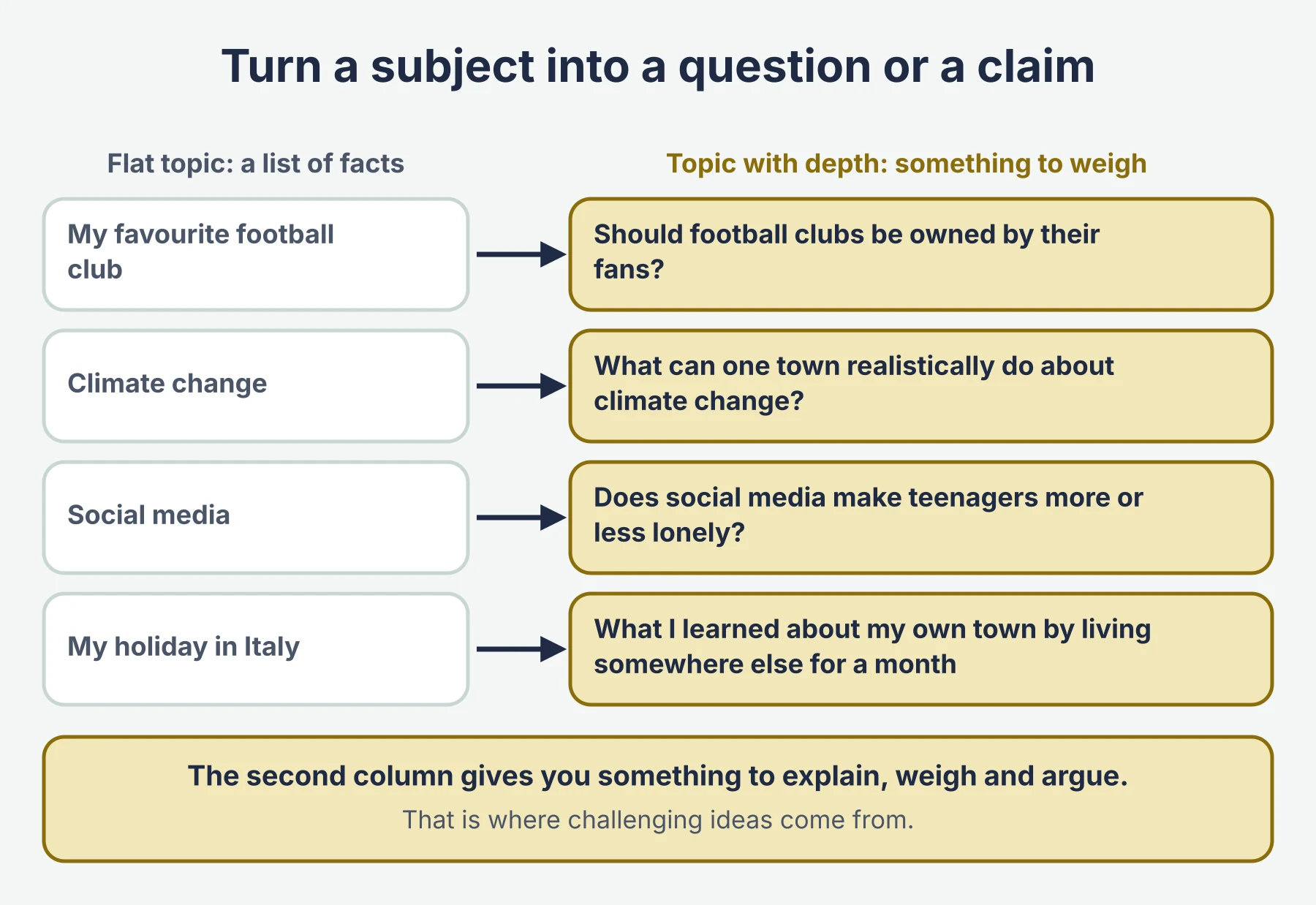
A topic that can only produce a list of facts limits you to straightforward ideas. Turn a subject into a question or a claim:
| Flat topic | Topic with depth |
|---|---|
| My favourite football club | Should football clubs be owned by their fans? |
| Climate change | What can one town realistically do about climate change? |
| Social media | Does social media make teenagers more or less lonely? |
| My holiday in Italy | What I learned about my own town by living somewhere else for a month |
The second column gives you something to explain, weigh and argue, which is where challenging ideas come from.
Selecting information
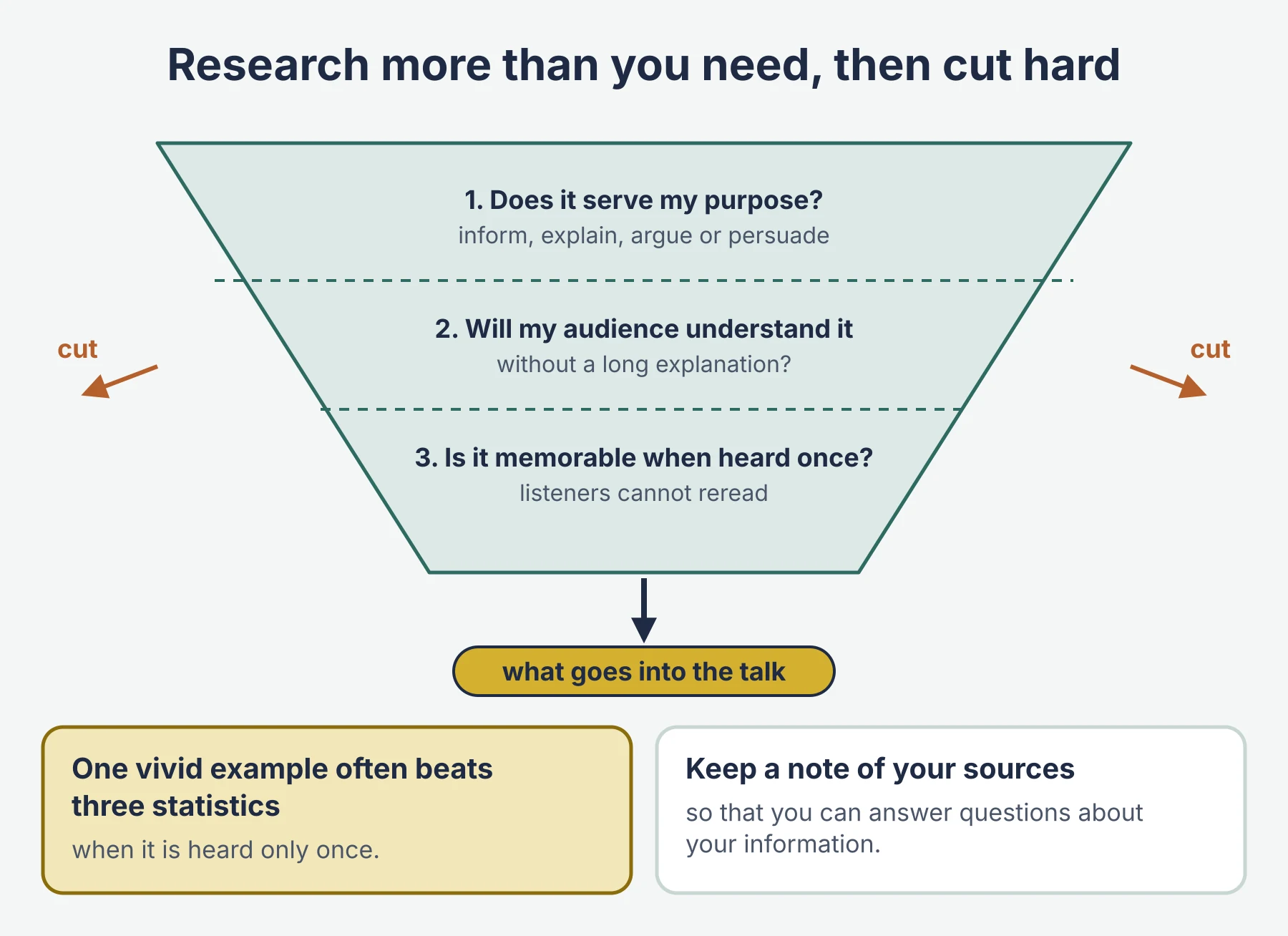
Research more than you need, then cut hard. For each piece of information, ask:
- Does it serve my purpose (to inform, explain, argue or persuade)?
- Will my audience understand it without a long explanation?
- Is it memorable when heard once? Listeners cannot reread, so one vivid example often beats three statistics.
Keep a note of where your information came from so that you can answer questions about it.
Organising for listeners
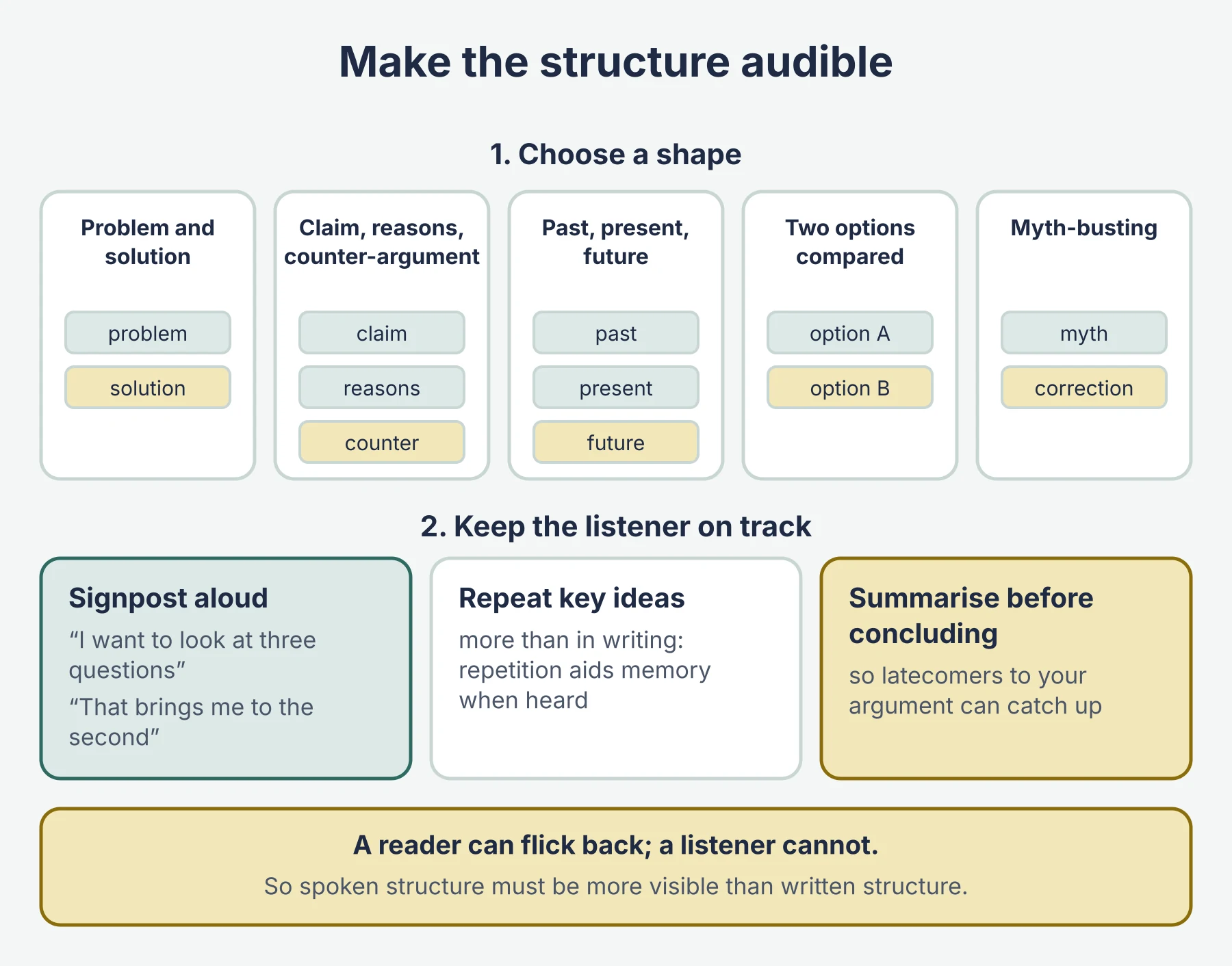
A reader can flick back; a listener cannot. Spoken structure therefore needs to be more visible than written structure.
- Choose a shape: problem and solution; claim, reasons and counter-argument; past, present and future; two options compared; or a myth-busting structure that corrects common misunderstandings.
- Signpost aloud: tell the audience what is coming (“I want to look at three questions”) and where they are (“That brings me to the second”).
- Repeat key ideas more than you would in writing; repetition aids memory when heard.
- Summarise before concluding, so that latecomers to your argument can catch up.
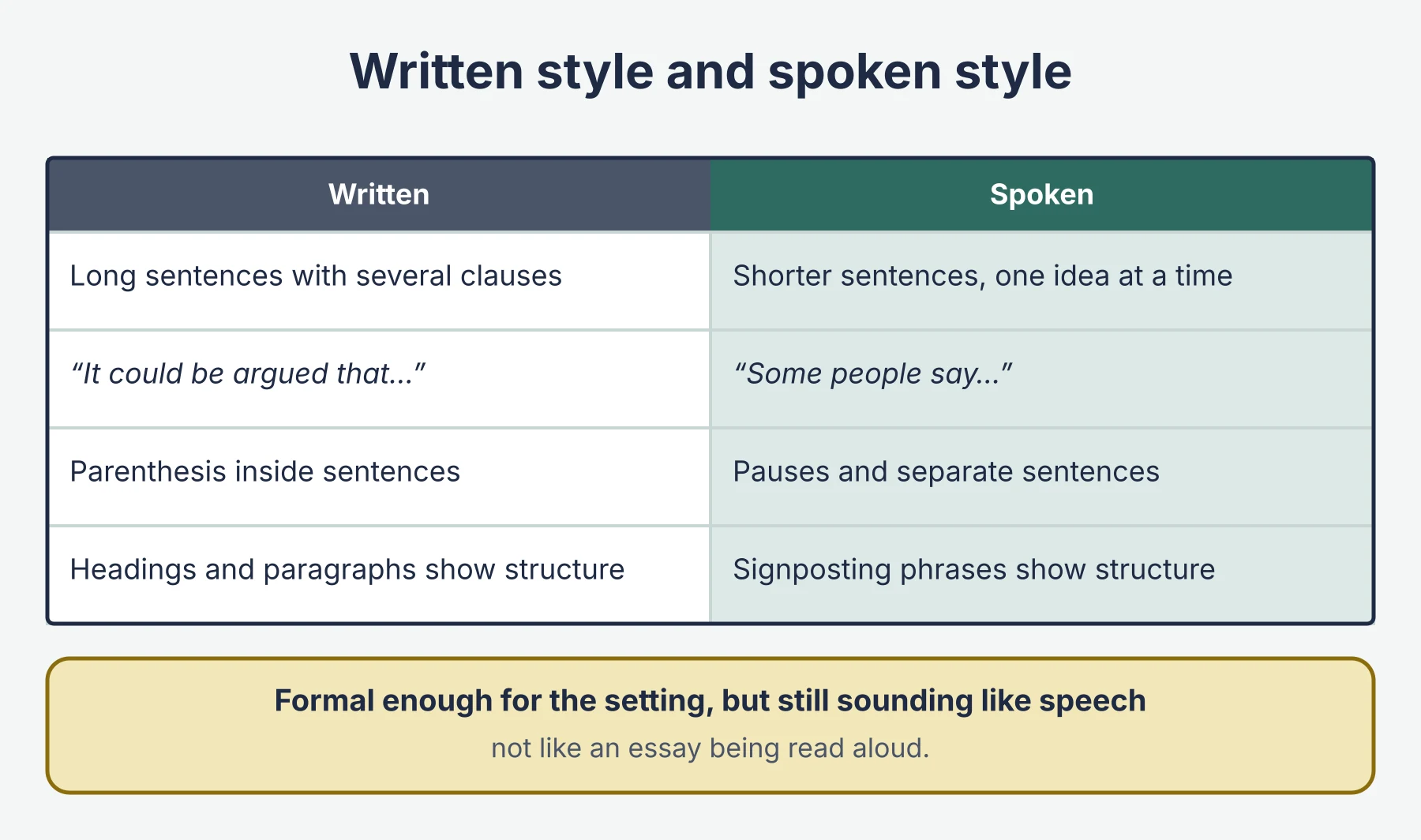
Spoken style is different from written style
| Written | Spoken |
|---|---|
| Long sentences with several clauses | Shorter sentences, one idea at a time |
| “It could be argued that…” | “Some people say…” |
| Parenthesis inside sentences | Pauses and separate sentences |
| Headings and paragraphs show structure | Signposting phrases show structure |
Keep the register formal enough for the setting while sounding like speech, not like an essay being read aloud.
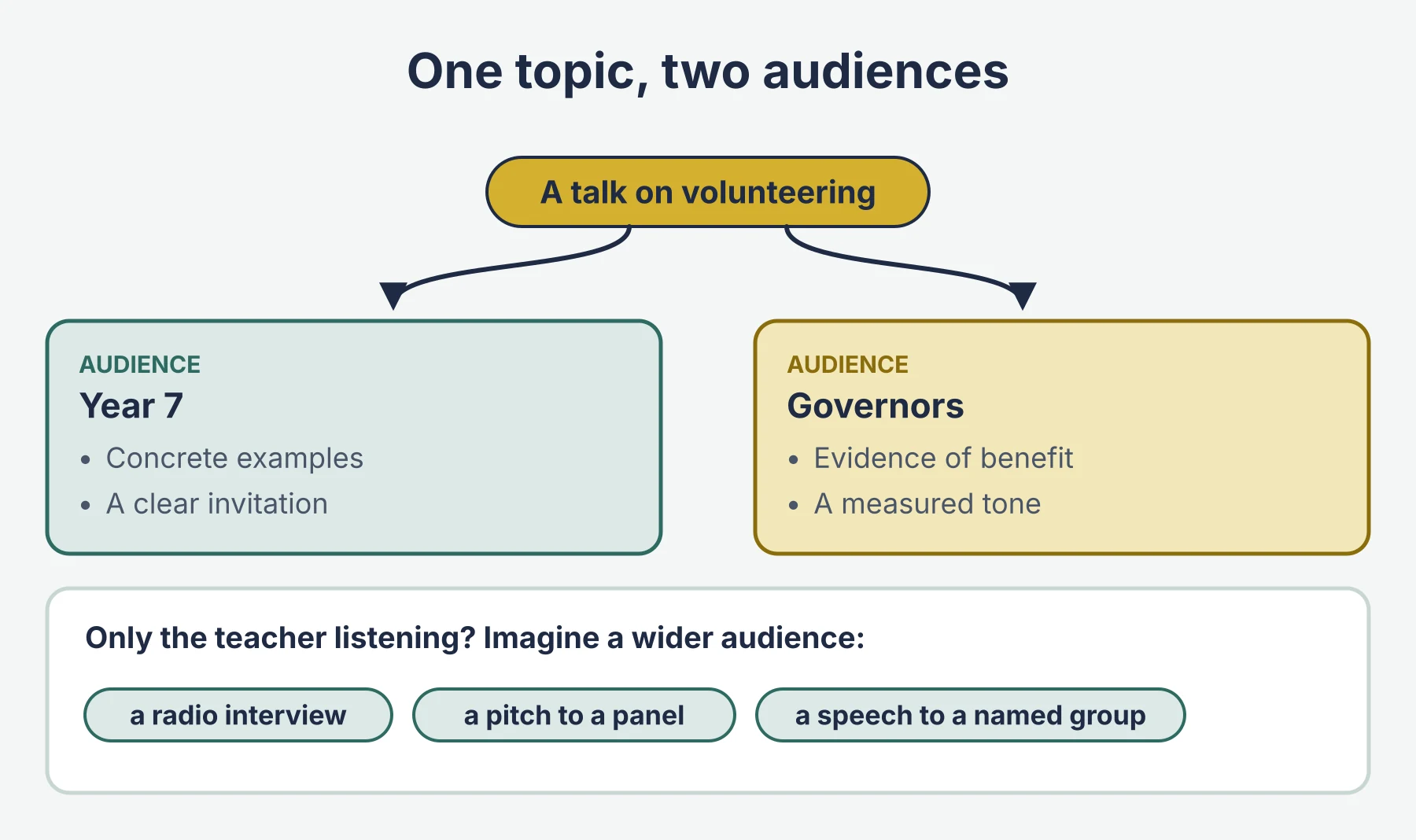
Planning for different purposes and audiences
The same topic changes with the audience. A talk on volunteering for Year 7 needs concrete examples and a clear invitation; the same talk to governors needs evidence of benefit and a measured tone. If your teacher is the only listener, choose a form that imagines a wider audience: a radio interview, a pitch to a panel, or a speech to a named group.
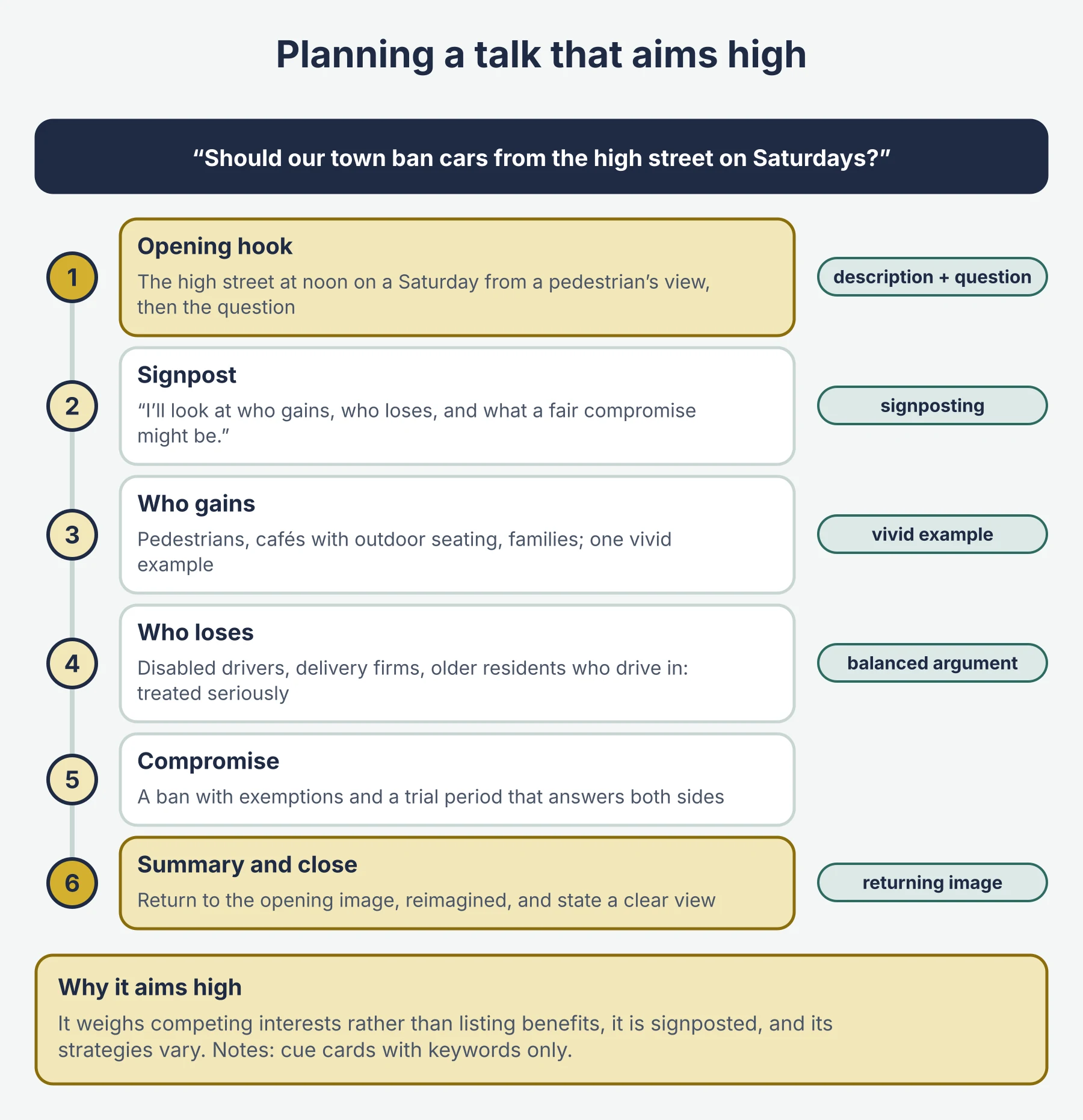
Worked example: planning a Merit-to-Distinction talk
Topic (agreed with the teacher): “Should our town ban cars from the high street on Saturdays?”
Plan:
- Opening hook: describe the high street at noon on a Saturday from a pedestrian’s view, then pose the question.
- Signpost: “I’ll look at who gains, who loses, and what a fair compromise might be.”
- Who gains: pedestrians, cafés with outdoor seating, families; one vivid example.
- Who loses: disabled drivers, delivery firms, older residents who drive in; treated seriously, not dismissed.
- Compromise: a ban with exemptions and a trial period; explain why this answers both sides.
- Summary and close: return to the opening image, now reimagined, and state a clear view.
Why this plan aims high: the ideas are challenging (it weighs competing interests rather than listing benefits), the structure is signposted and clear, and the strategies vary (description, direct question, balanced argument, returning image). Prepared notes would be cue cards with keywords only.
Common mistakes
- Choosing a topic that allows only straightforward, factual ideas.
- Reading a written essay aloud, with long sentences listeners cannot follow.
- No signposting, so the audience loses the thread.
- Slides crowded with text that compete with the speaker.
- Too much information for the time, leading to rushing.
- Forgetting that a teacher-only audience must be treated as a potentially wider one.
Technique for the criteria
- Write your purpose in one sentence before planning; check every section serves it.
- Plan at least three different engagement strategies.
- Use a range of vocabulary, including subject terms you can explain.
- Rehearse aloud to check the length stays well within the guide time.
Related: spoken language revision notes | spoken Standard English study guide
Official syllabus
AQA GCSE English Language (8700) specification, for GCSE exams June 2017 onwards: 3.1.3 Spoken language (presenting information and ideas), section 4.4 Non-exam assessment, and assessment objective AO7.
Related resources
-
Practice questions
AQA GCSE English Language (8700): Presenting Information and Ideas – Practice Questions
Original AQA GCSE English Language 8700 spoken language tasks on choosing topics, selecting information, spoken structure and judging talks against AO7.
English · AQA · GCSE
Try questions -
Revision notes
AQA GCSE English Language (8700): Presenting Information and Ideas – Revision Notes
AQA GCSE English Language 8700 presenting recall notes: presentation requirements, AO7 criteria by grade, topic choice, spoken structure and a self-test.
English · AQA · GCSE
Revise topic -
Study guides
AQA GCSE English Language (8700): Responding to Spoken Language
AQA GCSE English Language 8700 guide to responding to questions and feedback after a presentation: active listening, answer shapes and the AO8 grade criteria.
English · AQA · GCSE
Read guide
Get free revision emails (optional)
Occasional emails with practice questions, worked explanations and links to free resources for the qualification and subjects you choose. No spam, and you can unsubscribe from any email. The free tools on this site never need an email.