
Revision Notes
AQA GCSE Sociology (8192): Ethical issues – Revision Notes
AQA GCSE Sociology 8192 revision notes on consent, confidentiality and harm, how each is addressed, covert research and children, with traps and a self-test.
- Subject
- Sociology
- Level
- GCSE
- Topic
- Sociological research methods
- Author
- Marlbridge Academic Team
- Updated
- Reviewed by
- Naqiya Yousaf (what this means)
Aligned to AQA GCSE Sociology (8192), first teaching 2017. Official specification .
Syllabus page (what it covers and how it is assessed): AQA GCSE Sociology.
Syllabus points this page covers
8192
- Ethical issues
Found an error? Report a correction.
Need help with this topic? Request a free trial class for GCSE Sociology (8192).
These notes cover the “ethical issues” row of section 3.7 in the AQA GCSE Sociology (8192) specification: consent, confidentiality and harm to participants, and how the issues can be addressed. Read the ethical issues study guide for full explanations and a worked answer, then practise with the ethical issues practice questions. The research methods revision notes cover all of section 3.7.
What you must be able to do
- Explain the three ethical issues: consent, confidentiality and harm to participants.
- Explain how each can be addressed, for a specific area of research.
Memory hook: CCH: Can Children Help? Consent, Confidentiality, Harm. Then ask: are children or vulnerable people involved?
Key terms
| Term | Meaning |
|---|---|
| Ethical considerations | Moral issues researchers must take into account |
| Informed consent | Agreeing to take part with full knowledge of what the research involves |
| Right to withdraw | Participants can leave the study at any time |
| Confidentiality | Information given is kept private and not shared in identifiable form |
| Anonymity | Identity is not recorded or is hidden |
| Pseudonym | A false name used to protect identity |
| Data protection | Laws on how personal data are stored and used |
| Harm | Physical, emotional, social or legal damage |
| Debrief | Explaining the research to participants afterwards and checking their wellbeing |
| Deception | Misleading participants about the research |
| Covert observation | Studying a group without its knowledge |
| Gatekeeper | Person controlling access, such as a head teacher |
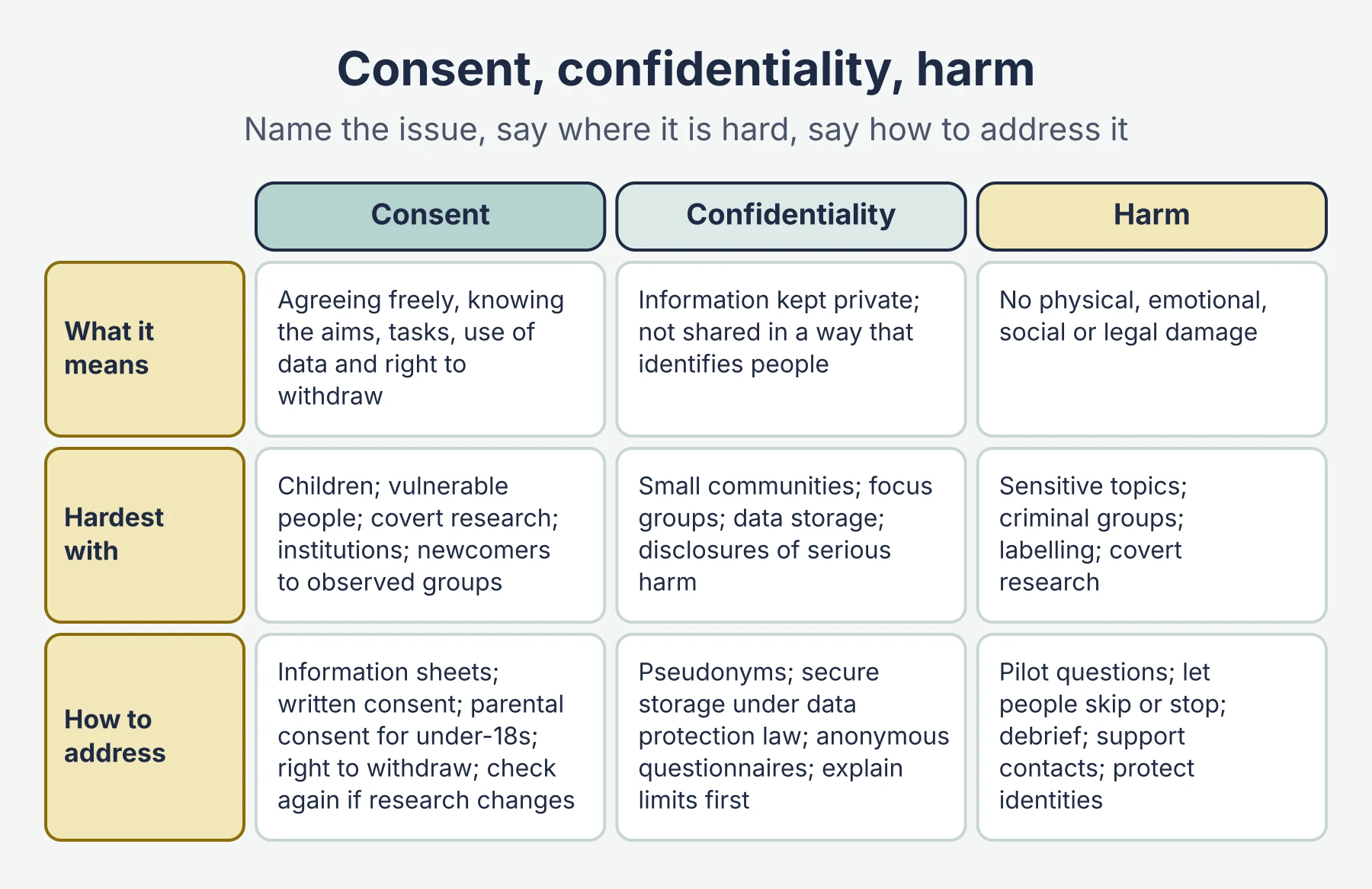
The three issues at a glance
| Issue | Hardest cases | How to address |
|---|---|---|
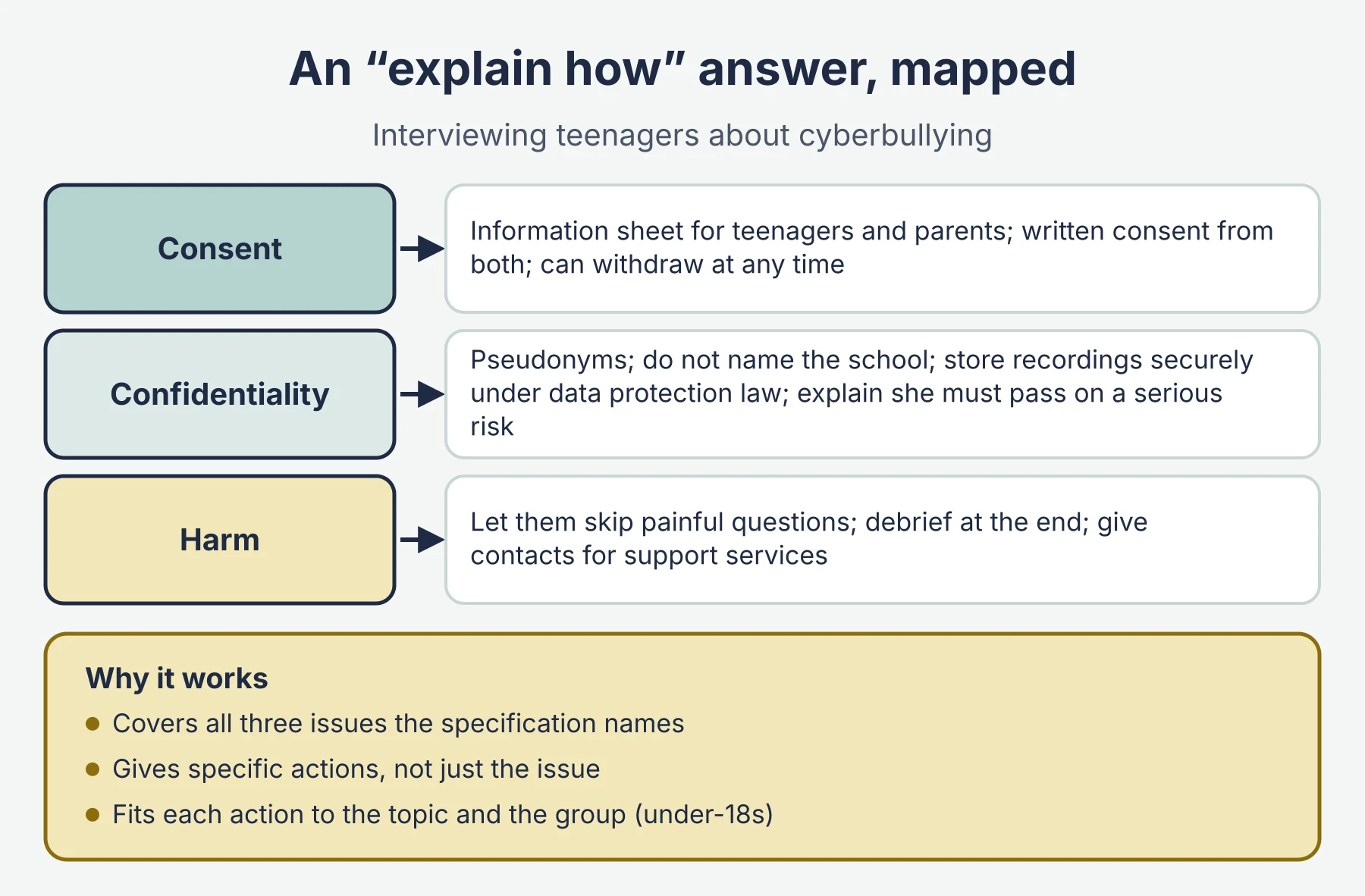
| Consent | Children; vulnerable people; covert research; people who feel unable to refuse | Information sheets; written consent; right to withdraw; parental consent; ongoing checks |
| Confidentiality | Small settings; focus groups; insecure data; disclosures of serious harm | Pseudonyms; change details; secure storage; anonymous questionnaires; explain limits |
| Harm | Sensitive topics; deviant groups; labelling; covert research | Avoid distressing questions; allow stopping; debrief; support contacts; protect identities |
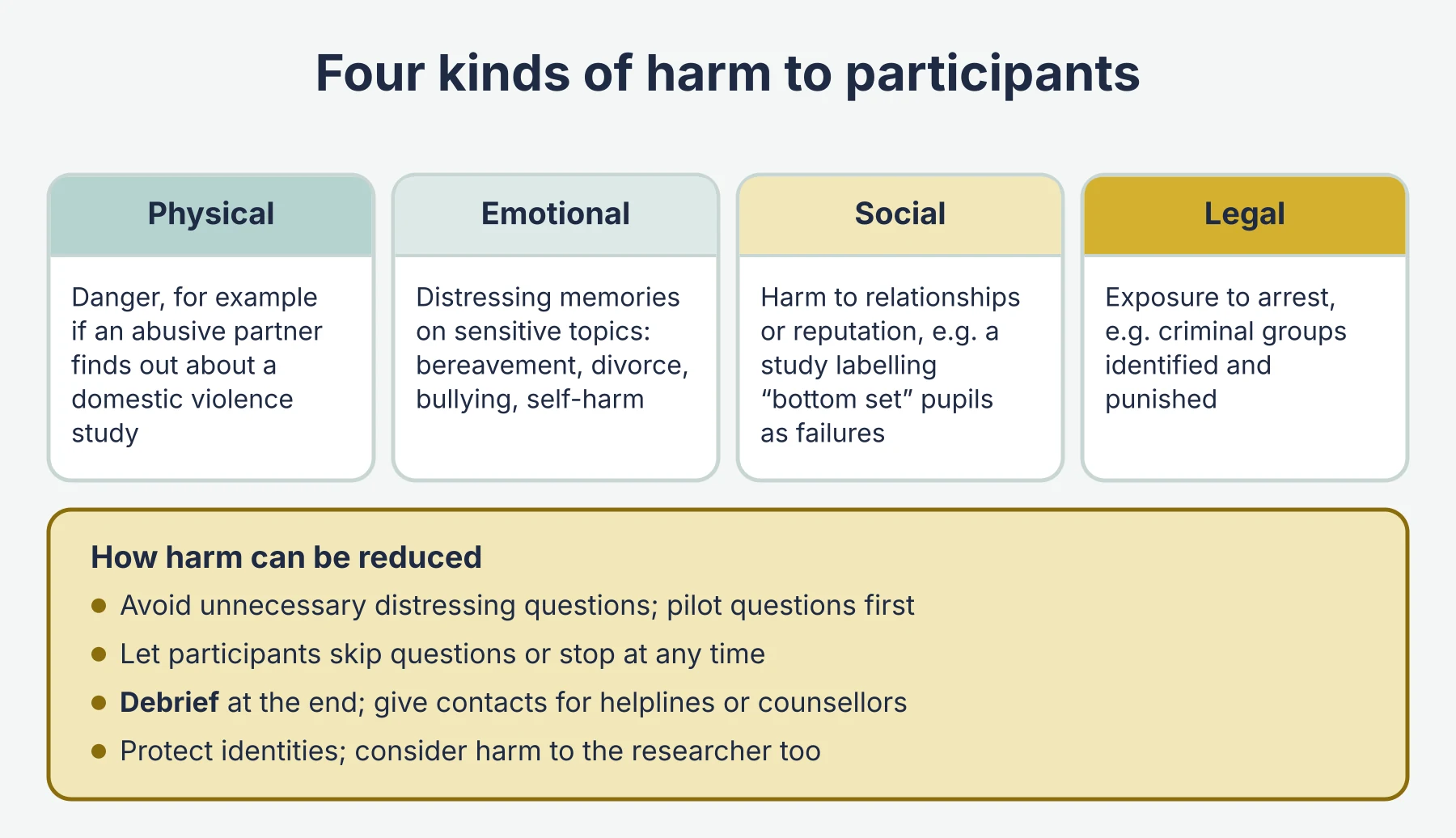
Types of harm
- Physical: injury or danger.
- Emotional: distress, anxiety, reliving trauma.
- Social: damage to relationships or reputation.
- Legal: exposure to arrest or punishment.
Children and young people
- Parental consent plus the young person’s own agreement.
- Head teacher’s permission for school-based research.
- Simple, age-appropriate explanations.
- Extra care over labelling and distressing topics.
- Limits of confidentiality explained: serious risk to a child may have to be reported.
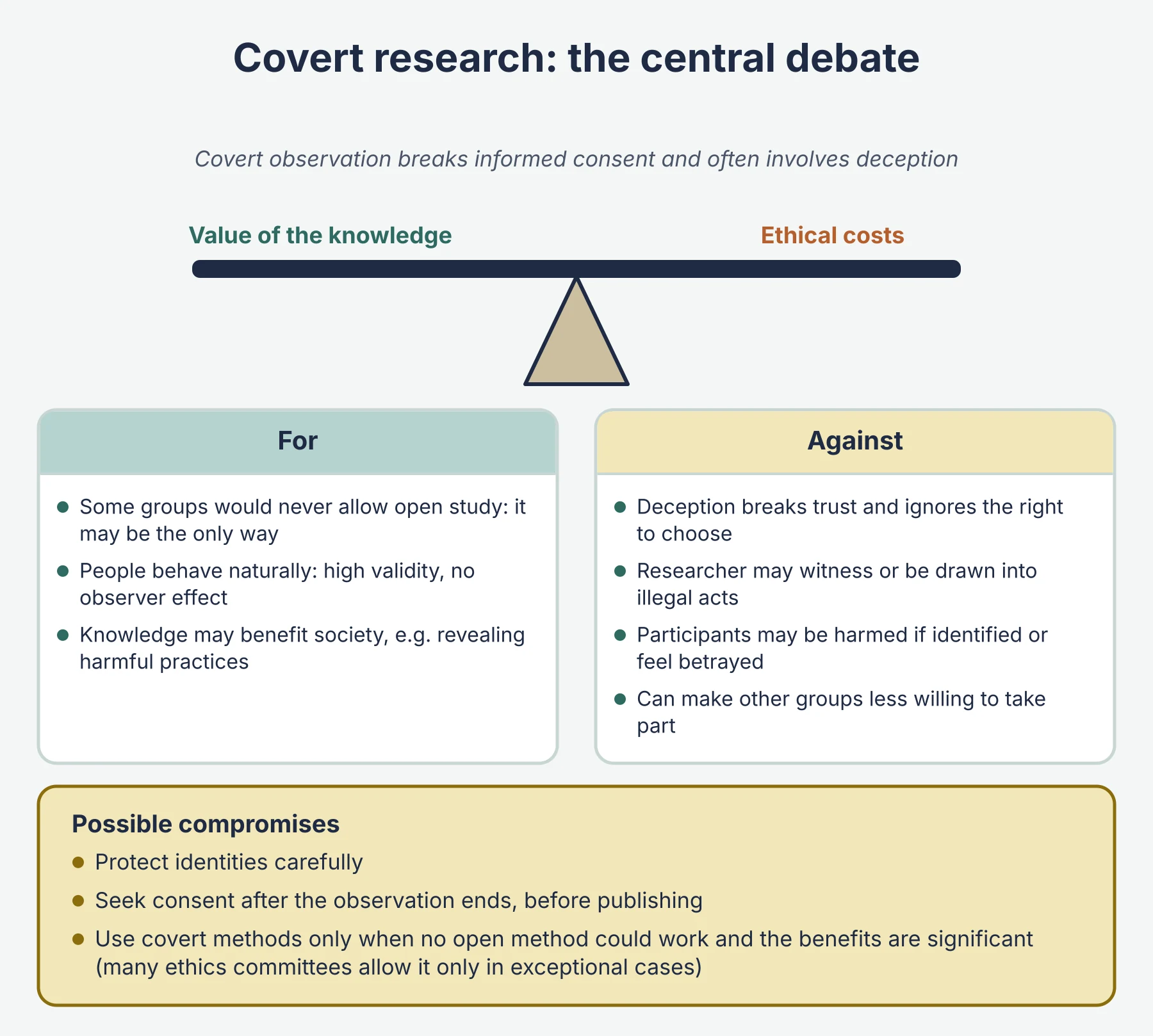
Covert research debate
| For | Against |
|---|---|
| Only way to study some closed or deviant groups | Breaks informed consent; involves deception |
| Natural behaviour, high validity, no observer effect | Researcher may witness or join illegal acts |
| Knowledge may benefit society | Participants may feel betrayed or be harmed |
| Damages trust in research generally |
Compromises: protect identities; seek consent before publishing; use only when no open method works.
Guidance and oversight
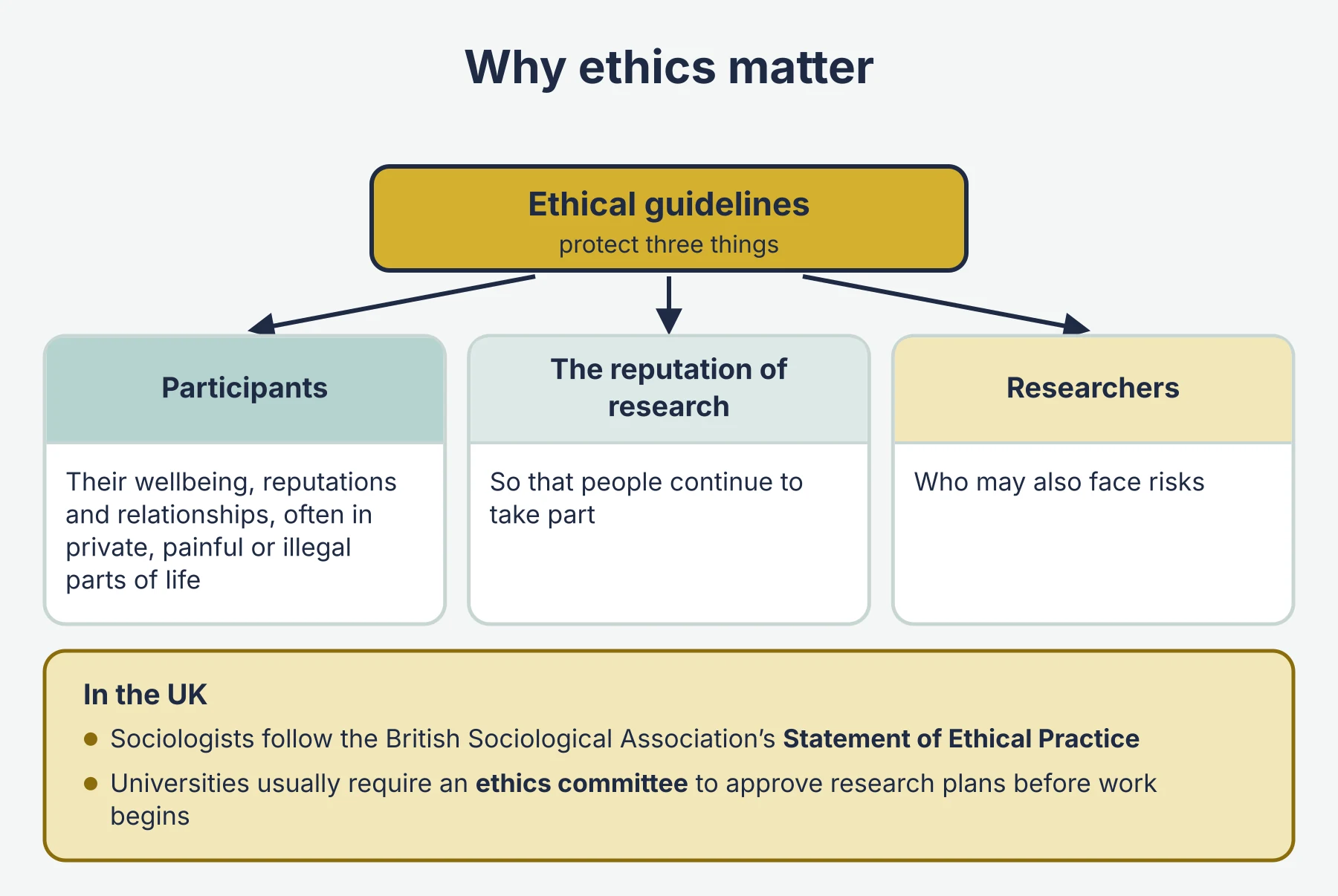
- The British Sociological Association’s Statement of Ethical Practice.
- University ethics committees approve research plans.
- Data protection law governs how personal data are stored.
Applying ethics: quick examples
- Domestic violence interviews: private location; skip any question; support contacts; danger if an abuser finds out.
- School setting study: parental consent; avoid labelling pupils in reports.
- Young offenders: anonymity; avoid recording details of unreported crimes.
- Family conflict: interview members separately; never pass on what one member said.
Mini plan for an extended answer
“Discuss how far covert observation can be justified for studying a pupil subculture.”
- Define covert participant observation; note that an adult can rarely pass as a pupil.
- Against: no informed consent; deception; pupils are under 18, so parental consent is also missing.
- Against: harm if pupils are identified or labelled in the report.
- For: natural behaviour and high validity; anti-school groups may hide behaviour from known researchers.
- Compromise: overt observation over a long period, so pupils get used to the researcher; pseudonyms; consent before publishing.
- Judgement: hard to justify with children, because open methods can work and the risks fall on young people.
Exam traps
- Trap: naming issues without solutions. Fix: the specification asks how they “can be addressed”.
- Trap: “covert research is wrong” and nothing else. Fix: name the issue, give both sides.
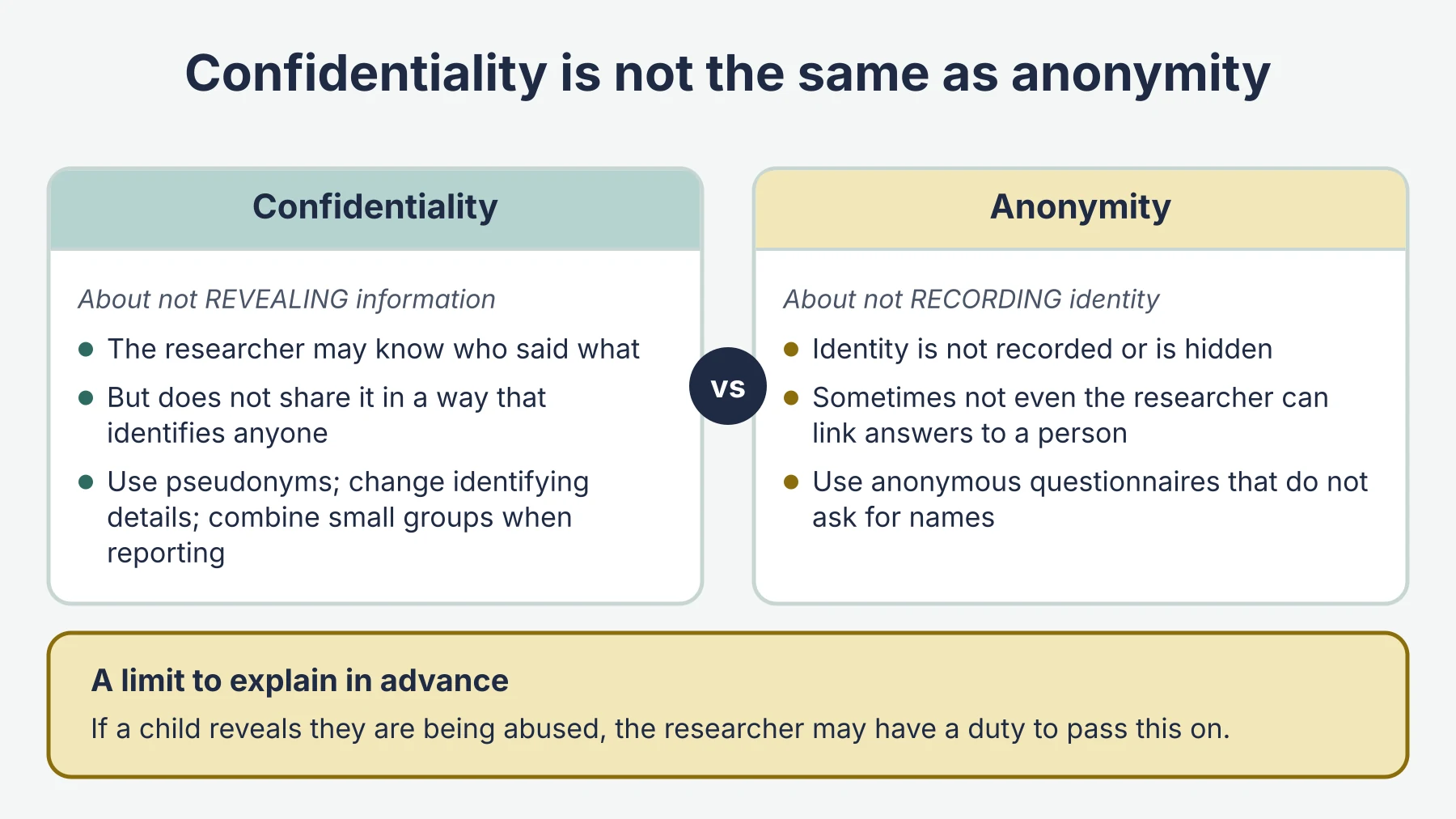
- Trap: confidentiality = anonymity. Fix: not revealing information versus not recording identity.
- Trap: ethical and practical issues mixed. Fix: cost and time are practical.
- Trap: generic solutions. Fix: fit each step to the group and topic.
Quick self-test
- Name the three ethical issues in the specification.
- What makes consent “informed”?
- Why is consent harder to obtain from children?
- Why might prisoners not give fully free consent?
- What is the difference between confidentiality and anonymity?
- Give two ways of protecting confidentiality.
- Why is confidentiality hard to guarantee in a focus group?
- Name four types of harm.
- What is a debrief?
- Give one argument for covert observation.
- Give one argument against covert observation.
- Which professional body publishes a statement of ethical practice for UK sociologists?
Answers
- Consent, confidentiality and harm to participants.
- Participants know the aims, what they will do, how data will be used and that they can withdraw.
- They may not fully understand the research, so parental consent is also needed.
- They may feel they cannot refuse if the institution has agreed.
- Confidentiality means information is not shared in an identifiable way; anonymity means identity is not recorded or is hidden.
- Any two of: pseudonyms, changing details, secure storage, anonymous questionnaires, careful reporting.
- Other members may repeat what was said.
- Physical, emotional, social and legal.
- Explaining the research to participants afterwards and checking their wellbeing.
- It may be the only way to study a closed group, and behaviour is natural.
- It breaks informed consent and involves deception.
- The British Sociological Association.
Specification reference
AQA GCSE Sociology (8192), section 3.7 Sociological research methods, “ethical issues” row; Appendix A research key terms.
Related resources
-
Study guides
AQA GCSE Sociology (8192): Interpretation of data
AQA GCSE Sociology 8192 guide to reading tables, graphs and charts: patterns and trends, percentages, rates and percentage points, and common data traps.
Sociology · AQA · GCSE
Read guide -
Practice questions
AQA GCSE Sociology (8192): Interpretation of data – Practice Questions
Original AQA GCSE Sociology 8192 data interpretation practice: tables, rates, percentage points, averages and misleading charts, with mark-scheme answers.
Sociology · AQA · GCSE
Try questions -
Revision notes
AQA GCSE Sociology (8192): Interpretation of data – Revision Notes
AQA GCSE Sociology 8192 revision notes on interpreting data: patterns, trends, key calculations, reading charts, common traps and a self-test with answers.
Sociology · AQA · GCSE
Revise topic
Related articles
Get free revision emails (optional)
Occasional emails with practice questions, worked explanations and links to free resources for the qualification and subjects you choose. No spam, and you can unsubscribe from any email. The free tools on this site never need an email.