
Study Guides
AQA GCSE Sociology (8192): Ethical issues
AQA GCSE Sociology 8192 guide to research ethics: consent, confidentiality and harm, how each can be addressed, children, covert research and topic examples.
- Subject
- Sociology
- Level
- GCSE
- Topic
- Sociological research methods
- Author
- Marlbridge Academic Team
- Updated
- Reviewed by
- Naqiya Yousaf (what this means)
Aligned to AQA GCSE Sociology (8192), first teaching 2017. Official specification .
Syllabus page (what it covers and how it is assessed): AQA GCSE Sociology.
Syllabus points this page covers
8192
- Ethical issues
Found an error? Report a correction.
Need help with this topic? Request a free trial class for GCSE Sociology (8192).
This guide covers the “ethical issues” row of section 3.7 Sociological research methods in the AQA GCSE Sociology (8192) specification. The specification states that “ethical issues are consent, confidentiality and harm to participants and how the issues can be addressed”. The second half of that sentence matters: you must be able to say how a researcher would deal with each issue, not just name it. Methods are assessed in both Paper 1 and Paper 2.
The research methods study guide has a short table of the three issues. This guide explains each in depth, shows where they are hardest to manage, and works through the debate about covert research. Revise with the ethical issues revision notes and practise with the ethical issues practice questions.
Why ethics matter in sociology
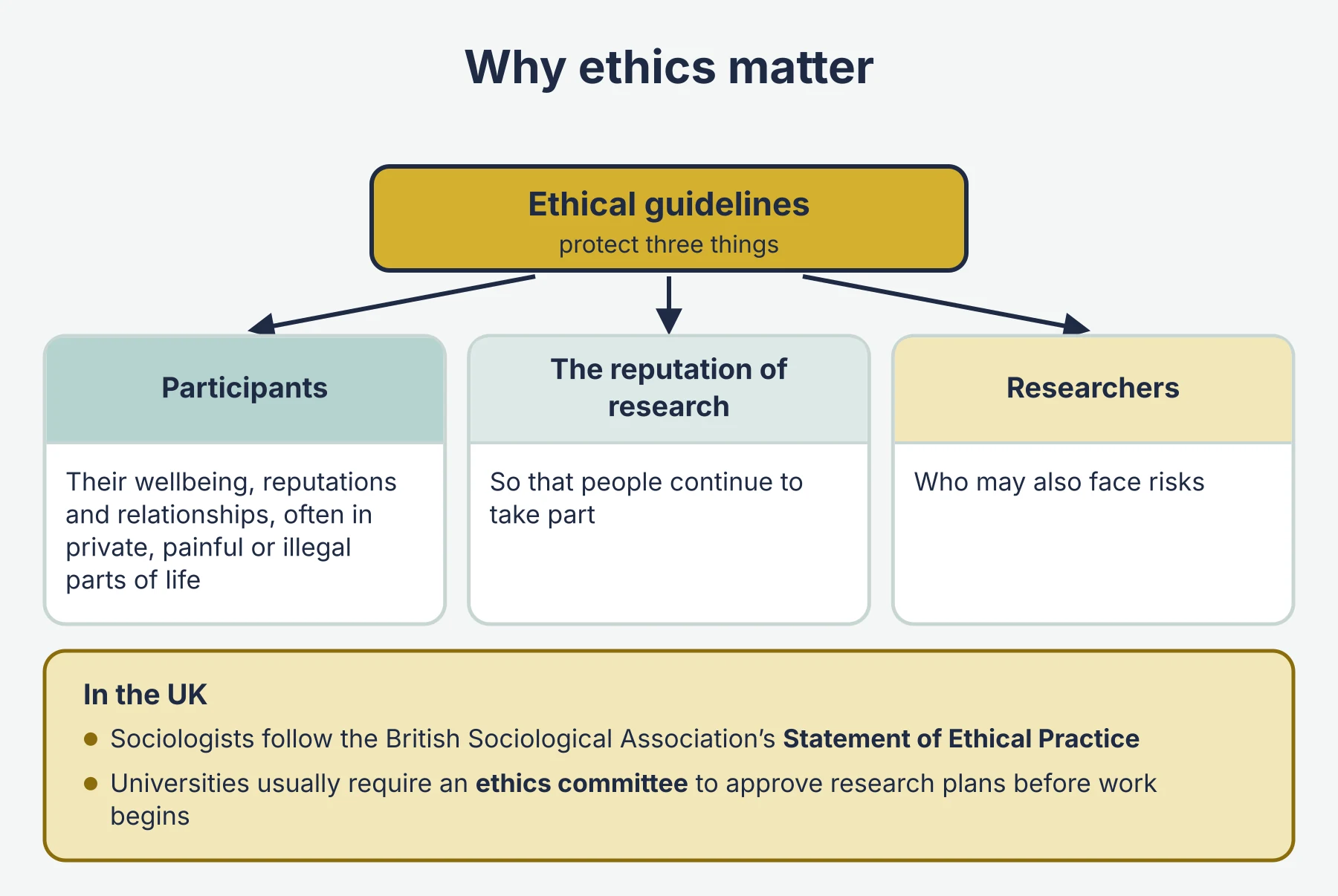
Sociologists study people, often about private, painful or illegal parts of their lives. Research can affect participants’ wellbeing, reputations and relationships. Ethical guidelines protect participants, protect the reputation of research so that people continue to take part, and protect researchers themselves. In the UK, sociologists follow the British Sociological Association’s Statement of Ethical Practice, and universities usually require research plans to be approved by an ethics committee before work begins.
Consent
What it means
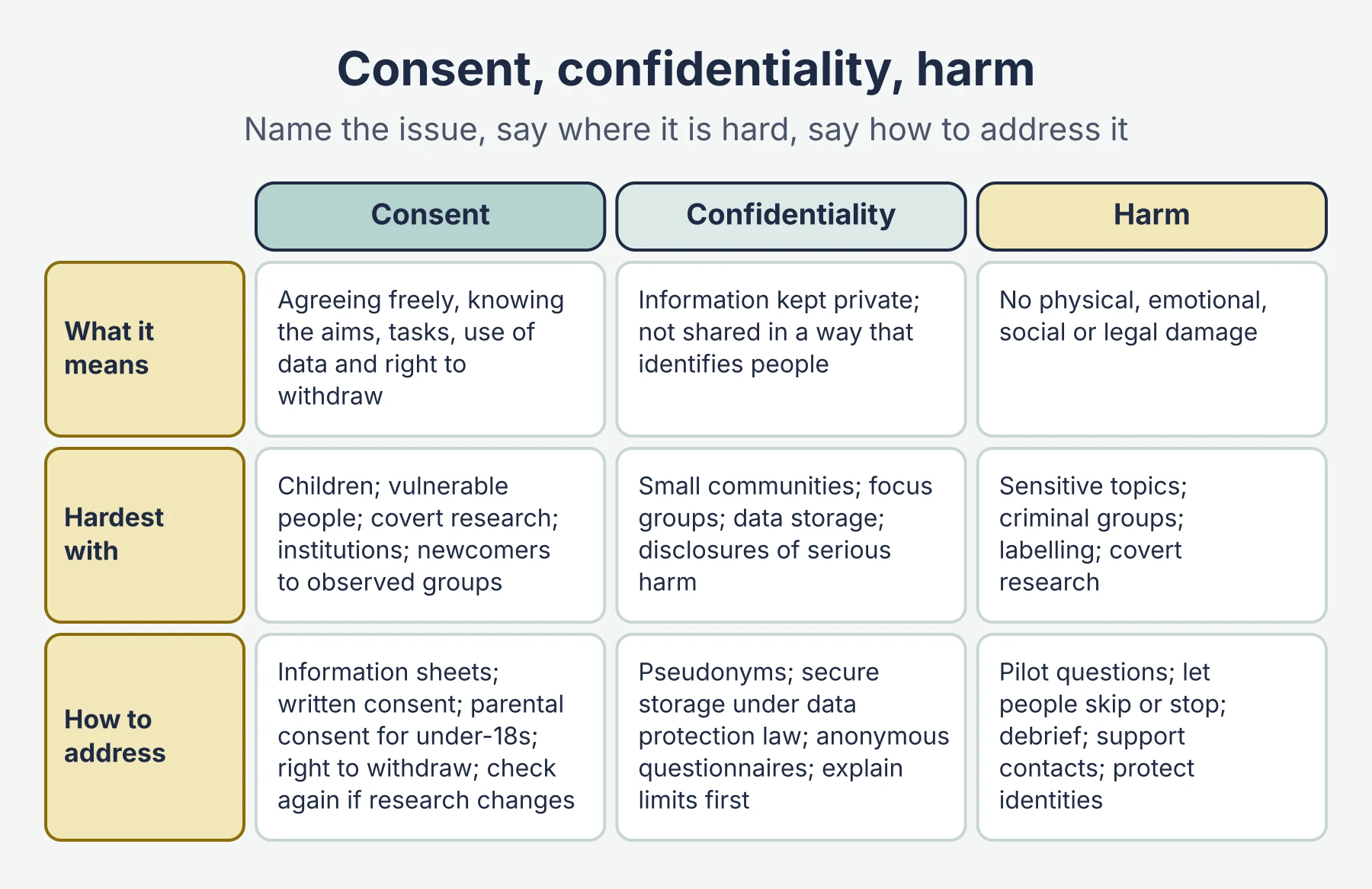
Informed consent means participants agree to take part, freely and with full knowledge of what the research involves: its aims, what they will be asked to do, how the data will be used, and their right to withdraw.
Where it is difficult
- Children and young people: researchers normally need consent from a parent or guardian as well as agreement from the child. In schools, the head teacher’s permission is usually needed too.
- Vulnerable people: people with some learning disabilities or serious illness may not fully understand what they are agreeing to.
- Covert research: the group does not know it is being studied, so it cannot consent.
- Institutions: in prisons or workplaces, people may feel they cannot refuse if managers have agreed, so consent may not be fully free.
- Observation in groups: in overt observation, newcomers to the group may never have been asked.
How it can be addressed
- Give clear information sheets in plain language and explain the research face to face.
- Collect written or recorded consent.
- Make the right to withdraw clear, at any time and without giving a reason.
- Seek parental consent for under-18s and check the young person also agrees.
- Treat consent as ongoing: check again if the research changes direction.
Confidentiality
What it means
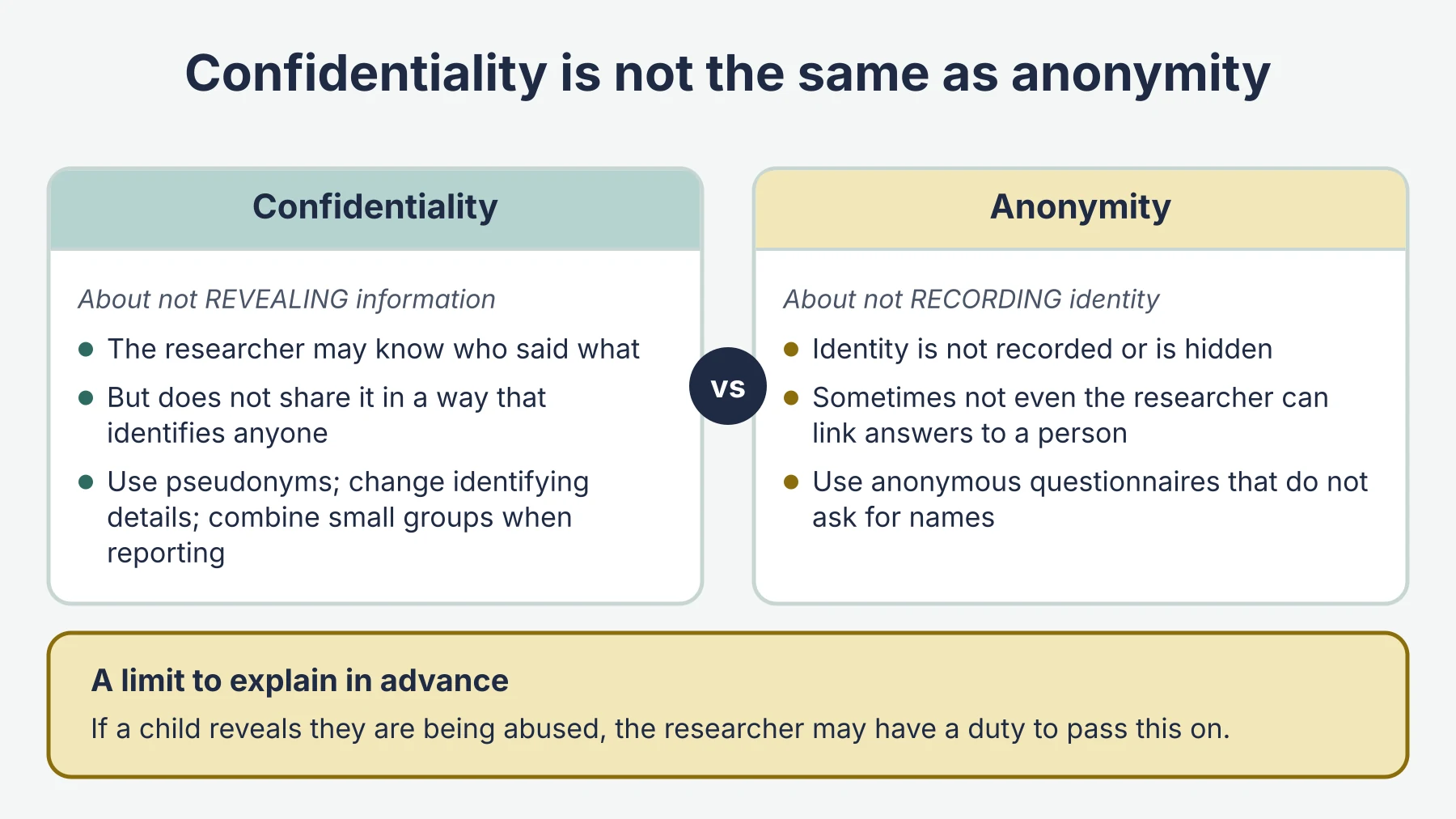
Confidentiality means that information participants give is kept private and is not shared in a way that identifies them. A related idea is anonymity: the participant’s identity is not recorded or is hidden, so no one, sometimes not even the researcher, can link answers to a person.
Where it is difficult
- Small communities or settings: in a study of one school or village, a description of “the head of science” may identify someone even without a name.
- Focus groups: the researcher cannot stop other members repeating what was said.
- Data storage: recordings, transcripts and questionnaires could be lost or hacked.
- Disclosures of serious harm: if a child reveals they are being abused, the researcher may have a duty to pass this on. Participants should be told about this limit in advance.
How it can be addressed
- Use pseudonyms for people and places, and change identifying details.
- Store data securely, using passwords and locked storage, in line with data protection law, and delete it when no longer needed.
- Use anonymous questionnaires that do not ask for names.
- Report findings in a way that prevents identification, for example combining small groups.
- Explain the limits of confidentiality before research begins.
Harm to participants
What it means
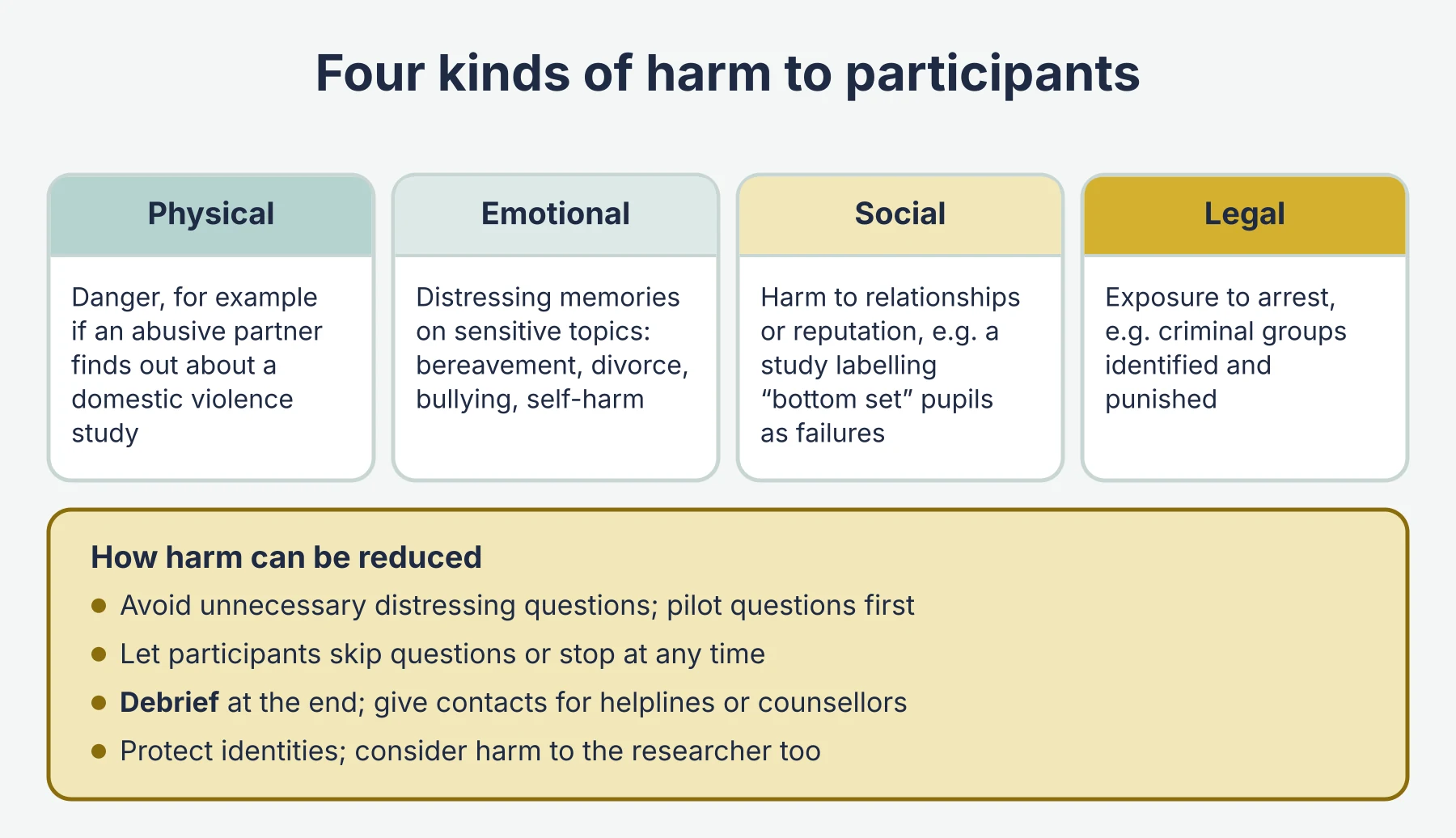
Research must not damage participants physically, emotionally (psychologically), socially (for example harming their relationships or reputation) or legally (for example exposing them to arrest).
Where it is most likely
- Sensitive topics: domestic violence, bereavement, divorce, bullying or self-harm can bring back distressing memories.
- Deviant or criminal groups: findings could lead to participants being identified and punished.
- Labelling: a published study describing pupils in a “bottom set” as failures could harm their self-image if they read it.
- Covert research: participants who later discover they were studied may feel betrayed.
How it can be addressed
- Avoid unnecessary distressing questions; pilot questions to check they are not upsetting.
- Allow participants to skip questions or stop at any time.
- Debrief participants at the end, explaining the research and checking how they feel.
- Provide contact details for support services, such as helplines or counsellors.
- Protect identities to avoid social and legal harm.
- Consider harm to the researcher too, for example in dangerous settings.
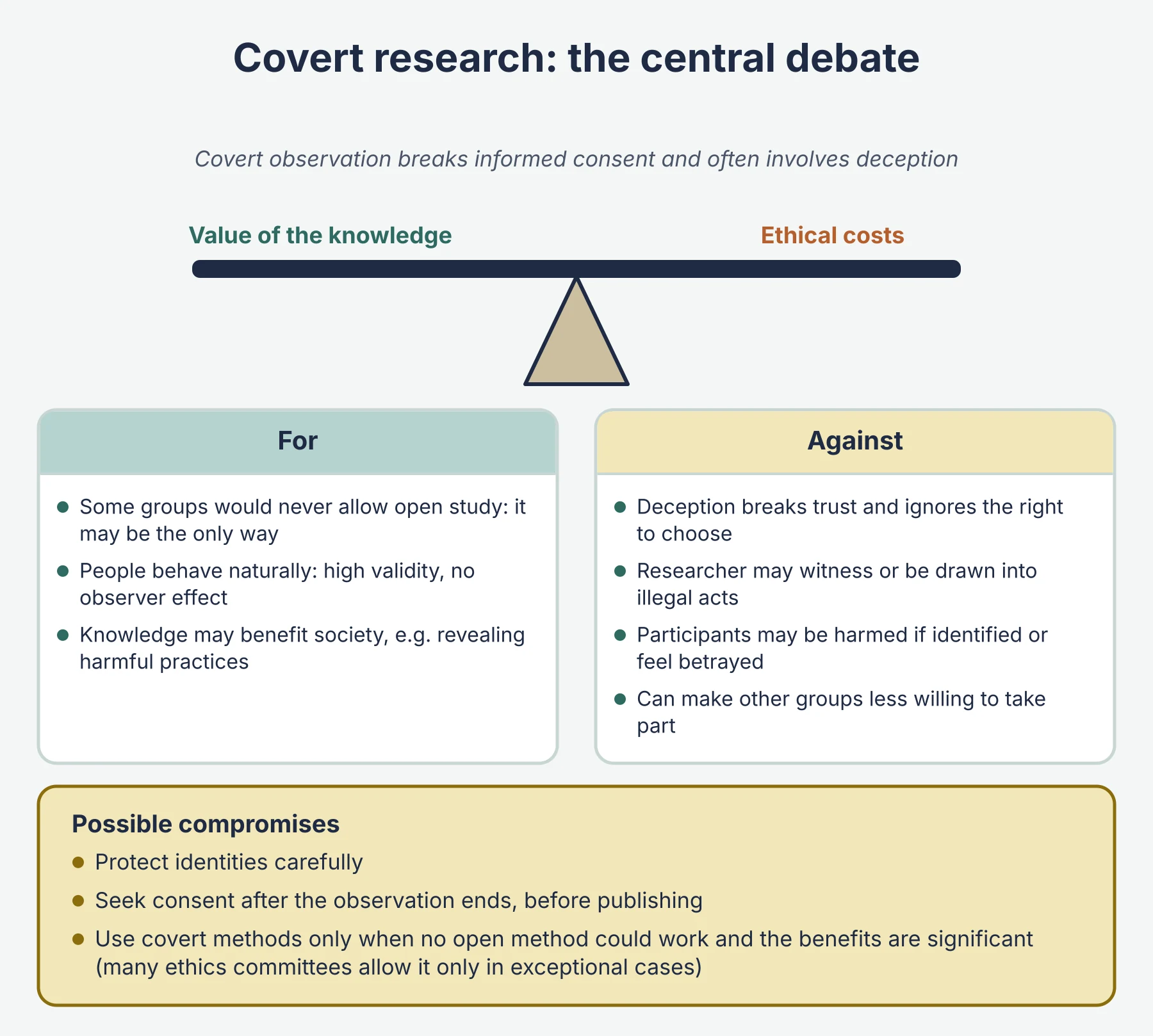
Covert research: the central debate
Covert observation breaks informed consent and often involves deception. So why do some sociologists use it?
Arguments for:
- Some groups would never allow an outsider to study them openly, so covert research may be the only way to study them.
- People behave naturally, so the data have high validity and avoid the observer effect.
- The knowledge gained may benefit society, for example by revealing harmful practices.
Arguments against:
- Deception breaks trust and ignores participants’ right to choose.
- The researcher may witness or be drawn into illegal acts.
- Participants may be harmed if they are identified or feel betrayed.
- It can damage the reputation of research and make other groups less willing to take part.
Possible compromises: protecting identities carefully; seeking consent after the observation ends, before publishing; using covert methods only when no open method could work and the benefits are significant. Many ethics committees allow covert research only in exceptional cases.
Applying ethics to specific areas of research
| Area | Main ethical issue | How to address it |
|---|---|---|
| Domestic violence | Harm: distress; danger if an abusive partner finds out | Private settings; skip any question; support contacts; secure storage |
| Pupils in bottom sets | Consent for under-18s; harm through labelling | Parental consent; careful wording; anonymised reporting |
| Young offenders | Legal harm; confidentiality | Anonymity; not recording details of unreported crimes; explaining limits |
| Family conflict | Confidentiality between family members | Separate interviews; not sharing one member’s answers with another |
| Workplace culture | Free consent if managers have agreed | Make clear refusal will not be reported to managers |
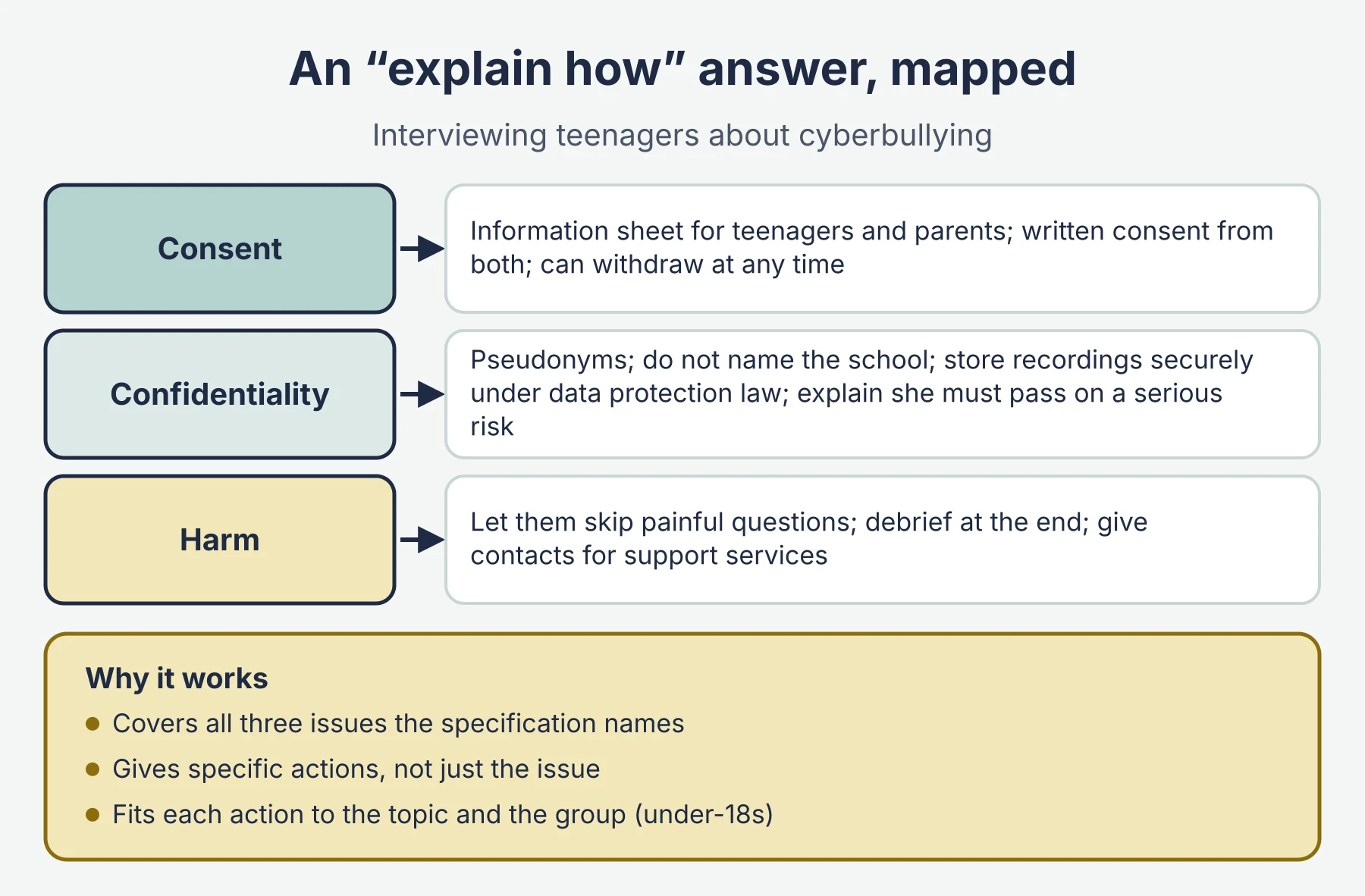
Worked example: an “explain how” answer
Explain how a researcher could address the ethical issues in interviewing teenagers about cyberbullying.
For consent, the researcher should give teenagers and their parents an information sheet, gain written consent from both, and make clear the teenager can withdraw at any time. For confidentiality, she should use pseudonyms, avoid naming the school, and store recordings securely in line with data protection law, while explaining that she would have to pass on information if a young person disclosed they were at serious risk. For harm, she should let participants skip questions about painful experiences, end with a debrief, and provide contacts for support services.
This answer addresses all three issues the specification names, gives specific actions, and fits them to the topic.
Common mistakes
- Naming ethical issues without saying how to address them.
- Saying “covert research is unethical” and stopping; explain which issue and consider the arguments.
- Confusing ethical issues with practical ones, such as cost.
- Treating confidentiality and anonymity as identical: confidentiality is about not revealing information; anonymity is about not recording identity.
- Forgetting the extra steps needed for children.
Exam technique
- Identify the ethical issue that matters most for the topic.
- Explain why it is an issue for that group, and how it can be addressed.
- In extended answers, weigh ethical costs against the value of the knowledge gained, and compare methods.
Specification reference
AQA GCSE Sociology (8192), section 3.7 Sociological research methods, “ethical issues” row, with research key terms in Appendix A.
Related resources
-
Practice questions
AQA GCSE Sociology (8192): Ethical issues – Practice Questions
Original AQA GCSE Sociology 8192 practice on consent, confidentiality and harm in research, covert methods and research with children, with full answers.
Sociology · AQA · GCSE
Try questions -
Revision notes
AQA GCSE Sociology (8192): Ethical issues – Revision Notes
AQA GCSE Sociology 8192 revision notes on consent, confidentiality and harm, how each is addressed, covert research and children, with traps and a self-test.
Sociology · AQA · GCSE
Revise topic -
Study guides
AQA GCSE Sociology (8192): Interpretation of data
AQA GCSE Sociology 8192 guide to reading tables, graphs and charts: patterns and trends, percentages, rates and percentage points, and common data traps.
Sociology · AQA · GCSE
Read guide
Related articles
Get free revision emails (optional)
Occasional emails with practice questions, worked explanations and links to free resources for the qualification and subjects you choose. No spam, and you can unsubscribe from any email. The free tools on this site never need an email.