
Revision Notes
AQA GCSE Sociology (8192): Practical issues – Revision Notes
AQA GCSE Sociology 8192 revision notes on practical issues in research: time, cost and access by method, gatekeepers, trade-offs, exam traps and a self-test.
- Subject
- Sociology
- Level
- GCSE
- Topic
- Sociological research methods
- Author
- Marlbridge Academic Team
- Updated
- Reviewed by
- Naqiya Yousaf (what this means)
Aligned to AQA GCSE Sociology (8192), first teaching 2017. Official specification .
Syllabus page (what it covers and how it is assessed): AQA GCSE Sociology.
Syllabus points this page covers
8192
- Practical issues
Found an error? Report a correction.
Need help with this topic? Request a free trial class for GCSE Sociology (8192).
These notes cover the “practical issues” row of section 3.7 in the AQA GCSE Sociology (8192) specification: time, cost and access. Read the practical issues study guide for full explanations and a worked example, then practise with the practical issues practice questions. The research methods revision notes cover all of section 3.7.
What you must be able to do
- Explain the practical issues named in the specification: time, cost and access.
- Apply them to research design for a specific area of research, as “practical difficulties”.
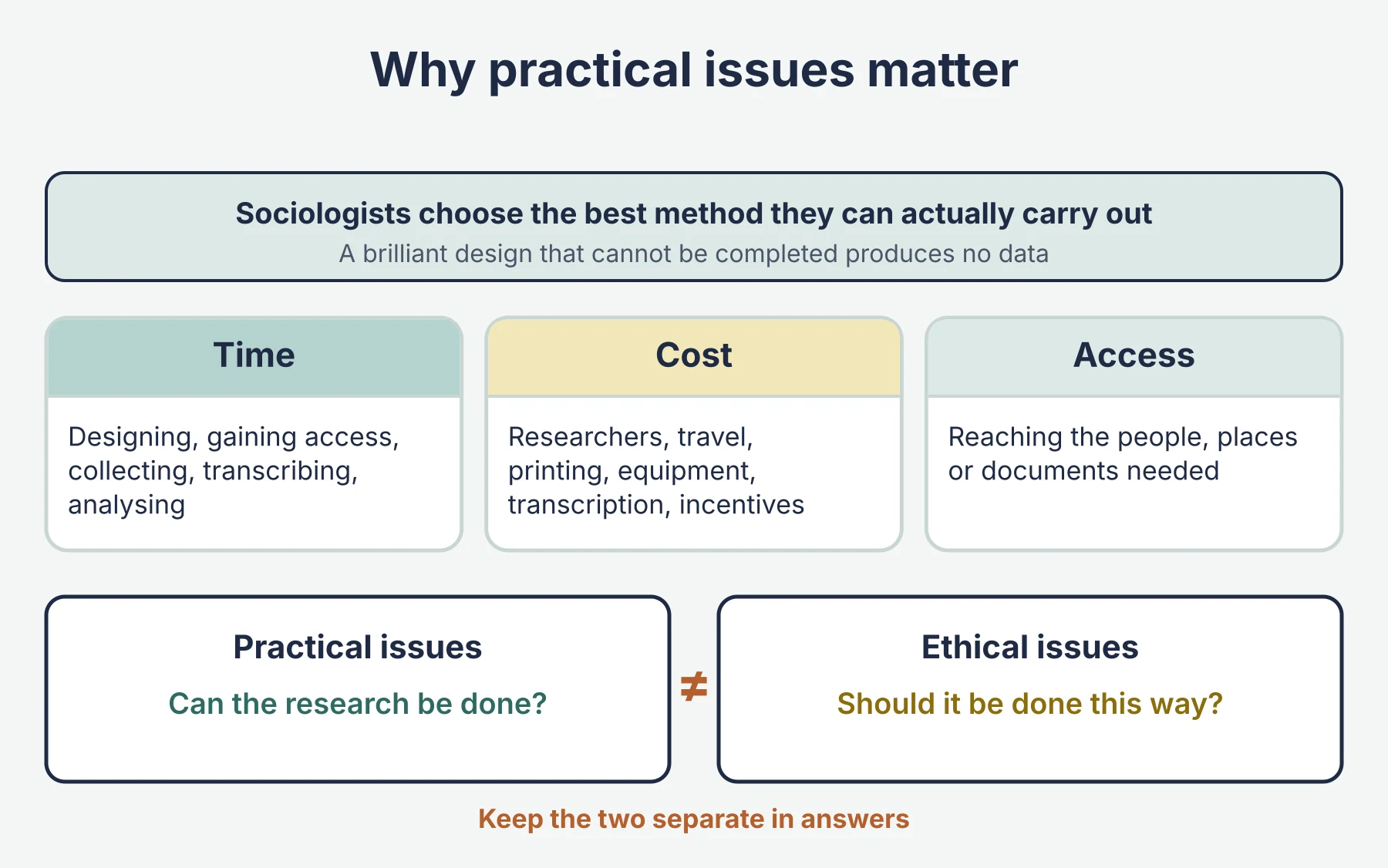
Practical versus ethical
- Practical: can the research be done? Time, cost, access.
- Ethical: should it be done this way? Consent, confidentiality, harm.
Never merge them in one sentence without explaining each.
Key terms
| Term | Meaning |
|---|---|
| Practical issues | Time, cost and access: factors affecting whether research can be carried out |
| Access | Being able to reach the people, places or documents needed |
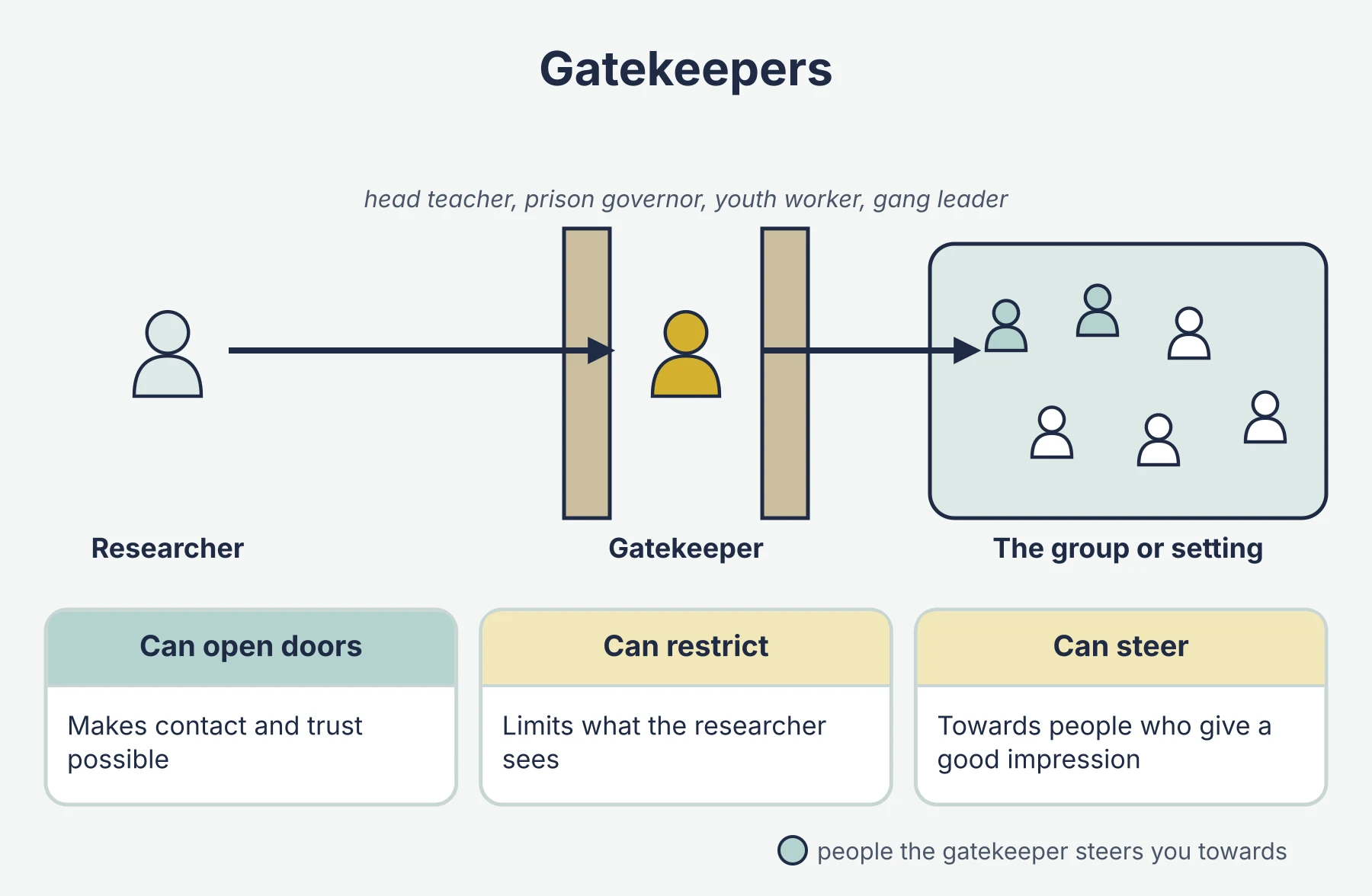
| Gatekeeper | Person who controls access to a group or setting |
| Hard-to-reach group | Group that is hidden, distrustful or lacks a sampling frame |
| Funding body | Organisation that pays for research |
| Response rate | Percentage of people asked who take part |
| Transcription | Typing up recorded interviews |
| Longitudinal study | Research following the same group over time |
| Sampling frame | List of the population from which a sample is drawn |
| Snowball sample | Participants introduce further participants |
Time, cost and access by method
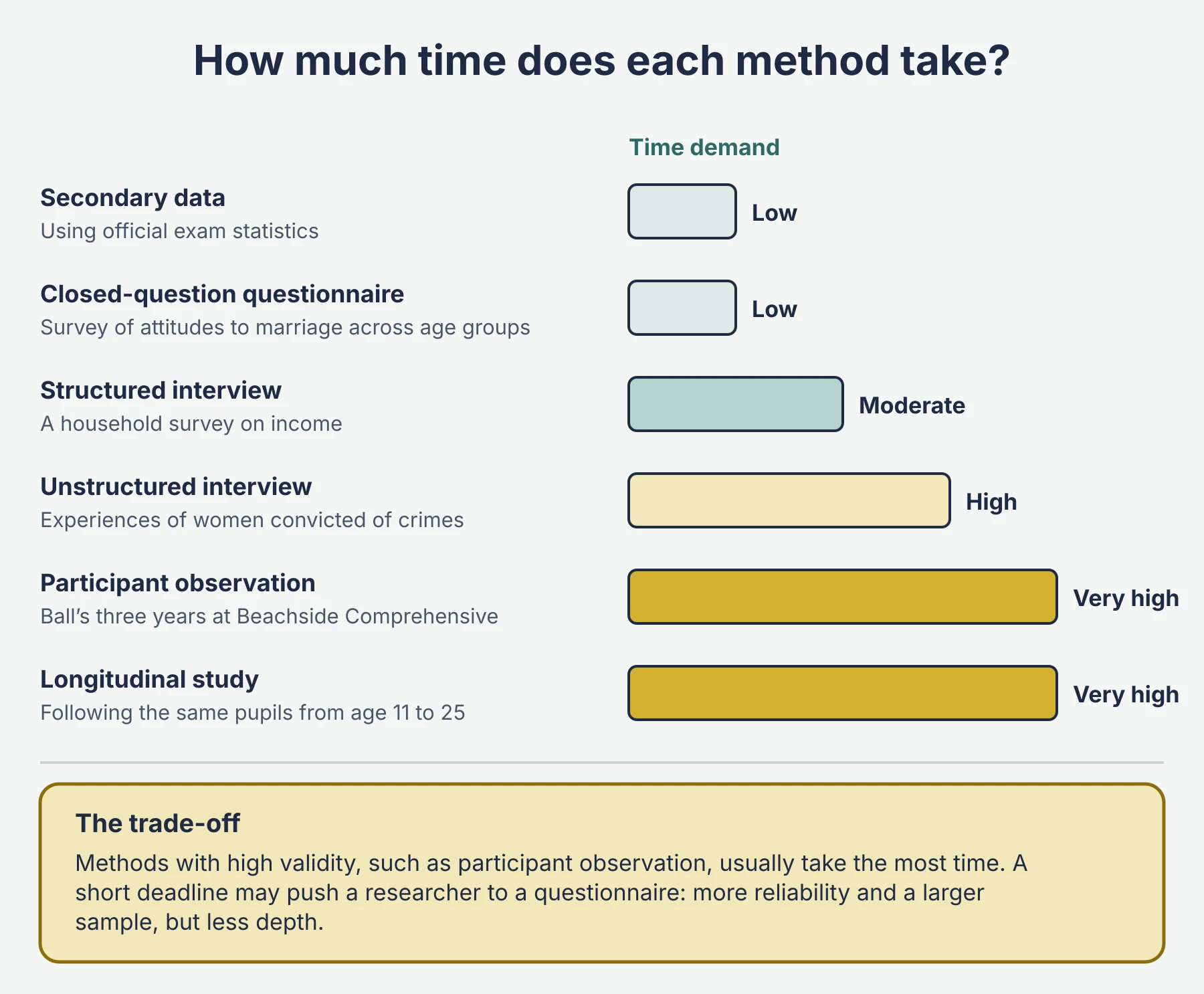
| Method | Time | Cost | Access |
|---|---|---|---|
| Postal or online questionnaire | Low | Low | Easy to distribute; low response rates |
| Structured interview | Moderate | Moderate to high (interviewers) | Needs respondents to agree to meet or call |
| Unstructured interview | High (talk and transcription) | High | Trust needed for sensitive topics |
| Focus group | Moderate | Moderate | Need to bring people together at one time |
| Participant observation | Very high | High | Must be accepted by the group; covert entry may be impossible |
| Longitudinal study | Very high | Very high | People drop out over time |
| Secondary data | Low | Low or free | Some records restricted |
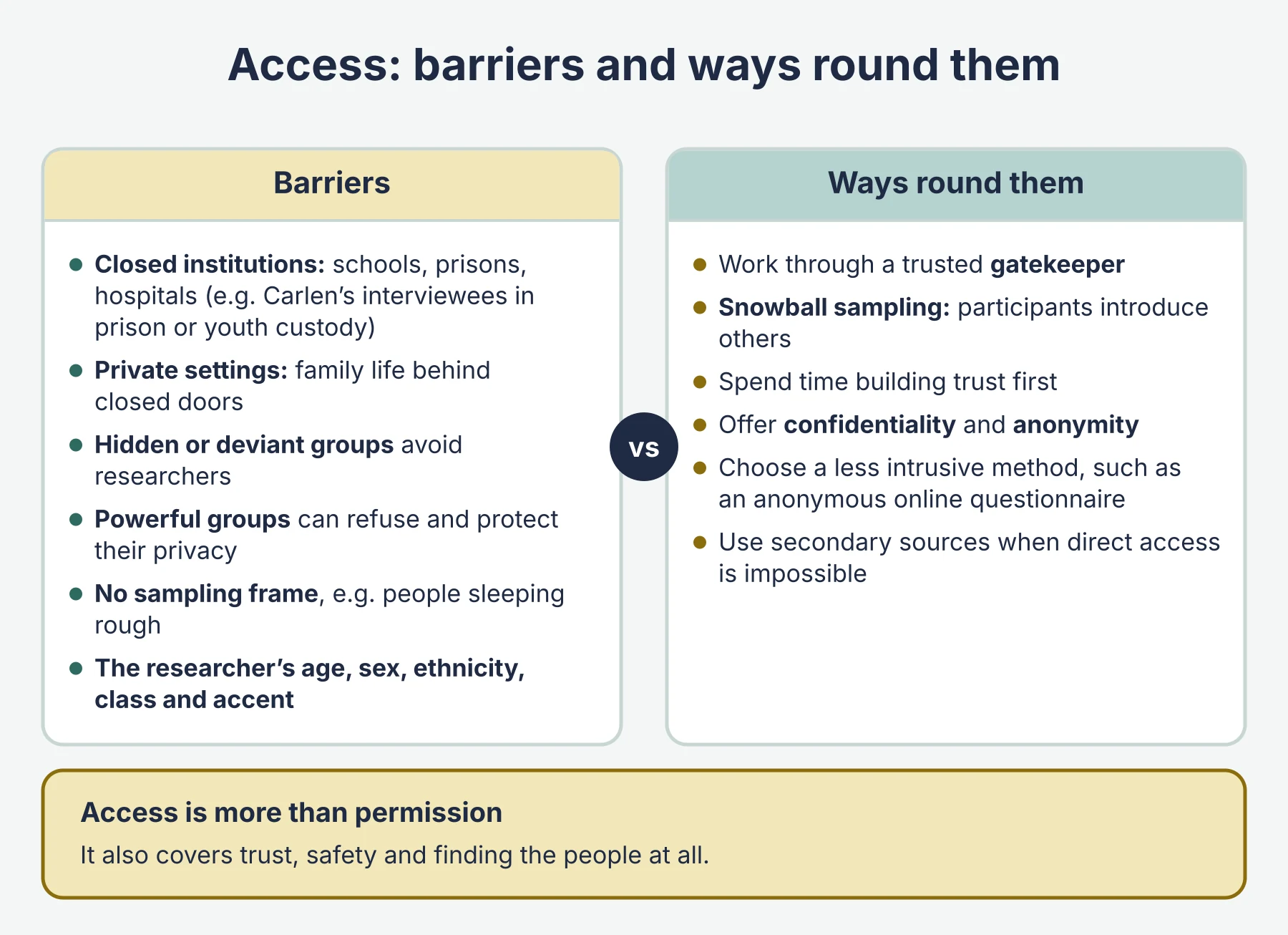
Access problems and solutions
| Problem | Example | Possible solution |
|---|---|---|
| Closed institution | School, prison, hospital | Permission from a gatekeeper; parental consent for pupils |
| Private setting | Family homes | Interviews in neutral places; anonymous questionnaires |
| Hidden group | Gangs, rough sleepers | Snowball sampling; trusted intermediary |
| Powerful group | Company directors, elites | Use published documents; formal requests |
| No sampling frame | Young runaways | Snowball or quota sampling |
| Researcher’s characteristics | Adult studying pupils | Overt role; work with youth workers |
Named studies and practical issues
- Ball: three years of fieldwork at one school; needed the school’s agreement.
- Willis: used several methods to study twelve boys; small scale made intensive work possible.
- Carlen: some interviewees were in prison or youth custody, so access depended on institutions.
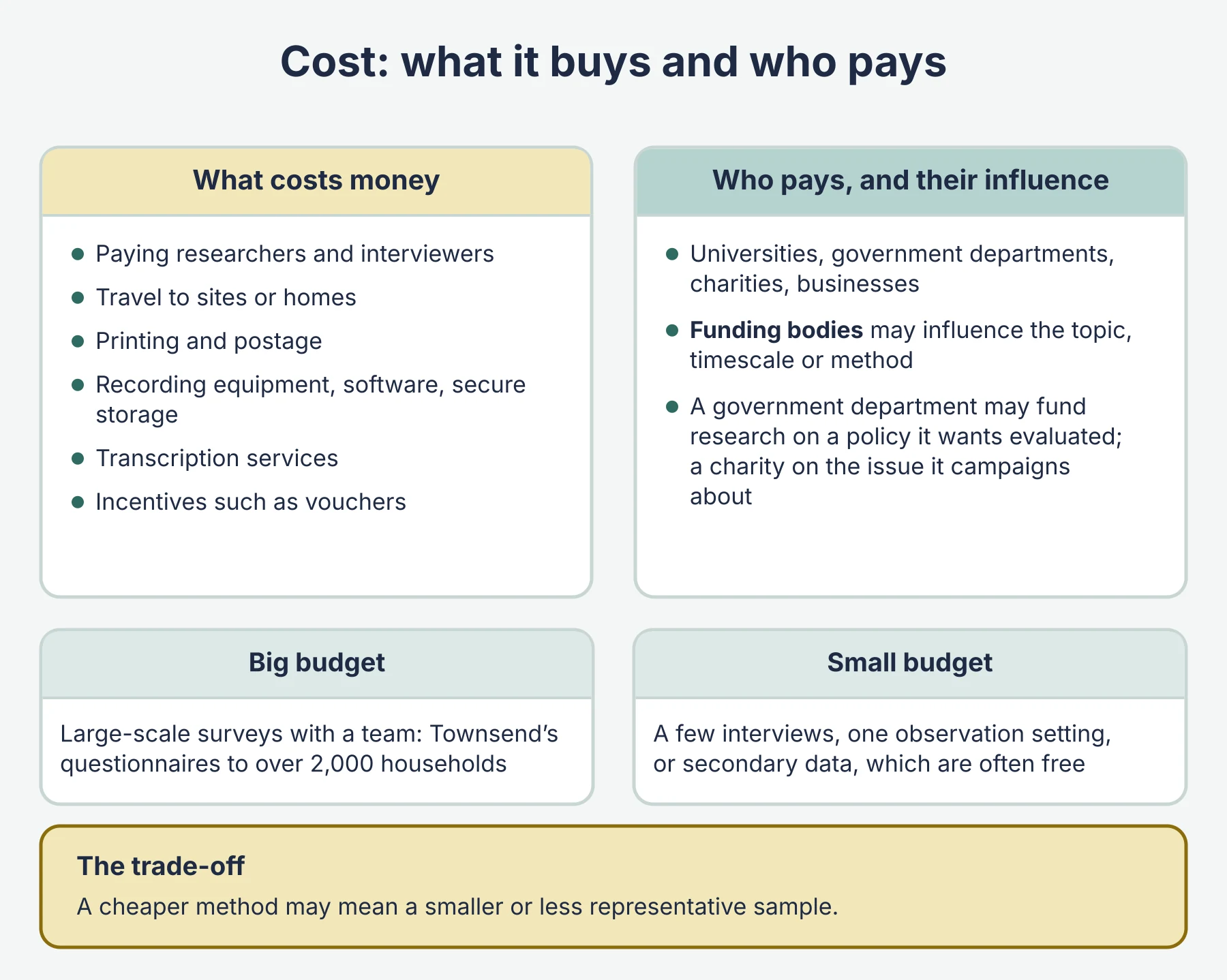
- Townsend: questionnaires to over 2,000 households required major resources.
- Halsey, Heath and Ridge: sample of over 8,000 males needed a large research operation.
- Devine: returning to Luton allowed comparison with earlier research.
Trade-offs to mention in evaluation
- Higher validity (participant observation, unstructured interviews) usually costs more time and money.
- Larger, more representative samples cost more.
- Gatekeepers give access but may limit or steer what the researcher sees.
- Secondary data save time and cost but may not fit the research aim.
Mini plan for a design answer
“Explain the practical issues in studying pupils’ experiences of exclusion.”
- Access: excluded pupils may be in pupil referral units or at home; gatekeepers such as head teachers control entry; parental consent needed.
- Trust: pupils may see a researcher as linked to the school.
- Time: unstructured interviews and transcription are slow.
- Cost: travel between units and homes; transcription.
- Solution: a small interview sample through a referral unit, plus official exclusion figures to show scale.
Exam traps
- Trap: “it is expensive” with no reason. Fix: say what costs money: interviewers, travel, transcription.
- Trap: practical and ethical issues merged. Fix: explain each separately.
- Trap: access = permission only. Fix: include trust, finding people and safety.
- Trap: generic answers. Fix: link each issue to the topic and group in the question.
- Trap: stopping at the problem. Fix: say how it affects the research or how it could be overcome.
Quick self-test
- Name the three practical issues in the specification.
- What is the difference between practical and ethical issues?
- Why do unstructured interviews take a lot of time?
- Give two things that make research expensive.
- What is a gatekeeper? Give an example.
- Give one disadvantage of relying on a gatekeeper.
- Why are powerful groups hard to access?
- How could a researcher reach a group with no sampling frame?
- How can a researcher’s age affect access?
- Why might a funding body influence research?
- Which named study involved three years of fieldwork?
- Give one practical advantage of secondary data.
Answers
- Time, cost and access.
- Practical issues concern whether research can be done; ethical issues concern whether it should be done in a particular way.
- Conversations are long and recordings must be transcribed and analysed.
- Any two of: paying interviewers, travel, printing and postage, recording equipment, transcription, incentives.
- A person who controls access to a group or setting, such as a head teacher or youth worker.
- They may restrict what the researcher sees or steer them towards certain people.
- They can refuse to take part and have the resources to protect their privacy.
- Through snowball sampling or a trusted intermediary.
- An adult cannot pass as a pupil, and young people may not trust an older researcher.
- It pays for the research and may want results on a topic or within a timescale that suits it.
- Ball’s study of Beachside Comprehensive.
- It is quick and cheap or free to use.
Specification reference
AQA GCSE Sociology (8192), section 3.7 Sociological research methods, “practical issues” row; Appendix A research key terms.
Related resources
-
Study guides
AQA GCSE Sociology (8192): Primary and secondary sources
AQA GCSE Sociology 8192 guide to primary and secondary sources: types of each, documents and content analysis, judging sources, and choosing for a topic.
Sociology · AQA · GCSE
Read guide -
Practice questions
AQA GCSE Sociology (8192): Primary and secondary sources – Practice Questions
Original AQA GCSE Sociology 8192 practice on primary and secondary sources, documents and content analysis, applied to research topics, with full answers.
Sociology · AQA · GCSE
Try questions -
Revision notes
AQA GCSE Sociology (8192): Primary and secondary sources – Revision Notes
AQA GCSE Sociology 8192 revision notes on primary and secondary sources: types, strengths, limits, judging documents, content analysis and a self-test.
Sociology · AQA · GCSE
Revise topic
Related articles
Get free revision emails (optional)
Occasional emails with practice questions, worked explanations and links to free resources for the qualification and subjects you choose. No spam, and you can unsubscribe from any email. The free tools on this site never need an email.