
Study Guides
AQA GCSE Sociology (8192): Primary and secondary sources
AQA GCSE Sociology 8192 guide to primary and secondary sources: types of each, documents and content analysis, judging sources, and choosing for a topic.
- Subject
- Sociology
- Level
- GCSE
- Topic
- Sociological research methods
- Author
- Marlbridge Academic Team
- Updated
- Reviewed by
- Naqiya Yousaf (what this means)
Aligned to AQA GCSE Sociology (8192), first teaching 2017. Official specification .
Syllabus page (what it covers and how it is assessed): AQA GCSE Sociology.
Syllabus points this page covers
8192
- Primary and secondary sources
Found an error? Report a correction.
Need help with this topic? Request a free trial class for GCSE Sociology (8192).
This guide covers the “primary and secondary sources” row of section 3.7 Sociological research methods in the AQA GCSE Sociology (8192) specification. The content row asks you to “describe and explain primary and secondary sources of data”, and the skills listed for section 3.7 add that you should “demonstrate an understanding of the relevance and usefulness of various primary and secondary sources for a specific area of research”. Methods are assessed in both Paper 1 and Paper 2.
The research methods study guide defines the two types in a few lines. This guide sorts secondary sources into their main kinds, shows how to judge a document, introduces content analysis, and explains how to choose the right mix of sources for a study. Revise with the primary and secondary sources revision notes and practise with the primary and secondary sources practice questions.
The basic distinction
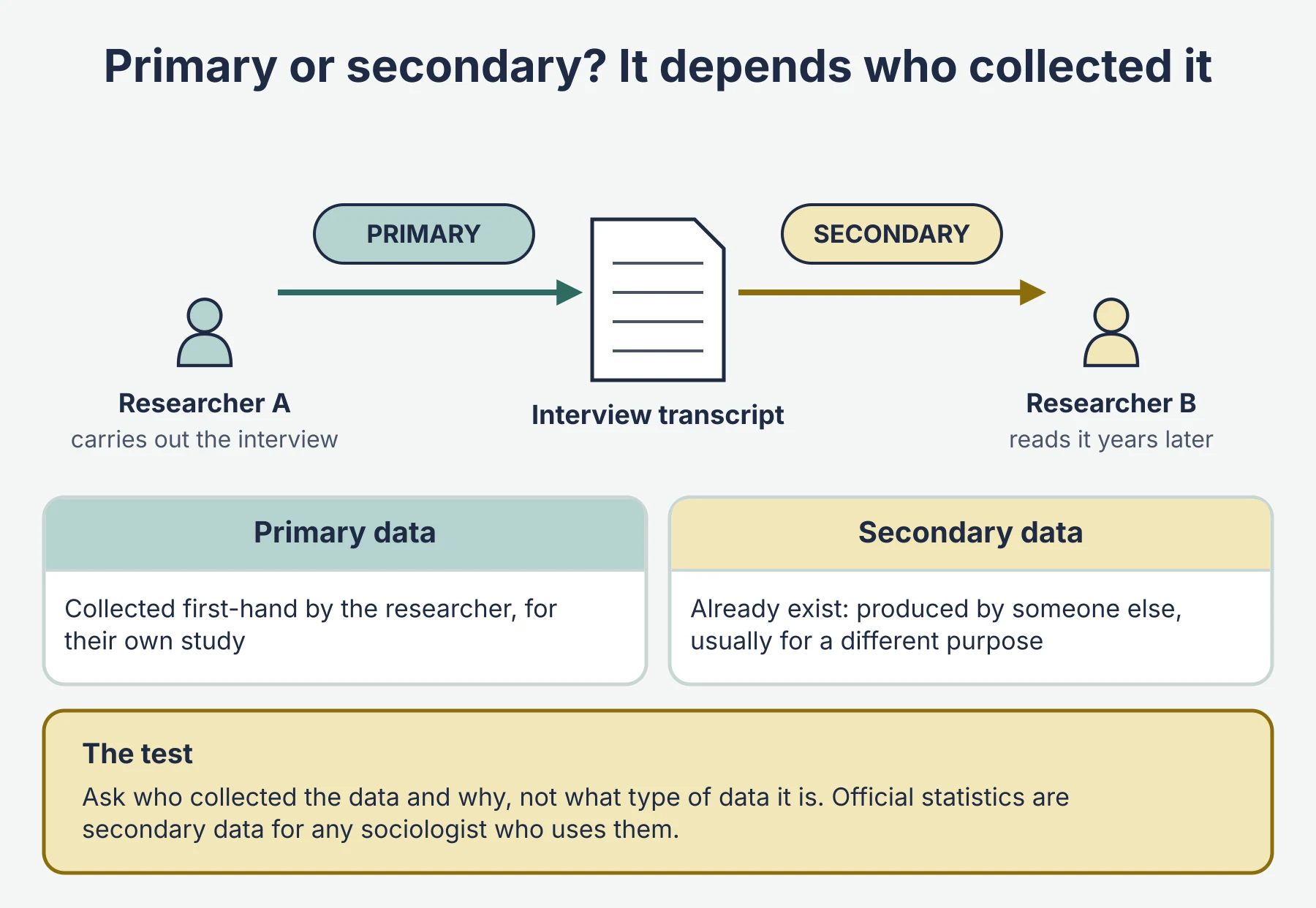
- Primary data are collected first-hand by the researcher for their own study.
- Secondary data already exist; they were produced by someone else, usually for a different purpose.
The test is who collected the data and why, not what type of data it is. An interview transcript is primary data for the researcher who carried out the interview, but secondary data for a later researcher who reads it. Official statistics are secondary data for any sociologist who uses them.
Primary sources
The main primary methods in the specification are:
- questionnaires and surveys;
- interviews, structured and unstructured, including focus groups;
- observation, participant and non-participant, overt and covert.
Strengths of primary data
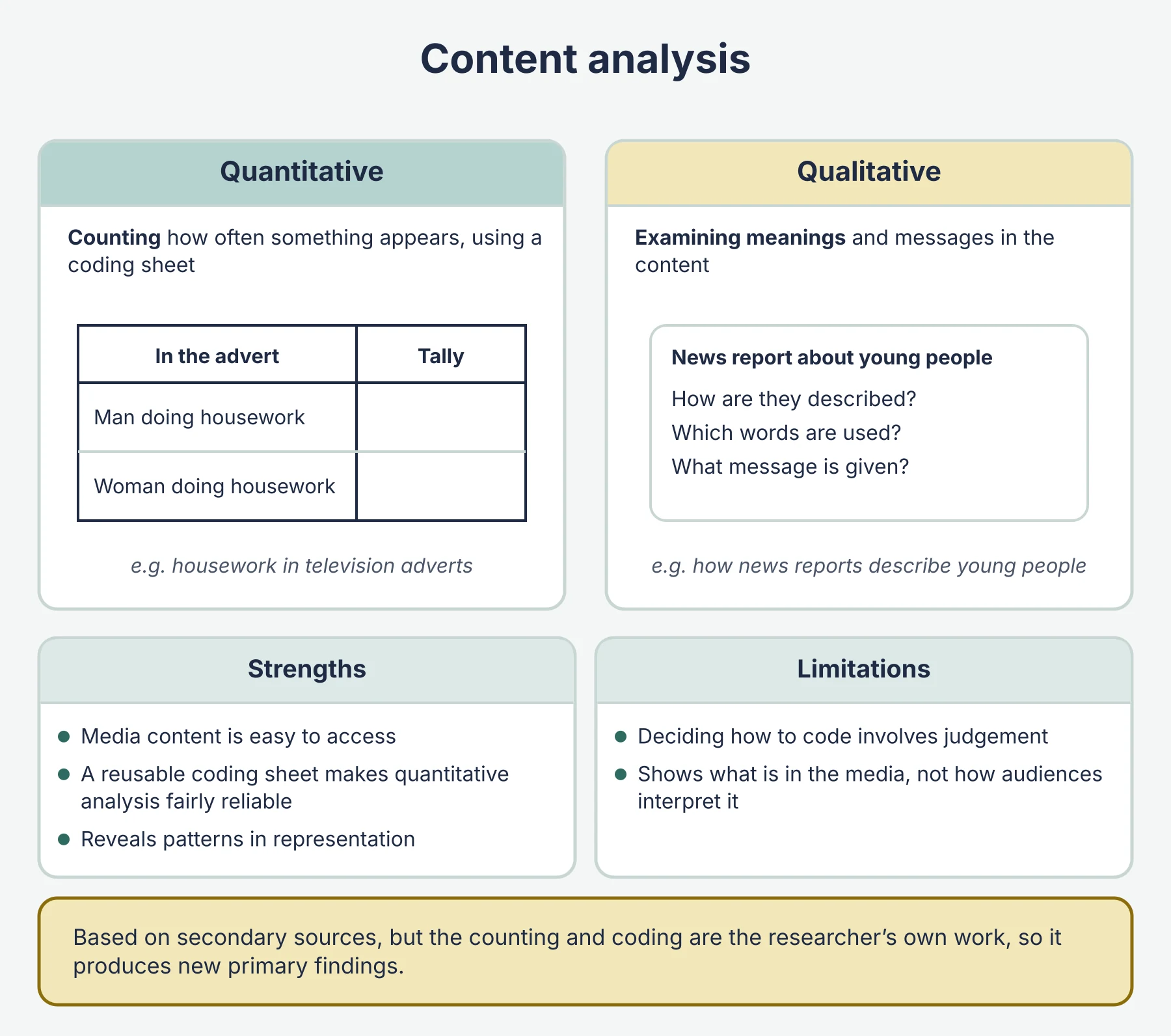
- They fit the research aim exactly, because the researcher designs the questions or chooses what to observe.
- The researcher knows how the data were collected, so can judge their reliability and validity.
- They can be up to date.
- The researcher controls the sample.
Limitations of primary data
- They take time and cost money: designing, piloting, sampling, collecting and analysing.
- Access to some groups is difficult.
- Ethical issues must be managed directly by the researcher.
- They cannot usually reach the past.
Secondary sources
Main kinds
| Kind | Examples | Typical use |
|---|---|---|
| Official statistics | Census, exam results, recorded crime, divorce figures | Patterns and trends across the country |
| Previous research | Published studies, such as Goldthorpe and Lockwood’s 1960s Luton study | Comparison, background, testing earlier findings |
| Public documents | Government reports, school policies, inspection reports, court records | How institutions describe and organise themselves |
| Personal documents | Diaries, letters, autobiographies, personal blogs and social media posts | People’s own experiences and feelings |
| Historical documents | Old registers, records and letters | Social change over long periods |
| Mass media | Newspapers, television, websites, advertisements | How groups and issues are represented |
Strengths of secondary data
- Quick and cheap, often free.
- Can cover very large groups, sometimes a whole population.
- May be the only way to study the past.
- Avoid some ethical problems, because no new participants are involved.
- Allow comparison over time, as when Devine compared her new research with the earlier Luton study.
Limitations of secondary data
- Collected for another purpose, so they may not answer the researcher’s question.
- Definitions may differ from those the researcher needs, as Townsend found with the state standard of poverty.
- The researcher may not know how the data were collected.
- Documents may be biased, incomplete or written for an audience.
- Data may be out of date.
Judging a document: four questions
When you assess a document, such as a diary, a letter or a school report, ask:
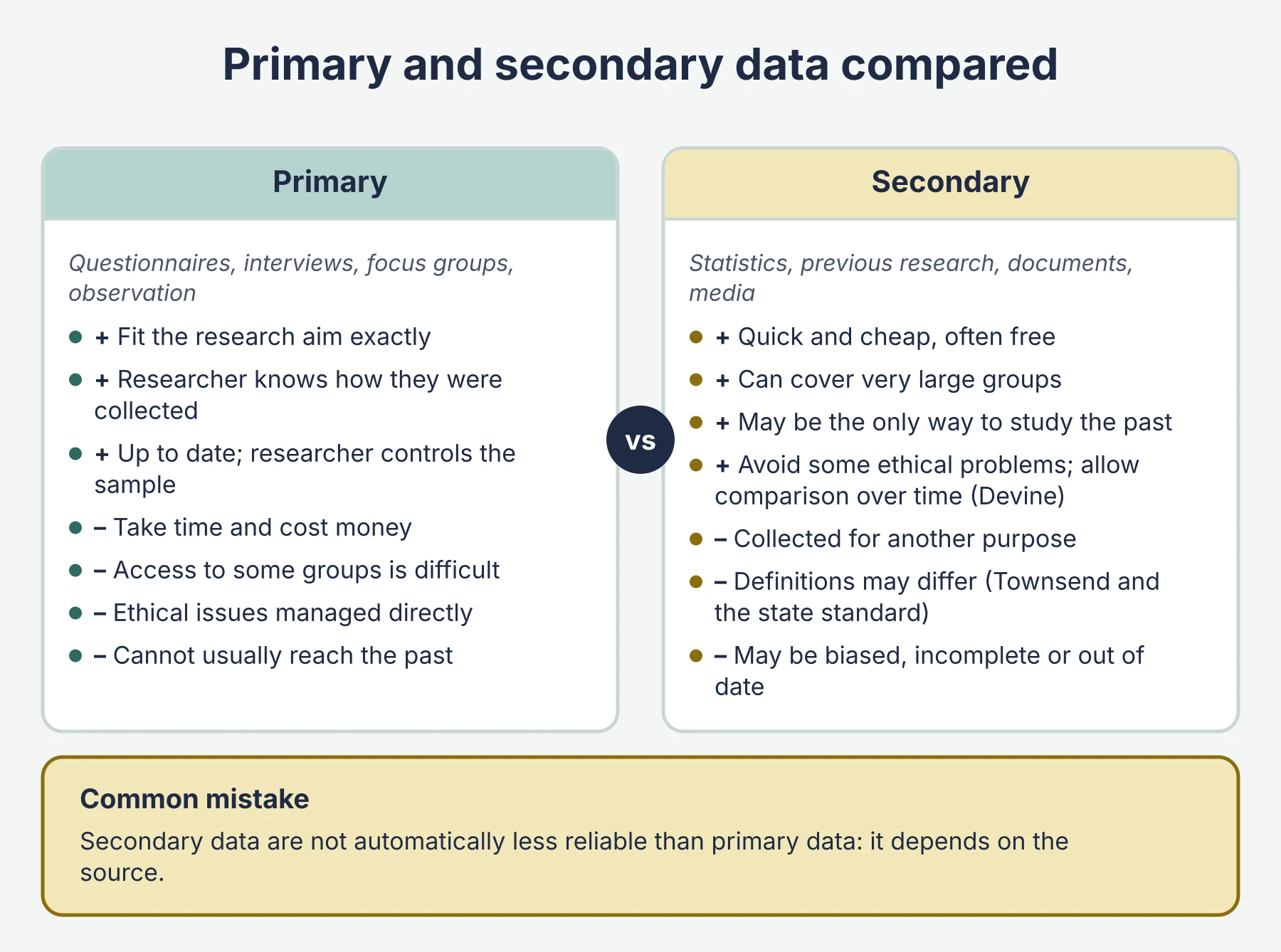
- Is it genuine? Is it what it claims to be, and written by the person it claims?
- Is it believable? Was the author sincere and accurate, or writing to impress, persuade or protect themselves?
- Is it typical? Does it represent a wider group, or just one person or organisation?
- Is its meaning clear? Can the researcher understand what the author meant, especially in older documents or texts using slang?
A school’s published behaviour policy, for example, is genuine and clear, but may describe how the school wants to be seen rather than what actually happens in classrooms.
Content analysis
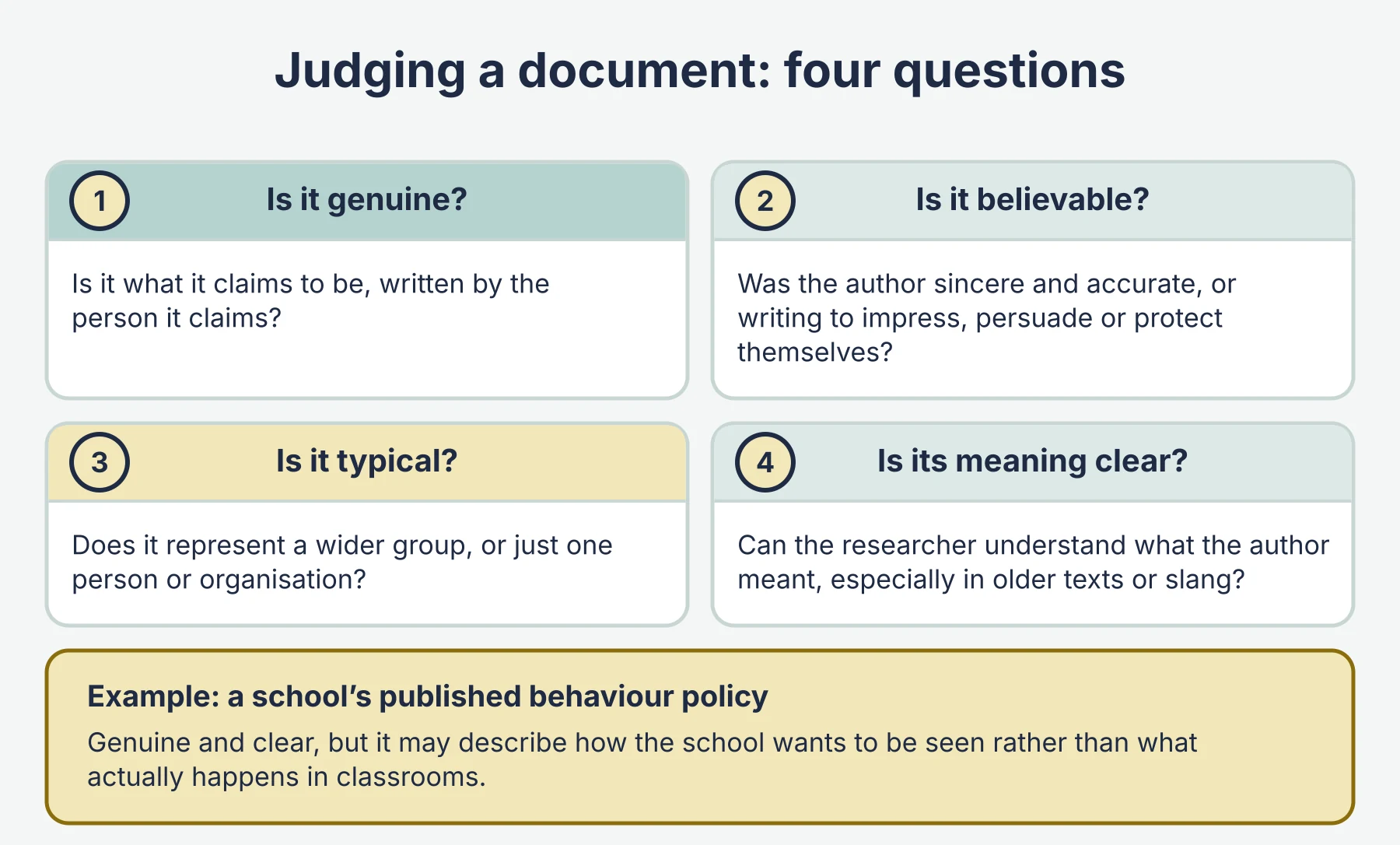
Content analysis is the systematic study of documents or media content. It can be:
- quantitative: counting how often something appears, using a coding sheet, such as the number of times men and women are shown doing housework in television adverts;
- qualitative: examining the meanings and messages in the content, such as how news reports describe young people.
Strengths: media content is easy to access; the coding sheet can be reused, so quantitative content analysis is fairly reliable; it reveals patterns in representation.
Limitations: deciding how to code content involves judgement; it shows what is in the media, not how audiences interpret it.
Content analysis is usually based on secondary sources, but the counting and coding are the researcher’s own work, so it produces new primary findings from secondary material.
Combining sources
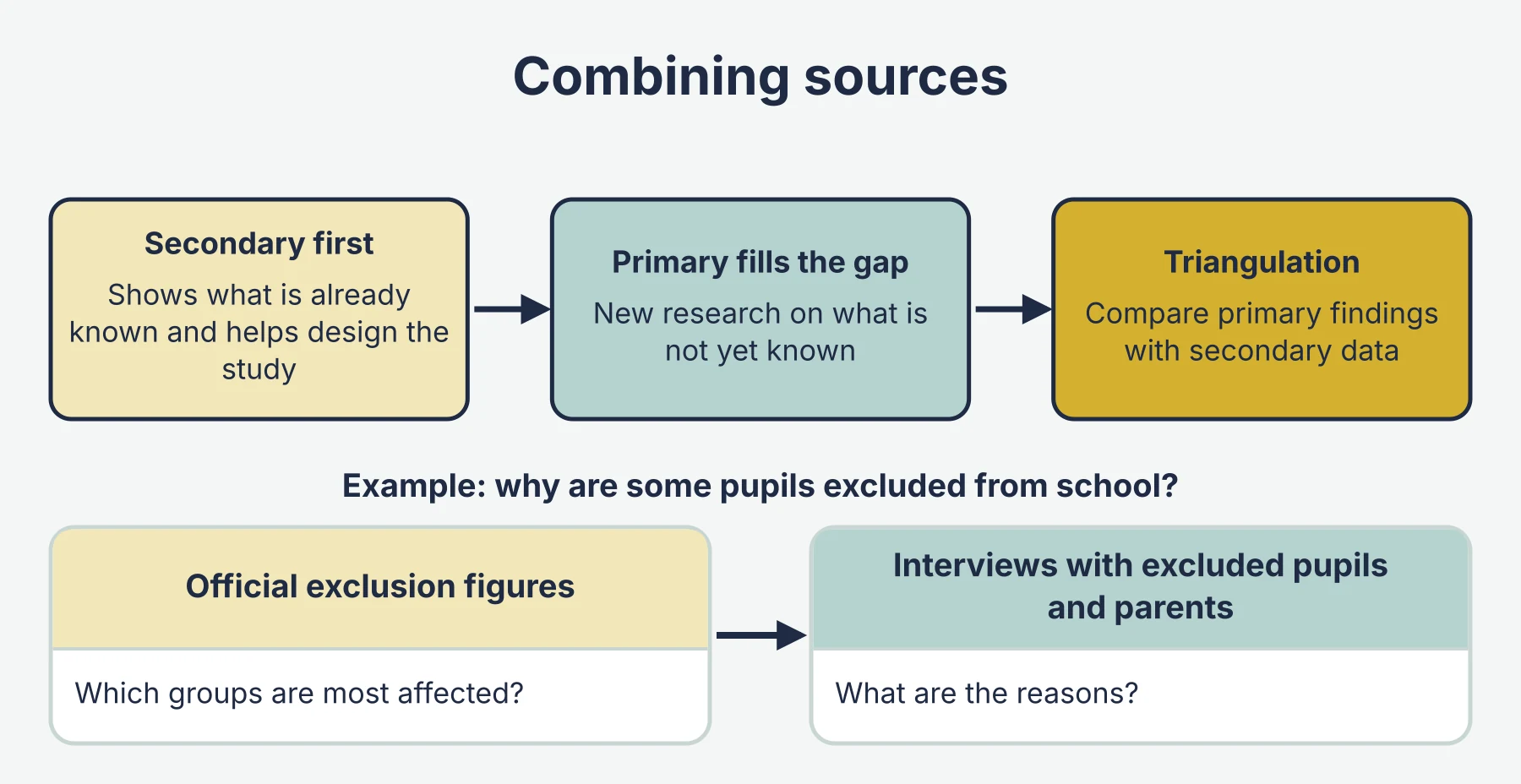
Most studies use both types:
- secondary sources help design the study by showing what is already known;
- primary research then fills the gap;
- comparing primary findings with secondary data allows triangulation.
Example: a study of why some pupils are excluded from school might begin with official exclusion figures to see which groups are most affected, then interview excluded pupils and their parents to understand the reasons.
Worked example: choosing sources for a specific area
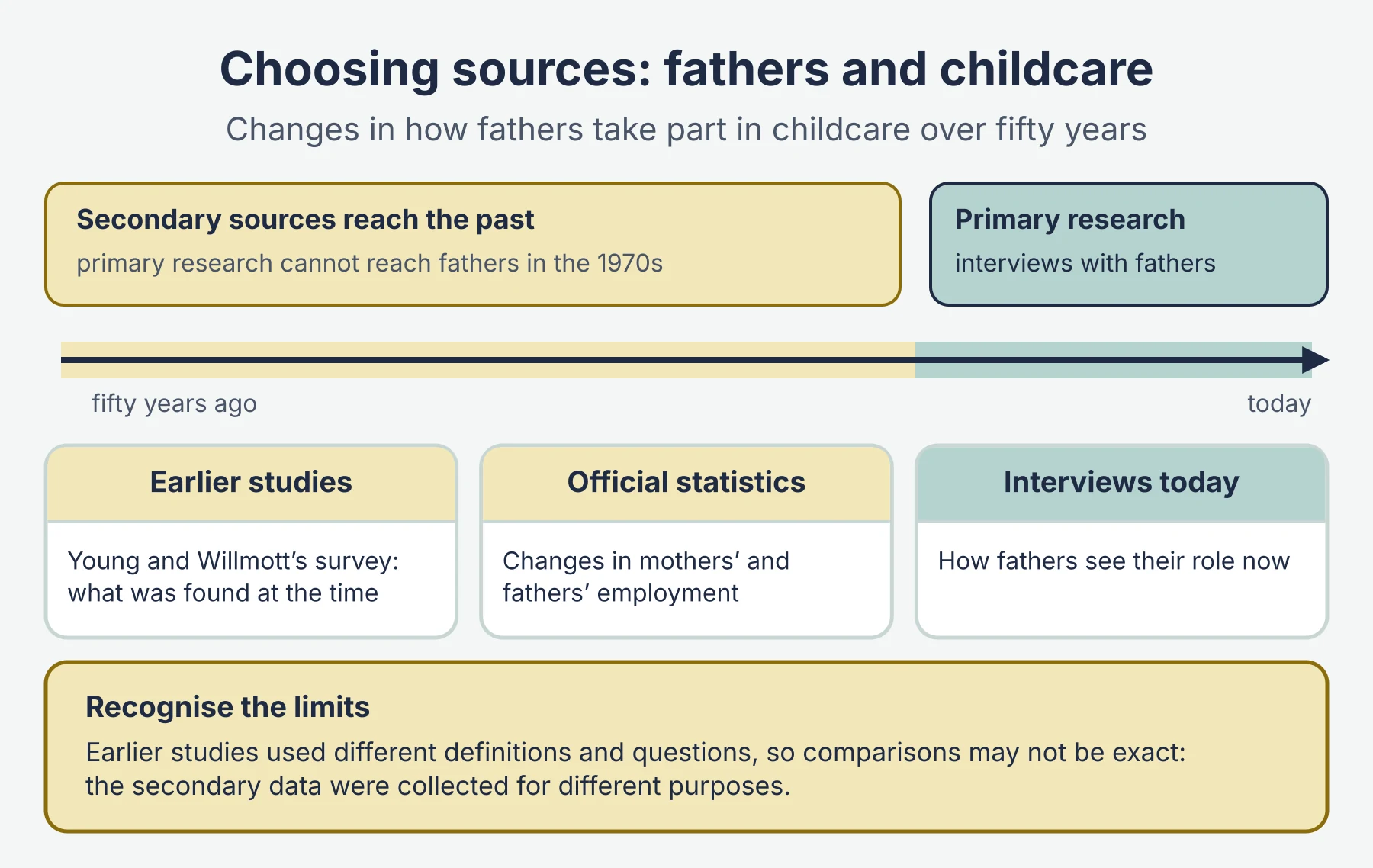
Area: changes in how fathers take part in childcare over the past fifty years.
The researcher could use secondary sources to cover the past, because primary research cannot reach fathers in the 1970s. Earlier studies of family life, such as Young and Willmott’s survey, show what was found at the time, and official statistics on working patterns show changes in mothers’ and fathers’ employment. However, earlier studies used different definitions and questions, so comparisons may not be exact. Primary research, such as interviews with fathers today, would show how they see their role now. Combining the two allows the researcher to compare past and present, while recognising that the secondary data were collected for different purposes.
Common mistakes
- Saying “secondary data are less reliable than primary data”. It depends on the source.
- Defining primary data as “data you get from people”. Secondary documents also come from people.
- Forgetting that the same data can be primary for one researcher and secondary for another.
- Describing documents without assessing them: always ask whether they are genuine, believable, typical and clear.
- Treating media content as an accurate picture of society.
Exam technique
- Describe a source by naming its type and an example.
- Explain why it is useful or limited for the area of research in the question.
- In extended answers, compare primary and secondary sources for that area, consider practical and ethical issues, and recommend a combination with reasons.
Frequently asked questions
Is a diary primary or secondary data? For a sociologist who reads someone else’s diary, it is a secondary source, because it was written by another person for their own purposes.
Why might a sociologist use secondary data? To save time and money, to study the past, to cover large groups, or to compare new findings with earlier research.
Specification reference
AQA GCSE Sociology (8192), section 3.7 Sociological research methods, “primary and secondary sources” row, with research key terms in Appendix A.
Related resources
-
Practice questions
AQA GCSE Sociology (8192): Primary and secondary sources – Practice Questions
Original AQA GCSE Sociology 8192 practice on primary and secondary sources, documents and content analysis, applied to research topics, with full answers.
Sociology · AQA · GCSE
Try questions -
Revision notes
AQA GCSE Sociology (8192): Primary and secondary sources – Revision Notes
AQA GCSE Sociology 8192 revision notes on primary and secondary sources: types, strengths, limits, judging documents, content analysis and a self-test.
Sociology · AQA · GCSE
Revise topic -
Study guides
AQA GCSE Sociology (8192): Qualitative and quantitative methods
AQA GCSE Sociology 8192 guide to questionnaires, interviews and observation: how each works, when to use it, strengths and weaknesses, and mixed methods.
Sociology · AQA · GCSE
Read guide
Related articles
Get free revision emails (optional)
Occasional emails with practice questions, worked explanations and links to free resources for the qualification and subjects you choose. No spam, and you can unsubscribe from any email. The free tools on this site never need an email.