
Study Guides
AQA GCSE Sociology (8192): Qualitative and quantitative methods
AQA GCSE Sociology 8192 guide to questionnaires, interviews and observation: how each works, when to use it, strengths and weaknesses, and mixed methods.
- Subject
- Sociology
- Level
- GCSE
- Topic
- Sociological research methods
- Author
- Marlbridge Academic Team
- Updated
- Reviewed by
- Naqiya Yousaf (what this means)
Aligned to AQA GCSE Sociology (8192), first teaching 2017. Official specification .
Syllabus page (what it covers and how it is assessed): AQA GCSE Sociology.
Syllabus points this page covers
8192
- Qualitative and quantitative methods
Found an error? Report a correction.
Need help with this topic? Request a free trial class for GCSE Sociology (8192).
This guide covers the “qualitative and quantitative methods” row of section 3.7 Sociological research methods in the AQA GCSE Sociology (8192) specification. The specification asks you to “describe and explain qualitative and quantitative methods (questionnaires, interviews, observations) and assess the value, application, and strengths and weaknesses of different methods”, and to “assess the usefulness of the mixed methods approach”. Methods are assessed in both Paper 1 and Paper 2, and questions usually ask about a method “for a specific area of research”.
The research methods study guide describes each method briefly. This guide goes further into the decisions a researcher makes inside each method, how to match a method to a topic, and how to evaluate a method in an extended answer. Revise with the qualitative and quantitative methods revision notes and practise with the qualitative and quantitative methods practice questions.
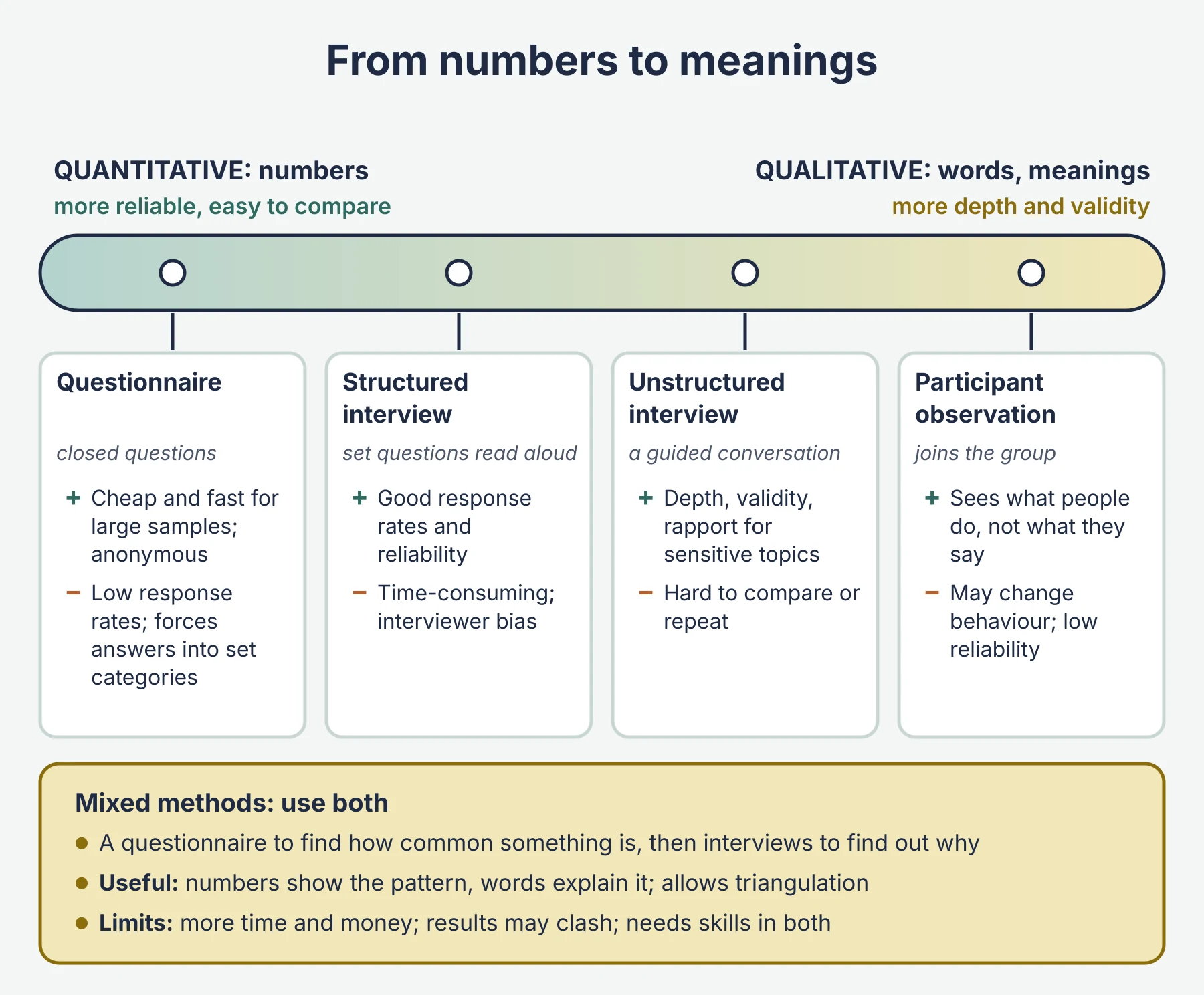
Quantitative and qualitative: the core contrast
| Quantitative methods | Qualitative methods | |
|---|---|---|
| Produce | Numbers and statistics | Words, meanings, descriptions |
| Typical methods | Closed-question questionnaires, structured interviews | Unstructured interviews, participant observation |
| Strength | Reliability: easy to repeat and compare | Validity: a true, detailed picture of what is studied |
| Weakness | May miss meaning and context | Hard to compare, repeat or generalise |
| Answers | “How many?” “How often?” “Is there a pattern?” | “Why?” “How do people experience this?” |
Use the words reliability, validity and representativeness in every evaluation. They are the three tests examiners expect you to apply.
Questionnaires
A questionnaire is a list of written questions answered by respondents.
Decisions inside the method
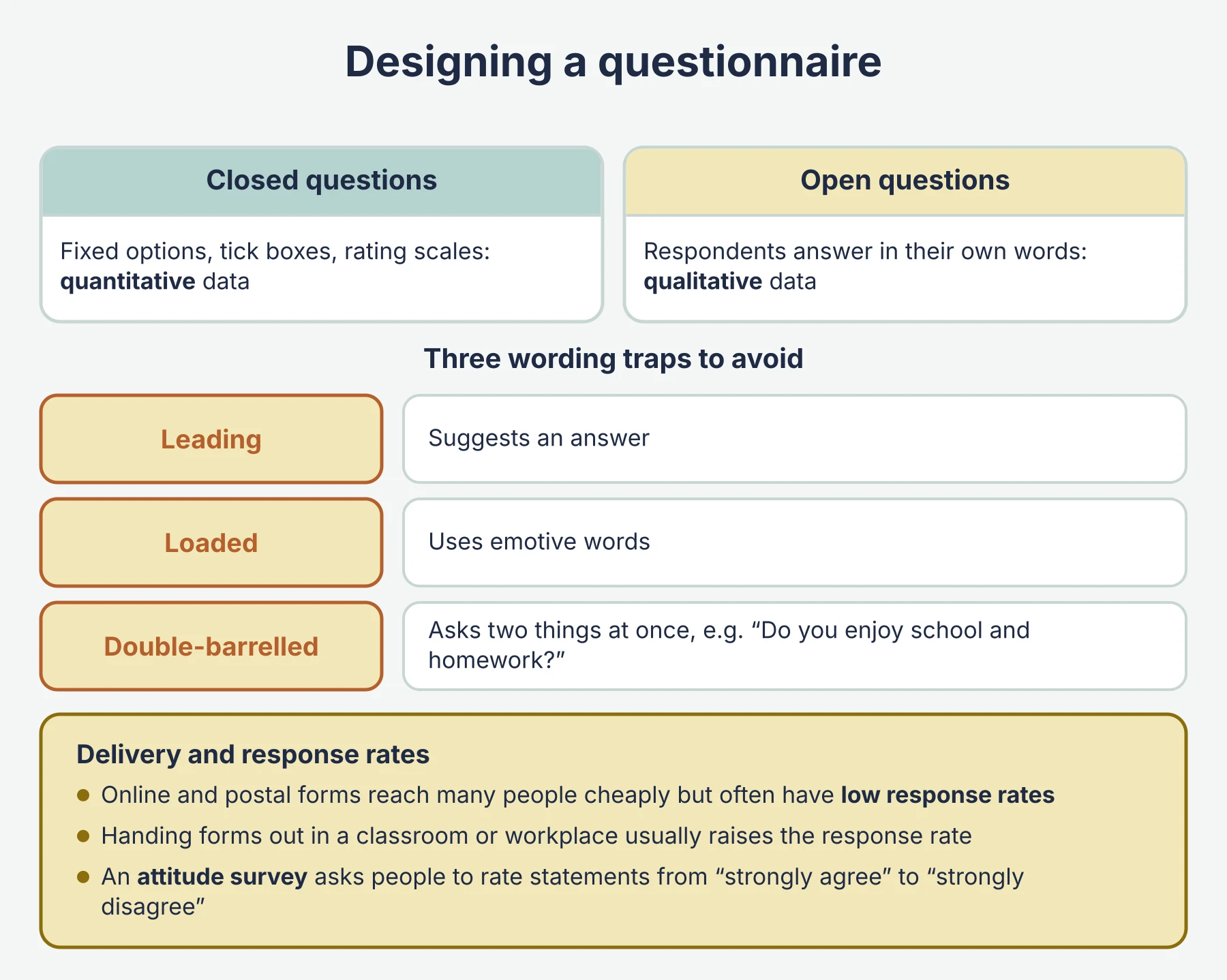
- Delivery: handed out in person, posted, emailed or completed online. Online and postal forms reach many people cheaply but often have low response rates. Handing forms out in a classroom or workplace usually raises the response rate.
- Question type: closed questions (fixed options, tick boxes, rating scales) produce quantitative data; open questions produce qualitative data.
- Attitude scales: an attitude survey asks respondents to rate agreement with statements, from “strongly agree” to “strongly disagree”.
- Wording: questions must avoid being leading (suggesting an answer), loaded (using emotive words) or double-barrelled (asking two things at once, such as “Do you enjoy school and homework?”).
Value and application
Questionnaires suit research that needs a large sample and comparable answers, such as attitudes to marriage across age groups, or how many parents use private tutoring. Townsend used questionnaires because he needed data from thousands of households to build a deprivation index.
Strengths and weaknesses
- Strengths: cheap per respondent; quick to analyse; reliable because every respondent gets the same questions; anonymity may encourage honesty about private behaviour.
- Weaknesses: low response rates can make the sample unrepresentative; closed questions impose the researcher’s categories; respondents cannot ask what a question means; people may give socially desirable answers, choosing what sounds acceptable rather than what is true; the researcher cannot check whether the right person completed the form.
Interviews
An interview is a conversation in which the researcher asks questions and records the answers.
Types
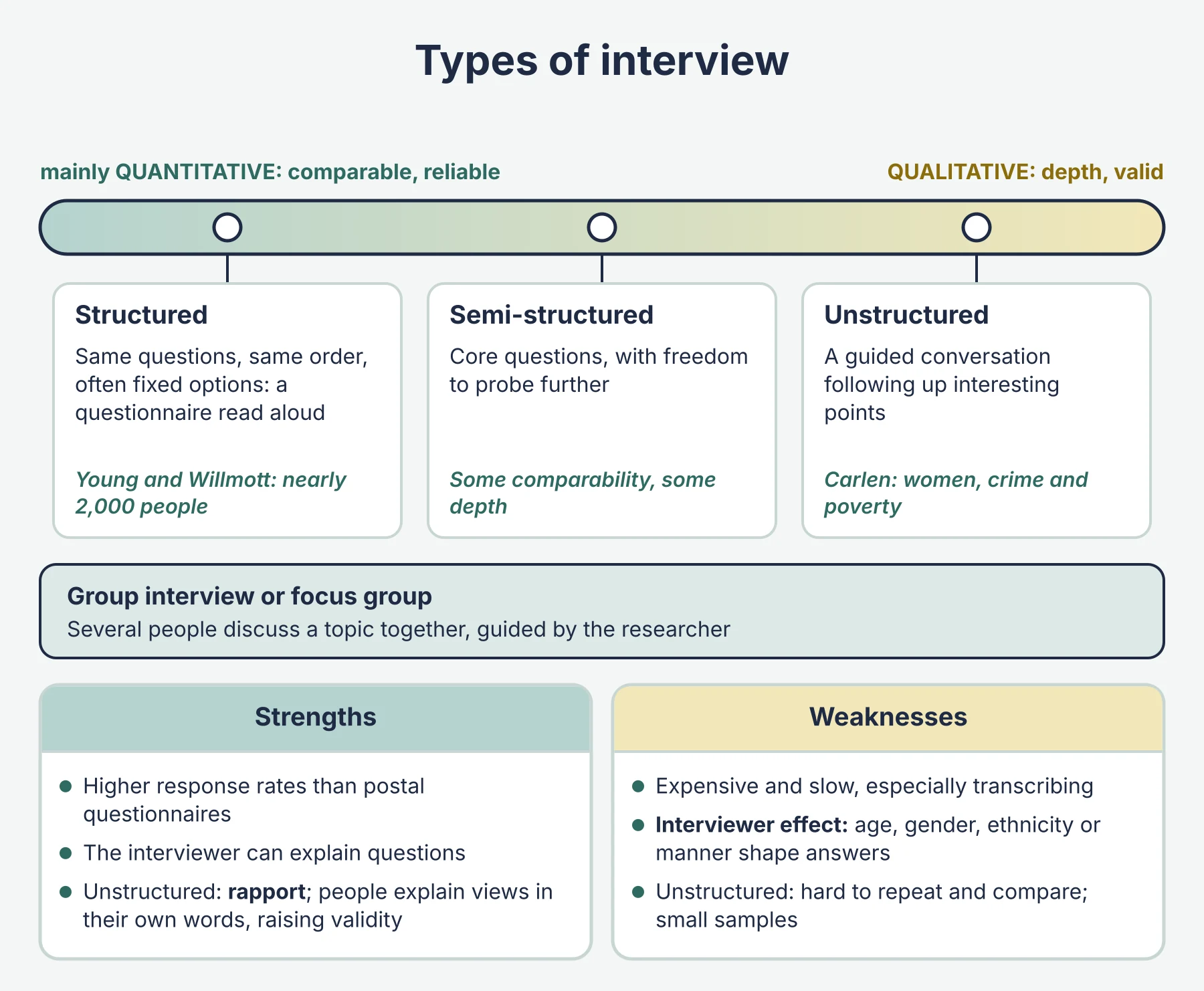
- Structured interview: the same questions, in the same order, often with fixed answer options. It is effectively a questionnaire read aloud and produces mainly quantitative data.
- Unstructured interview: a guided conversation in which the interviewer follows up interesting points. It produces qualitative data.
- Semi-structured interview: a set list of core questions, with freedom to probe further. It combines some comparability with some depth.
- Group interview or focus group: several people discuss a topic together, guided by the researcher.
Value and application
Unstructured interviews suit sensitive or complex topics where trust and depth matter, such as women’s experiences of crime and poverty, which Carlen explored through in-depth, unstructured interviews. Structured interviews suit large surveys where responses must be counted, as in Young and Willmott’s survey of nearly 2,000 people.
Strengths and weaknesses
- Strengths: higher response rates than postal questionnaires; the interviewer can explain questions; unstructured interviews build rapport and allow people to explain their views in their own words, increasing validity.
- Weaknesses: expensive and time-consuming, especially transcribing; interviewer bias or the interviewer effect, where the interviewer’s age, gender, ethnicity or manner shapes answers; unstructured interviews are hard to repeat and compare, so reliability is low; samples are usually small.
Observation
Observation means watching and recording behaviour.
Types
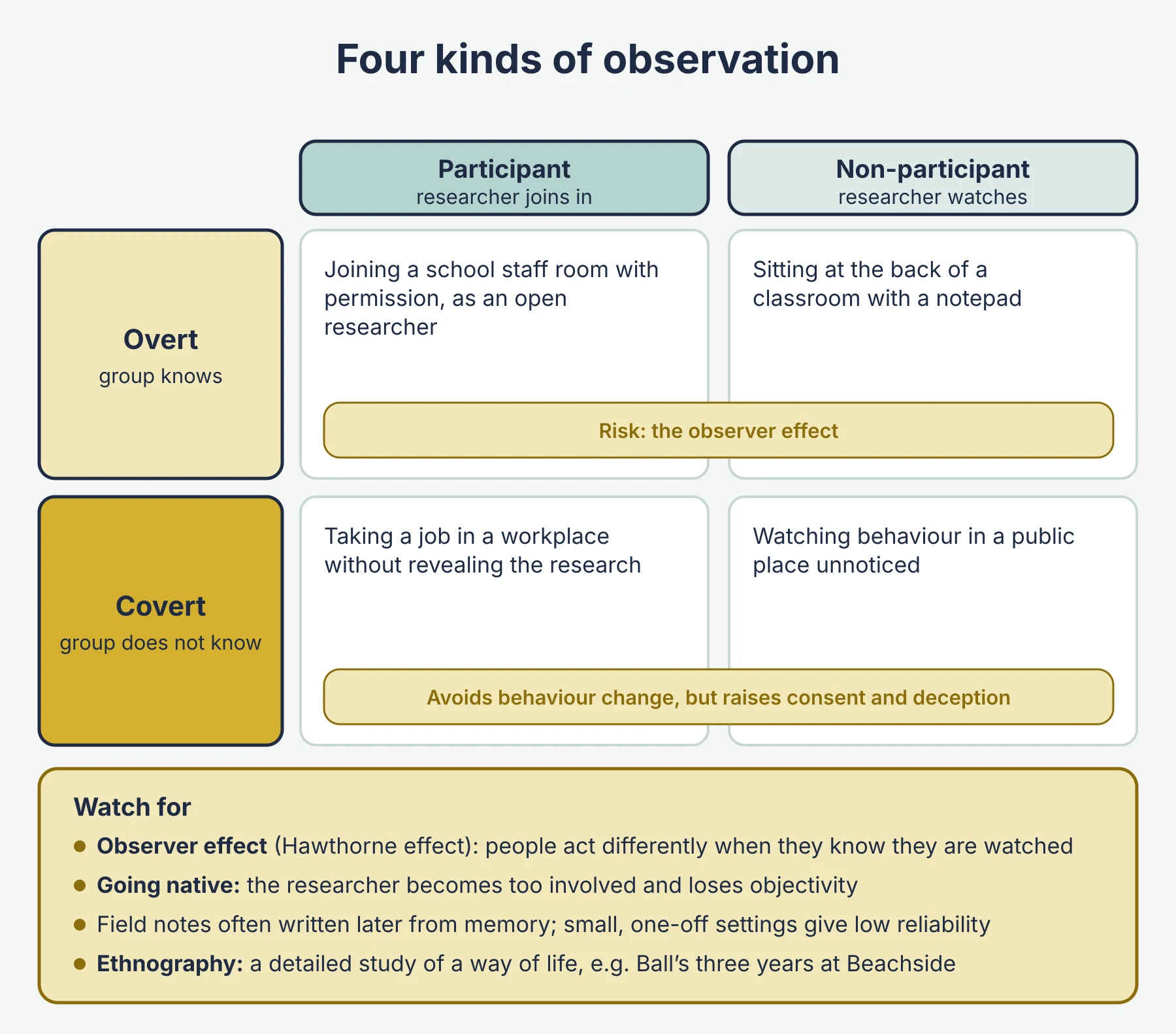
| Overt (group knows) | Covert (group does not know) | |
|---|---|---|
| Participant (researcher joins in) | Joining a school staff room with permission, as an open researcher | Taking a job in a workplace without revealing the research |
| Non-participant (researcher watches) | Sitting at the back of a classroom with a notepad | Watching behaviour in a public place unnoticed |
An ethnography is a detailed study of a group’s way of life, usually by long-term participant observation. Ball’s three years at Beachside Comprehensive is an example.
Value and application
Observation suits topics where what people do may differ from what they say, such as classroom interaction, pupil subcultures or behaviour in gangs. It also suits groups unlikely to fill in questionnaires.
Strengths and weaknesses
- Strengths: high validity, because behaviour is seen in its natural setting; the researcher may discover issues they had not thought to ask about; covert observation avoids people changing their behaviour.
- Weaknesses: in overt observation people may act differently because they know they are watched (the observer effect, sometimes called the Hawthorne effect after studies in a US factory in the 1920s and 1930s); the researcher may become too involved and lose objectivity, known as going native; recording is difficult, as field notes are often written later from memory; covert work raises serious ethical issues of consent and deception; small groups and one-off settings give low reliability and representativeness.
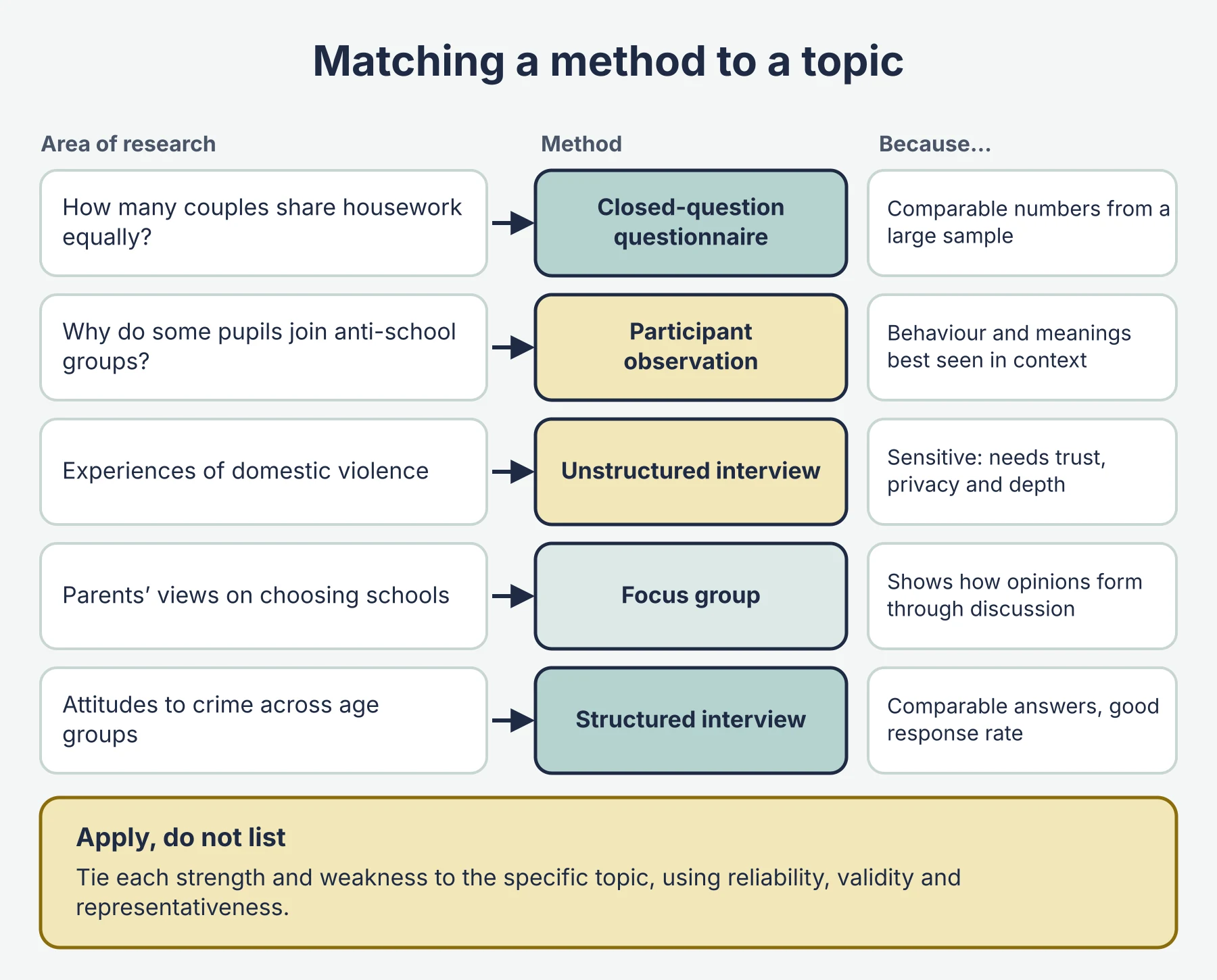
Matching a method to a topic
| Area of research | Suitable method | Reason |
|---|---|---|
| How many couples share housework equally | Closed-question questionnaire | Needs comparable numbers from a large sample |
| Why some pupils join anti-school groups | Participant observation | Behaviour and meanings are best seen in context |
| Experiences of domestic violence | Unstructured interview | Sensitive; needs trust, privacy and depth |
| Parents’ views on choosing schools | Focus group | Shows how opinions form through discussion |
| Attitudes to crime across age groups | Structured interview | Comparable answers with a good response rate |
Mixed methods
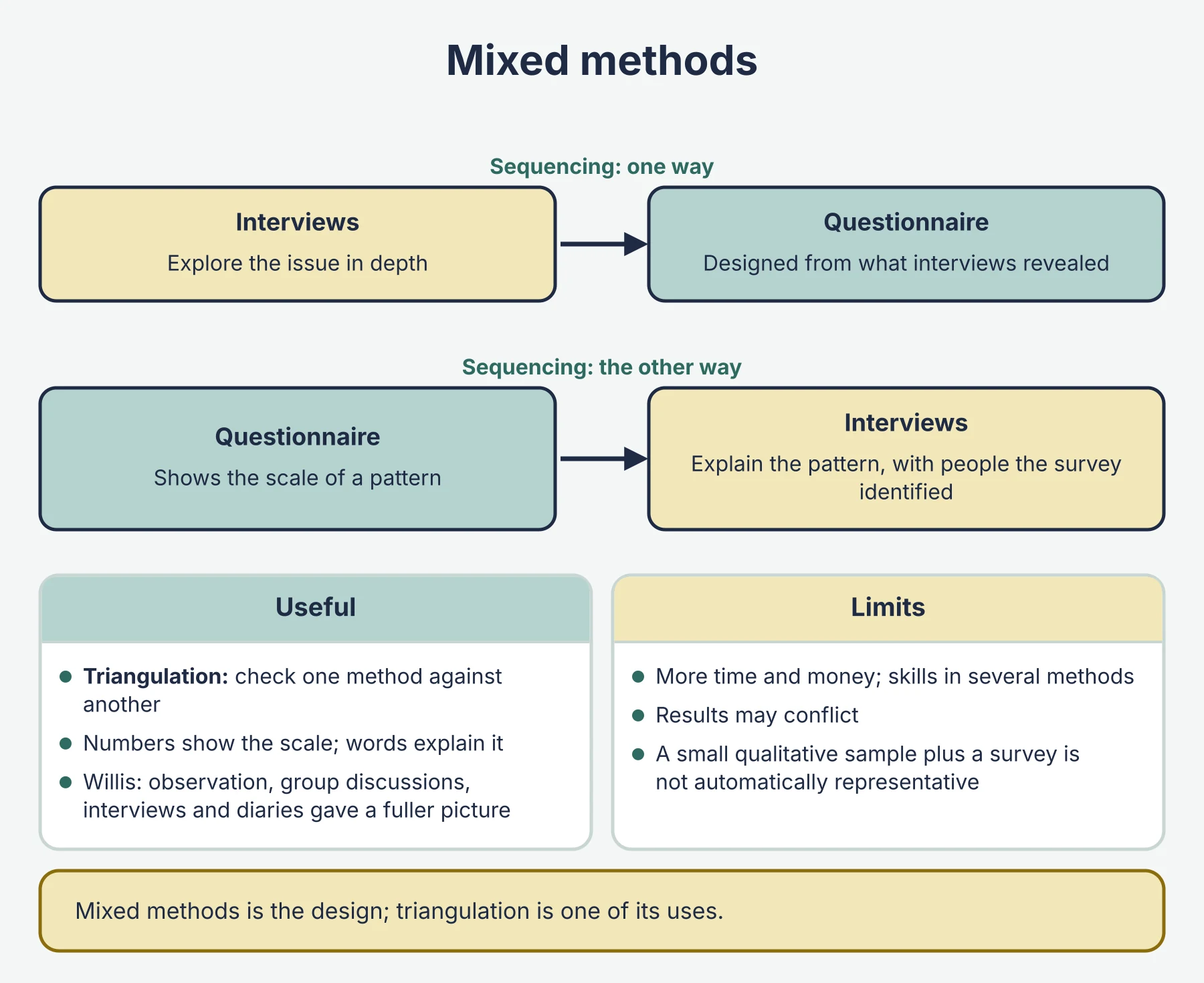
Mixed methods research combines quantitative and qualitative methods in one study.
Usefulness:
- Triangulation: checking findings from one method against another.
- Complementary strengths: numbers show the scale of a pattern; words explain it.
- Sequencing: interviews can help design a questionnaire, or a questionnaire can identify people to interview in depth.
- Willis combined observation, participant observation, group discussions, informal interviews and diaries, giving a fuller picture of the lads’ school lives.
Limitations:
- Costs more time and money.
- The researcher needs skills in several methods.
- Results from different methods may conflict, and it may be unclear which to trust.
- Combining a small qualitative sample with a survey does not automatically make the whole study representative.
Annotated model paragraph
Point: Unstructured interviews would be useful for studying why women leave violent relationships. Application: This topic is private and painful, so a woman is more likely to explain her reasons to an interviewer she trusts than tick boxes on a form. Analysis: Rapport allows the interviewer to follow up hesitant answers, which increases validity. Evaluation: However, the interviewer’s own characteristics could affect what is said, and a small sample of women willing to talk may not represent all women in this situation.
The paragraph ties every strength and weakness to the specific topic. That is what the specification means by “application”.
Common mistakes
- Calling interviews “qualitative” without saying which type. Structured interviews are mainly quantitative.
- Listing strengths and weaknesses that would apply to any topic.
- Saying observation is “unbiased”. The observer chooses what to record.
- Confusing mixed methods with triangulation. Mixed methods is the design; triangulation is one of its uses.
Exam technique
- Identify a method precisely (“unstructured interview”, not “interview”).
- Explain a strength or weakness by naming the concept (validity, reliability, representativeness) and linking it to the topic.
- In discuss how far or evaluate answers, compare the method with at least one alternative and reach a judgement about fitness for the topic.
Specification reference
AQA GCSE Sociology (8192), section 3.7 Sociological research methods, “qualitative and quantitative methods” row, with research key terms in Appendix A and the study summaries in Appendix B.
Related resources
-
Practice questions
AQA GCSE Sociology (8192): Qualitative and quantitative methods – Practice Questions
Original AQA GCSE Sociology 8192 practice on questionnaires, interviews, observation and mixed methods, applied to research topics, with mark-scheme answers.
Sociology · AQA · GCSE
Try questions -
Revision notes
AQA GCSE Sociology (8192): Qualitative and quantitative methods – Revision Notes
AQA GCSE Sociology 8192 revision notes on questionnaires, interviews, observation and mixed methods: key terms, evaluation grids, exam traps and a self-test.
Sociology · AQA · GCSE
Revise topic -
Study guides
AQA GCSE Sociology (8192): Sociological research methods – Study Guide
Study guide to AQA GCSE Sociology 8192 section 3.7: research design, sampling, methods, data types, reading tables, and practical and ethical issues.
Sociology · AQA · GCSE
Read guide
Related articles
Get free revision emails (optional)
Occasional emails with practice questions, worked explanations and links to free resources for the qualification and subjects you choose. No spam, and you can unsubscribe from any email. The free tools on this site never need an email.