
Revision Notes
AQA GCSE Sociology (8192): Qualitative and quantitative methods – Revision Notes
AQA GCSE Sociology 8192 revision notes on questionnaires, interviews, observation and mixed methods: key terms, evaluation grids, exam traps and a self-test.
- Subject
- Sociology
- Level
- GCSE
- Topic
- Sociological research methods
- Author
- Marlbridge Academic Team
- Updated
- Reviewed by
- Naqiya Yousaf (what this means)
Aligned to AQA GCSE Sociology (8192), first teaching 2017. Official specification .
Syllabus page (what it covers and how it is assessed): AQA GCSE Sociology.
Syllabus points this page covers
8192
- Qualitative and quantitative methods
Found an error? Report a correction.
Need help with this topic? Request a free trial class for GCSE Sociology (8192).
These notes cover the “qualitative and quantitative methods” row of section 3.7 in the AQA GCSE Sociology (8192) specification: questionnaires, interviews, observations and the mixed methods approach. Read the qualitative and quantitative methods study guide for full explanations, then practise with the qualitative and quantitative methods practice questions. The research methods revision notes cover the whole of section 3.7.
What you must be able to do
- Describe and explain questionnaires, interviews and observations.
- Assess their value, application (fit to a topic) and strengths and weaknesses.
- Assess the usefulness of mixed methods research.
The three evaluation tests
- Reliability: would another researcher using the same method get the same results?
- Validity: do the data give a true picture of what is being studied?
- Representativeness: do the people studied reflect the wider population?
Add practical (time, cost, access) and ethical (consent, confidentiality, harm) points to complete an evaluation.
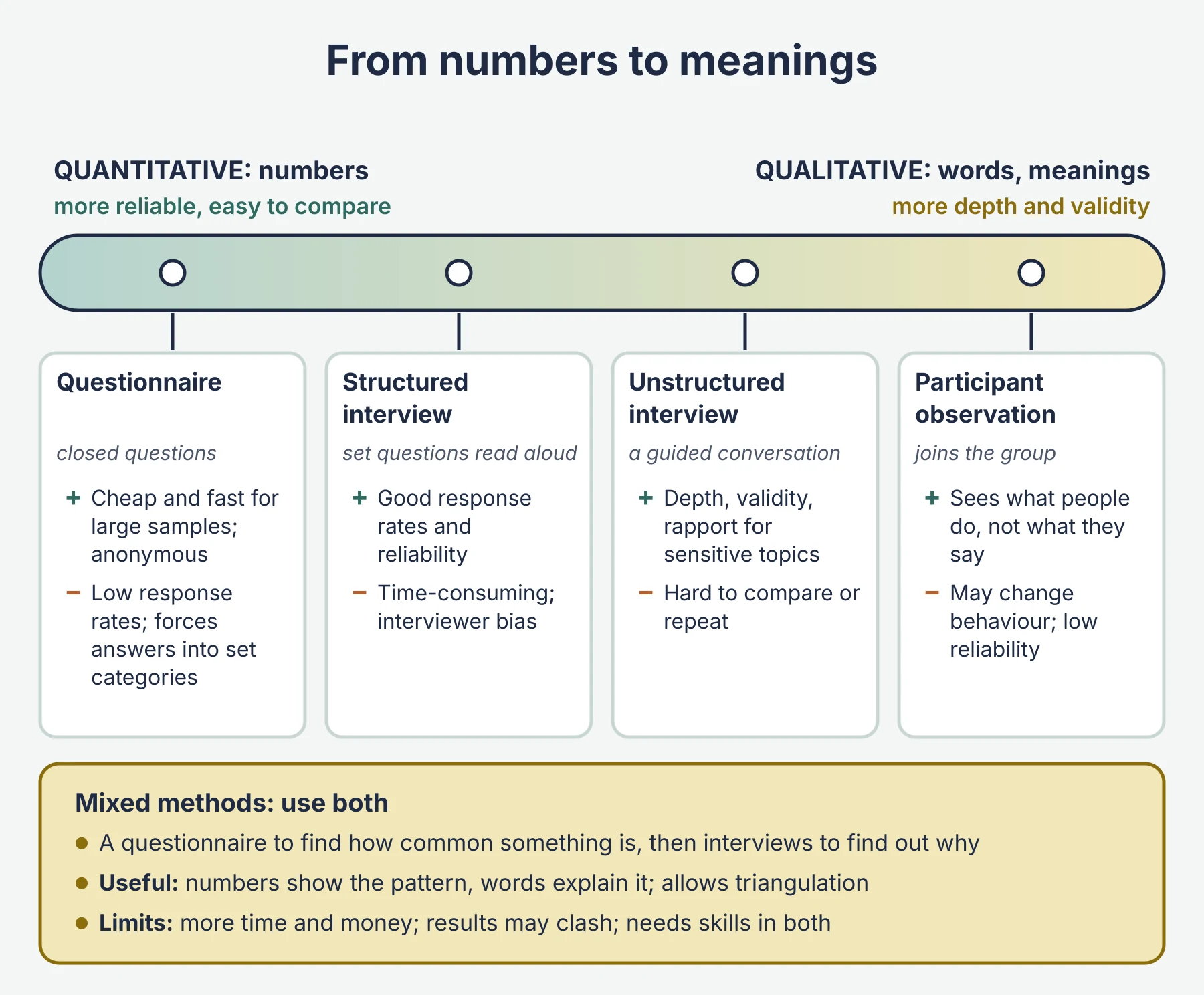
Key terms
| Term | Meaning |
|---|---|
| Quantitative data | Numerical data showing patterns and trends |
| Qualitative data | Descriptive data in words, showing meanings |
| Respondent | Person who answers questions |
| Response rate | Percentage of people asked who take part |
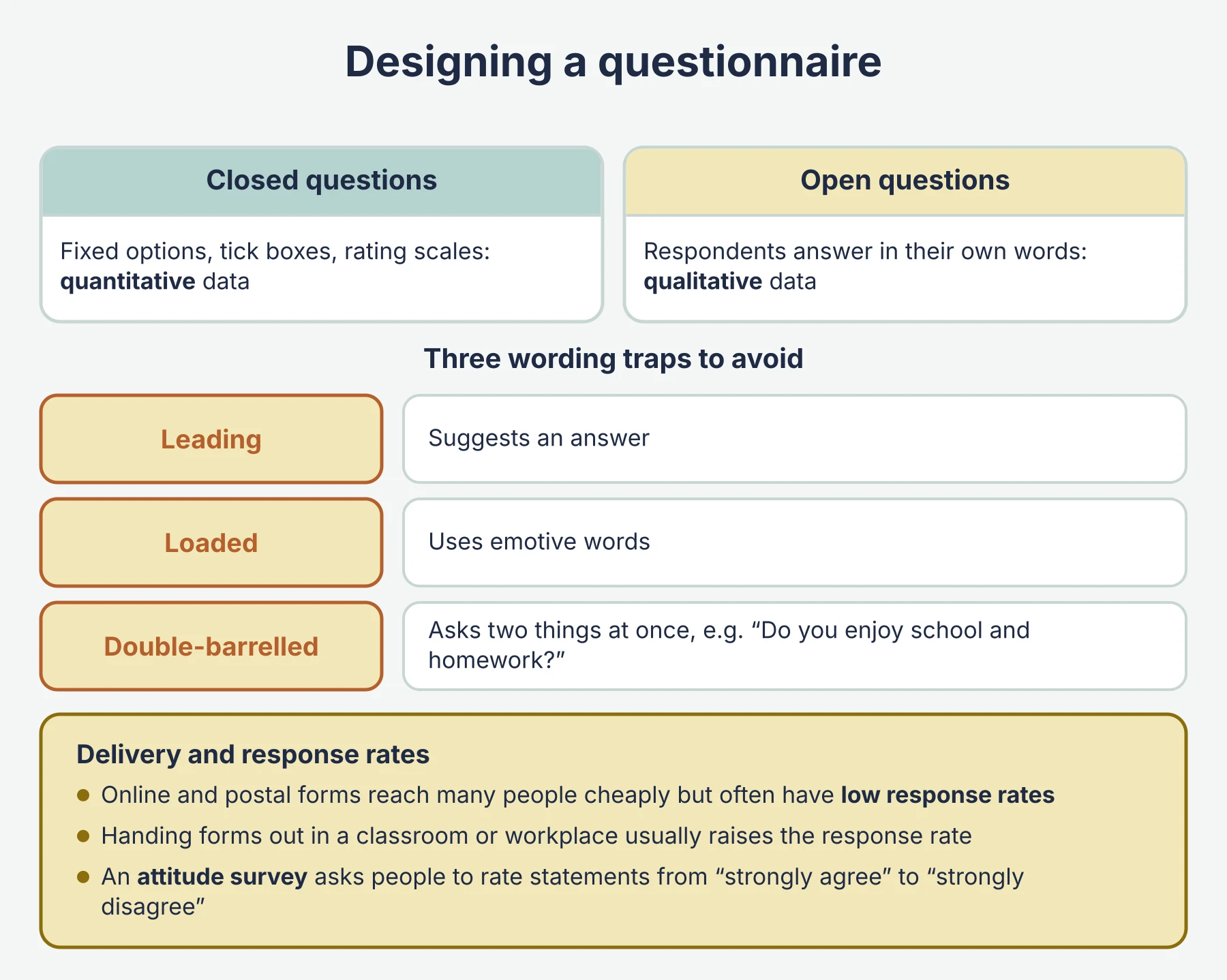
| Closed question | Fixed choice of answers |
| Open question | Answer in the respondent’s own words |
| Attitude survey | Measures opinions, often on an agree–disagree scale |
| Leading question | Wording that suggests an answer |
| Social desirability | Giving the answer that sounds acceptable rather than the truth |
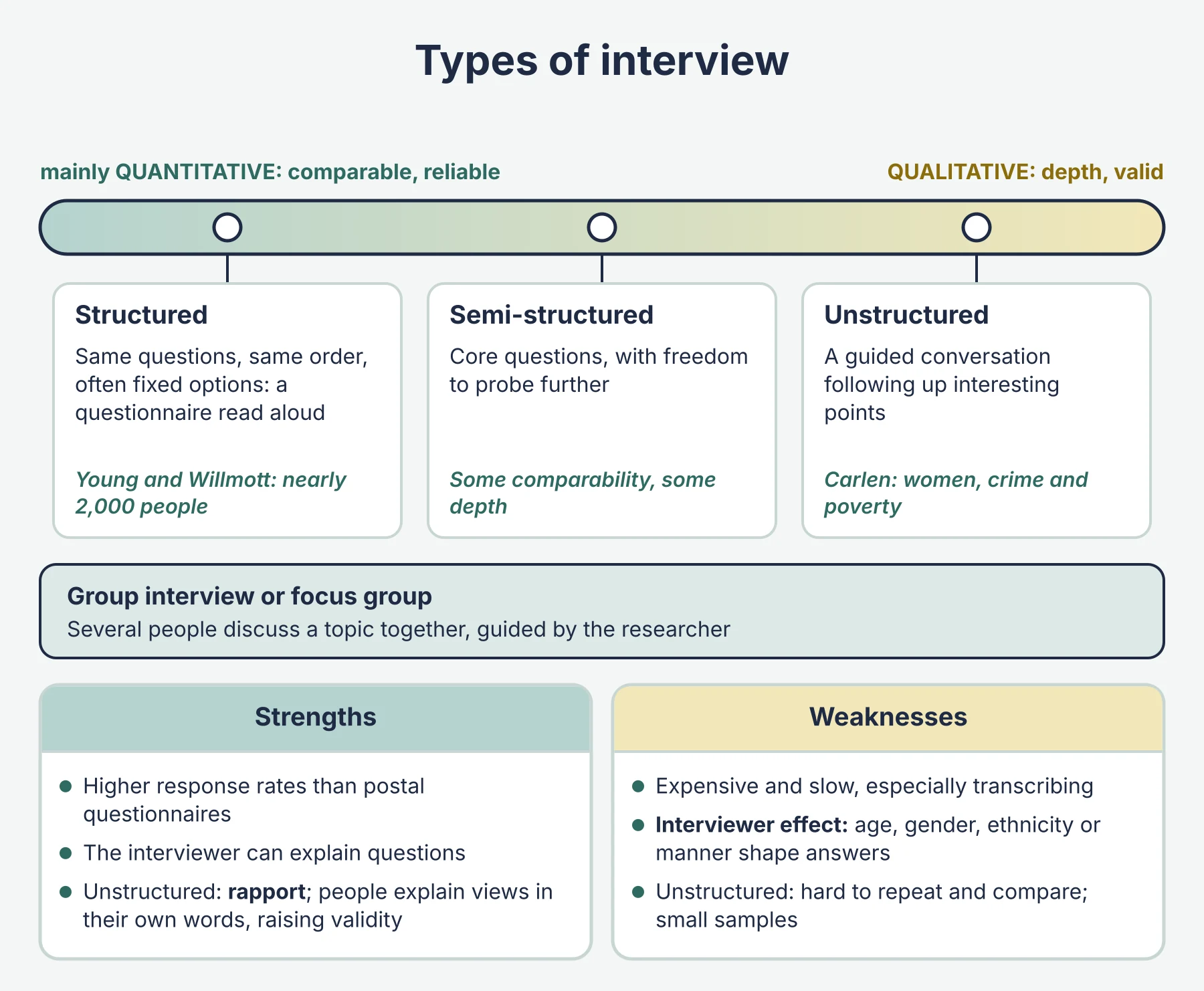
| Structured interview | Same questions in the same order; mainly quantitative |
| Semi-structured interview | Core questions with freedom to probe |
| Unstructured interview | Guided conversation; qualitative |
| Focus group | Group discussion led by the researcher |
| Rapport | Trust between researcher and participant |
| Interviewer effect | Interviewer’s characteristics or manner shaping answers |
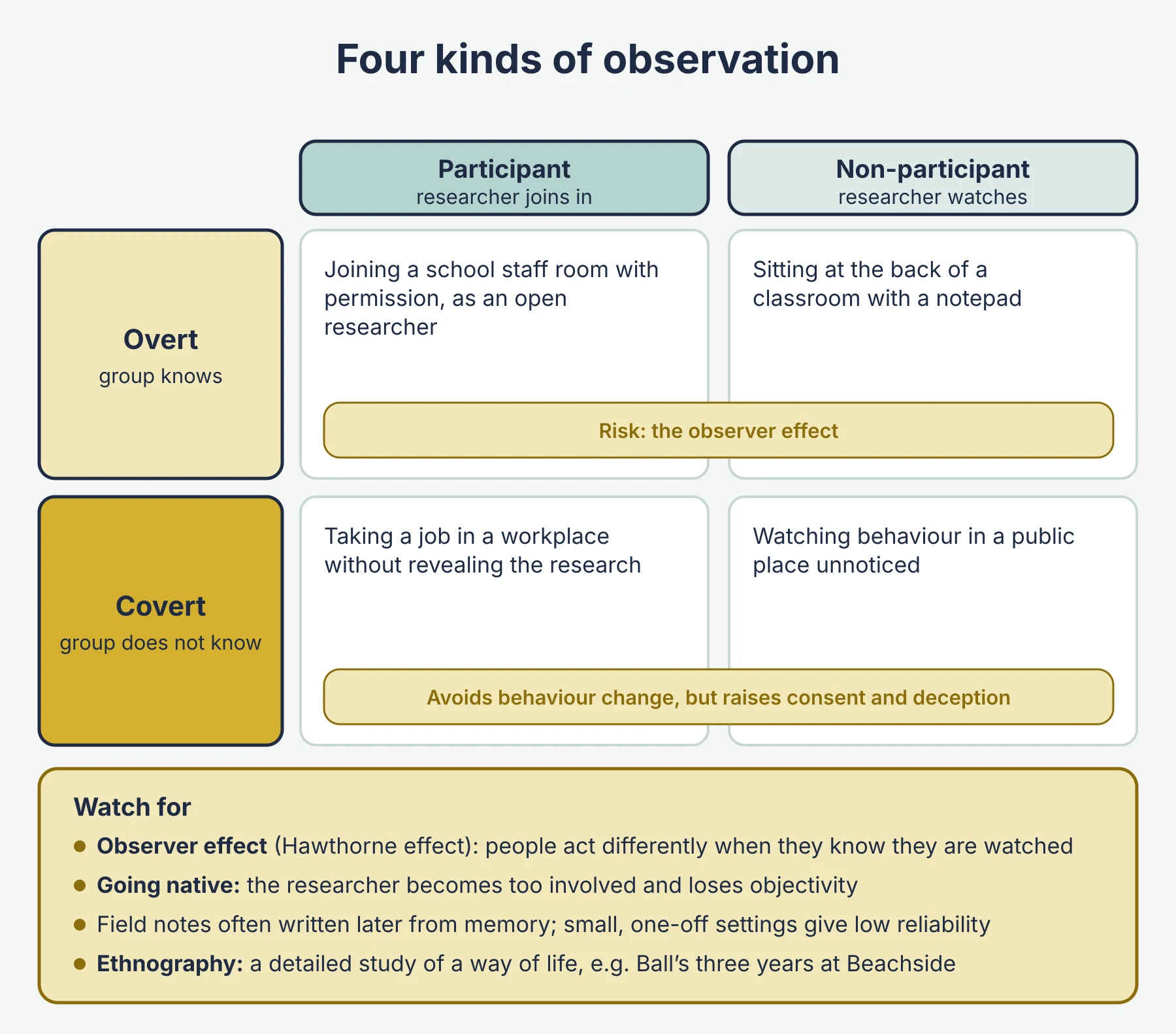
| Participant observation | Researcher joins the group |
| Non-participant observation | Researcher watches without joining |
| Covert / overt | Group does not know / knows it is being studied |
| Observer effect | People change behaviour because they are watched |
| Going native | Researcher becomes too involved and loses objectivity |
| Ethnography | Detailed study of a way of life, usually by participant observation |
| Mixed methods research | Combining quantitative and qualitative methods in one study |
| Triangulation | Checking findings with more than one method or source |
Evaluation grid
| Method | Reliability | Validity | Representativeness | Practical | Ethical |
|---|---|---|---|---|---|
| Closed questionnaire | High | Lower: imposed categories, social desirability | Large samples possible, but low response rates | Cheap, quick | Anonymity easy |
| Structured interview | High | Moderate: interviewer effect | Good response rate | Costs interviewer time | Consent straightforward |
| Unstructured interview | Low | High: rapport, depth | Usually small samples | Slow; transcription | Suits sensitive topics; must manage harm |
| Focus group | Low | Shows how views form, but one voice may dominate | Small | Quicker than many single interviews | Confidentiality harder in a group |
| Overt participant observation | Low | High, but observer effect | One group or setting | Long; access needed | Consent obtained |
| Covert participant observation | Low | High: natural behaviour | One group | Risky; hard to record | No informed consent; deception |
| Non-participant observation | Moderate if a checklist is used | Observer effect if overt | One setting | Less time than joining | Depends on overt or covert |
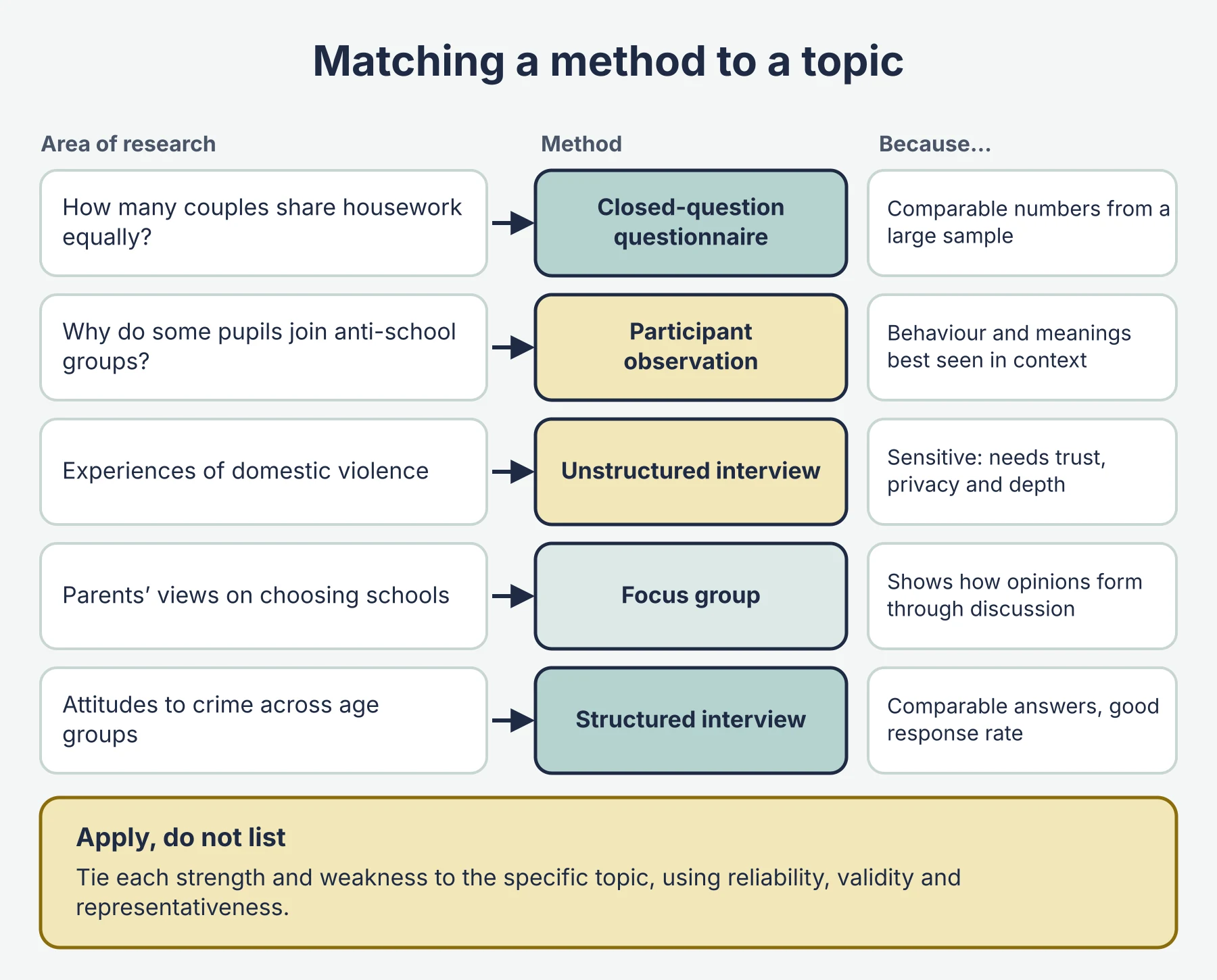
Choosing a method: quick rules
- “How many?” → questionnaire or structured interview.
- “Why?” or “How do they feel?” → unstructured interview.
- “What do they actually do?” → observation.
- “How do views form or clash?” → focus group.
- Sensitive and private topic → unstructured interview, with careful ethics.
- Hidden or deviant group → participant observation, often with snowball access.
Mixed methods: for and against
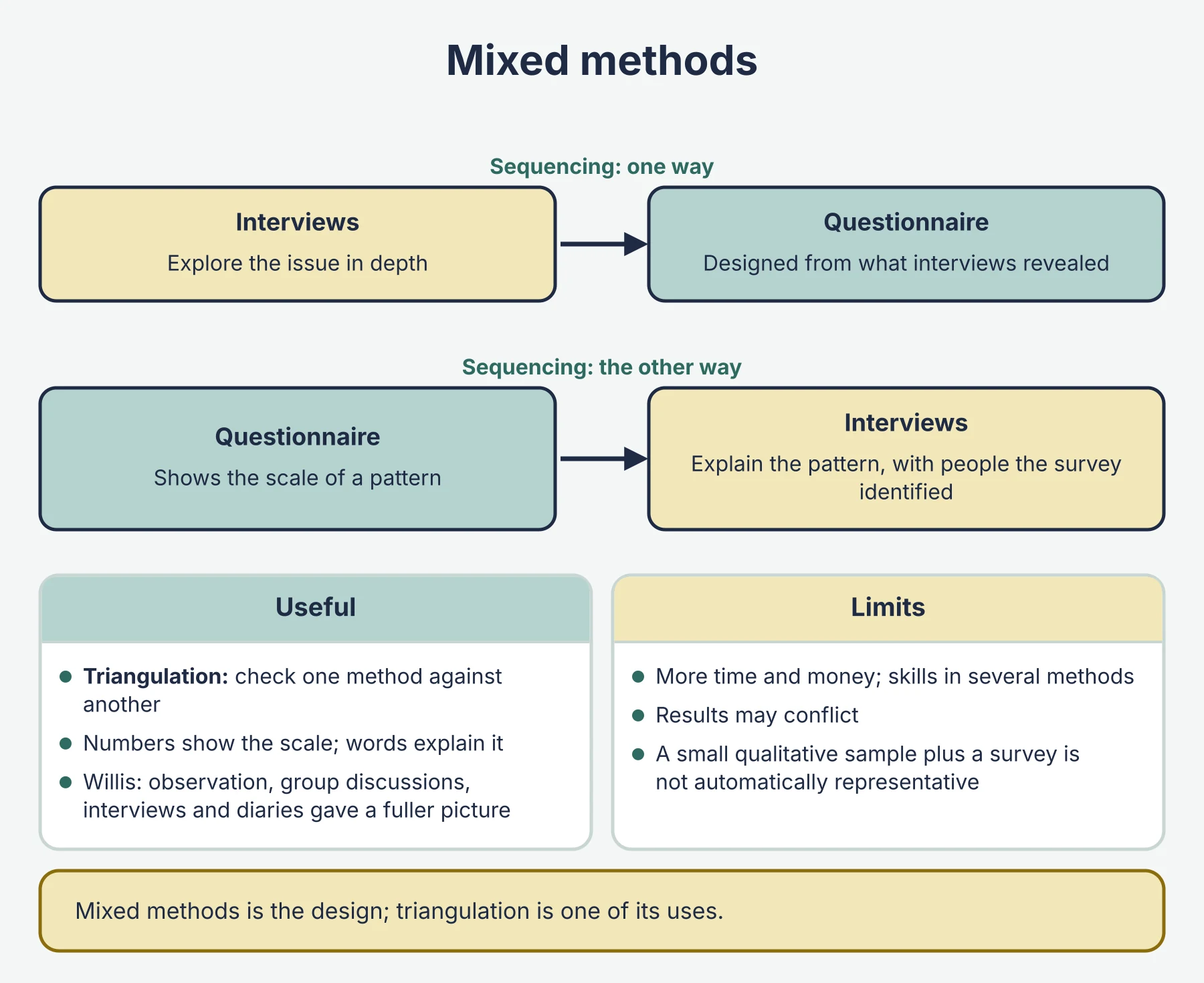
For: triangulation; numbers show scale and words explain it; one method can help design another; a fuller picture, as Willis’s combination of methods shows.
Against: more time and money; needs several skills; results may conflict; a small qualitative part does not make the whole study representative.
Named studies by method
- Questionnaires: Townsend, over 2,000 households and more than 6,000 individuals.
- Large-scale interview survey: Young and Willmott, nearly 2,000 people in Greater London and surrounding areas.
- Unstructured interviews: Carlen, 39 women aged 15 to 46 convicted of crimes.
- Interviews over time: Devine, Vauxhall workers and their wives in Luton.
- Participant observation: Ball, three years at Beachside Comprehensive.
- Mixed methods: Willis, observation, participant observation, group discussions, informal interviews and diaries.
Exam traps
- Trap: “interviews are qualitative”. Fix: say which type; structured interviews are mainly quantitative.
- Trap: generic strengths (“cheap”, “quick”) with no topic. Fix: say why it matters for this topic.
- Trap: “observation shows the truth”. Fix: the observer selects and interprets what to record.
- Trap: reliability and validity swapped. Fix: reliable = repeatable; valid = true to life.
- Trap: mixed methods = triangulation. Fix: mixed methods is the design; triangulation is a use of it.
Quick self-test
- Give one difference between quantitative and qualitative data.
- What is a double-barrelled question?
- Why might online questionnaires produce unrepresentative samples?
- What is social desirability in a questionnaire?
- What is the difference between a structured and a semi-structured interview?
- Give one weakness of focus groups.
- What is the interviewer effect?
- What is the observer effect?
- What does “going native” mean?
- Which method would suit a study of what happens in a school staff room, and why?
- Give two benefits of mixed methods research.
- Which named study used unstructured interviews with 39 women?
Answers
- Quantitative data are numerical; qualitative data are descriptive, in words.
- A question that asks about two things at once.
- Low response rates, and those who reply may differ from those who do not; some groups have less internet access.
- Choosing answers that sound acceptable rather than true ones.
- A structured interview uses fixed questions in a fixed order; a semi-structured interview has core questions but lets the interviewer probe further.
- One person may dominate, or confidentiality is harder to protect.
- The interviewer’s characteristics or manner influencing the answers given.
- People changing their behaviour because they know they are being watched.
- The researcher becomes too involved with the group and loses objectivity.
- Participant or non-participant observation, because it records what staff actually do and say, not what they claim.
- Any two of: triangulation; numbers show scale and words explain it; one method helps design another; a fuller picture.
- Carlen.
Specification reference
AQA GCSE Sociology (8192), section 3.7 Sociological research methods, “qualitative and quantitative methods” row; Appendix A research key terms; Appendix B study summaries.
Related resources
-
Study guides
AQA GCSE Sociology (8192): Sociological research methods – Study Guide
Study guide to AQA GCSE Sociology 8192 section 3.7: research design, sampling, methods, data types, reading tables, and practical and ethical issues.
Sociology · AQA · GCSE
Read guide -
Practice questions
AQA GCSE Sociology (8192): Sociological research methods – Practice Questions
Original AQA GCSE Sociology 8192 research methods questions with marked answers: sampling, data tables, practical and ethical issues, research design.
Sociology · AQA · GCSE
Try questions -
Revision notes
AQA GCSE Sociology (8192): Sociological research methods – Revision Notes
Condensed AQA GCSE Sociology 8192 research methods notes: sampling, methods, data types, ethics, an essay plan and a quick self-test with answers.
Sociology · AQA · GCSE
Revise topic
Related articles
Get free revision emails (optional)
Occasional emails with practice questions, worked explanations and links to free resources for the qualification and subjects you choose. No spam, and you can unsubscribe from any email. The free tools on this site never need an email.