
Revision Notes
AQA GCSE Sociology (8192): Primary and secondary sources – Revision Notes
AQA GCSE Sociology 8192 revision notes on primary and secondary sources: types, strengths, limits, judging documents, content analysis and a self-test.
- Subject
- Sociology
- Level
- GCSE
- Topic
- Sociological research methods
- Author
- Marlbridge Academic Team
- Updated
- Reviewed by
- Naqiya Yousaf (what this means)
Aligned to AQA GCSE Sociology (8192), first teaching 2017. Official specification .
Syllabus page (what it covers and how it is assessed): AQA GCSE Sociology.
Syllabus points this page covers
8192
- Primary and secondary sources
Found an error? Report a correction.
Need help with this topic? Request a free trial class for GCSE Sociology (8192).
These notes cover the “primary and secondary sources” row of section 3.7 in the AQA GCSE Sociology (8192) specification. Read the primary and secondary sources study guide for full explanations and a worked example, then practise with the primary and secondary sources practice questions. The research methods revision notes cover all of section 3.7.
What you must be able to do
- Describe and explain primary and secondary sources of data.
- Show the relevance and usefulness of different primary and secondary sources for a specific area of research.
The rule
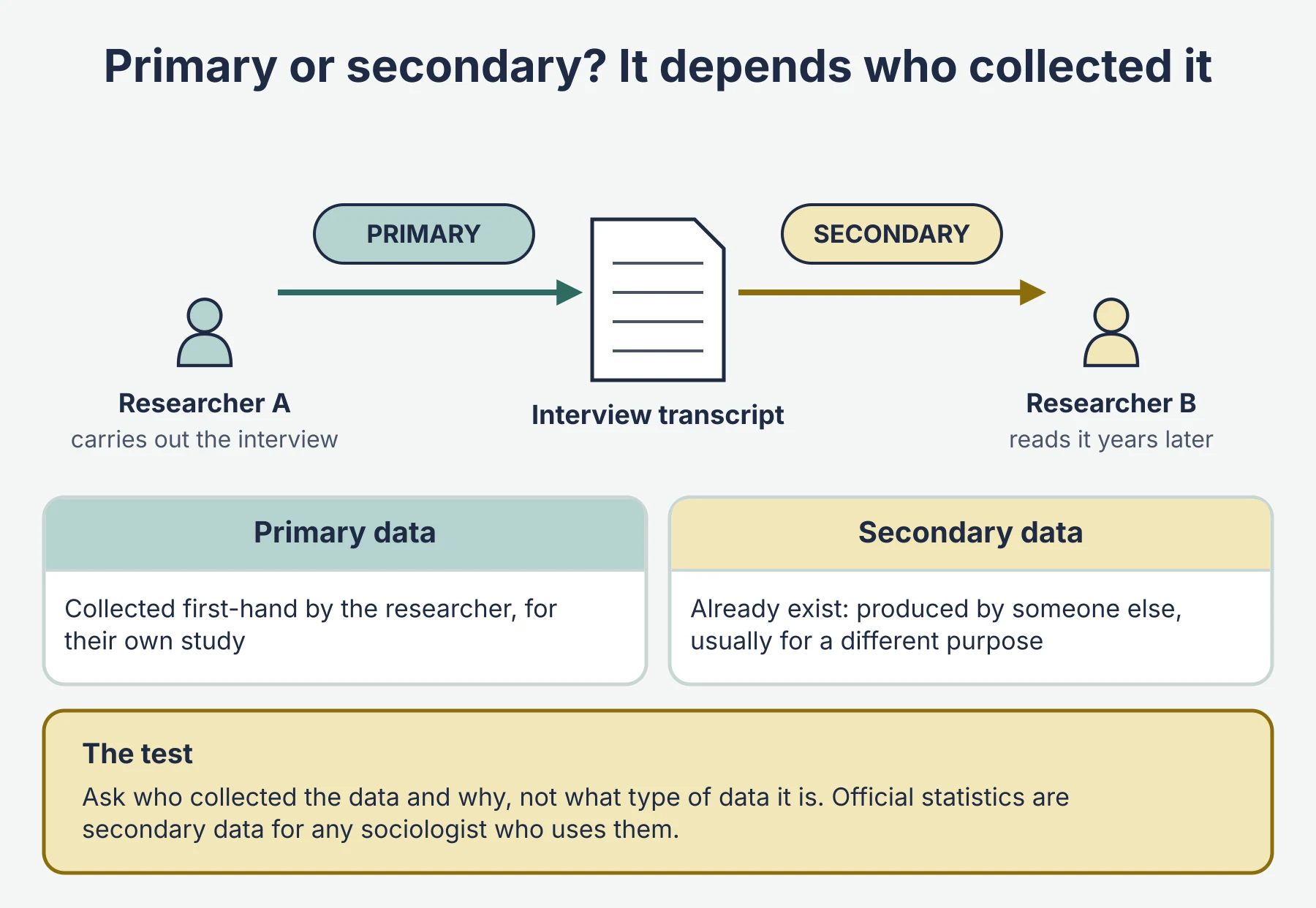
Primary = collected first-hand by the researcher for this study. Secondary = already exists, produced by someone else, usually for another purpose. The test is who collected it and why.
Key terms
| Term | Meaning |
|---|---|
| Primary data | Data collected first-hand by the researcher for their own study |
| Secondary data | Existing data produced by someone else |
| Official statistics | Numerical data produced by government and its agencies |
| Public documents | Documents produced by organisations, such as government reports or school policies |
| Personal documents | Diaries, letters, autobiographies, personal posts |
| Historical documents | Records from the past, such as old registers |
| Mass media | Newspapers, television, websites, advertisements |
| Content analysis | Systematic study of documents or media content |
| Coding sheet | List of categories used to count content |
| Triangulation | Checking findings with more than one method or source |
| Bias | Anything that distorts the picture given |
Primary versus secondary at a glance
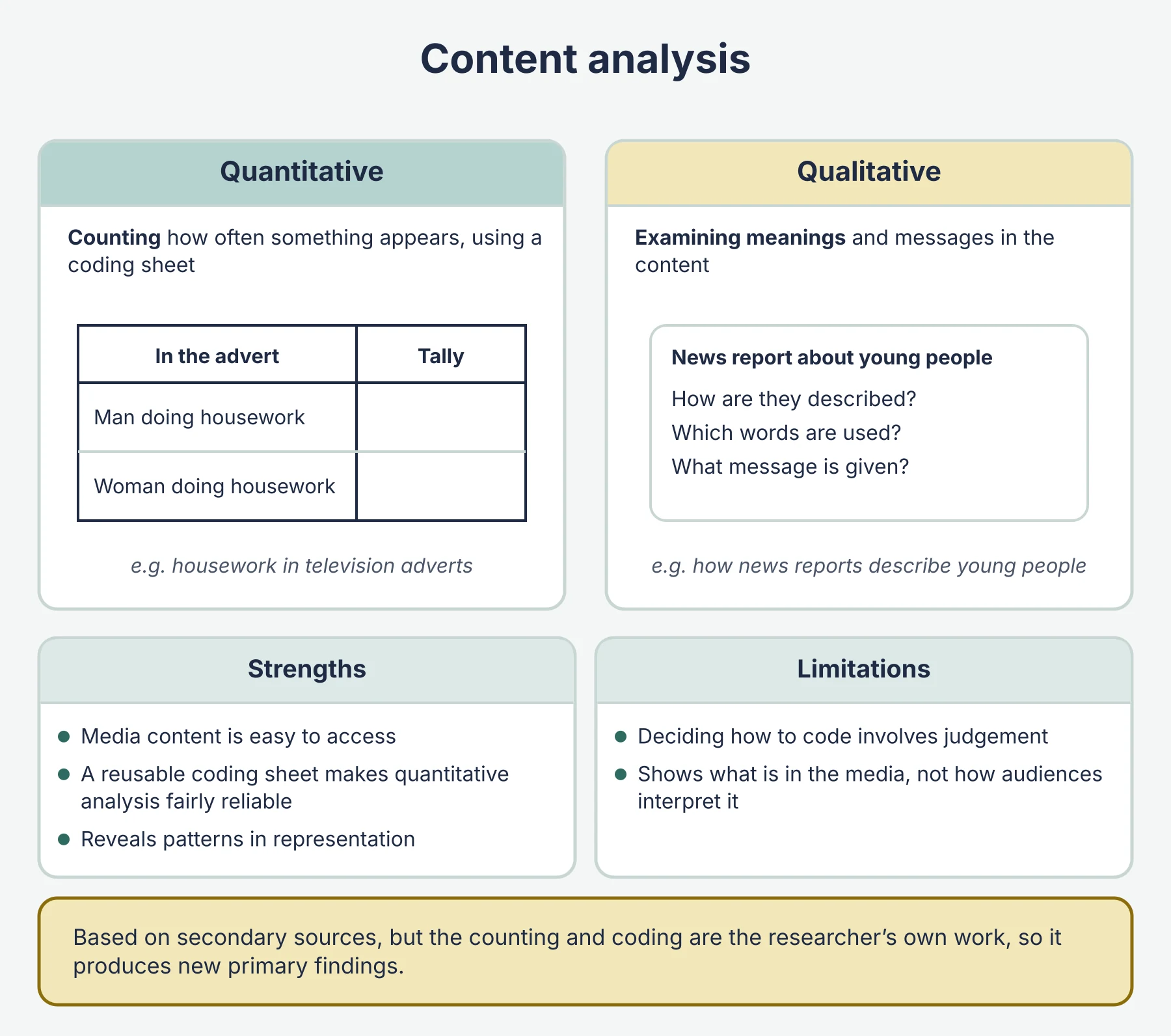
| Primary | Secondary | |
|---|---|---|
| Fit to aim | Exact | May not fit; collected for another purpose |
| Cost and time | High | Low, often free |
| Control over method | Full | None; may not know how collected |
| Reach | Present only | Can reach the past and whole populations |
| Ethics | Researcher must manage consent, confidentiality, harm | Fewer issues, but personal documents still raise privacy concerns |
| Examples | Questionnaires, interviews, observation | Statistics, earlier studies, documents, media |
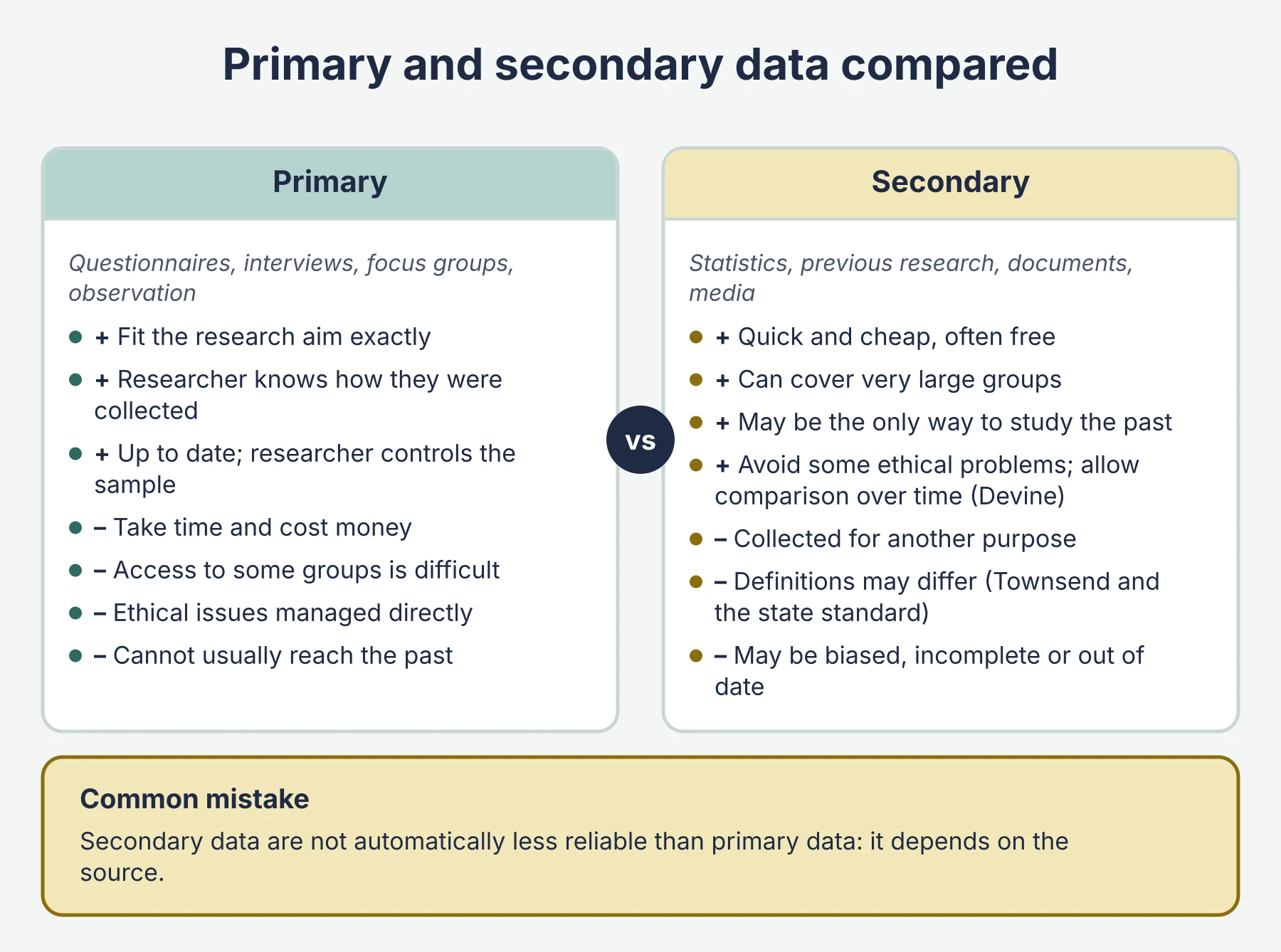
Judging a document: four questions
- Genuine? Is it what it claims to be?
- Believable? Was the author sincere and accurate?
- Typical? Does it represent a wider group?
- Clear? Can its meaning be understood?
Memory hook: Get Better Through Checking.
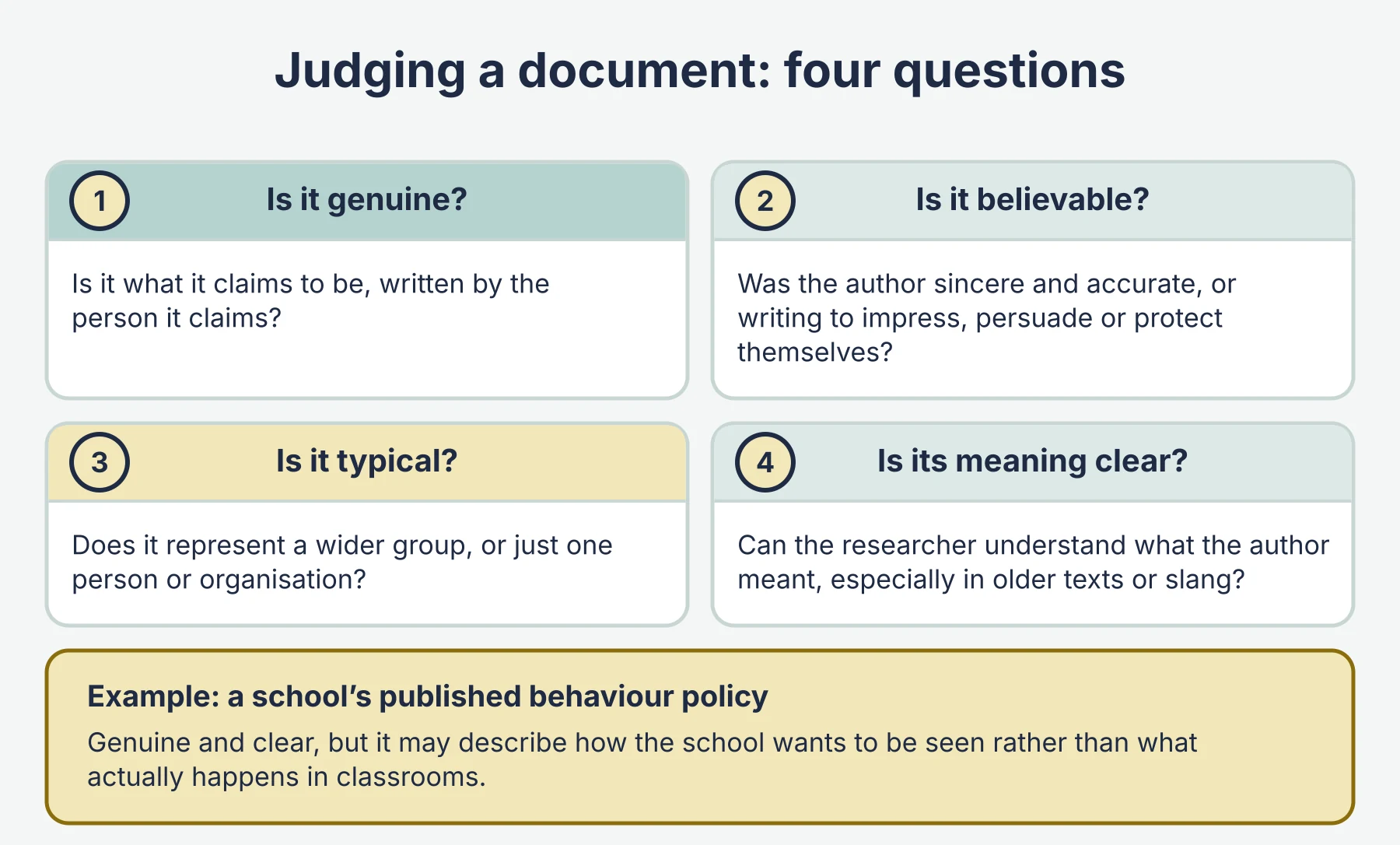
Content analysis
- Quantitative: count occurrences using a coding sheet (how often women appear as experts on news programmes).
- Qualitative: interpret meanings and messages (how headlines describe young people).
- Strengths: easy access; coding sheet can be reused, so fairly reliable; shows patterns of representation.
- Limitations: coding involves judgement; shows content, not how audiences interpret it.
Named examples
- Devine compared her new interviews with Goldthorpe and Lockwood’s 1960s Luton study, which by then was a secondary source.
- Townsend rejected the state standard of poverty, a secondary official measure, because its definition was arbitrary, and collected his own primary data.
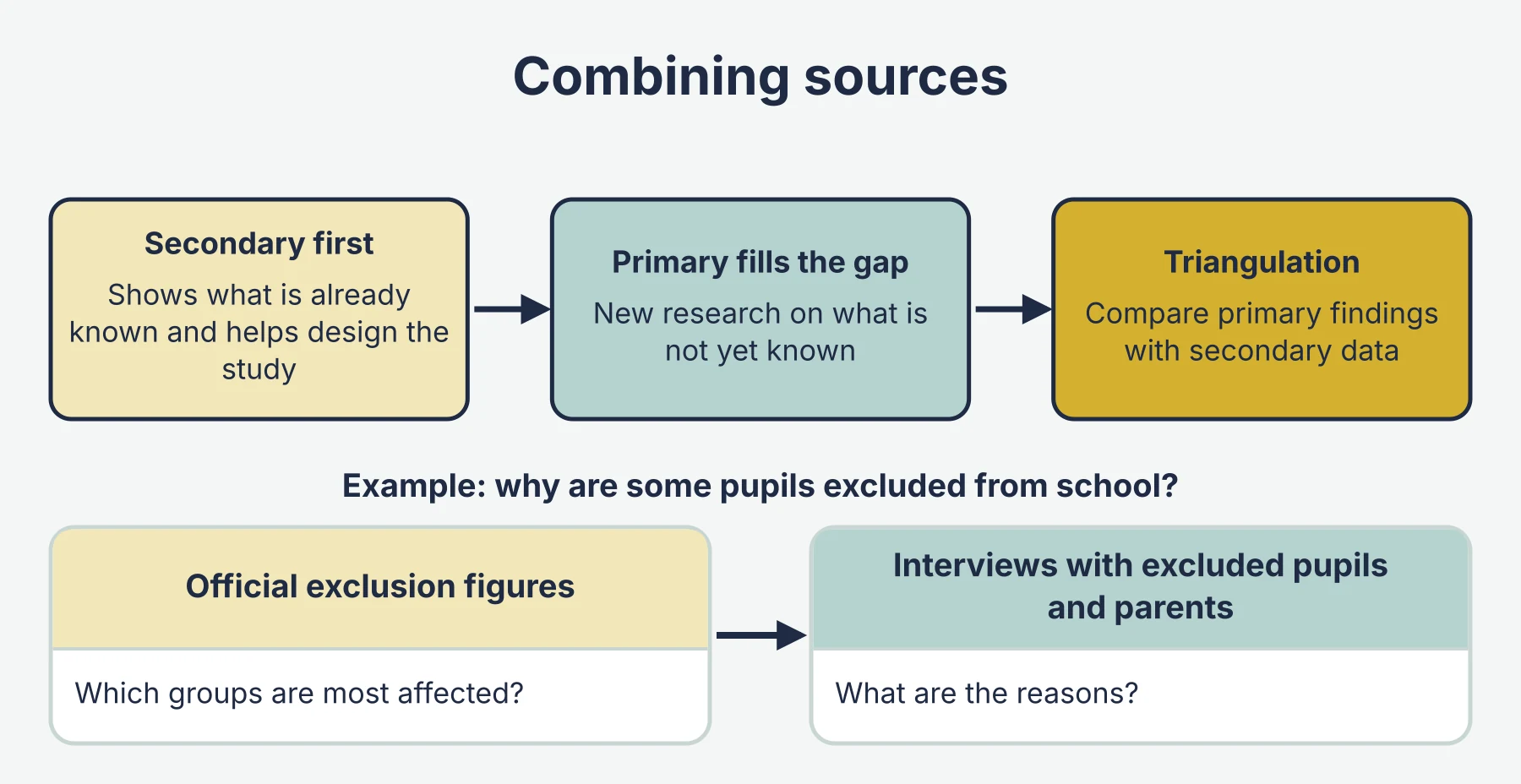
- Official exam and exclusion figures are secondary sources often used to choose which groups to study in depth.
Matching sources to an area of research
| Area | Useful secondary source | Useful primary source |
|---|---|---|
| Change in divorce over 50 years | Official divorce statistics | Interviews with divorced people today |
| Gender in children’s books | The books themselves (content analysis) | Interviews with children about the books |
| Experiences of young carers | Young carers’ diaries or blogs | Unstructured interviews |
| How schools describe discipline | School behaviour policies | Observation of lessons |
| Class and university entry | Official entry figures | Questionnaires to sixth-form students |
Mini plan for an extended answer
“Discuss how far secondary sources are useful for studying changes in family life.”
- Define secondary sources; name official statistics, earlier studies and personal documents.
- For: statistics on marriage, divorce and household types show long-term trends.
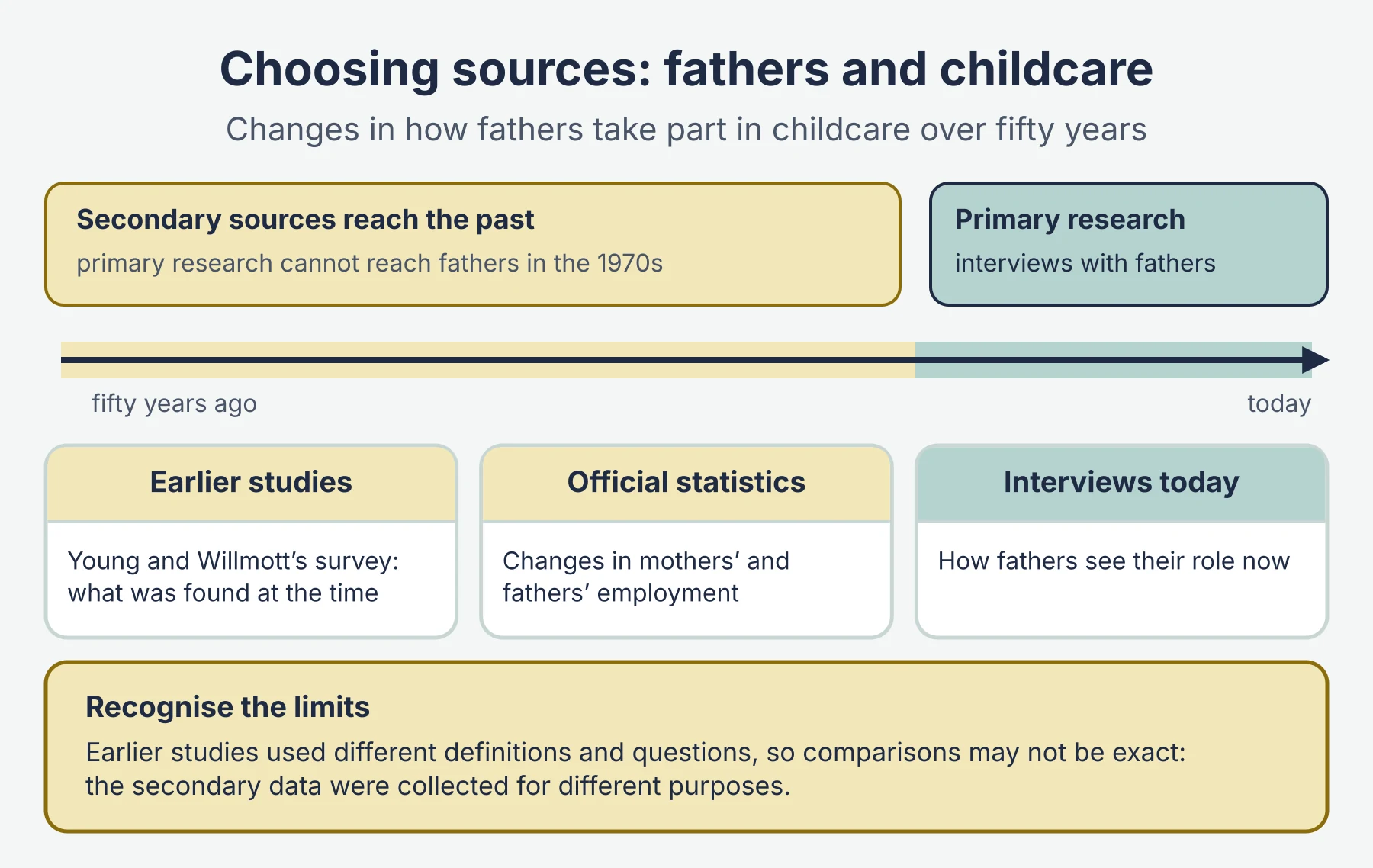
- For: earlier studies, such as Young and Willmott’s survey, record family life at the time.
- For: diaries and letters give insight into past experiences that cannot be studied first-hand.
- Against: earlier studies used different definitions and questions, so comparison is not exact.
- Against: documents may not be typical or believable.
- Primary alternative: interviews with older people about their own family life.
- Judgement: essential for studying the past, but best combined with primary research.
Exam traps
- Trap: “secondary data are unreliable”. Fix: it depends on the source and purpose.
- Trap: “primary data come from people; secondary from books”. Fix: both may come from people; the difference is who collected them.
- Trap: a transcript is always primary. Fix: primary for the interviewer, secondary for later researchers.
- Trap: using the media as a mirror of reality. Fix: media content is constructed and selective.
- Trap: naming a source with no link to the area of research. Fix: say what it would show about that topic.
Quick self-test
- Define primary data.
- Define secondary data.
- Give three kinds of secondary source.
- Give two strengths of secondary data.
- Give two limitations of secondary data.
- Give one strength of primary data.
- Name the four questions for judging a document.
- What is content analysis?
- What is a coding sheet used for?
- How did Devine use secondary data?
- Why might a school’s behaviour policy not show what happens in classrooms?
- Is an old research interview transcript primary or secondary for a new researcher?
Answers
- Data collected first-hand by the researcher for their own study.
- Existing data produced by someone else, usually for a different purpose.
- Any three of: official statistics, previous research, public documents, personal documents, historical documents, mass media.
- Any two of: quick, cheap, covers large groups, reaches the past, fewer ethical issues, allows comparison over time.
- Any two of: collected for another purpose, different definitions, unknown collection methods, possible bias, out of date.
- Fits the aim exactly, or the researcher controls the sample and method.
- Is it genuine, believable, typical and clear?
- The systematic study of documents or media content.
- Recording and counting how often chosen categories appear in content.
- She compared her findings with Goldthorpe and Lockwood’s 1960s Luton research.
- It may describe how the school wants to be seen rather than everyday practice.
- Secondary.
Specification reference
AQA GCSE Sociology (8192), section 3.7 Sociological research methods, “primary and secondary sources” row; Appendix A research key terms.
Related resources
-
Study guides
AQA GCSE Sociology (8192): Qualitative and quantitative methods
AQA GCSE Sociology 8192 guide to questionnaires, interviews and observation: how each works, when to use it, strengths and weaknesses, and mixed methods.
Sociology · AQA · GCSE
Read guide -
Practice questions
AQA GCSE Sociology (8192): Qualitative and quantitative methods – Practice Questions
Original AQA GCSE Sociology 8192 practice on questionnaires, interviews, observation and mixed methods, applied to research topics, with mark-scheme answers.
Sociology · AQA · GCSE
Try questions -
Revision notes
AQA GCSE Sociology (8192): Qualitative and quantitative methods – Revision Notes
AQA GCSE Sociology 8192 revision notes on questionnaires, interviews, observation and mixed methods: key terms, evaluation grids, exam traps and a self-test.
Sociology · AQA · GCSE
Revise topic
Related articles
Get free revision emails (optional)
Occasional emails with practice questions, worked explanations and links to free resources for the qualification and subjects you choose. No spam, and you can unsubscribe from any email. The free tools on this site never need an email.