
Study Guides
AQA GCSE Sociology (8192): Practical issues
AQA GCSE Sociology 8192 guide to practical issues in research: time, cost and access, how they shape method choice, gatekeepers and hard-to-reach groups.
- Subject
- Sociology
- Level
- GCSE
- Topic
- Sociological research methods
- Author
- Marlbridge Academic Team
- Updated
- Reviewed by
- Naqiya Yousaf (what this means)
Aligned to AQA GCSE Sociology (8192), first teaching 2017. Official specification .
Syllabus page (what it covers and how it is assessed): AQA GCSE Sociology.
Syllabus points this page covers
8192
- Practical issues
Found an error? Report a correction.
Need help with this topic? Request a free trial class for GCSE Sociology (8192).
This guide covers the “practical issues” row of section 3.7 Sociological research methods in the AQA GCSE Sociology (8192) specification. The content row names “practical issues including time, cost and access”, and the skills listed for section 3.7 ask you to understand research design “including practical difficulties” for a specific area of research. Methods are assessed in both Paper 1 and Paper 2.
The research methods study guide gives one line on each issue. This guide shows how time, cost and access shape every stage of a study, how they trade off against validity and representativeness, and how to write about them for a specific topic. Revise with the practical issues revision notes and practise with the practical issues practice questions.
Why practical issues matter
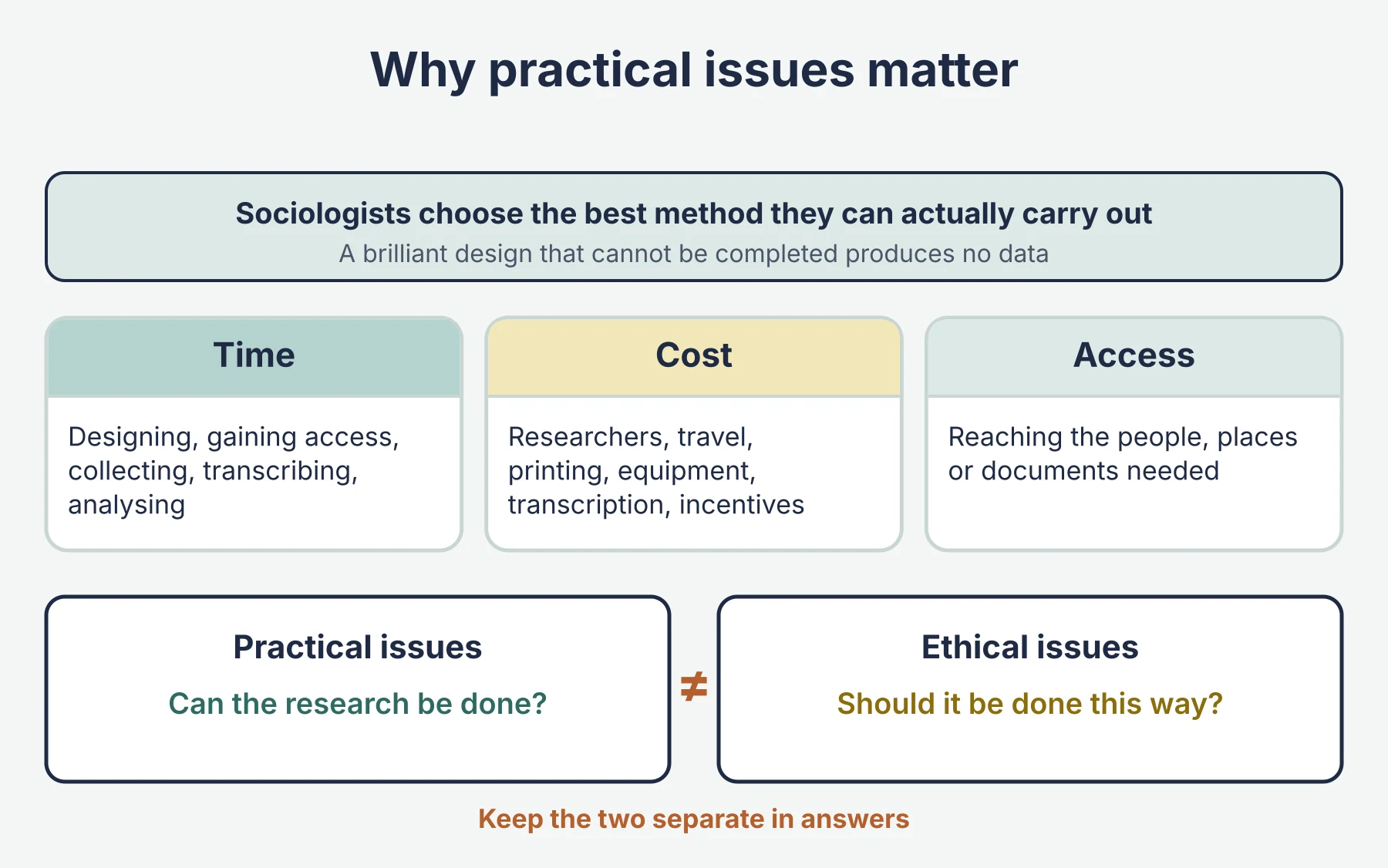
Sociologists rarely choose the method that would be ideal in theory. They choose the best method they can actually carry out with the time, money and access available. A brilliant design that cannot be completed produces no data. Practical issues therefore explain many of the choices you meet in named studies, and they are often the first evaluation point in an exam answer.
Practical issues are different from ethical issues. Practical issues are about whether research can be done; ethical issues are about whether it should be done in a particular way. Keep the two separate in answers.
Time
What takes time
- Designing and piloting a questionnaire or interview schedule.
- Gaining access and building trust with a group.
- Collecting data, especially in participant observation, which may last months or years.
- Transcribing recorded interviews: a single long interview can take many hours to type up.
- Analysing qualitative data by reading and sorting it into themes.
- Following people over time in a longitudinal study.
How time shapes choices
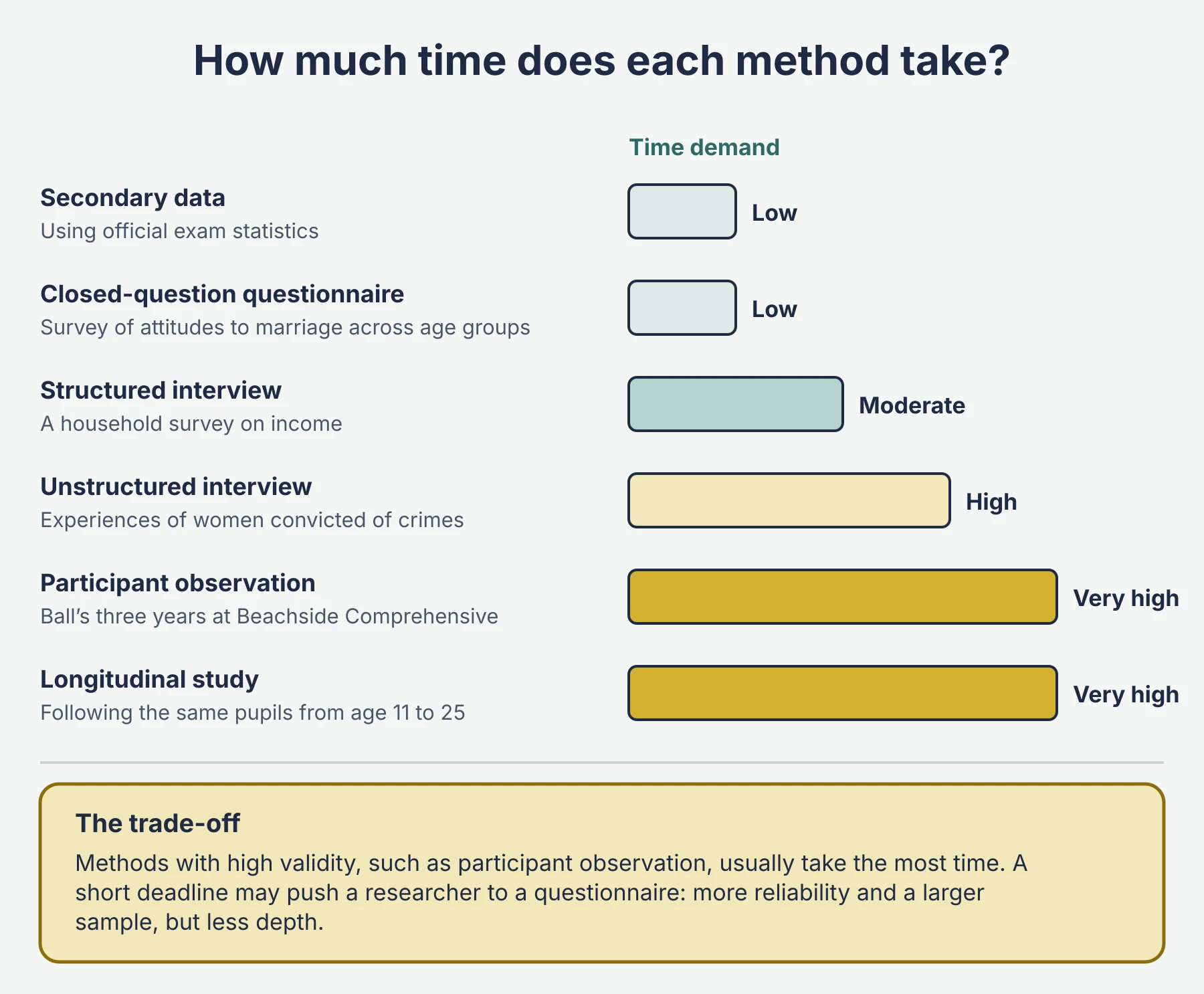
| Method | Time demand | Example |
|---|---|---|
| Closed-question questionnaire | Low per respondent; quick to analyse | A survey of attitudes to marriage across age groups |
| Structured interview | Moderate | A household survey on income |
| Unstructured interview | High: long conversations and transcription | Experiences of women convicted of crimes |
| Participant observation | Very high | Ball’s three years of fieldwork at Beachside Comprehensive |
| Longitudinal study | Very high: years or decades | Following the same pupils from age 11 to 25 |
| Secondary data | Low | Using official exam statistics |
Trade-off: methods that give high validity, such as participant observation, usually take the most time. A researcher with a short deadline may choose a questionnaire, gaining reliability and a larger sample but losing depth.
Cost
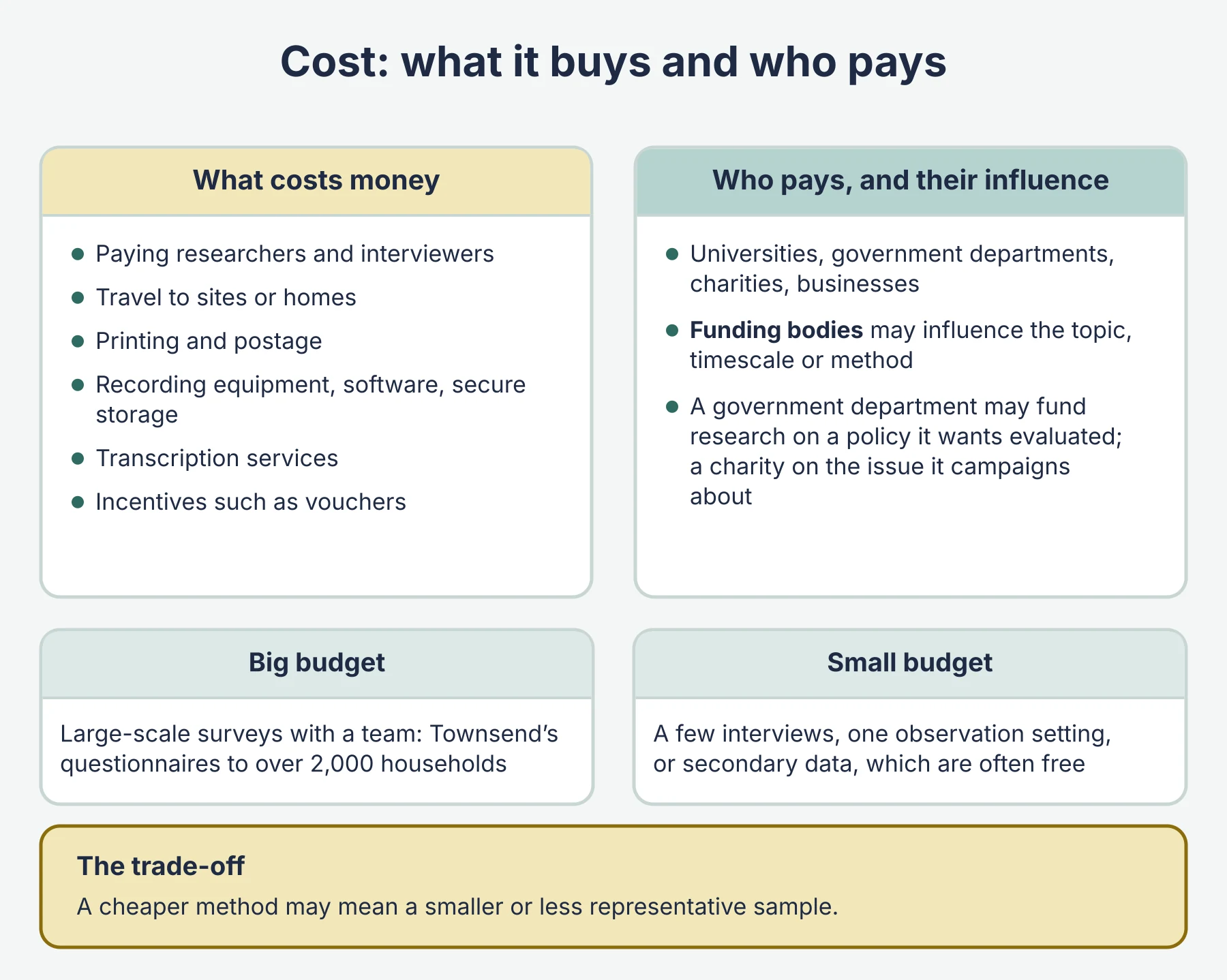
What costs money
- Paying researchers and interviewers.
- Travel to research sites or respondents’ homes.
- Printing and postage for paper questionnaires.
- Recording equipment, software and secure data storage.
- Transcription services.
- Incentives, such as vouchers, to encourage participation.
Who pays
Research is often paid for by universities, government departments, charities or businesses. Funding bodies may influence the topic, the timescale or the method. A government department might fund research on a policy it wants to evaluate; a charity might fund research on the issue it campaigns about.
How cost shapes choices
Large-scale surveys, such as Townsend’s questionnaires to over 2,000 households, need substantial funding and a team. A single researcher with little money is more likely to use a small number of interviews, an observation in one setting, or secondary data, which are often free.
Trade-off: a cheaper method may mean a smaller or less representative sample.
Access
Access means being able to reach the people, places or documents needed for the research.
Why access can be difficult
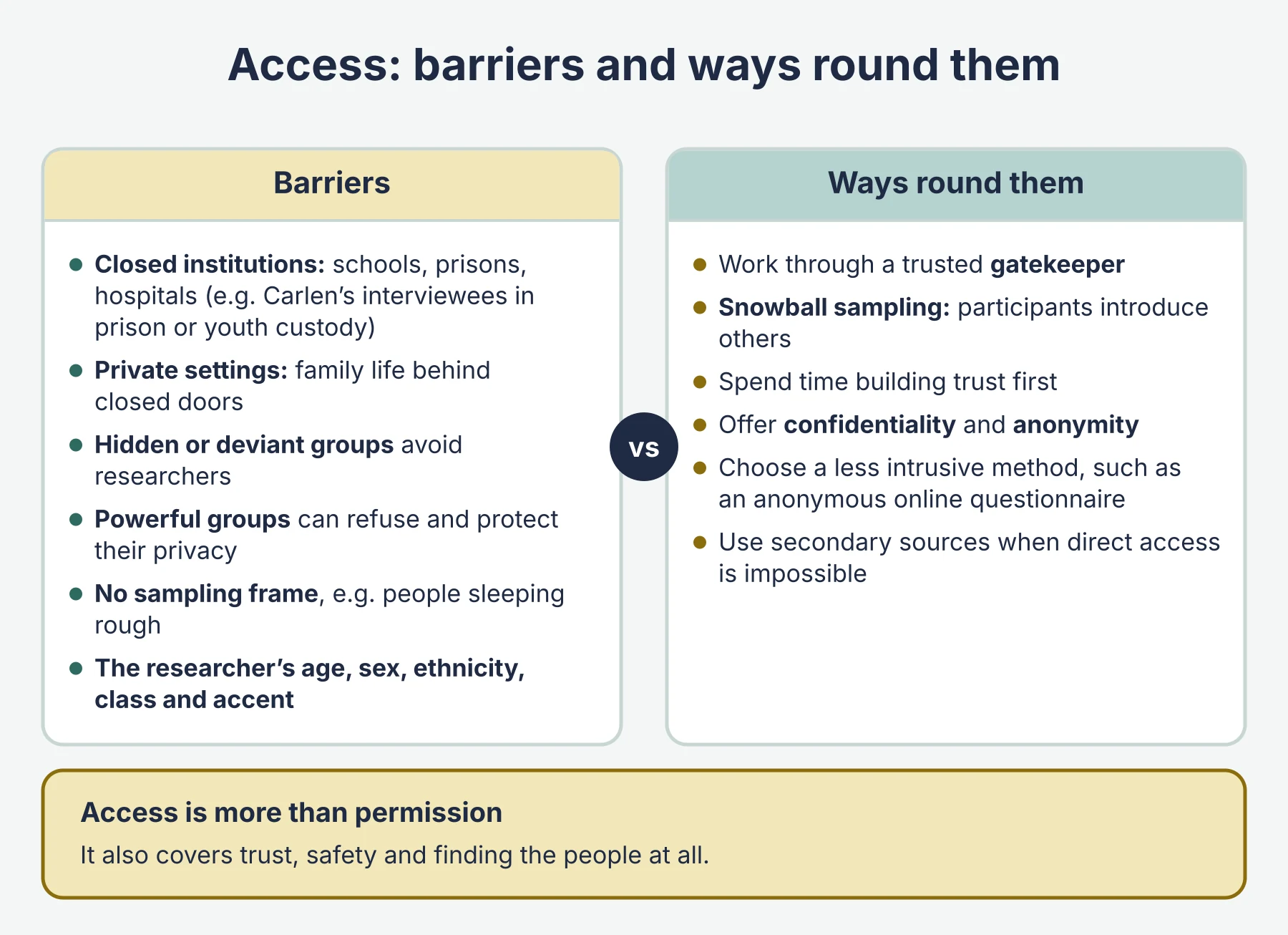
- Closed institutions: schools, prisons, hospitals and police stations control who can enter. Research in a school usually needs the head teacher’s agreement and parental consent for pupils. Some of Carlen’s interviewees were in prison or youth custody, so access depended on the institutions agreeing.
- Private settings: family life happens behind closed doors; partners may not want a researcher present.
- Hidden or deviant groups: people involved in crime, drug use or unlicensed activities may avoid researchers.
- Powerful groups: senior managers, the very wealthy and political elites can refuse to take part and have the resources to protect their privacy.
- No sampling frame: there is no list of, for example, people sleeping rough or young runaways.
Gatekeepers
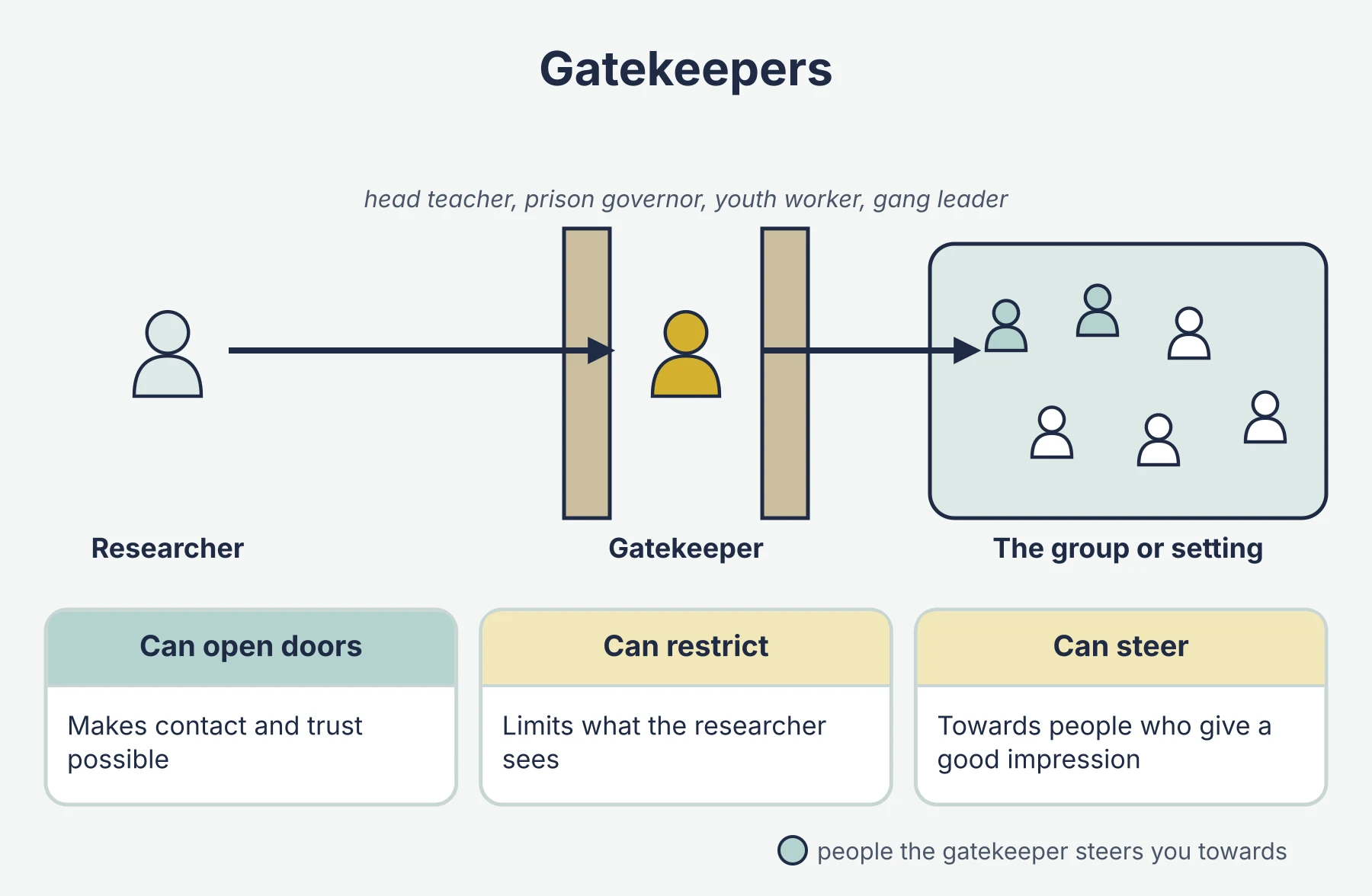
A gatekeeper is a person who controls access to a group or setting, such as a head teacher, a prison governor, a youth worker or a gang leader. Gatekeepers can open doors, but they may also restrict what the researcher sees, or steer them towards people who give a good impression.
The researcher’s characteristics
A researcher’s age, sex, ethnicity, class and accent can affect access. A middle-aged researcher cannot pass as a pupil in covert observation of a school; a male researcher may find it harder to gain the trust of women discussing domestic violence; a researcher who shares a group’s background may be accepted more easily.
Ways of overcoming access problems
- Working through a trusted gatekeeper.
- Snowball sampling, where participants introduce others.
- Spending time building trust before collecting data.
- Offering confidentiality and anonymity.
- Choosing a less intrusive method, such as an anonymous online questionnaire.
- Using secondary sources when direct access is impossible.
Other practical factors
- Personal safety: studying violent groups or dangerous settings may put the researcher at risk.
- Skills: unstructured interviewing and participant observation need interpersonal skills; statistical analysis needs numerical skills.
- Response rates: low returns waste time and money and reduce representativeness.
- The topic itself: sensitive topics may need longer, more careful methods.
Worked example: practical issues for a specific area
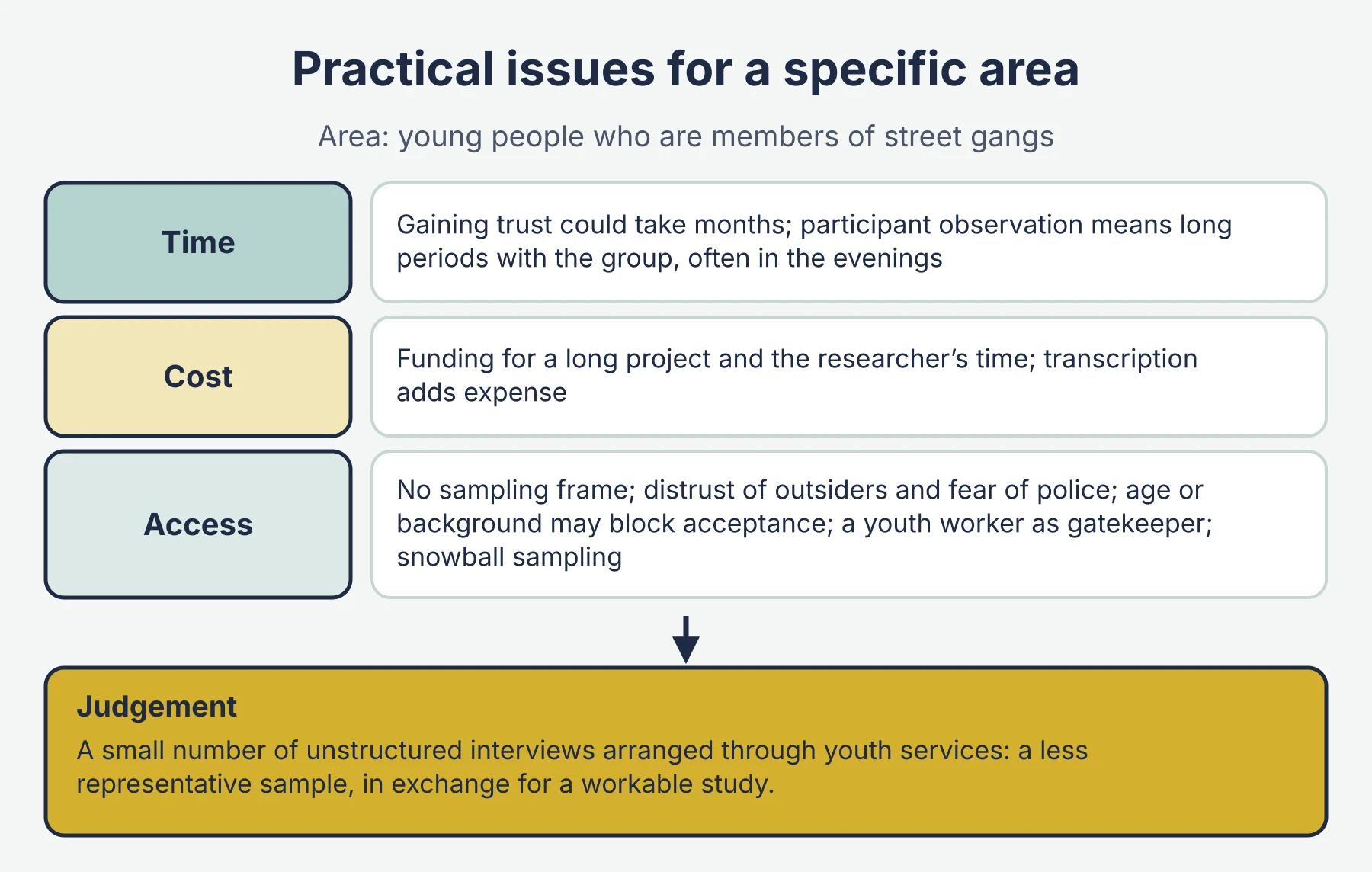
Area: the experiences of young people who are members of street gangs.
Time: gaining the trust of gang members could take many months, and covert or overt participant observation would mean spending long periods with the group, often in the evenings. Cost: a long project needs funding for the researcher’s time, and transcribing any recorded conversations adds expense. Access: there is no sampling frame, members may distrust outsiders and fear police involvement, and a researcher whose age or background differs from the group may struggle to be accepted. A youth worker could act as a gatekeeper, and snowball sampling could help, but the researcher may only meet members whom the gatekeeper trusts. Judgement: because of these issues, a researcher might choose a small number of unstructured interviews arranged through youth services, accepting a less representative sample in exchange for a workable study.
Common mistakes
- Mixing practical and ethical issues: “covert observation is expensive and unethical” needs two separate explanations.
- Writing “it would take a long time” without saying why, for this topic.
- Treating access as only “permission”. It also covers trust, safety and finding people.
- Forgetting that secondary data reduce time and cost but may not answer the question.
- Listing time, cost and access without linking them to the method’s validity or representativeness.
Exam technique
- Identify a practical issue and the method or topic it affects.
- Explain by giving the cause (why it is costly, slow or hard to access) and the consequence for the research.
- In extended design questions, raise practical issues at each stage and show how your choices deal with them.
Specification reference
AQA GCSE Sociology (8192), section 3.7 Sociological research methods, “practical issues” row, with research key terms in Appendix A and the study summaries in Appendix B.
Related resources
-
Practice questions
AQA GCSE Sociology (8192): Practical issues – Practice Questions
Original AQA GCSE Sociology 8192 practice on time, cost and access in research, applied to schools, families and crime, with mark-scheme style answers.
Sociology · AQA · GCSE
Try questions -
Revision notes
AQA GCSE Sociology (8192): Practical issues – Revision Notes
AQA GCSE Sociology 8192 revision notes on practical issues in research: time, cost and access by method, gatekeepers, trade-offs, exam traps and a self-test.
Sociology · AQA · GCSE
Revise topic -
Study guides
AQA GCSE Sociology (8192): Primary and secondary sources
AQA GCSE Sociology 8192 guide to primary and secondary sources: types of each, documents and content analysis, judging sources, and choosing for a topic.
Sociology · AQA · GCSE
Read guide
Related articles
Get free revision emails (optional)
Occasional emails with practice questions, worked explanations and links to free resources for the qualification and subjects you choose. No spam, and you can unsubscribe from any email. The free tools on this site never need an email.