
Revision Notes
AQA GCSE Sociology (8192): Power relationships – Revision Notes
AQA GCSE Sociology 8192 revision notes on 3.6.6 power relationships: the named factors, Walby on patriarchy, perspectives, equality laws, traps and a self-test.
- Subject
- Sociology
- Level
- GCSE
- Topic
- Social stratification
- Author
- Marlbridge Academic Team
- Updated
- Reviewed by
- Naqiya Yousaf (what this means)
Aligned to AQA GCSE Sociology (8192), first teaching 2017. Official specification .
Syllabus page (what it covers and how it is assessed): AQA GCSE Sociology.
Syllabus points this page covers
8192
- 3.6.6 Power relationships
Found an error? Report a correction.
Need help with this topic? Request a free trial class for GCSE Sociology (8192).
These notes cover AQA GCSE Sociology (8192) section 3.6.6 Power relationships, assessed in Paper 2. Read the power relationships study guide for full explanations and a worked paragraph, then try the power relationships practice questions. The Social stratification revision notes cover the whole topic.
What you must be able to do
- Identify, describe and explain factors affecting power relationships: social class, gender, sexuality, race, age, disability, religion and beliefs.
- Compare functionalist, feminist and Marxist perspectives on power relationships.
- Describe the key ideas of Walby on patriarchy.
Power relationships in one line
A power relationship is one in which a person or group can shape the choices, opportunities or behaviour of another: in families, workplaces, schools, politics and the criminal justice system.
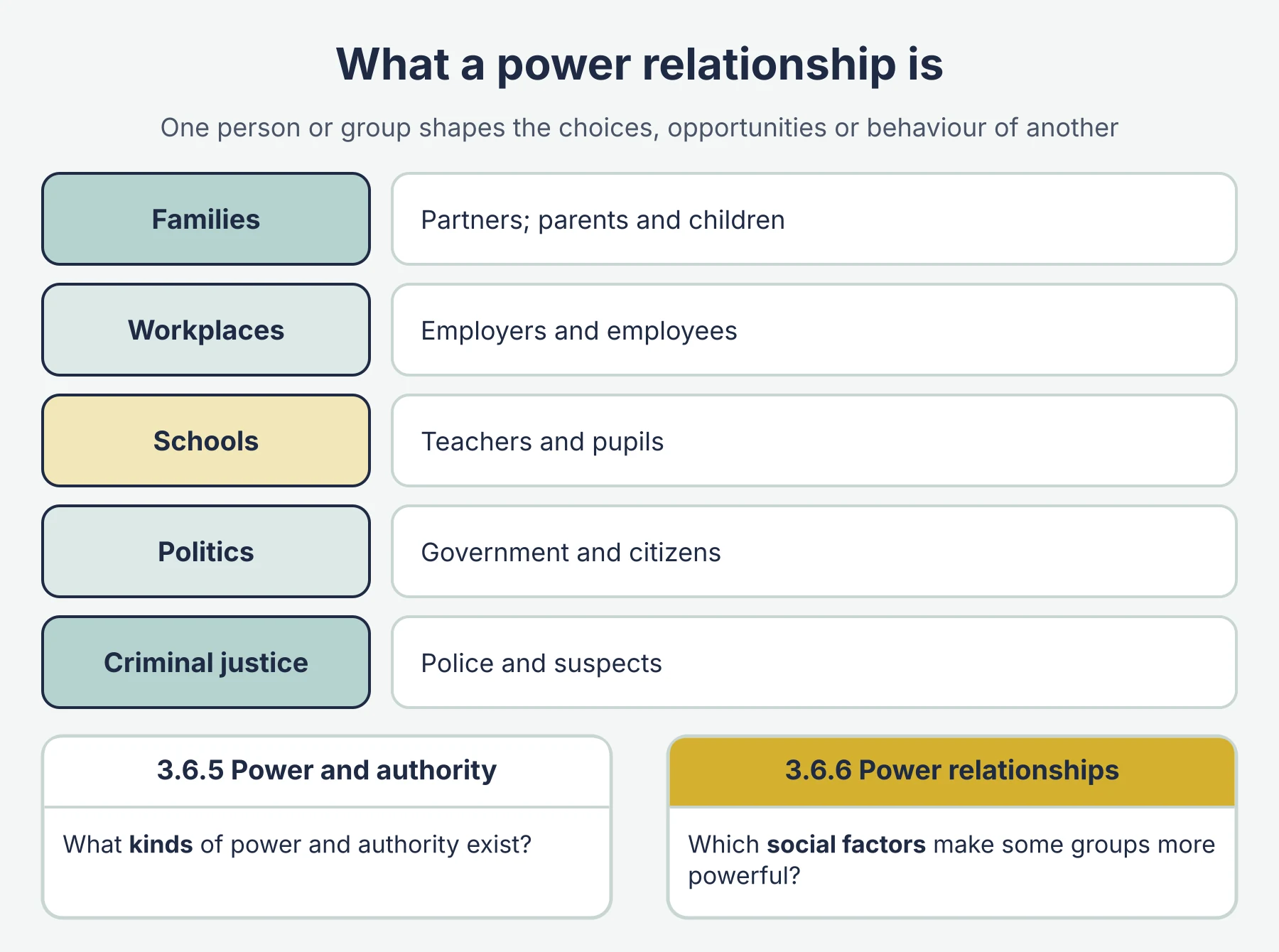
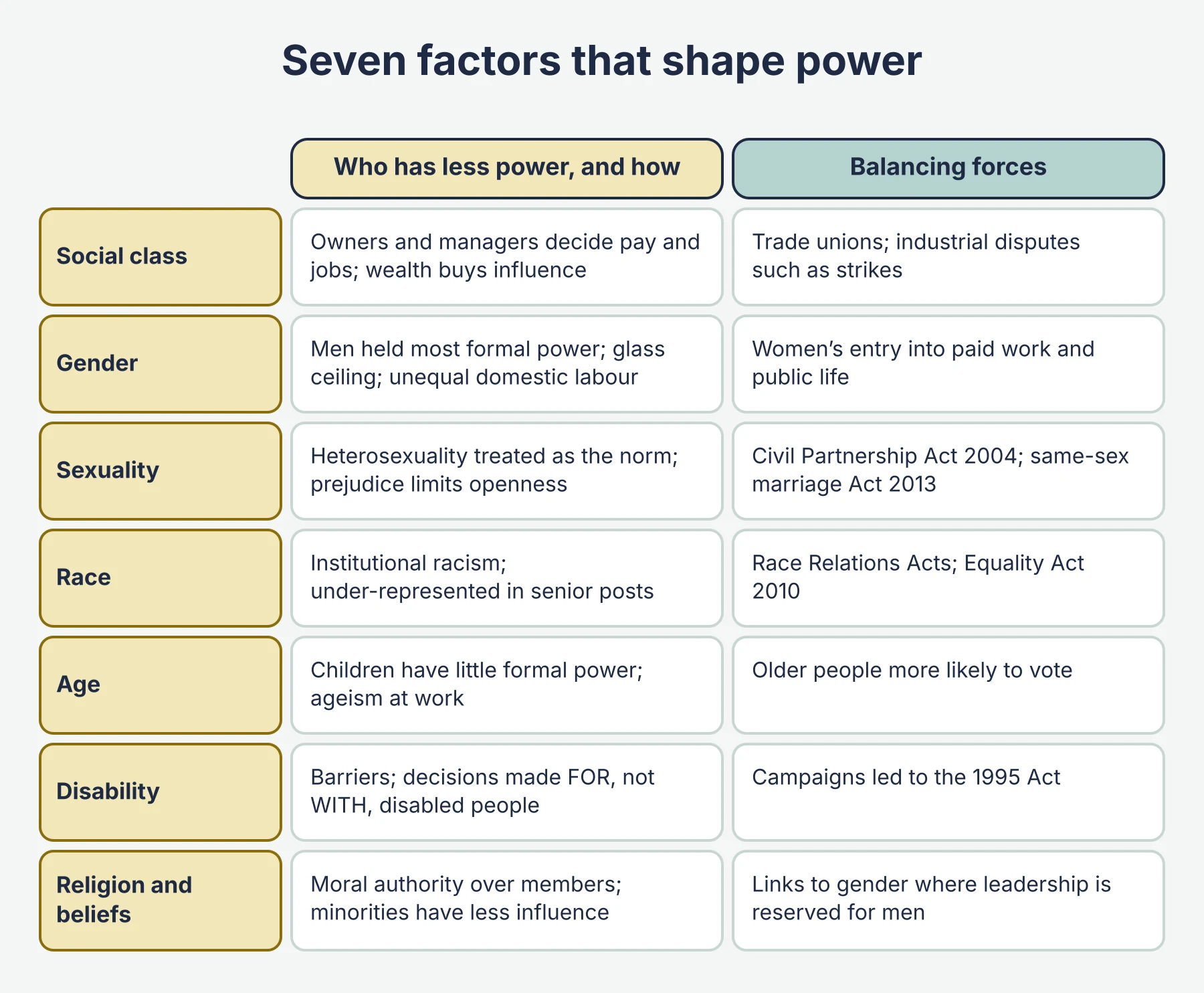
Factors: who holds more power, and how
| Factor | Who tends to hold more power | How it works |
|---|---|---|
| Social class | Owners, managers, the wealthy | Control of jobs and pay; donations, lobbying, media ownership |
| Gender | Men | Most top posts; the glass ceiling; unequal domestic labour |
| Sexuality | Heterosexual majority | Historic lack of legal recognition; prejudice and harassment |
| Race | White majority in many institutions | Racial discrimination; institutional racism; under-representation in senior posts |
| Age | Adults of working age | Children have little formal power; ageism against older workers; young workers on insecure contracts |
| Disability | Non-disabled people | Barriers to work and public life; decisions made for disabled people |
| Religion and beliefs | Majority or established faiths | Moral authority over members; minorities may face discrimination |
Key terms
| Term | Meaning |
|---|---|
| Power relationship | A relationship in which one side can shape the other’s choices or behaviour |
| Patriarchy | Male domination of society |
| Private patriarchy | Direct control of women by fathers or husbands (Walby) |
| Public patriarchy | Women in public life but segregated into low-paid, low-status jobs (Walby) |
| Patriarchal relations of production | Men benefiting from women’s unpaid labour in the home |
| Double standard | Judging the same behaviour differently in men and women |
| Glass ceiling | Invisible barrier that stops women reaching top jobs |
| Sex (gender) discrimination | Unfair treatment because of sex |
| Racial discrimination | Unfair treatment because of race |
| Institutional racism | Racism built into an organisation’s routines and rules |
| Ageism | Prejudice or discrimination on grounds of age |
| Industrial dispute | Conflict between employers and workers, such as a strike |
| Trade union | Organisation of workers acting together to protect pay and conditions |
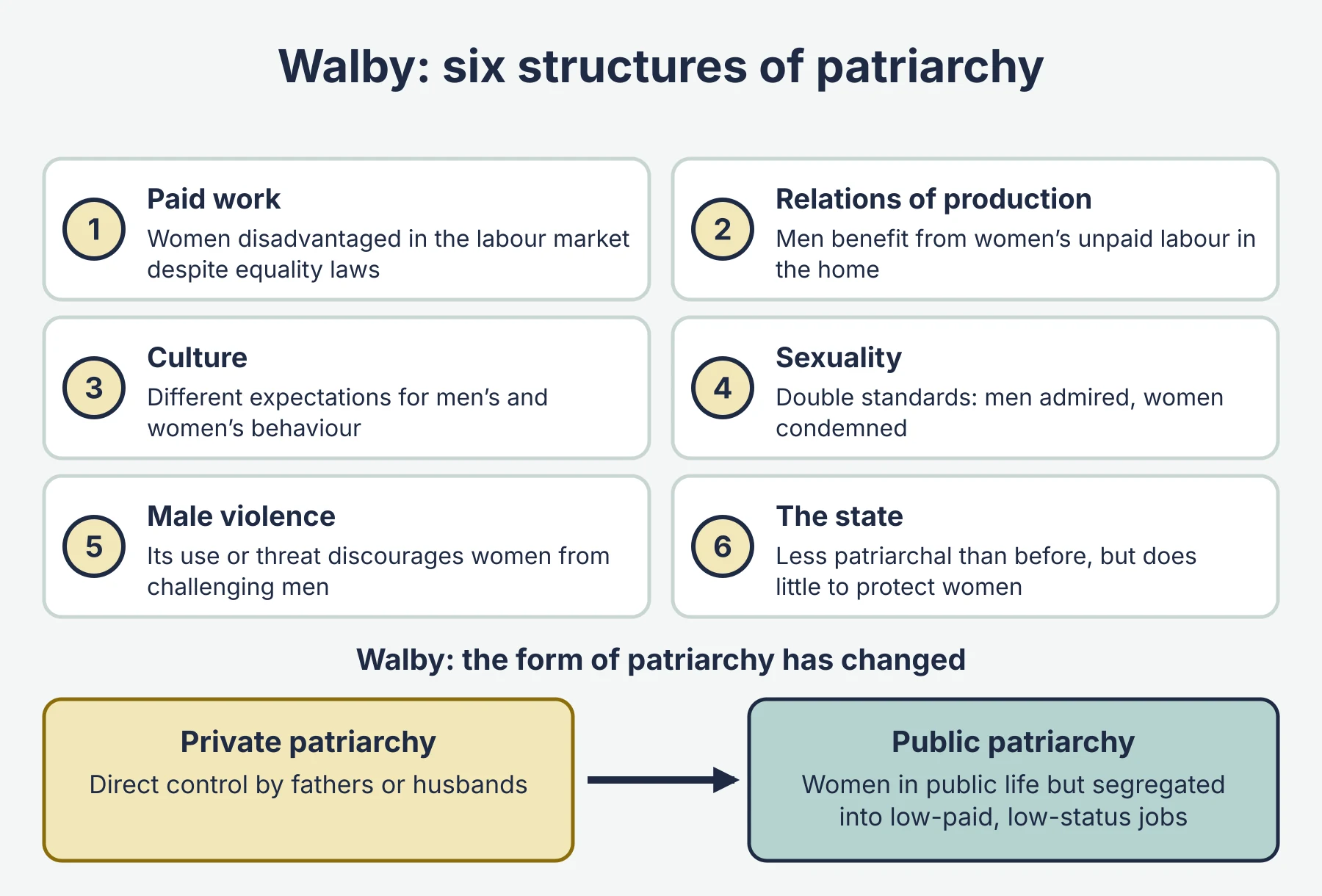
Walby (1990): six structures
- Paid work: disadvantaged despite the Equal Pay and Sex Discrimination Acts; cultural values about wives and mothers.
- Patriarchal relations of production: men benefit from women’s unpaid domestic labour.
- Patriarchal culture: different standards for men’s and women’s behaviour.
- Sexuality: double standards.
- Male violence towards women: use or threat of violence discourages challenges.
- The state: less patriarchal than before but does relatively little; lower wages; equal opportunities laws seldom enforced.
Shift: from private patriarchy (control at home) to public patriarchy (segregation in public life).
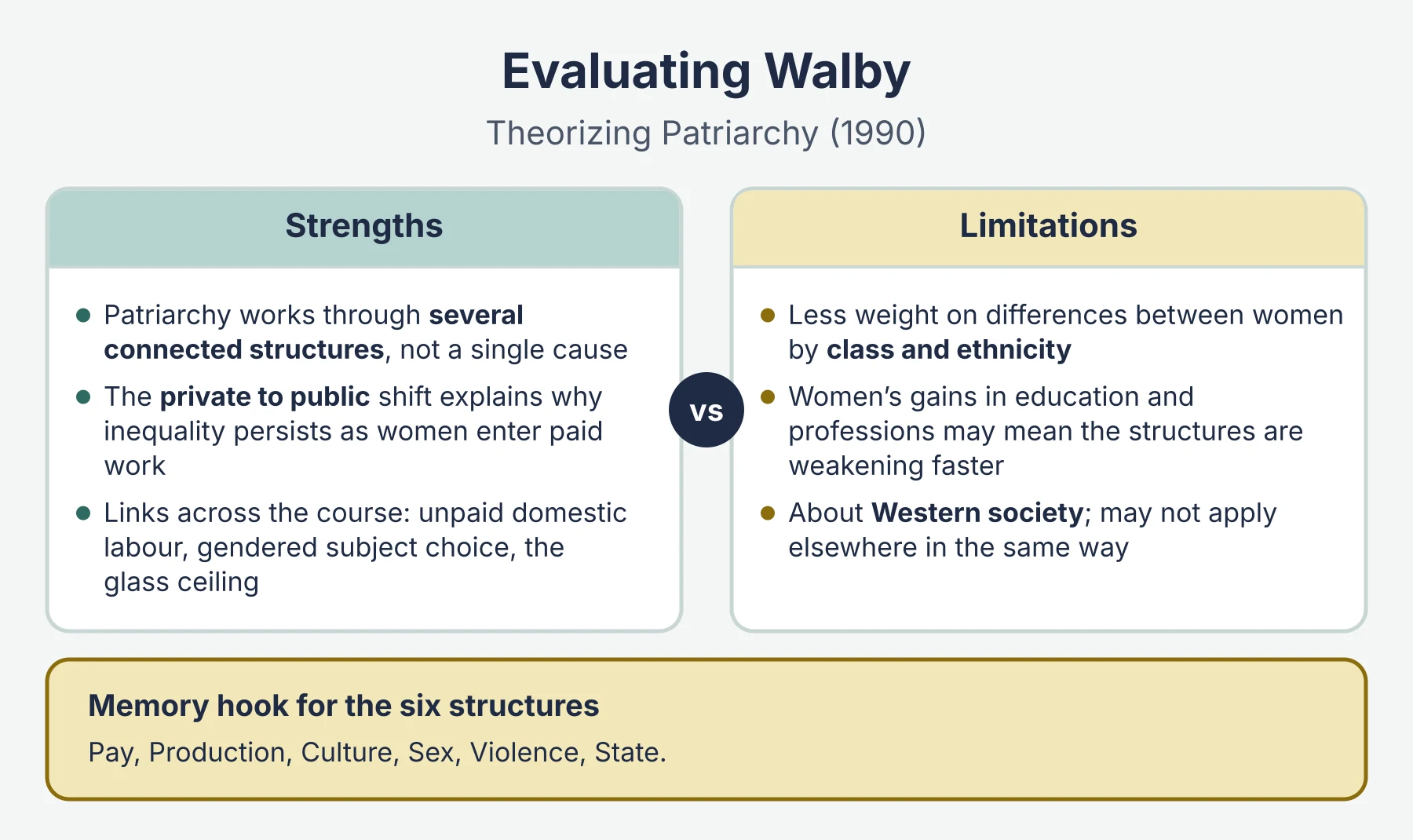
Memory hook: Pay, Production, Culture, Sex, Violence, State.
Evaluation: shows many connected structures; explains persistence as women enter work; but gives less weight to differences between women by class and ethnicity; women’s gains may suggest faster change.
Laws to name accurately
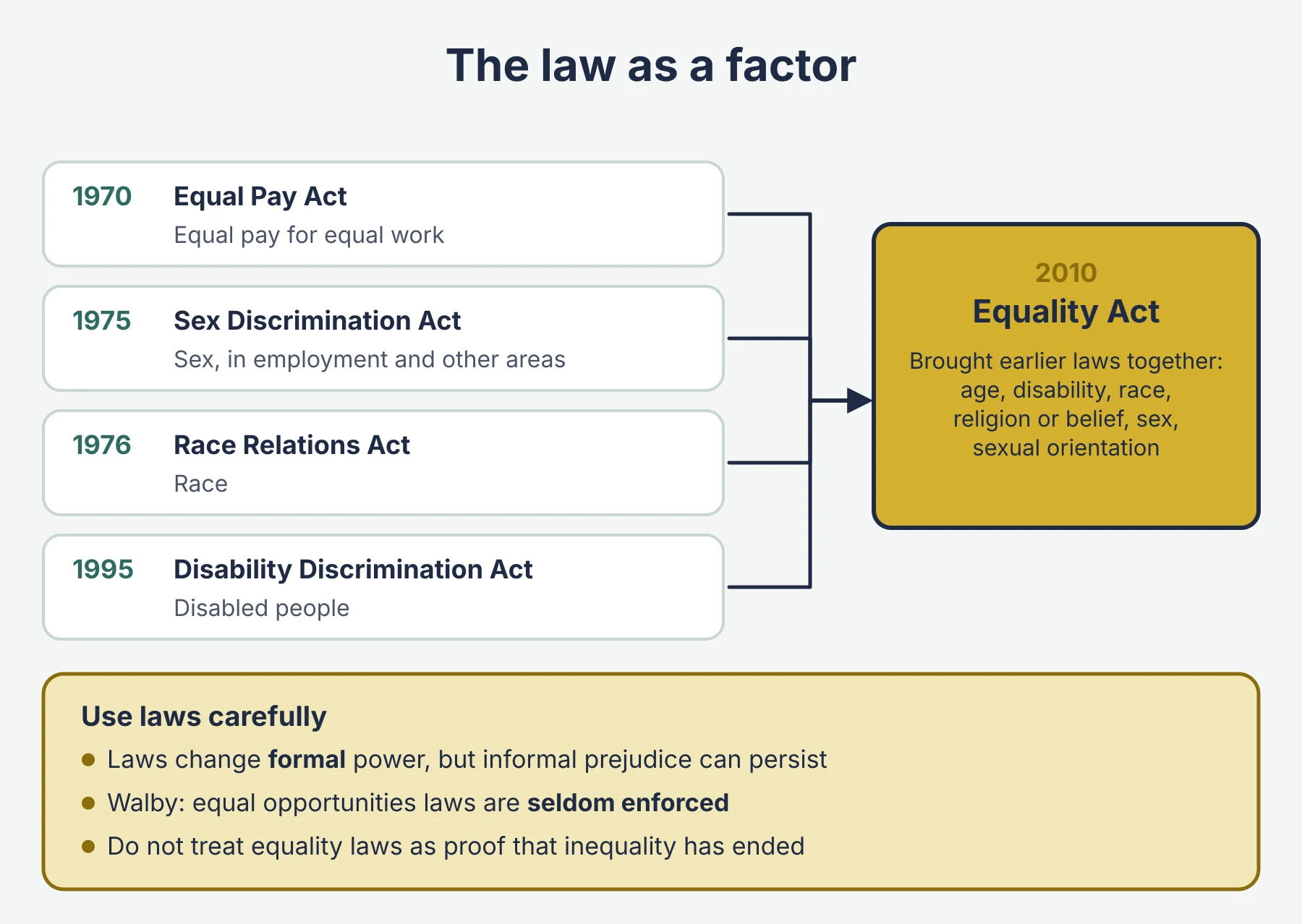
- Equal Pay Act 1970
- Sex Discrimination Act 1975
- Race Relations Act 1976
- Disability Discrimination Act 1995
- Civil Partnership Act 2004
- Equality Act 2010
- Marriage (Same Sex Couples) Act 2013
Perspectives
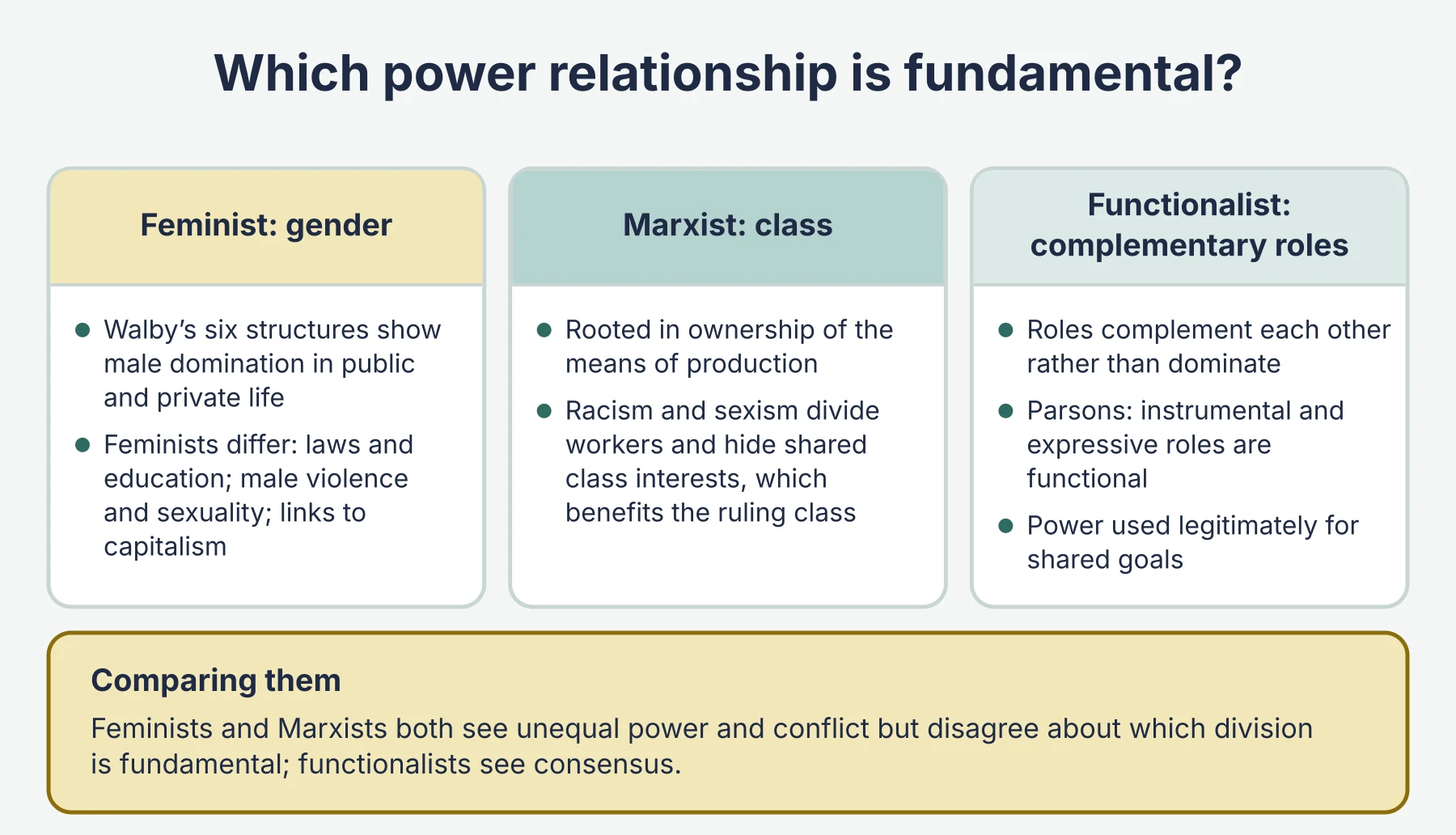
- Feminist: gender is the key power relationship; Walby’s structures.
- Marxist: class is the key power relationship; racism and sexism divide workers and benefit the ruling class.
- Functionalist: roles are complementary (Parsons’ instrumental and expressive roles); power used for shared goals.
Exam traps
- Trap: six structures with no private to public shift. Fix: always add the shift.
- Trap: “laws have ended discrimination”. Fix: laws change formal power; Walby says enforcement is weak.
- Trap: only writing about gender. Fix: the specification names seven factors plus beliefs.
- Trap: confusing Walby’s “state” structure with Marxist views of the state. Fix: Walby’s point is about protecting women, not serving owners.
- Trap: treating all women as one group. Fix: note class and ethnic differences between women.
Quick self-test
- What is a power relationship?
- List the factors the specification names for power relationships.
- Name Walby’s six structures.
- What did Walby mean by patriarchal relations of production?
- Give an example of a double standard.
- What is private patriarchy?
- What is public patriarchy?
- What did Walby say about the state?
- Give one criticism of Walby.
- How do Marxists see racism and sexism?
- How might age give older people some power?
- Name the 2010 law that brought earlier equality laws together.
Answers
- A relationship in which one person or group can shape the choices, opportunities or behaviour of another.
- Social class, gender, sexuality, race, age, disability, religion and beliefs.
- Paid work, patriarchal relations of production, patriarchal culture, sexuality, male violence towards women, the state.
- Men exploit women by benefiting from their unpaid labour in the home.
- Men with many partners admired, women with many partners condemned.
- Direct control of women by their fathers or husbands.
- Women have access to public life but are segregated into low-paid, low-status jobs.
- It is less patriarchal than before but does relatively little to protect women; equal opportunities laws are seldom enforced.
- She gives less weight to differences between women by class and ethnicity.
- As divisions that stop workers recognising shared class interests, benefiting the ruling class.
- Older age groups are more likely to vote, which can give them political influence.
- The Equality Act 2010.
Specification reference
AQA GCSE Sociology (8192), section 3.6.6 Power relationships; Appendix B (7.4) summary of Walby; Appendix A (6.4) key terms.
Related resources
-
Study guides
AQA GCSE Sociology (8192): Social stratification – Study Guide
Study guide to AQA GCSE Sociology 8192 social stratification: Davis and Moore, Marx and Weber on class, life chances, poverty, power and Walby.
Sociology · AQA · GCSE
Read guide -
Practice questions
AQA GCSE Sociology (8192): Social stratification – Practice Questions
Original AQA GCSE Sociology 8192 stratification questions with marked answers on Davis and Moore, class, poverty data, authority and patriarchy.
Sociology · AQA · GCSE
Try questions -
Revision notes
AQA GCSE Sociology (8192): Social stratification – Revision Notes
Condensed AQA GCSE Sociology 8192 stratification notes: key terms, the seven named sociologists, must-know contrasts, an essay plan and a self-test.
Sociology · AQA · GCSE
Revise topic
Related articles
Get free revision emails (optional)
Occasional emails with practice questions, worked explanations and links to free resources for the qualification and subjects you choose. No spam, and you can unsubscribe from any email. The free tools on this site never need an email.