
Study Guides
AQA GCSE Sociology (8192): Power relationships
AQA GCSE Sociology 8192 guide to 3.6.6 power relationships: class, gender, race, age and other factors, Walby's six structures of patriarchy, and perspectives.
- Subject
- Sociology
- Level
- GCSE
- Topic
- Social stratification
- Author
- Marlbridge Academic Team
- Updated
- Reviewed by
- Naqiya Yousaf (what this means)
Aligned to AQA GCSE Sociology (8192), first teaching 2017. Official specification .
Syllabus page (what it covers and how it is assessed): AQA GCSE Sociology.
Syllabus points this page covers
8192
- 3.6.6 Power relationships
Found an error? Report a correction.
Need help with this topic? Request a free trial class for GCSE Sociology (8192).
This guide covers AQA GCSE Sociology (8192) section 3.6.6 Power relationships, assessed in Paper 2: The sociology of crime and deviance and social stratification. The specification asks you to “identify, describe and explain different factors affecting power relationships including social class, gender, sexuality, race, age, disability, religion and beliefs”, to compare functionalist, feminist and Marxist perspectives, and to describe the key ideas of Walby on patriarchy.
The Social stratification study guide lists Walby’s six structures. This guide explains each one with an example and an evaluation point, shows how each factor shapes power in real settings, and sets out how feminist, Marxist and functionalist views differ. Revise with the power relationships revision notes and practise with the power relationships practice questions.
What a power relationship is
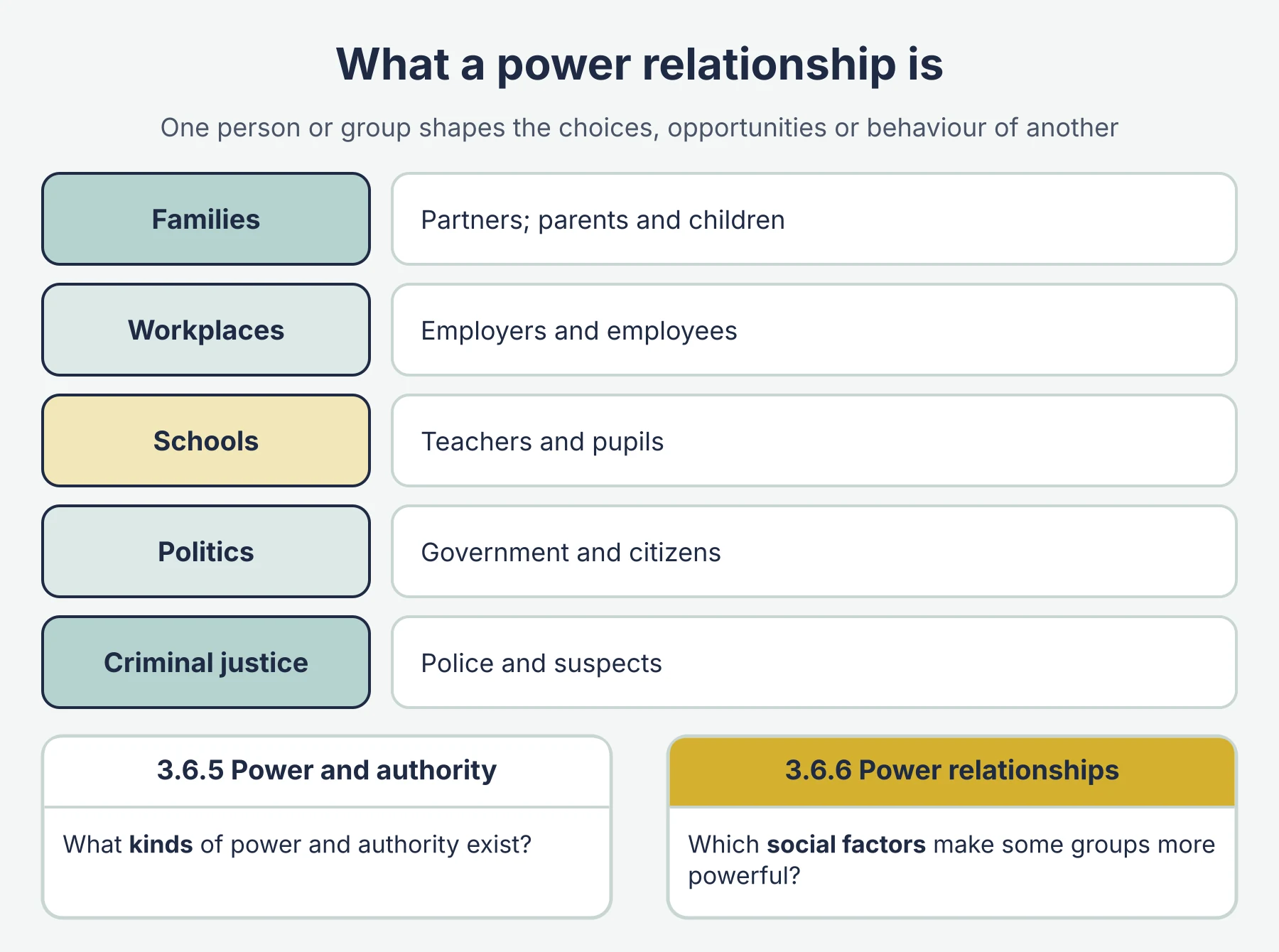
A power relationship is any relationship in which one person or group is able to shape the choices, opportunities or behaviour of another. Power relationships exist in families (between partners, or parents and children), workplaces (employers and employees), schools (teachers and pupils), politics (government and citizens) and the criminal justice system (police and suspects).
The 3.6.5 sub-section asks what kinds of power and authority exist. This sub-section asks which social factors make some groups more powerful than others.
Factors affecting power relationships
Social class
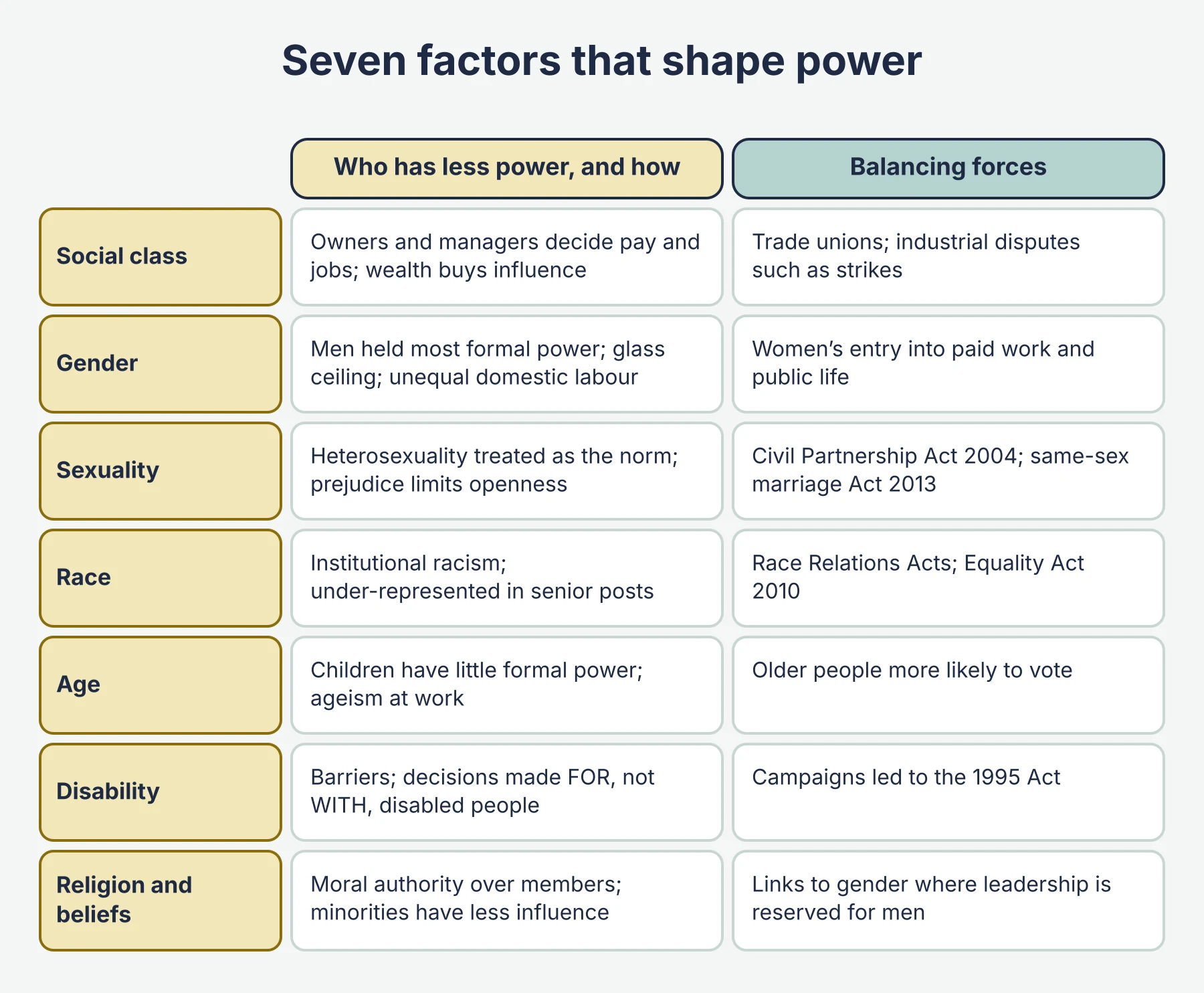
Owners and managers make decisions about pay, hours and jobs; employees usually do not. Wealth can buy influence through donations, lobbying and media ownership. Marxists see this as the central power relationship. Trade unions and industrial disputes, such as strikes, show workers trying to balance it through collective action.
Gender
Men have historically held most formal power in politics, business, religion and the family. Women’s entry into paid work and public life has changed this, but the glass ceiling, the concentration of women in lower-paid work and unequal shares of domestic labour continue. Power within couples also links to who earns more and who controls money, which you meet in the families topic.
Sexuality
Heterosexuality has been treated as the norm, and same-sex relationships were long excluded from legal recognition. Prejudice and harassment can limit openness at school and work. Legal changes, such as the Civil Partnership Act 2004 and the Marriage (Same Sex Couples) Act 2013, have shifted formal power, although informal prejudice can persist.
Race
Racial discrimination and institutional racism can affect access to jobs, promotion, housing and fair treatment by the police and courts. People from minority ethnic groups have historically been under-represented in senior positions in many institutions. The Race Relations Acts and the Equality Act 2010 give legal protection.
Age
Children have little formal power: adults make most decisions about their lives. Young workers may be on lower pay and insecure contracts. Older people may face ageism at work, but older age groups are also more likely to vote, which can give them political influence.
Disability
Disabled people may face barriers to work, transport and public life, and decisions are often made for them rather than with them. Campaigns by disabled people’s organisations led to the Disability Discrimination Act 1995, later brought into the Equality Act 2010.
Religion and beliefs
Religious organisations can hold power over members through rules and moral authority. Religious minorities may face discrimination or have less influence over public life. In some institutions, religious leadership has been reserved for men, which links religion to gender.
The law as a factor
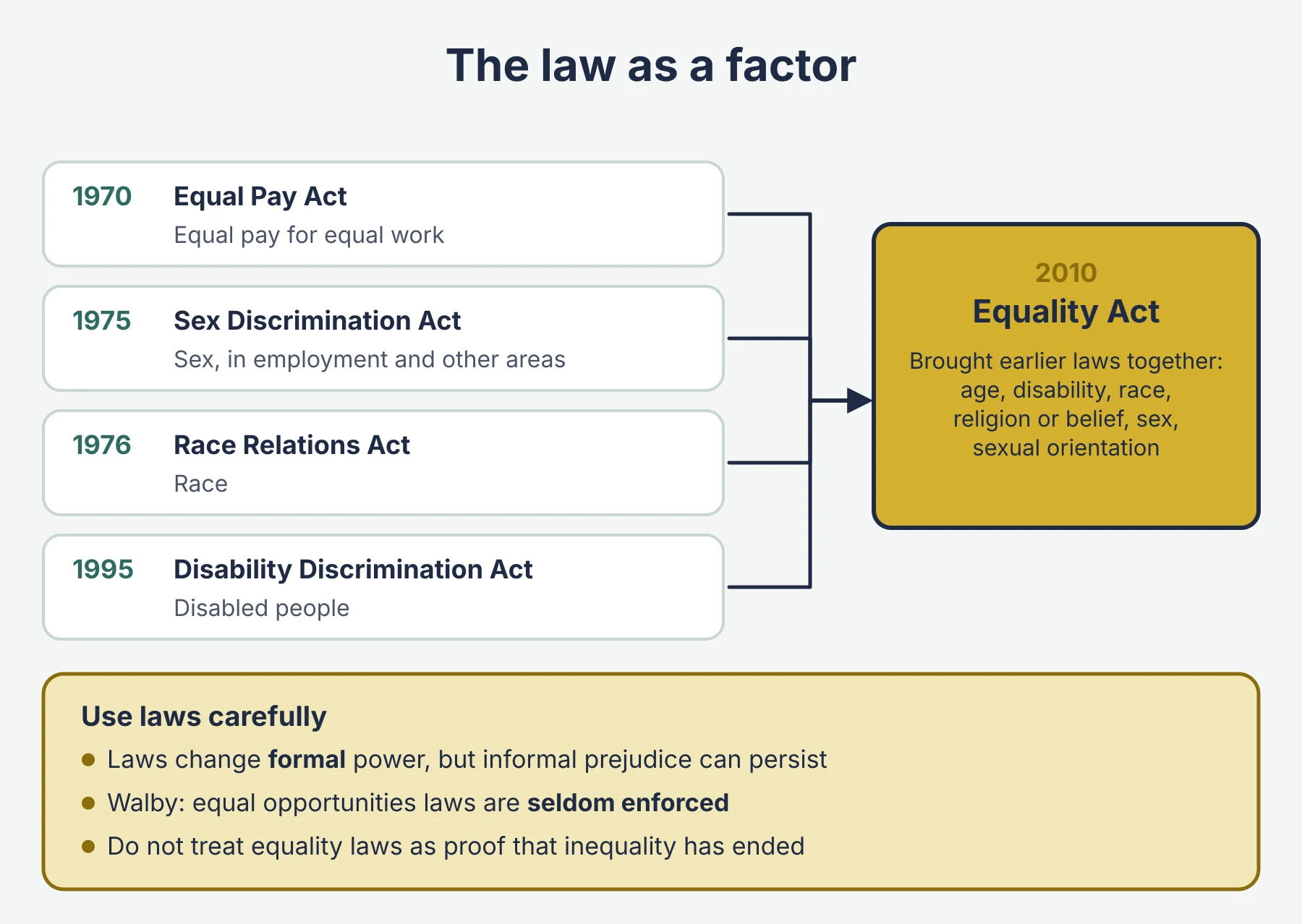
| Law | What it addressed |
|---|---|
| Equal Pay Act 1970 | Equal pay for men and women doing equal work |
| Sex Discrimination Act 1975 | Discrimination on grounds of sex in employment and other areas |
| Race Relations Act 1976 | Discrimination on grounds of race |
| Disability Discrimination Act 1995 | Discrimination against disabled people |
| Equality Act 2010 | Brought earlier laws together and protected several characteristics, including age, disability, race, religion or belief, sex and sexual orientation |
Use laws carefully in evaluation: they change formal power, but Walby argues equal opportunities laws are seldom enforced.
Walby’s theory of patriarchy
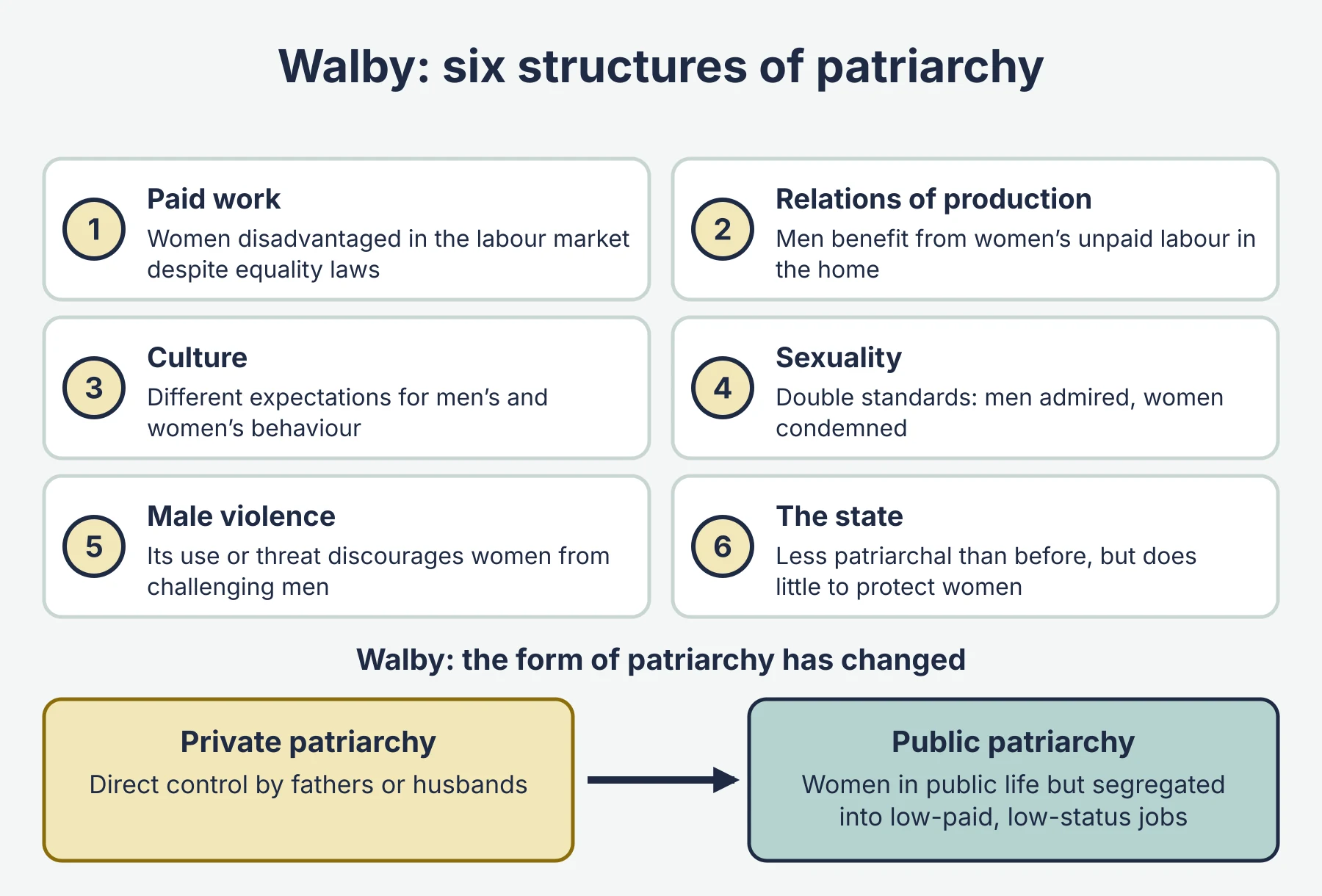
Sylvia Walby (Theorizing Patriarchy, 1990) wrote from a feminist perspective. She argued that the concept of patriarchy is central to understanding society, and described six structures that restrict women and help maintain male domination.
| Structure | What Walby argued | Example to use |
|---|---|---|
| 1. Paid work | Despite equality laws (the Equal Pay and Sex Discrimination Acts), women are disadvantaged in the labour market, their opportunities restricted by cultural values about wives and mothers | A mother passed over for promotion because managers assume she will not work long hours |
| 2. Patriarchal relations of production | Men exploit women by benefiting from their unpaid labour in the home | A woman in full-time work who still does most of the cooking and cleaning |
| 3. Patriarchal culture | Women have more freedom but face expectations that apply different standards to men and women | Girls criticised for behaviour accepted in boys |
| 4. Sexuality | Women express their sexuality more freely, but under double standards | Men with many partners admired; women condemned |
| 5. Male violence towards women | The use or threat of violence discourages women from challenging patriarchal authority | Fear of harassment limiting where women go at night |
| 6. The state | Less patriarchal than before, but does relatively little to protect women; women generally receive lower wages and equal opportunities laws are seldom enforced | Equality laws in place but rarely used to challenge unequal pay |
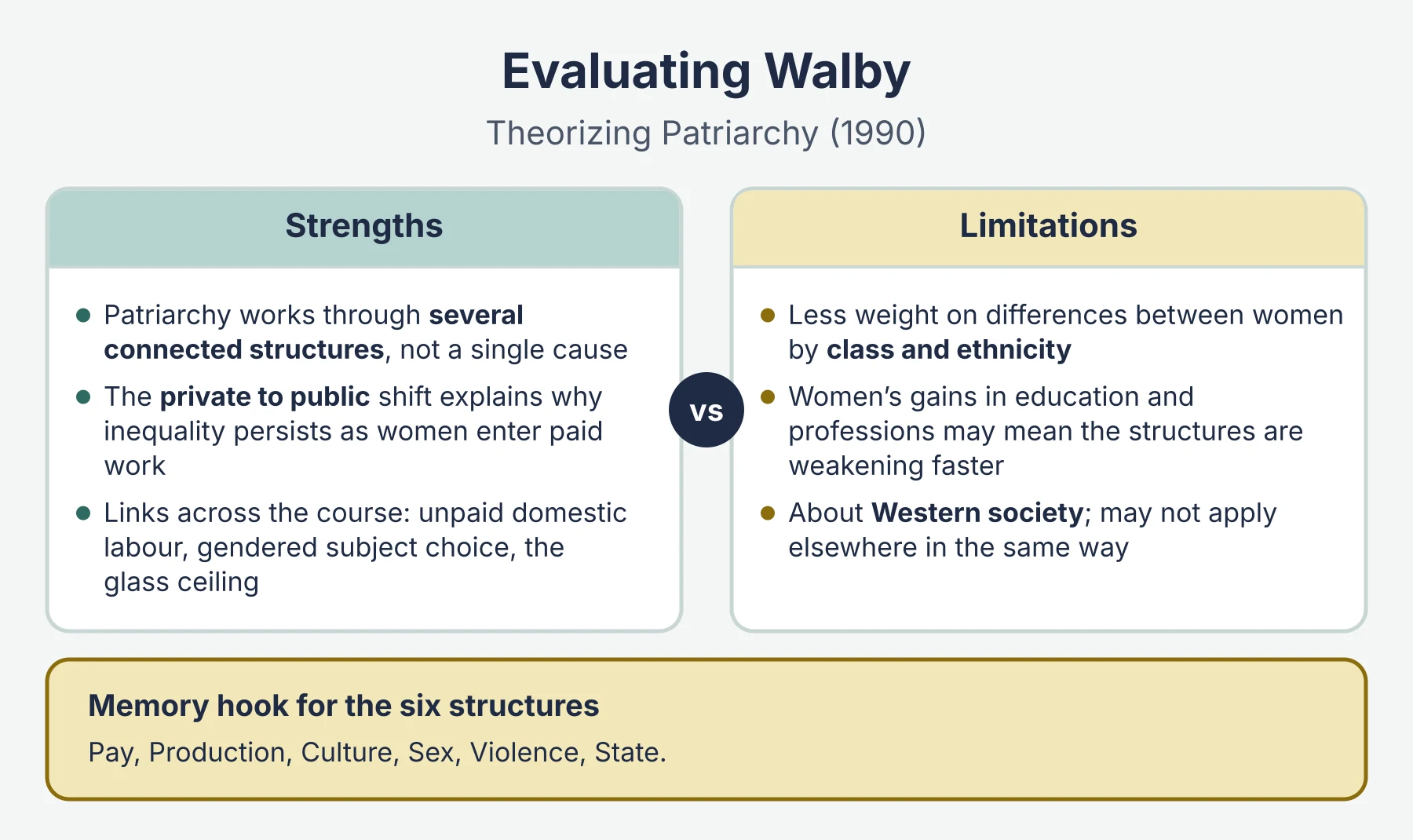
Memory hook: Pay, Production, Culture, Sex, Violence, State.
From private to public patriarchy
Walby argued that patriarchy in Western society has changed form:
- Private patriarchy (in the past): direct control of women by their fathers or husbands, mainly within the household.
- Public patriarchy (today): women have access to public life, such as paid work, education and politics, but are generally segregated into low-paid, low-status jobs where they are collectively exploited by male-dominated society.
The key point is that patriarchy has not disappeared; it has moved from the home into public institutions.
Evaluating Walby
Strengths:
- She shows patriarchy works through several connected structures, not a single cause.
- The private to public shift explains why inequality persists even as women enter paid work.
- Her structures link to evidence across the course: unpaid domestic labour in families, gendered subject choice in education, and the glass ceiling.
Limitations:
- Critics argue she gives less weight to differences between women by class and ethnicity; a professional woman and a low-paid migrant worker experience patriarchy differently.
- Some argue women’s gains in education and professions suggest the structures are weakening faster than she allows.
- The theory is about Western society, so it may not apply elsewhere in the same way.
Perspectives on power relationships
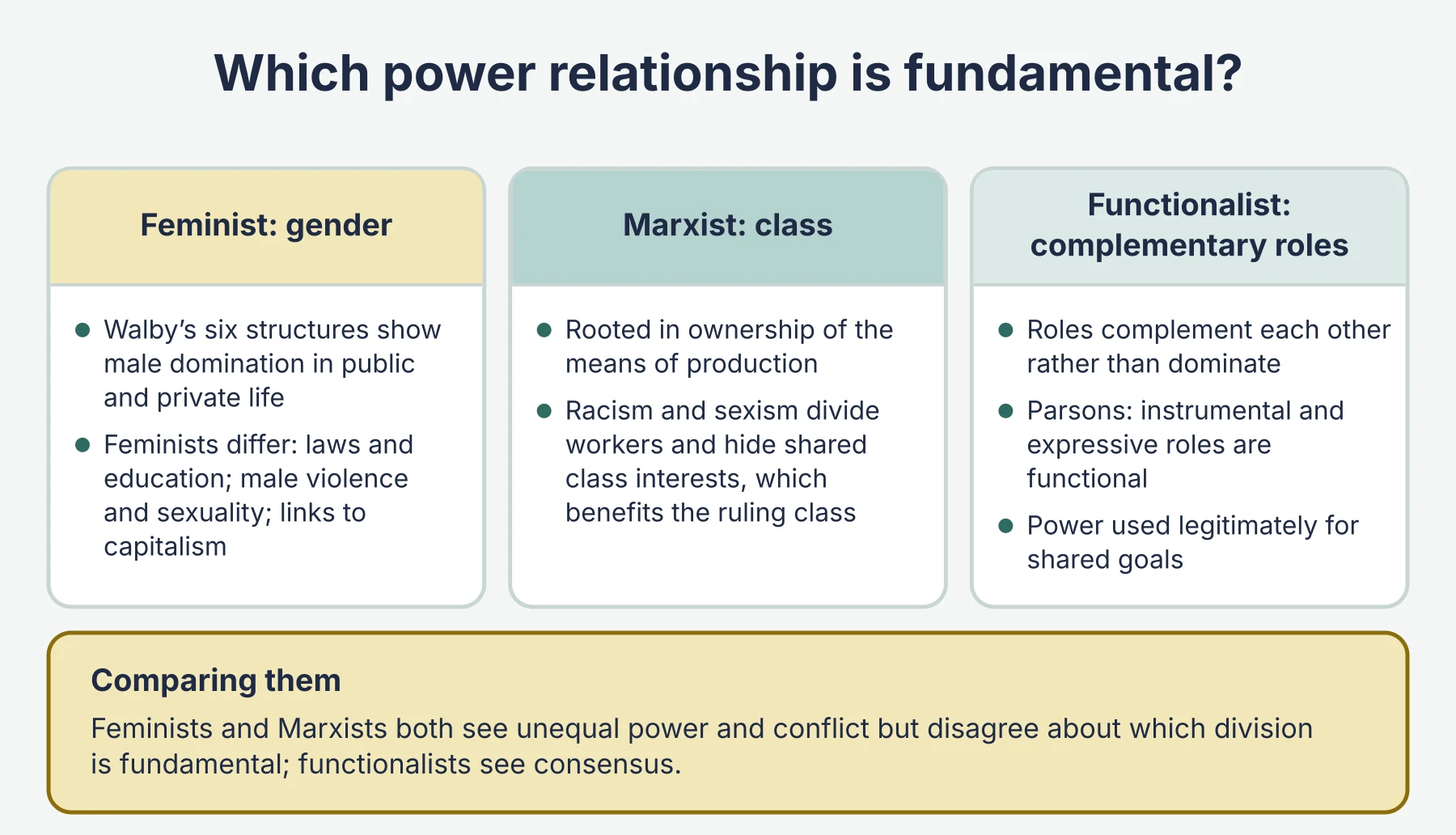
Feminist. Gender is the key power relationship. Walby’s six structures show male domination in public and private life. Feminists differ in emphasis: some stress gradual change through laws and education, others stress male violence and sexuality, and others link patriarchy to capitalism.
Marxist. Class is the key power relationship, rooted in ownership of the means of production. Other divisions, such as racism and sexism, can divide workers and stop them recognising shared class interests, which benefits the ruling class.
Functionalist. Different roles are seen as complementary rather than as relationships of domination. Parsons, in the families topic, described men’s instrumental and women’s expressive roles as functional for the family. Functionalists see power used legitimately for shared goals.
Comparing them: feminists and Marxists both see power relationships as unequal and in conflict, but disagree about which division is fundamental. Functionalists see consensus and complementary roles where others see inequality.
Worked paragraph
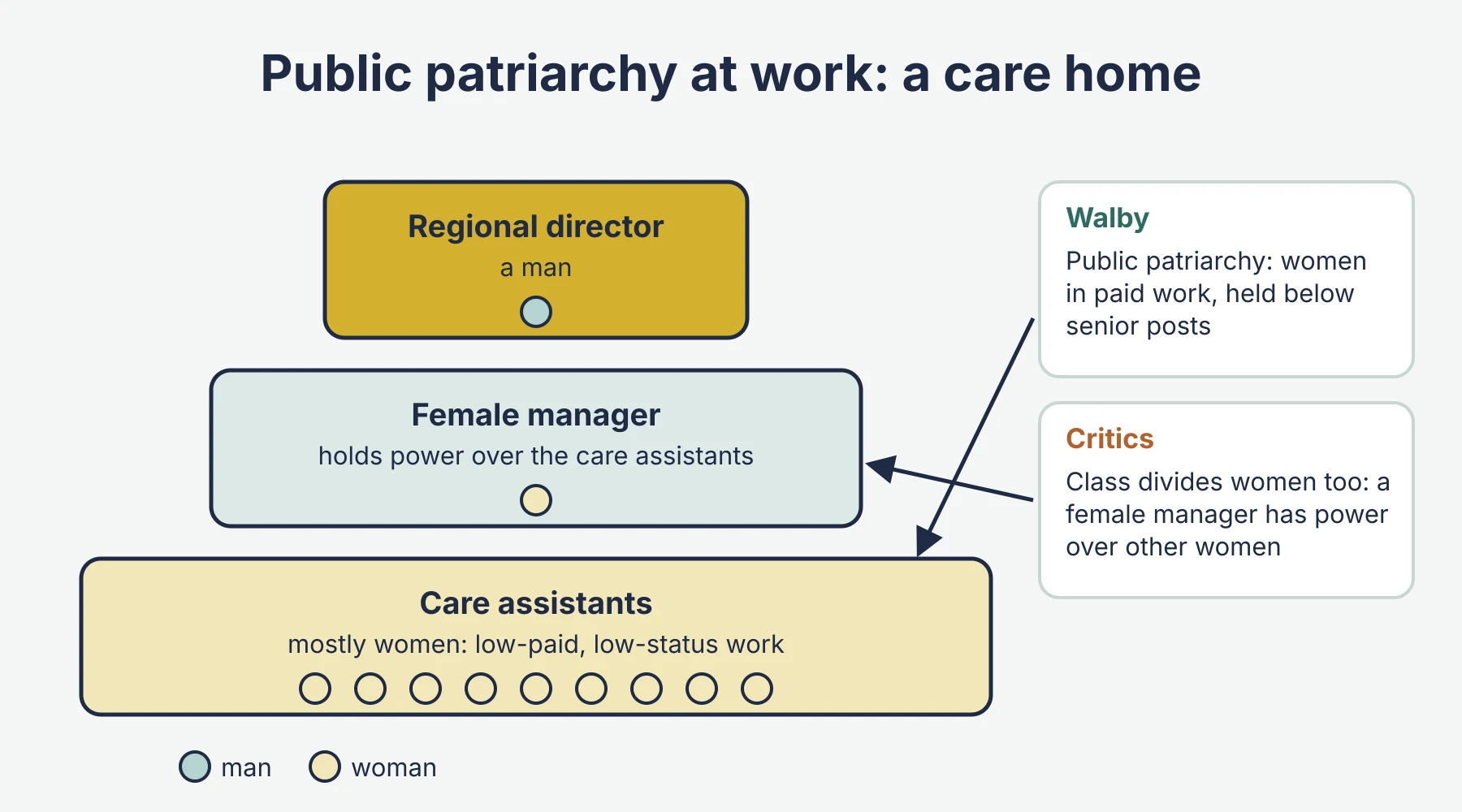
Walby argues that public patriarchy keeps women in low-paid, low-status jobs. For example, in a care home where most care assistants are women and the regional director is a man, women are present in paid work but held below the senior posts. This shows patriarchy now works through segregation in public life rather than direct control at home. However, critics argue Walby underplays differences between women: a female manager in the same company may hold power over the care assistants, so class divides women too.
Common mistakes
- Listing Walby’s six structures without explaining the private to public shift.
- Treating equality laws as proof that inequality has ended.
- Writing about only gender when the specification lists seven factors plus beliefs.
- Using “patriarchy” to mean any unfair situation. It means male domination of society.
Exam technique
- Identify a factor from the specification list and name a setting where it shapes power.
- Explain by saying who holds more power and how it is used.
- In discuss how far answers, test a claim such as “gender is the most important power relationship” against class and ethnicity, using Walby and Marxist views.
Frequently asked questions
What is the difference between private and public patriarchy? Private patriarchy is direct control of women by fathers or husbands; public patriarchy gives women access to public life but segregates them into low-paid, low-status work.
Which laws does Walby mention? The specification’s summary refers to the Equal Pay and Sex Discrimination Acts, which in theory support equality.
Specification reference
AQA GCSE Sociology (8192), section 3.6.6 Power relationships, with the Walby summary in Appendix B (7.4) and the social stratification key terms in Appendix A (6.4).
Related resources
-
Practice questions
AQA GCSE Sociology (8192): Power relationships – Practice Questions
Original AQA GCSE Sociology 8192 practice on power relationships and Walby's theory of patriarchy, with data, item-based and extended questions and answers.
Sociology · AQA · GCSE
Try questions -
Revision notes
AQA GCSE Sociology (8192): Power relationships – Revision Notes
AQA GCSE Sociology 8192 revision notes on 3.6.6 power relationships: the named factors, Walby on patriarchy, perspectives, equality laws, traps and a self-test.
Sociology · AQA · GCSE
Revise topic -
Study guides
AQA GCSE Sociology (8192): Social stratification – Study Guide
Study guide to AQA GCSE Sociology 8192 social stratification: Davis and Moore, Marx and Weber on class, life chances, poverty, power and Walby.
Sociology · AQA · GCSE
Read guide
Related articles
Get free revision emails (optional)
Occasional emails with practice questions, worked explanations and links to free resources for the qualification and subjects you choose. No spam, and you can unsubscribe from any email. The free tools on this site never need an email.