
Revision Notes
AQA GCSE Sociology (8192): Power and authority – Revision Notes
AQA GCSE Sociology 8192 revision notes on 3.6.5 power and authority: Weber's types, formal and informal power, perspectives, key terms and a self-test.
- Subject
- Sociology
- Level
- GCSE
- Topic
- Social stratification
- Author
- Marlbridge Academic Team
- Updated
- Reviewed by
- Naqiya Yousaf (what this means)
Aligned to AQA GCSE Sociology (8192), first teaching 2017. Official specification .
Syllabus page (what it covers and how it is assessed): AQA GCSE Sociology.
Syllabus points this page covers
8192
- 3.6.5 Power and authority
Found an error? Report a correction.
Need help with this topic? Request a free trial class for GCSE Sociology (8192).
These notes cover AQA GCSE Sociology (8192) section 3.6.5 Power and authority, assessed in Paper 2. Read the power and authority study guide for full explanations and an item-based model answer, then practise with the power and authority practice questions. The Social stratification revision notes cover the rest of the topic.
What you must be able to do
- Identify, describe and explain forms of power and authority: traditional, charismatic, rational-legal, formal and informal sources of power.
- Compare functionalist, feminist and Marxist perspectives on power and authority.
- Describe the key ideas of Weber on power and authority.
Core definitions
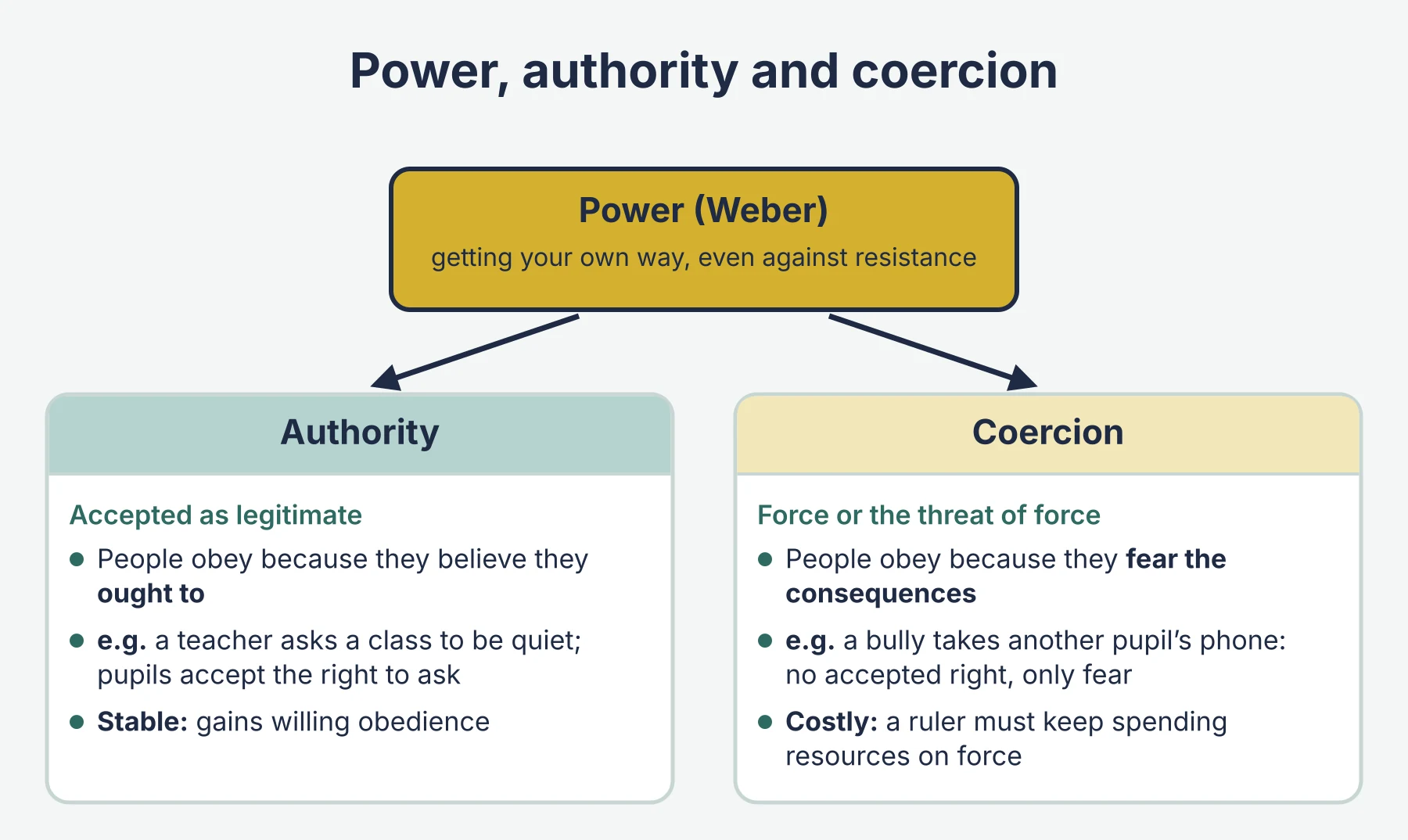
- Power: the chance of getting your own way, even against resistance (Weber).
- Authority: power accepted as legitimate.
- Coercion: power based on force or the threat of force.
- Legitimacy: the belief that a person or rule has the right to be obeyed.
Weber’s three types
| Type | Why people obey | Example | Weakness |
|---|---|---|---|
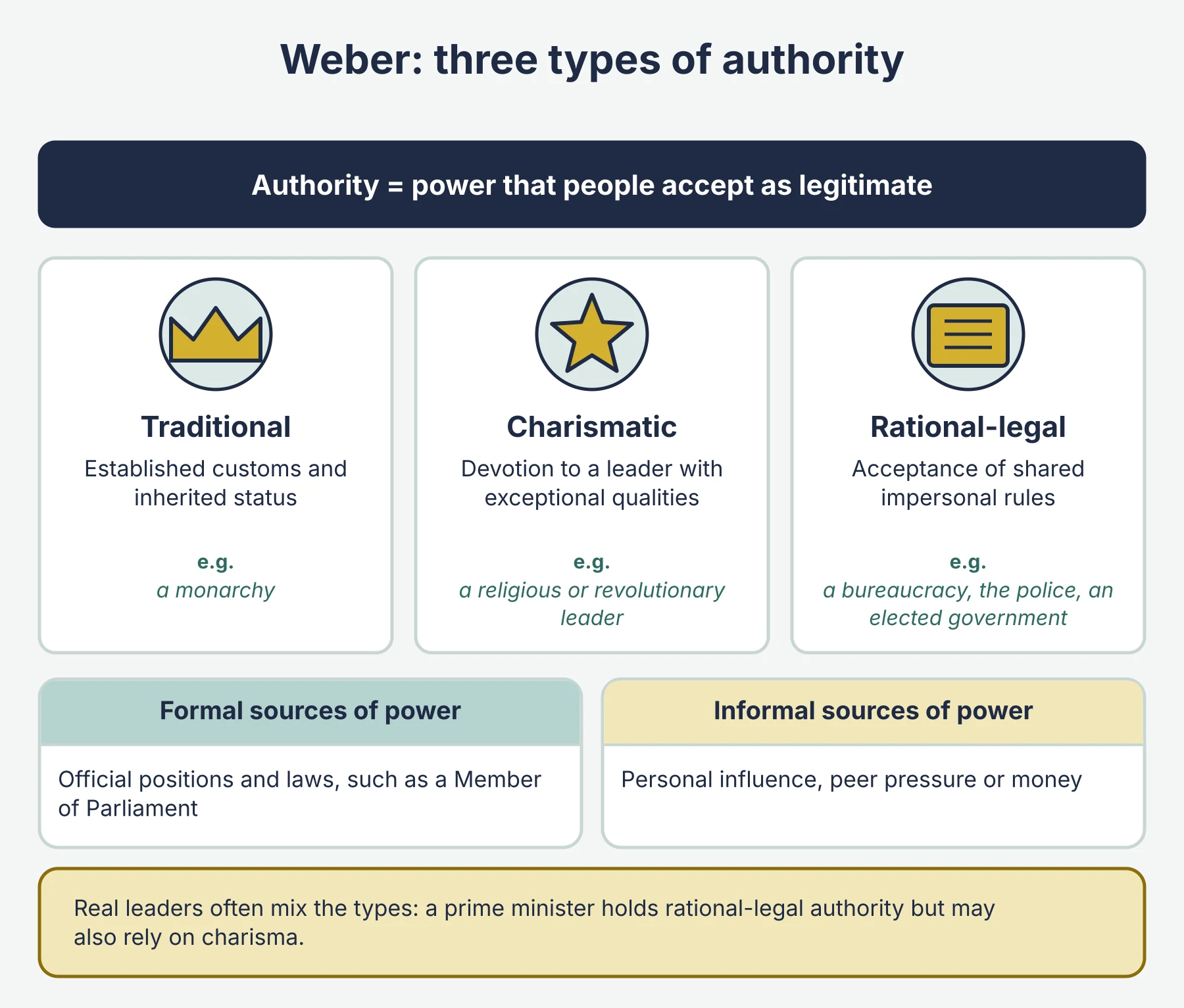
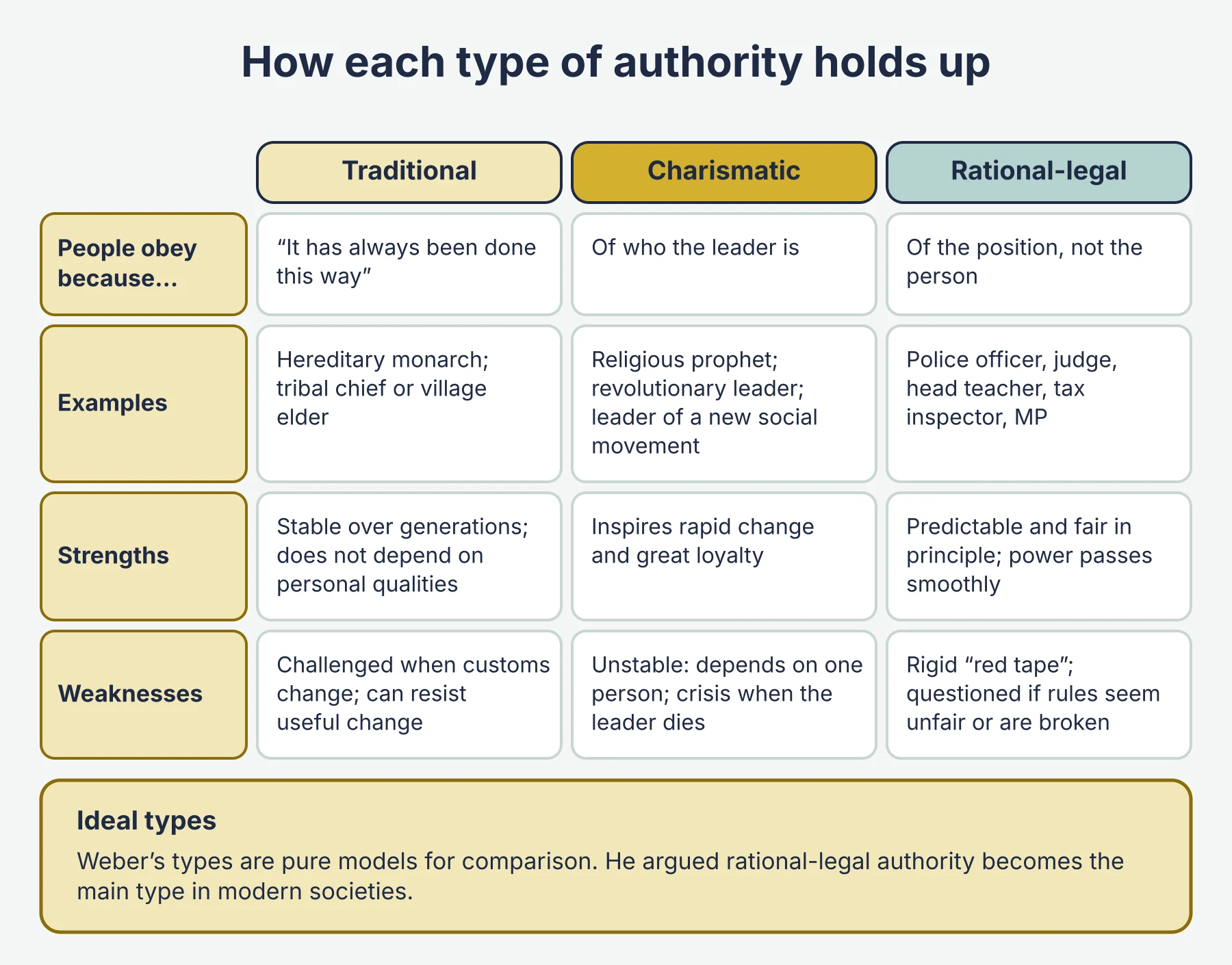
| Traditional | Established customs and inherited status | Hereditary monarch, village elder | Weakens when customs change |
| Charismatic | Devotion to a leader’s exceptional qualities | Religious prophet, revolutionary leader | Unstable; crisis when the leader dies |
| Rational-legal | Acceptance of shared impersonal rules | Police officer, judge, MP, head teacher | Can become rigid “red tape” |
Memory hook: Tradition, Charisma, Rules: the past, the person, the position.
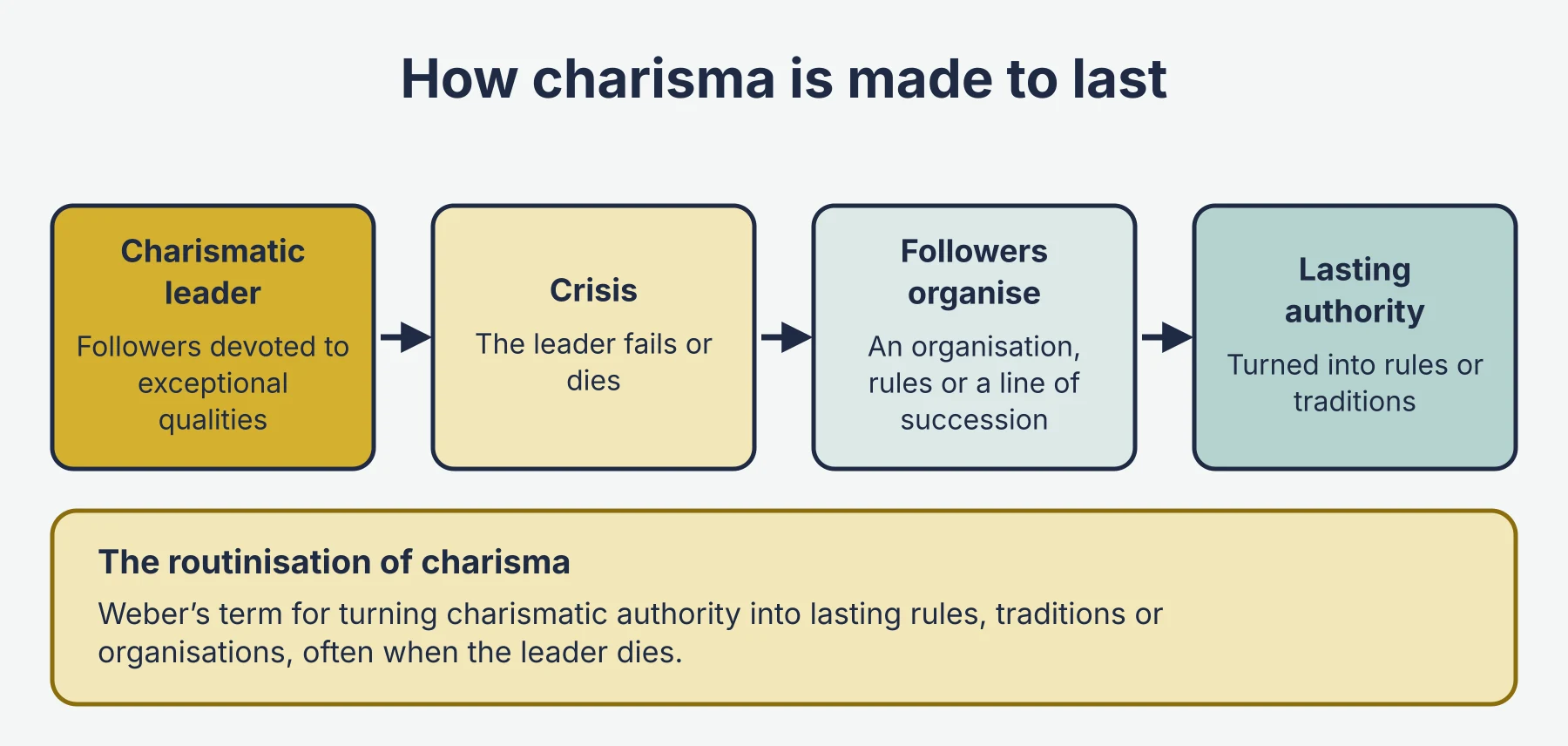
Routinisation of charisma: charismatic authority turned into lasting rules or organisations.
Ideal types: Weber’s types are pure models; real leaders mix them.
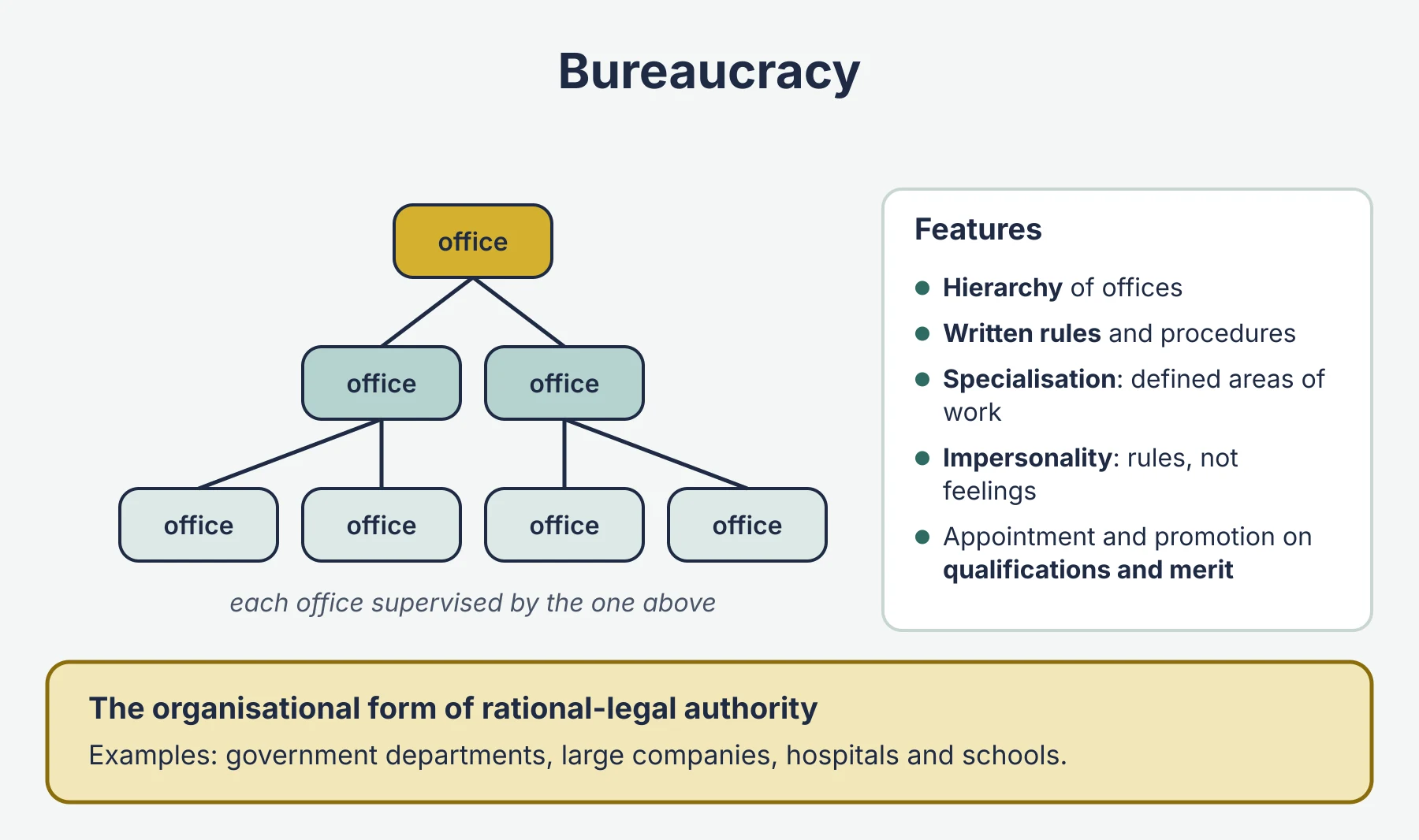
Bureaucracy in five features
Hierarchy; written rules; specialisation; impersonality; appointment on qualifications and merit.
Formal and informal power
| Formal | Informal |
|---|---|
| Comes from official positions, laws and job titles | Comes from personal influence, peer pressure, money, knowledge or reputation |
| Backed by formal sanctions: fines, exclusion, dismissal | Backed by informal sanctions: gossip, ridicule, being left out |
| MP, manager, head teacher | Popular pupil, experienced worker, wealthy donor |
Key terms
| Term | Meaning |
|---|---|
| Traditional authority | Authority based on customs and inherited status |
| Charismatic authority | Authority based on devotion to a leader with exceptional qualities |
| Legal rational authority | Authority based on shared impersonal rules |
| Bureaucracy | Organisation run on rational-legal lines with a hierarchy of offices |
| Monarchy | Rule by a king or queen, usually inherited |
| Dictatorship | Rule by one person or group without free elections |
| Oligarchy | Rule by a small group |
| Pluralism | Power spread among competing groups |
| Pressure group | Organisation trying to influence policy without standing for government |
| Political party | Organisation seeking to win elections and form a government |
| Elite | A small group holding a large share of power or wealth |
| Male domination | Men holding most positions of power |
Perspectives
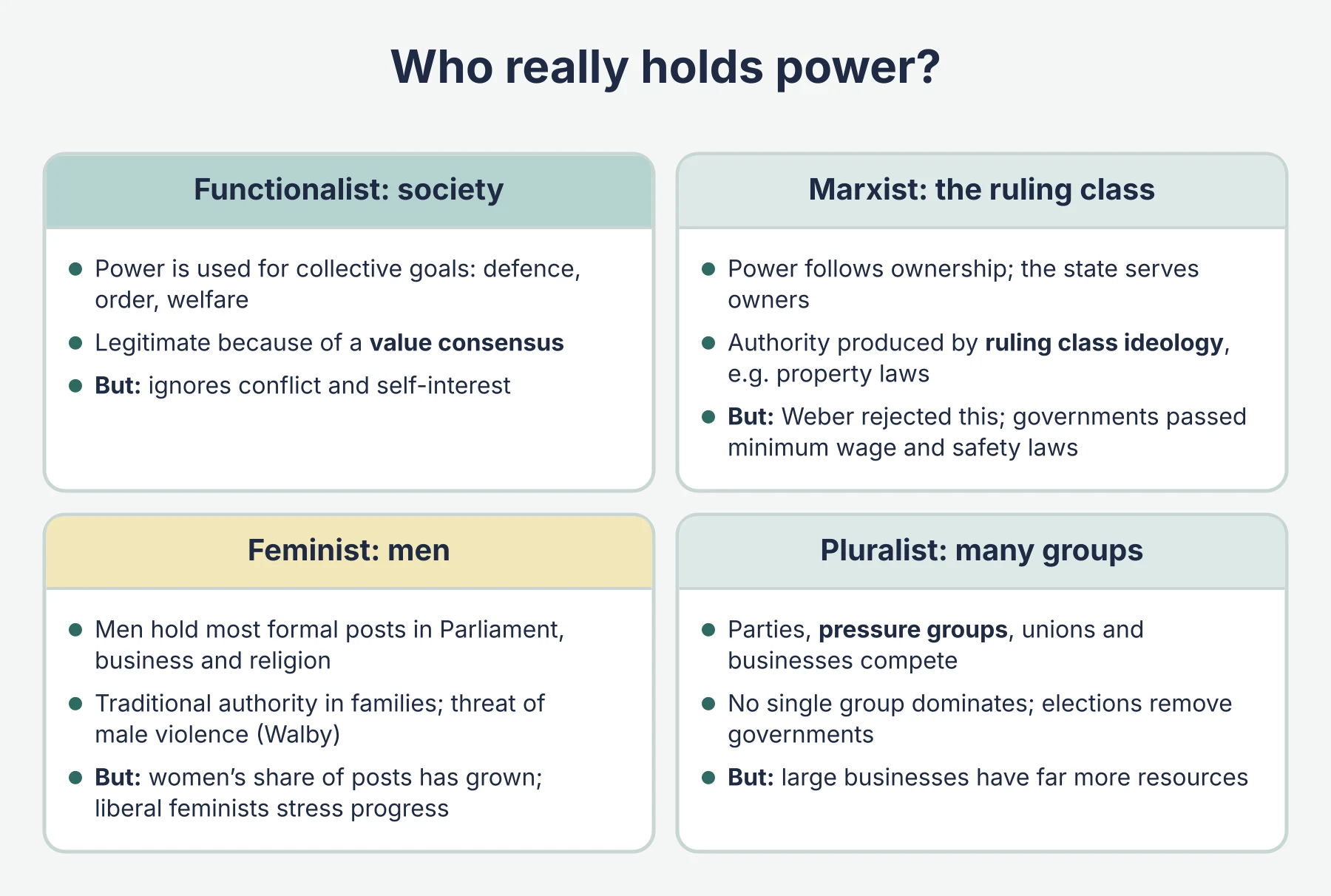
- Functionalist: power is a resource for collective goals; authority rests on value consensus; supports order.
- Marxist: power follows ownership; political power comes from economic power; the state serves the ruling class; legitimacy comes from ruling class ideology.
- Feminist: male domination of formal positions; traditional male authority in families; informal power through expectations and male violence.
- Pluralist: power spread among parties, pressure groups, unions and businesses; elections allow change.
Weber versus Marx: Weber rejected the view that political power derives only from economic power.
Exam traps
- Trap: power = authority. Fix: authority is legitimate power.
- Trap: “a monarch has a title, so rational-legal”. Fix: inherited status is traditional.
- Trap: any popular person is charismatic. Fix: charisma means devotion to exceptional qualities.
- Trap: describing an item without naming the type. Fix: name it, link it to a detail, say why.
- Trap: perspectives missing. Fix: include functionalist, Marxist and feminist views in extended answers.
Mini plan for an extended answer
“Discuss how far sociologists would agree that authority in the UK today is mainly rational-legal.”
- Define authority and outline Weber’s three types.
- For: Parliament, courts, police and civil service follow written rules; elected posts change hands.
- For: bureaucracy runs schools, hospitals and businesses.
- Against: the monarchy rests on traditional authority.
- Against: charismatic leaders still win support in politics, religion and social movements.
- Informal power: money, media influence and peer pressure work outside formal rules.
- Marxist: rules serve the ruling class, so legitimacy is ideological. Feminist: formal positions remain male-dominated.
- Judgement: rational-legal authority is the main formal type, but traditional, charismatic and informal power still operate alongside it.
Quick self-test
- How did Weber define power?
- What is the difference between authority and coercion?
- What is the basis of traditional authority?
- Why is charismatic authority unstable?
- What is the routinisation of charisma?
- Give two examples of rational-legal authority.
- Name three features of a bureaucracy.
- Give one example of an informal source of power.
- How do functionalists see power?
- How do Marxists explain legitimacy?
- What do feminists mean by male domination of power?
- What do pluralists argue?
Answers
- The chance of getting your own way, even against the resistance of others.
- Authority is power accepted as legitimate; coercion relies on force or the threat of force.
- Established customs and inherited status.
- It depends on one person’s qualities, so it may fade or face a crisis when the leader dies.
- The process of turning charismatic authority into lasting rules, traditions or organisations.
- Any two of: police officer, judge, MP, head teacher, civil servant, tax inspector.
- Any three of: hierarchy, written rules, specialisation, impersonality, appointment on merit.
- A popular pupil, an experienced worker whose colleagues follow them, a wealthy donor, peer pressure.
- As a resource used for collective goals, made legitimate by value consensus.
- As the product of ruling class ideology persuading people to accept rules that benefit owners.
- Men holding most positions of formal power in politics, business and religion, and authority in families.
- That power is spread among many competing groups, so no single group dominates.
Specification reference
AQA GCSE Sociology (8192), section 3.6.5 Power and authority; Appendix B (7.4) summary of Weber; Appendix A (6.4) key terms.
Related resources
-
Study guides
AQA GCSE Sociology (8192): Power relationships
AQA GCSE Sociology 8192 guide to 3.6.6 power relationships: class, gender, race, age and other factors, Walby's six structures of patriarchy, and perspectives.
Sociology · AQA · GCSE
Read guide -
Practice questions
AQA GCSE Sociology (8192): Power relationships – Practice Questions
Original AQA GCSE Sociology 8192 practice on power relationships and Walby's theory of patriarchy, with data, item-based and extended questions and answers.
Sociology · AQA · GCSE
Try questions -
Revision notes
AQA GCSE Sociology (8192): Power relationships – Revision Notes
AQA GCSE Sociology 8192 revision notes on 3.6.6 power relationships: the named factors, Walby on patriarchy, perspectives, equality laws, traps and a self-test.
Sociology · AQA · GCSE
Revise topic
Related articles
Get free revision emails (optional)
Occasional emails with practice questions, worked explanations and links to free resources for the qualification and subjects you choose. No spam, and you can unsubscribe from any email. The free tools on this site never need an email.