
Study Guides
AQA GCSE Sociology (8192): Power and authority
AQA GCSE Sociology 8192 guide to 3.6.5 power and authority: Weber's three types, formal and informal power, bureaucracy and the three perspectives.
- Subject
- Sociology
- Level
- GCSE
- Topic
- Social stratification
- Author
- Marlbridge Academic Team
- Updated
- Reviewed by
- Naqiya Yousaf (what this means)
Aligned to AQA GCSE Sociology (8192), first teaching 2017. Official specification .
Syllabus page (what it covers and how it is assessed): AQA GCSE Sociology.
Syllabus points this page covers
8192
- 3.6.5 Power and authority
Found an error? Report a correction.
Need help with this topic? Request a free trial class for GCSE Sociology (8192).
This guide covers AQA GCSE Sociology (8192) section 3.6.5 Power and authority, assessed in Paper 2: The sociology of crime and deviance and social stratification. The specification asks you to “identify, describe and explain different forms of power and authority including traditional, charismatic, rational-legal, formal and informal sources of power”, to compare functionalist, feminist and Marxist perspectives, and to describe the key ideas of Weber on power and authority.
The Social stratification study guide defines the three types of authority. This guide goes further: how each type gains and loses legitimacy, how bureaucracy works, how to tell formal from informal power in an item, and how the perspectives disagree about who really holds power. Revise with the power and authority revision notes and practise with the power and authority practice questions.
Power, authority and coercion
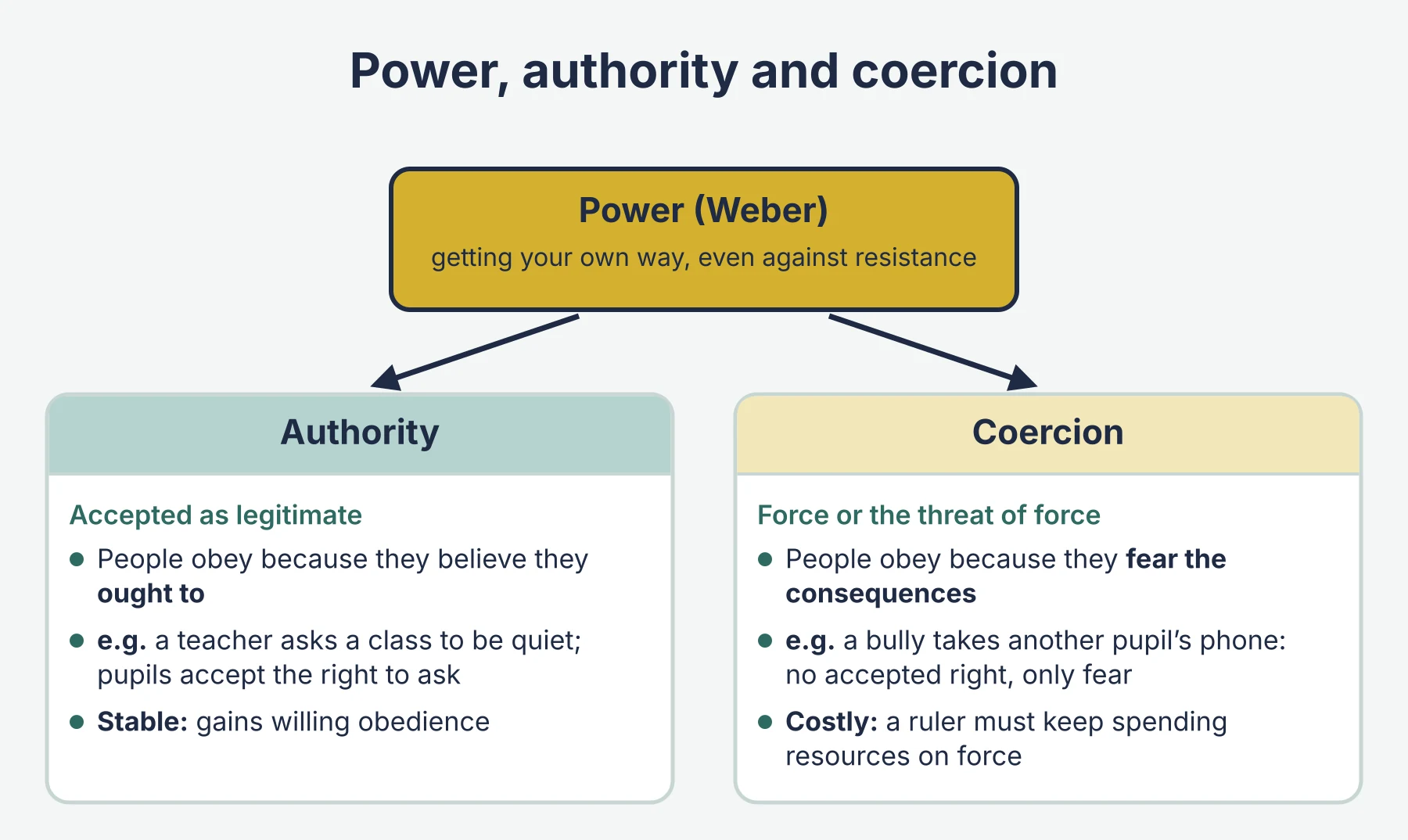
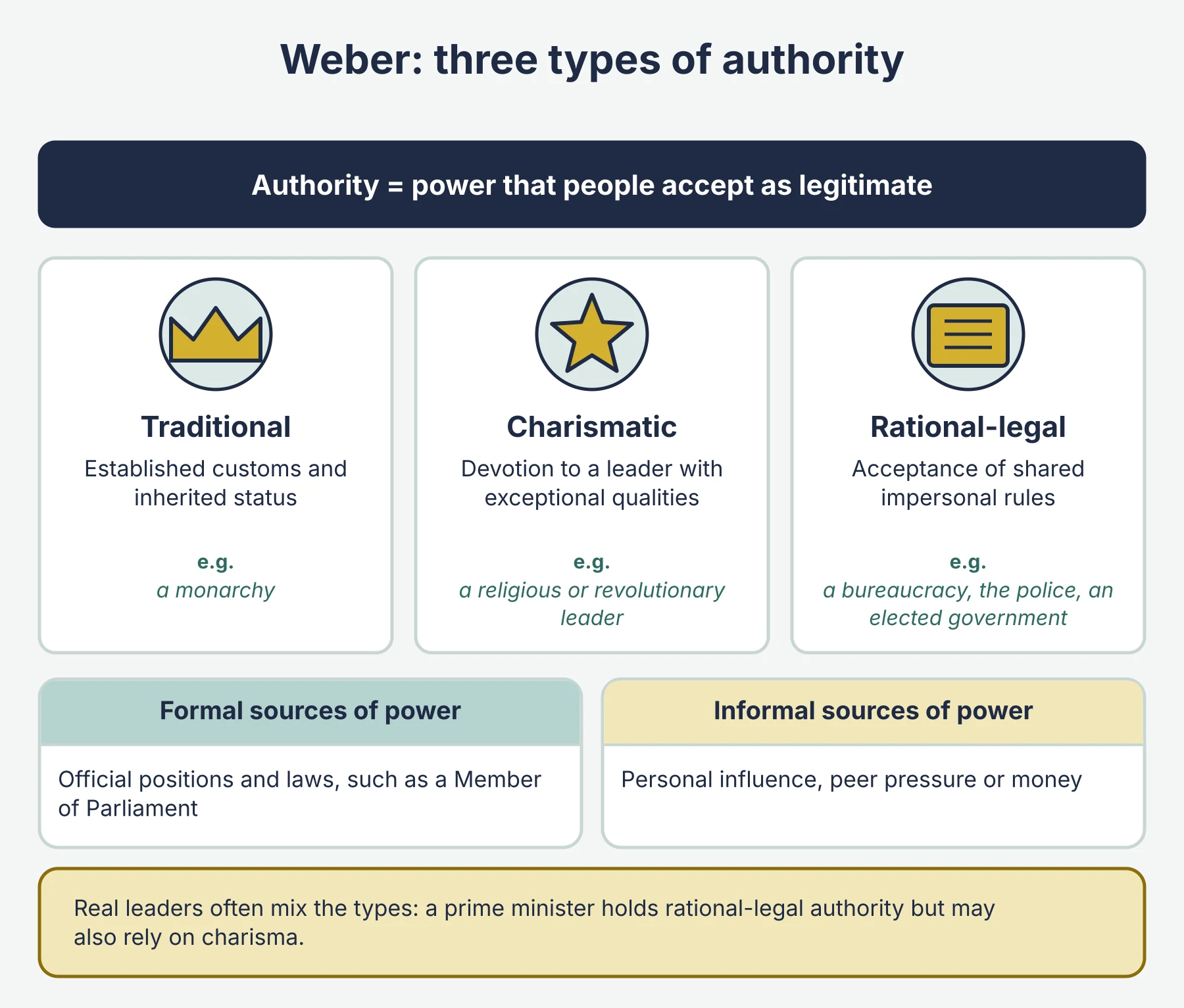
Weber defined power as the chance of a person or group getting their own way, even against the resistance of others. Power can take two broad forms:
- Authority: power that people accept as legitimate, or rightful. People obey because they believe they ought to.
- Coercion: power based on force or the threat of force. People obey because they fear the consequences.
A teacher who asks a class to be quiet usually relies on authority: pupils accept the teacher’s right to ask. A bully who takes another pupil’s phone uses coercion: there is no accepted right, only fear. The distinction matters because authority is more stable. A ruler who relies only on coercion must keep spending resources on force; one with authority gains willing obedience.
Weber’s three types of authority
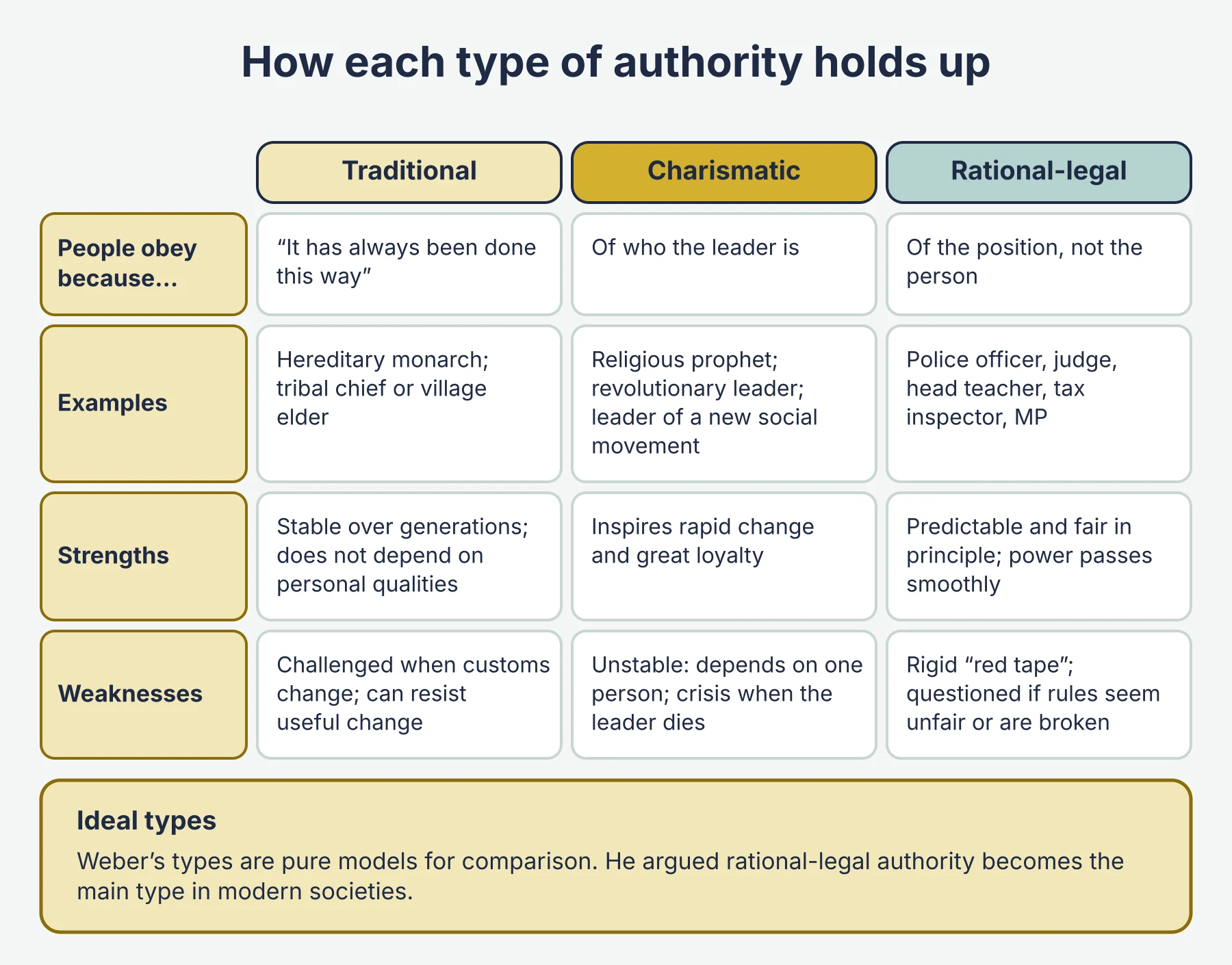
The specification’s summary of Weber names three sources: charismatic, traditional and rational-legal. Each rests on a different reason for obedience.
Traditional authority
Basis: established customs and inherited status. People obey because “it has always been done this way”.
- Examples: a hereditary monarch; a tribal chief or village elder; a head of household in societies where custom gives the eldest man authority.
- Strengths for rulers: stable over generations; does not depend on the ruler’s personal qualities.
- Weaknesses: can be challenged when customs change or people stop seeing inherited status as fair; it can resist useful change.
Charismatic authority
Basis: devotion to a leader who is believed to have exceptional qualities. People obey because of who the leader is.
- Examples: a religious prophet; the leader of a revolutionary movement; a magnetic leader of a new social movement or pressure group.
- Strengths: can inspire rapid change and great loyalty; often challenges existing traditional or legal authority.
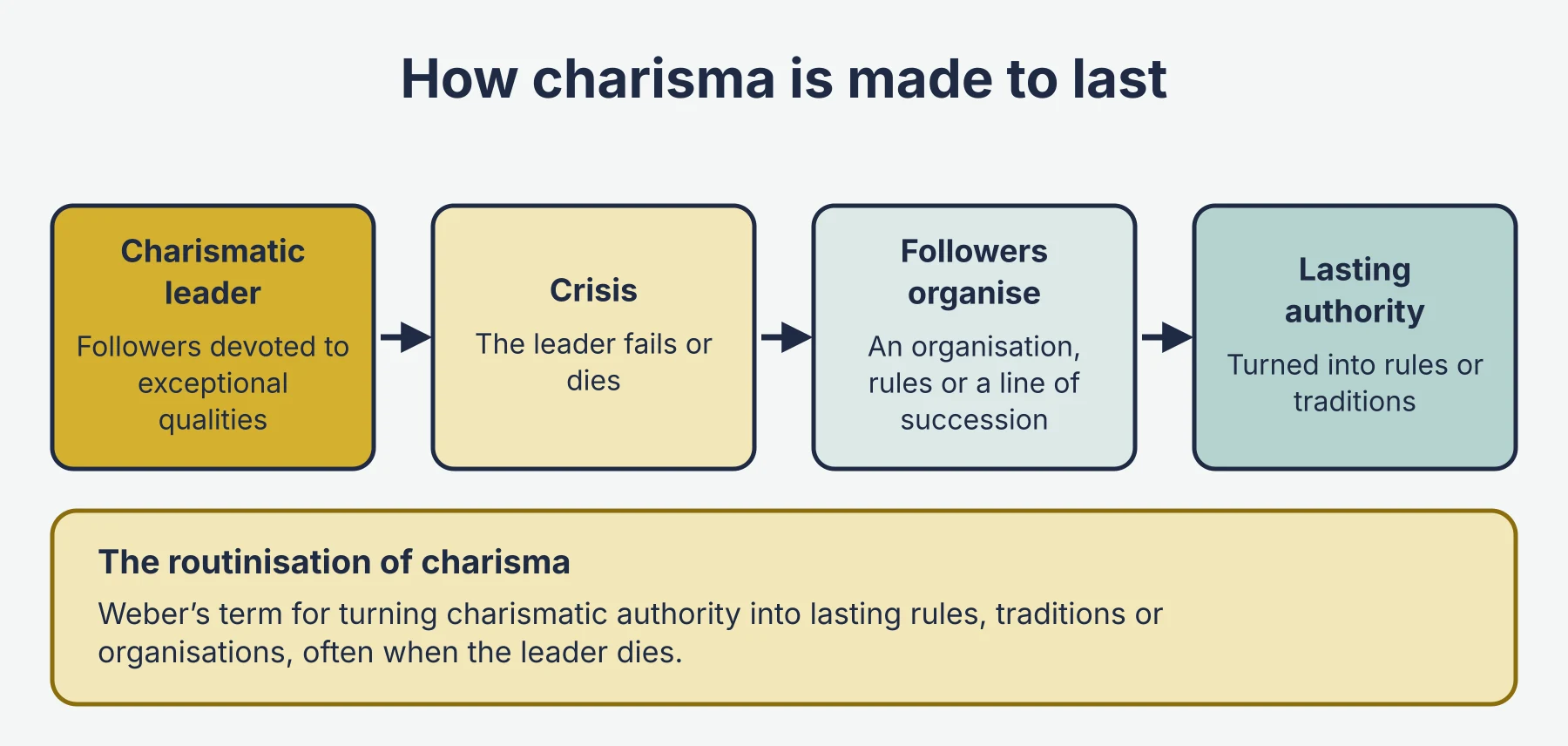
- Weaknesses: unstable, because it depends on one person; it may fade if the leader fails, and it faces a crisis when the leader dies. Weber called the process by which charisma is turned into lasting rules or traditions the routinisation of charisma: followers set up an organisation, rules or a line of succession.
Rational-legal authority
Basis: acceptance of shared impersonal rules. People obey the position, not the person. Also called legal-rational or bureaucratic authority.
- Examples: a police officer, a judge, a head teacher, a tax inspector, an elected Member of Parliament.
- Strengths: predictable and fair in principle, because the same rules apply to everyone; power passes smoothly when post-holders change.
- Weaknesses: rules can become rigid “red tape”; the authority can be questioned if the rules are seen as unfair or the post-holder breaks them.
Weber argued that rational-legal authority becomes the main type in modern societies.
Bureaucracy
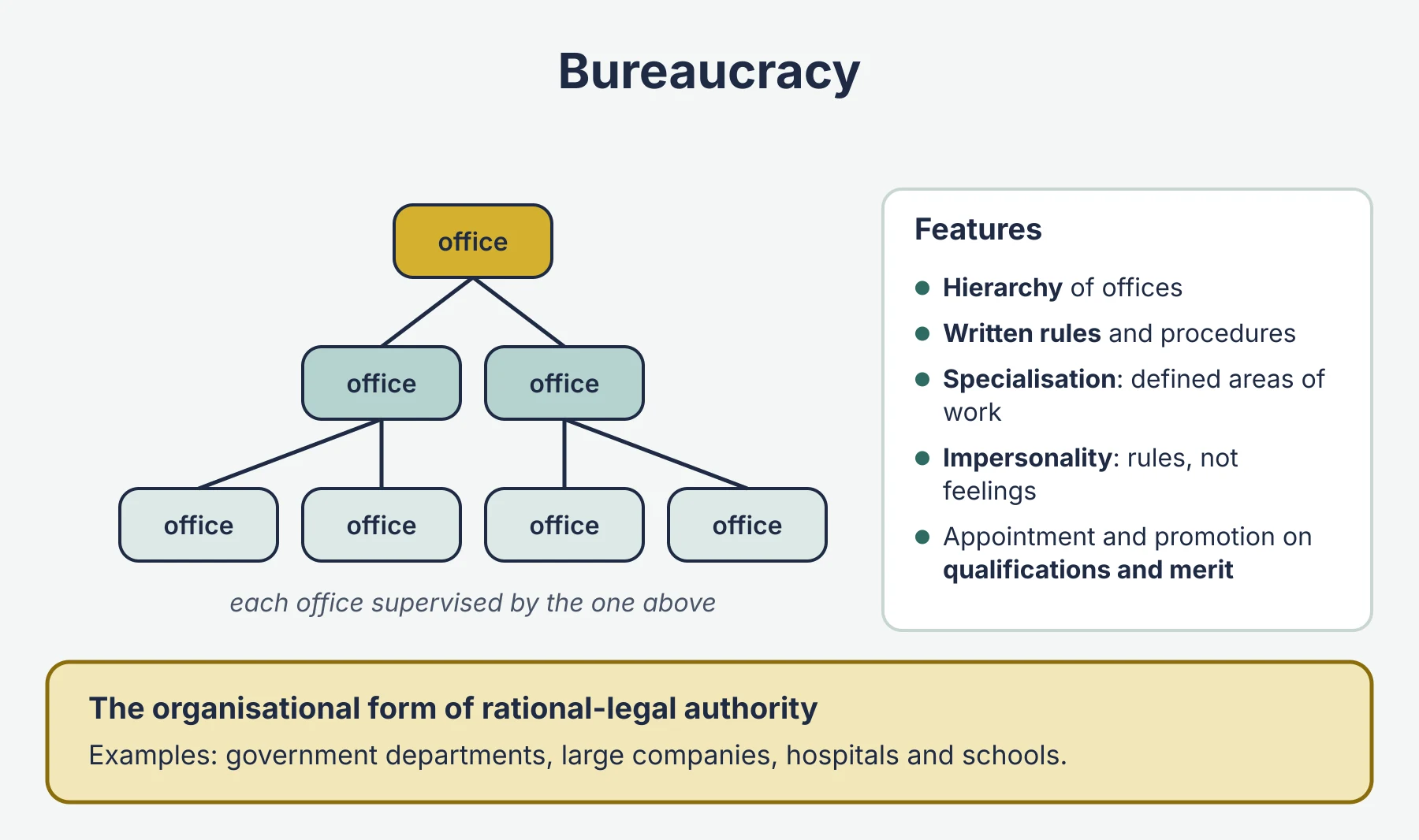
A bureaucracy is the organisational form of rational-legal authority. Its main features are:
- a hierarchy of offices, each supervised by the one above;
- written rules and procedures;
- specialisation: each official has a defined area of work;
- impersonality: decisions follow rules, not personal feelings;
- appointment and promotion based on qualifications and merit.
Government departments, large companies, hospitals and schools are bureaucracies.
Mixed types
Real leaders often combine types. A monarch may hold traditional authority but act within constitutional rules; a prime minister holds rational-legal authority but may rely on personal charisma to win elections. Weber’s types are ideal types: pure models used for comparison, not exact descriptions of any real leader.
Formal and informal sources of power
| Formal sources | Informal sources | |
|---|---|---|
| Where it comes from | Official positions, laws, rules and job titles | Personal influence, relationships, peer pressure, money, knowledge or reputation |
| Example in school | A head teacher excluding a pupil under the behaviour policy | A popular pupil who decides who sits where at lunch |
| Example at work | A manager issuing rotas under the staff handbook | An experienced worker whose colleagues follow their lead |
| Example in politics | An MP voting on laws in Parliament | A wealthy donor or media owner influencing policy |
| Backed by | Formal sanctions such as fines, exclusion or dismissal | Informal sanctions such as gossip, ridicule or exclusion from a group |
This links to social control in the crime and deviance topic: formal social control comes from agencies such as the police and courts; informal control from family, peers and community.
Perspectives on power and authority
Functionalist
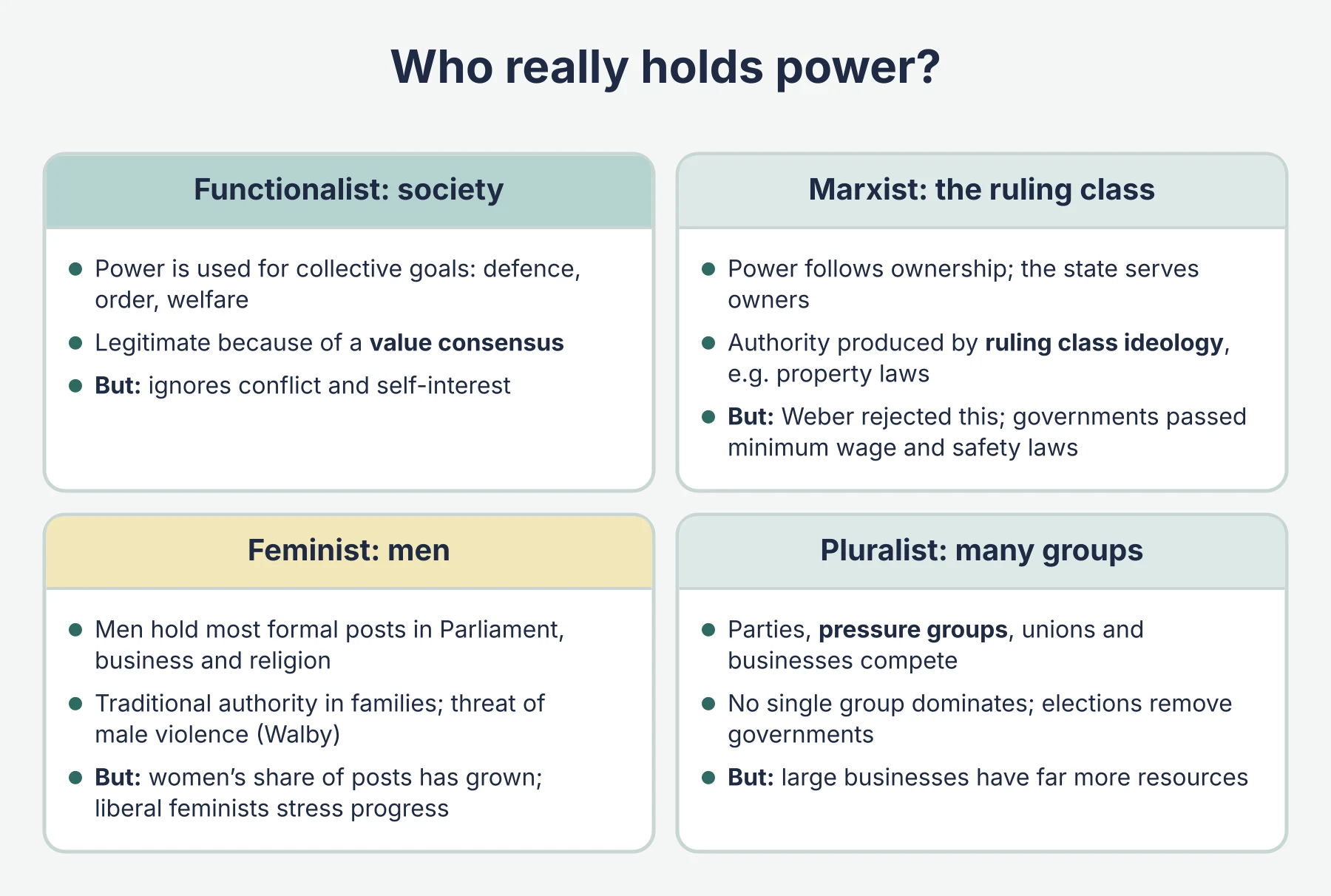
Functionalists see power as a resource used for the benefit of society as a whole. Authority is legitimate because it rests on a value consensus: shared agreement about how society should be run. Leaders use power to achieve collective goals, such as defence, order and welfare. Rational-legal authority, with rules that apply to all, supports social order.
Criticism: this ignores conflict and the possibility that some groups use power for their own interests.
Marxist
Marxists argue that power follows ownership of the means of production. Political power comes from economic power, so the state tends to serve the ruling class. What looks like legitimate authority is the product of ruling class ideology, which persuades people to accept rules that benefit owners. Laws protecting private property, for example, benefit those who own the most.
Criticism: Weber rejected the view that political power derives only from economic power; elected governments have also passed laws that limit employers, such as minimum wage and health and safety laws.
Feminist
Feminists point to male domination of positions of formal power: men have historically held most seats in Parliament, top posts in business and senior roles in religious organisations. Within families, traditional authority has often given men control over women. Informal power also works through expectations and the threat of male violence, which Walby includes among her structures of patriarchy.
Criticism: women’s share of formal positions has grown, and liberal feminists stress the progress that equality laws have brought.
Pluralism
Pluralists argue that power in a democracy is spread among many competing groups, including political parties, pressure groups, trade unions and businesses. No single group dominates, and elections allow citizens to remove governments. Marxists and feminists reply that some groups, such as large businesses, have far more resources than others.
Worked example: applying Weber to an item
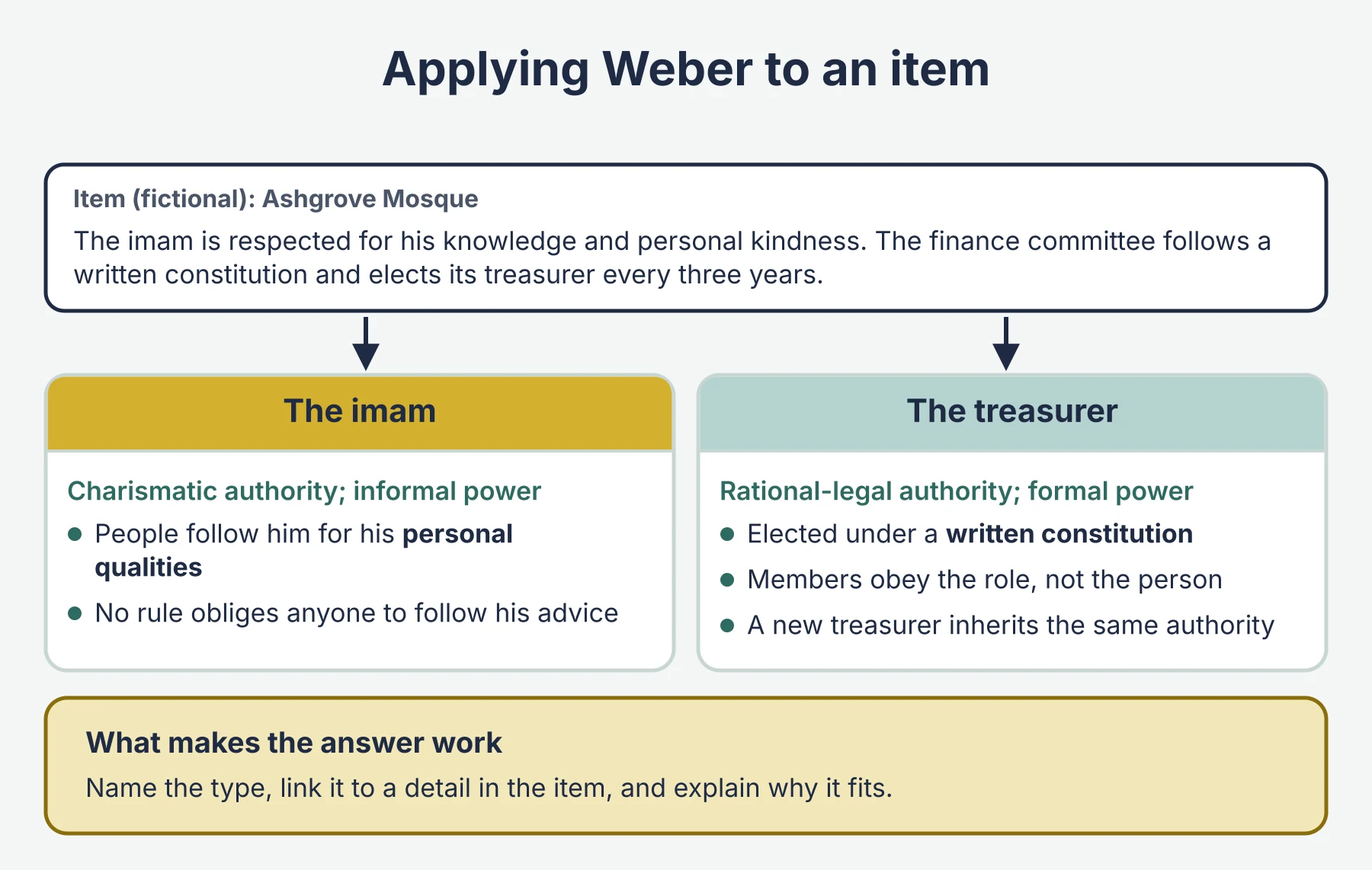
Item (fictional): At Ashgrove Mosque, the imam is respected for his knowledge and personal kindness, and many people seek his advice. The mosque’s finance committee follows a written constitution and elects its treasurer every three years.
Model answer: The imam’s influence draws partly on charismatic authority, because people follow him for his personal qualities, and his advice is an informal source of power since no rule obliges anyone to follow it. The treasurer holds rational-legal authority: her position comes from an election under a written constitution, so members obey the role rather than the person, and a new treasurer would inherit the same authority.
Notice that the answer names the type, links it to a detail in the item and explains why it fits.
Common mistakes
- Treating power and authority as the same. Authority is power accepted as legitimate.
- Calling any popular person “charismatic”. Charismatic authority needs devotion to exceptional qualities and a following.
- Describing a monarch as rational-legal because they have a title. Inherited status is traditional.
- Writing “formal power is good, informal power is bad”. Both can be used well or badly.
- Forgetting the three named perspectives.
Exam technique
- Identify a type of authority from a short example.
- Describe Weber’s types using the words “customs and inherited status”, “exceptional qualities” and “shared impersonal rules”.
- Explain by giving the reason people obey.
- In discuss how far answers, compare functionalist consensus with Marxist, feminist and pluralist views, and judge whether authority in the UK is genuinely legitimate.
Frequently asked questions
What is the routinisation of charisma? Weber’s term for the way charismatic authority is turned into lasting rules, traditions or organisations, often when the leader dies.
Is a teacher’s authority traditional or rational-legal? Rational-legal: pupils obey the teacher’s position under the school’s rules, and a replacement teacher holds the same authority.
Specification reference
AQA GCSE Sociology (8192), section 3.6.5 Power and authority, with the Weber summary in Appendix B (7.4) and the social stratification key terms in Appendix A (6.4).
Related resources
-
Practice questions
AQA GCSE Sociology (8192): Power and authority – Practice Questions
Original AQA GCSE Sociology 8192 practice on Weber's types of authority and formal and informal power, with item-based, extended and mark-scheme style answers.
Sociology · AQA · GCSE
Try questions -
Revision notes
AQA GCSE Sociology (8192): Power and authority – Revision Notes
AQA GCSE Sociology 8192 revision notes on 3.6.5 power and authority: Weber's types, formal and informal power, perspectives, key terms and a self-test.
Sociology · AQA · GCSE
Revise topic -
Study guides
AQA GCSE Sociology (8192): Power relationships
AQA GCSE Sociology 8192 guide to 3.6.6 power relationships: class, gender, race, age and other factors, Walby's six structures of patriarchy, and perspectives.
Sociology · AQA · GCSE
Read guide
Related articles
Get free revision emails (optional)
Occasional emails with practice questions, worked explanations and links to free resources for the qualification and subjects you choose. No spam, and you can unsubscribe from any email. The free tools on this site never need an email.