
Revision Notes
AQA GCSE Sociology (8192): Poverty as a social issue – Revision Notes
AQA GCSE Sociology 8192 revision notes on 3.6.4 poverty: definitions, Townsend, Murray, culture versus material deprivation, policy, key terms and a self-test.
- Subject
- Sociology
- Level
- GCSE
- Topic
- Social stratification
- Author
- Marlbridge Academic Team
- Updated
- Reviewed by
- Naqiya Yousaf (what this means)
Aligned to AQA GCSE Sociology (8192), first teaching 2017. Official specification .
Syllabus page (what it covers and how it is assessed): AQA GCSE Sociology.
Syllabus points this page covers
8192
- 3.6.4 Poverty as a social issue
Found an error? Report a correction.
Need help with this topic? Request a free trial class for GCSE Sociology (8192).
These notes cover AQA GCSE Sociology (8192) section 3.6.4 Poverty as a social issue, assessed in Paper 2. Read the poverty study guide for full explanations and a worked paragraph, then try the poverty practice questions. For the whole topic, see the Social stratification revision notes.
What you must be able to do
- Explain interpretations of poverty: culture of poverty, material deprivation, government attempts to alleviate poverty and unemployment, the impact of globalisation.
- Compare functionalist, feminist and Marxist perspectives on poverty.
- Describe Townsend on relative deprivation and Murray on the underclass, with links to the New Right.
Definitions
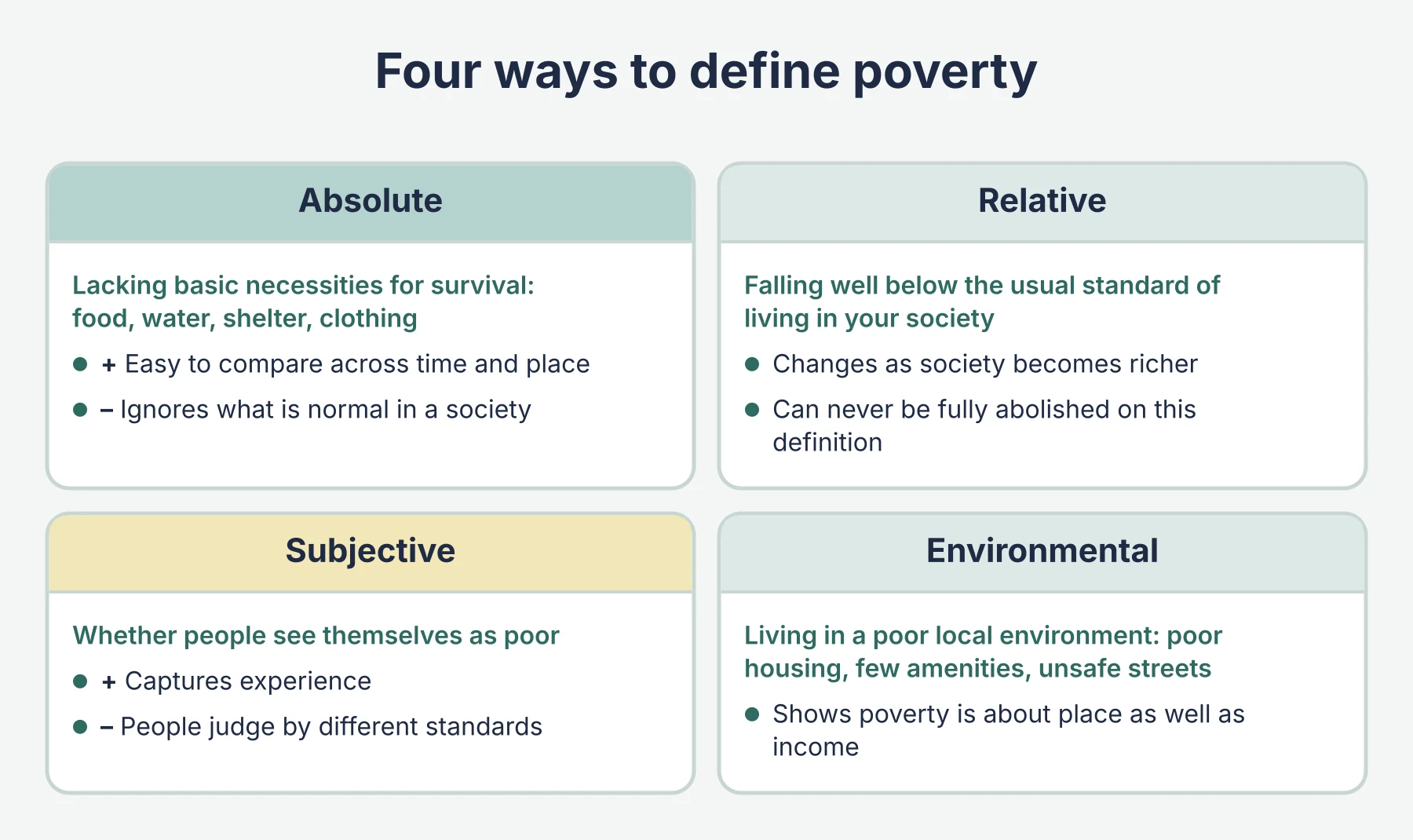
- Absolute poverty: lacking the basics for survival.
- Relative poverty: falling well below the usual standard of your society.
- Subjective poverty: feeling poor.
- Environmental poverty: a poor local environment, such as bad housing and few amenities.
Key terms
| Term | Meaning |
|---|---|
| Relative deprivation | Lacking resources for the diet, activities and living conditions widely available (Townsend) |
| State standard of poverty | Poverty line based on entitlement to benefits |
| Relative income standard | Income below the average for similar households |
| Deprivation index | Townsend’s list of items, such as diet, fuel and social activities, used to score households |
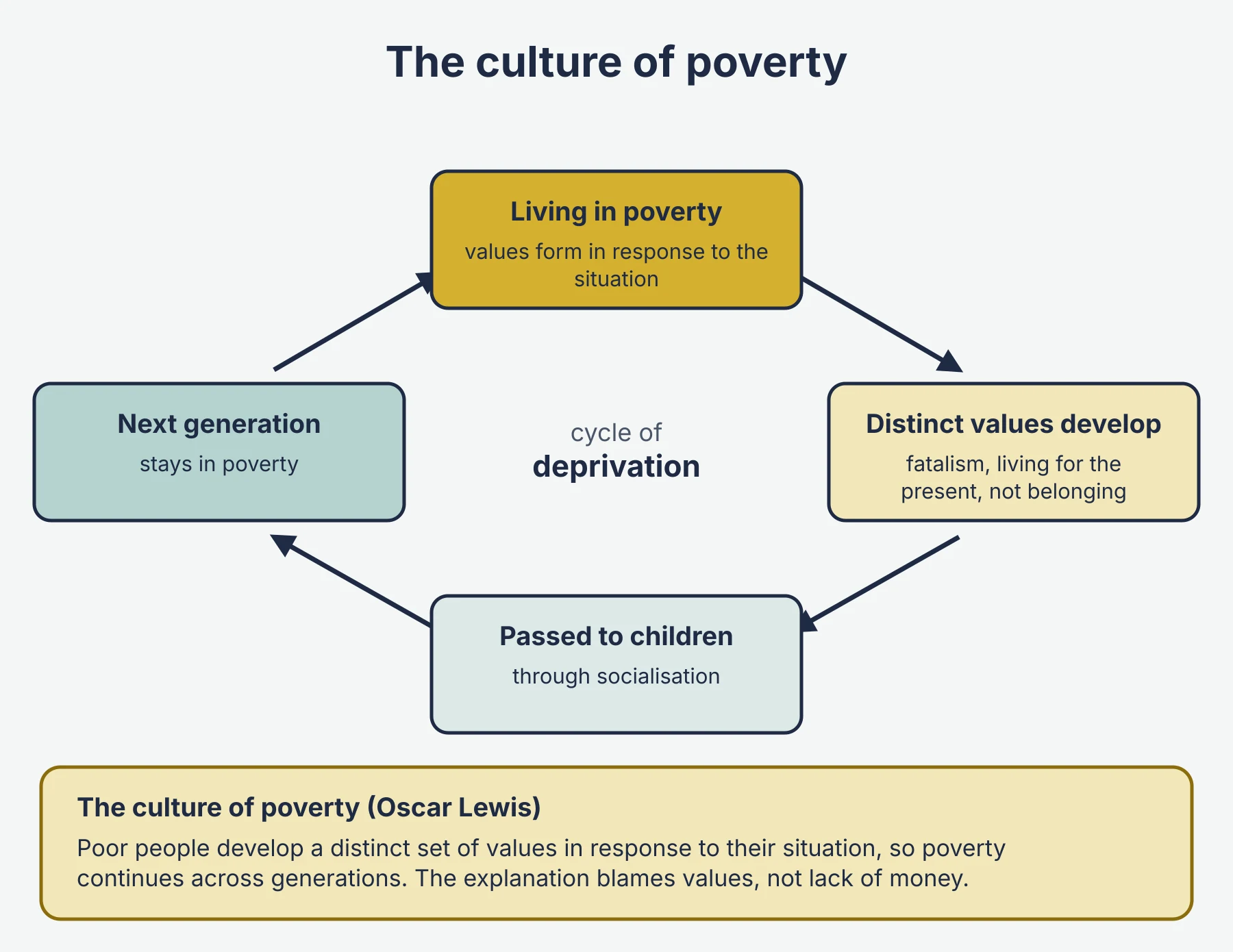
| Culture of poverty | Values such as fatalism passed between generations, keeping people poor |
| Cycle of deprivation | Disadvantage repeated from one generation to the next |
| Material deprivation | Lack of money and resources |
| Underclass | A group below the working class, defined by Murray through behaviour and dependency |
| Culture of dependency | Reliance on benefits as a way of life (New Right) |
| Universal benefits | Paid to everyone in a group regardless of income |
| Selective benefits | Targeted using means testing |
| Poverty trap | Earning more leads to losing benefits, so people gain little |
| Under-employment | Wanting more work than you can get |
| Welfare state | State provision of benefits, health care and services |
| Globalisation | Growing interconnection of economies and cultures worldwide |
Townsend (1979) at a glance
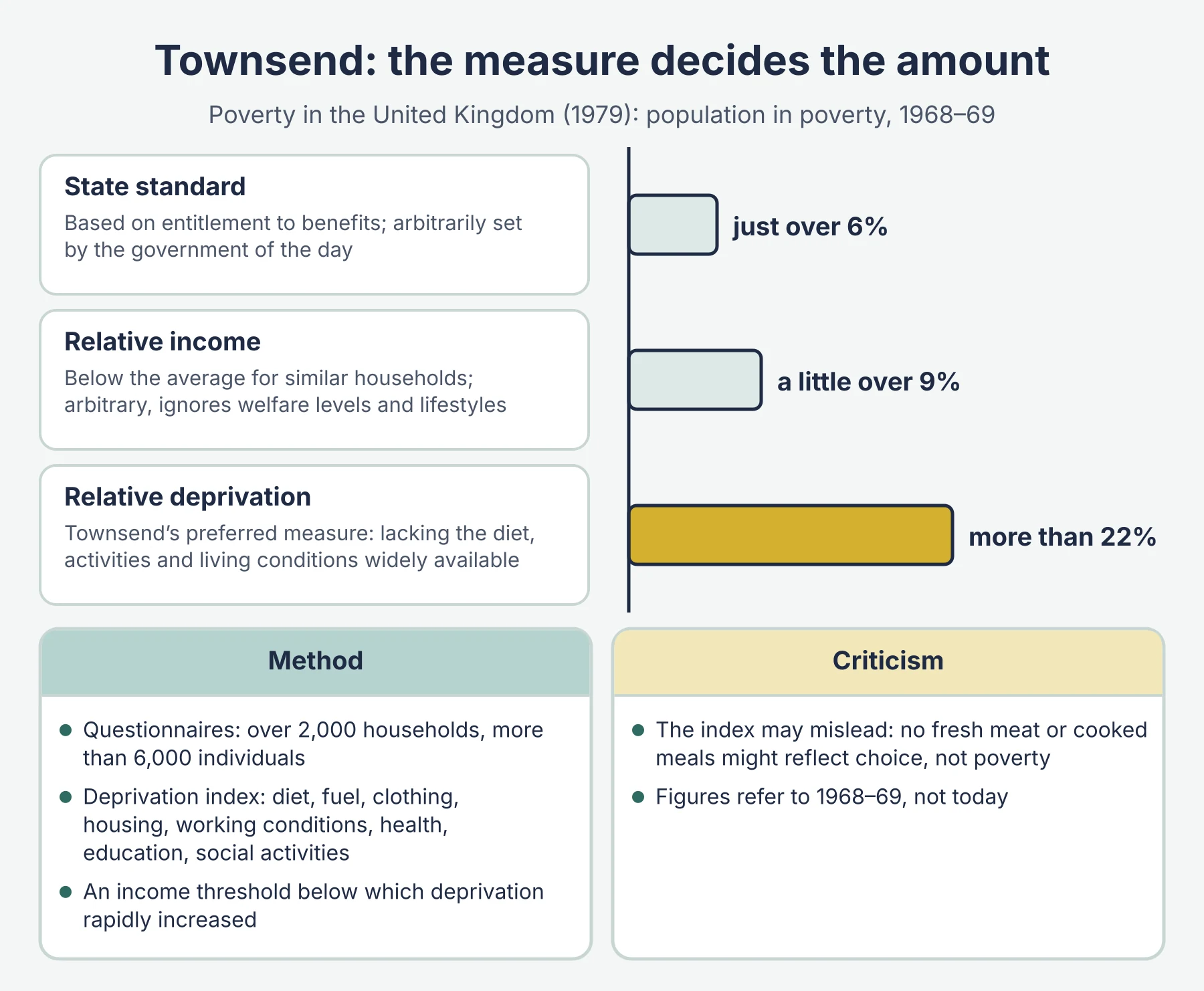
- Three measures: state standard (arbitrary); relative income (arbitrary, misleading, inadequate); relative deprivation (preferred).
- Method: questionnaires to over 2,000 households and more than 6,000 individuals across the UK; deprivation index.
- Finding: over 22% in poverty in 1968–69 on his measure; just over 6% on the state standard; a little over 9% on relative income.
- Criticism: items may reflect choice, such as not eating fresh meat.
Murray (1984) at a glance
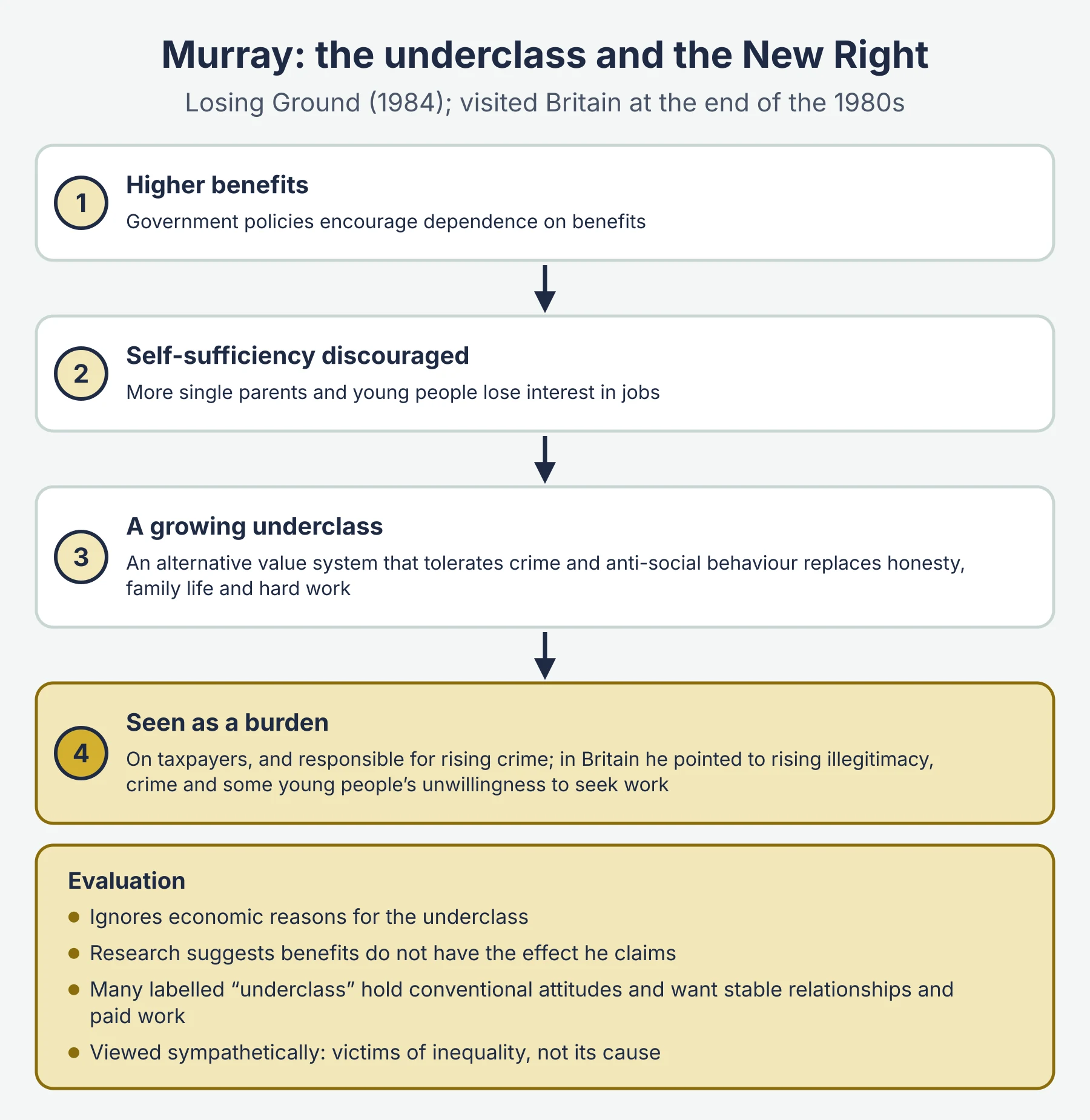
- USA: growing underclass; higher benefits discouraged self-sufficiency; single parents and young people lost interest in jobs; burden on taxpayers; rising crime.
- Britain (end of the 1980s): rising illegitimacy, rising crime, some youth unwilling to seek work.
- Values: honesty, family life and hard work replaced by a value system tolerating crime.
- New Right link: benefits system blamed for dependency.
- Criticism: ignores economic causes; poor evidence base; most “underclass” members hold conventional attitudes and want work; victims, not causes.
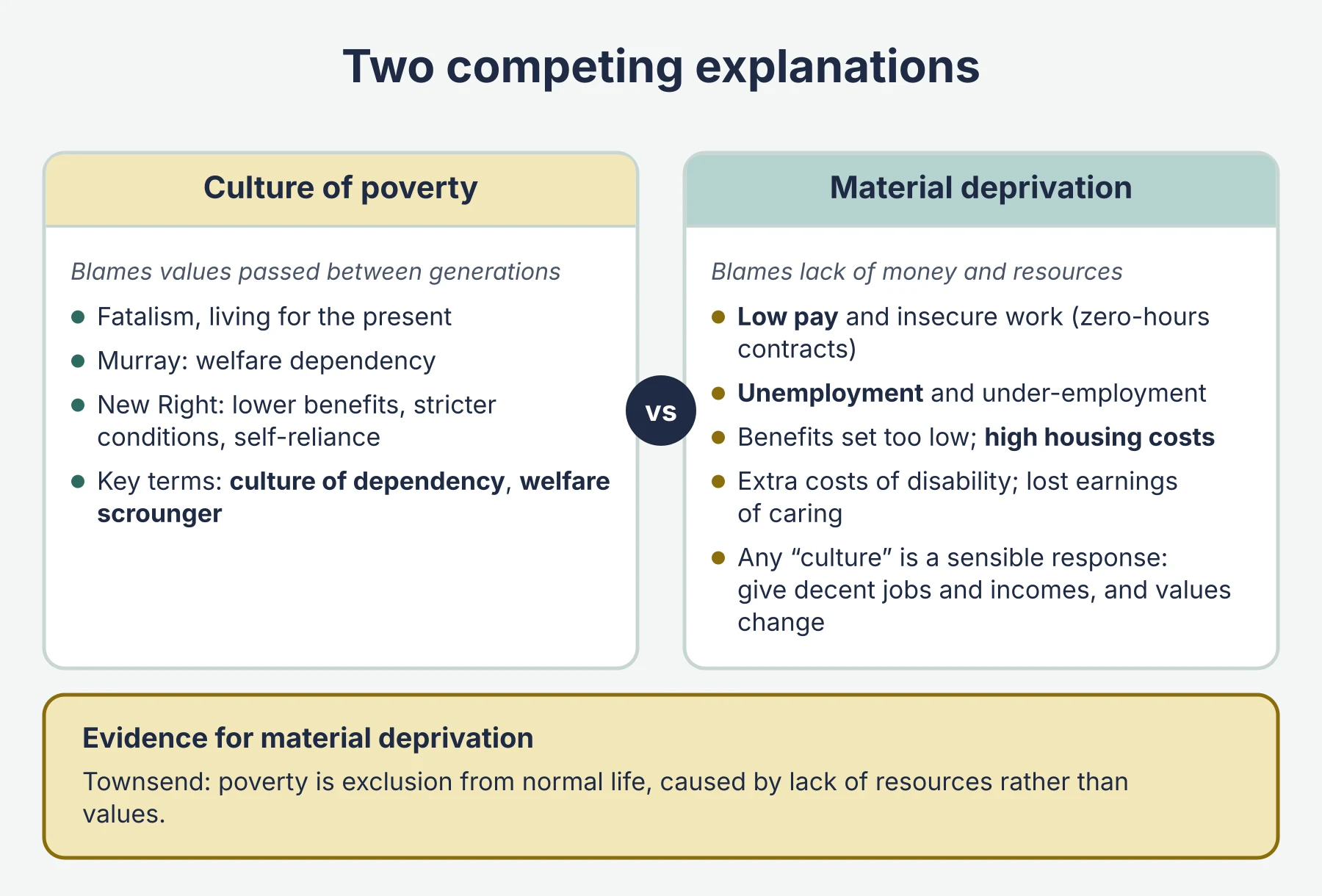
Two explanations compared
| Culture of poverty / underclass | Material deprivation | |
|---|---|---|
| Cause | Values and behaviour | Lack of money and resources |
| Linked to | Lewis; Murray; New Right | Townsend; structural views; Marxists |
| Policy answer | Cut or tighten benefits; encourage self-reliance | Better pay, jobs and benefits |
| Weakness | Blames the victim | May underplay individual choice |
Government action
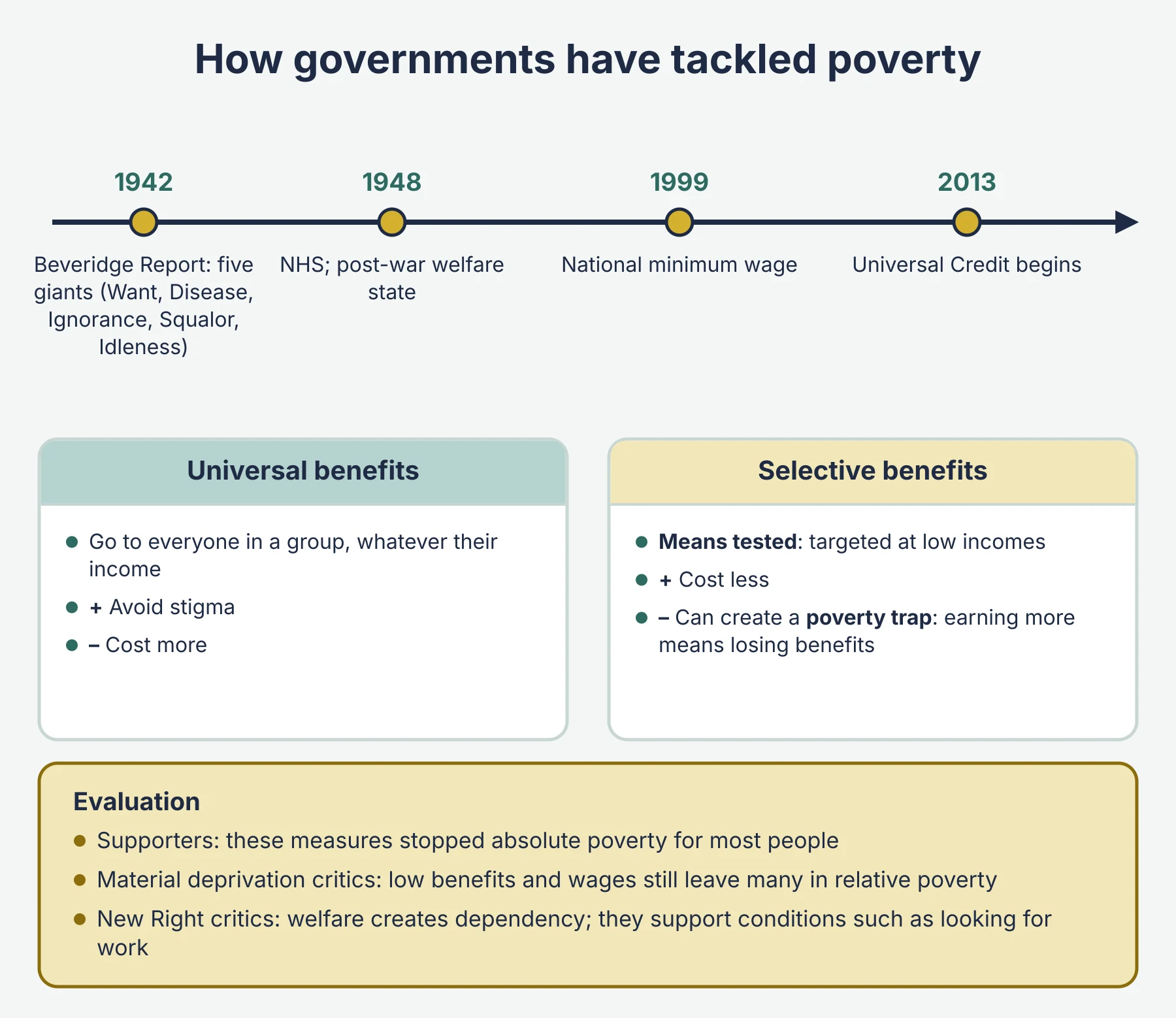
- Beveridge Report (1942): the “five giants” of Want, Disease, Ignorance, Squalor and Idleness.
- National Health Service (1948) and national insurance.
- Universal versus selective (means-tested) benefits.
- National minimum wage (1999).
- Universal Credit (from 2013).
- Benefit conditions and job search support.
Globalisation
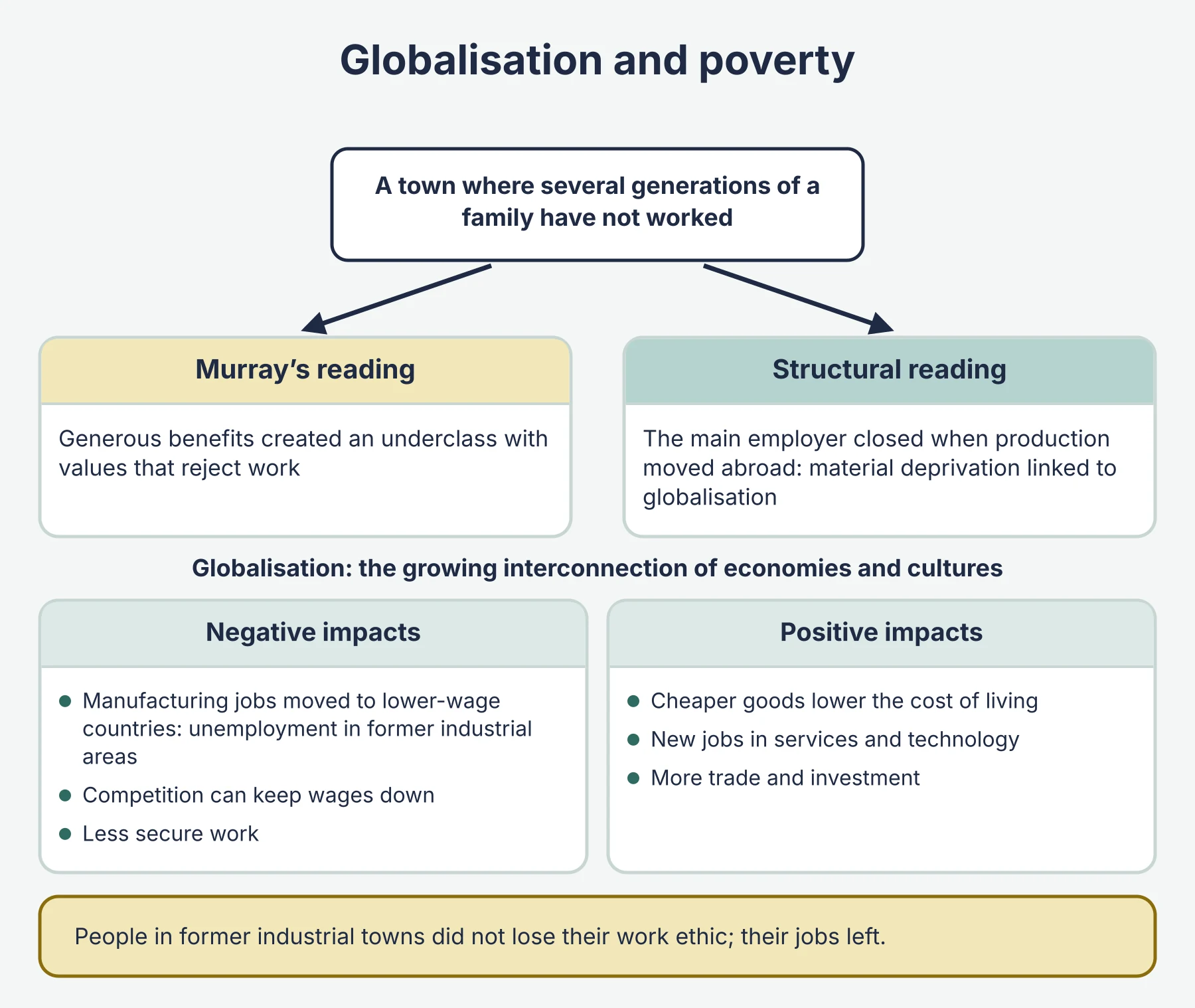
- Harm: factory jobs moved abroad; unemployment in former industrial areas; downward pressure on wages.
- Benefit: cheaper goods; new service and technology jobs.
Perspectives
- Functionalist: Gans (1972), poverty has functions for the better-off, such as getting low-paid work done.
- Marxist: poverty is built into capitalism; a reserve army of labour keeps wages low.
- Feminist: women at higher risk through low pay, caring and lone parenthood.
- New Right: dependency and underclass values.
Exam traps
- Trap: quoting Townsend’s figures as current. Fix: they refer to 1968–69.
- Trap: Murray as Marxist. Fix: New Right.
- Trap: describing benefits with no link to poverty. Fix: say how each measure was meant to reduce poverty or unemployment.
- Trap: one-sided globalisation answers. Fix: give harms and benefits.
- Trap: “relative poverty means having less than others.” Fix: falling well below the usual standard of living.
Quick self-test
- Define relative poverty.
- Name Townsend’s three ways of defining poverty.
- Why did Townsend reject the relative income standard?
- What percentage of the population did Townsend find in poverty on his own measure?
- Give one criticism of Townsend’s index.
- What three signs of an underclass did Murray identify in Britain?
- Which theories is Murray linked to?
- What is the culture of poverty?
- Give two causes of poverty on the material deprivation view.
- What were Beveridge’s five giants?
- What is the difference between universal and selective benefits?
- Give one way globalisation may have increased poverty in the UK.
Answers
- Falling well below the usual standard of living in your society.
- The state standard, the relative income standard and relative deprivation.
- It was arbitrary, misleading (it ignored welfare payments available) and inadequate (it ignored lifestyles available to the relatively disadvantaged).
- More than 22%, in 1968–69.
- Missing items may reflect choice rather than poverty, such as not eating fresh meat.
- Rising illegitimacy, rising crime and some young people’s unwillingness to seek work.
- New Right theories.
- The idea that the poor develop values, such as fatalism, that are passed between generations and keep them poor.
- Any two of: low pay, unemployment, under-employment, low benefits, high housing costs.
- Want, Disease, Ignorance, Squalor and Idleness.
- Universal benefits go to everyone in a group; selective benefits are means-tested and targeted at those on low incomes.
- Manufacturing jobs moved to lower-wage countries, causing unemployment in former industrial areas.
Specification reference
AQA GCSE Sociology (8192), section 3.6.4 Poverty as a social issue; Appendix B (7.4) summaries of Townsend and Murray; Appendix A (6.4) key terms.
Related resources
-
Study guides
AQA GCSE Sociology (8192): Power and authority
AQA GCSE Sociology 8192 guide to 3.6.5 power and authority: Weber's three types, formal and informal power, bureaucracy and the three perspectives.
Sociology · AQA · GCSE
Read guide -
Practice questions
AQA GCSE Sociology (8192): Power and authority – Practice Questions
Original AQA GCSE Sociology 8192 practice on Weber's types of authority and formal and informal power, with item-based, extended and mark-scheme style answers.
Sociology · AQA · GCSE
Try questions -
Revision notes
AQA GCSE Sociology (8192): Power and authority – Revision Notes
AQA GCSE Sociology 8192 revision notes on 3.6.5 power and authority: Weber's types, formal and informal power, perspectives, key terms and a self-test.
Sociology · AQA · GCSE
Revise topic
Related articles
Get free revision emails (optional)
Occasional emails with practice questions, worked explanations and links to free resources for the qualification and subjects you choose. No spam, and you can unsubscribe from any email. The free tools on this site never need an email.