
Study Guides
AQA GCSE Sociology (8192): Poverty as a social issue
AQA GCSE Sociology 8192 guide to 3.6.4 poverty: definitions, culture of poverty versus material deprivation, policy, globalisation, Townsend and Murray.
- Subject
- Sociology
- Level
- GCSE
- Topic
- Social stratification
- Author
- Marlbridge Academic Team
- Updated
- Reviewed by
- Naqiya Yousaf (what this means)
Aligned to AQA GCSE Sociology (8192), first teaching 2017. Official specification .
Syllabus page (what it covers and how it is assessed): AQA GCSE Sociology.
Syllabus points this page covers
8192
- 3.6.4 Poverty as a social issue
Found an error? Report a correction.
Need help with this topic? Request a free trial class for GCSE Sociology (8192).
This guide covers AQA GCSE Sociology (8192) section 3.6.4 Poverty as a social issue, assessed in Paper 2: The sociology of crime and deviance and social stratification. The specification asks you to explain “different interpretations of poverty as a social issue including, the culture of poverty, material deprivation, the way in which governments have attempted to alleviate poverty and unemployment, the impact of globalisation”, to compare functionalist, feminist and Marxist perspectives on poverty, and to describe the key ideas of Townsend on relative deprivation and of Murray on the underclass, including links to New Right theories.
The Social stratification study guide summarises Townsend and Murray. This guide goes further into how poverty is defined, the two competing explanations, and how to evaluate government policy. Revise with the poverty revision notes and practise with the poverty practice questions.
Why poverty is a “social issue”
A social issue is a problem that affects many people and has social causes and consequences. Treating poverty this way means asking why it exists in a wealthy society, who is most at risk, and what should be done. Sociologists disagree sharply on all three questions, which is why the specification uses the word “interpretations”.
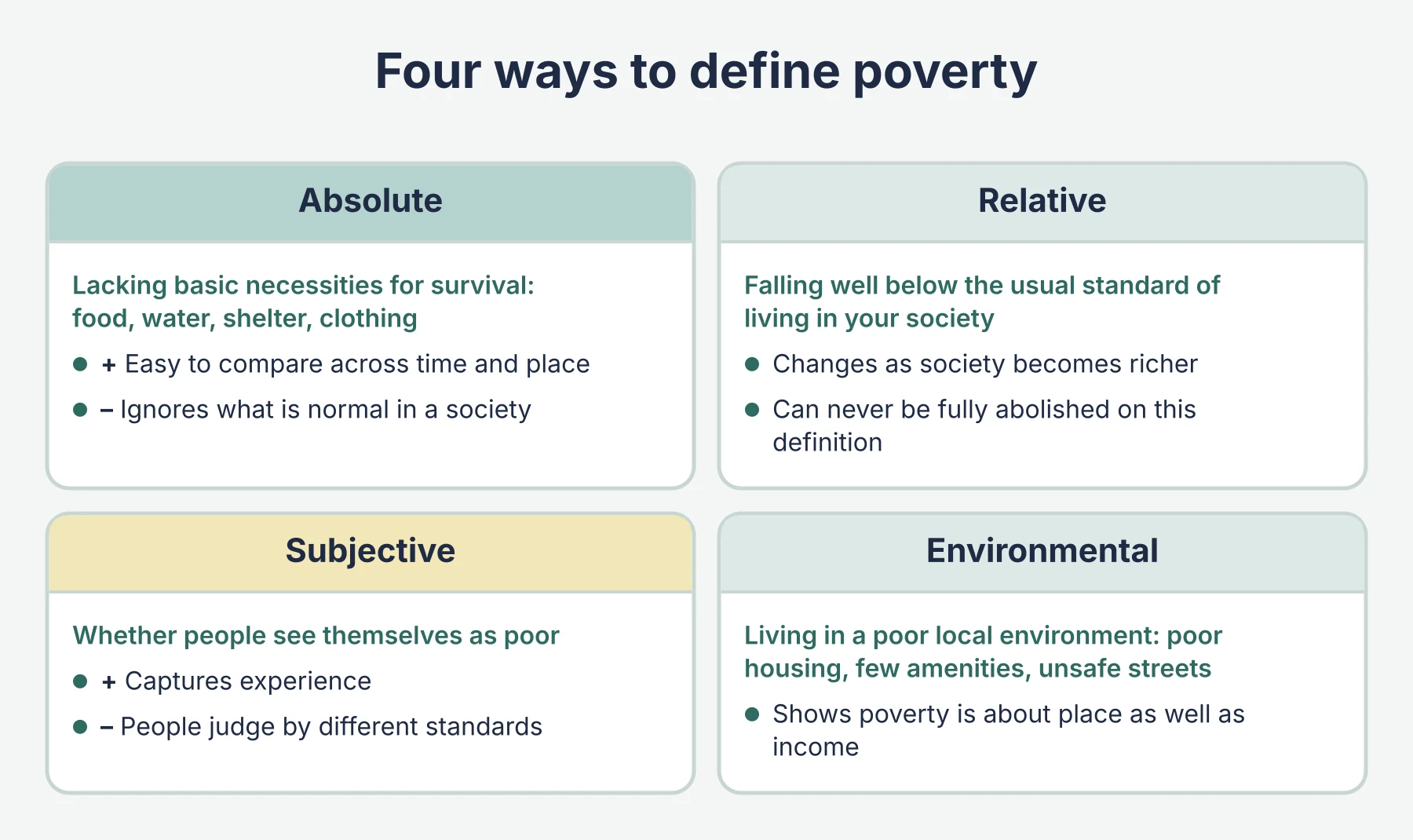
Defining poverty
| Definition | Meaning | Comment |
|---|---|---|
| Absolute poverty | Lacking the basic necessities for survival: food, water, shelter, clothing | Easy to compare across time and place, but ignores what is normal in a society |
| Relative poverty | Falling well below the usual standard of living in your society | Changes as society becomes richer; poverty can never be fully abolished on this definition |
| Subjective poverty | Whether people see themselves as poor | Captures experience, but people judge by different standards |
| Environmental poverty | Living in a poor local environment, such as poor housing, few amenities or unsafe streets | Shows poverty is about place as well as income |
Townsend’s three measures in detail
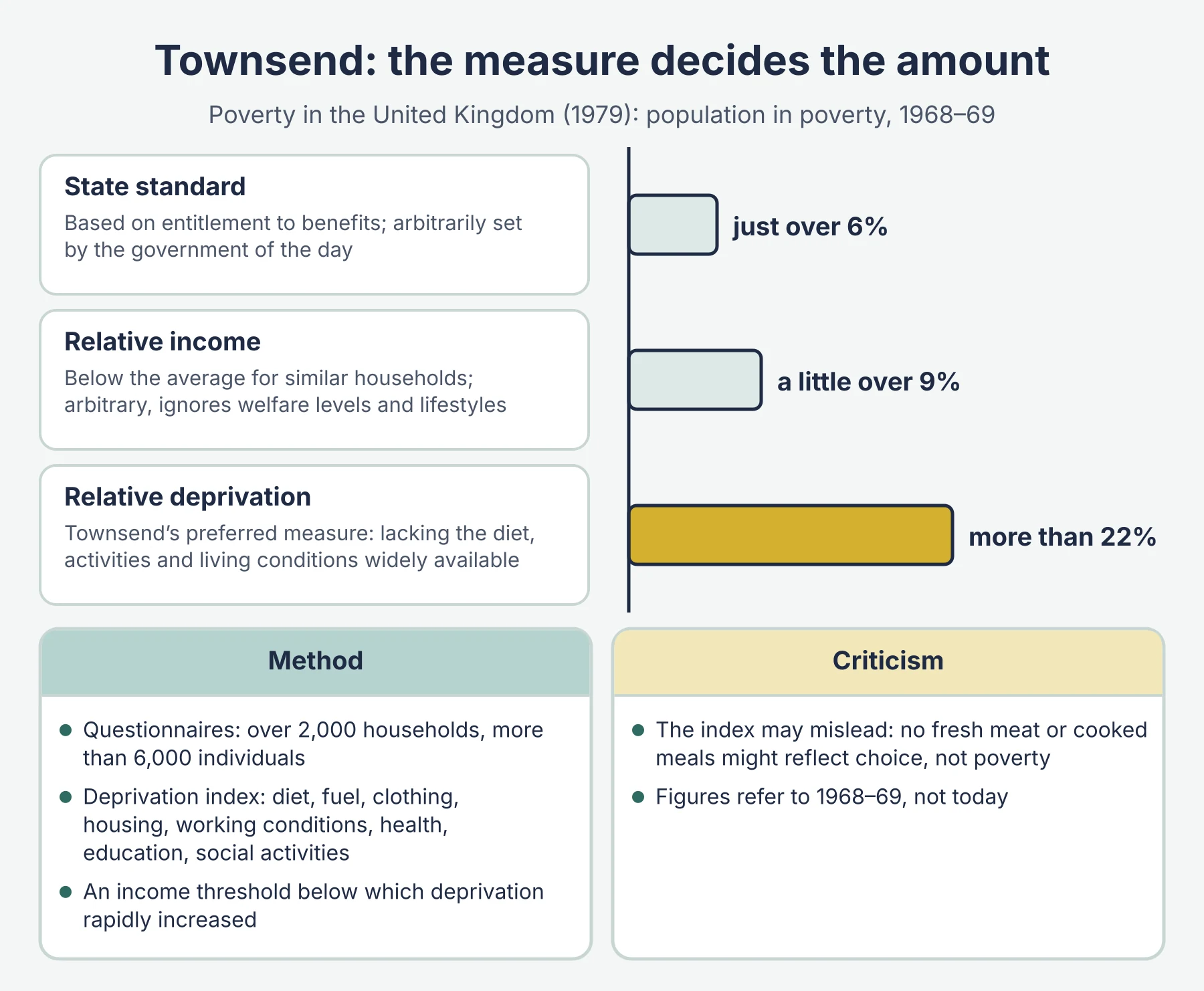
Townsend (Poverty in the United Kingdom, 1979) argued that how you define poverty decides how much of it you find. He identified:
- The state’s standard of poverty, on which official statistics were based. It rested on entitlement to claim certain benefits. Townsend believed it was arbitrarily set by the government of the day.
- The relative income standard, which identifies households with incomes below the average for similar households. He saw this as arbitrary, potentially misleading because it did not account for the level of welfare payments available, and inadequate because it did not account for the lifestyles open to the relatively disadvantaged.
- Relative deprivation, his preferred measure. People are in poverty when they lack the resources to obtain the types of diet, take part in the activities and have the living conditions widely available in their society.
Method. Questionnaires were issued to over 2,000 households and more than 6,000 individuals across the UK. He built a deprivation index covering diet, fuel, clothing, housing conditions, working conditions, health, education and social activities, gave each household a score, and calculated an income threshold below which deprivation rapidly increased.
Result. On his measure, more than 22% of the population were in poverty in 1968–69, compared with just over 6% on the state standard and a little over 9% on relative income.
Criticism. The index may produce misleading results: the absence of fresh meat or cooked meals might reflect individual choice rather than poverty.
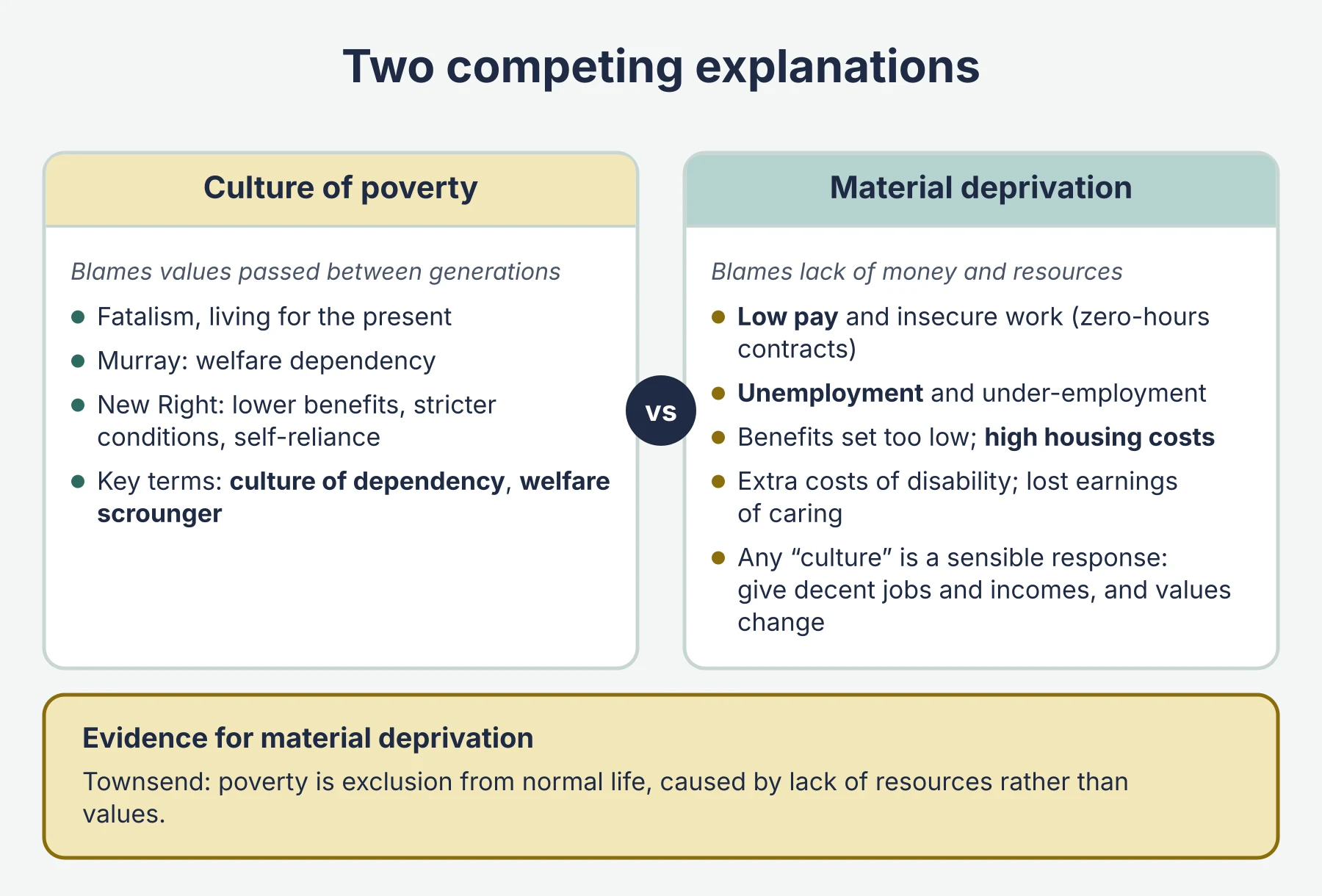
How to use Townsend. He is your best evidence that poverty is about exclusion from normal life, and that it is shaped by material deprivation, a lack of resources, rather than values.
Interpretation 1: the culture of poverty
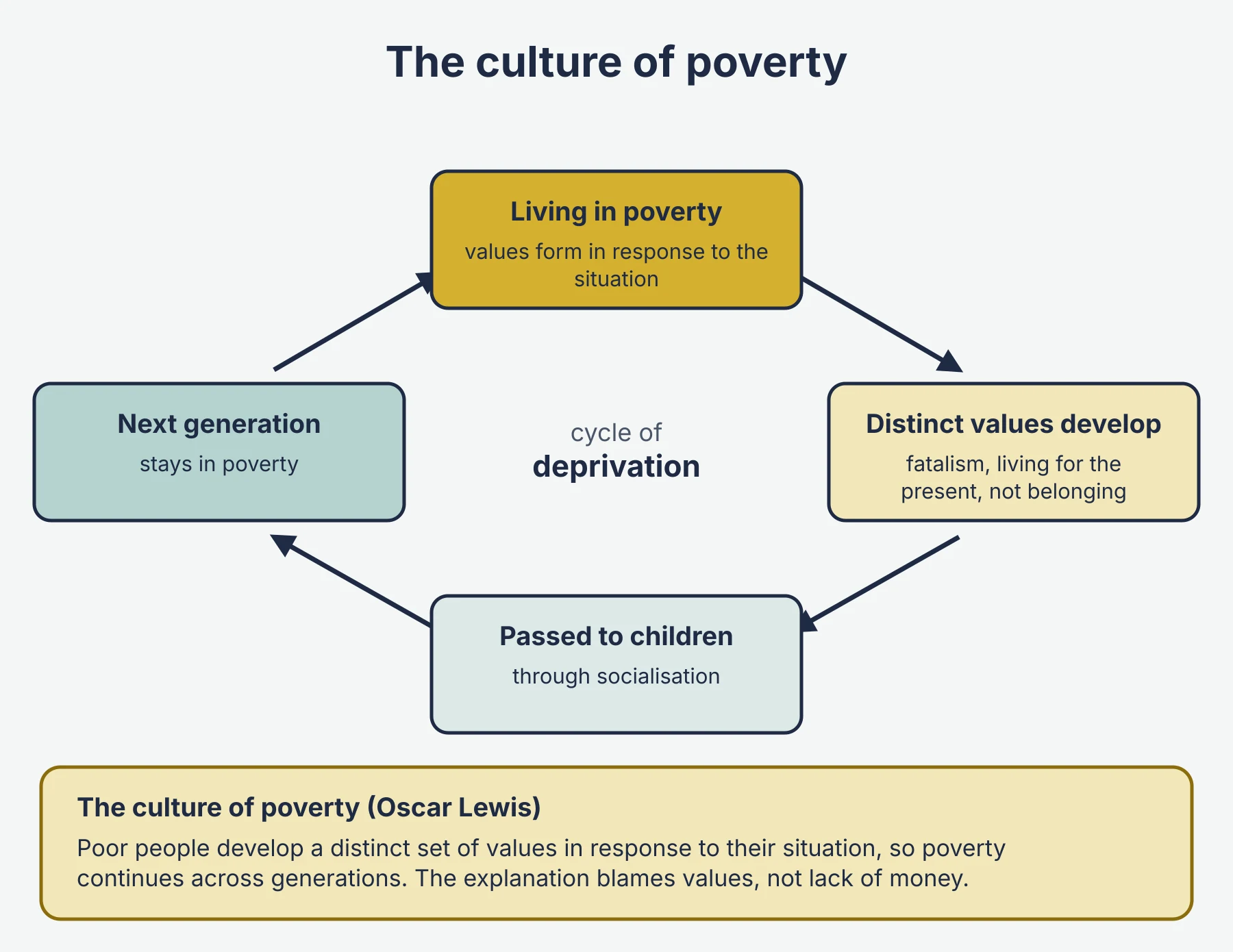
The culture of poverty explanation, associated with the anthropologist Oscar Lewis, says that poor people develop a distinct set of values in response to their situation, such as fatalism (a belief that nothing can change), living for the present and a sense of not belonging to wider society. These values are passed from parents to children through socialisation, so poverty continues across generations. This is a version of the cycle of deprivation.
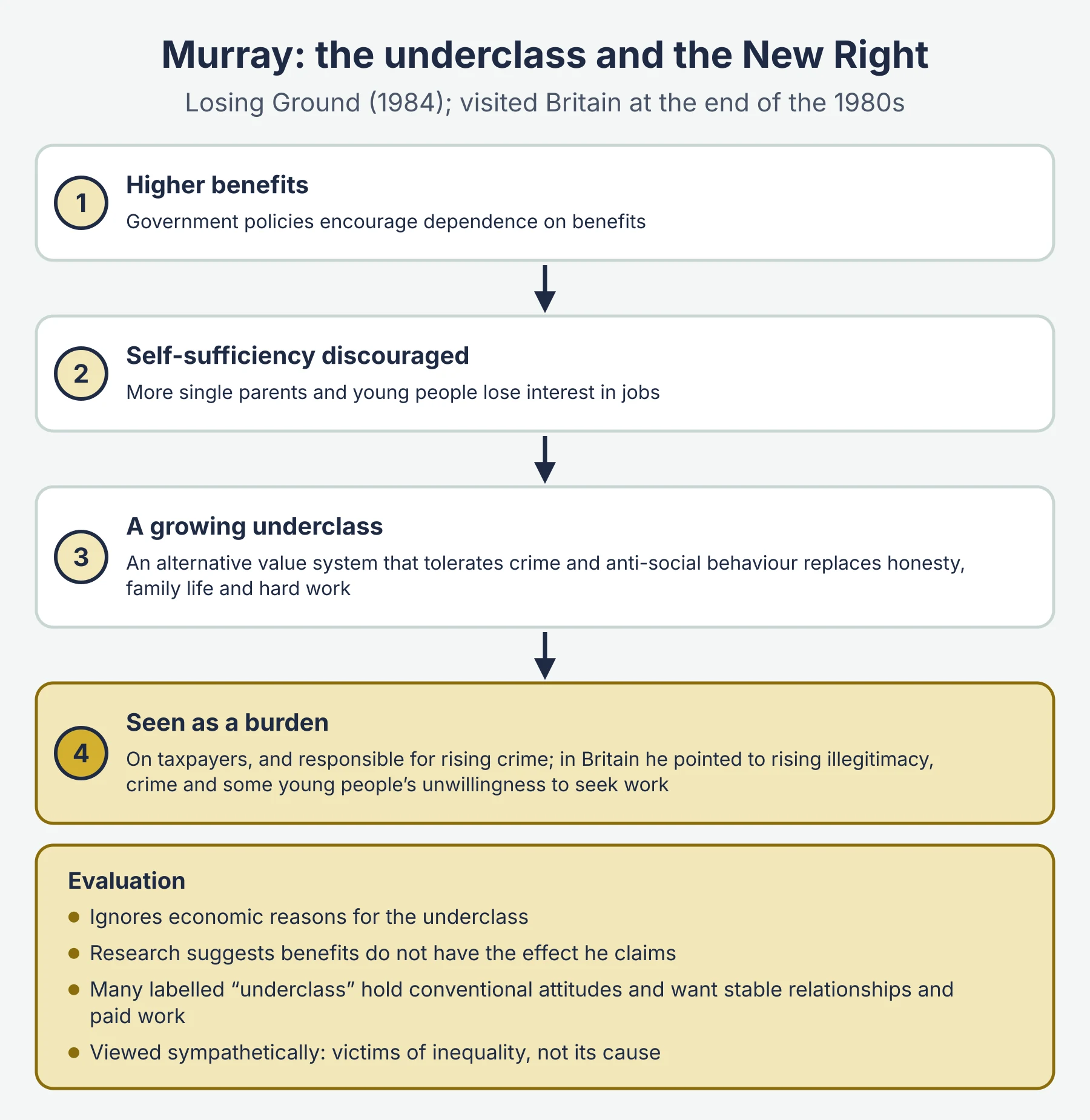
Murray’s underclass develops this idea in a New Right direction. In Losing Ground (1984) Murray argued that America had a growing underclass, encouraged by government policies to depend on benefits. Higher benefits discouraged self-sufficiency and led more single parents and young people to lose interest in jobs. He saw the underclass as a burden on taxpayers and responsible for rising crime. Visiting Britain at the end of the 1980s, he argued an underclass was developing here too, pointing to rising illegitimacy, rising crime and an apparent unwillingness among some young people to seek work. He believed traditional values such as honesty, family life and hard work were being replaced by an alternative value system that tolerated crime and anti-social behaviour.
New Right links. New Right theories also blame the benefits system for producing groups unable or unwilling to earn their own living. They favour lower benefits, stricter conditions and self-reliance. Terms such as culture of dependency and welfare scrounger belong to this view.
Evaluation.
- Murray’s cultural definition largely ignores economic reasons for the underclass.
- His evidence base has been criticised: much research suggests the benefit system does not have the effect he claims.
- Many of those labelled “underclass” hold conventional attitudes and want stable relationships and paid work.
- Viewed sympathetically, they are victims of inequality rather than its cause.
Interpretation 2: material deprivation
The material deprivation explanation says poverty is caused by a lack of money and resources, not by values. Causes include:
- low pay and insecure work, such as zero-hours contracts;
- unemployment and under-employment (wanting more hours than you can get);
- benefits set too low to reach a normal standard of living;
- high housing costs;
- the extra costs of disability, or the lost earnings of caring.
On this view, any “culture” among the poor is a sensible response to lack of opportunity. Give people decent jobs and incomes, and the values change.
How governments have tried to alleviate poverty and unemployment
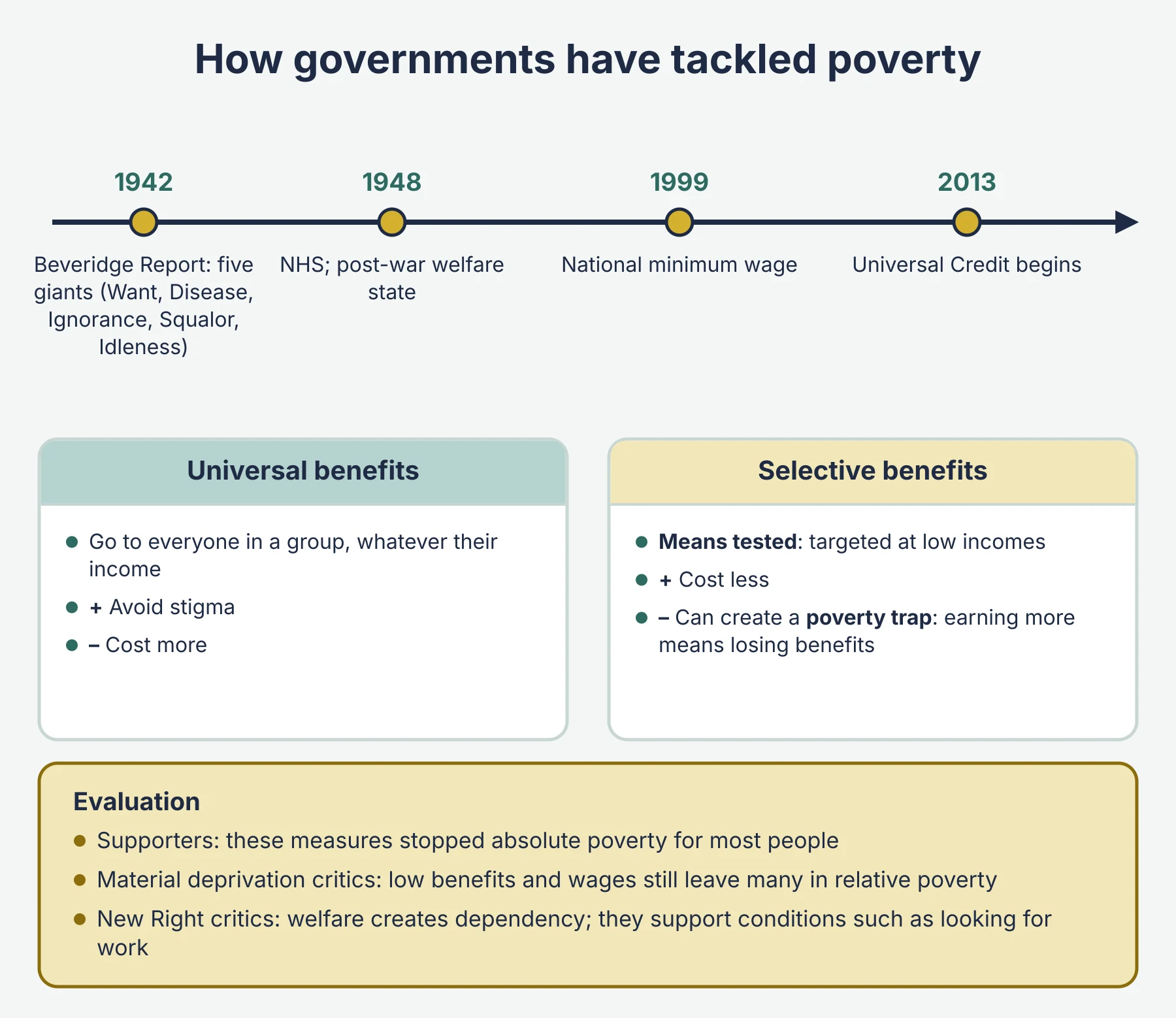
- The welfare state. The Beveridge Report (1942) identified “five giants” to be tackled: Want, Disease, Ignorance, Squalor and Idleness. The post-war welfare state introduced national insurance and, in 1948, the National Health Service.
- Universal benefits go to everyone in a group regardless of income. Selective benefits use means testing to target help at those with low incomes. Universal benefits avoid stigma; selective benefits cost less but can create a poverty trap, where earning more leads to losing benefits.
- The national minimum wage was introduced in 1999 to set a legal floor for pay.
- Universal Credit, introduced from 2013, combined several means-tested benefits into one payment, partly to make work pay.
- Welfare reform has included conditions on benefits, such as looking for work, which New Right thinkers support and critics say punish people for low pay.
- Employment policies include training schemes and help with job searching.
Evaluation. Supporters say these measures stopped absolute poverty for most people. Critics from a material deprivation view argue benefits and low wages still leave many in relative poverty. New Right critics argue welfare creates dependency.
The impact of globalisation
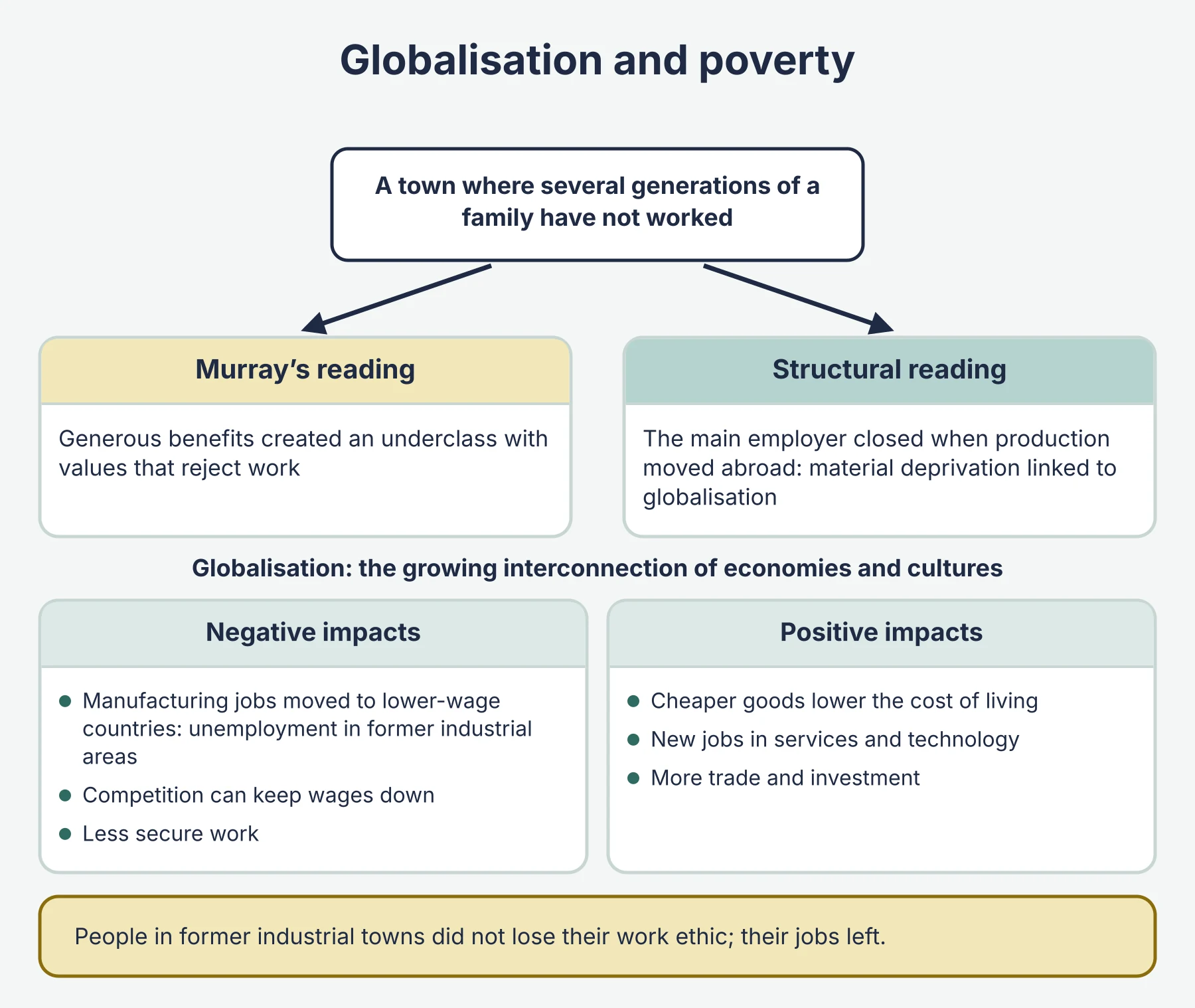
Globalisation is the growing interconnection of economies and cultures across the world.
- Negative impacts: manufacturing jobs moved to countries with lower wages, causing unemployment in former industrial areas of the UK; competition can keep wages down; work may become less secure.
- Positive impacts: cheaper goods lower the cost of living; new jobs in services and technology; more trade and investment.
Globalisation supports a structural explanation: people in former industrial towns did not lose their work ethic; their jobs left.
Perspectives on poverty
- Functionalist: Gans (1972) argued that poverty has functions for the better-off, such as ensuring low-paid and unpleasant jobs get done, and creating work for people in welfare and social services.
- Marxist: poverty is built into capitalism. A pool of unemployed and low-paid workers, which Marx called a reserve army of labour, keeps wages down and benefits owners.
- Feminist: women face a higher risk of poverty because of lower pay, part-time work, unpaid caring and lone parenthood, sometimes called the feminisation of poverty.
- New Right: poverty results from dependency and the values of the underclass.
Worked paragraph
Murray argues that generous benefits create an underclass with values that reject work. A town where several generations of a family have not worked might seem to support this. However, if the town’s main employer closed when production moved abroad, the cause is more likely to be material deprivation linked to globalisation than a culture of dependency. This suggests Murray’s cultural explanation ignores economic causes, as the specification’s summary notes.
Common mistakes
- Treating relative and absolute poverty as the same thing.
- Calling Murray Marxist or functionalist; he is linked to the New Right.
- Forgetting that the culture of poverty and material deprivation are competing explanations.
- Writing “the government ended poverty”. Policies have reduced some poverty but debates continue.
- Using Townsend’s figures for today; they refer to 1968–69.
Exam technique
- Describe an interpretation using its key terms, then explain what causes poverty on that view.
- For policy questions, name a specific measure and say how it was meant to work.
- In discuss how far answers, set the culture of poverty and Murray against material deprivation, Townsend and globalisation, then judge.
Frequently asked questions
What is the difference between the culture of poverty and material deprivation? The culture of poverty blames values passed between generations; material deprivation blames a lack of money and resources.
What is a poverty trap? A situation where earning more leads to losing means-tested benefits, so people gain little from working more.
Specification reference
AQA GCSE Sociology (8192), section 3.6.4 Poverty as a social issue, with the Townsend and Murray summaries in Appendix B (7.4) and the social stratification key terms in Appendix A (6.4).
Related resources
-
Practice questions
AQA GCSE Sociology (8192): Poverty as a social issue – Practice Questions
Original AQA GCSE Sociology 8192 practice on poverty: Townsend, Murray, the culture of poverty, welfare policy and globalisation, with full mark-scheme answers.
Sociology · AQA · GCSE
Try questions -
Revision notes
AQA GCSE Sociology (8192): Poverty as a social issue – Revision Notes
AQA GCSE Sociology 8192 revision notes on 3.6.4 poverty: definitions, Townsend, Murray, culture versus material deprivation, policy, key terms and a self-test.
Sociology · AQA · GCSE
Revise topic -
Study guides
AQA GCSE Sociology (8192): Power and authority
AQA GCSE Sociology 8192 guide to 3.6.5 power and authority: Weber's three types, formal and informal power, bureaucracy and the three perspectives.
Sociology · AQA · GCSE
Read guide
Related articles
Get free revision emails (optional)
Occasional emails with practice questions, worked explanations and links to free resources for the qualification and subjects you choose. No spam, and you can unsubscribe from any email. The free tools on this site never need an email.