
Revision Notes
AQA GCSE Sociology (8192): Life chances – Revision Notes
AQA GCSE Sociology 8192 revision notes on 3.6.3 life chances: the seven factors, Devine's affluent worker study, perspectives, key terms, traps and a self-test.
- Subject
- Sociology
- Level
- GCSE
- Topic
- Social stratification
- Author
- Marlbridge Academic Team
- Updated
- Reviewed by
- Naqiya Yousaf (what this means)
Aligned to AQA GCSE Sociology (8192), first teaching 2017. Official specification .
Syllabus page (what it covers and how it is assessed): AQA GCSE Sociology.
Syllabus points this page covers
8192
- 3.6.3 Life chances
Found an error? Report a correction.
Need help with this topic? Request a free trial class for GCSE Sociology (8192).
These notes cover AQA GCSE Sociology (8192) section 3.6.3 Life chances, assessed in Paper 2. Read the life chances study guide for full explanations, then test yourself with the life chances practice questions. The Social stratification revision notes cover the rest of the topic.
What you must be able to do
- Identify, describe and explain factors affecting life chances: social class, gender, race and ethnicity, sexuality, age, disability, religion and belief.
- Describe, compare and contrast functionalist, feminist and Marxist perspectives on life chances.
- Describe the key ideas of Devine on the affluent worker.
Memory hook for the seven factors: Can Good Rules Stop All Discrimination Rapidly? Class, Gender, Race and ethnicity, Sexuality, Age, Disability, Religion and belief.
Life chances in one paragraph
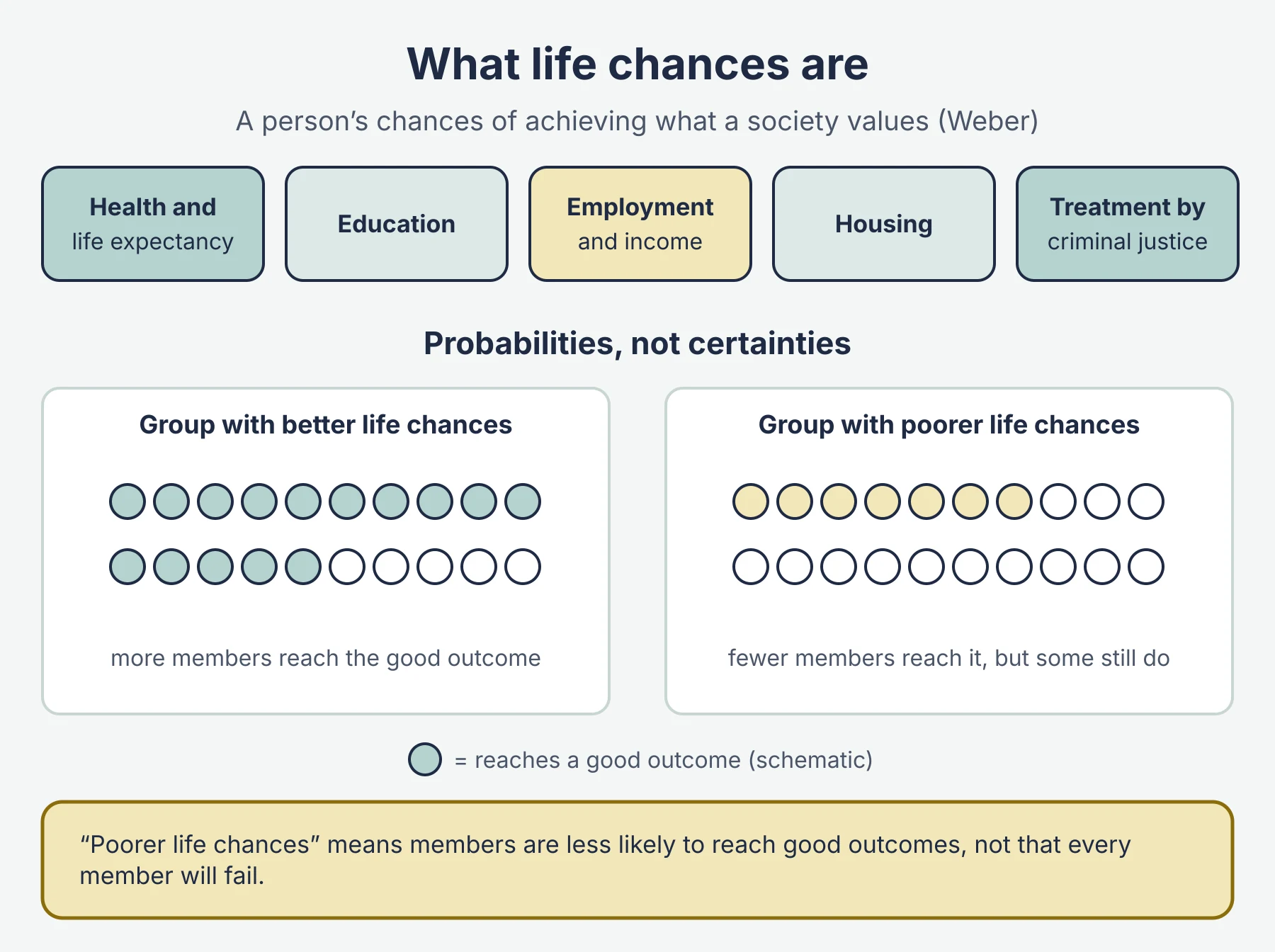
Life chances are a person’s chances of achieving positive outcomes valued in society, such as good health, a long life, education, a good job, decent housing and fair treatment by institutions. The idea comes from Weber, who linked shared class situation to shared life chances. They are probabilities, not certainties.
Key terms
| Term | Meaning |
|---|---|
| Life chances | Chances of achieving valued outcomes such as health, education, work and housing |
| Life expectancy | Average number of years a person can expect to live |
| Affluence | Being well off, with rising income and living standards |
| Affluent worker | A well-paid manual worker |
| Privatised instrumentalism | Life centred on the home, with work only a means to earn money (Lockwood) |
| Embourgeoisement | Affluent workers becoming middle class in lifestyle and values |
| Discrimination | Treating people unfairly because of a characteristic |
| Prejudice | A negative attitude towards a group, often not based on evidence |
| Racial discrimination | Unfair treatment because of race or ethnicity |
| Institutional racism | Racism built into the routines and rules of an organisation |
| Ageism | Prejudice or discrimination on grounds of age |
| Glass ceiling | Invisible barrier that stops women reaching top jobs |
| Social mobility | Movement up or down the class structure |
| Meritocracy | Rewards based on ability and effort |
Factors: one mechanism each
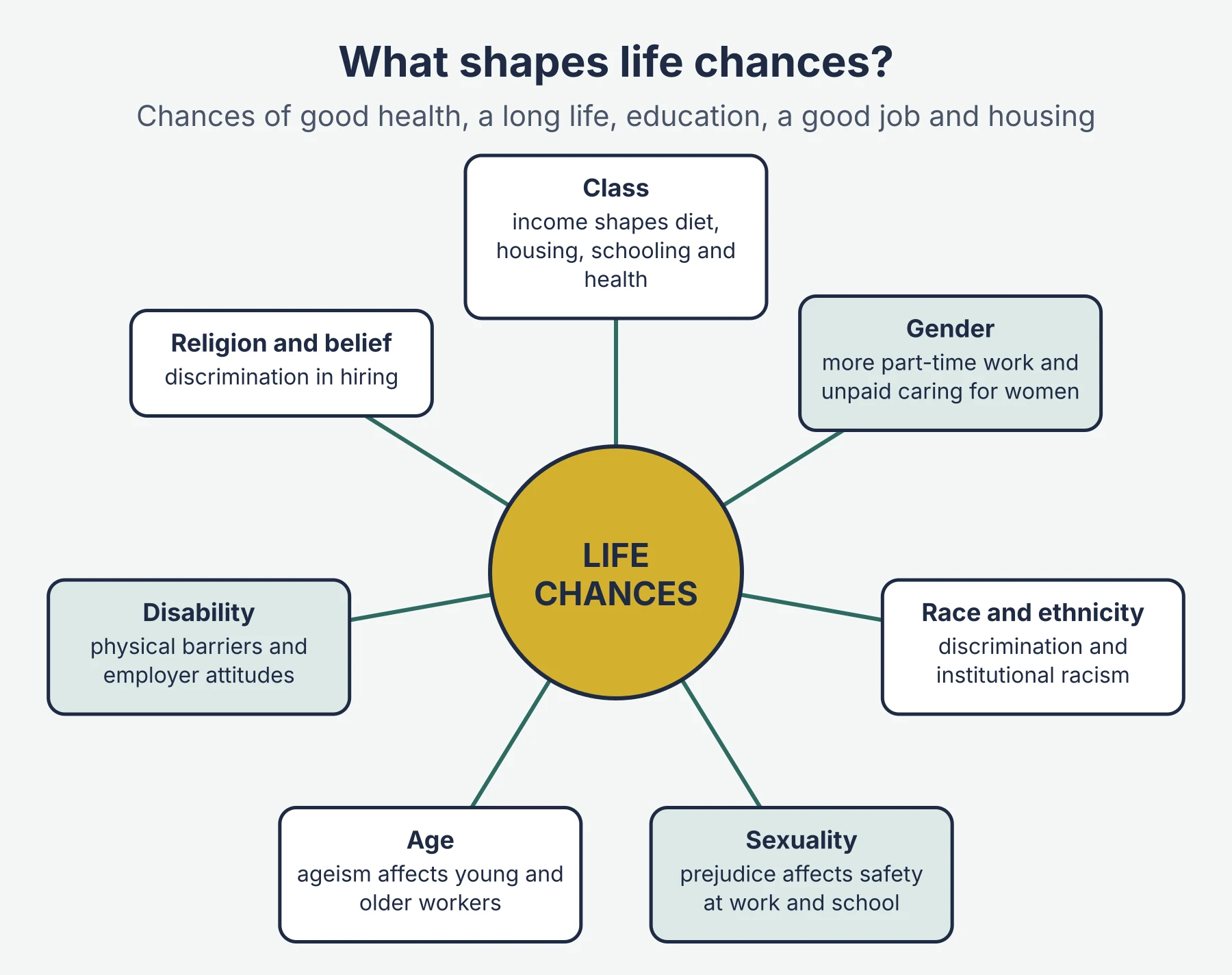
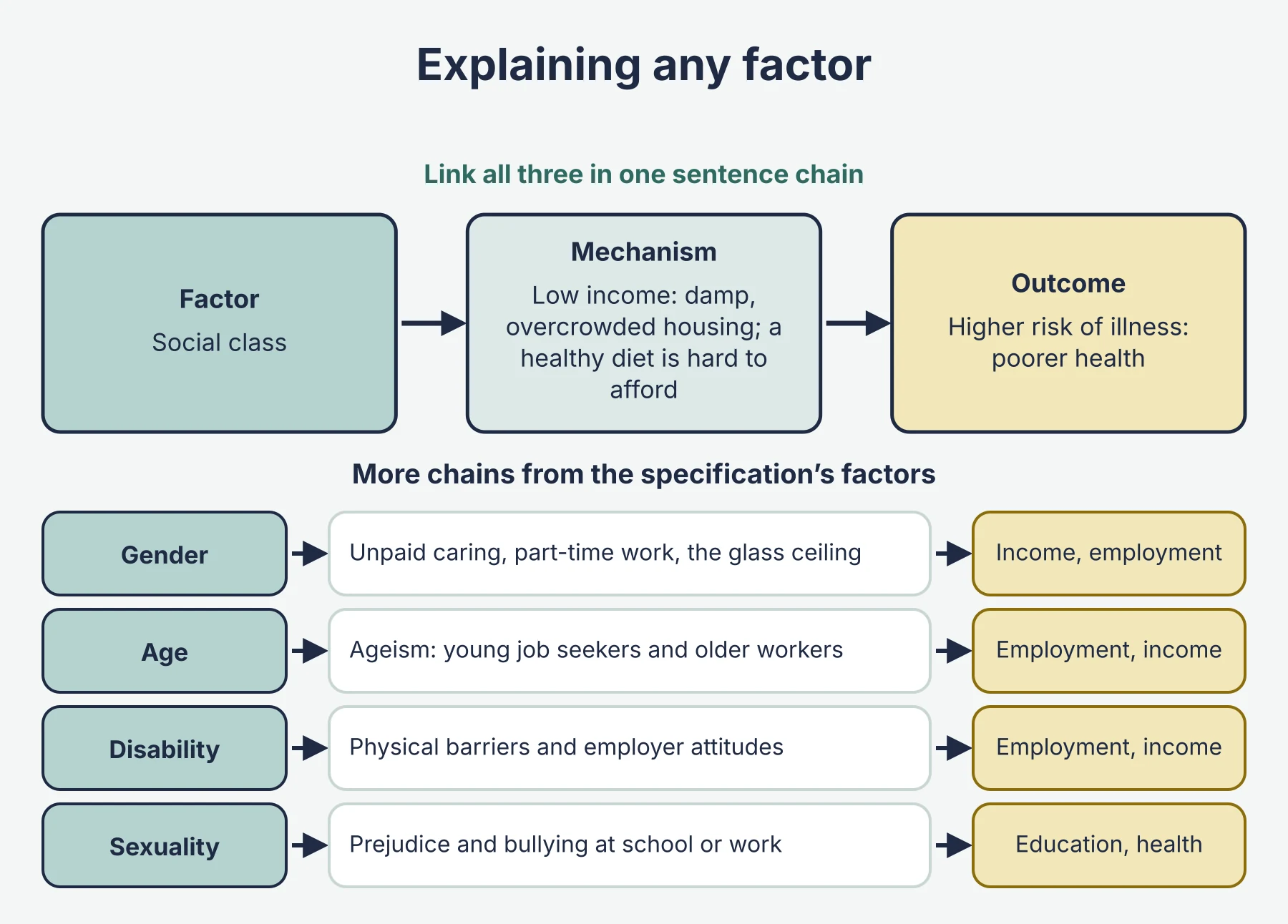
- Class: income affects diet, housing and schooling, so health and education outcomes differ.
- Gender: unpaid caring, part-time work and the glass ceiling reduce women’s pay; men face higher risks of early death through accidents, violence and suicide.
- Race and ethnicity: racial discrimination in hiring and institutional racism affect jobs and treatment by the police.
- Sexuality: prejudice and harassment can affect wellbeing, schooling and work.
- Age: ageism affects young job seekers and older workers; some pensioners face poverty.
- Disability: physical barriers and employer attitudes limit access to work and buildings.
- Religion and belief: discrimination, especially where faith is visible.
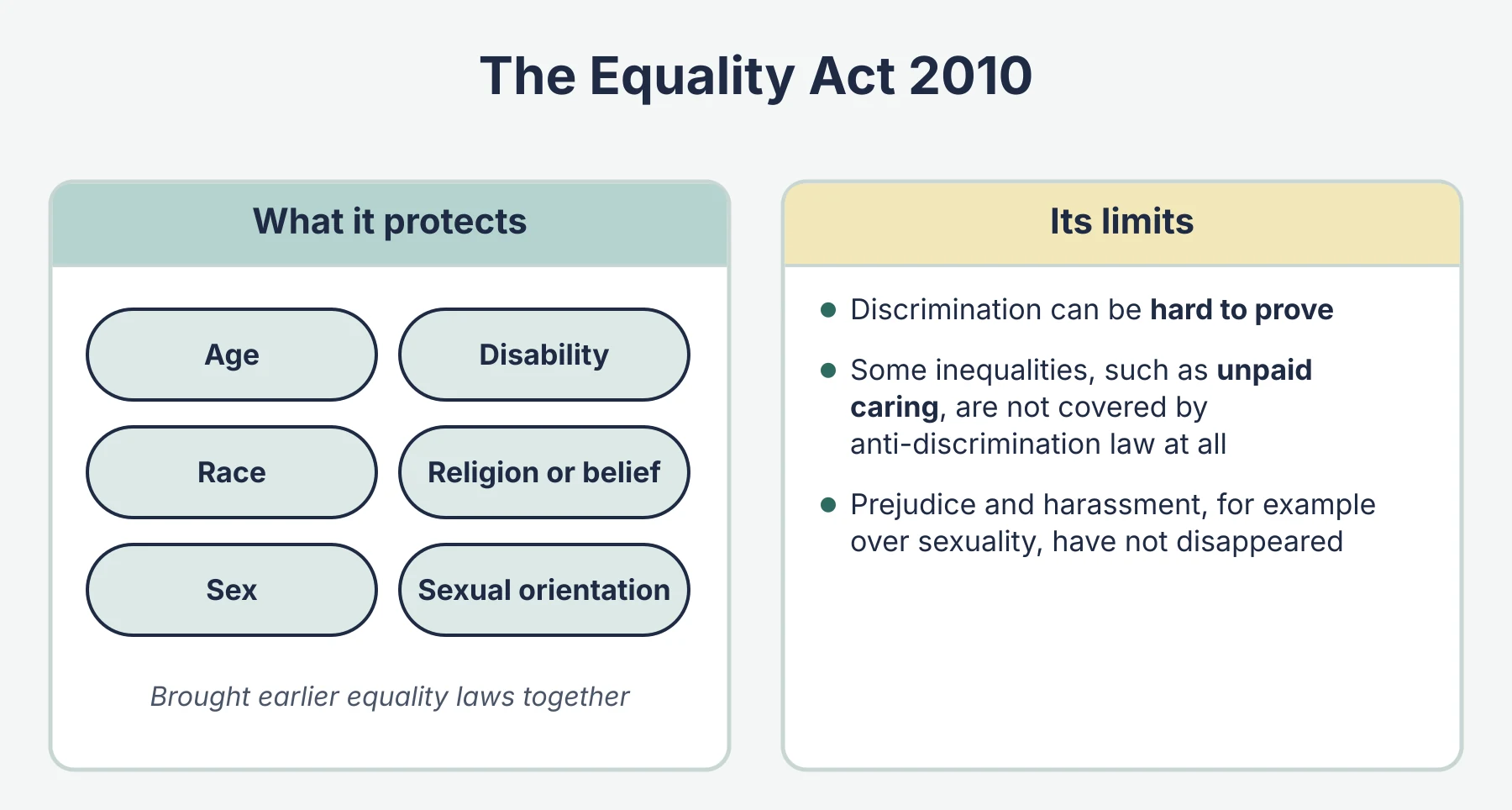
Law: the Equality Act 2010 protects against discrimination on grounds including age, disability, race, religion or belief, sex and sexual orientation. It cannot reach all inequality, such as unpaid caring, and discrimination can be hard to prove.
Devine (1992) in five boxes
| Part | Detail |
|---|---|
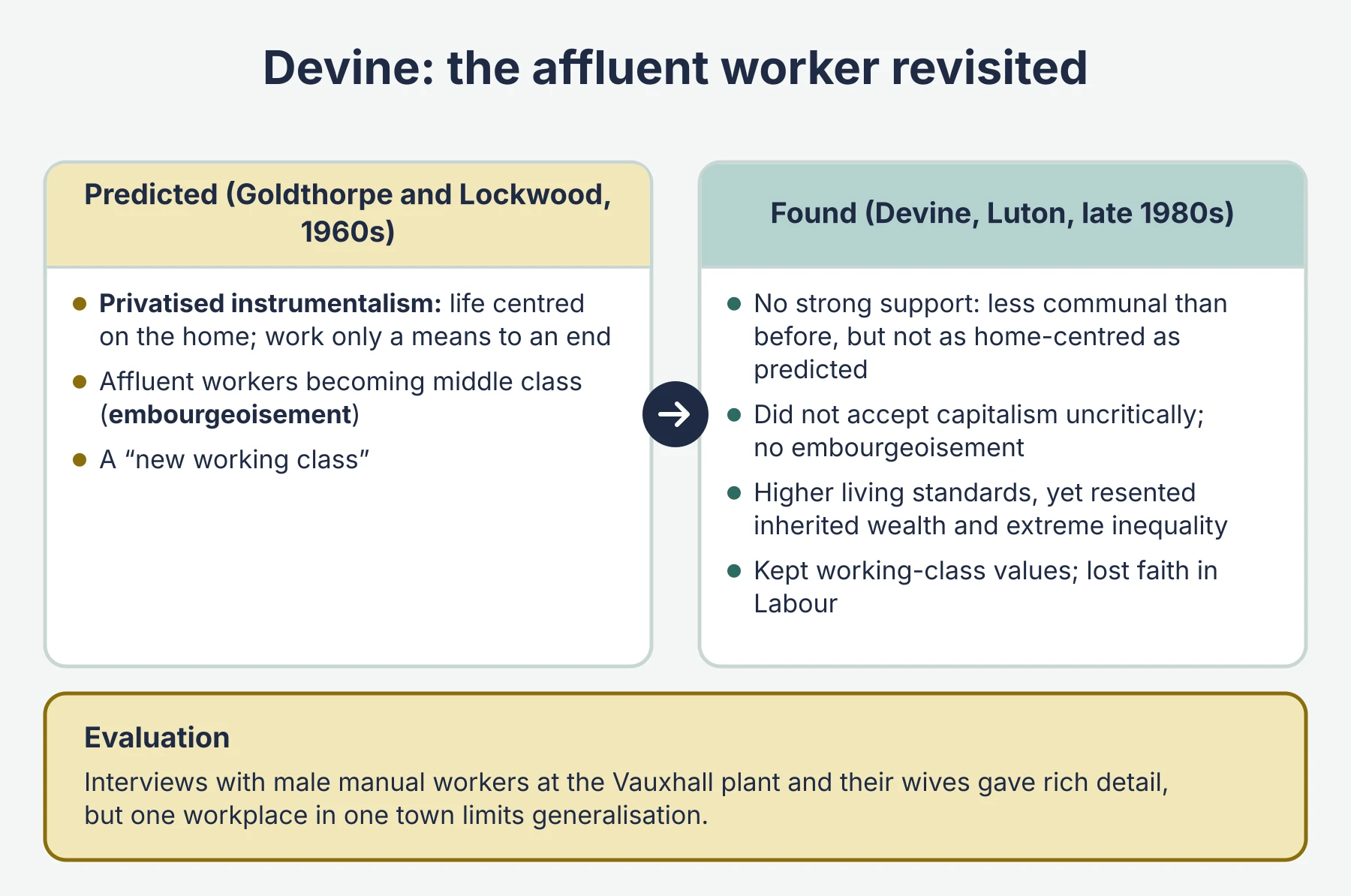
| Background | Goldthorpe and Lockwood, Luton, 1960s (The Affluent Worker in the Class Structure, 1969); Lockwood predicted privatised instrumentalism |
| Method | Late 1980s interviews with male manual workers at the Vauxhall car plant, Luton, and their wives |
| Main finding | No evidence for privatised instrumentalism: less communal than the traditional working class, but not as home-centred as predicted |
| Other findings | Rejected the “new working class”; workers had not accepted capitalism uncritically; rising living standards and consumer aspirations; resentment of inherited wealth; lost faith in the Labour Party |
| Evaluation | Rich interview data and direct comparison over time; but one plant, one town, male manual workers only |
Perspectives
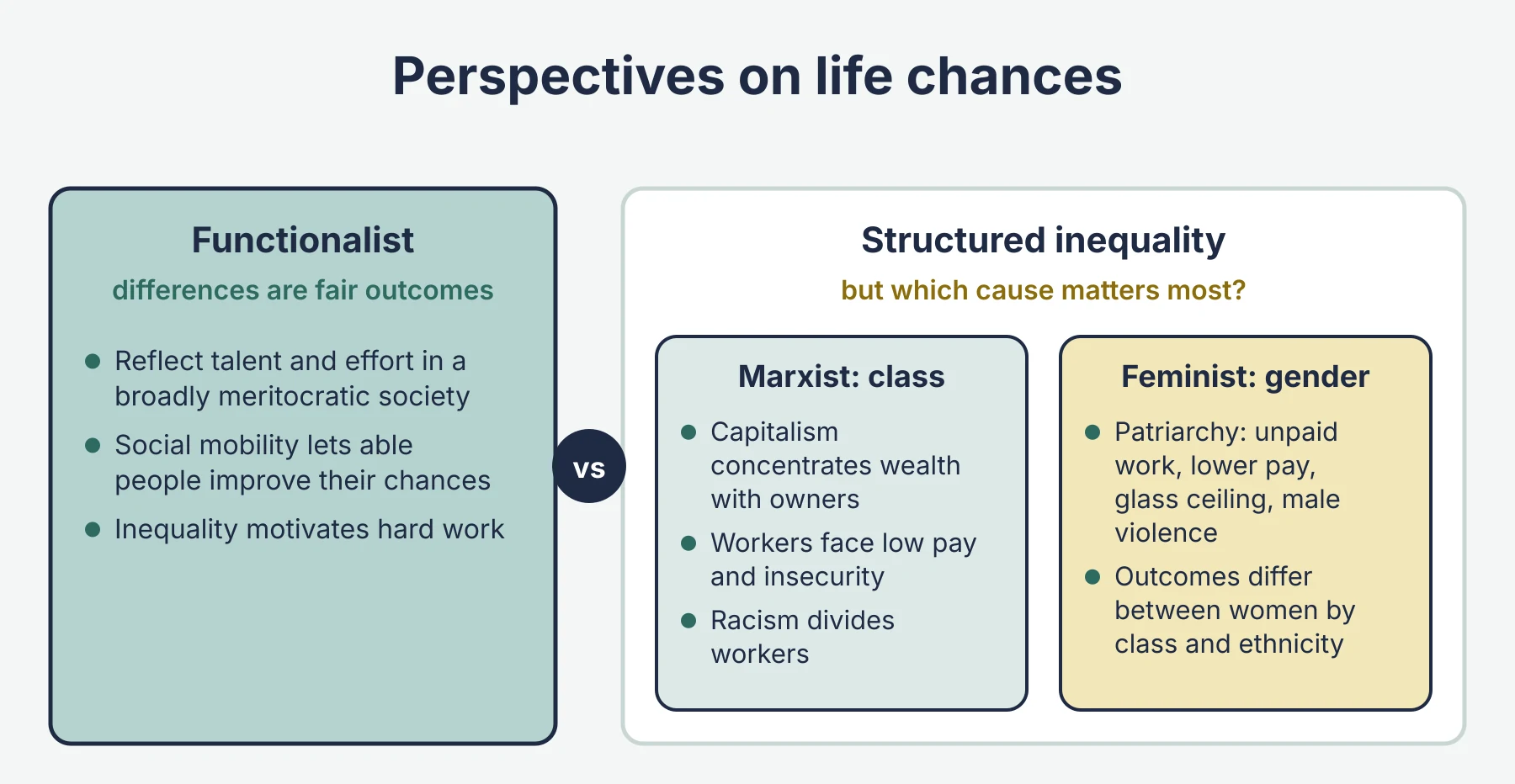
| Functionalist | Marxist | Feminist | |
|---|---|---|---|
| Cause of unequal life chances | Differences in talent and effort | Class exploitation under capitalism | Patriarchy |
| Is it fair? | Broadly, in a meritocracy | No | No |
| Key evidence | Social mobility | Class gaps in health and education | Pay gap, glass ceiling, unpaid care |
Exam traps
- Trap: “Life chances means your chances in life.” Fix: name concrete outcomes.
- Trap: a factor with no mechanism. Fix: factor → how it works → outcome.
- Trap: Devine as proof of embourgeoisement. Fix: her findings do not support it.
- Trap: treating factors separately when the question invites overlap. Fix: show how class, gender and ethnicity combine.
- Trap: inventing statistics. Fix: describe patterns without made-up numbers.
Quick self-test
- Which sociologist is the term “life chances” linked to?
- List the seven factors the specification names.
- Give two areas in which life chances can be measured.
- Explain one way gender can harm men’s life chances.
- What is institutional racism?
- Whose idea did Devine test?
- What does “privatised instrumentalism” mean?
- Where and when did Devine carry out her interviews?
- Who did Devine interview?
- Give two findings from Devine’s study.
- Give one limitation of Devine’s study.
- How would a functionalist explain unequal life chances?
Answers
- Weber.
- Social class, gender, race and ethnicity, sexuality, age, disability, religion and belief.
- Any two of: health and life expectancy, education, employment and income, housing, treatment by the criminal justice system.
- Men are more likely to die young through accidents, violence or suicide.
- Racism built into the routines and rules of an organisation.
- Lockwood’s.
- Social life centred on the home, with work seen only as a means to earn money.
- At the Vauxhall car plant in Luton, in the late 1980s.
- Male manual workers and their wives.
- Any two of: no evidence for privatised instrumentalism; rejected the “new working class”; workers had not accepted capitalism uncritically; rising living standards; resentment of inherited wealth; lost faith in the Labour Party.
- One plant in one town limits generalisation, or only male manual workers were sampled.
- As the result of differences in talent and effort in a meritocratic society, with social mobility open to the able.
Specification reference
AQA GCSE Sociology (8192), section 3.6.3 Life chances; Appendix B (7.4) summary of Devine; Appendix A (6.4) key terms.
Related resources
-
Study guides
AQA GCSE Sociology (8192): Poverty as a social issue
AQA GCSE Sociology 8192 guide to 3.6.4 poverty: definitions, culture of poverty versus material deprivation, policy, globalisation, Townsend and Murray.
Sociology · AQA · GCSE
Read guide -
Practice questions
AQA GCSE Sociology (8192): Poverty as a social issue – Practice Questions
Original AQA GCSE Sociology 8192 practice on poverty: Townsend, Murray, the culture of poverty, welfare policy and globalisation, with full mark-scheme answers.
Sociology · AQA · GCSE
Try questions -
Revision notes
AQA GCSE Sociology (8192): Poverty as a social issue – Revision Notes
AQA GCSE Sociology 8192 revision notes on 3.6.4 poverty: definitions, Townsend, Murray, culture versus material deprivation, policy, key terms and a self-test.
Sociology · AQA · GCSE
Revise topic
Related articles
Get free revision emails (optional)
Occasional emails with practice questions, worked explanations and links to free resources for the qualification and subjects you choose. No spam, and you can unsubscribe from any email. The free tools on this site never need an email.