
Study Guides
AQA GCSE Sociology (8192): Life chances
AQA GCSE Sociology 8192 guide to 3.6.3 life chances: the seven named factors, Devine on the affluent worker, and functionalist, Marxist and feminist views.
- Subject
- Sociology
- Level
- GCSE
- Topic
- Social stratification
- Author
- Marlbridge Academic Team
- Updated
- Reviewed by
- Naqiya Yousaf (what this means)
Aligned to AQA GCSE Sociology (8192), first teaching 2017. Official specification .
Syllabus page (what it covers and how it is assessed): AQA GCSE Sociology.
Syllabus points this page covers
8192
- 3.6.3 Life chances
Found an error? Report a correction.
Need help with this topic? Request a free trial class for GCSE Sociology (8192).
This guide covers AQA GCSE Sociology (8192) section 3.6.3 Life chances, assessed in Paper 2: The sociology of crime and deviance and social stratification. The specification asks you to “identify, describe and explain factors affecting life chances including social class, gender, race and ethnicity, sexuality, age, disability, religion and belief”, to compare functionalist, feminist and Marxist perspectives, and to describe the key ideas of Devine on the idea of the affluent worker.
The Social stratification study guide gives a short list of the factors. This guide explains how each one works across different areas of life and gives Devine’s study the detail an extended answer needs. Use it with the life chances revision notes and the life chances practice questions.
What life chances are
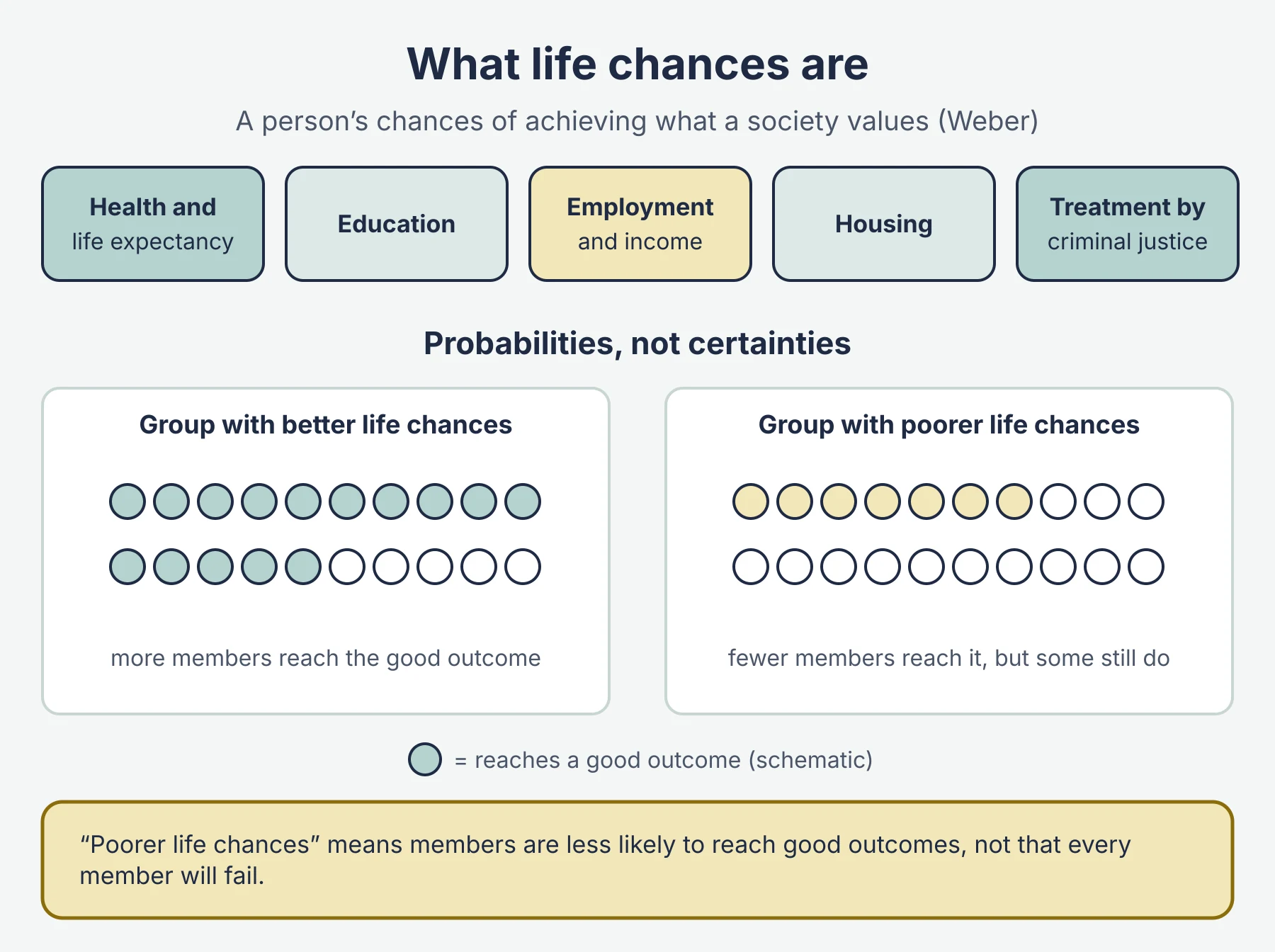
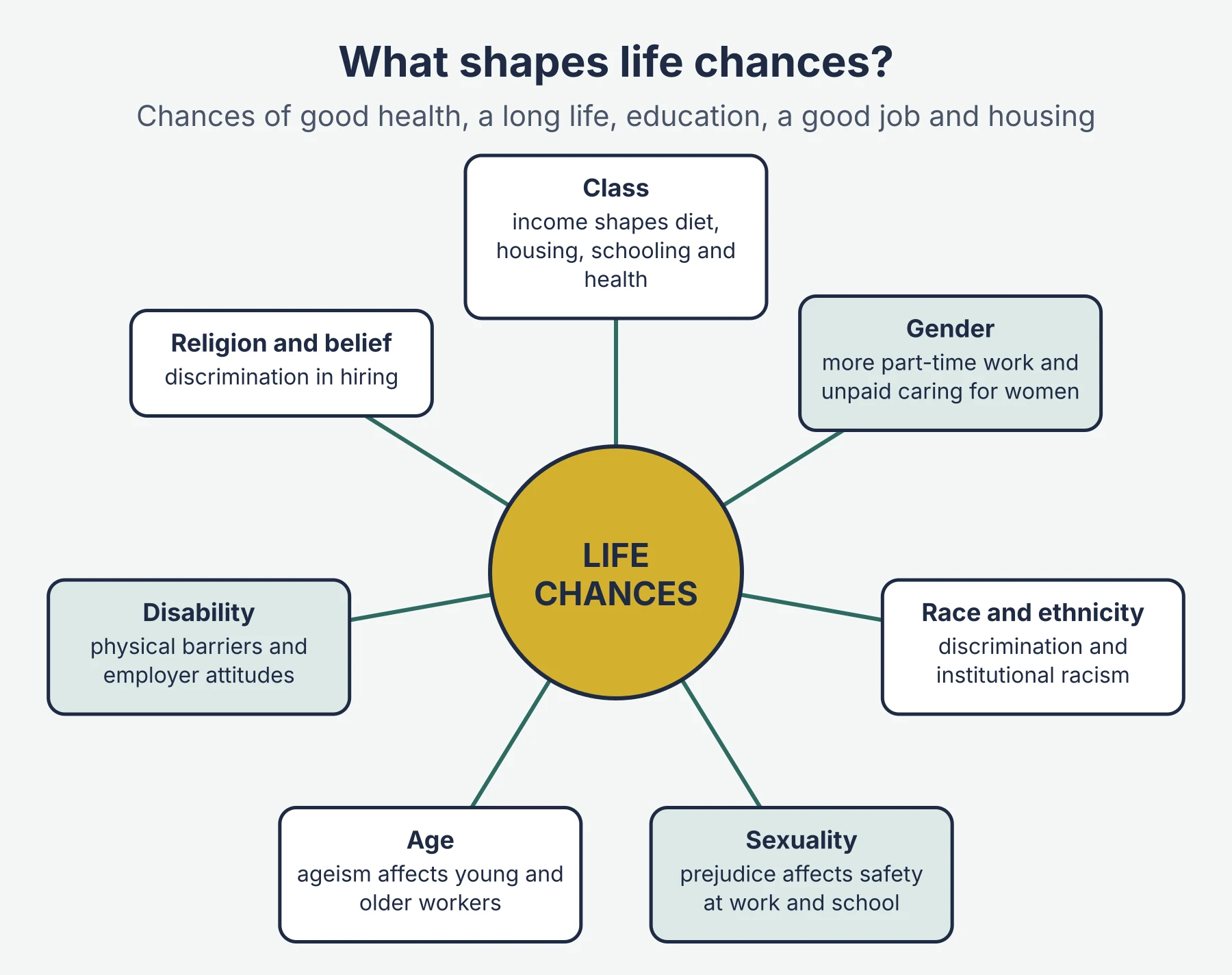
Life chances are a person’s chances of achieving the things a society values: good health, a long life, education, a good job, decent housing, and fair treatment by institutions such as the police and courts. The term comes from Weber, who argued that people who share a class situation share similar life chances.
Two points make answers stronger:
- Life chances are about probabilities, not certainties. Saying a group has poorer life chances means its members are less likely to reach good outcomes, not that every member will fail.
- Life chances can be measured across several areas. The most useful are health and life expectancy, education, employment and income, housing, and treatment by the criminal justice system.
A grid for explaining any factor
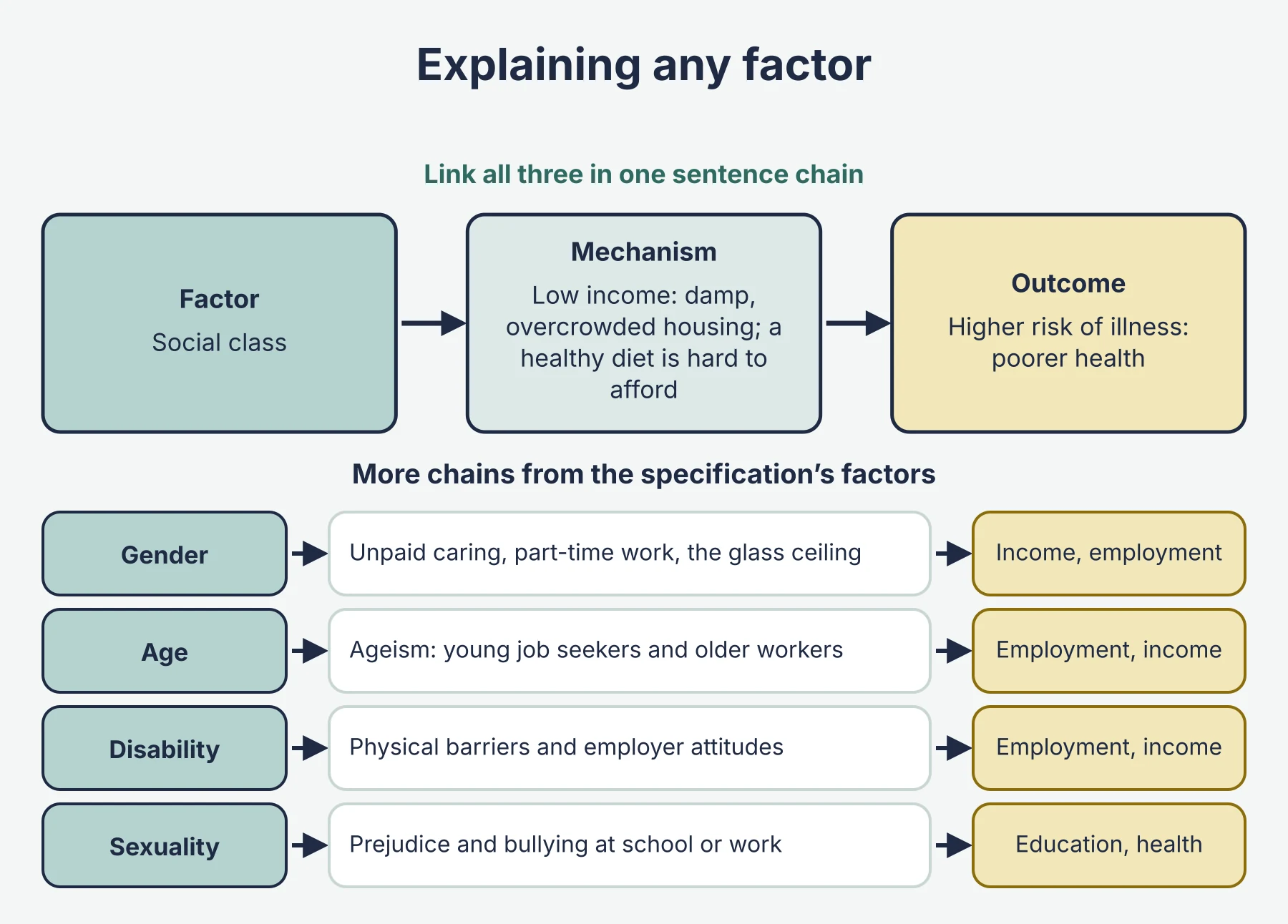
When a question names a factor, explain how it affects life chances by picking one or two areas and giving a mechanism.
| Factor | Example of a mechanism | Area affected |
|---|---|---|
| Social class | Lower income limits diet, housing and access to private tutoring | Health, education |
| Gender | Women do more unpaid caring and part-time work; the glass ceiling limits promotion | Income, employment |
| Race and ethnicity | Racial discrimination in hiring; institutional racism in organisations | Employment, criminal justice |
| Sexuality | Prejudice and bullying at school or work can affect wellbeing and progress | Education, health |
| Age | Ageism affects young job seekers and older workers; pensioners may face poverty | Employment, income |
| Disability | Physical barriers and employer attitudes limit access to work and buildings | Employment, income |
| Religion and belief | Discrimination in hiring or harassment linked to visible symbols of faith | Employment, safety |
Notes on each factor
Social class is the factor most sociologists put first. Income and wealth affect where families can live, the schools nearby, diet, leisure and the stress people face. Official data have consistently shown a gap in life expectancy between people in the most and least deprived areas of the UK. Class also affects education: you can link to Halsey, Heath and Ridge’s finding that service-class boys were far more likely than working-class boys to reach university.
Gender affects life chances in mixed ways. Women live longer than men on average, and girls now outperform boys at most levels of school. But women are more likely to work part time, to do unpaid caring, and to face a pay gap and the glass ceiling. Men are more likely to die young through accidents, violence and suicide, which shows gender can harm men’s life chances too.
Race and ethnicity combine with class. Some minority ethnic groups are more likely to live in poverty, while others achieve above average results in education. Racial discrimination and institutional racism, racism built into the routines of organisations, can affect hiring, promotion and treatment by the police.
Sexuality can affect safety, mental health and acceptance at school and work. The law now protects sexual orientation, but prejudice and harassment have not disappeared.
Age shapes chances at both ends of life. Young people may be refused jobs for lack of experience; older workers may find it hard to be re-employed after redundancy. Ageism is prejudice or discrimination on grounds of age.
Disability can limit access to buildings, transport and work. Many sociologists stress that it is society’s barriers, not the impairment itself, that reduce life chances.
Religion and belief can lead to discrimination, especially where religious identity is visible, and may combine with ethnicity.
The role of the law
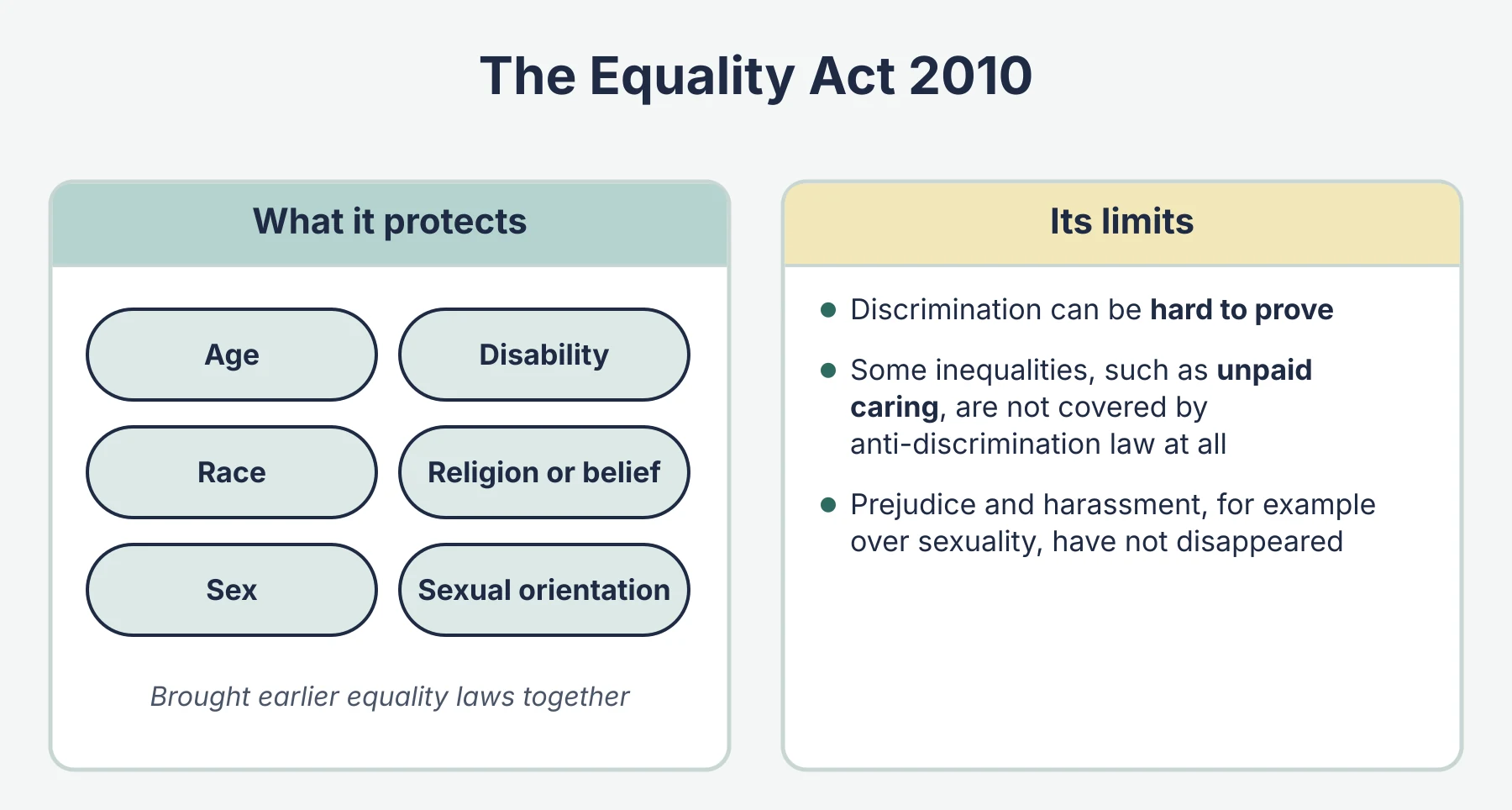
The Equality Act 2010 brought earlier equality laws together and protects people from discrimination on several grounds, including age, disability, race, religion or belief, sex and sexual orientation. Use it in evaluation: the law offers protection, but discrimination can be hard to prove and some inequalities, such as unpaid caring, are not covered by anti-discrimination law at all.
Devine: affluent workers revisited
Devine’s study (Affluent Workers Revisited, 1992) is the named study for this sub-section. Learn its four parts: background, method, findings and evaluation.
Background
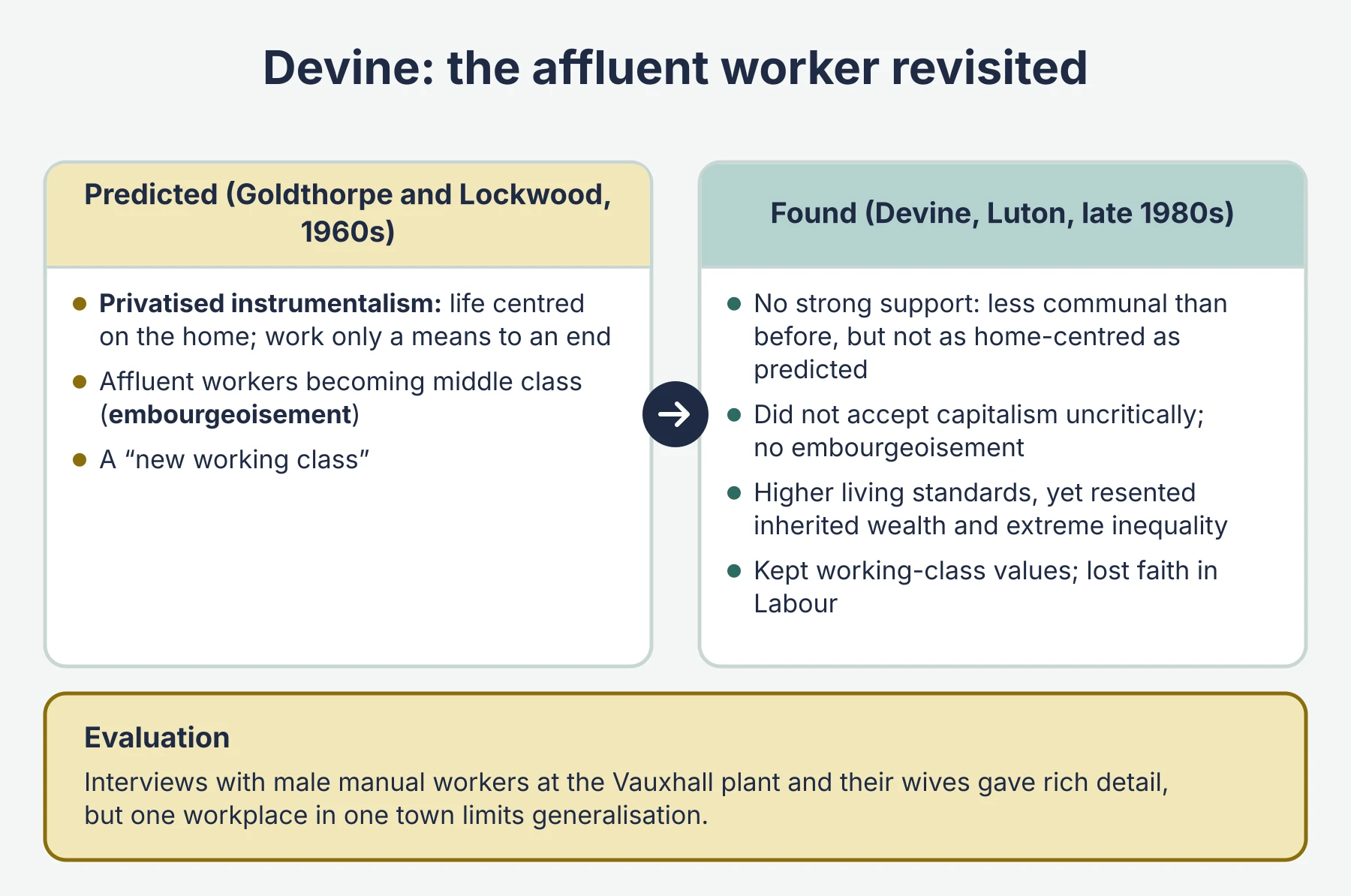
In the 1960s Goldthorpe and Lockwood studied well-paid manual workers in Luton (The Affluent Worker in the Class Structure, 1969). Lockwood suggested that privatised instrumentalism would become typical of the working class:
- Privatised: social life centred on the home and immediate family, not on the wider community.
- Instrumentalism: work seen only as a means to an end, a way to earn money. When affluent workers joined with workmates, they did so as self-interested individuals to improve wages and conditions, not out of collective solidarity.
This was linked to the wider debate about embourgeoisement: were affluent workers becoming middle class?
Method
During the late 1980s Devine interviewed a sample of male manual workers employed at the Vauxhall car plant in Luton, and their wives. By returning to the same town she could make a direct comparison with the 1960s research.
Findings
- She did not find evidence to support privatised instrumentalism. Her sample’s lifestyle was not as communal as the traditional working class, but neither was it as home-centred and privatised as predicted.
- She rejected the idea of a “new working class” and denied that affluent workers had been persuaded to accept capitalism uncritically.
- She found rising living standards and aspirations as consumers.
- Many still resented the privileges of inherited wealth and felt a sense of injustice about extreme class inequalities.
- They kept many traditional working-class values, but had generally lost faith in the Labour Party’s ability to deliver a more just and equal society.
Why Devine matters for life chances
Devine shows that rising incomes improved some life chances, such as housing and consumer goods, without removing class identity. Affluence did not turn manual workers into middle-class people. This supports the view that class remains a meaningful influence on how people see their position and chances.
Evaluation
- Strengths: interviews gave detailed, meaningful accounts; including wives added a view of home life; returning to Luton allowed comparison over time.
- Limitations: one workplace in one town limits generalisation; the sample was of male manual workers in one industry; the study is now over thirty years old and manufacturing employs fewer people today.
Perspectives on life chances
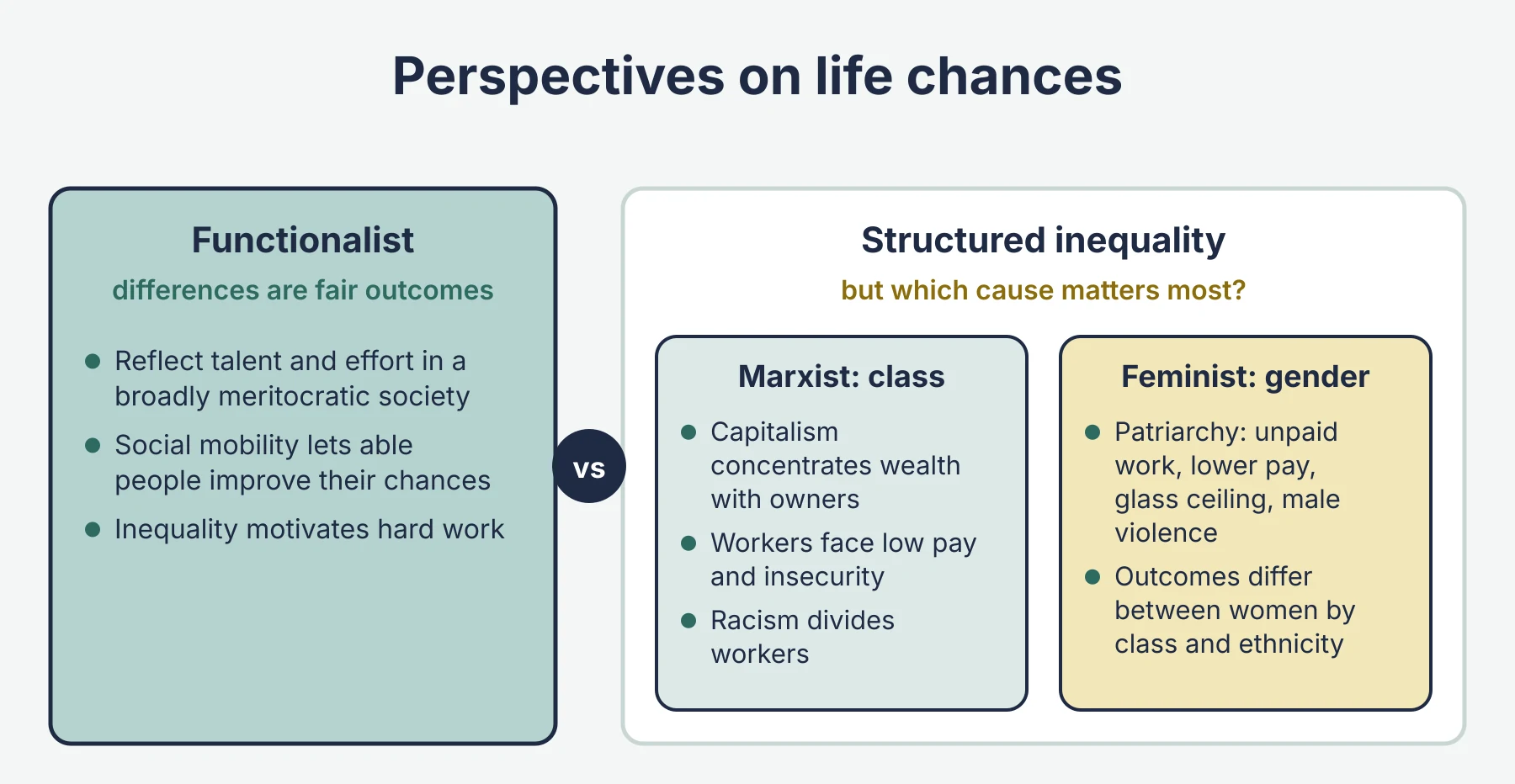
Functionalist. Differences in life chances reflect differences in talent and effort in a broadly meritocratic society. Social mobility allows able people to improve their chances. Inequality motivates people to work hard.
Marxist. Class is the root of unequal life chances. Capitalism concentrates wealth in the hands of owners, while workers face low pay and insecurity. Other inequalities, such as racism, can divide workers and weaken class solidarity.
Feminist. Patriarchy limits women’s life chances through unpaid domestic work, lower pay, the glass ceiling and male violence. Feminists also point out that outcomes differ between women by class and ethnicity.
Comparing them: functionalists see differences as fair outcomes; Marxists and feminists see them as the product of structured inequality, but disagree about whether class or gender is the main cause.
Worked paragraph
Social class affects life chances in health. A family on a low income may live in damp, overcrowded housing and struggle to afford a healthy diet, which increases the risk of illness. This shows how class works through material conditions rather than individual choice. Marxists would use this to argue that capitalism produces unequal life chances. However, functionalists might reply that social mobility allows some children from such families to improve their chances through education, so class does not fix outcomes completely.
Common mistakes
- Defining life chances as “chances in life”. Name the outcomes: health, education, work, housing.
- Writing about a factor without a mechanism. Say how gender or age affects a specific outcome.
- Presenting Devine as evidence for embourgeoisement. Her findings do not support it.
- Forgetting that factors overlap: a disabled older woman may face several disadvantages at once.
Exam technique
- Identify a factor from the specification’s list; do not invent new ones such as “luck”.
- Explain by linking factor, mechanism and outcome in one sentence chain.
- In discuss how far questions, test the claim that one factor (usually class) matters most against at least two others.
Frequently asked questions
What did Devine test? Lockwood’s idea that privatised instrumentalism would become typical of affluent working-class people.
Did Devine support embourgeoisement? No. She found rising living standards, but her respondents kept many traditional working-class values and resented inherited wealth.
Specification reference
AQA GCSE Sociology (8192), section 3.6.3 Life chances, with the Devine summary in Appendix B (7.4) and the social stratification key terms in Appendix A (6.4).
Related resources
-
Practice questions
AQA GCSE Sociology (8192): Life chances – Practice Questions
Original AQA GCSE Sociology 8192 practice on life chances and Devine's affluent worker study, with data, item-based and extended questions and full answers.
Sociology · AQA · GCSE
Try questions -
Revision notes
AQA GCSE Sociology (8192): Life chances – Revision Notes
AQA GCSE Sociology 8192 revision notes on 3.6.3 life chances: the seven factors, Devine's affluent worker study, perspectives, key terms, traps and a self-test.
Sociology · AQA · GCSE
Revise topic -
Study guides
AQA GCSE Sociology (8192): Poverty as a social issue
AQA GCSE Sociology 8192 guide to 3.6.4 poverty: definitions, culture of poverty versus material deprivation, policy, globalisation, Townsend and Murray.
Sociology · AQA · GCSE
Read guide
Related articles
Get free revision emails (optional)
Occasional emails with practice questions, worked explanations and links to free resources for the qualification and subjects you choose. No spam, and you can unsubscribe from any email. The free tools on this site never need an email.