
Revision Notes
AQA GCSE Sociology (8192): Socio-economic class – Revision Notes
AQA GCSE Sociology 8192 revision notes on 3.6.2 socio-economic class: class divisions, Marx versus Weber, perspectives, key terms, exam traps and a self-test.
- Subject
- Sociology
- Level
- GCSE
- Topic
- Social stratification
- Author
- Marlbridge Academic Team
- Updated
- Reviewed by
- Naqiya Yousaf (what this means)
Aligned to AQA GCSE Sociology (8192), first teaching 2017. Official specification .
Syllabus page (what it covers and how it is assessed): AQA GCSE Sociology.
Syllabus points this page covers
8192
- 3.6.2 Socio-economic class
Found an error? Report a correction.
Need help with this topic? Request a free trial class for GCSE Sociology (8192).
These notes cover AQA GCSE Sociology (8192) section 3.6.2 Socio-economic class, assessed in Paper 2. For full explanations and a worked answer, read the socio-economic class study guide, then practise with the socio-economic class practice questions. The Social stratification revision notes cover the whole topic.
What you must be able to do
- Identify, describe and explain socio-economic class divisions in society.
- Describe, compare and contrast functionalist, feminist and Marxist perspectives on class.
- Describe the key ideas of Marx and of Weber on class.
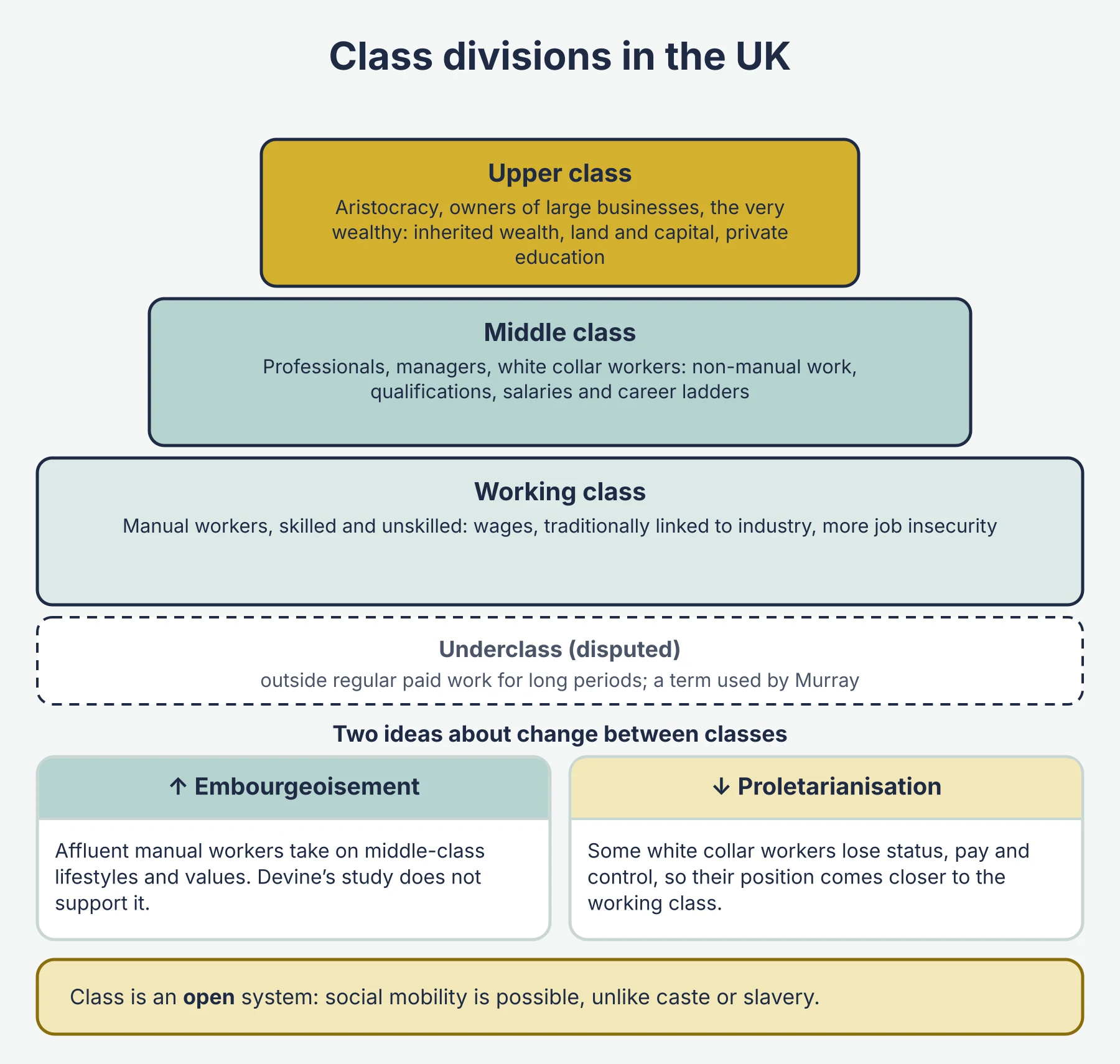
Class divisions in brief
- Upper class: the aristocracy and the very wealthy; wealth often inherited; ownership of land and capital.
- Middle class: professionals, managers and white collar workers; non-manual work; qualifications and careers.
- Working class: manual workers; wages; more insecurity.
- Underclass: a disputed term (Murray) for those outside regular work for long periods.
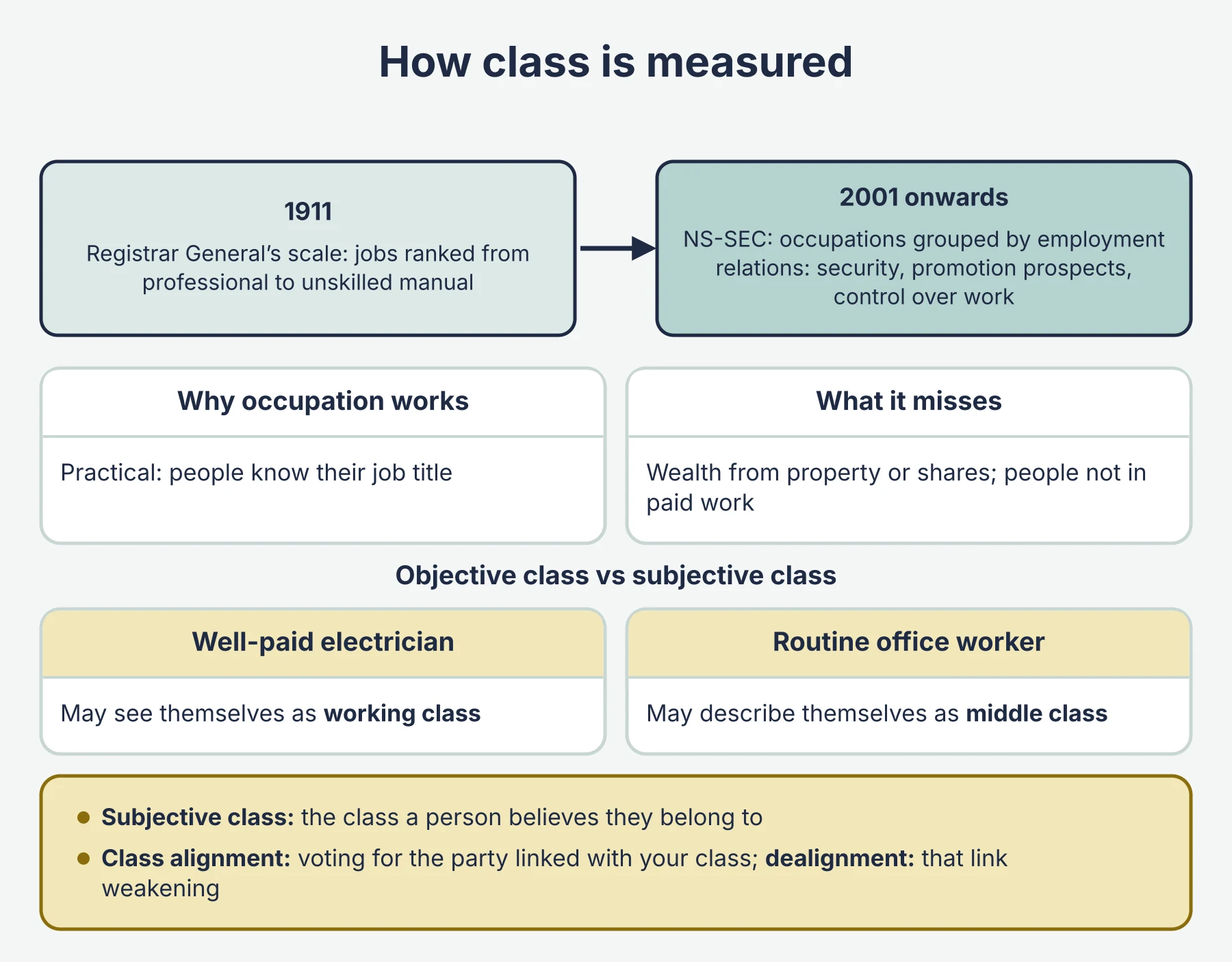
- Measurement: occupation-based scales. The Registrar General’s scale was used from 1911; the NS-SEC has been used in official statistics since 2001.
- Subjective class: the class people think they belong to, which may differ from the official measure.
Key terms
| Term | Meaning |
|---|---|
| Socio-economic class | Grouping by shared economic position: occupation, income and wealth |
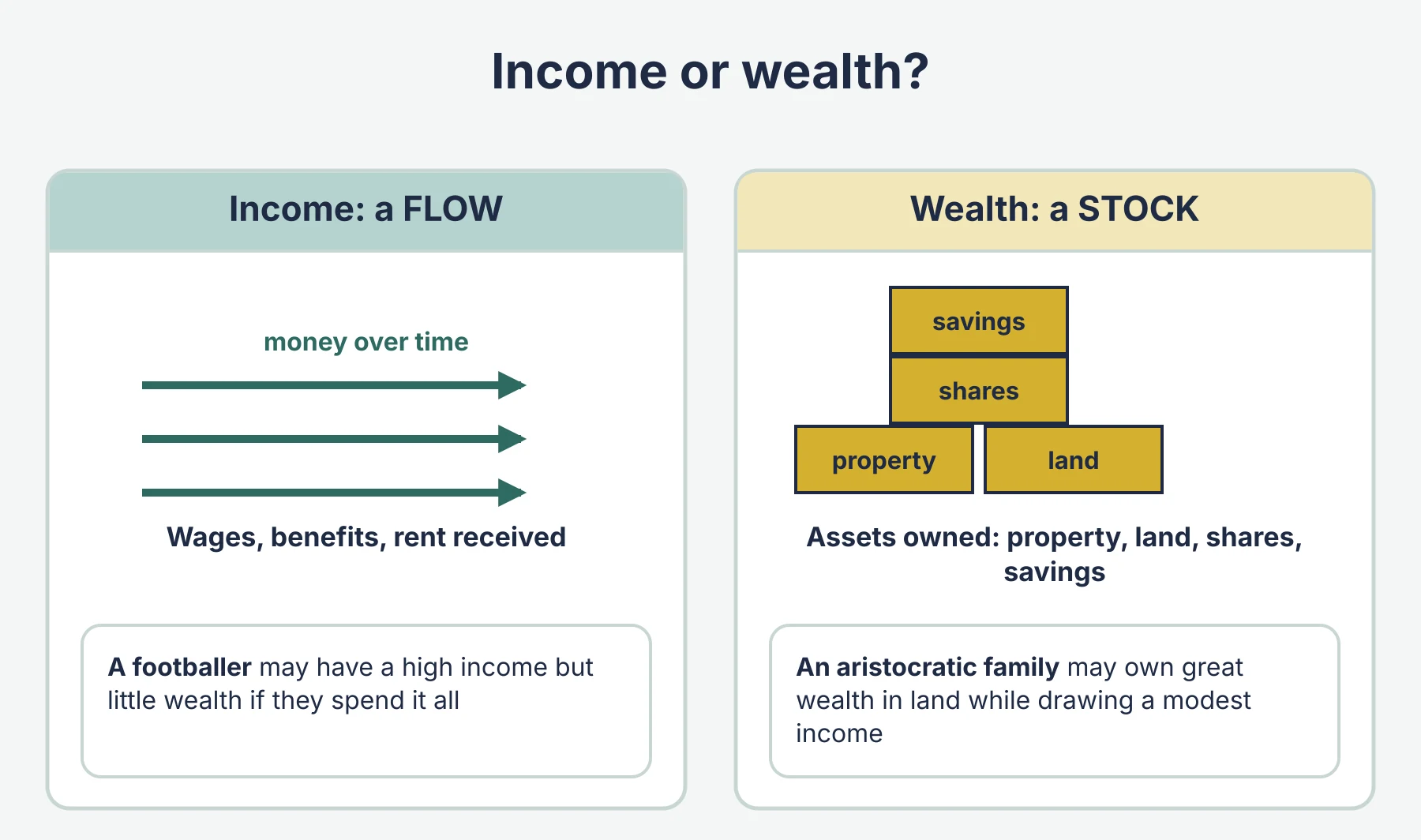
| Income / wealth | A flow of money over time / a stock of assets owned |
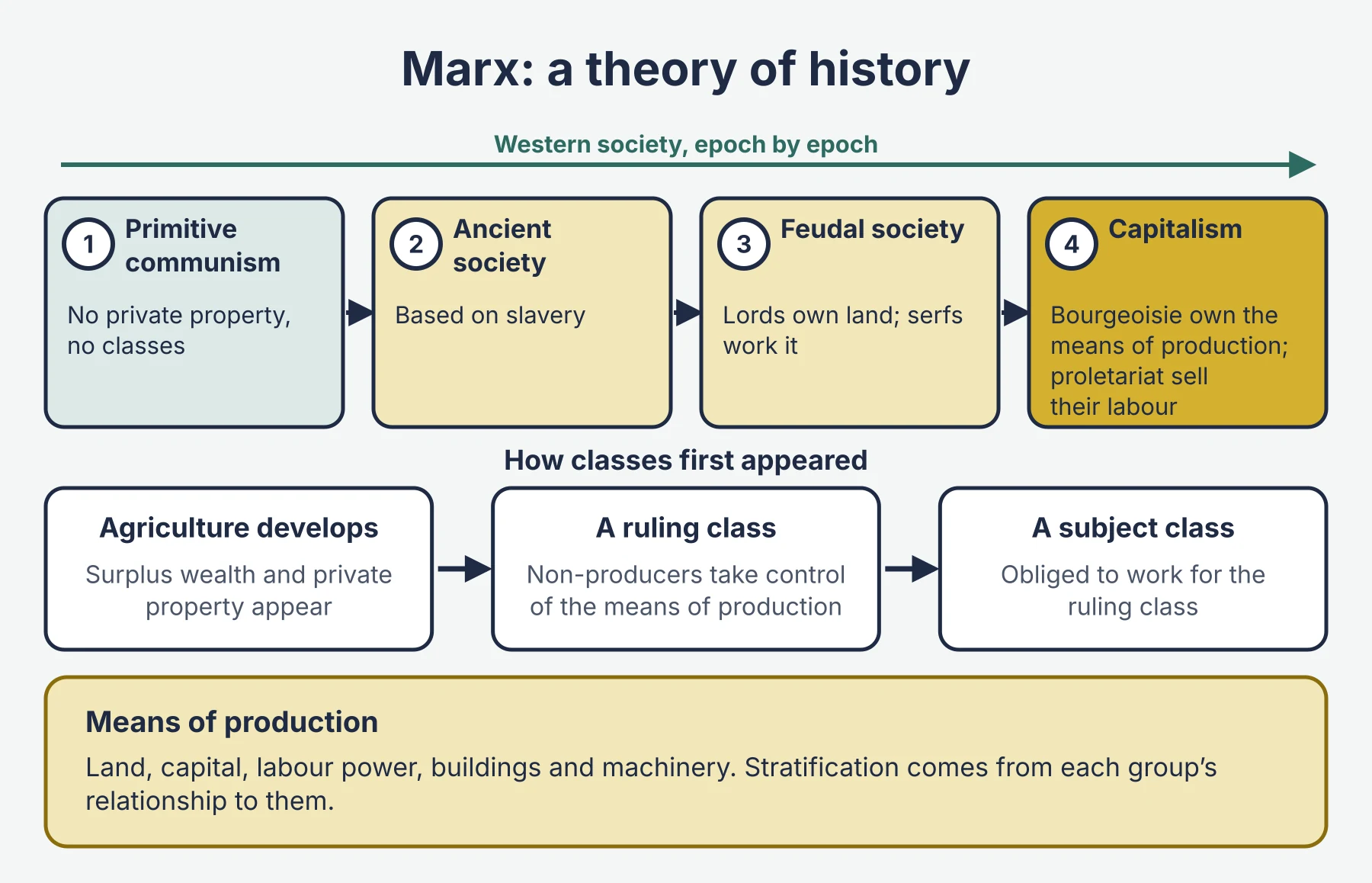
| Means of production | Land, capital, labour power, buildings and machinery |
| Bourgeoisie | The class that owns the means of production |
| Proletariat | The class that owns only its labour power |
| Petty bourgeoisie | Owners of small businesses |
| Lumpenproletariat | People at the very bottom, outside regular work |
| Surplus wealth | Wealth beyond what is needed to survive, allowing a ruling class to emerge |
| Ruling class ideology | Ideas, such as “the free market”, that present capitalism as normal and natural |
| False class consciousness | Workers accepting a system that exploits them |
| Polarisation | The gap between the two main classes growing wider |
| Market situation | Weber: a person’s position in the market for skills and pay |
| Status | Weber: prestige or esteem, separate from class |
| Party | Weber: groups seeking power, including pressure and interest groups |
| Social closure | Excluding outsiders from a status group, as in the caste system |
| Embourgeoisement / proletarianisation | Workers becoming middle class / white collar workers losing status |
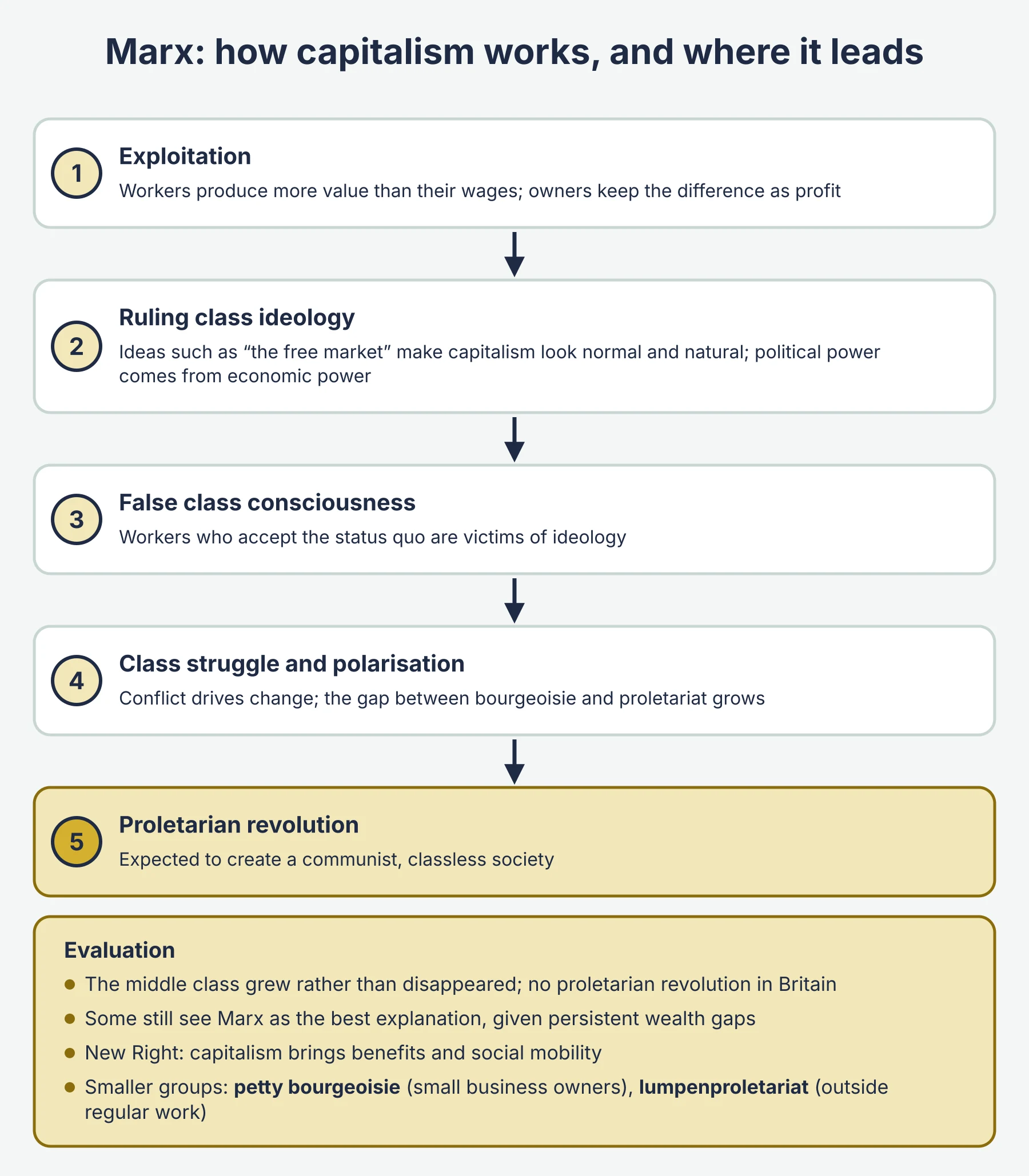
Marx in eight points
- Classes arise from groups’ relationship to the means of production.
- Four epochs: primitive communism, ancient society, feudal society, capitalism.
- Surplus wealth and private property let a ruling class gain control and oblige a subject class to work for it.
- Political power comes from economic power.
- Ruling class ideology creates false class consciousness.
- Class struggle is the driving force of social change.
- Capitalism is unstable because of the conflict of interest at its heart.
- Polarisation would lead to proletarian revolution and a communist society.
Weber in eight points
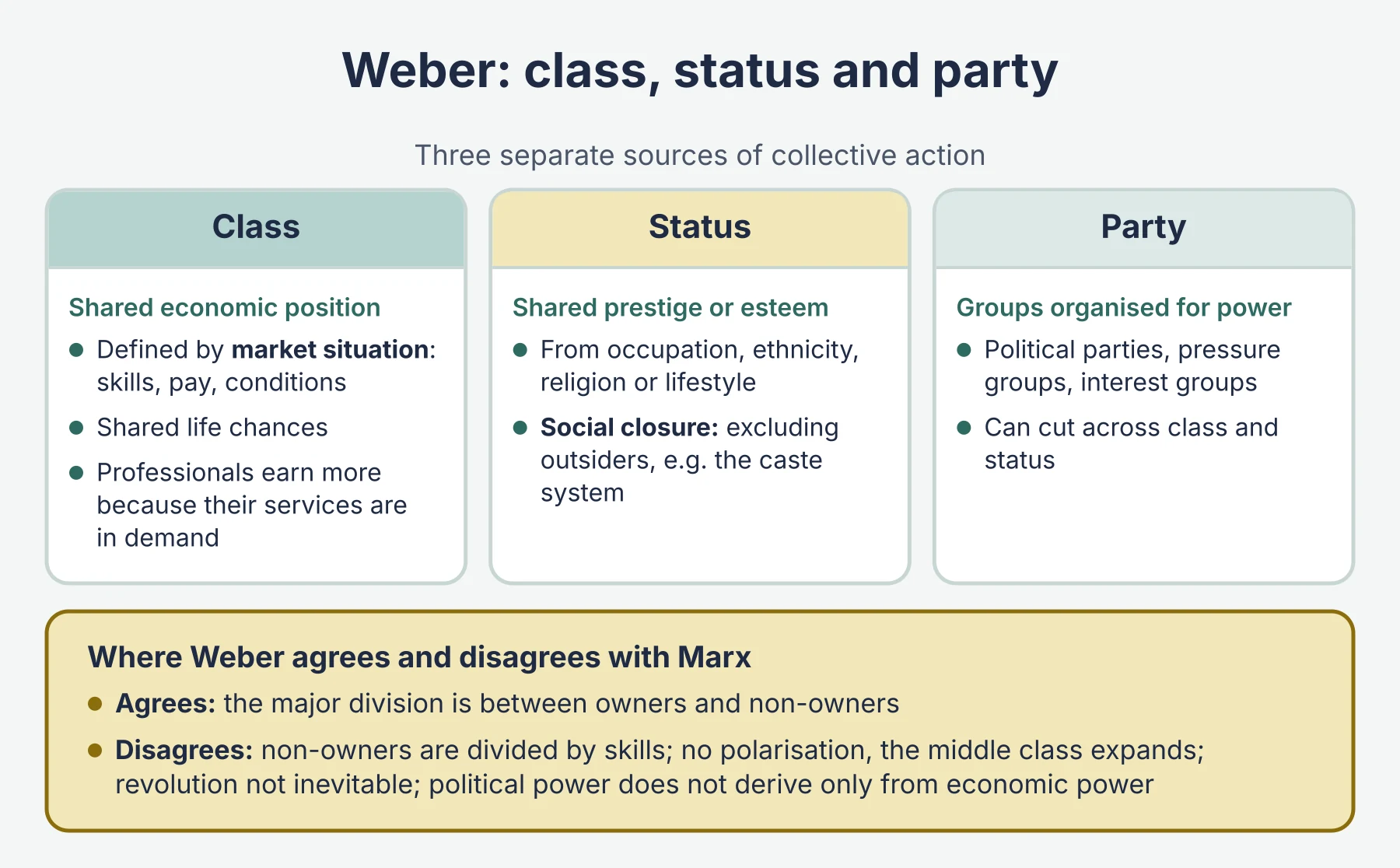
- Classes develop in market economies where individuals compete for gain.
- Class = shared market situation; shared class situation = shared life chances.
- Main division is owners versus non-owners, as Marx said.
- Non-owners are divided: professionals earn more because their services are in demand.
- No polarisation: the middle class expands.
- Revolution is not inevitable; political power does not derive only from economic power.
- Status (prestige) and party (power-seeking groups) are separate from class.
- Social closure lets status groups exclude others.
Marx versus Weber
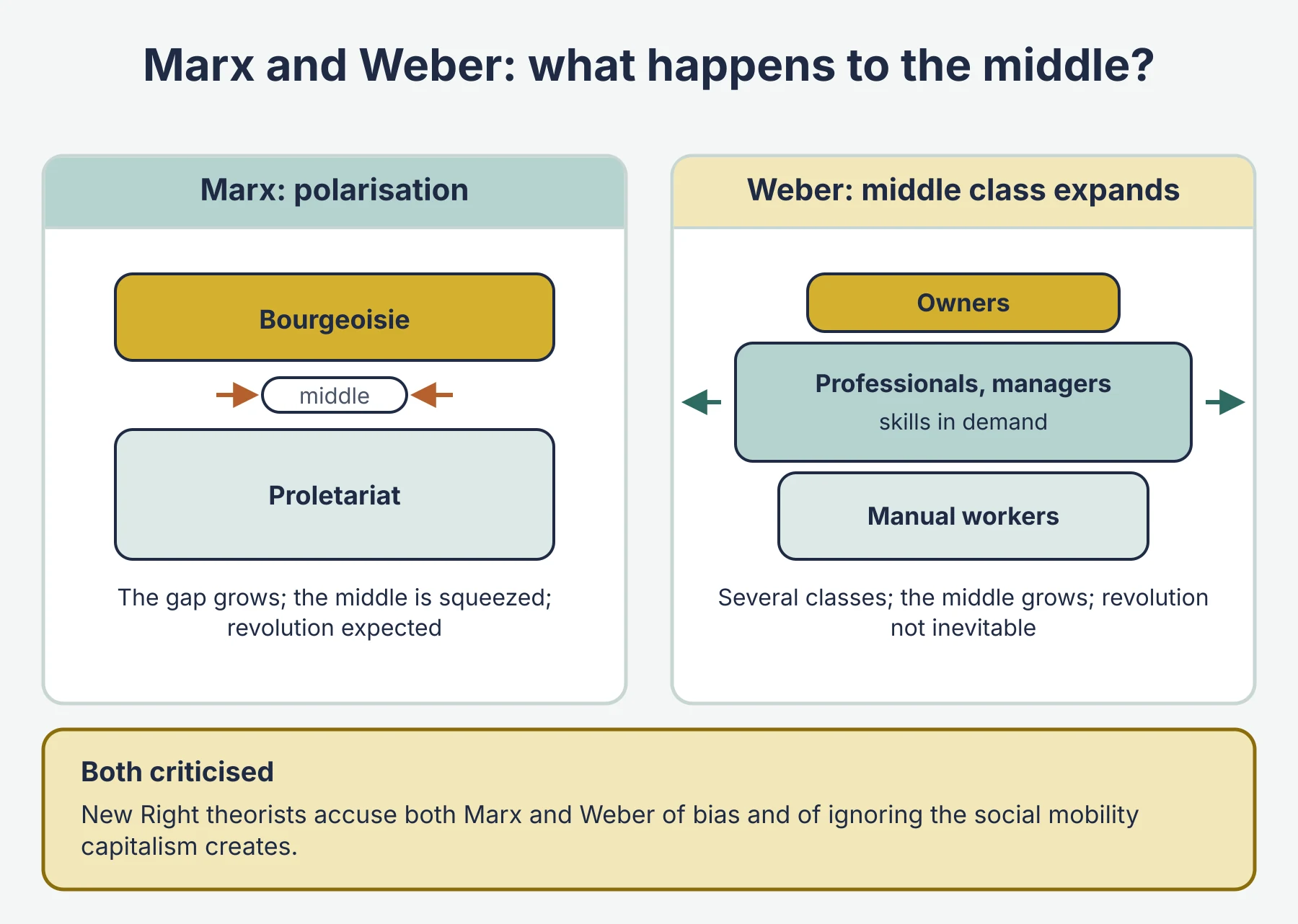
| Marx | Weber | |
|---|---|---|
| Class based on | Ownership | Market situation |
| Middle class | Shrinks | Grows |
| Revolution | Expected | Not inevitable |
| Other inequalities | Follow from economics | Status and party are separate |
Shared criticism: New Right theorists accuse both of bias and of ignoring the social mobility and opportunity capitalism creates.
Perspectives
- Functionalist: class reflects talent and the importance of jobs; mobility shows the system is open.
- Marxist: class is about exploitation by owners; inequality is built into capitalism.
- Feminist: class schemes placed women by husbands’ or fathers’ jobs; unpaid domestic labour was ignored; Marxist feminists say it benefits capitalism.
Exam traps
- Trap: “Weber completely disagreed with Marx.” Fix: both saw ownership versus non-ownership as the main divide.
- Trap: using status and class as synonyms. Fix: class is economic, status is prestige.
- Trap: income and wealth used interchangeably. Fix: flow versus stock.
- Trap: describing Marx’s view of today. Fix: Marx wrote in nineteenth-century Britain; apply carefully and evaluate.
- Trap: missing the feminist view. Fix: the specification names functionalist, feminist and Marxist perspectives for class.
Quick self-test
- What is the difference between income and wealth?
- Name Marx’s four epochs in order.
- What allowed a ruling class to emerge, according to Marx?
- What did Marx mean by polarisation?
- Give an example of ruling class ideology named in the specification.
- How did Weber define a class?
- Why did Weber think professionals earn more than other non-owners?
- What are Weber’s three dimensions of inequality?
- What is social closure? Give an example.
- Give one feminist criticism of traditional class analysis.
- Which group criticises both Marx and Weber for ignoring social mobility?
- What is subjective class?
Answers
- Income is a flow of money over time; wealth is a stock of assets owned.
- Primitive communism, ancient society, feudal society, capitalism.
- The development of agriculture produced surplus wealth and private property, so non-producers could control the means of production.
- The gap between bourgeoisie and proletariat becoming greater and more extreme.
- The idea of “the free market”.
- A group of individuals who share a similar market situation.
- Because their services are in demand.
- Class, status and party.
- Excluding outsiders from membership of a status group; the caste system.
- Women were classed by their husband’s or father’s job, or unpaid domestic labour was ignored.
- New Right theorists.
- The class a person believes they belong to.
Specification reference
AQA GCSE Sociology (8192), section 3.6.2 Socio-economic class; Appendix B (7.4) summaries of Marx and Weber; Appendix A (6.4) key terms.
Related resources
-
Study guides
AQA GCSE Sociology (8192): Functionalist theory of stratification
In-depth AQA GCSE Sociology 8192 guide to 3.6.1: Davis and Moore, effective role allocation, Tumin's critique, and feminist and Marxist responses.
Sociology · AQA · GCSE
Read guide -
Practice questions
AQA GCSE Sociology (8192): Functionalist theory of stratification – Practice Questions
Original AQA GCSE Sociology 8192 practice on Davis and Moore and functionalist stratification, with item-based questions and mark-scheme style answers.
Sociology · AQA · GCSE
Try questions -
Revision notes
AQA GCSE Sociology (8192): Functionalist theory of stratification – Revision Notes
Condensed AQA GCSE Sociology 8192 notes on 3.6.1: Davis and Moore's argument chain, criticisms, Marxist and feminist views, key terms and a self-test.
Sociology · AQA · GCSE
Revise topic
Related articles
Get free revision emails (optional)
Occasional emails with practice questions, worked explanations and links to free resources for the qualification and subjects you choose. No spam, and you can unsubscribe from any email. The free tools on this site never need an email.