
Study Guides
AQA GCSE Sociology (8192): Socio-economic class
Detailed AQA GCSE Sociology 8192 guide to 3.6.2 socio-economic class: class divisions, Marx's and Weber's key ideas, and functionalist and feminist views.
- Subject
- Sociology
- Level
- GCSE
- Topic
- Social stratification
- Author
- Marlbridge Academic Team
- Updated
- Reviewed by
- Naqiya Yousaf (what this means)
Aligned to AQA GCSE Sociology (8192), first teaching 2017. Official specification .
Syllabus page (what it covers and how it is assessed): AQA GCSE Sociology.
Syllabus points this page covers
8192
- 3.6.2 Socio-economic class
Found an error? Report a correction.
Need help with this topic? Request a free trial class for GCSE Sociology (8192).
This guide covers AQA GCSE Sociology (8192) section 3.6.2 Socio-economic class, assessed in Paper 2: The sociology of crime and deviance and social stratification. The specification asks you to “identify, describe and explain socio-economic class divisions in society”, to compare functionalist, feminist and Marxist perspectives on class, and to describe the key ideas of Marx and of Weber.
The Social stratification study guide gives a one-page overview of class. This guide adds depth: how class divisions are identified, the detail of Marx’s theory of history, Weber’s three dimensions of inequality, and how to compare the two. Revise with the socio-economic class revision notes and test yourself with the socio-economic class practice questions.
What “socio-economic class” means
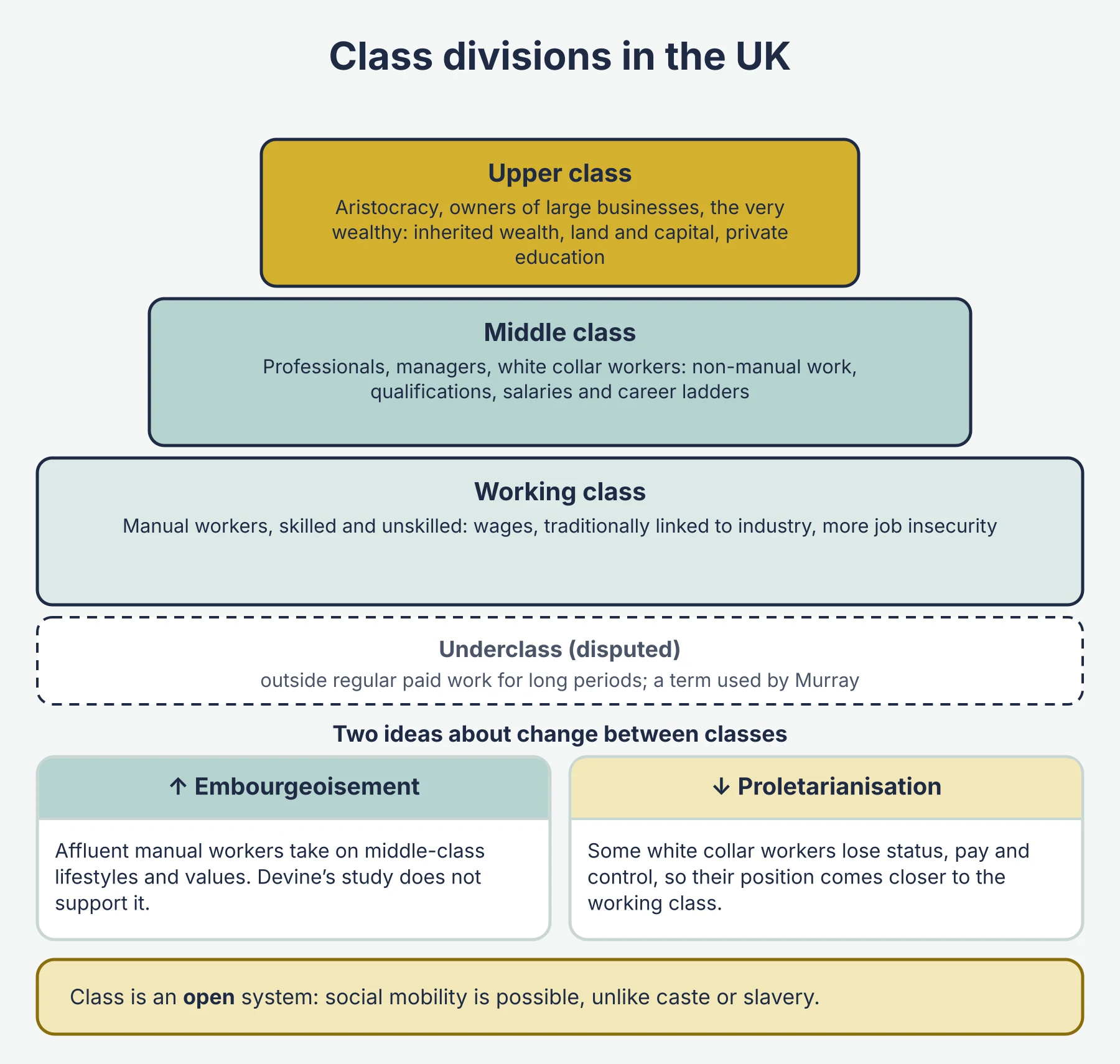
Socio-economic class groups people who share a similar economic position, usually judged by occupation, income and wealth. Unlike caste or slavery, class is in principle an open system: people can move between classes through social mobility. Class is also linked to lifestyle, values and life chances, which is why sociologists treat it as more than just money.
Two economic terms are often confused:
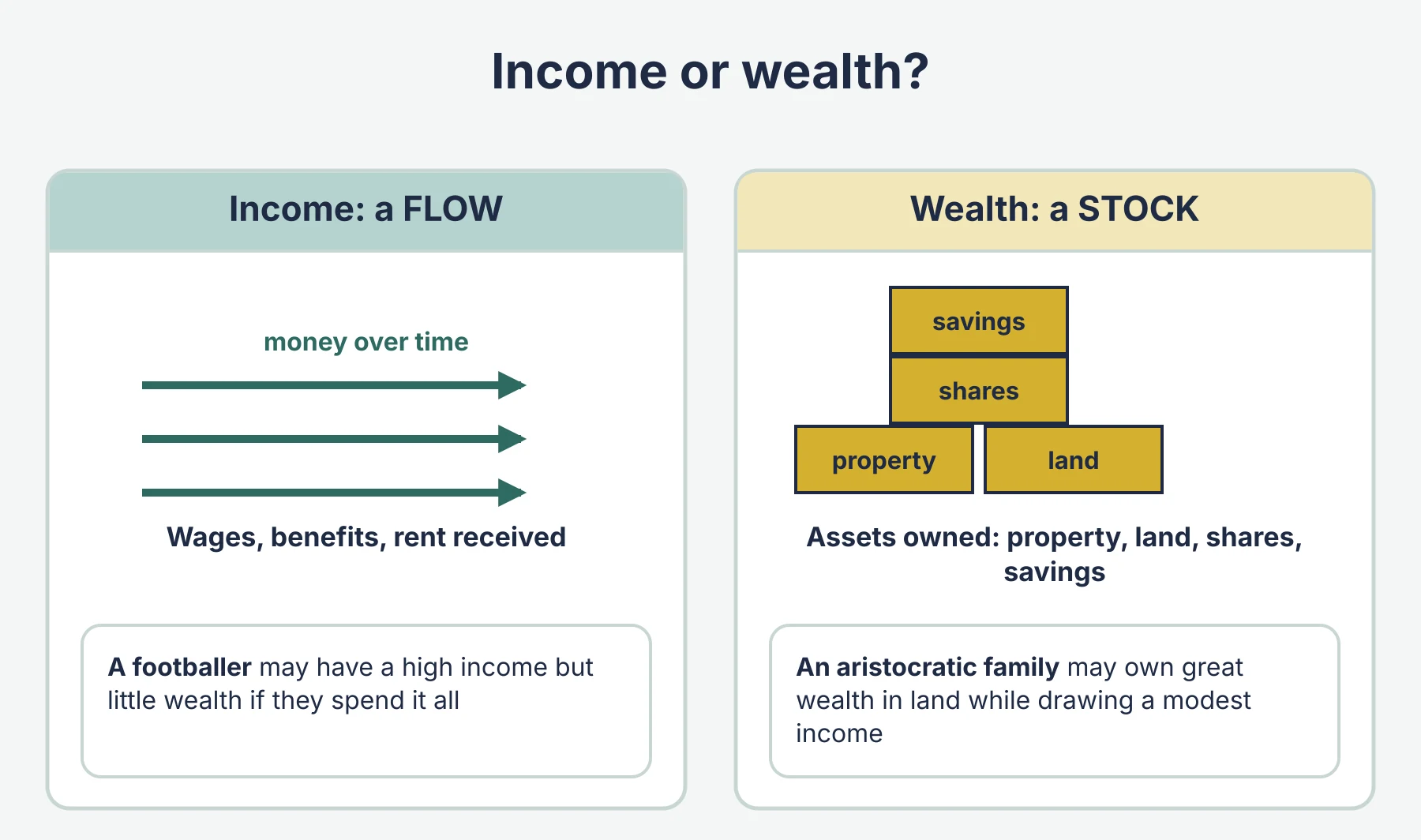
- Income is a flow of money over time, such as wages, benefits or rent received.
- Wealth is a stock of assets owned, such as property, land, shares and savings.
A footballer may have a high income but little wealth if they spend it all; an aristocratic family may own great wealth in land while drawing a modest income.
Identifying class divisions in the UK
Sociologists usually describe three broad classes, with a possible fourth group below them.
| Class | Typical members | Key features |
|---|---|---|
| Upper class | The aristocracy, owners of large businesses, the very wealthy | Wealth often inherited; ownership of land and capital; private education |
| Middle class | Professionals, managers, white collar workers | Non-manual work; qualifications; salaries and career ladders |
| Working class | Manual workers, skilled and unskilled | Paid wages; traditionally linked to industry; more job insecurity |
| Underclass (disputed) | People outside regular paid work for long periods | A term used by Murray; covered in the poverty sub-section |
How class is measured
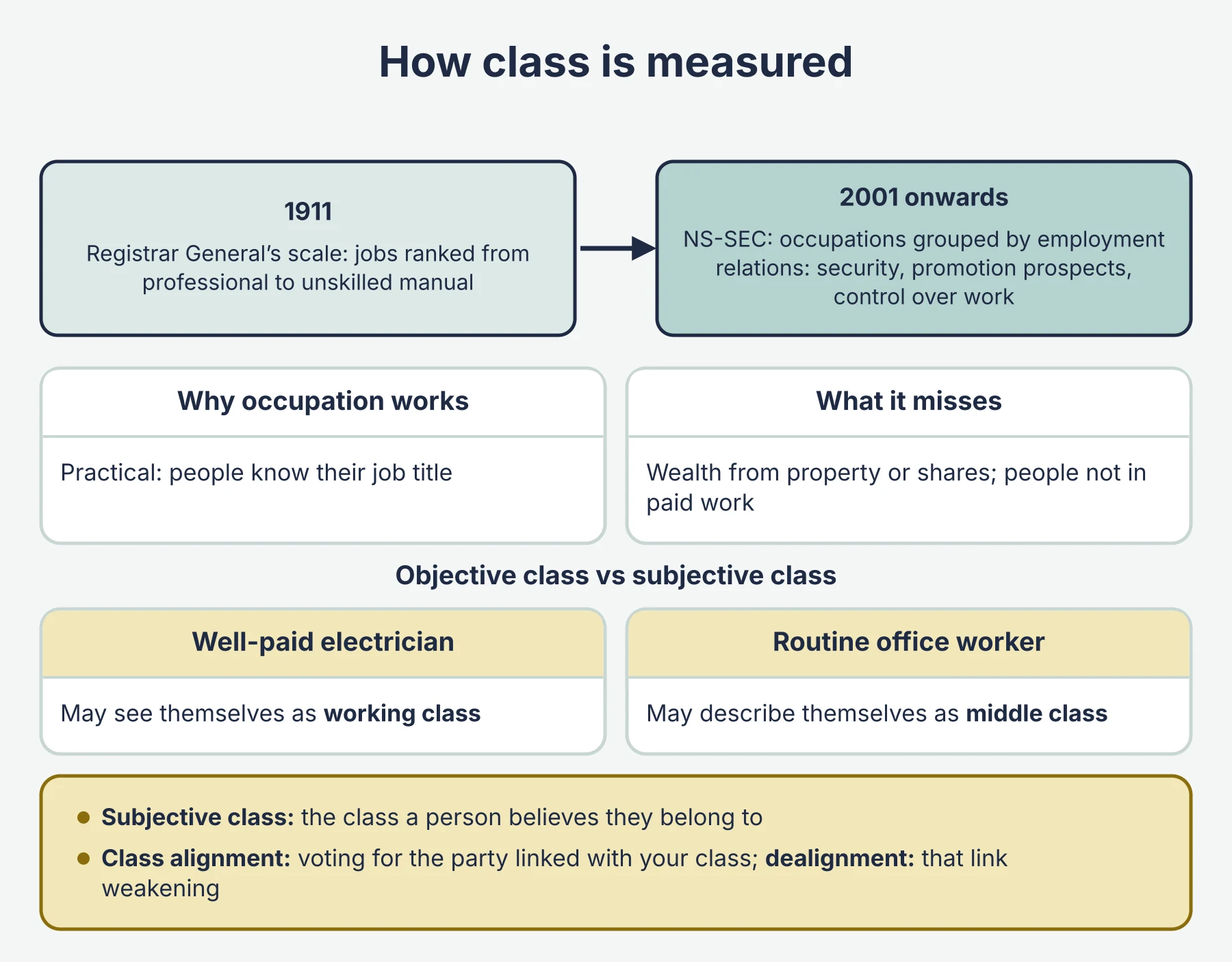
Official measures group people by occupation. From 1911 the Registrar General’s scale ranked jobs into classes from professional to unskilled manual. Since 2001 government statistics have used the National Statistics Socio-economic Classification (NS-SEC), which groups occupations by employment relations and conditions, such as job security, promotion prospects and control over work. Using occupation is practical, because people know their job title, but it misses wealth that comes from owning property or shares, and it struggles to place people who are not in paid work.
Subjective class
Subjective class is the class a person believes they belong to. It may differ from the objective measure: a well-paid electrician may see themselves as working class, while someone in a routine office job may describe themselves as middle class. Class alignment refers to people voting for the party linked with their class; class dealignment describes the weakening of that link.
Changes in class divisions
- Embourgeoisement: the idea that affluent manual workers take on middle-class lifestyles and values. Devine’s study, covered in the life chances sub-section, does not support it.
- Proletarianisation: the opposite idea, that some white collar workers have lost status, pay and control, so their position comes closer to the working class.
Marx on socio-economic class
The theory of history
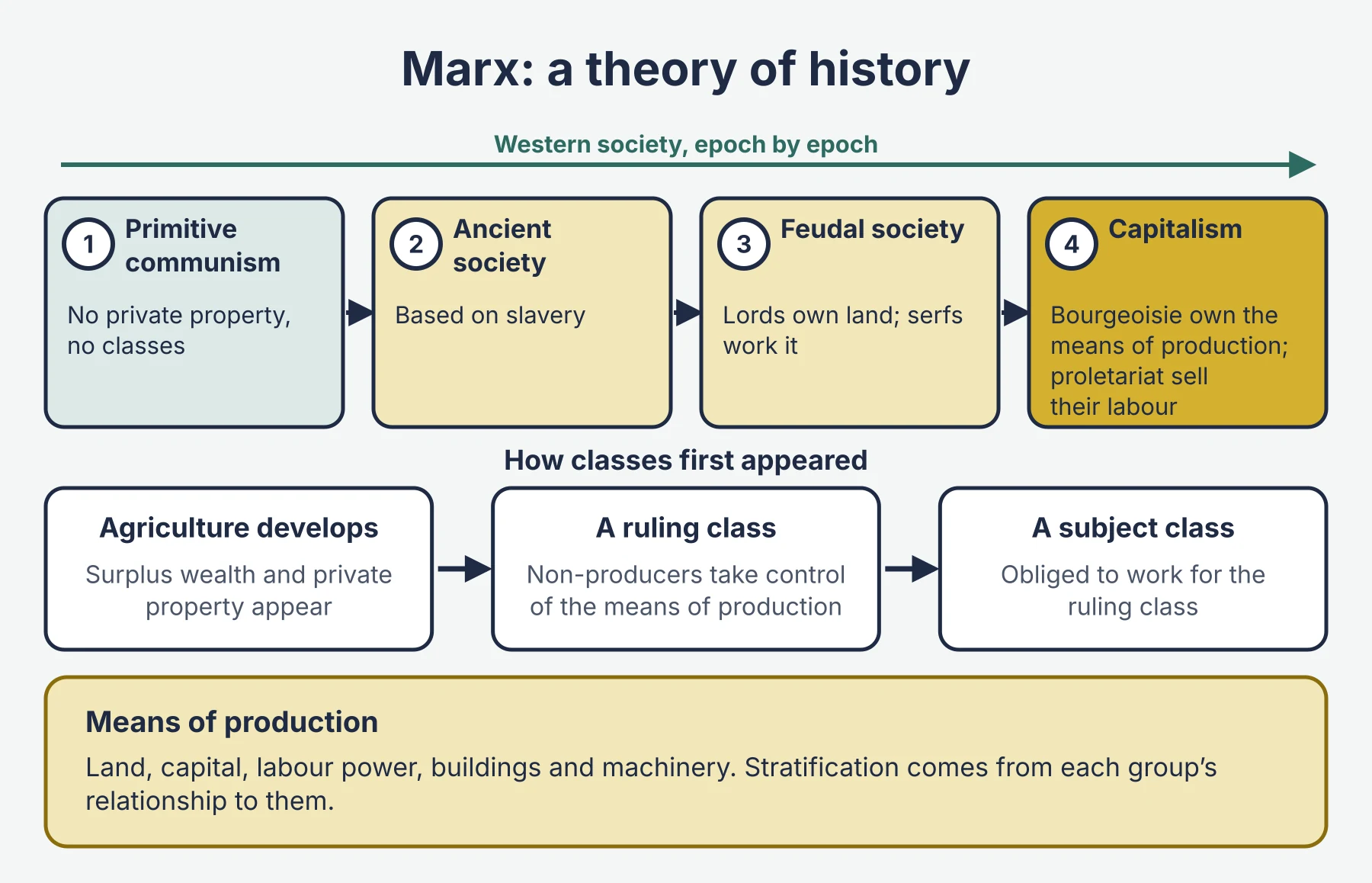
Marx argued that stratification arises from the relationship of social groups to the means of production: land, capital, labour power, buildings and machinery. He described Western society as developing through four main epochs:
- Primitive communism, with no private property and no classes.
- Ancient society, based on slavery.
- Feudal society, with lords who owned land and serfs who worked it.
- Capitalism, with the bourgeoisie who own the means of production and the proletariat who sell their labour.
As agriculture developed it produced surplus wealth and private property. This allowed a class of non-producers, a ruling class, to take control of the means of production and oblige a subject class to work for them.
Key ideas about capitalism
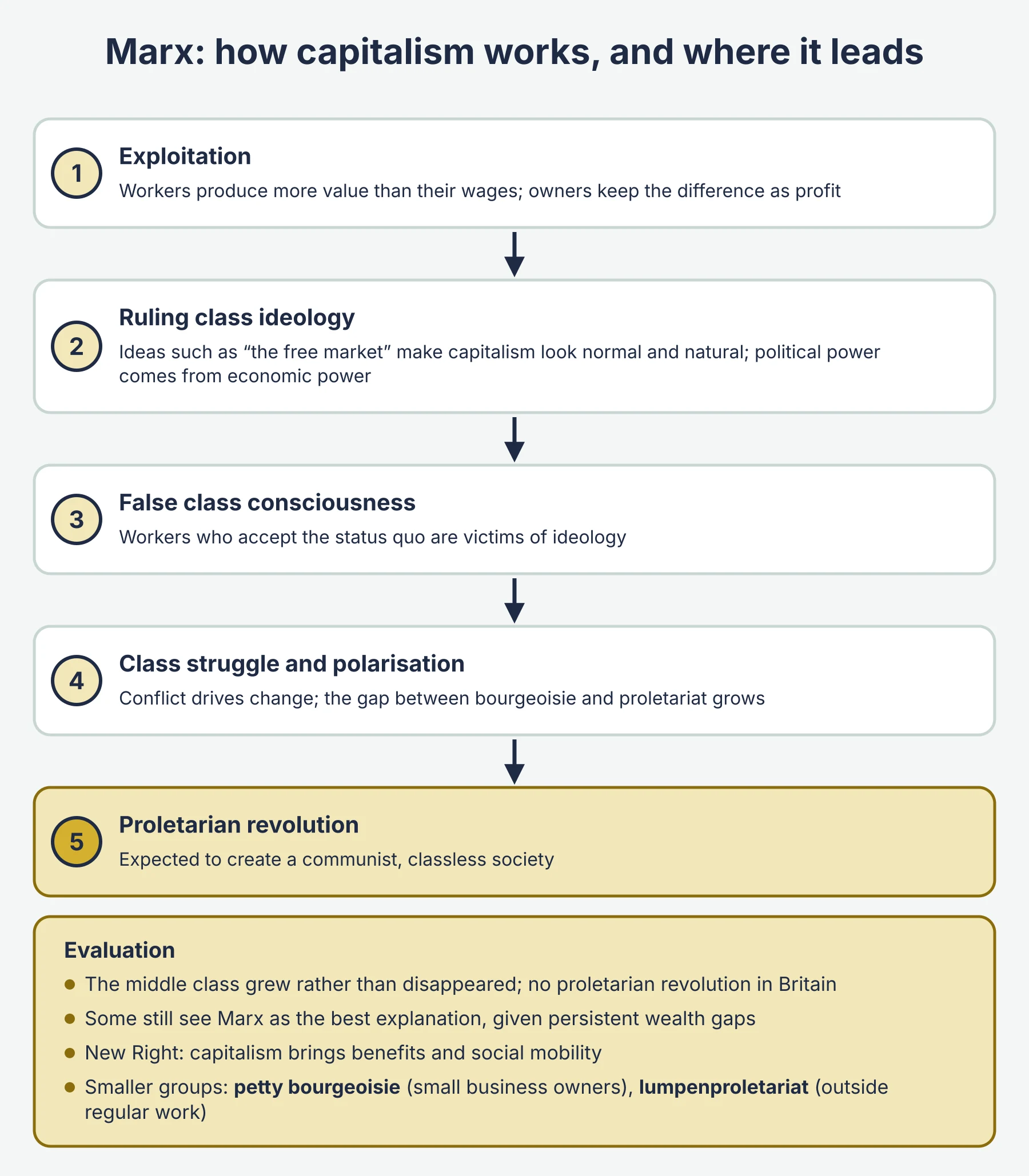
- Exploitation: workers produce more value than they are paid in wages; the owners keep the difference as profit.
- Political power comes from economic power: the ruling class’s power rests on ownership and control of the means of production.
- Ruling class ideology: ideas such as “the free market” distort reality and present capitalism as normal and natural.
- False class consciousness: members of the subject class who accept this status quo are victims of ideology.
- Class struggle: the conflict of interest between owners and workers drives social change.
- Polarisation: Marx expected the gap between bourgeoisie and proletariat to grow until a proletarian revolution created a communist, classless society.
Marx also named smaller groups: the petty bourgeoisie (owners of small businesses) and the lumpenproletariat (people at the very bottom, outside regular work).
Evaluation. Some sociologists believe Marx still gives the best explanation of capitalist society, pointing to persistent gaps in wealth. But the middle class grew rather than disappeared, and no proletarian revolution occurred in Britain. New Right theorists stress the benefits of capitalism and the opportunities for social mobility it creates.
Weber on socio-economic class
Weber, writing in the early twentieth century, gave a more complex picture.
- Classes develop in market economies in which individuals compete for economic gain.
- A class is a group sharing a similar market situation: their position in the market for skills, pay and conditions.
- People in the same class situation share similar life chances.
- Like Marx, Weber saw the major division as between those who own the forces of production and those who do not.
- But he saw important differences among non-owners. Professionals receive higher salaries because their services are in demand.
- He saw no evidence of polarisation: the middle class expands as capitalism develops.
- He rejected the views that a proletarian revolution was inevitable and that political power derives only from economic power.
Class, status and party
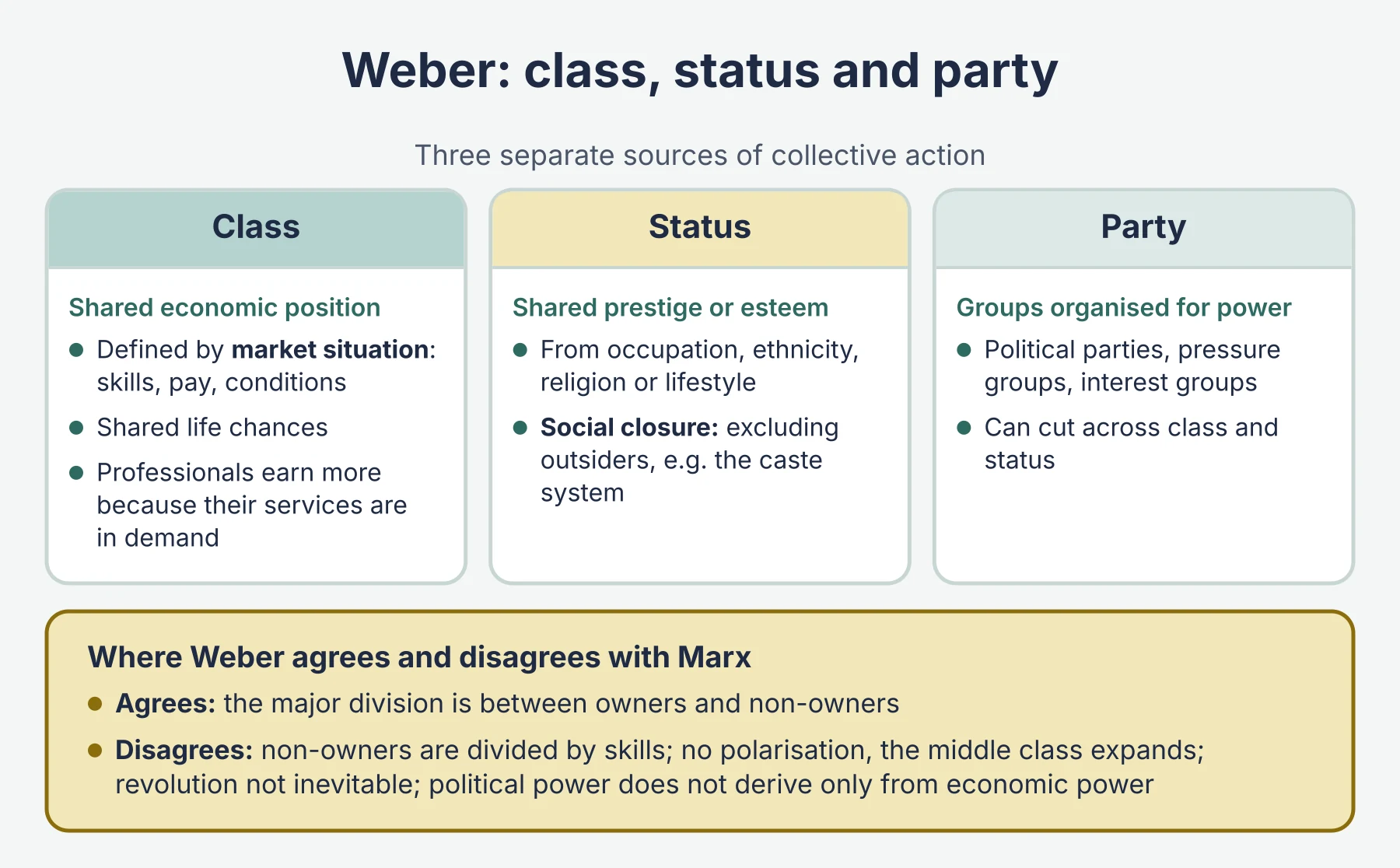
Weber argued that collective action could come from three sources, not only class:
- Class: shared economic position.
- Status: shared prestige or esteem, which may come from occupation, ethnicity, religion or lifestyle. Social closure is the process by which a status group excludes outsiders; the caste system is an example.
- Party: groups organised to gain political or social power, including pressure groups and interest groups as well as political parties. Party membership can cut across class and status groups.
Comparing Marx and Weber
| Issue | Marx | Weber |
|---|---|---|
| Basis of class | Relationship to the means of production | Market situation |
| Number of classes | Two main classes, plus smaller groups | Several, as non-owners are divided by skills |
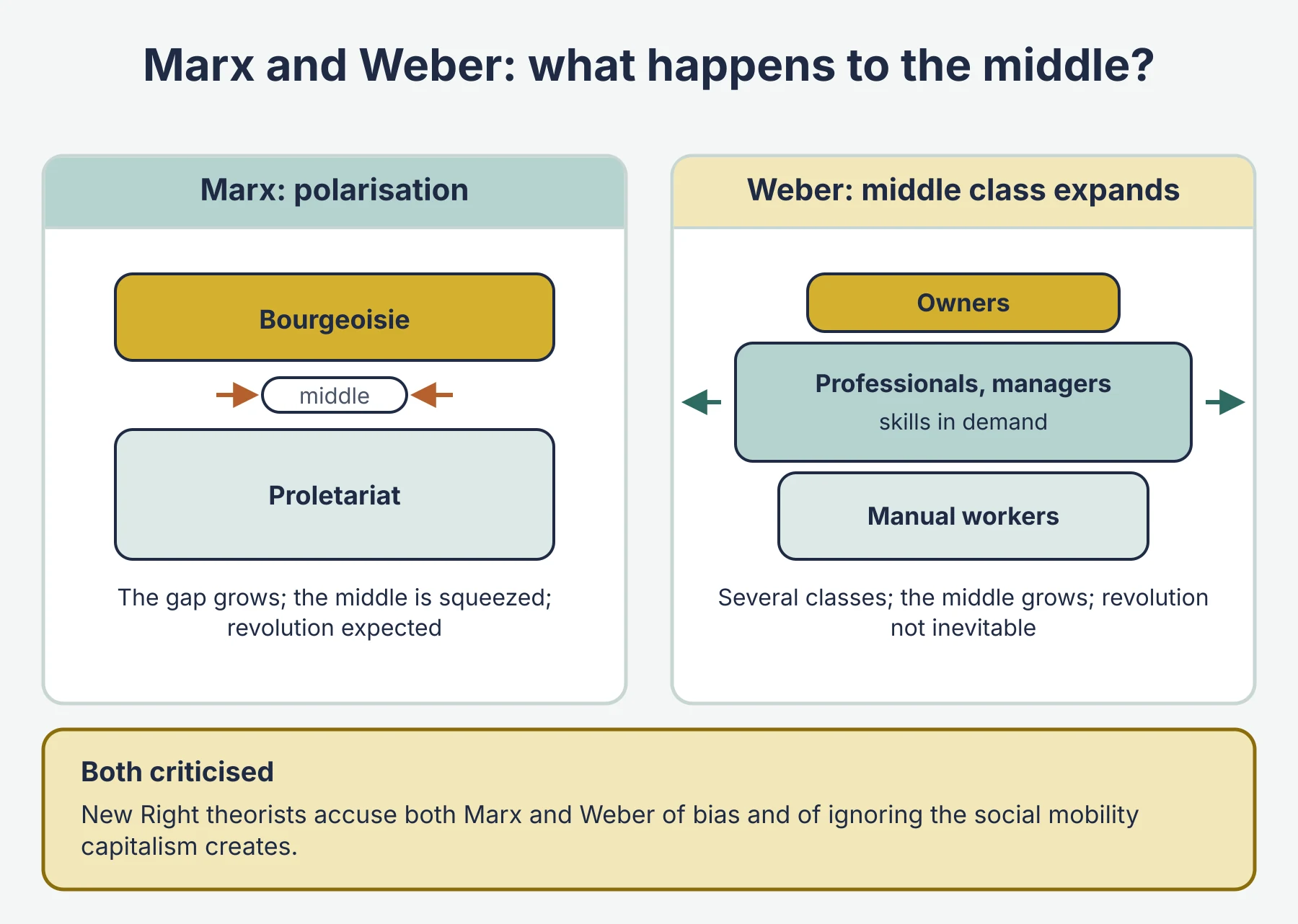
| Future of the middle class | Squeezed as society polarises | Expands as capitalism develops |
| Revolution | Expected and hoped for | Not inevitable |
| Other inequalities | Follow from economic power | Status and party are separate dimensions |
Both have been criticised by New Right theorists, who accuse them of bias and of ignoring the social mobility capitalism creates.
Functionalist and feminist perspectives on class
Functionalists see class differences as the outcome of a broadly meritocratic system. Davis and Moore’s theory implies that classes reflect differences in the functional importance of jobs and the talent of those who fill them. Social mobility shows the system is open.
Feminists argue that traditional class analysis was written about men. Class measures often placed a woman according to her husband’s or father’s occupation, hiding her own job, pay and position. Women’s unpaid domestic labour was left out of class analysis altogether. Marxist feminists add that this unpaid work benefits capitalism, because it reproduces and cares for the workforce at no cost to employers.
Worked example: an “identify and explain” answer
Identify and explain one difference between Marx’s and Weber’s views of class.
One difference is how they define class. Marx defined class by a group’s relationship to the means of production, so there are owners and non-owners. Weber defined class by market situation, so non-owners are split into different classes; a doctor and a cleaner both lack ownership, but the doctor’s scarce skills bring a much higher salary and better life chances.
The answer identifies the difference, explains both sides and gives an example that shows why the difference matters.
Common mistakes
- Saying Weber disagreed with Marx about everything. Both saw ownership as the major division.
- Using “status” to mean class. For Weber, status is prestige, a separate dimension.
- Confusing income with wealth.
- Describing the lumpenproletariat as the working class.
- Forgetting feminist and functionalist views: the specification names all three perspectives.
Exam technique
- Identify class divisions by naming them accurately, with a typical occupation.
- Describe Marx or Weber using their key terms, not general phrases like “rich and poor”.
- Explain by giving a reason or consequence, such as why Weber expected the middle class to grow.
- In discuss how far answers on class, set Marx against Weber, add functionalist and feminist views, and decide which explanation fits the UK today best, with reasons.
Frequently asked questions
What is the difference between class and status? Class is an economic position. Status, for Weber, is prestige or esteem, which can come from occupation, ethnicity, religion or lifestyle.
Why did Weber think the middle class would grow? Because capitalism creates demand for professional, technical and administrative skills, so more people hold non-owning but well-paid positions.
What is false class consciousness? Marx’s term for workers who accept ruling class ideology and see capitalism as normal and natural, against their own interests.
Specification reference
AQA GCSE Sociology (8192), section 3.6.2 Socio-economic class, with the Marx and Weber summaries in Appendix B (7.4) and the social stratification key terms in Appendix A (6.4).
Related resources
-
Practice questions
AQA GCSE Sociology (8192): Socio-economic class – Practice Questions
Original AQA GCSE Sociology 8192 questions on socio-economic class, Marx and Weber, with item-based tasks, extended answers and mark-scheme style guidance.
Sociology · AQA · GCSE
Try questions -
Revision notes
AQA GCSE Sociology (8192): Socio-economic class – Revision Notes
AQA GCSE Sociology 8192 revision notes on 3.6.2 socio-economic class: class divisions, Marx versus Weber, perspectives, key terms, exam traps and a self-test.
Sociology · AQA · GCSE
Revise topic -
Study guides
AQA GCSE Sociology (8192): Functionalist theory of stratification
In-depth AQA GCSE Sociology 8192 guide to 3.6.1: Davis and Moore, effective role allocation, Tumin's critique, and feminist and Marxist responses.
Sociology · AQA · GCSE
Read guide
Related articles
Get free revision emails (optional)
Occasional emails with practice questions, worked explanations and links to free resources for the qualification and subjects you choose. No spam, and you can unsubscribe from any email. The free tools on this site never need an email.