
Study Guides
AQA GCSE Sociology (8192): Functionalist theory of stratification
In-depth AQA GCSE Sociology 8192 guide to 3.6.1: Davis and Moore, effective role allocation, Tumin's critique, and feminist and Marxist responses.
- Subject
- Sociology
- Level
- GCSE
- Topic
- Social stratification
- Author
- Marlbridge Academic Team
- Updated
- Reviewed by
- Naqiya Yousaf (what this means)
Aligned to AQA GCSE Sociology (8192), first teaching 2017. Official specification .
Syllabus page (what it covers and how it is assessed): AQA GCSE Sociology.
Syllabus points this page covers
8192
- 3.6.1 Functionalist theory of stratification
Found an error? Report a correction.
Need help with this topic? Request a free trial class for GCSE Sociology (8192).
This guide goes deep on one sub-section of the AQA GCSE Sociology (8192) specification: 3.6.1 Functionalist theory of stratification. It is assessed in Paper 2: The sociology of crime and deviance and social stratification. The specification asks you to “describe and explain the functionalist theory of stratification (effective role allocation and performance linked to the promise of rewards)”, to describe the key ideas of Davis and Moore, and to “describe, compare and contrast” feminist and Marxist views of the theory.
For a summary of the whole topic, start with the Social stratification study guide. To revise this sub-section, use the functionalist theory of stratification revision notes, then test yourself with the functionalist theory of stratification practice questions.
What functionalism is trying to explain
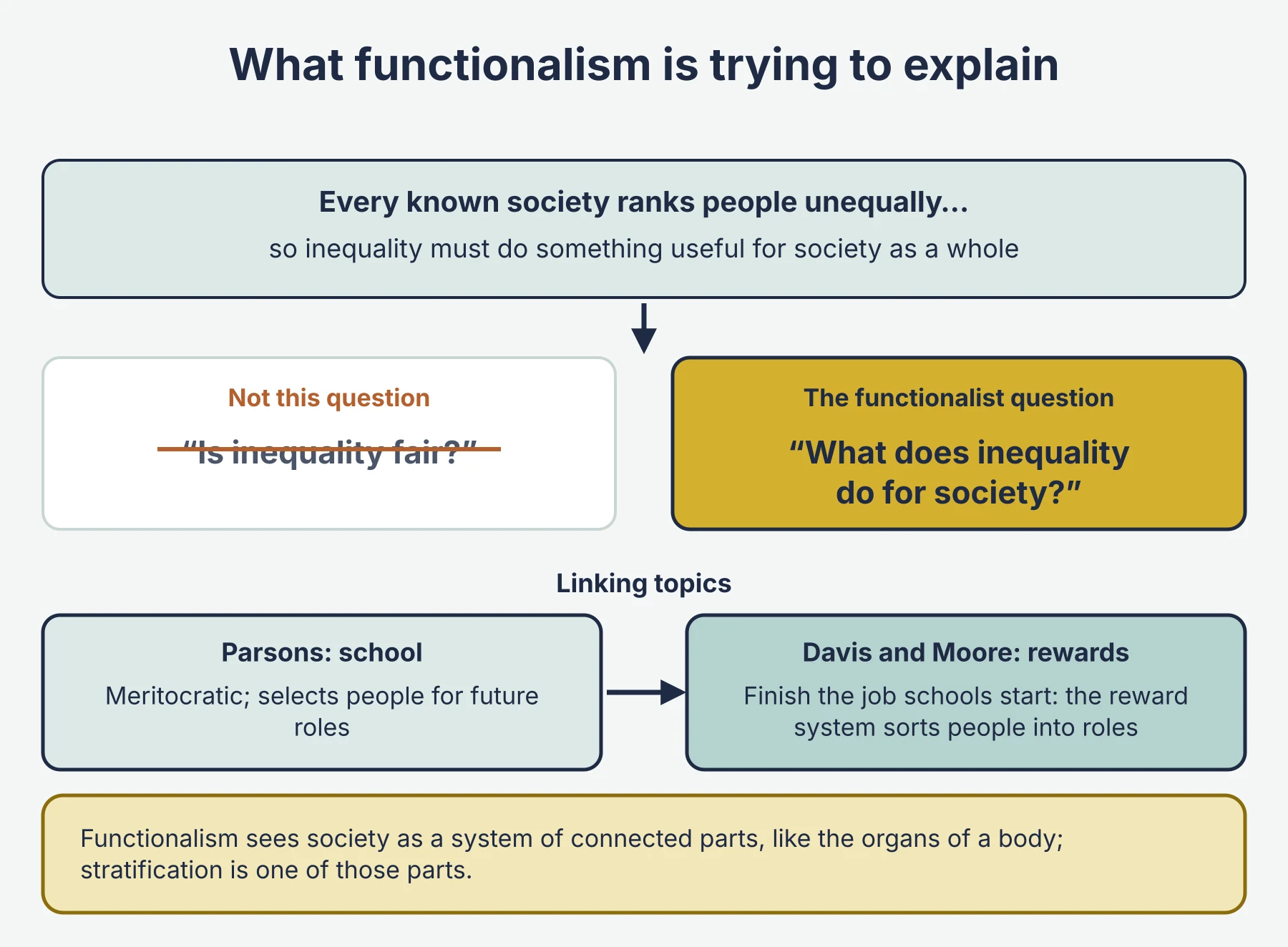
Every known society ranks people unequally. Functionalists start from a puzzle: if inequality is found everywhere, it must do something useful for society as a whole. Functionalism sees society as a system of connected parts, like the organs of a body, each contributing to the survival of the whole. Stratification is treated as one of those parts. The question is not “is inequality fair?” but “what does inequality do for society?”
This links to ideas you meet elsewhere in the course. In education, Parsons sees schools as meritocratic and as selecting people for future roles. Davis and Moore extend that logic to the whole of society: the reward system is the mechanism that finishes the job schools start.
Davis and Moore’s argument, step by step
Davis and Moore set out their theory in “Some principles of stratification” (1945). The specification’s summary describes stratification as, in their view, a “universal necessity” for every known human society. Their argument works as a chain.
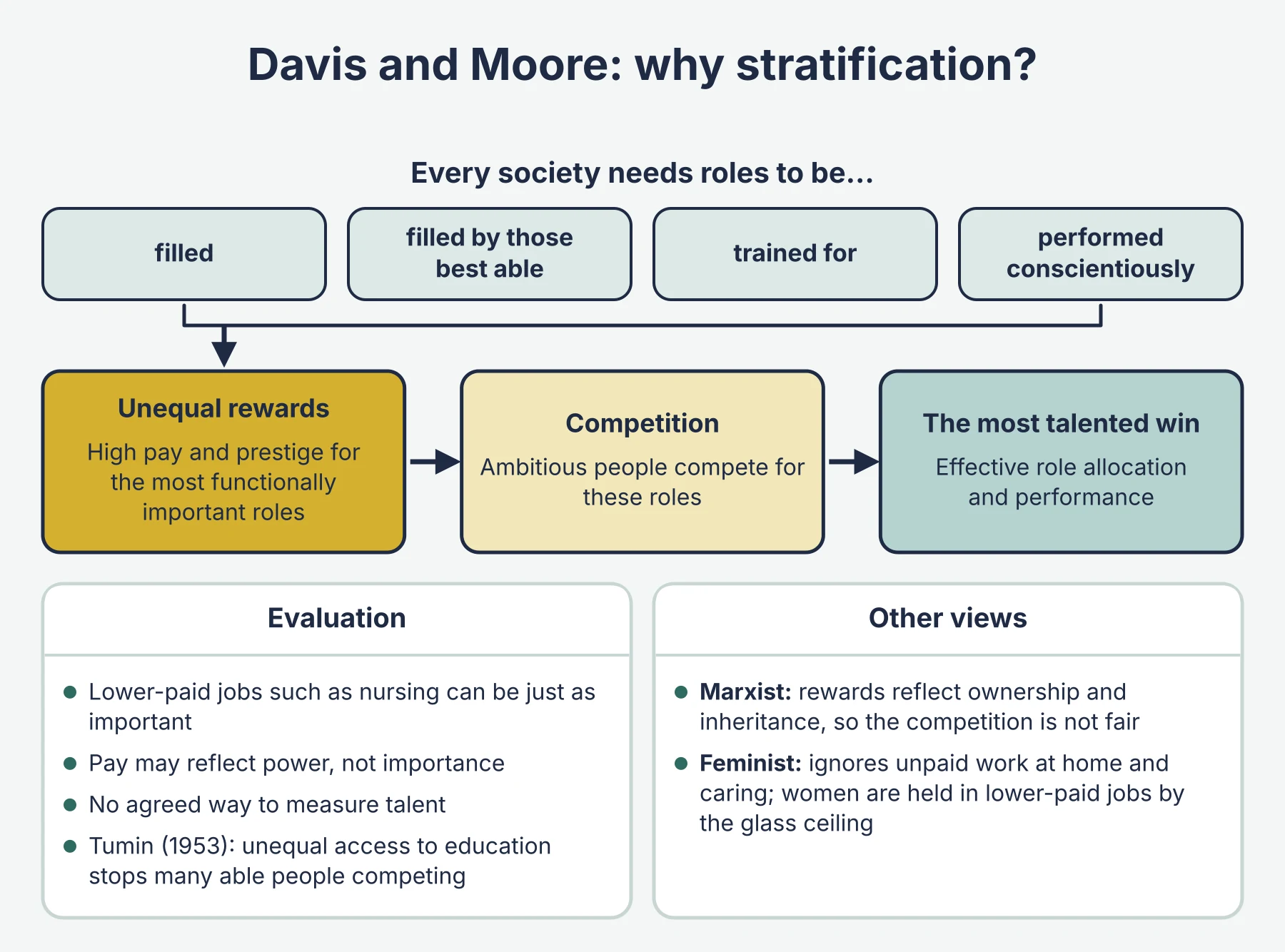
Step 1: four things must happen. For any society to survive and run efficiently:
- all roles must be filled;
- they must be filled by those best able to perform them;
- the necessary training must take place;
- roles must be performed conscientiously.
Step 2: roles are not equally important. Some positions are functionally important: they need the highest levels of skill, the greatest responsibility for directing and organising others, or both. A society suffers more if these positions are badly filled.
Step 3: talent is scarce. Only a limited number of people have the ability to do the most demanding roles, and the training is long and demanding.
Step 4: unequal rewards solve the problem. Society attaches high pay, prestige and privileges to the functionally important positions. People with ambition compete for them, and the most talented succeed. This is effective role allocation: the right people end up in the right roles.
Step 5: rewards keep people working hard. Once in post, the promise of continued rewards encourages people to perform conscientiously. This is the “performance” half of the specification’s phrase.
The result, for Davis and Moore, is that stratification is functional. It motivates, sorts and rewards. A society without it would struggle to fill its most demanding roles with the most able people.
Key terms to use precisely
- Social stratification: the division of society into layers that are unequal in wealth, income, status and power.
- Functionally important roles: positions that need rare skills or carry high responsibility.
- Meritocracy: a system in which rewards depend on ability and effort, not background.
- Achieved status: a position gained through effort and talent, such as becoming a surgeon.
- Ascribed status: a position fixed at birth, such as an inherited title.
- Value consensus: broad agreement on shared values, which functionalists say makes people accept the ranking as fair.
How to apply the theory to an example
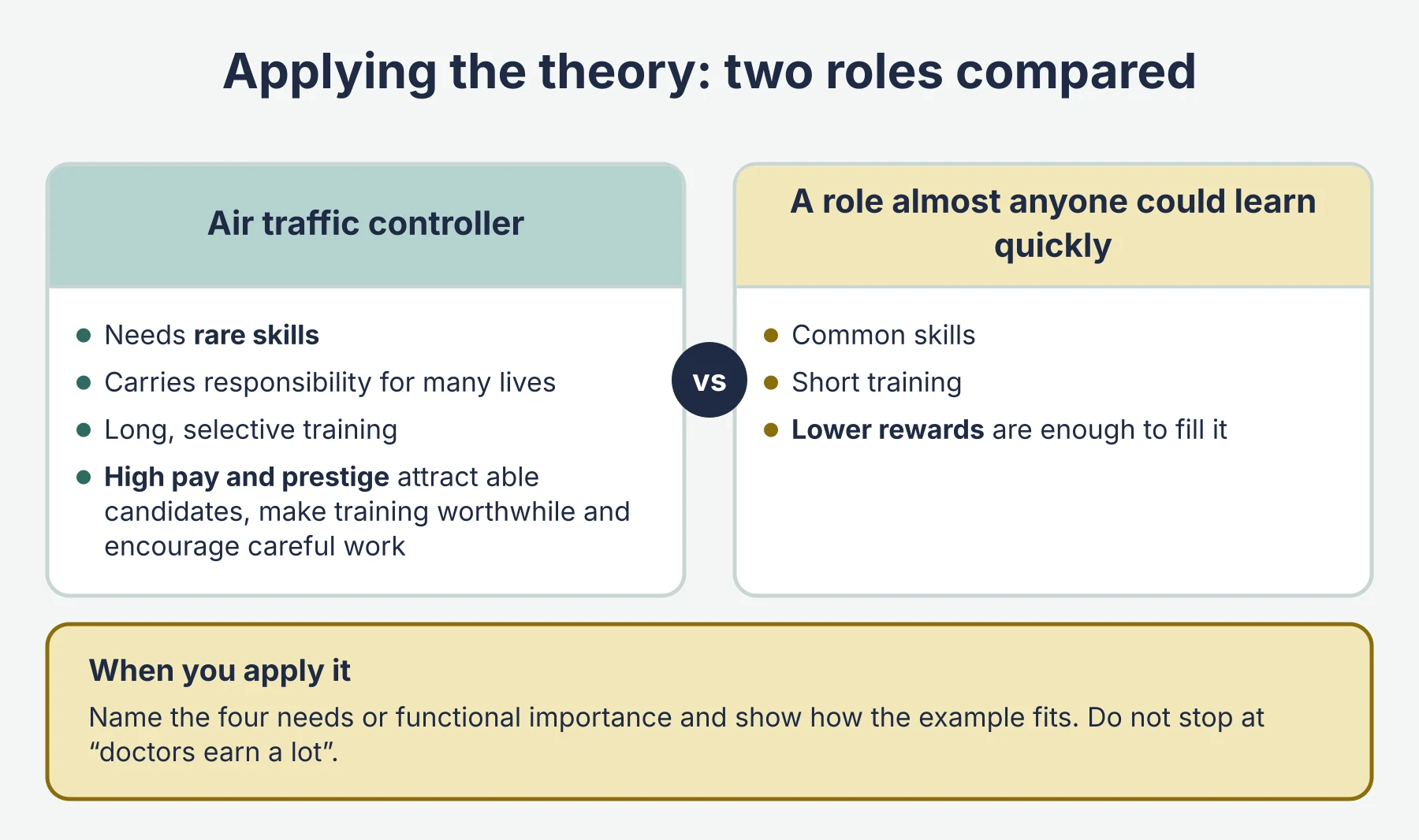
Examiners reward students who can apply the theory to a realistic case. Take an air traffic controller. The role needs rare skills and carries responsibility for many lives. Training is long and selective. On Davis and Moore’s view, the high pay and prestige of the job attract able candidates, make the training seem worthwhile and encourage controllers to work carefully. Compare a role that almost anyone could learn quickly: lower rewards are enough to fill it.
When you apply the theory, name the four needs or the idea of functional importance and say how the example fits. Do not stop at “doctors earn a lot”.
Criticisms: the core evaluation
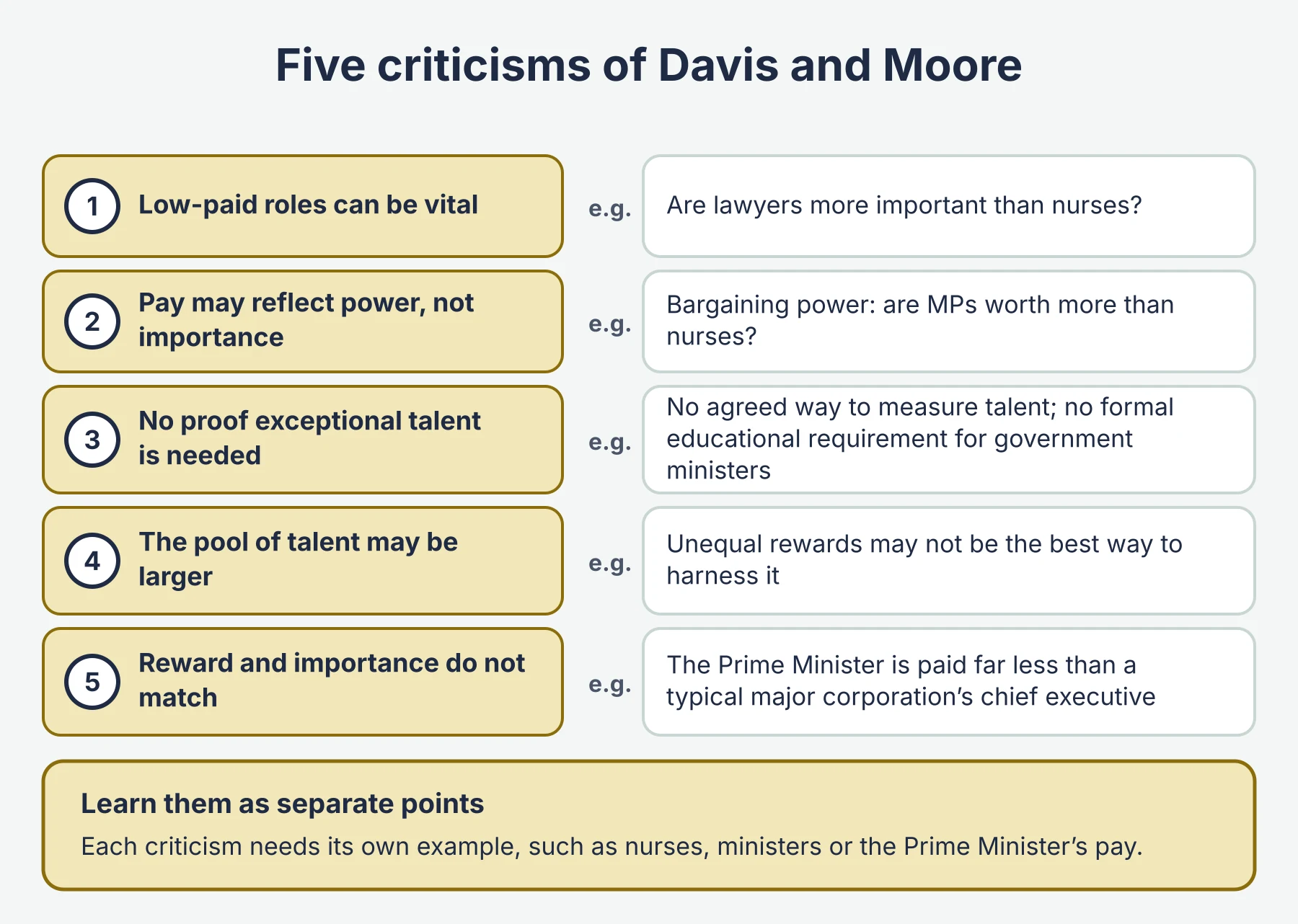
The specification’s summary of Davis and Moore lists several criticisms. Learn them as separate points, each with its own example.
- Low-paid roles can be vital. Occupations with lower prestige or pay can still be functionally important. The specification asks: are lawyers more important than nurses?
- Pay may reflect power, not importance. Differences in pay may come from a group’s bargaining power. The specification asks whether Members of Parliament are worth more than nurses.
- No proof that exceptional talent is needed. There is no agreed way to measure talent and ability. The specification notes that there is no formal educational requirement for government ministers.
- The pool of talent may be larger. The number of talented people may be far greater than Davis and Moore suggest, and unequal rewards may not be the best way to harness that talent.
- The link between reward and importance is inconsistent. The Prime Minister is paid far less than the chief executive of a typical major corporation, yet few would say the chief executive’s role matters more to society.
Tumin’s response
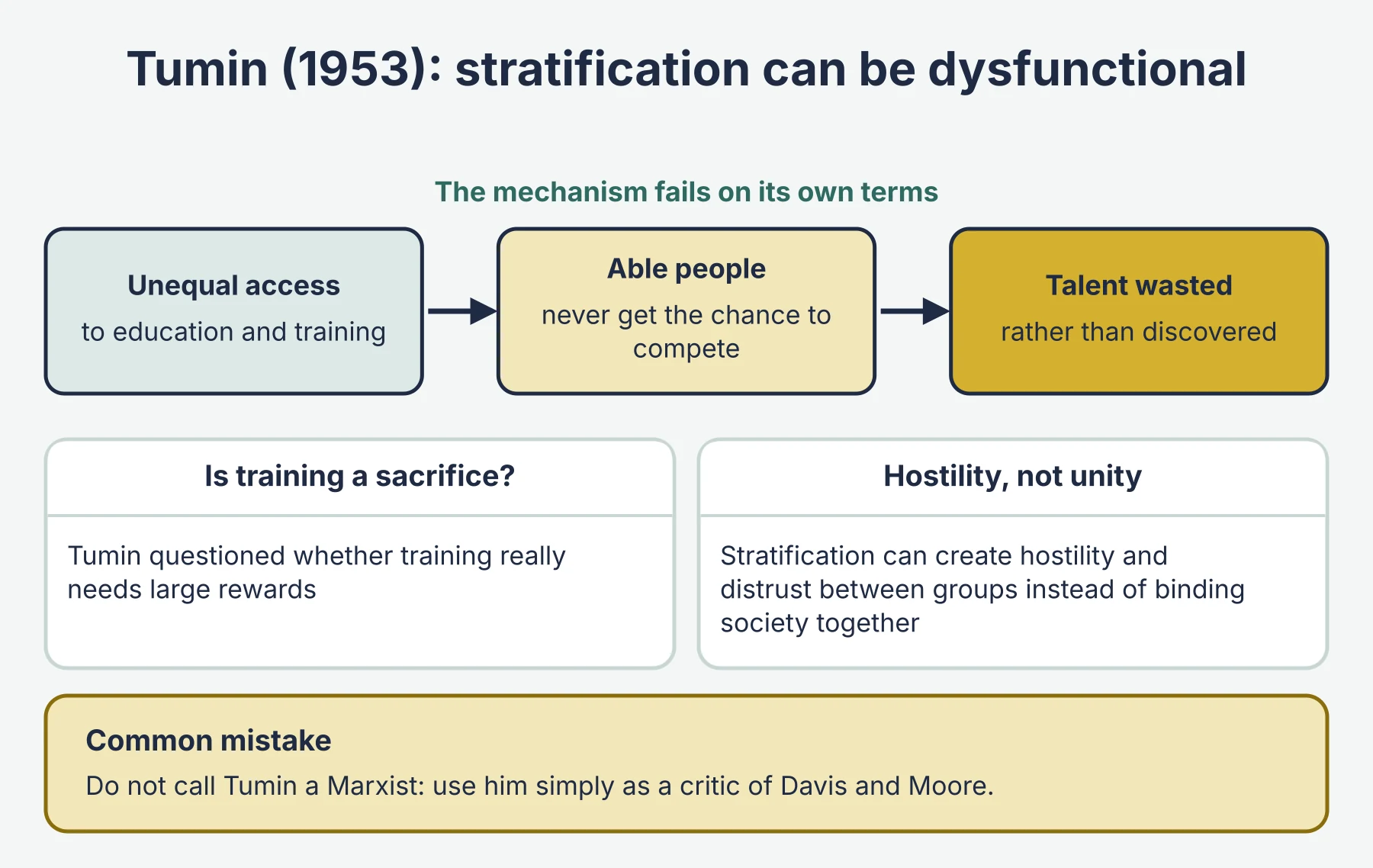
Melvin Tumin replied to Davis and Moore in 1953. He argued that stratification can be dysfunctional as well as functional. Unequal access to education and training means many able people never get the chance to compete, so talent is wasted rather than discovered. Tumin also questioned whether training is really a “sacrifice” that needs large rewards, and argued that stratification can create hostility and distrust between groups instead of binding society together. Use Tumin to show that a functionalist mechanism can fail on its own terms.
Alternative perspectives the specification names
Marxist view
Marxists reject the idea that stratification serves society as a whole. For Marx, inequality comes from ownership of the means of production. The bourgeoisie gain wealth from owning businesses, land and capital, not from performing functionally important roles. Inherited wealth means some people are rewarded without competing at all, which breaks the link between merit and reward. Marxists would see Davis and Moore’s theory as ruling class ideology: an idea that makes inequality look natural and fair, so workers accept it.
Feminist view
Feminists point out that the theory ignores unpaid work. Housework, childcare and caring for elderly relatives are essential to society’s survival, yet carry no wage. Most of this work is still done by women. Feminists also argue that women are concentrated in lower-paid work, such as care and cleaning, whatever their ability, and that the glass ceiling blocks them from top posts. If rewards followed talent alone, gender would not predict pay so strongly. Patriarchy, not functional importance, shapes many rewards.
Comparing the three
| Question | Functionalist | Marxist | Feminist |
|---|---|---|---|
| Why does stratification exist? | It is a universal necessity that fills important roles | It lets owners exploit workers | It reflects and maintains male domination |
| Is it fair? | Broadly yes, if rewards follow merit | No: wealth is inherited and exploitative | No: women’s work is undervalued or unpaid |
| Who benefits? | Society as a whole | The ruling class | Men |
Annotated model paragraph
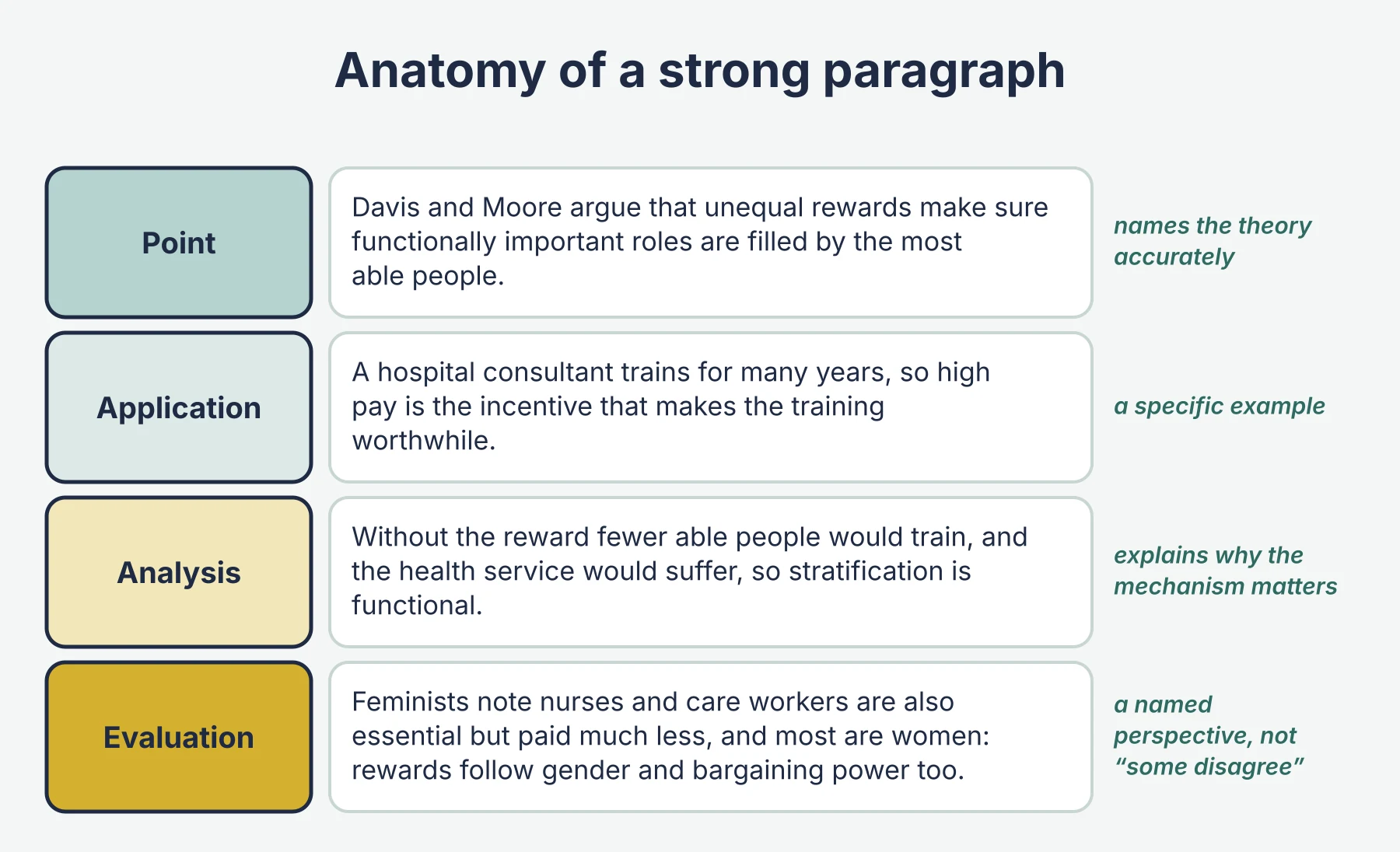
Point: Davis and Moore argue that unequal rewards are needed to make sure functionally important roles are filled by the most able people. Application: For example, a hospital consultant must train for many years, so high pay is the incentive that makes the training worthwhile. Analysis: This suggests stratification is functional, because without the reward fewer able people would choose to train, and the health service would suffer. Evaluation: However, feminists note that nurses and care workers are also essential to patient safety but are paid much less, and most of them are women. This suggests rewards follow gender and bargaining power as much as functional importance.
Why it works: the point names the theory accurately, the example is specific, the analysis explains why the mechanism matters, and the evaluation uses a named perspective rather than a vague “some people disagree”.
Common mistakes
- Saying Davis and Moore think “rich people deserve their wealth”. Their theory is about rewards attached to positions, not inherited fortunes.
- Forgetting the “performance” half: rewards also keep people working conscientiously once they are in post.
- Listing criticisms without examples. Each one needs a case, such as nurses, ministers or the Prime Minister’s pay.
- Treating feminist and Marxist criticisms as the same point. Marxists focus on ownership and class; feminists focus on unpaid work and gender.
- Calling Tumin a Marxist. He is best used simply as a critic of Davis and Moore’s argument.
Exam technique for this sub-section
- Identify: give a short, accurate answer, such as one of the four needs.
- Describe: set out what the theory says in your own words, such as the role of unequal rewards.
- Explain: give the idea and then the reason or consequence, using “because” or “so that”.
- Discuss how far sociologists would agree: build both sides. Use Davis and Moore for, then Marxist, feminist and Tumin’s points against, and finish with a judgement. A strong judgement weighs the points; for example, rewards may motivate effort in some roles, but inheritance and gender mean the system is not a pure meritocracy.
Frequently asked questions
What does “effective role allocation” mean? It means the right people are matched to the right roles. For Davis and Moore, unequal rewards attract the most talented people into the most functionally important positions.
Why is stratification a “universal necessity” for Davis and Moore? Because every society must fill its roles with able people, train them and make them work conscientiously, and they argued unequal rewards are the mechanism that achieves this.
What is the strongest criticism of Davis and Moore? A strong one is that pay may reflect power rather than importance, since low-paid roles such as nursing are vital. Support it with an example, and add the point about inherited wealth to show that some rewards involve no competition at all.
Specification reference
AQA GCSE Sociology (8192), section 3.6.1 Functionalist theory of stratification, with the Davis and Moore summary in Appendix B (7.4) and the social stratification key terms in Appendix A (6.4).
Related resources
-
Practice questions
AQA GCSE Sociology (8192): Functionalist theory of stratification – Practice Questions
Original AQA GCSE Sociology 8192 practice on Davis and Moore and functionalist stratification, with item-based questions and mark-scheme style answers.
Sociology · AQA · GCSE
Try questions -
Revision notes
AQA GCSE Sociology (8192): Functionalist theory of stratification – Revision Notes
Condensed AQA GCSE Sociology 8192 notes on 3.6.1: Davis and Moore's argument chain, criticisms, Marxist and feminist views, key terms and a self-test.
Sociology · AQA · GCSE
Revise topic -
Study guides
AQA GCSE Sociology (8192): Life chances
AQA GCSE Sociology 8192 guide to 3.6.3 life chances: the seven named factors, Devine on the affluent worker, and functionalist, Marxist and feminist views.
Sociology · AQA · GCSE
Read guide
Related articles
Get free revision emails (optional)
Occasional emails with practice questions, worked explanations and links to free resources for the qualification and subjects you choose. No spam, and you can unsubscribe from any email. The free tools on this site never need an email.