
Revision Notes
AQA GCSE Sociology (8192): Functionalist theory of stratification – Revision Notes
Condensed AQA GCSE Sociology 8192 notes on 3.6.1: Davis and Moore's argument chain, criticisms, Marxist and feminist views, key terms and a self-test.
- Subject
- Sociology
- Level
- GCSE
- Topic
- Social stratification
- Author
- Marlbridge Academic Team
- Updated
- Reviewed by
- Naqiya Yousaf (what this means)
Aligned to AQA GCSE Sociology (8192), first teaching 2017. Official specification .
Syllabus page (what it covers and how it is assessed): AQA GCSE Sociology.
Syllabus points this page covers
8192
- 3.6.1 Functionalist theory of stratification
Found an error? Report a correction.
Need help with this topic? Request a free trial class for GCSE Sociology (8192).
These notes cover AQA GCSE Sociology (8192) section 3.6.1 Functionalist theory of stratification, assessed in Paper 2. For full explanations and a model paragraph, read the functionalist theory of stratification study guide. When you are ready, try the functionalist theory of stratification practice questions. For the whole topic, see the Social stratification revision notes.
What you must be able to do
- Describe and explain the functionalist theory: effective role allocation and performance linked to the promise of rewards.
- Describe the key ideas of Davis and Moore.
- Describe, compare and contrast the feminist and Marxist views of the theory.
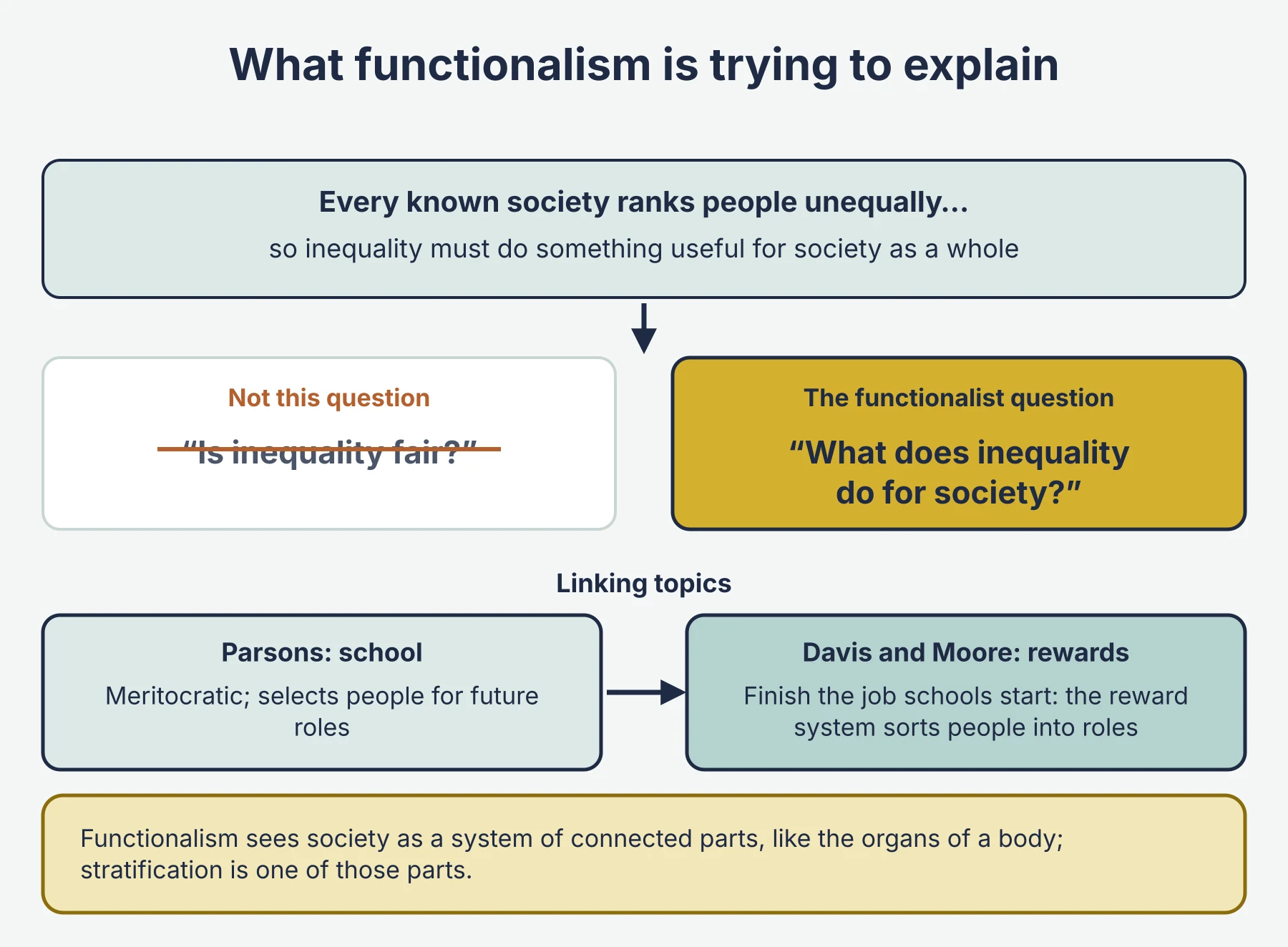
The argument in six lines
- Stratification is a “universal necessity” in every known society (Davis and Moore, 1945).
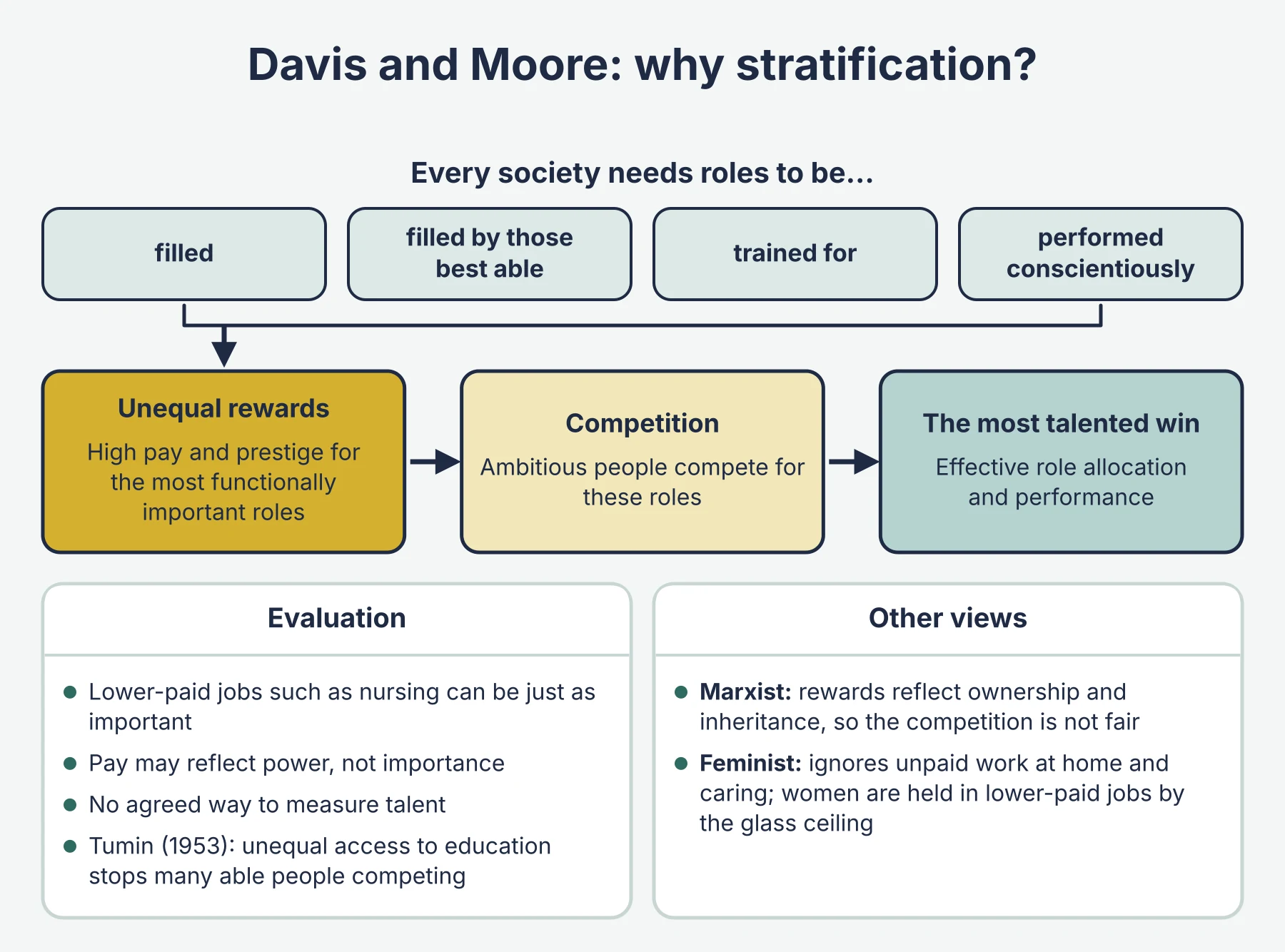
- Every society needs four things: all roles filled; filled by those best able; necessary training done; roles performed conscientiously.
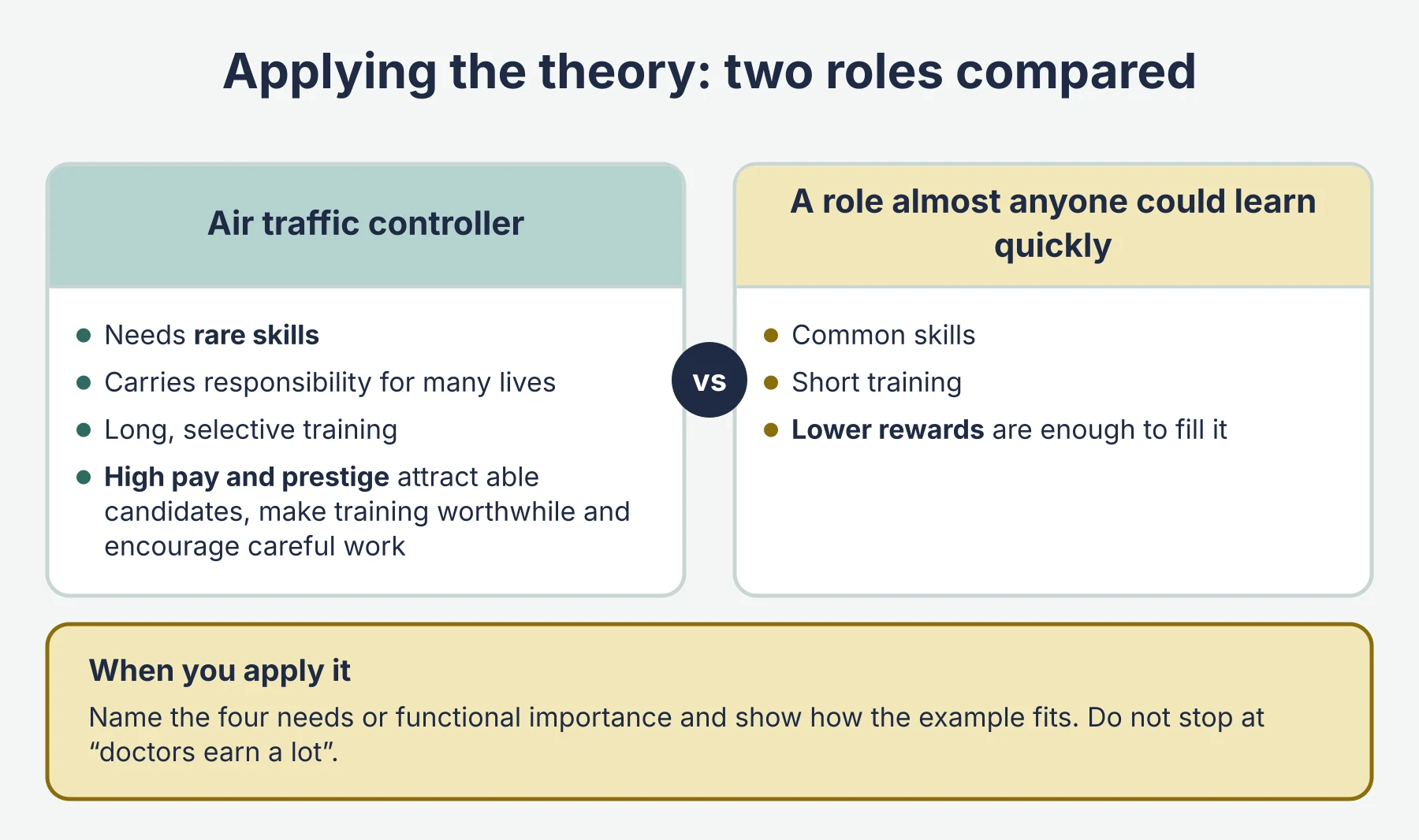
- Some roles are functionally important: they need the highest skill or the most responsibility for directing others.
- Talent is scarce and training is demanding.
- Unequal rewards (pay, prestige, privileges) attract the ambitious to compete; the most talented win.
- Continued rewards keep post-holders working hard.
Memory hook: Fill, Fit, Train, Try. Fill every role, fit the best person to it, train them, make them try hard.
Key terms
| Term | Meaning |
|---|---|
| Social stratification | Division of society into layers unequal in wealth, income, status and power |
| Functionalism | Perspective that sees society as a system of parts working together for the good of the whole |
| Functionally important roles | Positions needing rare skills or high responsibility |
| Effective role allocation | Matching the most able people to the most important roles |
| Meritocracy | Rewards depend on ability and effort, not background |
| Achieved status | Position gained through talent and effort |
| Ascribed status | Position fixed at birth |
| Value consensus | Shared agreement on values, so people accept the ranking |
| Social mobility | Movement up or down the class structure |
| Glass ceiling | Invisible barrier stopping women reaching top jobs |
| Ruling class ideology | Ideas that make inequality seem natural and fair (Marxist) |
| Dysfunction | A part of society that causes harm or disruption rather than benefit |
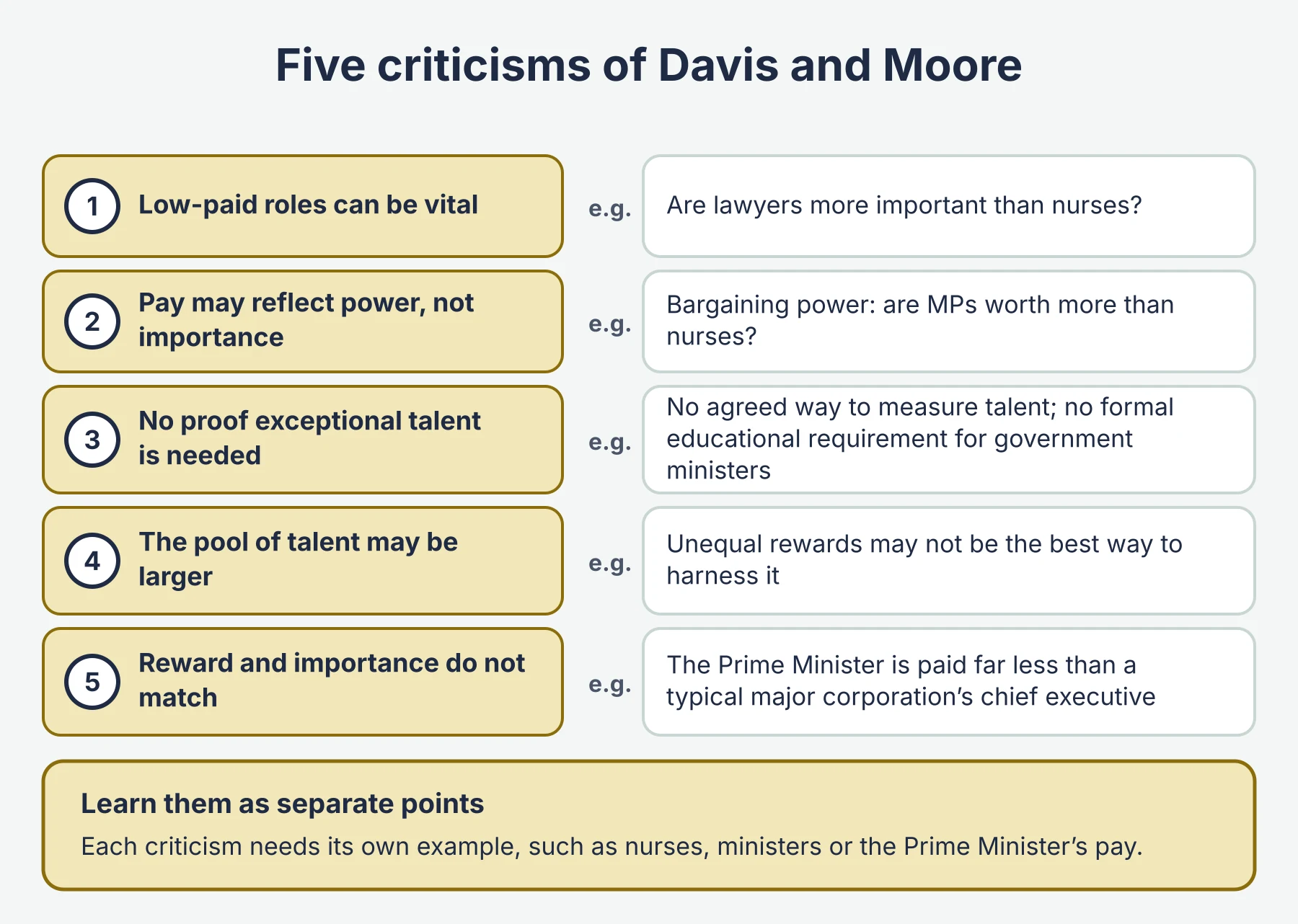
Criticisms to learn, with one example each
| Criticism | Example to use |
|---|---|
| Low-paid roles can be vital | Nurses and care workers keep people alive but earn far less than many lawyers |
| Pay reflects power, not importance | Groups with strong bargaining power can push up their own pay |
| No agreed measure of talent | There is no formal educational requirement for government ministers |
| Pool of talent is larger than assumed | Poor schooling and lack of money stop able people training |
| Rewards and importance do not match | The Prime Minister earns far less than the chief executive of a typical major corporation |
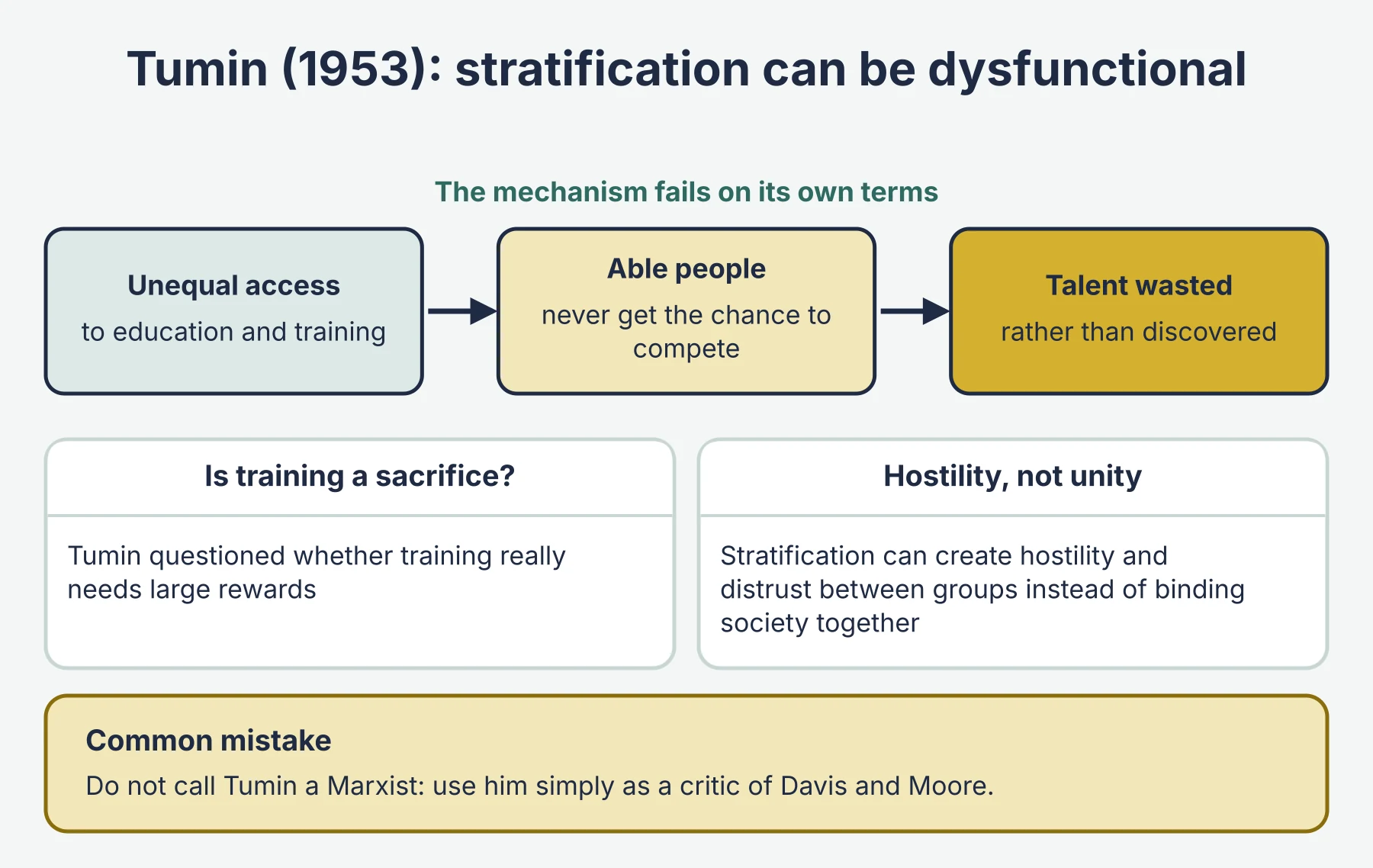
| Stratification can be dysfunctional (Tumin, 1953) | Inequality wastes talent and can create hostility between groups |
Perspectives at a glance
Functionalist (Davis and Moore): inequality is necessary, motivating and broadly fair. It benefits society as a whole.
Marxist: inequality comes from ownership of the means of production. Inherited wealth means some are rewarded without competing. The theory itself is ruling class ideology, encouraging false class consciousness.
Feminist: the theory ignores unpaid domestic and caring work, mostly done by women. Women cluster in low-paid jobs whatever their ability; the glass ceiling blocks promotion. Patriarchy shapes rewards.
Compare: Marxists and feminists agree the system is unfair, but disagree about who gains. Marxists say the ruling class; feminists say men.
Links across the course
- Education: Parsons sees school as meritocratic and selecting pupils for future roles, the first stage of the process Davis and Moore describe. Halsey, Heath and Ridge’s class differences in staying on challenge that.
- Families: feminist points about unpaid work connect to Delphy and Leonard and the domestic division of labour.
- Socio-economic class: Marx and Weber offer the main alternatives to functionalist explanations of class.
Exam traps
- Trap: “Davis and Moore say the rich deserve their money.” Fix: they talk about rewards attached to positions, not inherited wealth.
- Trap: forgetting performance. Fix: rewards also keep people working conscientiously once in post.
- Trap: one vague criticism (“some people disagree”). Fix: name the perspective and give an example.
- Trap: merging feminist and Marxist views. Fix: class and ownership versus gender and unpaid work.
- Trap: no judgement in a “discuss how far” answer. Fix: say how far the theory works, and why.
Mini plan for an extended answer
“Discuss how far sociologists would agree that social stratification is necessary for society to run efficiently.”
- Define stratification; outline Davis and Moore’s four needs.
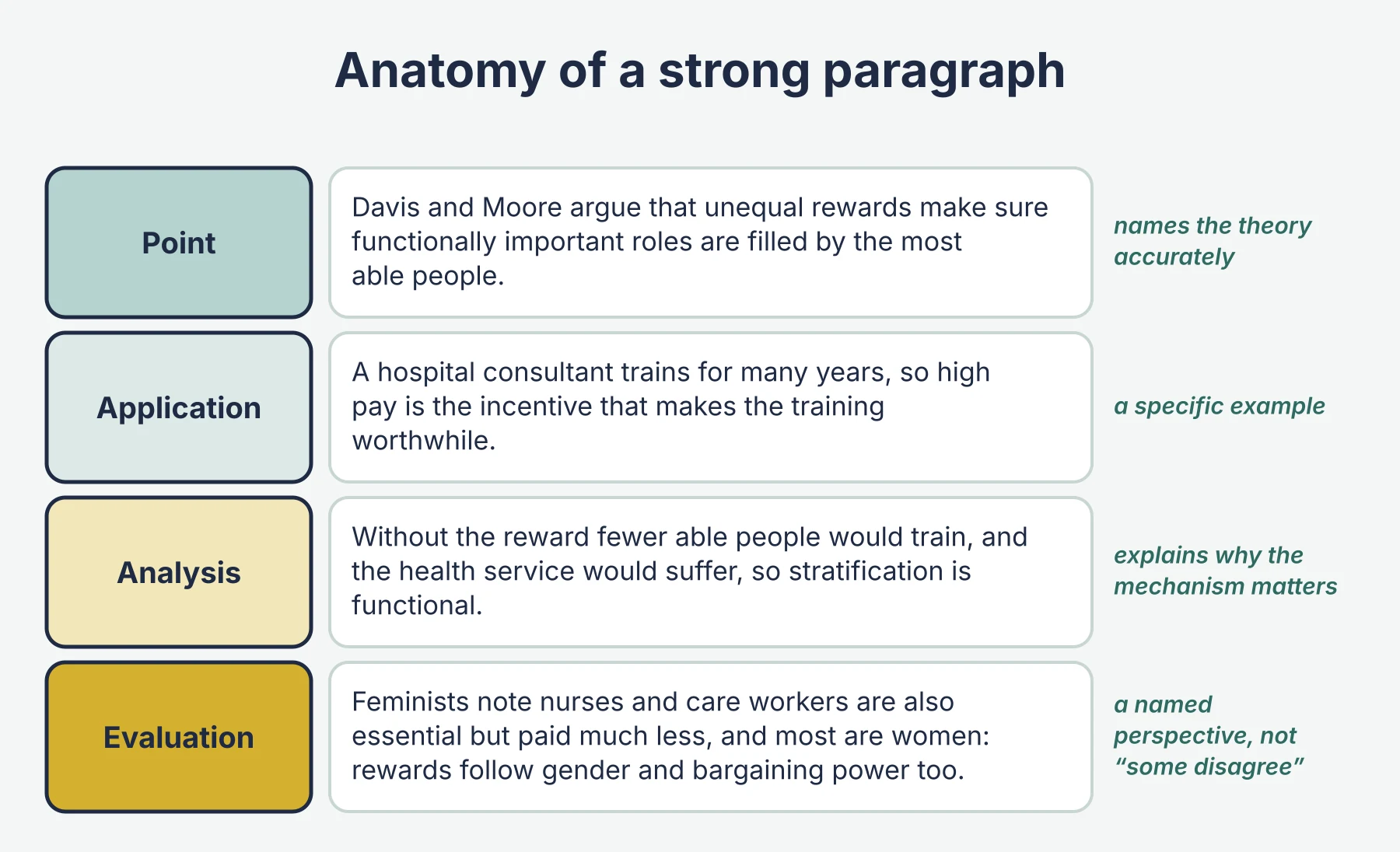
- Explain functional importance and unequal rewards with an applied example (air traffic controller, surgeon).
- Evaluate: low-paid essential roles; pay and power.
- Marxist view: ownership, inheritance, ideology.
- Feminist view: unpaid work, glass ceiling.
- Tumin: talent wasted, stratification dysfunctional.
- Judgement: rewards may encourage training in some roles, but class and gender shape outcomes, so “necessary” in its current form is hard to support.
Quick self-test
- In what year did Davis and Moore publish their theory?
- What phrase did they use to describe stratification?
- List the four things every society needs, according to Davis and Moore.
- What makes a role “functionally important”?
- What does “effective role allocation” mean?
- How do rewards affect performance once someone is in a role?
- Which example in the specification shows there is no agreed measure of talent?
- Give one Marxist criticism of Davis and Moore.
- Give one feminist criticism of Davis and Moore.
- What did Tumin argue about stratification in 1953?
- What is the difference between achieved and ascribed status?
- Why does the pay of the Prime Minister challenge the theory?
Answers
-
- A “universal necessity”.
- All roles filled; filled by those best able to perform them; necessary training takes place; roles performed conscientiously.
- It needs the highest levels of skill, or carries the greatest responsibility for directing and organising others, or both.
- The most able people are matched to the most important positions through competition for rewards.
- The promise of continued rewards encourages people to work hard and conscientiously.
- There is no formal educational requirement for government ministers.
- Rewards come from ownership and inheritance, not merit; or the theory is ruling class ideology that justifies exploitation.
- It ignores unpaid domestic and caring work done mainly by women; or women are held in low-paid jobs by the glass ceiling.
- That stratification can be dysfunctional: unequal access to education wastes talent, and inequality can create hostility between groups.
- Achieved status is earned through effort and talent; ascribed status is fixed at birth.
- The Prime Minister holds a very important role but is paid far less than the chief executive of a typical major corporation, so rewards do not match functional importance.
Specification reference
AQA GCSE Sociology (8192), section 3.6.1 Functionalist theory of stratification; Appendix B (7.4) summary of Davis and Moore; Appendix A (6.4) key terms.
Related resources
-
Study guides
AQA GCSE Sociology (8192): Life chances
AQA GCSE Sociology 8192 guide to 3.6.3 life chances: the seven named factors, Devine on the affluent worker, and functionalist, Marxist and feminist views.
Sociology · AQA · GCSE
Read guide -
Practice questions
AQA GCSE Sociology (8192): Life chances – Practice Questions
Original AQA GCSE Sociology 8192 practice on life chances and Devine's affluent worker study, with data, item-based and extended questions and full answers.
Sociology · AQA · GCSE
Try questions -
Revision notes
AQA GCSE Sociology (8192): Life chances – Revision Notes
AQA GCSE Sociology 8192 revision notes on 3.6.3 life chances: the seven factors, Devine's affluent worker study, perspectives, key terms, traps and a self-test.
Sociology · AQA · GCSE
Revise topic
Related articles
Get free revision emails (optional)
Occasional emails with practice questions, worked explanations and links to free resources for the qualification and subjects you choose. No spam, and you can unsubscribe from any email. The free tools on this site never need an email.