
Revision Notes
AQA GCSE History (8145): Health and the People – A Revolution in Medicine – Revision Notes
Revision notes for AQA GCSE History 8145 Health and the people, Part three: germ theory, surgery, cholera, reformers and the 1848 and 1875 Acts.
- Subject
- World History
- Level
- GCSE
- Topic
- Shaping the Nation
- Author
- Marlbridge Academic Team
- Updated
- Reviewed by
- Azam Siddique (what this means)
Aligned to AQA GCSE World History (8145), first teaching 2016. Official specification .
Syllabus page (what it covers and how it is assessed): AQA GCSE World History.
Syllabus points this page covers
8145
- 3.3.1 Section A: Thematic studies
This page covers 1 of the 2 subtopics in topic 2, Shaping the nation.
Found an error? Report a correction.
Need help with this topic? Request a free trial class for GCSE World History (8145).
Condensed notes on Part three, “A revolution in medicine”, of Britain: Health and the people, c1000 to the present day. The specification covers germ theory (“the importance of Pasteur, Robert Koch and microbe hunting; Pasteur and vaccination; Paul Ehrlich and magic bullets; everyday medical treatments and remedies”), “A revolution in surgery” and “Improvements in public health”. Explanations and a worked significance answer are in the revolution in medicine study guide; the paper’s structure is summarised in the Shaping the Nation revision notes.
Timeline
| Date | Event |
|---|---|
| 1831-32 | First cholera epidemic in Britain |
| 1842 | Chadwick’s Report on the Sanitary Condition of the Labouring Population |
| 1846 | Liston operates using ether in London |
| 1847 | Simpson discovers chloroform’s anaesthetic effect |
| 1848 | Hannah Greener dies under chloroform; cholera returns; Public Health Act |
| 1853 | Queen Victoria uses chloroform at Prince Leopold’s birth |
| 1854 | Snow and the Broad Street pump; General Board of Health abolished |
| 1858 | The Great Stink; Bazalgette’s sewers follow |
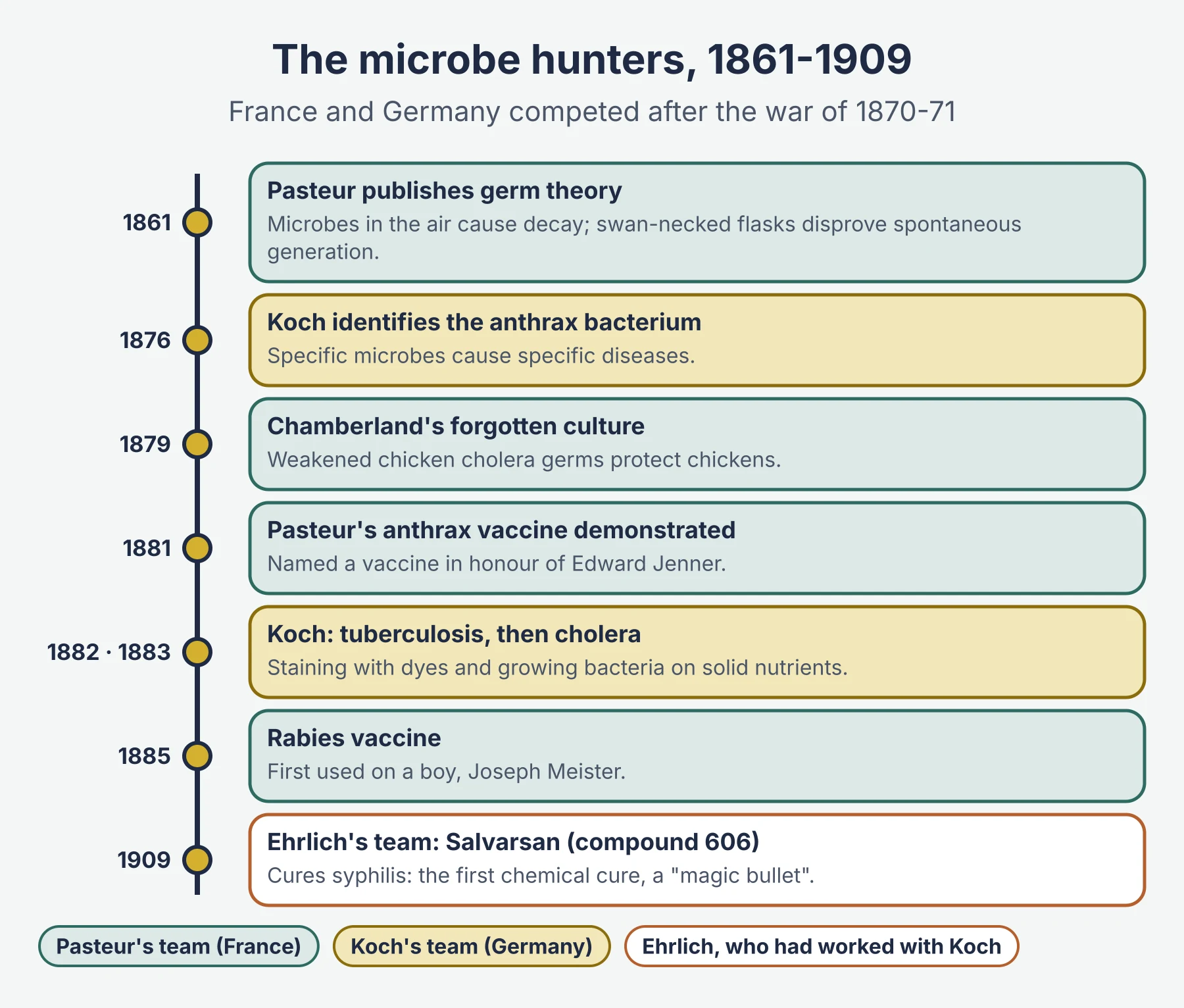
| 1861 | Pasteur publishes germ theory |
| 1865 | Lister first uses carbolic acid on a compound fracture |
| 1866 | Last major cholera epidemic in Britain |
| 1867 | Lister publishes his results; Reform Act extends the vote |
| 1875 | Public Health Act (compulsory) |
| 1876 / 1882 / 1883 | Koch identifies anthrax / tuberculosis / cholera bacteria |
| 1879 | Chicken cholera vaccine discovered by chance |
| 1881 / 1885 | Pasteur’s anthrax / rabies vaccines |
| 1880s-1890s | Aseptic surgery: sterilisation, gowns, masks, rubber gloves |
| 1902 | Edward VII’s appendix operation |
| 1909 | Ehrlich’s Salvarsan: first magic bullet |
Germ theory: who did what
| Person | Contribution |
|---|---|
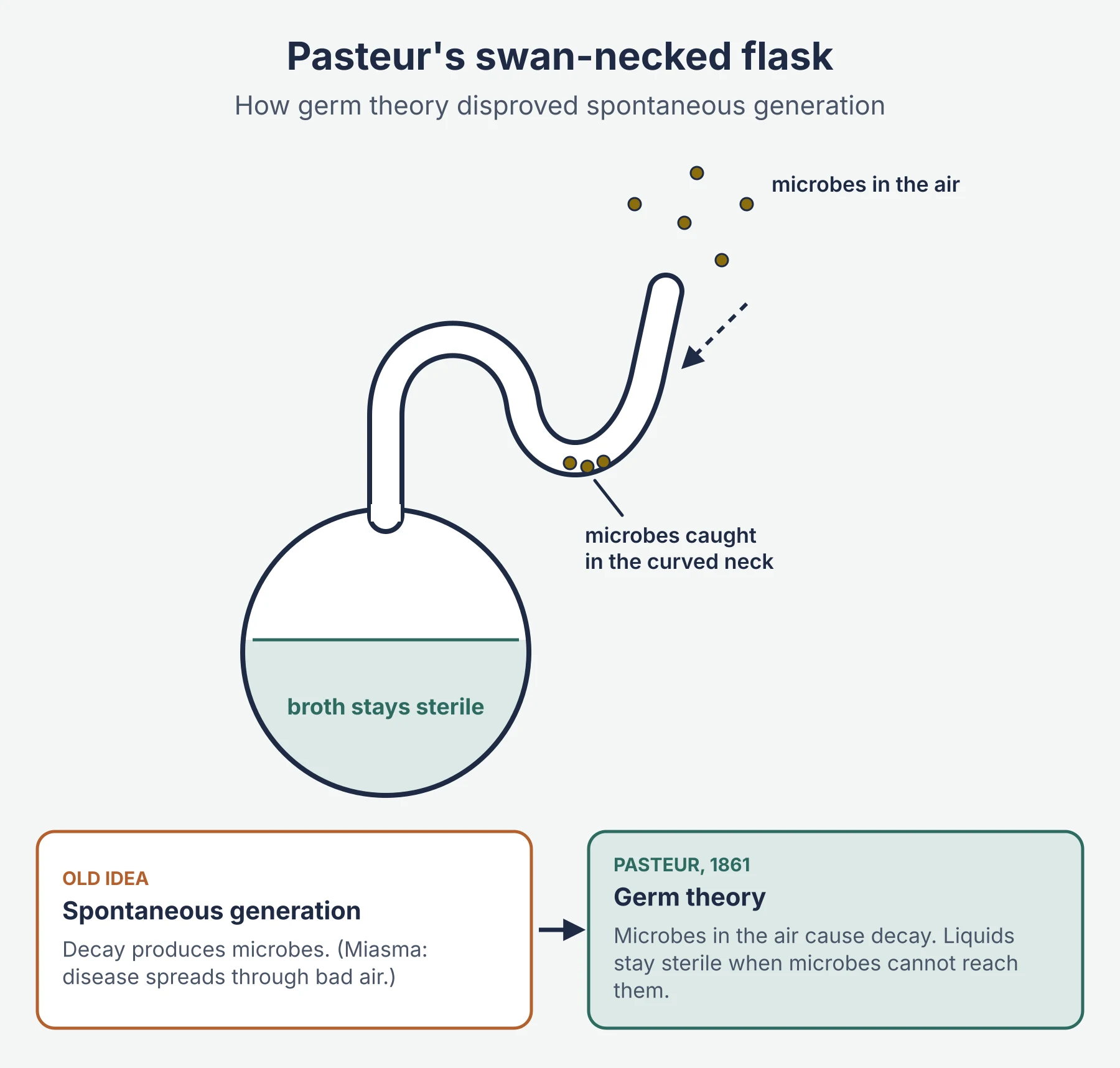
| Pasteur (France) | Germ theory (1861); disproved spontaneous generation; vaccines for chicken cholera, anthrax, rabies |
| Koch (Germany) | Specific germs cause specific diseases; staining; identified anthrax, TB, cholera germs |
| Ehrlich (Germany) | “Magic bullets”: chemicals targeting microbes; Salvarsan for syphilis |
| Chamberland | Pasteur’s assistant; the forgotten culture that led to the chicken cholera vaccine |
Impact in Britain: slow to change treatment; patent medicines and home remedies still common; doctors costly; main early impact on prevention and hygiene.
Surgery: three problems solved
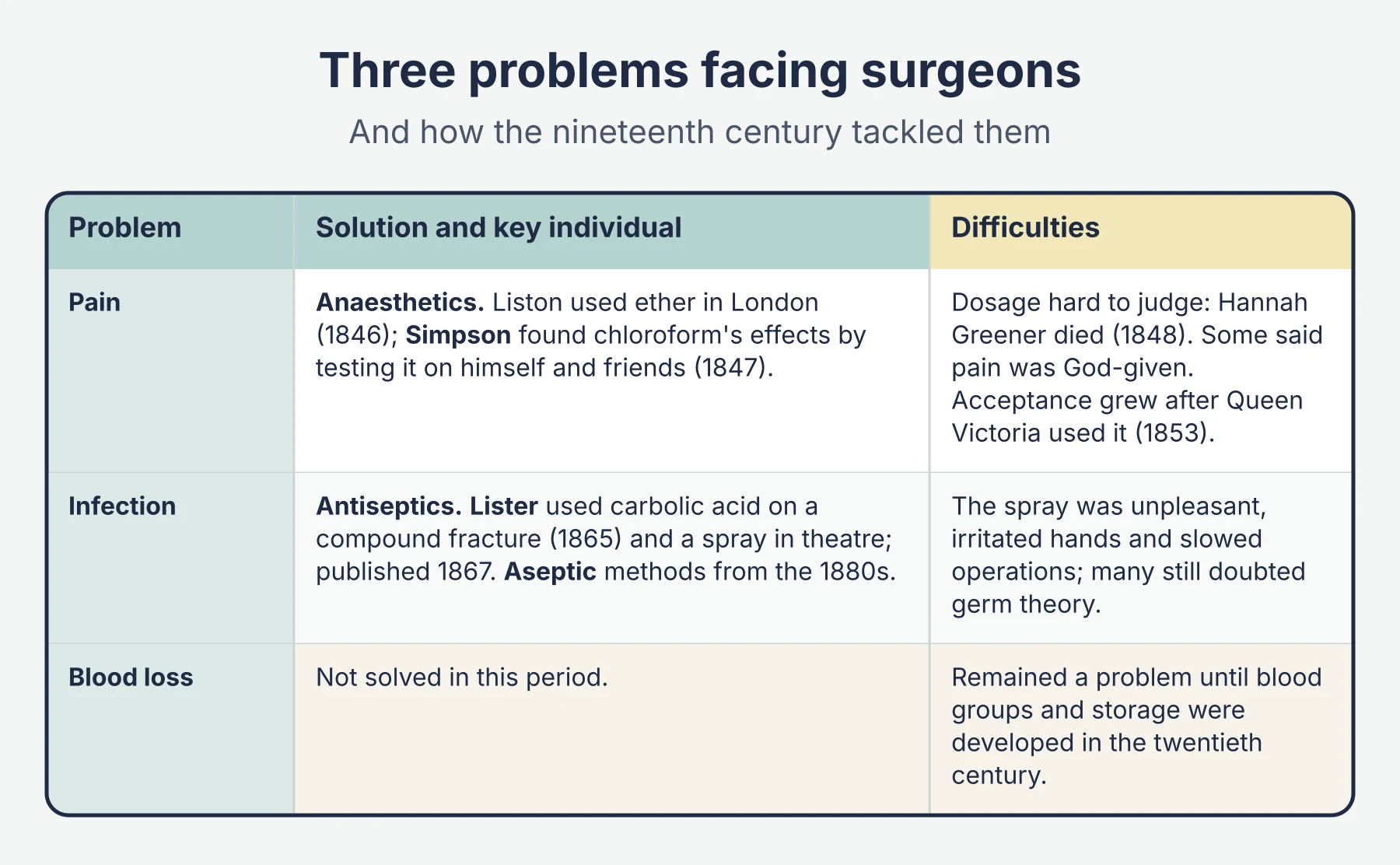
| Problem | Solution | Key person | Limits |
|---|---|---|---|
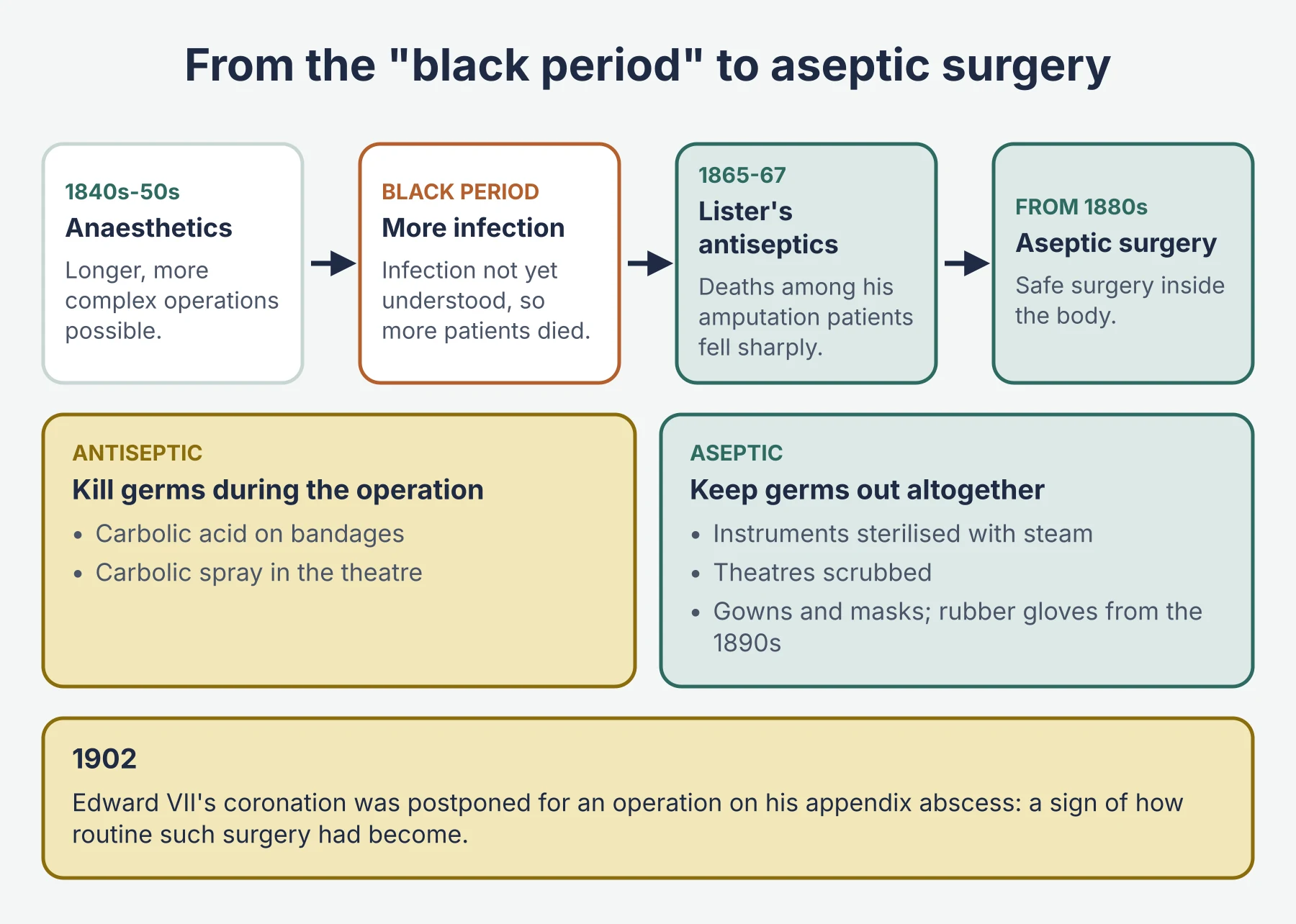
| Pain | Anaesthetics: ether, chloroform | Simpson (1847) | Dosage; deaths such as Hannah Greener; religious objections; “black period” of infection |
| Infection | Antiseptics: carbolic acid | Lister (1865-67) | Unpleasant spray; doubts about germ theory |
| Infection | Aseptic surgery | Many surgeons, 1880s-1890s | Needed equipment and training |
| Blood loss | Not solved until blood groups and storage in the twentieth century |
Public health
- Problems: overcrowded back-to-backs; shared privies; cesspits; polluted water; typhoid, TB, cholera.
- Chadwick (1842): dirt causes disease; cleaning towns saves money.
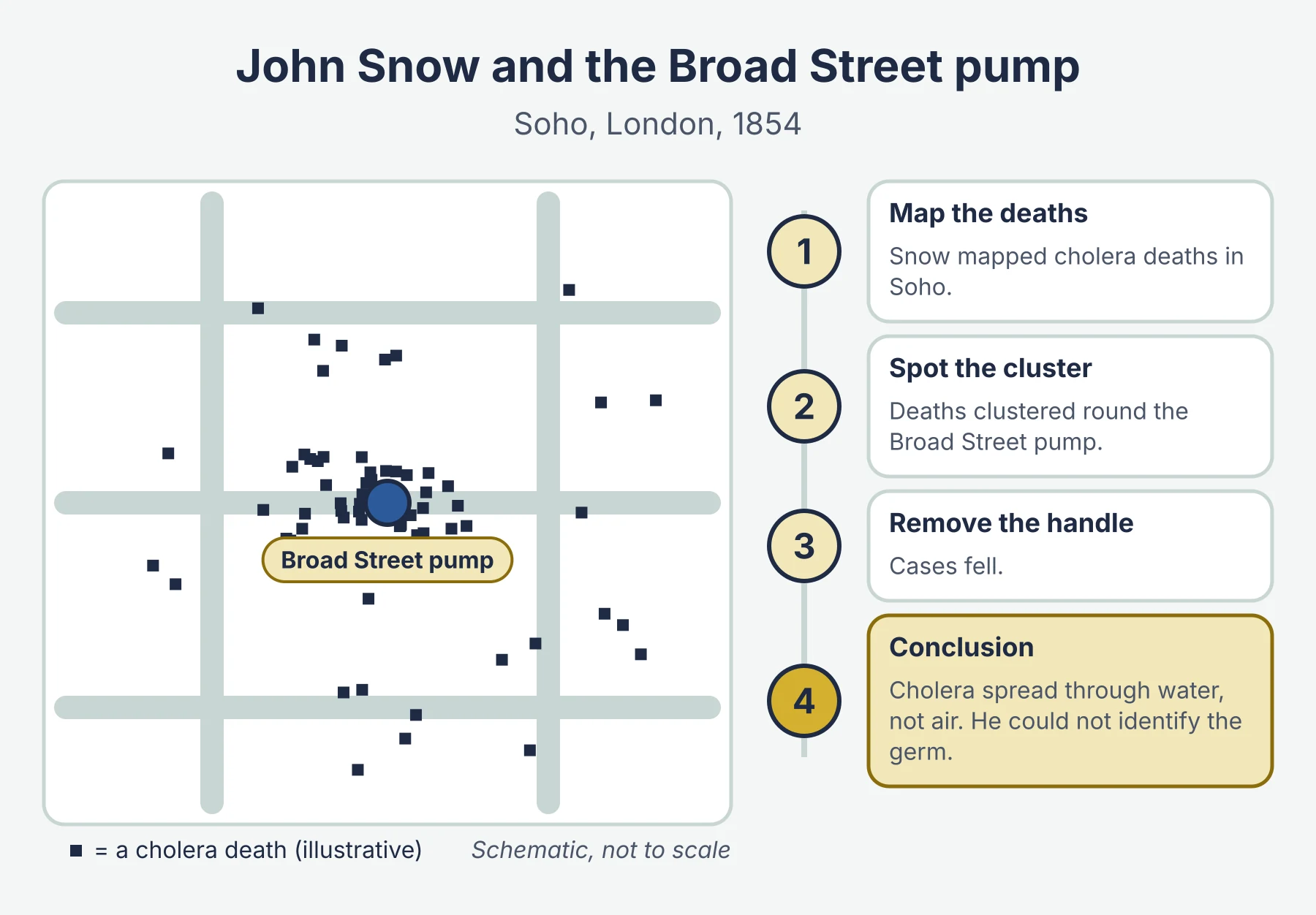
- Snow (1854): cholera spread through water; Broad Street pump.
- Bazalgette: London sewers after the Great Stink (1858).
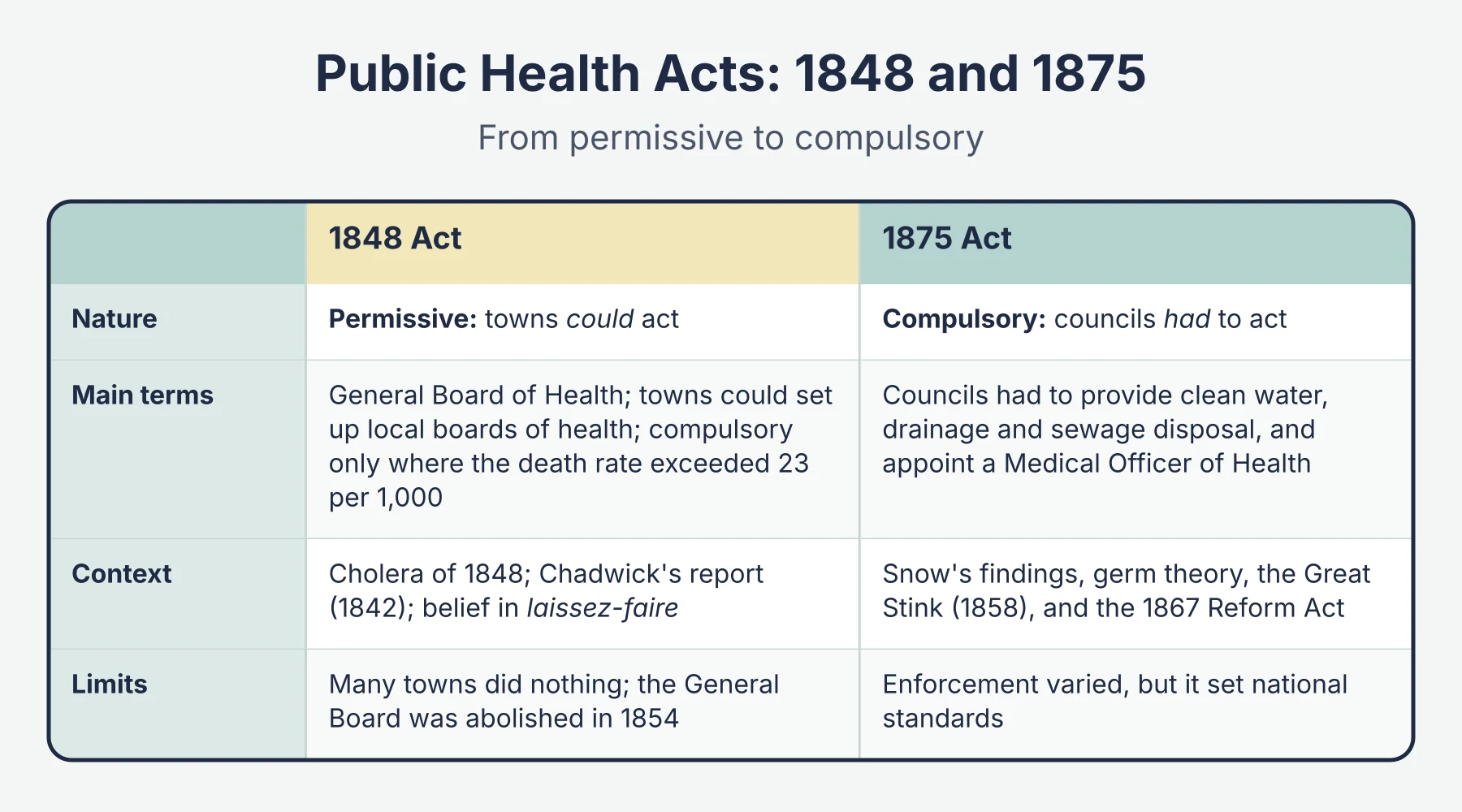
- 1848 Act: permissive; local boards of health; compulsory only if deaths exceeded 23 per 1,000.
- 1875 Act: compulsory; clean water, drainage, sewage; Medical Officers of Health.
- Why 1875 was compulsory: germ theory and Snow’s evidence; the Great Stink; working-class voters after 1867; a more interventionist attitude.
Factor links to learn
- Science + communication: Lister read Pasteur, then applied germ theory.
- Chance + individual: Chamberland’s mistake; Pasteur recognised its value.
- War + government: national rivalry funded Pasteur and Koch.
- Government + individuals: reformers’ evidence shaped the 1875 Act.
- Religion: objections to pain relief in childbirth slowed acceptance of anaesthetics.
Key terms
| Term | Meaning |
|---|---|
| Germ theory | The theory that microbes cause disease and decay |
| Spontaneous generation | The belief that decay creates microbes |
| Miasma | The belief that disease is spread by bad air |
| Vaccination | Using a weakened form of a germ to give immunity |
| Magic bullet | A chemical that kills a specific microbe without harming the body |
| Anaesthetic | A substance that removes pain or consciousness |
| Antiseptic | Killing germs on wounds and in the operating area |
| Aseptic | Preventing germs reaching the wound at all |
| Permissive law | A law allowing but not requiring action |
| Patent medicine | A branded remedy sold to the public, often with unproven claims |
Exam traps
- Germ theory did not bring instant cures: the first magic bullet was in 1909.
- Antiseptic and aseptic are different.
- Snow did not know about germs.
- The 1848 Act was permissive; the 1875 Act compulsory.
- In a question 4 factor essay, use all four parts of the course, not only Part three.
Self-test
- What did Pasteur’s swan-necked flasks disprove?
- Name two diseases whose bacteria Koch identified.
- How did chance help Pasteur develop a vaccine?
- What was Salvarsan, and when was it found?
- Who discovered chloroform’s anaesthetic effect, and when?
- Why did anaesthetics lead to a “black period” in surgery?
- Why did Lister use carbolic acid?
- What is the difference between antiseptic and aseptic surgery?
- What did Chadwick’s 1842 report argue?
- What did Snow show in 1854?
- Why was the 1848 Public Health Act limited?
- Give two reasons why the 1875 Act was compulsory.
Answers
- Spontaneous generation.
- Any two: anthrax, tuberculosis, cholera.
- A forgotten, weakened culture of chicken cholera protected chickens instead of killing them.
- Ehrlich’s chemical cure for syphilis, the first magic bullet, found in 1909.
- James Simpson, in 1847.
- Longer operations were possible, but infection was not understood, so more patients died of it.
- It was used to treat sewage, and he reasoned from Pasteur’s work that it would kill germs in wounds.
- Antiseptic kills germs during surgery; aseptic keeps germs away altogether.
- That poor living conditions caused disease, and cleaning towns would save money on poor relief.
- Cholera deaths clustered round the Broad Street pump, so the disease spread through water.
- It was permissive, so many towns did nothing, and the General Board was abolished in 1854.
- Any two: germ theory and Snow’s evidence; the Great Stink; working men’s votes after 1867; changing views of the government’s role.
Related resources
-
Study guides
AQA GCSE History: Paper 2 Shaping the Nation — Thematic Study and Depth Study Options
The thematic study and British depth study options in AQA GCSE History 8145 Paper 2, Shaping the nation, and how to approach each once your school has chosen.
World History · AQA · GCSE
Read guide -
Practice questions
AQA GCSE History: Shaping the Nation — Practice Questions
Original exam-technique practice questions with full worked answers on Paper 2's structure, options and revision approach, for AQA GCSE History (8145).
World History · AQA · GCSE
Try questions -
Revision notes
AQA GCSE History: Shaping the Nation — Revision Notes
Condensed revision notes on the thematic study and British depth study options of AQA GCSE History 8145 Paper 2, Shaping the nation, and how to approach each.
World History · AQA · GCSE
Revise topic
Get free revision emails (optional)
Occasional emails with practice questions, worked explanations and links to free resources for the qualification and subjects you choose. No spam, and you can unsubscribe from any email. The free tools on this site never need an email.