
Study Guides
AQA GCSE History (8145): Health and the People – A Revolution in Medicine
AQA GCSE History 8145 Health and the people, Part three: germ theory, Pasteur, Koch and Ehrlich, anaesthetics, antiseptics, cholera and the Public Health Acts.
- Subject
- World History
- Level
- GCSE
- Topic
- Shaping the Nation
- Author
- Marlbridge Academic Team
- Updated
- Reviewed by
- Azam Siddique (what this means)
Aligned to AQA GCSE World History (8145), first teaching 2016. Official specification .
Syllabus page (what it covers and how it is assessed): AQA GCSE World History.
Syllabus points this page covers
8145
- 3.3.1 Section A: Thematic studies
This page covers 1 of the 2 subtopics in topic 2, Shaping the nation.
Found an error? Report a correction.
Need help with this topic? Request a free trial class for GCSE World History (8145).
This guide covers Part three, “A revolution in medicine”, of the thematic study Britain: Health and the people, c1000 to the present day. The specification names three content statements: “The development of Germ Theory and its impact on the treatment of disease in Britain”; “A revolution in surgery: anaesthetics, including Simpson and chloroform; antiseptics, including Lister and carbolic acid; surgical procedures; aseptic surgery”; and “Improvements in public health… including the 1848 and 1875 Public Health Acts.” The Shaping the Nation options guide names the four parts of the thematic study but does not teach them; this page gives the detail of Part three and links it to the named factors.
Why the nineteenth century was a turning point
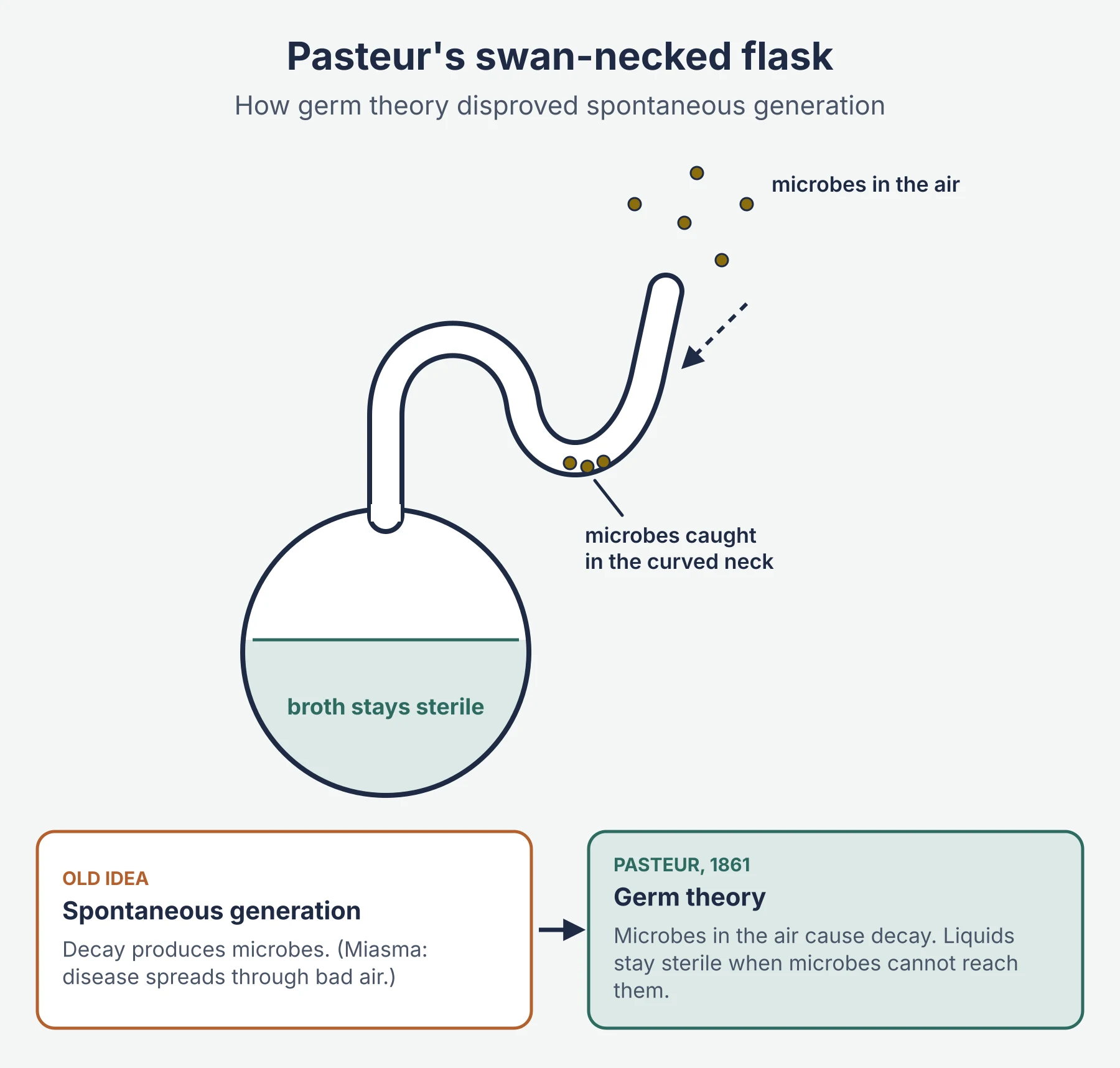
For centuries, medicine in Britain rested on ideas such as the Four Humours and miasma, the belief that disease spread through bad air. Many scientists also believed in spontaneous generation, that decay produced microbes. In the nineteenth century, new science, industrial cities, rival nations and campaigning individuals combined to change how disease was understood, how surgery was performed and how government protected health.
Germ theory
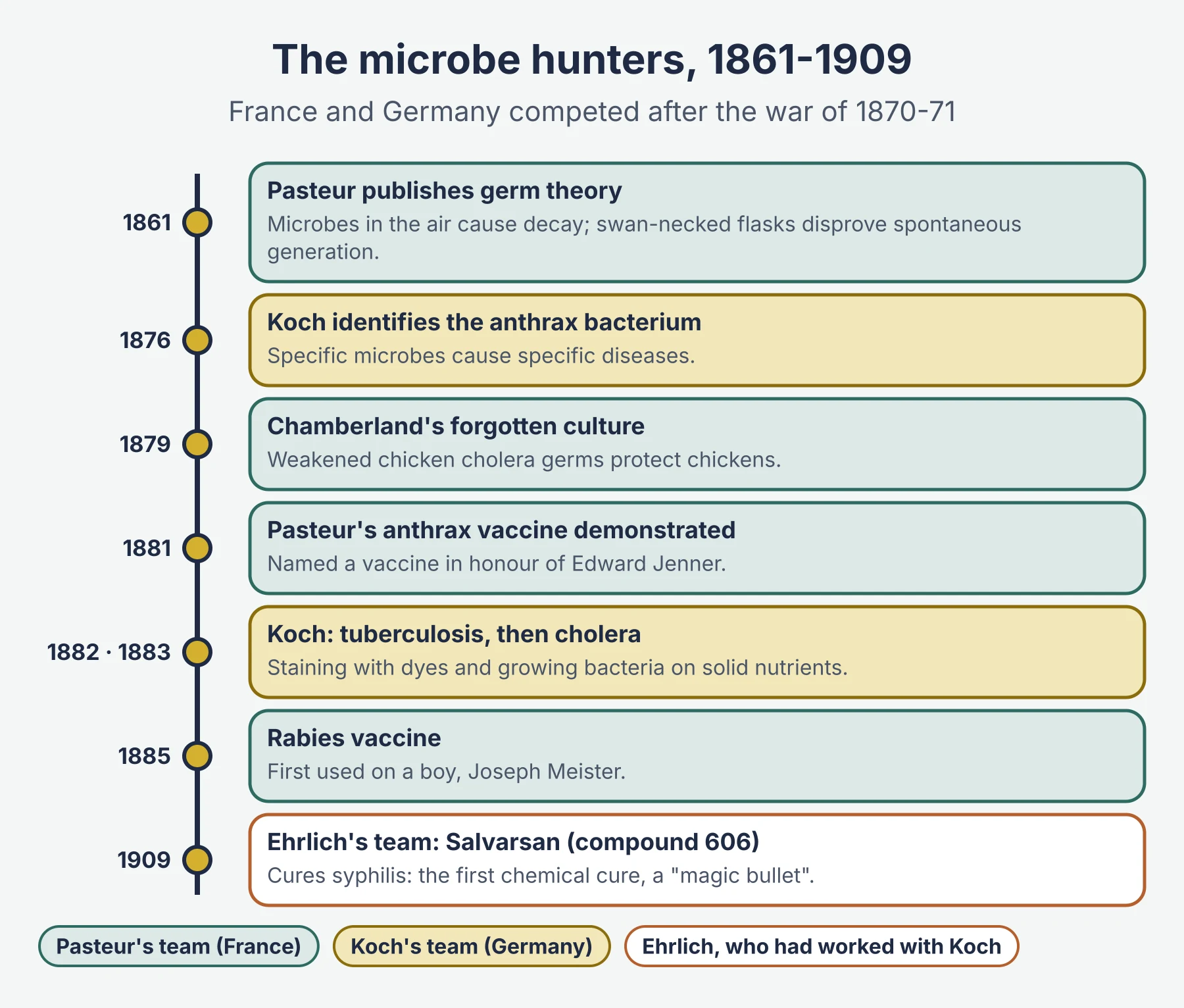
Louis Pasteur, a French chemist, was asked to investigate why wine, beer and vinegar went sour. He showed that microbes in the air caused decay; in 1861 he published his germ theory, and his experiments with swan-necked flasks showed that liquids stayed sterile when microbes could not reach them, disproving spontaneous generation.
Robert Koch, a German doctor, proved that specific microbes caused specific diseases. He identified the bacterium causing anthrax (1876), tuberculosis (1882) and cholera (1883). His methods, including staining bacteria with dyes so they could be seen and photographed, and growing them on solid nutrients, allowed his team and other “microbe hunters” to identify the germs causing many other diseases. Rivalry between France and Germany after the war of 1870-71 drove the two teams to compete.
Pasteur and vaccination. In 1879 Pasteur’s assistant Charles Chamberland accidentally left a culture of chicken cholera over the summer; the weakened germs, injected into chickens, protected them. Pasteur developed vaccines for anthrax (publicly demonstrated in 1881) and rabies (first used on a boy, Joseph Meister, in 1885). He called them vaccines in honour of Edward Jenner.
Paul Ehrlich and magic bullets. Ehrlich, who had worked with Koch, searched for chemicals that would kill a specific microbe without harming the body, a “magic bullet”. In 1909 his team found that compound 606, Salvarsan, cured syphilis: the first chemical cure for a disease.
Impact on treatment in Britain. Germ theory did not change treatment overnight. Many British doctors were slow to accept it, and few new cures existed before the twentieth century. Most people still relied on everyday remedies: home cures, herbal medicines, and patent medicines sold by chemists and travelling sellers, often with exaggerated claims. Doctors cost money, so the poor used them rarely. Germ theory’s main early impact was on prevention: it gave scientific support to cleaning up water and sewage, and to hygiene in hospitals.
A revolution in surgery
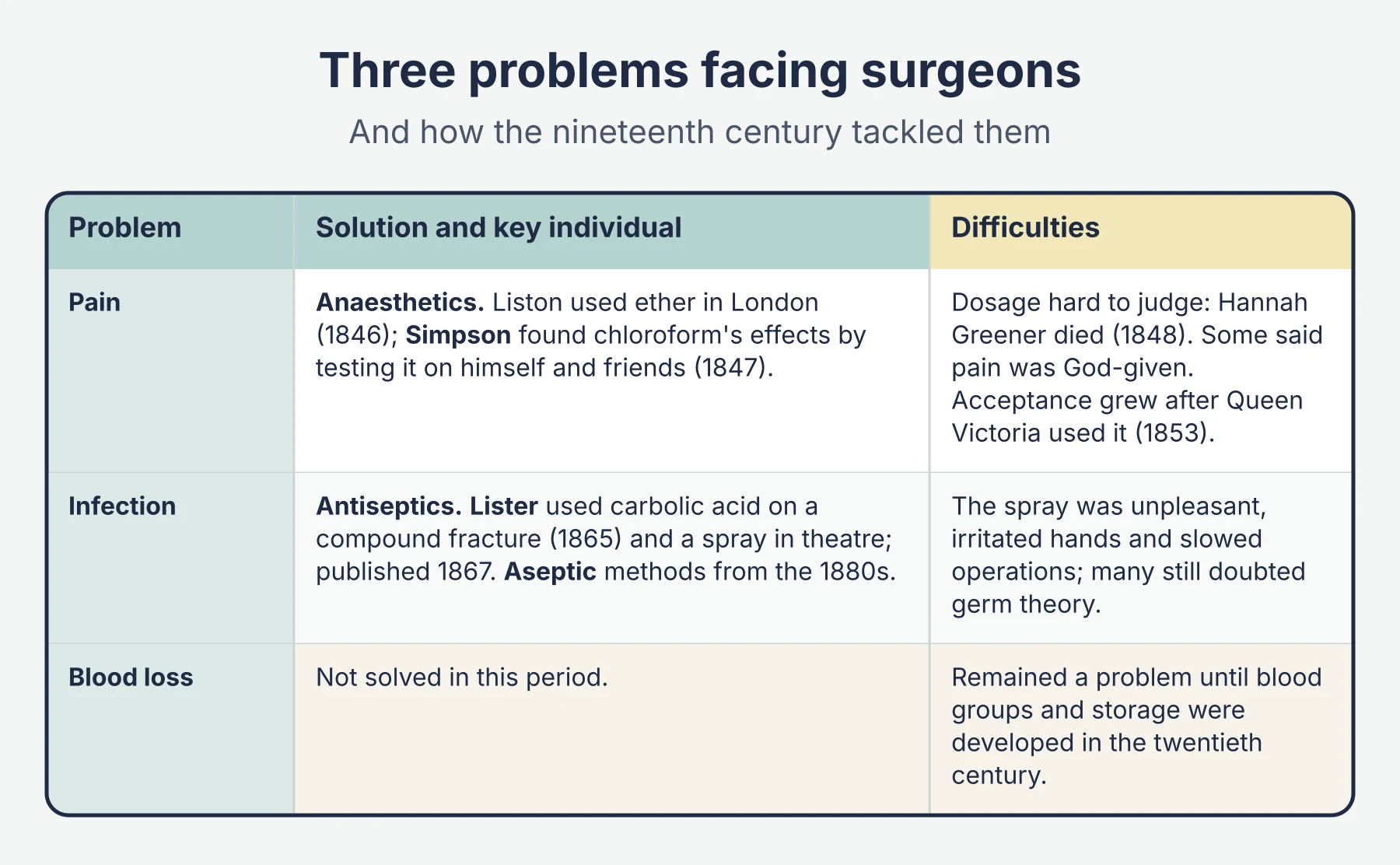
At the start of the century surgeons faced three problems: pain, infection and blood loss. Operations had to be fast, and many patients died of shock or infection afterwards.
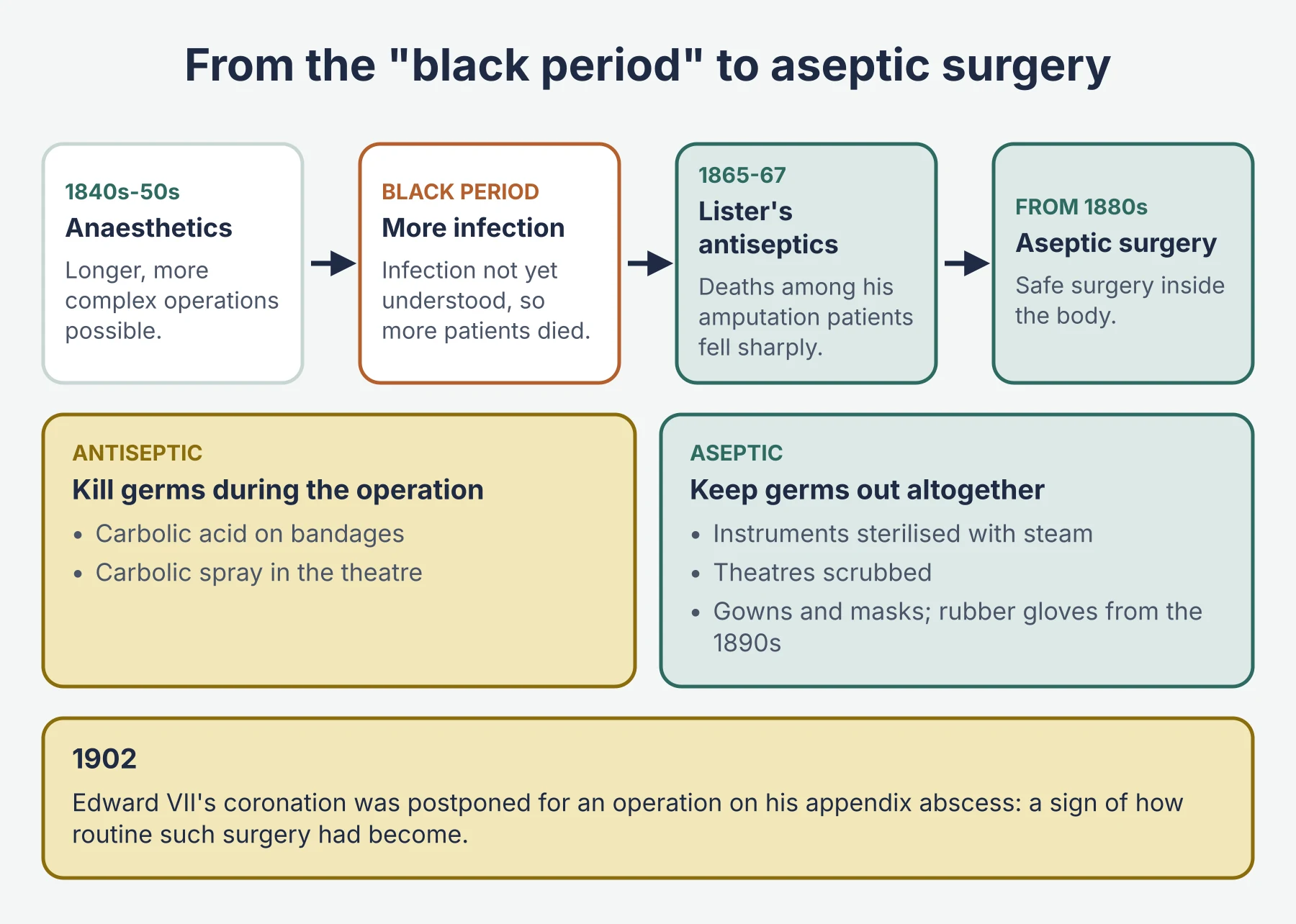
Anaesthetics. Nitrous oxide and then ether were tried in the 1840s; the surgeon Robert Liston operated with ether in London in 1846. In 1847 James Simpson, an Edinburgh professor of midwifery, discovered the effects of chloroform by testing it on himself and his friends. It was easier to use than ether, but dosage was hard to judge, and in 1848 a fifteen-year-old girl, Hannah Greener, died under chloroform during a minor operation. Some objected that pain was natural or God-given. Acceptance grew after Queen Victoria used chloroform during the birth of Prince Leopold in 1853. Anaesthetics allowed longer, more complex operations, but because infection was not yet understood, this produced a “black period” in which more patients died of infection.
Antiseptics. Joseph Lister, a surgeon in Glasgow, read Pasteur’s work and reasoned that germs caused wounds to rot. Knowing that carbolic acid was used to treat sewage, he soaked bandages in it and in 1865 treated an eleven-year-old boy’s compound fracture, which healed without infection. He developed a carbolic spray for the operating theatre and published his results in 1867, reporting that deaths among his amputation patients fell sharply. Some surgeons resisted: the spray was unpleasant, irritated hands and slowed operations, and many still doubted germ theory.
Aseptic surgery. From the 1880s surgeons moved from killing germs during operations (antiseptic) to keeping them out altogether (aseptic): instruments were sterilised with steam, theatres were scrubbed, and surgeons wore gowns, masks and, from the 1890s, rubber gloves.
Surgical procedures. With pain and infection controlled, surgeons could operate inside the body. In 1902 King Edward VII’s coronation was postponed so that his appendix abscess could be operated on, a sign of how routine such surgery had become. Blood loss remained a problem until blood groups and storage were developed in the twentieth century.
Improvements in public health
Problems in industrial Britain. Industrial towns grew rapidly. Workers lived in overcrowded back-to-back houses with shared privies, cesspits and water taken from polluted rivers and pumps. Typhoid, tuberculosis and cholera spread easily, and life expectancy in industrial cities was low.
Cholera epidemics. Cholera reached Britain in 1831-32 and returned in 1848-49, 1853-54 and 1866, killing tens of thousands. Its speed and violence caused panic among rich and poor alike.
Public health reformers.
- Edwin Chadwick’s Report on the Sanitary Condition of the Labouring Population (1842) linked poor living conditions with disease and argued that cleaning up towns would save money on poor relief.
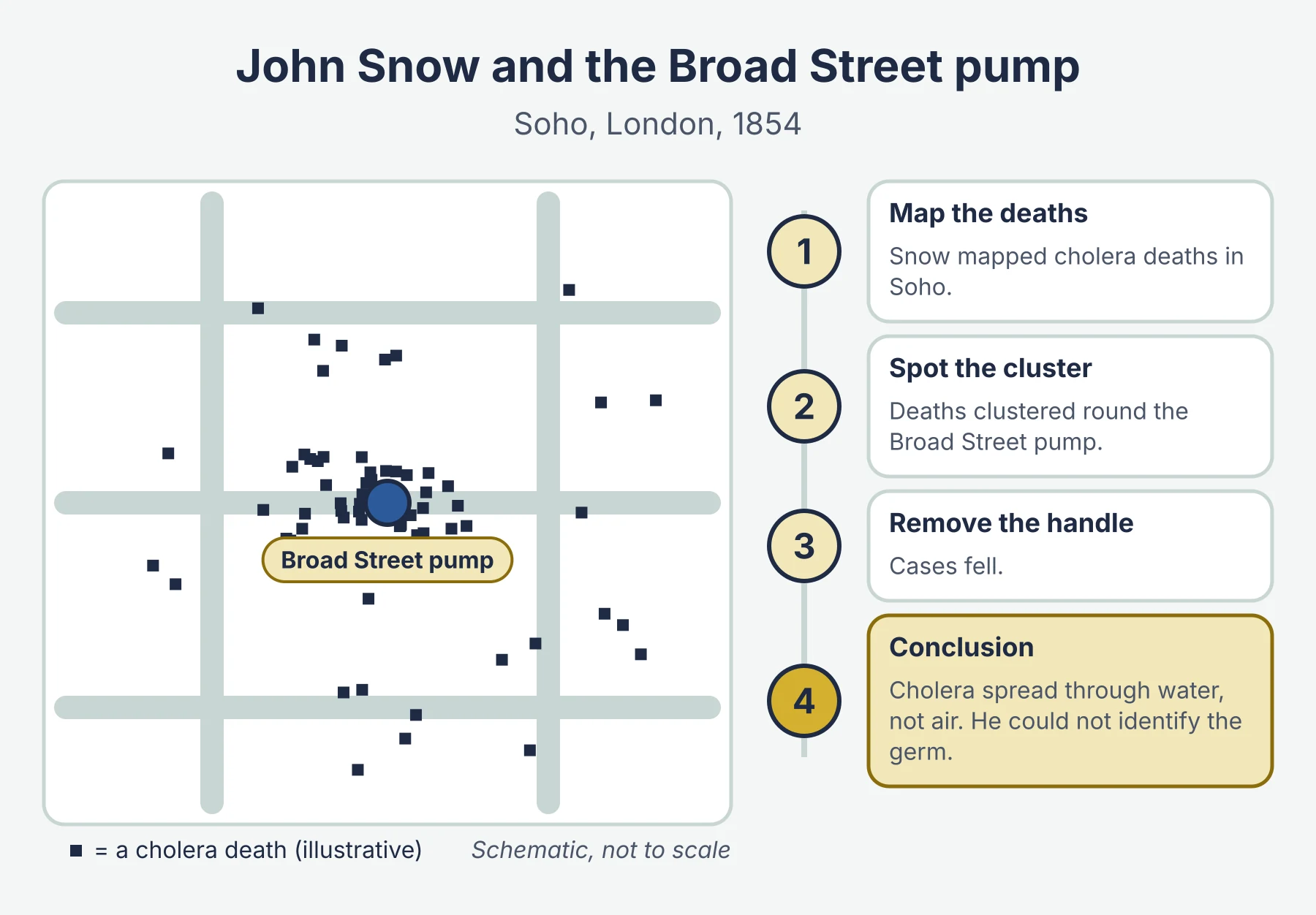
- John Snow mapped cholera deaths in Soho, London, in 1854 and showed they clustered round the Broad Street pump; when the handle was removed, cases fell. He argued that cholera spread through water, not air, although he could not identify the germ.
- After the “Great Stink” of 1858, when the smell of the Thames disrupted Parliament, Joseph Bazalgette built a network of sewers for London.
Government action.
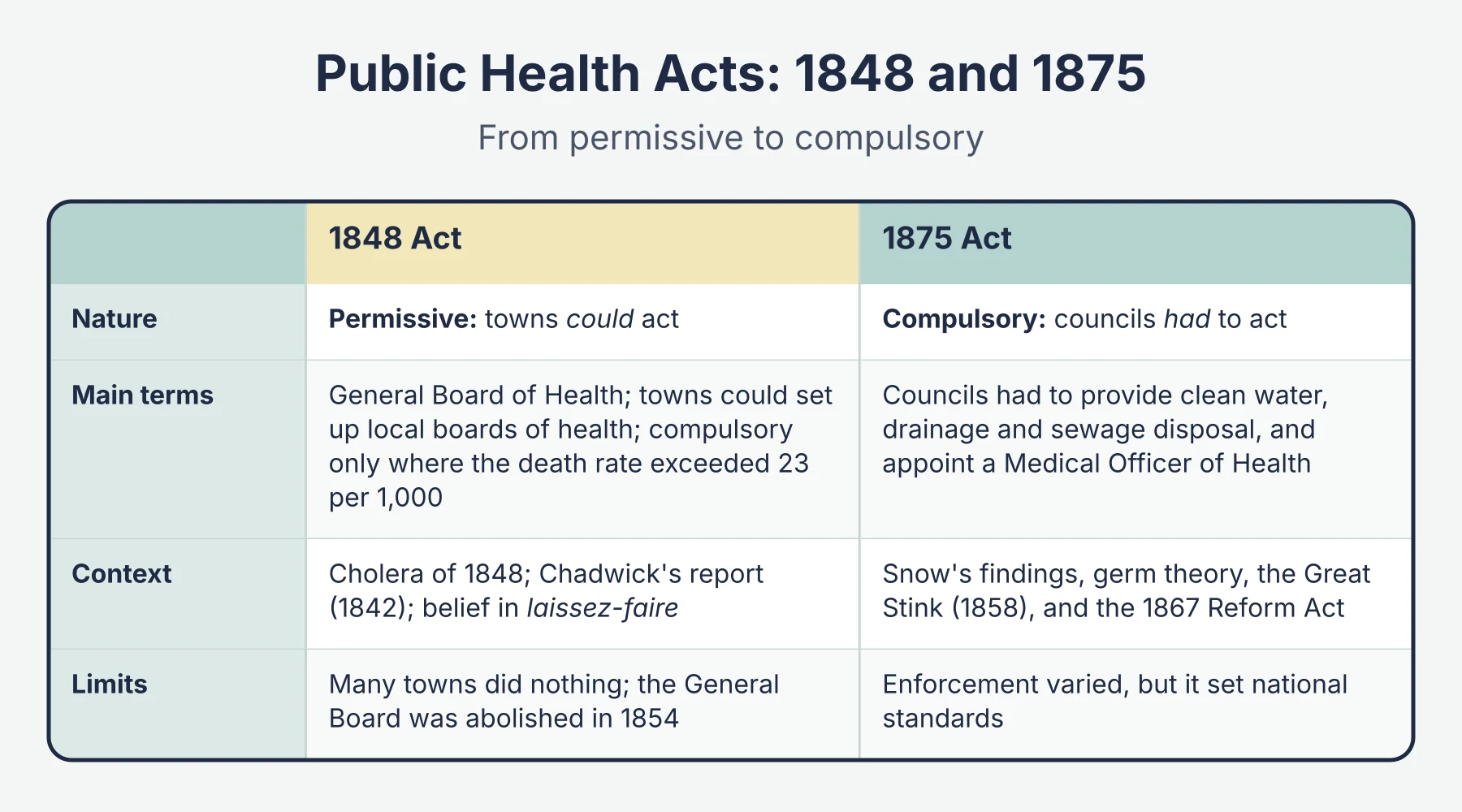
| 1848 Public Health Act | 1875 Public Health Act | |
|---|---|---|
| Nature | Permissive: towns could act | Compulsory: councils had to act |
| Main terms | General Board of Health; towns could set up local boards of health; compulsory only where the death rate exceeded 23 per 1,000 | Councils had to provide clean water, drainage and sewage disposal, and appoint a Medical Officer of Health |
| Context | Cholera of 1848; Chadwick’s report; belief in laissez-faire | Snow’s findings, germ theory, the Great Stink, and the 1867 Reform Act giving the vote to many working men in towns |
| Limits | Many towns did nothing; the General Board was abolished in 1854 | Enforcement varied, but it set national standards |
The factors at work
| Factor | Evidence in Part three |
|---|---|
| Science and technology | Better microscopes, staining, Pasteur’s experiments, chloroform, steam sterilisation |
| Role of the individual | Pasteur, Koch, Ehrlich, Simpson, Lister, Chadwick, Snow, Bazalgette |
| Government | The 1848 and 1875 Public Health Acts; voting reform of 1867 |
| Chance | Chamberland’s forgotten culture; Simpson’s discovery at a dinner experiment |
| Communication | Lister reading Pasteur; publishing in medical journals; Snow’s map |
| War | Franco-Prussian rivalry spurring Pasteur and Koch |
| Superstition and religion | Objections to anaesthetics in childbirth |
Worked example: question 2 (significance)
Explain the significance of Joseph Lister’s work for surgery. [8]
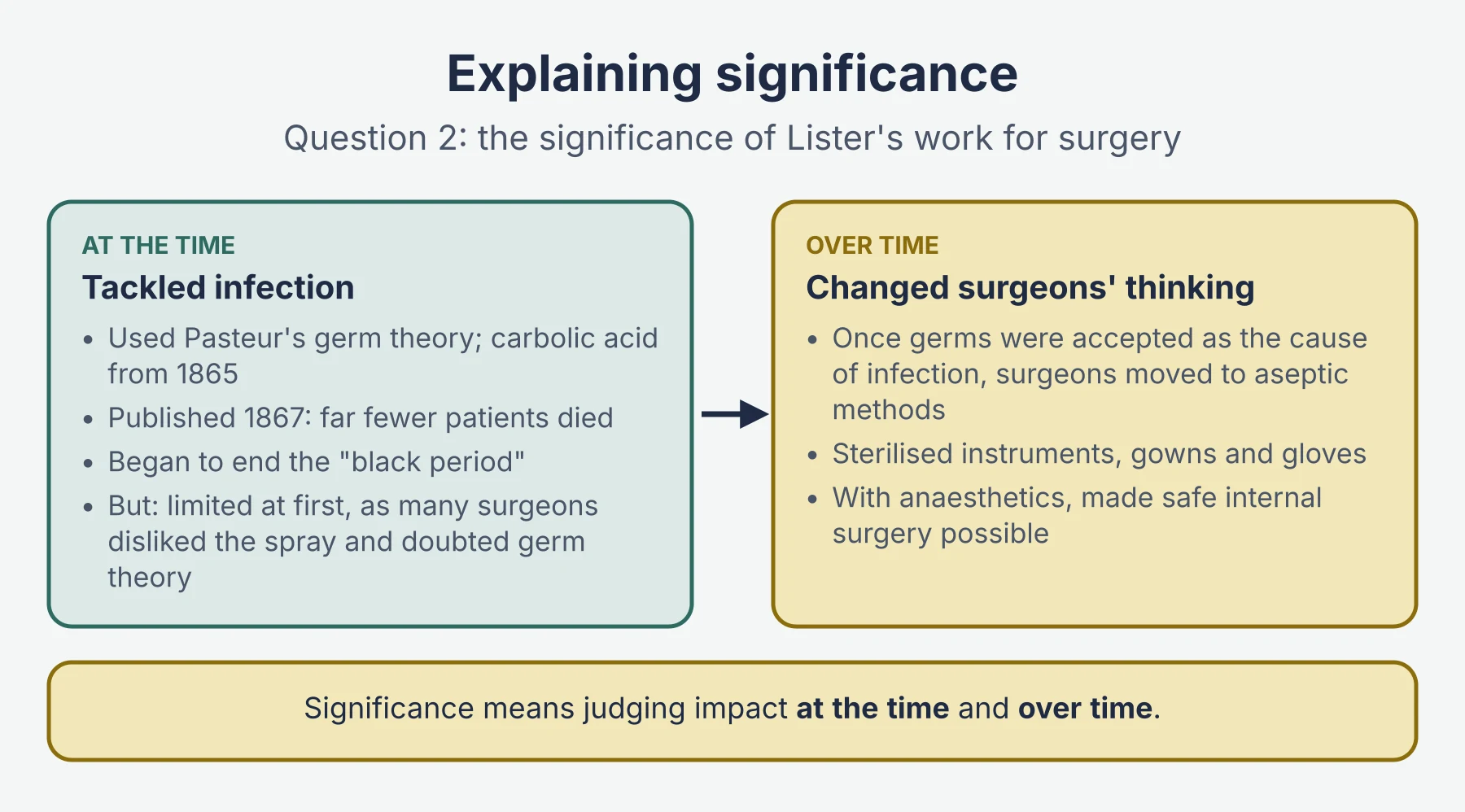
At the time, Lister’s work was significant because it tackled infection, the main cause of death after surgery. Using Pasteur’s germ theory, he treated wounds and theatres with carbolic acid from 1865, and published his results in 1867, showing that far fewer of his patients died. This began to end the “black period” that had followed the introduction of anaesthetics. However, his significance was limited at first, because many surgeons disliked the spray and doubted germ theory. Over time, Lister’s work was more significant still, because it changed surgeons’ thinking: once they accepted that germs caused infection, they moved to aseptic methods such as sterilised instruments, gowns and gloves. Together with anaesthetics, this made safe internal surgery possible, so Lister’s work underlies modern surgery.
The answer considers significance at the time and over time, which is what the specification means by significance.
Common mistakes
- Saying germ theory immediately produced cures; Salvarsan (1909) was the first chemical cure.
- Confusing antiseptic (killing germs) with aseptic (excluding them).
- Saying Snow knew about germs; he proved a link with water before the cholera germ was identified.
- Treating the 1848 Act as compulsory everywhere.
- Ignoring factor interaction: Lister needed Pasteur (communication and science) as well as his own skill.
Further practice
- Revolution in medicine revision notes
- Revolution in medicine practice questions
- Shaping the Nation revision notes
Specification
AQA GCSE History (8145) specification, section 3.3.1, Britain: Health and the people, c1000 to the present day, Part three – aqa.org.uk.
Related resources
-
Practice questions
AQA GCSE History (8145): Health and the People – A Revolution in Medicine – Practice Questions
Original AQA GCSE History 8145 Health and the people practice on Part three: source utility, significance, similarity and a factor essay, with full answers.
World History · AQA · GCSE
Try questions -
Revision notes
AQA GCSE History (8145): Health and the People – A Revolution in Medicine – Revision Notes
Revision notes for AQA GCSE History 8145 Health and the people, Part three: germ theory, surgery, cholera, reformers and the 1848 and 1875 Acts.
World History · AQA · GCSE
Revise topic -
Study guides
AQA GCSE History: Paper 2 Shaping the Nation — Thematic Study and Depth Study Options
The thematic study and British depth study options in AQA GCSE History 8145 Paper 2, Shaping the nation, and how to approach each once your school has chosen.
World History · AQA · GCSE
Read guide
Get free revision emails (optional)
Occasional emails with practice questions, worked explanations and links to free resources for the qualification and subjects you choose. No spam, and you can unsubscribe from any email. The free tools on this site never need an email.