
Revision Notes
AQA GCSE History (8145): Elizabethan Religious Matters and Mary Queen of Scots – Revision Notes
Revision notes for AQA GCSE History 8145 Elizabethan England: the Catholic threat, missionaries, plots, Puritans, Mary Queen of Scots and her execution.
- Subject
- World History
- Level
- GCSE
- Topic
- Shaping the Nation
- Author
- Marlbridge Academic Team
- Updated
- Reviewed by
- Azam Siddique (what this means)
Aligned to AQA GCSE World History (8145), first teaching 2016. Official specification .
Syllabus page (what it covers and how it is assessed): AQA GCSE World History.
Syllabus points this page covers
8145
- 3.3.2 Section B: British depth studies
This page covers 1 of the 2 subtopics in topic 2, Shaping the nation.
Found an error? Report a correction.
Need help with this topic? Request a free trial class for GCSE World History (8145).
Condensed notes on Part three of Elizabethan England, c1568-1603. The specification names “Religious matters: the question of religion, English Catholicism and Protestantism; the Northern Rebellion; Elizabeth’s excommunication; the missionaries; Catholic plots and the threat to the Elizabethan settlement; the nature and ideas of the Puritans and Puritanism” and “Mary Queen of Scots: background; Elizabeth and Parliament’s treatment of Mary; the challenge posed by Mary; plots; execution and its impact.” Explanations and a worked account are in the Elizabethan religion and Mary Queen of Scots study guide; the depth study’s place in Paper 2 is in the Shaping the Nation revision notes.
Timeline
| Date | Event |
|---|---|
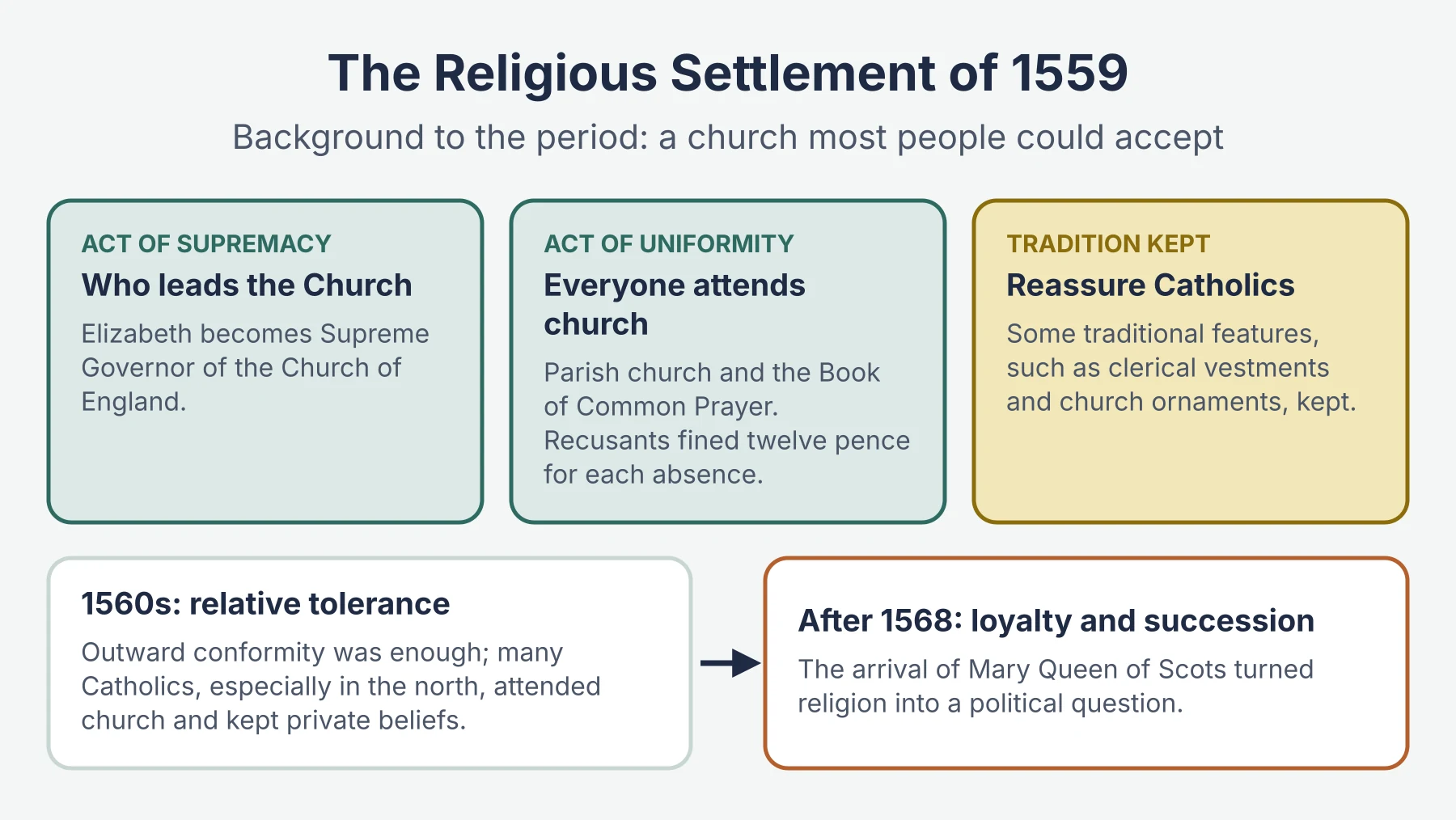
| 1559 | Religious Settlement: Acts of Supremacy and Uniformity (background) |
| 1567 | Darnley murdered; Mary forced to abdicate |
| May 1568 | Mary defeated at Langside; flees to England |
| 1568 | Allen founds the English college at Douai |
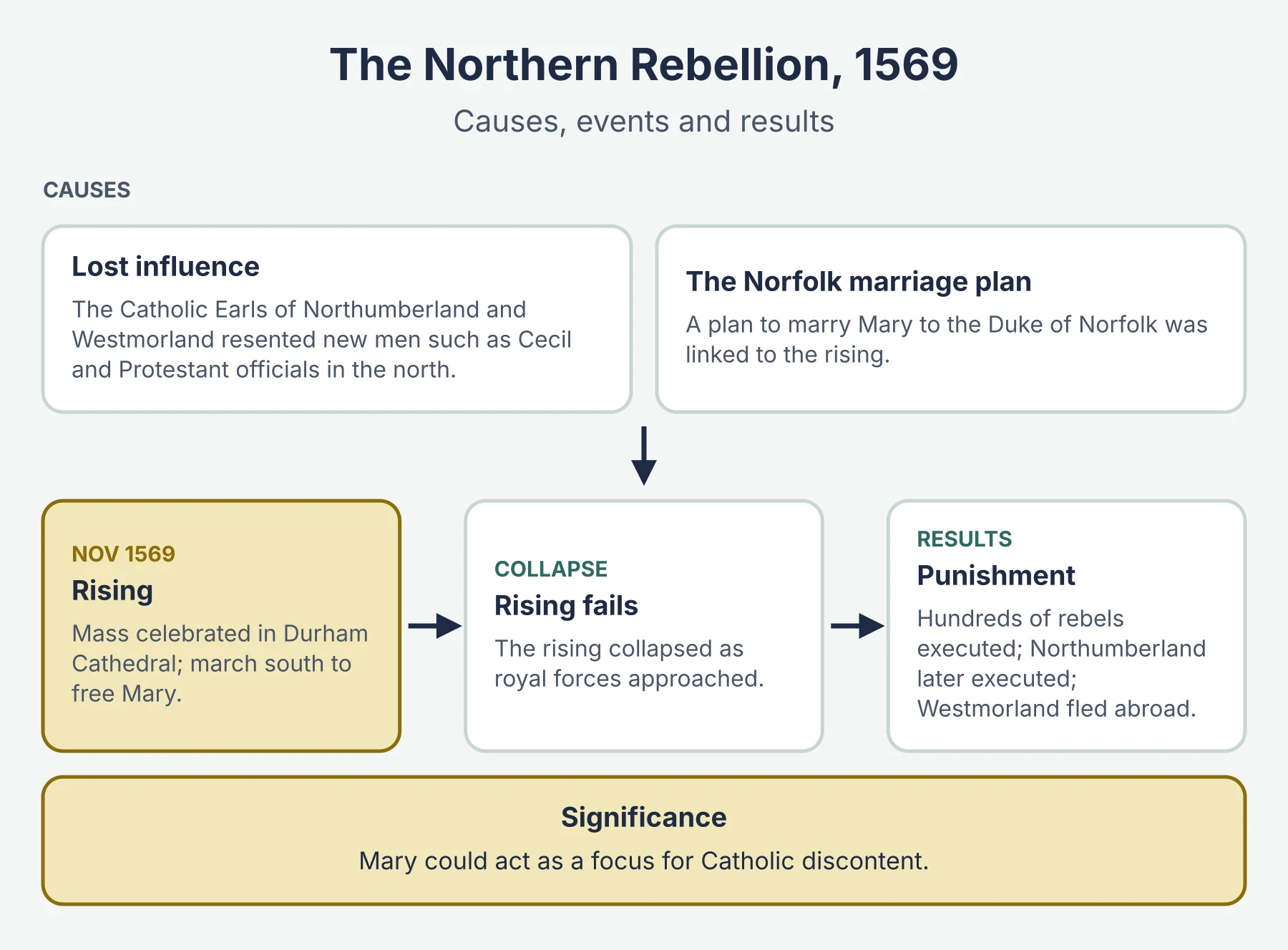
| November 1569 | Northern Rebellion; Mass in Durham Cathedral |
| 1570 | Regnans in Excelsis: Elizabeth excommunicated |
| 1571 | Ridolfi Plot; Treason Act |
| 1572 | Duke of Norfolk executed |
| 1574 | First seminary priests arrive |
| 1577 | Archbishop Grindal suspended over prophesyings |
| 1580 | First Jesuits, including Campion, arrive |
| 1581 | Campion executed; recusancy fine raised to £20 a month |
| 1583 | Throckmorton Plot; Whitgift becomes Archbishop |
| 1584 | Bond of Association |
| 1585 | Act against Jesuits and seminary priests; Act for the Queen’s Safety |
| 1586 | Babington Plot; Mary tried at Fotheringhay |
| 8 February 1587 | Mary executed |
| 1588 | Spanish Armada defeated |
| 1588-89 | Marprelate Tracts |
| 1593 | Act against separatists; Barrow and Greenwood executed |
The religious spectrum
| Group | Beliefs | Threat to Elizabeth |
|---|---|---|
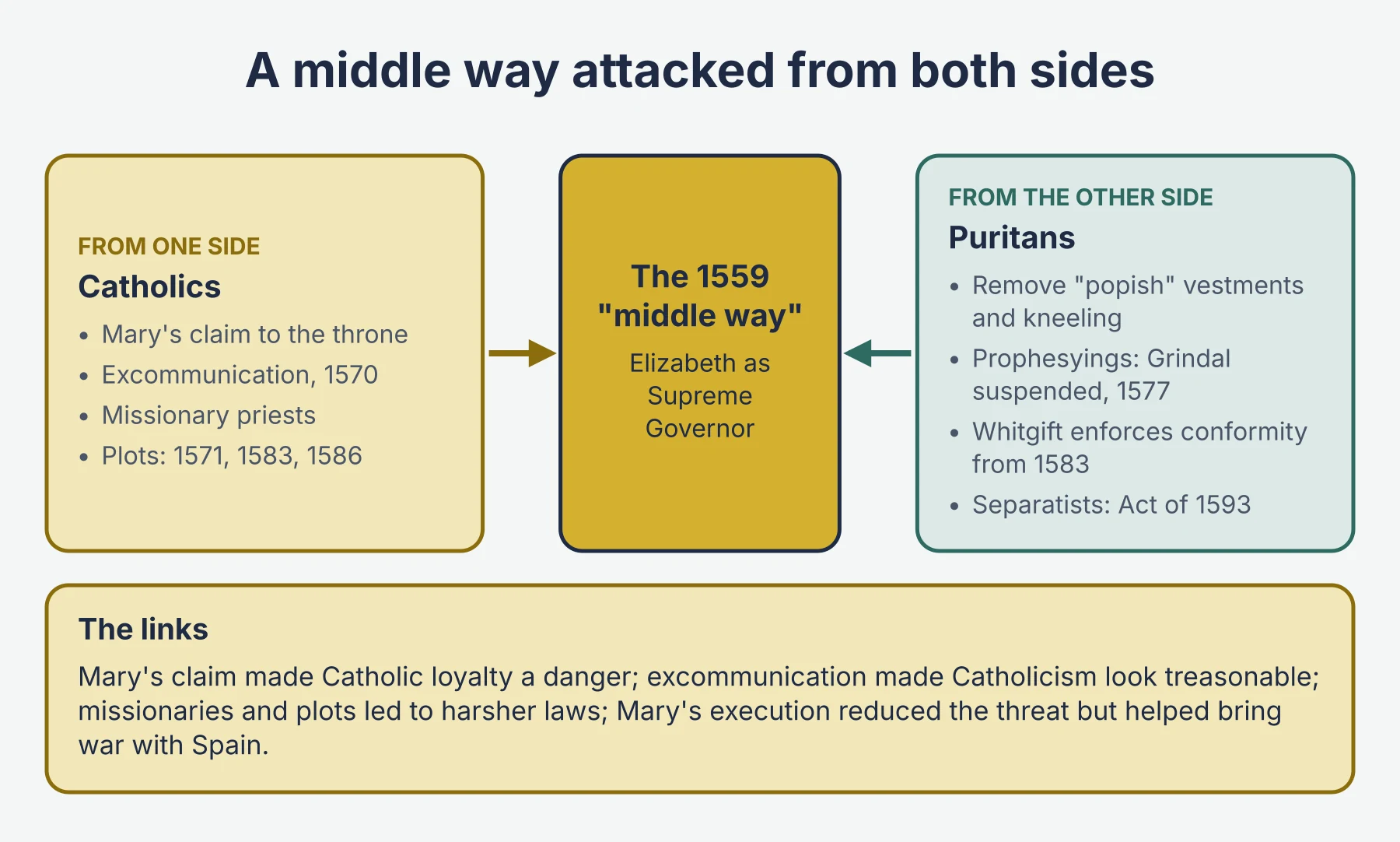
| Catholics | Loyal to the pope; Mass; many saw Elizabeth as illegitimate | Rebellion, plots, foreign invasion, especially after 1570 |
| Church of England | 1559 Settlement; Elizabeth Supreme Governor | None: the official church |
| Puritans | Remove “popish” practices; preaching; some wanted Presbyterianism | Challenged her authority over the church |
| Separatists | Leave the Church of England altogether | Seen as a threat to order; harshly punished |
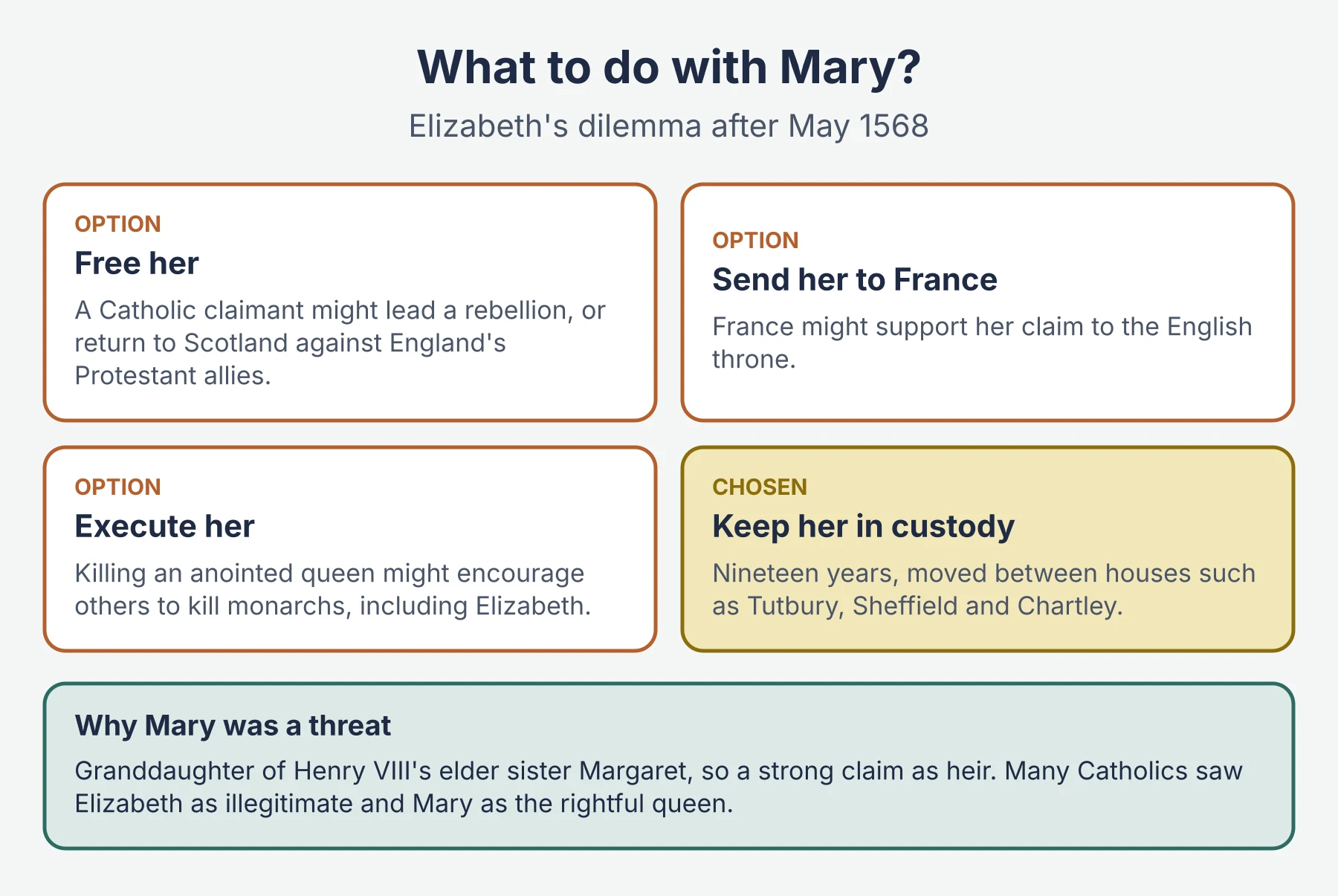
Why Mary was a threat, and why Elizabeth kept her alive
Threat: strong claim through Margaret Tudor; Catholic; focus for rebellion and plots; possible French or Spanish support. Dilemma: freeing her risked rebellion; sending her abroad risked foreign support; executing a queen set a dangerous precedent. So she was kept in custody for nineteen years.
The plots in order
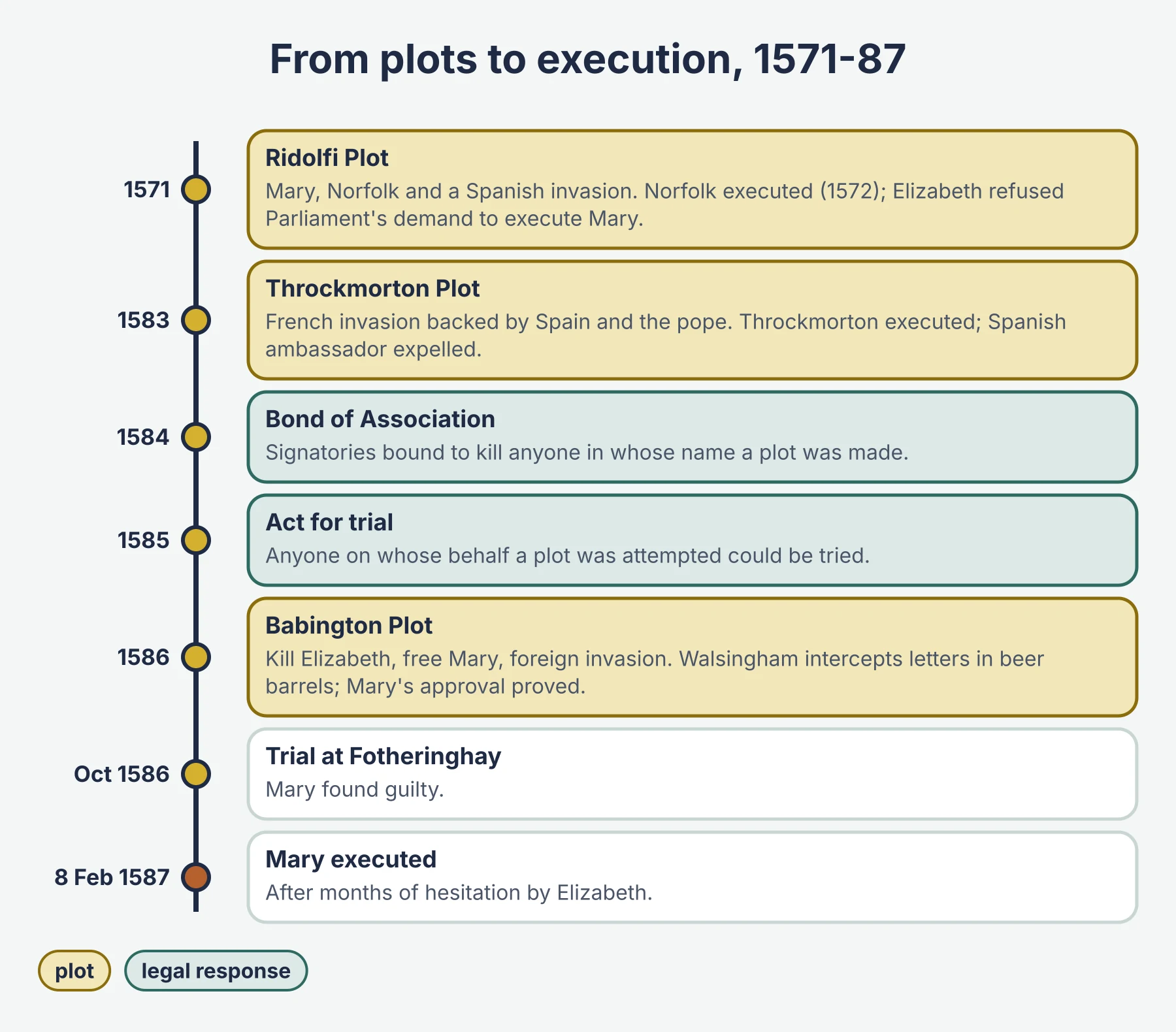
- Ridolfi (1571): Spanish invasion; Mary to marry Norfolk; Norfolk executed 1572.
- Throckmorton (1583): French-led invasion; Spanish ambassador expelled.
- Babington (1586): kill Elizabeth; Walsingham’s intercepted beer-barrel letters; Mary’s approval proved.
Government responses
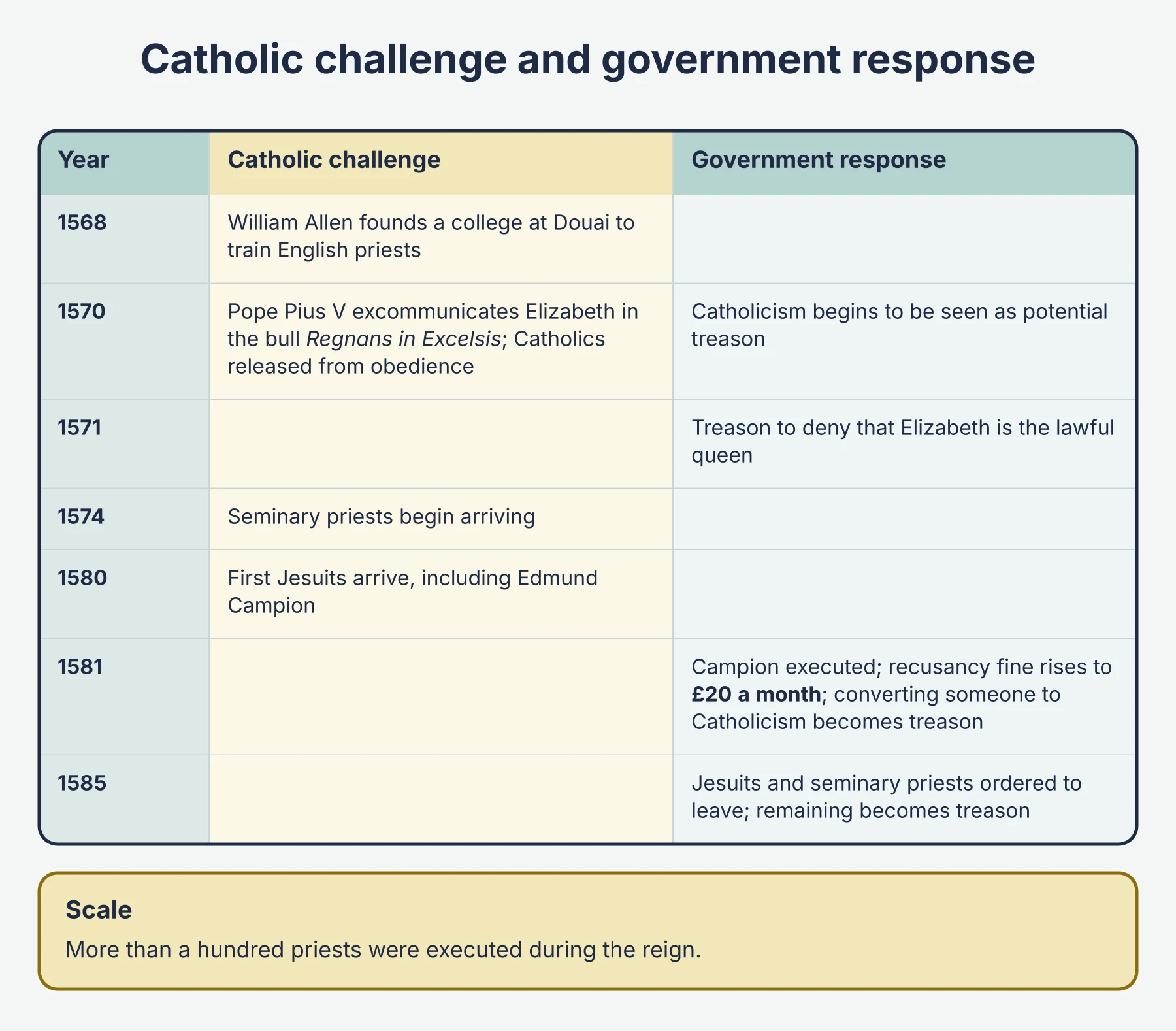
- Laws: Treason Act 1571; 1581 Act (£20 a month fine; conversion to Catholicism treason); 1585 Act (priests to leave or face treason); 1593 Act against separatists.
- Spying: Walsingham’s network of agents and double agents.
- Executions: more than a hundred priests; Campion (1581); plotters.
- Against Puritans: Grindal suspended (1577); Whitgift enforces conformity; crackdown after Marprelate.
- Parliament: pressed for Mary’s execution from 1572; Bond of Association (1584).
Impact of Mary’s execution
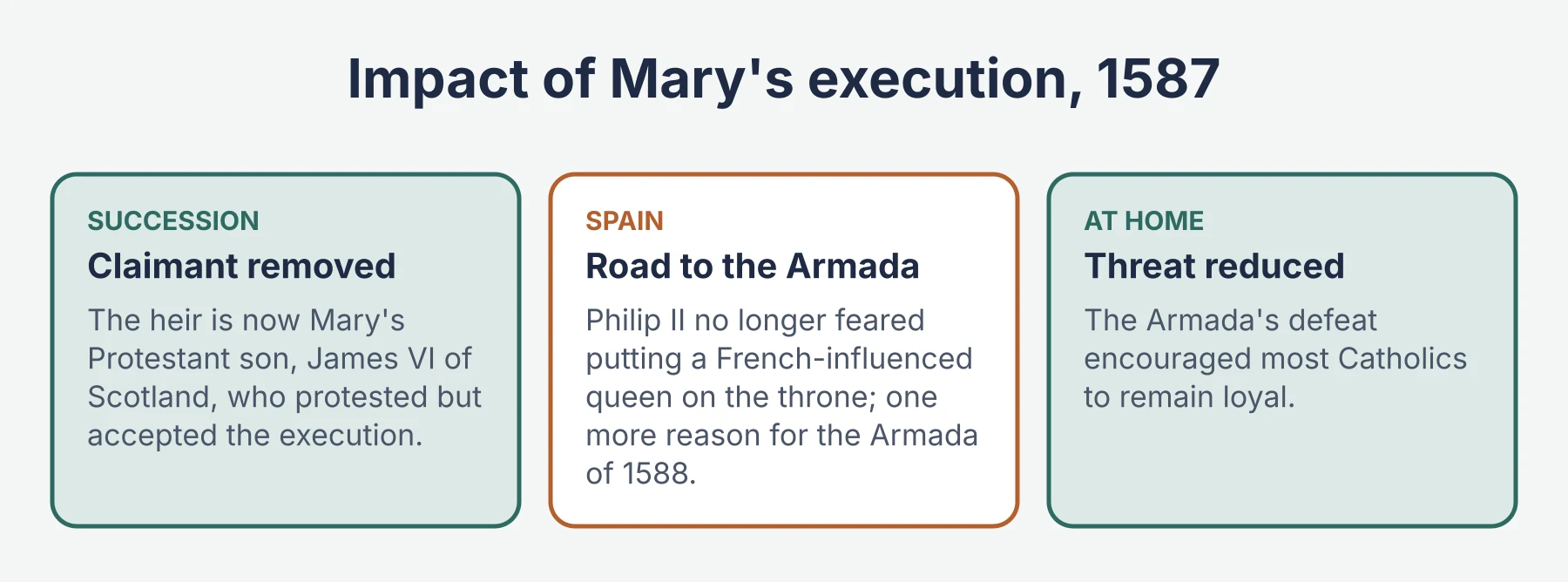
- Main Catholic claimant removed; heir now Protestant James VI.
- Philip II freed to invade without helping a French-linked queen; Armada 1588.
- Most English Catholics stayed loyal during the Armada crisis.
Key terms
| Term | Meaning |
|---|---|
| Recusant | Someone who refused to attend Church of England services |
| Excommunication | Expulsion from the Catholic Church by the pope |
| Papal bull | A formal order from the pope |
| Seminary priest | English Catholic priest trained abroad, for example at Douai |
| Jesuit | Member of the Society of Jesus, a Catholic missionary order |
| Priest hole | A hiding place for priests in Catholic houses |
| Puritan | Protestant wanting further reform of the Church of England |
| Prophesying | Puritan meeting for preaching and Bible study |
| Separatist | Protestant who wanted to leave the Church of England |
| Bond of Association | 1584 oath to kill anyone in whose name a plot was made |
Exam traps
- Seminary priests (from 1574) are not the same as Jesuits (from 1580).
- Put the plots in order: Ridolfi, Throckmorton, Babington.
- Puritans were Protestants, not Catholics.
- The 1559 Settlement is background; the study begins c1568.
- In a question 1 interpretation answer, test the interpretation against precise knowledge, not general impressions.
Self-test
- What did the Act of Uniformity require?
- Why did many Catholics see Mary as the rightful queen?
- Where was Mary defeated before fleeing to England?
- What happened in Durham Cathedral in 1569?
- What did Regnans in Excelsis do?
- Who founded the college at Douai?
- Which Jesuit was executed in 1581?
- Name the three main plots in order.
- How did Walsingham trap Mary in 1586?
- When was Mary executed?
- What did Puritans want?
- Why was Grindal suspended?
Answers
- Attendance at parish church using the Book of Common Prayer, with fines for absence.
- They saw Elizabeth as illegitimate, and Mary descended from Henry VIII’s sister Margaret.
- At Langside, in 1568.
- The Northern rebels celebrated Mass there.
- Excommunicated Elizabeth and released Catholics from obedience to her.
- William Allen.
- Edmund Campion.
- Ridolfi (1571), Throckmorton (1583), Babington (1586).
- He intercepted letters smuggled in beer barrels and obtained Mary’s approval of the plot.
- 8 February 1587.
- Further reform: removing “popish” practices, more preaching, and for some no bishops.
- He refused to suppress prophesyings.
Try the Elizabethan religion and Mary Queen of Scots practice questions.
Related resources
-
Study guides
AQA GCSE History (8145): Health and the People – A Revolution in Medicine
AQA GCSE History 8145 Health and the people, Part three: germ theory, Pasteur, Koch and Ehrlich, anaesthetics, antiseptics, cholera and the Public Health Acts.
World History · AQA · GCSE
Read guide -
Practice questions
AQA GCSE History (8145): Health and the People – A Revolution in Medicine – Practice Questions
Original AQA GCSE History 8145 Health and the people practice on Part three: source utility, significance, similarity and a factor essay, with full answers.
World History · AQA · GCSE
Try questions -
Revision notes
AQA GCSE History (8145): Health and the People – A Revolution in Medicine – Revision Notes
Revision notes for AQA GCSE History 8145 Health and the people, Part three: germ theory, surgery, cholera, reformers and the 1848 and 1875 Acts.
World History · AQA · GCSE
Revise topic
Get free revision emails (optional)
Occasional emails with practice questions, worked explanations and links to free resources for the qualification and subjects you choose. No spam, and you can unsubscribe from any email. The free tools on this site never need an email.