
Study Guides
AQA GCSE History (8145): Elizabethan Religious Matters and Mary Queen of Scots
AQA GCSE History 8145 Elizabethan England, Part three: Catholics, missionaries, plots, Puritans, Elizabeth's policies and the challenge and execution of Mary.
- Subject
- World History
- Level
- GCSE
- Topic
- Shaping the Nation
- Author
- Marlbridge Academic Team
- Updated
- Reviewed by
- Azam Siddique (what this means)
Aligned to AQA GCSE World History (8145), first teaching 2016. Official specification .
Syllabus page (what it covers and how it is assessed): AQA GCSE World History.
Syllabus points this page covers
8145
- 3.3.2 Section B: British depth studies
This page covers 1 of the 2 subtopics in topic 2, Shaping the nation.
Found an error? Report a correction.
Need help with this topic? Request a free trial class for GCSE World History (8145).
This guide covers two content statements in Part three, “Troubles at home and abroad”, of the British depth study Elizabethan England, c1568-1603. The specification names “Religious matters: the question of religion, English Catholicism and Protestantism; the Northern Rebellion; Elizabeth’s excommunication; the missionaries; Catholic plots and the threat to the Elizabethan settlement; the nature and ideas of the Puritans and Puritanism; Elizabeth and her government’s responses and policies towards religious matters” and “Mary Queen of Scots: background; Elizabeth and Parliament’s treatment of Mary; the challenge posed by Mary; plots; execution and its impact.” The Shaping the Nation options guide notes that these two strands must be connected; this page shows how.
The question of religion
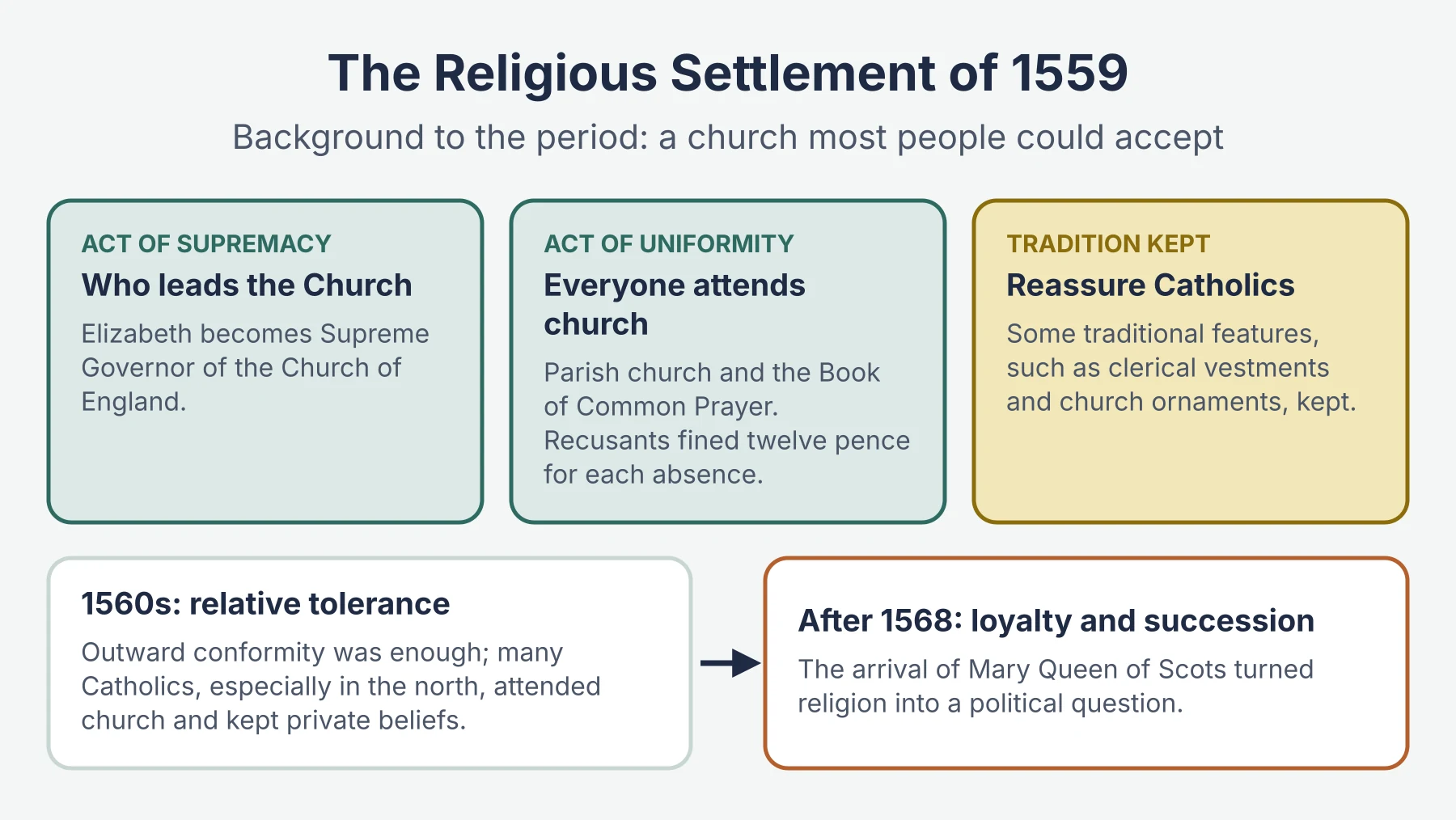
Elizabeth inherited a divided country. Her father Henry VIII had broken with Rome; her brother Edward VI had made England Protestant; her sister Mary I had restored Catholicism and burned Protestants. Elizabeth’s Religious Settlement of 1559, before the period of this study begins but the background to all of it, tried to create a church most people could accept:
- The Act of Supremacy made Elizabeth Supreme Governor of the Church of England.
- The Act of Uniformity required everyone to attend their parish church, using the Book of Common Prayer; those who refused, recusants, paid a fine of twelve pence for each absence.
- Some traditional features, such as clerical vestments and church ornaments, were kept, to reassure Catholics.
In the 1560s Elizabeth was relatively tolerant: in a phrase later attributed to her, she did not wish to “make windows into men’s souls”, so outward conformity was enough, and many Catholics, especially in the north, attended church while keeping their private beliefs. After 1568 the arrival of Mary Queen of Scots turned religion into a question of loyalty and succession.
Mary Queen of Scots: background and challenge
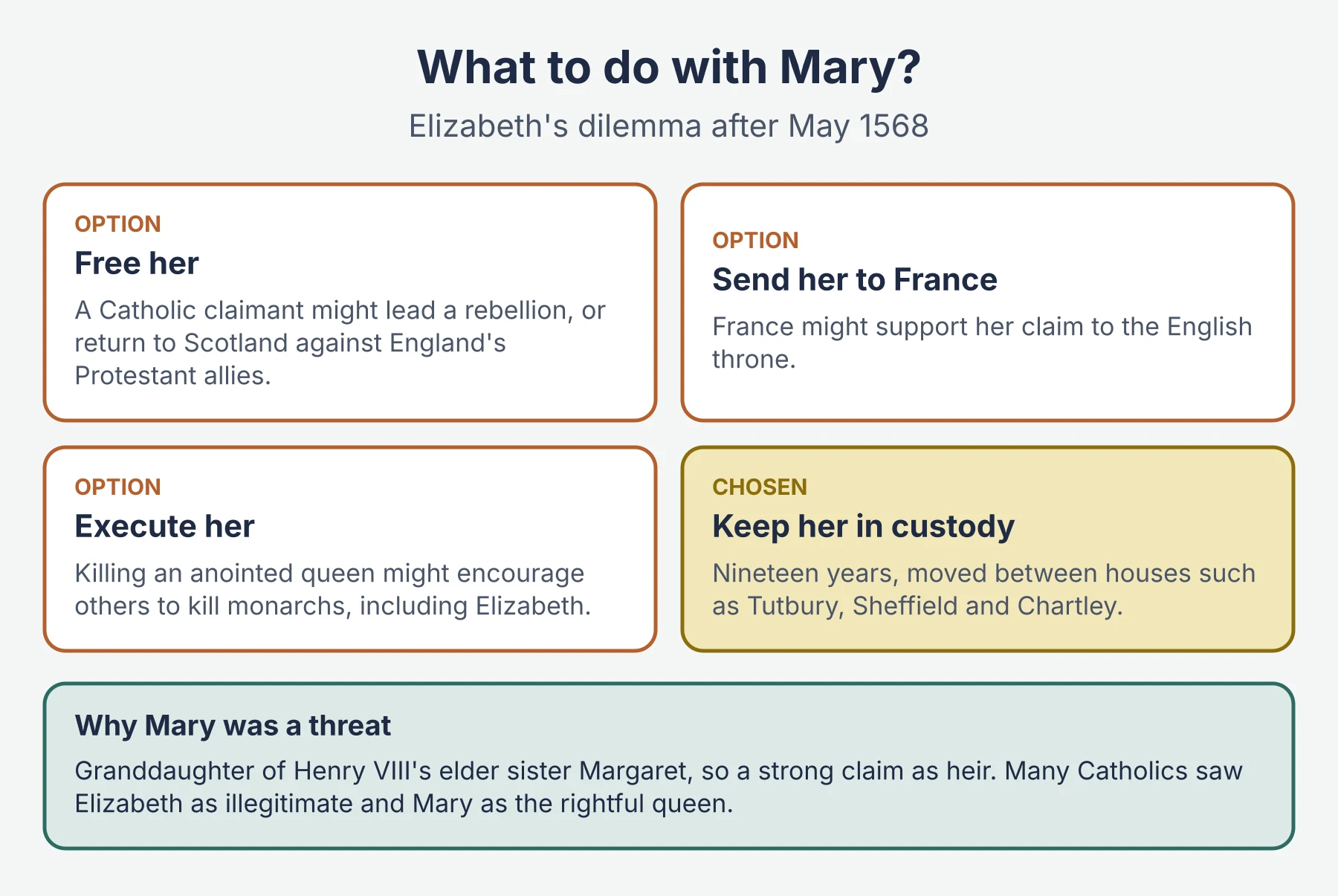
Mary was the granddaughter of Henry VIII’s elder sister Margaret, so she had a strong claim to be Elizabeth’s heir. Many Catholics regarded Elizabeth, the daughter of Anne Boleyn, as illegitimate, and therefore saw Mary as the rightful queen. Mary had been queen of Scotland since infancy and had been married to the king of France. After the murder of her second husband, Lord Darnley, in 1567 and her marriage to the Earl of Bothwell, the suspected murderer, Scottish nobles forced her to abdicate in favour of her infant son James. She escaped, was defeated at Langside, and in May 1568 fled to England.
Mary posed a dilemma. Freeing her might put a Catholic claimant at the head of rebellion or return her to Scotland against England’s Protestant allies; sending her to France might bring French support for her claim; executing an anointed queen might encourage others to kill monarchs, including Elizabeth. So Elizabeth kept her in custody for nineteen years, moving her between houses such as Tutbury, Sheffield and Chartley.
The Northern Rebellion, 1569
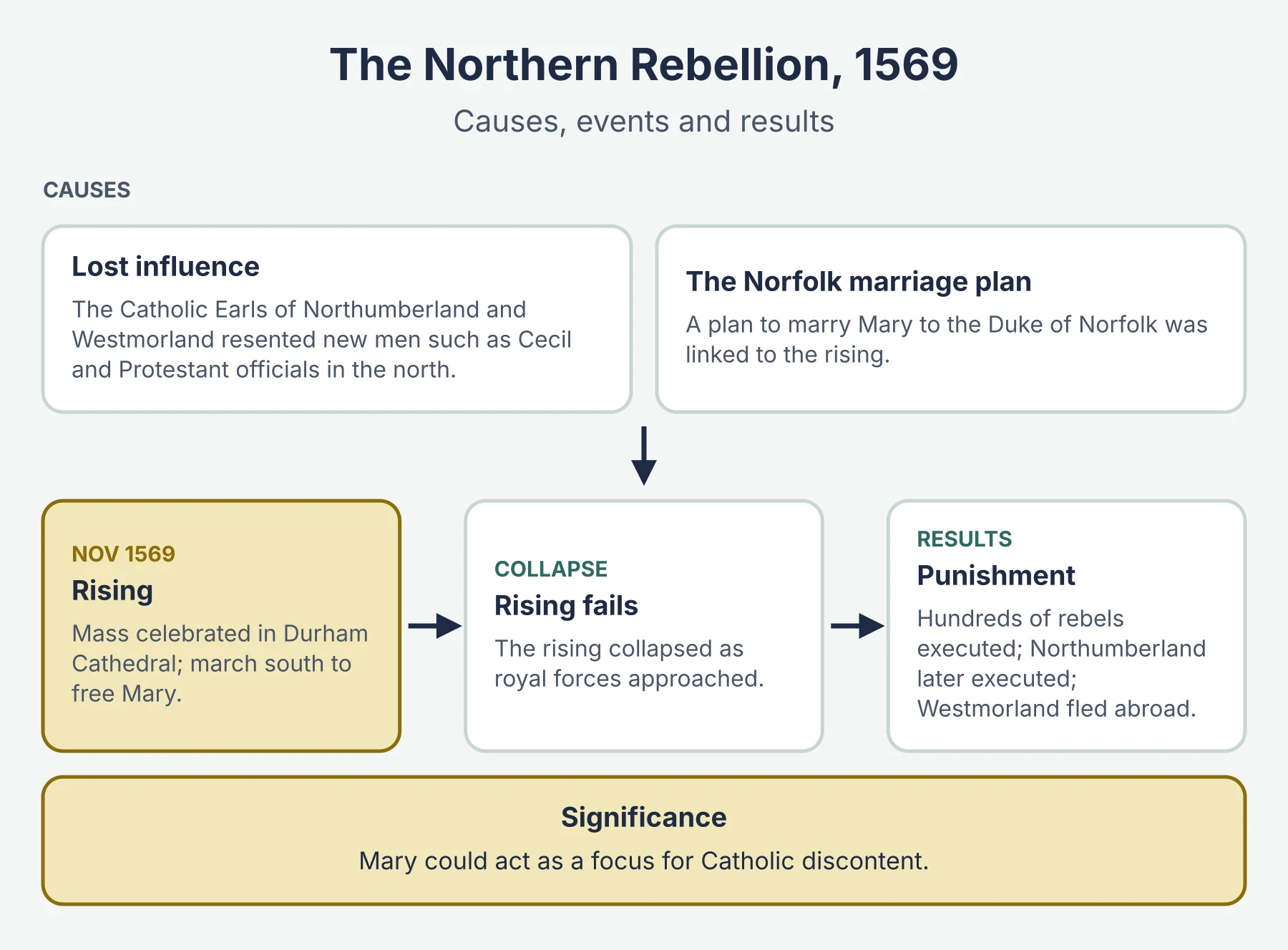
The Catholic Earls of Northumberland and Westmorland resented their loss of influence to new men such as Cecil and to Protestant officials in the north. A plan to marry Mary to the Duke of Norfolk was linked to their rising in November 1569. The rebels celebrated Mass in Durham Cathedral and marched south, aiming to free Mary, but the rising collapsed as royal forces approached. Hundreds of rebels were executed, Northumberland was later executed, and Westmorland fled abroad. The rebellion showed that Mary could act as a focus for Catholic discontent.
Excommunication and the missionaries
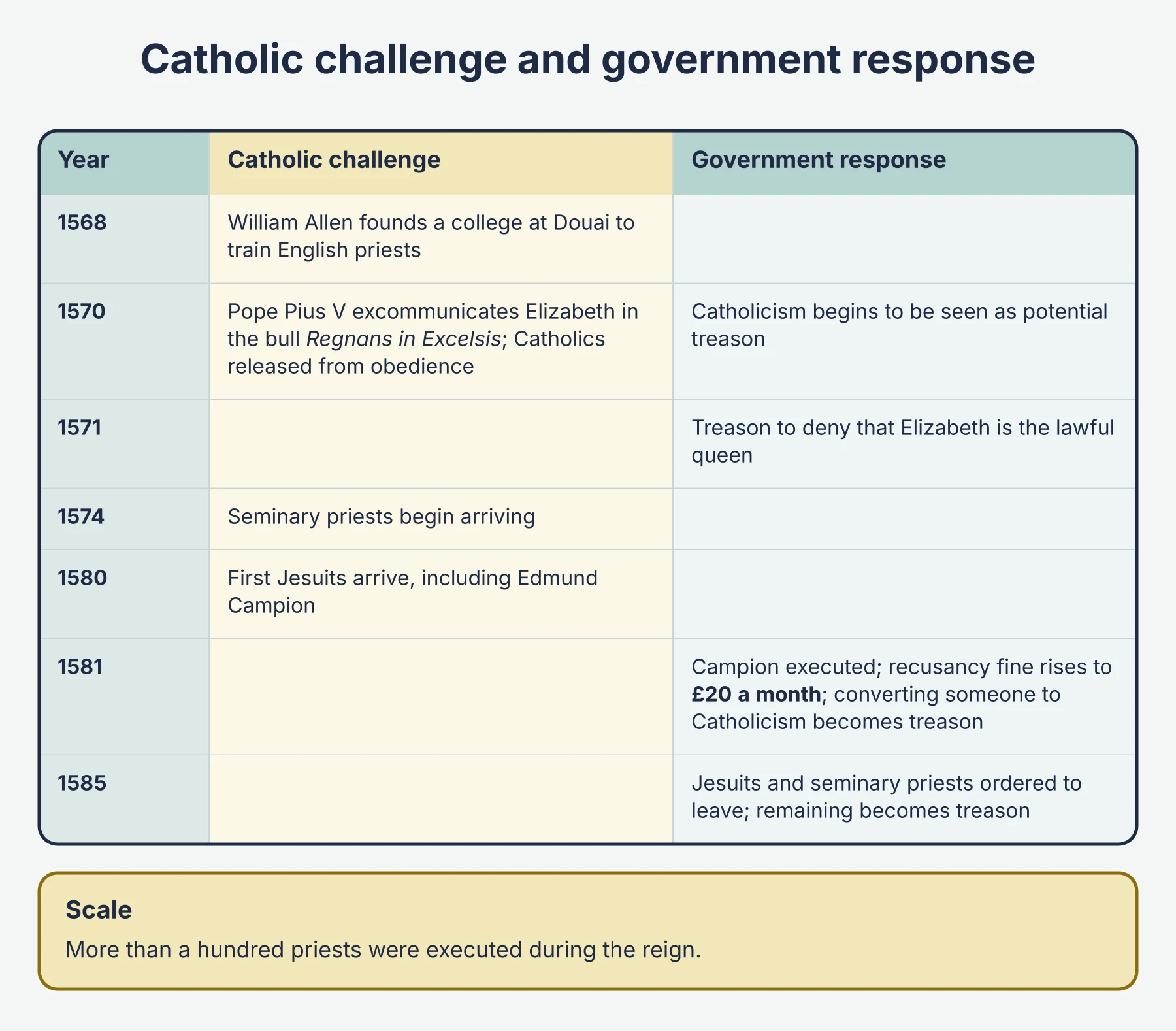
In 1570 Pope Pius V issued a papal bull, Regnans in Excelsis, excommunicating Elizabeth and releasing Catholics from obedience to her. English Catholics now faced a choice between pope and queen, and the government began to see Catholicism as potential treason. A 1571 Act made it treason to deny that Elizabeth was the lawful queen.
William Allen founded a college at Douai in 1568 to train English priests. Seminary priests began arriving in England in 1574, and the first Jesuits, including Edmund Campion, came in 1580. They travelled secretly between Catholic households, often hidden in priest holes. Campion was captured in 1581 and executed. The government’s laws tightened: in 1581 the recusancy fine rose to £20 a month, and converting someone to Catholicism became treason; in 1585 Jesuits and seminary priests were ordered to leave the country, and remaining became treason. More than a hundred priests were executed during the reign.
Catholic plots
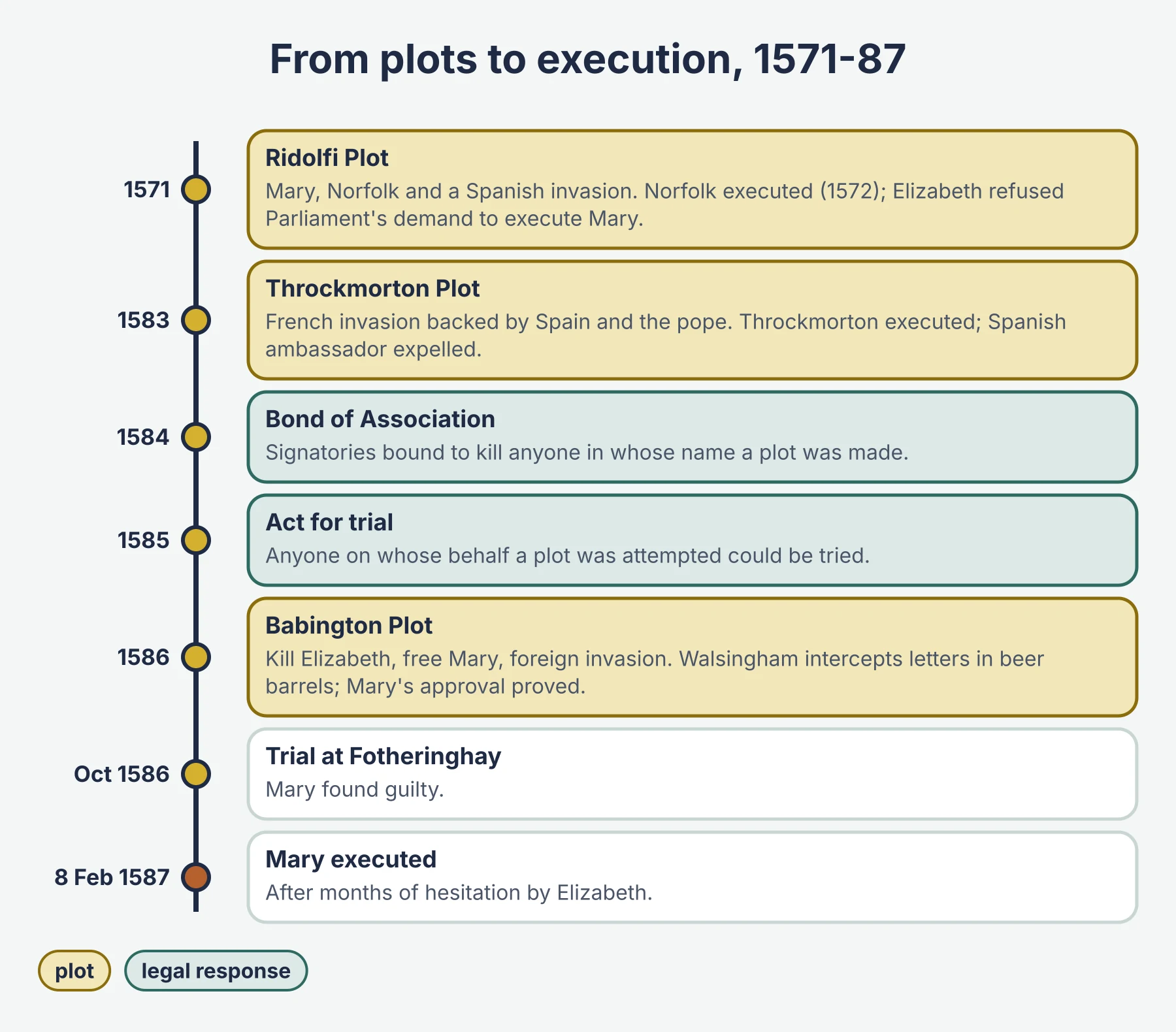
| Plot | Date | Aim | Outcome |
|---|---|---|---|
| Ridolfi | 1571 | A Florentine banker linked Mary, Norfolk and a Spanish invasion from the Netherlands | Uncovered; Norfolk executed (1572); Parliament demanded Mary’s execution, but Elizabeth refused |
| Throckmorton | 1583 | French invasion, backed by Spain and the pope, to free Mary | Throckmorton executed; Spanish ambassador expelled |
| Babington | 1586 | Kill Elizabeth, free Mary, foreign invasion | Walsingham intercepted letters smuggled in beer barrels; Mary’s approval proved; Babington executed |
After Throckmorton, the Bond of Association (1584) bound its signatories to kill anyone in whose name a plot was made, and an Act of 1585 provided for the trial of anyone on whose behalf such a plot was attempted. The Babington letters gave Walsingham the evidence. Mary was tried at Fotheringhay in October 1586 and found guilty.
Execution and its impact
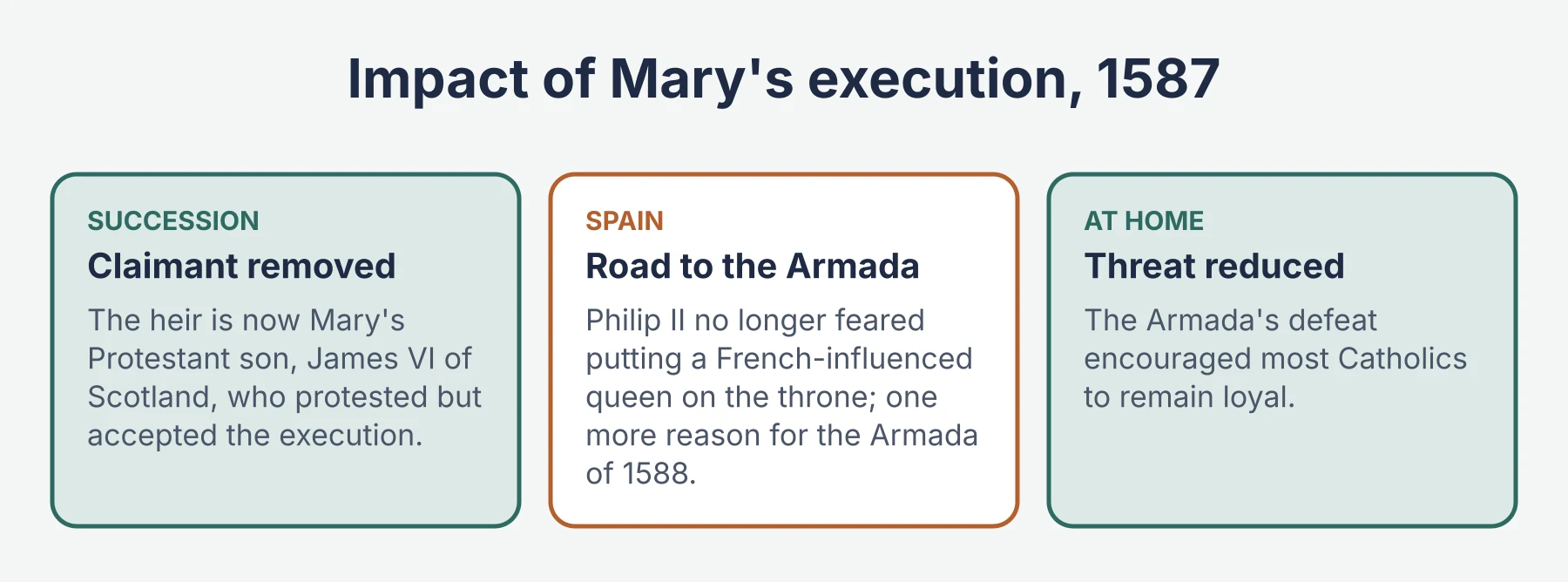
Elizabeth hesitated for months before signing the death warrant. Mary was executed on 8 February 1587. Elizabeth claimed the warrant had been sent without her consent and punished her secretary, William Davison. The impact:
- The main Catholic claimant was removed; the heir was now Mary’s Protestant son, James VI of Scotland, who protested but accepted the execution.
- Philip II of Spain no longer had to fear that a successful invasion would put a French-influenced queen on the throne, and the execution added to his reasons for the Armada of 1588.
- At home, the Catholic threat was reduced, and the Armada’s defeat encouraged most Catholics to remain loyal.
Puritans and Puritanism
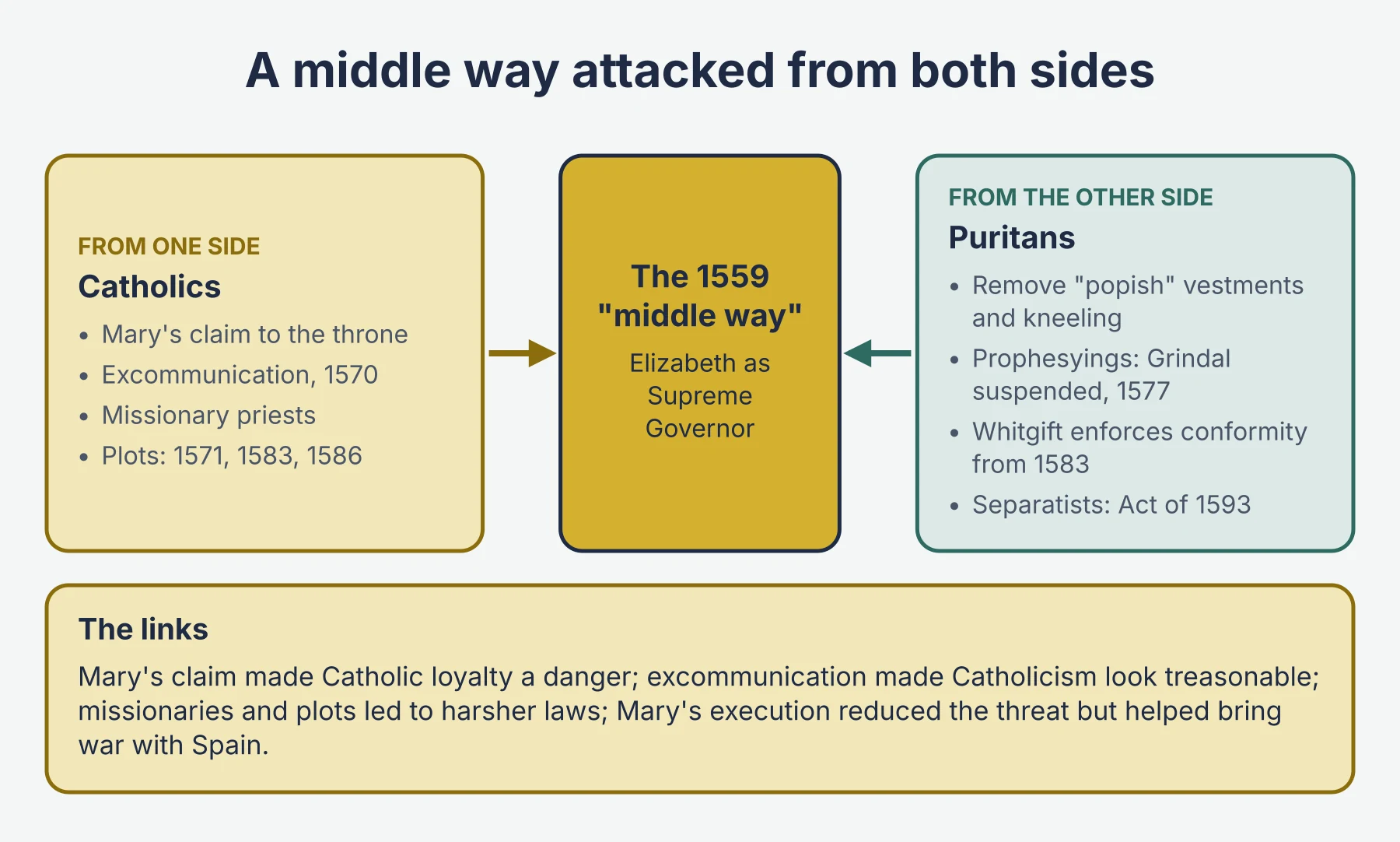
Puritans were Protestants who believed the 1559 Settlement had not gone far enough. They wanted to remove “popish” practices such as vestments, kneeling at communion and the sign of the cross; they valued preaching and Bible study; some, such as Thomas Cartwright, wanted to replace bishops with a Presbyterian system. Some held senior posts and had support at court.
Elizabeth saw Puritanism as a challenge to her authority as Supreme Governor. When Archbishop Edmund Grindal refused to suppress Puritan meetings for preaching and study called prophesyings, she suspended him in 1577. His successor, John Whitgift (from 1583), enforced conformity. In 1588-89 the anonymous Marprelate Tracts mocked the bishops, provoking a crackdown. Separatists, who wanted to leave the Church of England altogether, were treated harshly: an Act of 1593 targeted them, and the separatist leaders Henry Barrow and John Greenwood were executed that year.
Linking the strands
Religion and the succession were inseparable: Mary’s claim made Catholic loyalty a political danger; excommunication made Catholicism look treasonable; missionaries and plots led to harsher laws; Mary’s execution reduced the threat but helped bring war with Spain. Puritans, meanwhile, challenged the settlement from the opposite direction, showing that Elizabeth’s “middle way” was attacked from both sides.
Worked example: question 3 account
Write an account of the ways in which Mary Queen of Scots threatened Elizabeth in the years 1568-87. [8]
When Mary fled to England in 1568, she immediately became a threat because many Catholics believed she, not Elizabeth, was the rightful queen. This led to the Northern Rebellion of 1569, when the Earls of Northumberland and Westmorland rose partly to free her and marry her to the Duke of Norfolk. The Pope’s excommunication of Elizabeth in 1570 made the danger greater, since Catholics were now told they need not obey Elizabeth, and Mary became the centre of foreign-backed plots: Ridolfi (1571), Throckmorton (1583) and Babington (1586). As a result, Parliament passed the Bond of Association and the 1585 Act, so that when Walsingham proved Mary had approved the Babington Plot, she could be tried. Her execution in 1587 removed the threat at home, but gave Philip II a further reason to send the Armada.
Common mistakes
- Treating the 1559 Settlement as part of the period’s events rather than its background.
- Confusing seminary priests (trained at Douai, from 1574) with Jesuits (from 1580).
- Getting the plots out of order: Ridolfi 1571, Throckmorton 1583, Babington 1586.
- Describing Puritans as Catholics; they were Protestants wanting more reform.
- Writing about Mary without linking her to the religious threat.
Further practice
- Elizabethan religion and Mary Queen of Scots revision notes
- Elizabethan religion and Mary Queen of Scots practice questions
- Shaping the Nation revision notes
Specification
AQA GCSE History (8145) specification, section 3.3.2, BC Elizabethan England, c1568-1603, Part three: Troubles at home and abroad – aqa.org.uk.
Related resources
-
Practice questions
AQA GCSE History (8145): Elizabethan Religious Matters and Mary Queen of Scots – Practice Questions
Original AQA GCSE History 8145 Elizabethan England practice on Catholics, Puritans and Mary Queen of Scots: interpretations, explain and account questions.
World History · AQA · GCSE
Try questions -
Revision notes
AQA GCSE History (8145): Elizabethan Religious Matters and Mary Queen of Scots – Revision Notes
Revision notes for AQA GCSE History 8145 Elizabethan England: the Catholic threat, missionaries, plots, Puritans, Mary Queen of Scots and her execution.
World History · AQA · GCSE
Revise topic -
Study guides
AQA GCSE History (8145): Health and the People – A Revolution in Medicine
AQA GCSE History 8145 Health and the people, Part three: germ theory, Pasteur, Koch and Ehrlich, anaesthetics, antiseptics, cholera and the Public Health Acts.
World History · AQA · GCSE
Read guide
Get free revision emails (optional)
Occasional emails with practice questions, worked explanations and links to free resources for the qualification and subjects you choose. No spam, and you can unsubscribe from any email. The free tools on this site never need an email.