
Revision Notes
Cambridge A Level Literature in English (9695): Paper 3 Section B – Drama – Revision Notes
Quick-recall notes for Cambridge 9695 Paper 3 Section B Drama: modern stagecraft terms, structure, AO5 from productions and readings, traps and a self-test.
- Subject
- English Literature
- Level
- A LEVEL
- Topic
- Paper 3 – Shakespeare and Drama
- Author
- Marlbridge Academic Team
- Updated
- Reviewed by
- Ammar Bilal (what this means)
Aligned to Cambridge A Level English Literature (9695), 2024-2026. Official specification .
Syllabus page (what it covers and how it is assessed): Cambridge A Level English Literature.
Syllabus points this page covers
9695 (A Level)
- 3.2 Section B: Drama
Found an error? Report a correction.
Need help with this topic? Request a free trial class for A Level English Literature (9695).
Condensed notes for the modern drama half of Paper 3. For the full method and an annotated AO5 paragraph, use the Paper 3 Section B Drama study guide.
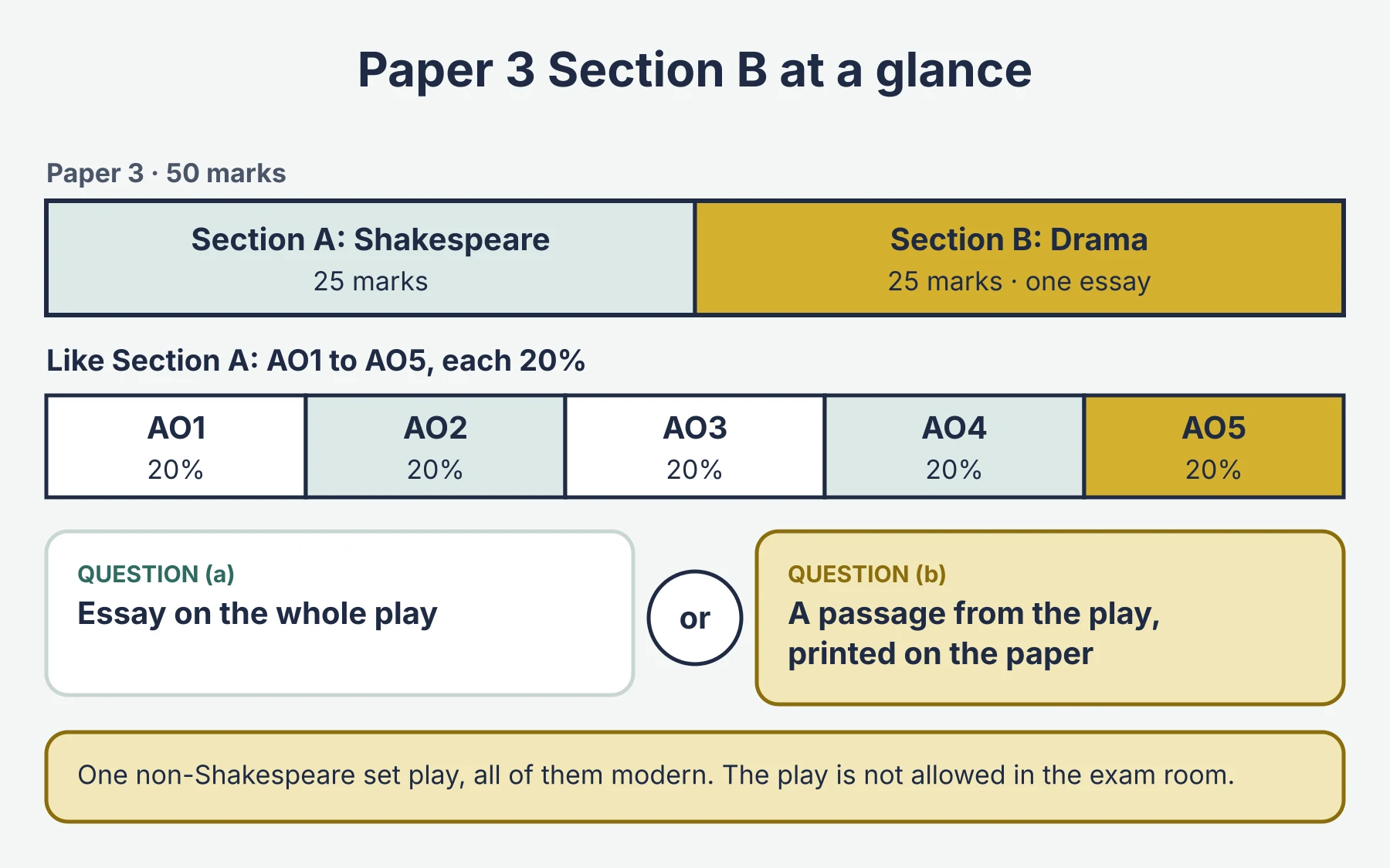
Section B in five lines
- One essay on one non-Shakespeare set play, worth 25 marks.
- (a) whole-play essay or (b) essay on a printed passage.
- Assessed on AO1 to AO5, each 20%.
- Closed book; no dictionaries.
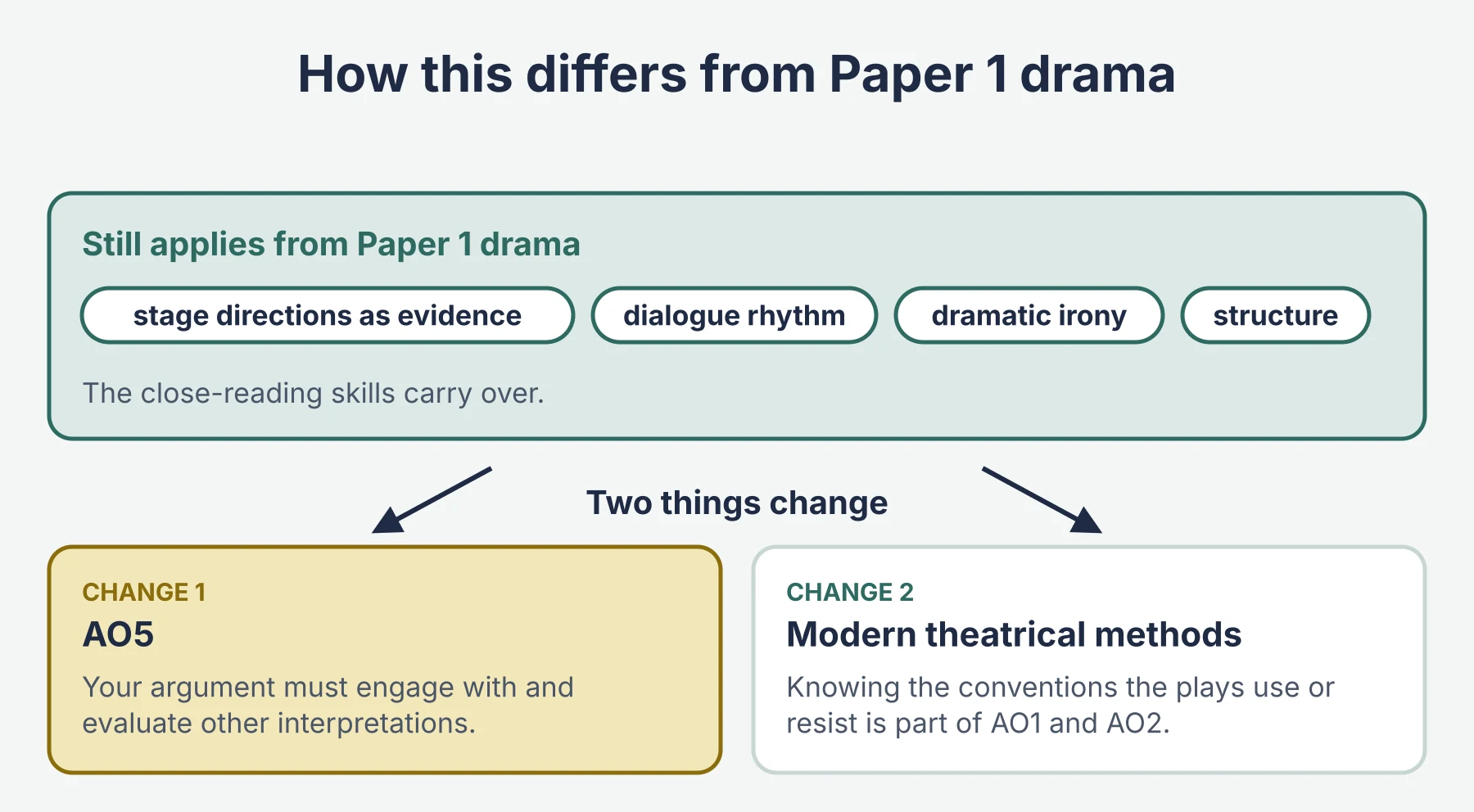
- Same close-reading skills as Paper 1 drama, plus AO5 and modern stagecraft.
Key terms
| Term | Meaning | What to discuss |
|---|---|---|
| Naturalism | Theatre presenting everyday life realistically | Real-time feel, domestic sets, environment shaping character |
| Non-naturalism | Theatre that breaks realist illusion | Song, direct address, ritual, symbolic staging |
| Authorial stage directions | Detailed, descriptive directions | What they tell us that dialogue cannot; how they are staged |
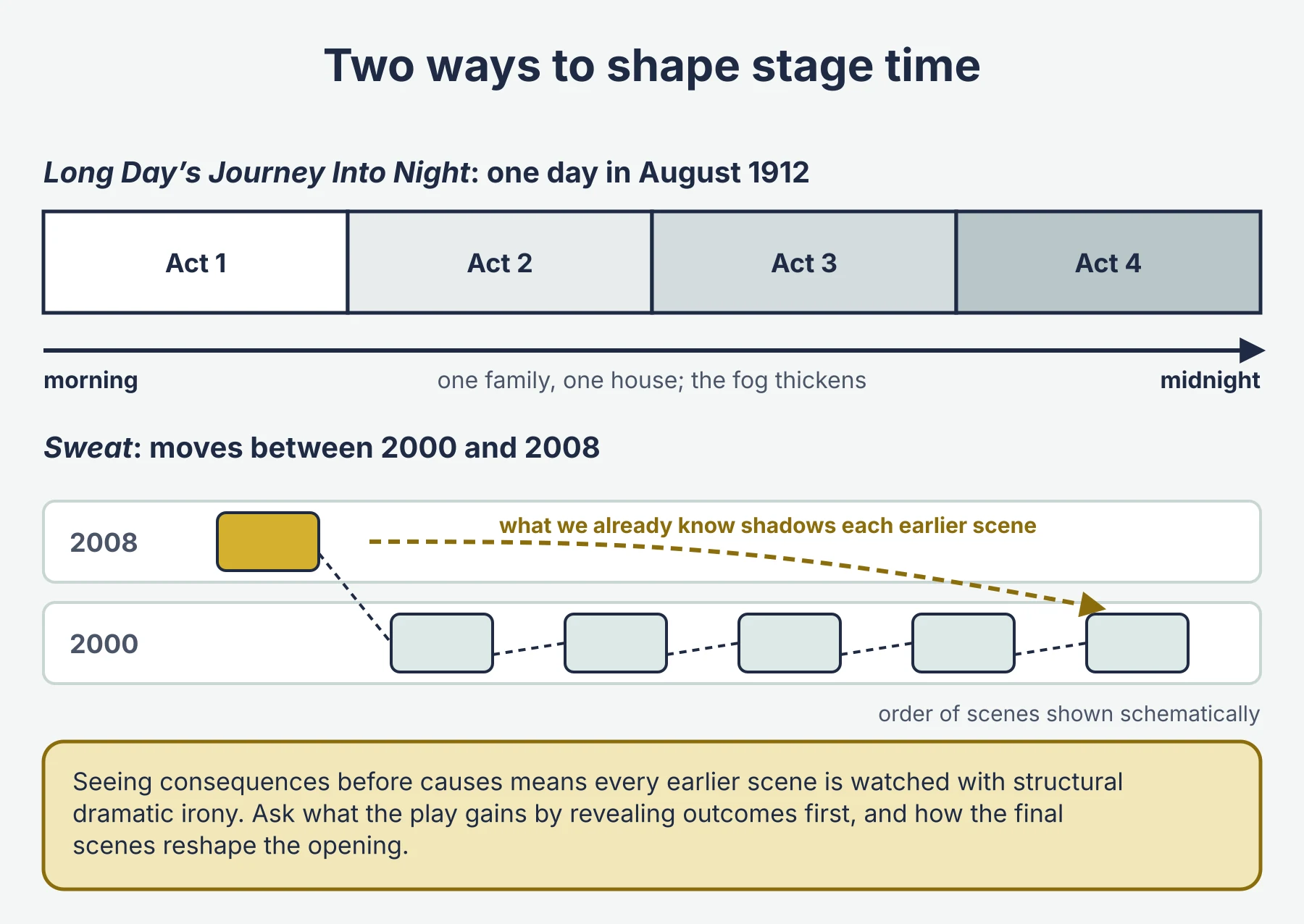
| Non-linear structure | Scenes out of chronological order | Consequences before causes; structural irony |
| Structural dramatic irony | Audience knows outcomes characters do not | Every earlier scene re-read in that light |
| Metatheatre | Theatre about theatre | Rehearsals, plays within plays, performance as theme |
| Doubling | One actor playing more than one role | Links between characters; comment on class or power |
| Satire | Ridicule exposing folly or abuse | Exaggeration, contrast, targets of critique |
| Symbolic sound or set | Realistic details carrying symbolic weight | Fog, foghorns, a single bar, a palace square |
| Confessional monologue | A long, self-revealing speech | Shifts sympathy; reveals history |
| Chorus or crowd | Collective presence on stage | Public versus private; community voice |
Set plays: methods to know
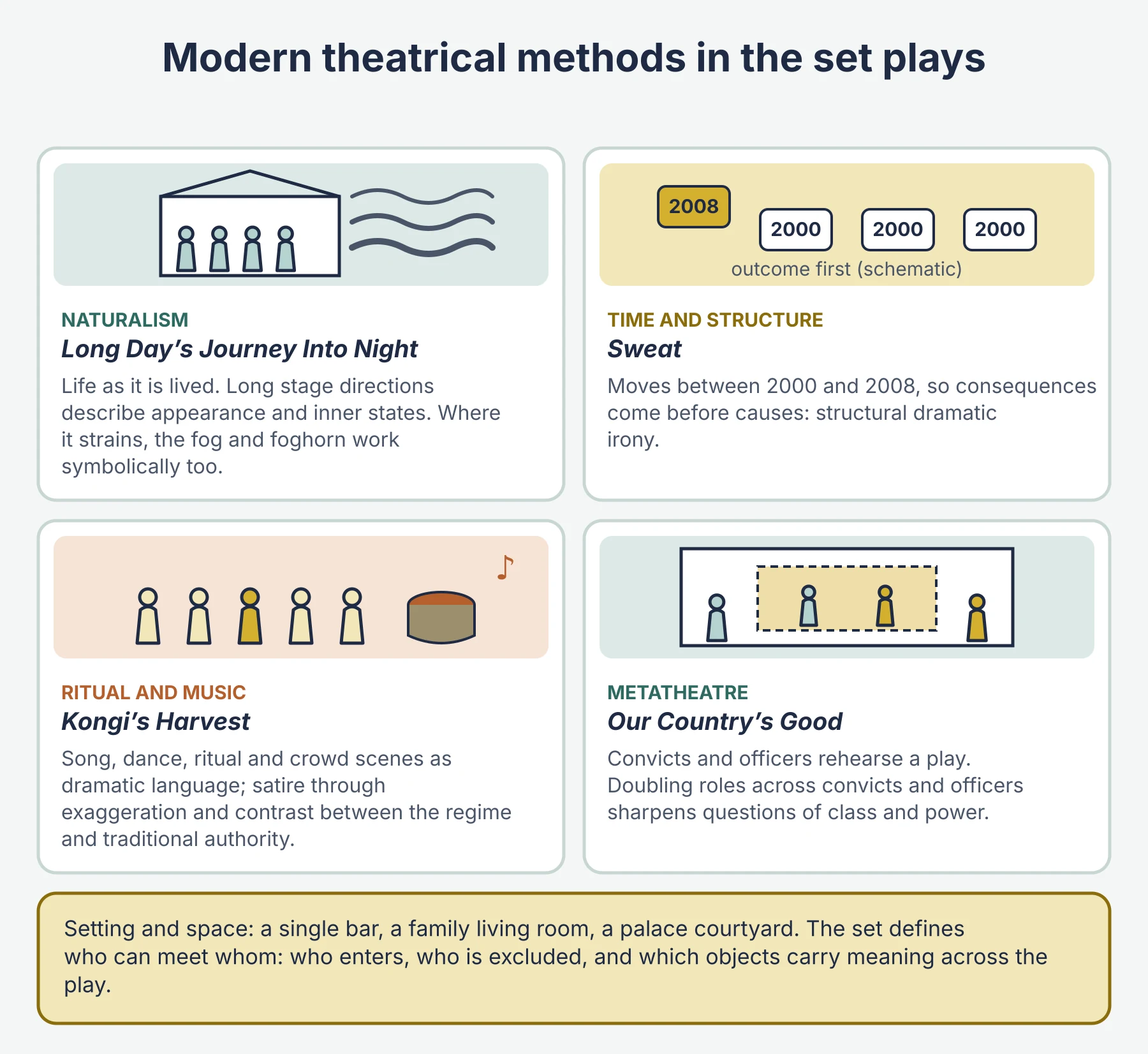
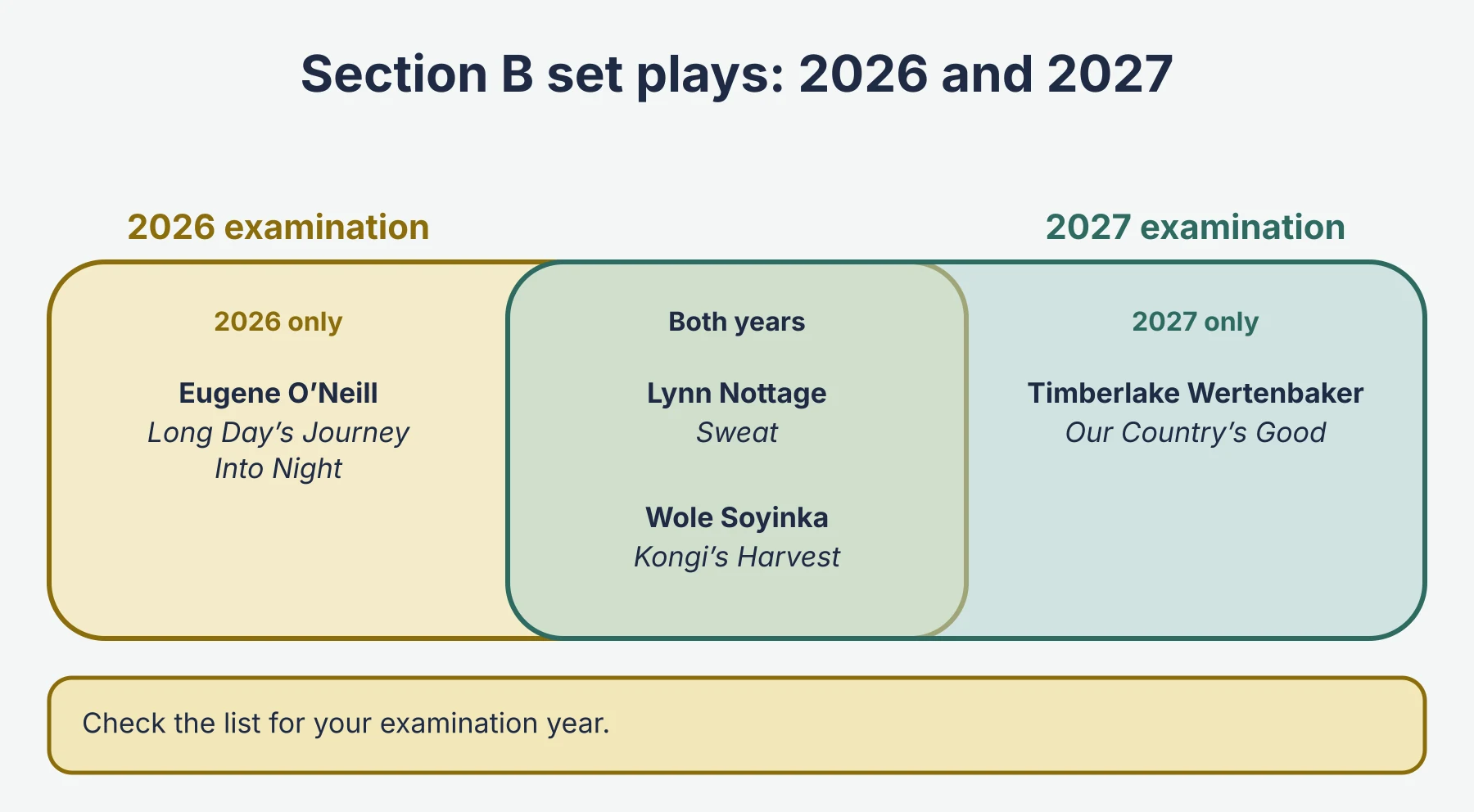
- Sweat (2026 and 2027): moves between 2000 and 2008, so outcomes are known early; a bar as the single communal space; economic pressure on workers as context.
- Long Day’s Journey Into Night (2026): naturalism; one day in August 1912, morning to midnight; long descriptive stage directions; fog and foghorn; confessional speeches.
- Kongi’s Harvest (2026 and 2027): political satire of a dictator seeking control of a traditional harvest festival; song, dance and ritual as dramatic language.
- Our Country’s Good (2027): convicts and officers in the first penal colony in New South Wales rehearse a play; metatheatre; doubling in performance.
AO5: three sources
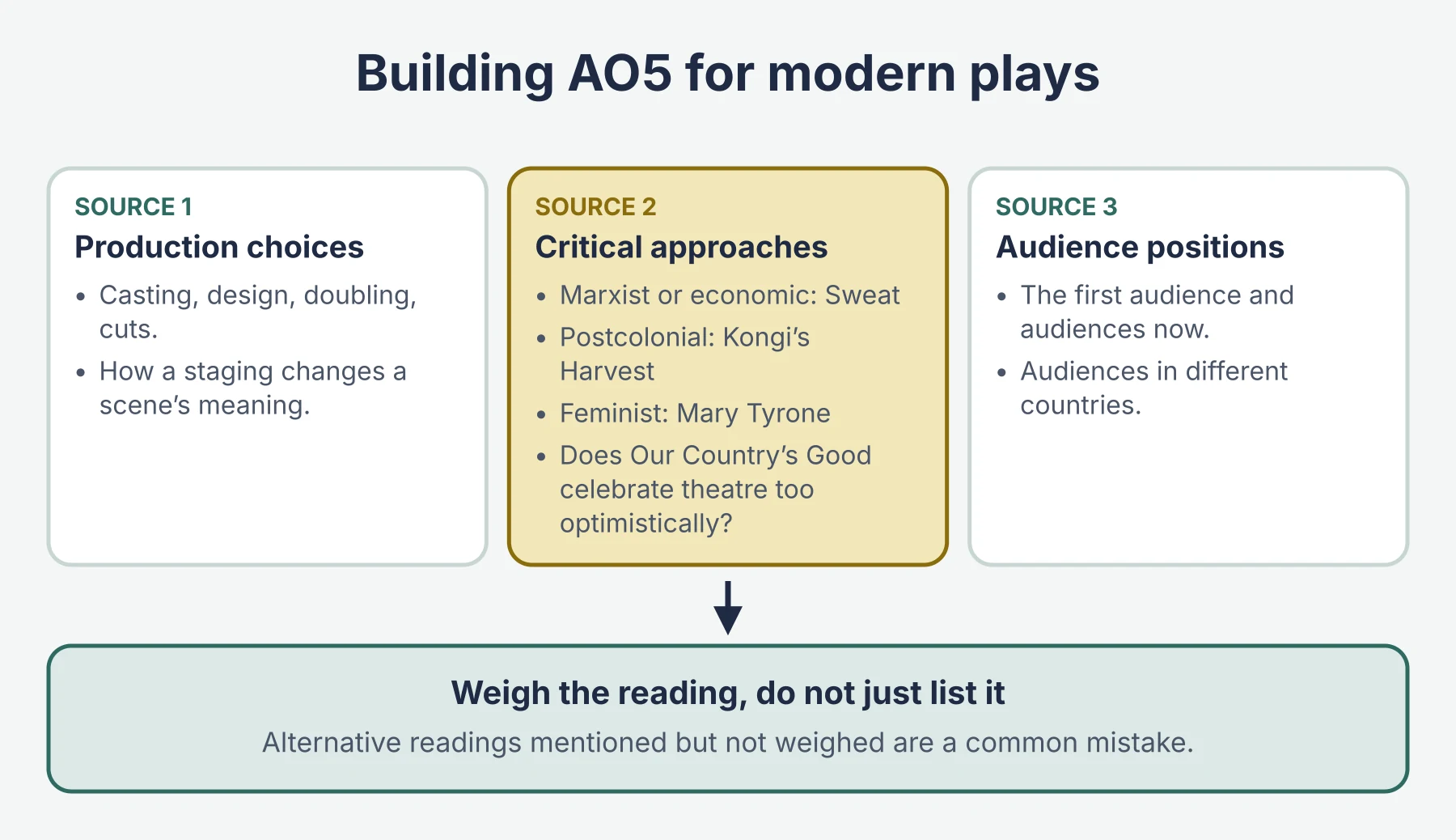
- Productions: casting, design, doubling, cuts; how a staging changes a scene.
- Critical approaches: Marxist or economic, feminist, postcolonial, historicist.
- Audiences: first audiences against modern ones, or audiences in different places.
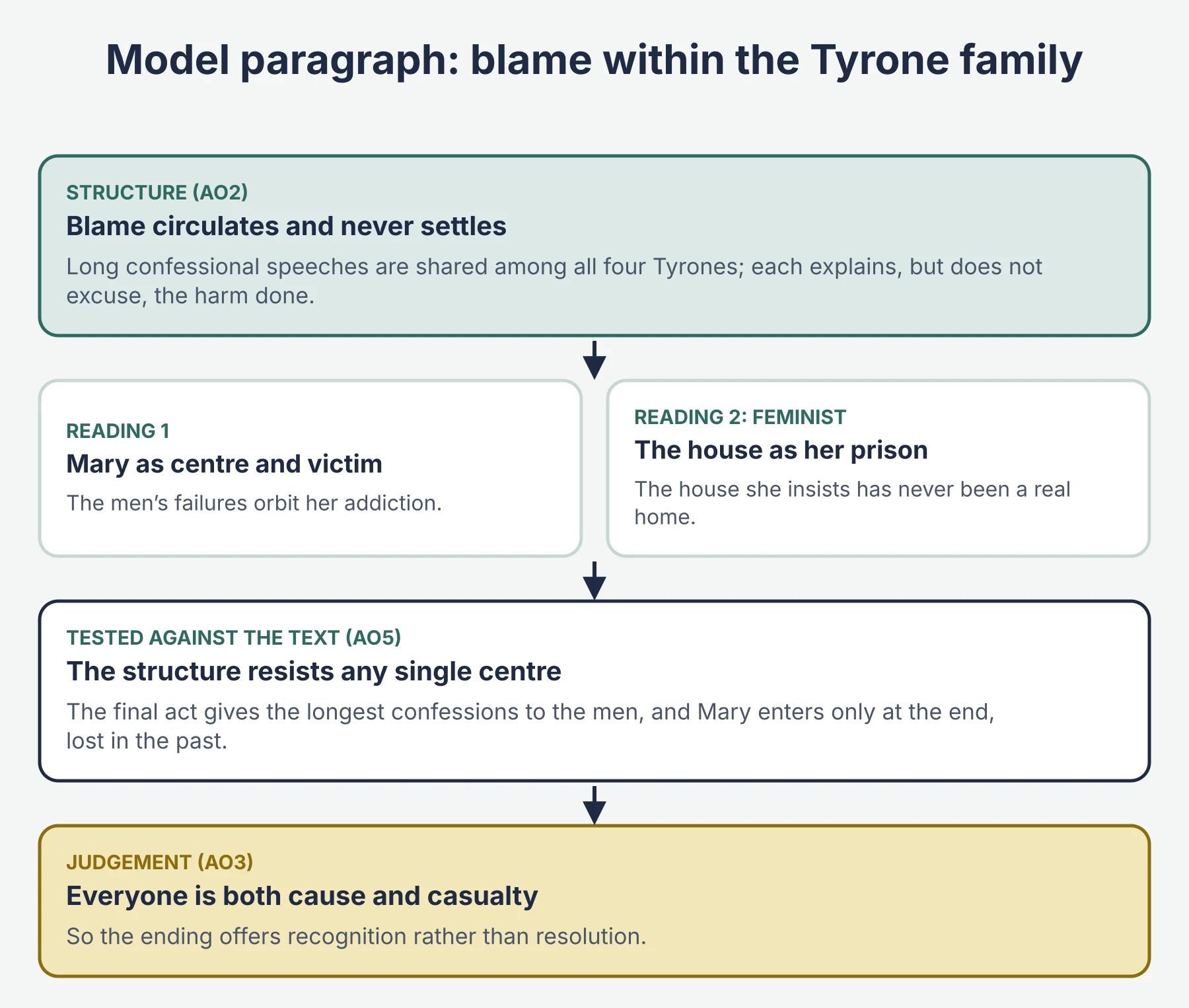
Pattern: reading → test against the text → judgement.
“A Marxist reading sees… as…; this is supported by…, but the play’s ending suggests…, so the more convincing view is…”
Answer shapes
(b) passage
- Locate in the play and, if non-linear, in the timeline.
- Thesis on dramatic function.
- Dialogue, directions, movement, set, sound.
- Outward links.
- Evaluated AO5 point or two.
(a) whole play
- Positioned thesis; judgement for “How far”.
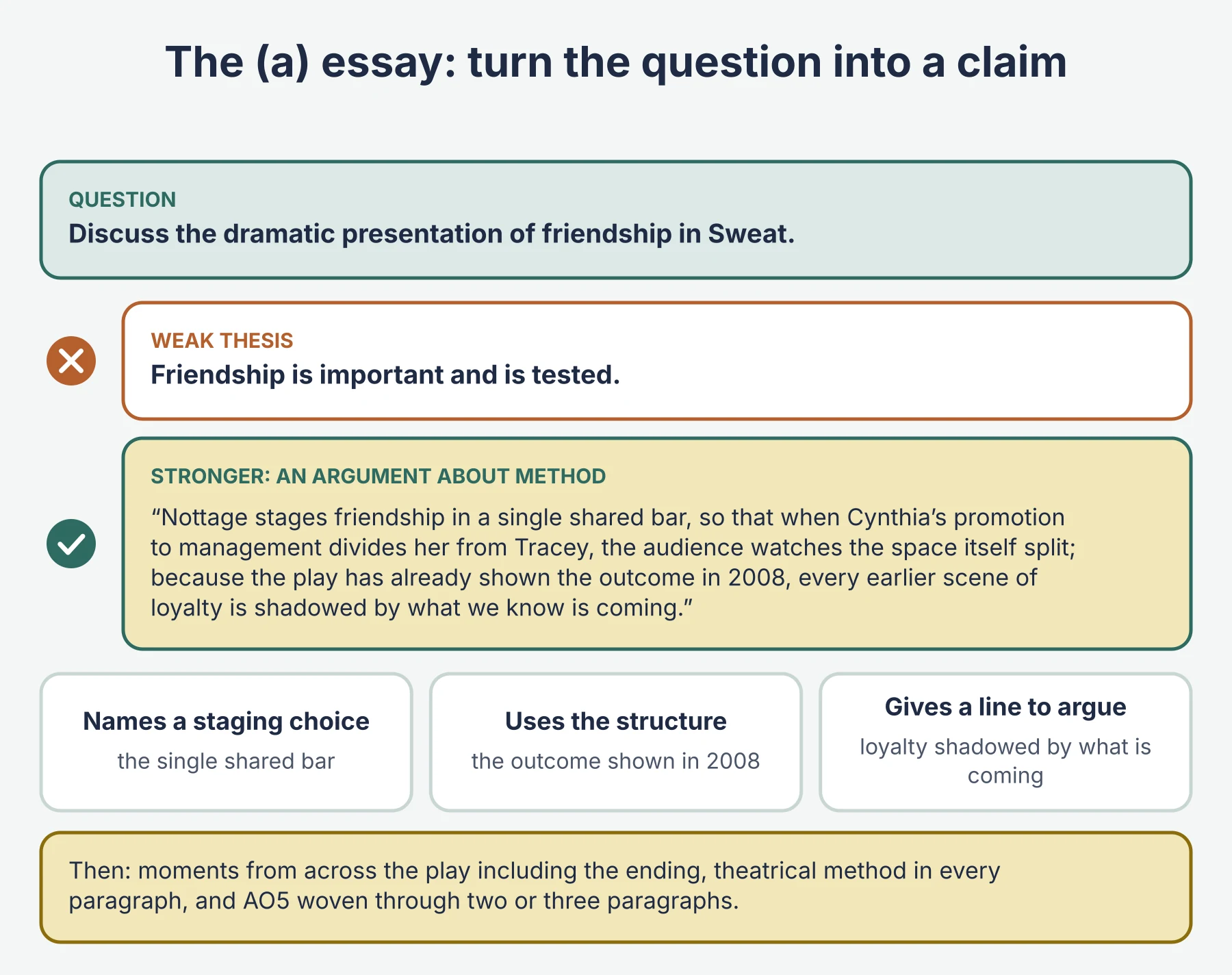
- Moments across the play, including the ending.
- Stagecraft in every paragraph.
- AO5 woven through.
Reading long stage directions
Some modern plays, Long Day’s Journey Into Night above all, describe characters and settings in novelistic detail. For each long direction ask:
- What does it tell the audience visually (set, costume, lighting, sound)?
- What does it say that cannot be staged directly, such as a character’s inner state, and how might an actor convey it?
- Does a detail return later (an object, a sound, a light) and gather symbolic weight?
- Does the direction guide judgement, telling us how to see a character before they speak?
Thesis: weak versus strong
| Weak | Strong |
|---|---|
| “The play shows friendship breaking down.” | “The play stages friendship in one shared space, so its breakdown is seen as a divided room; the non-linear structure makes every scene of loyalty ironic.” |
| “The dictator is presented as bad.” | “Satire presents the dictator as both absurd and dangerous, and the play’s music and ritual set his staged power against older traditions.” |
Context that earns credit
- Sweat: industrial decline and its human cost.
- Long Day’s Journey: the play’s autobiographical roots.
- Kongi’s Harvest: post-independence politics and traditional authority.
- Our Country’s Good: the eighteenth-century colony and the redemptive claims made for theatre.
Each only when tied to a scene or choice.
Exam traps
- Novel reading: character psychology without staging.
- Directions skipped: especially costly for plays with extensive directions.
- Timeline flattened: treating a non-linear play as chronological.
- AO5 listed, not weighed.
- Context detached from any dramatic choice.
- Ending ignored in an (a) essay.
Self-test
- Which assessment objectives does Paper 3 Section B test?
- Define naturalism.
- Give two features of non-naturalistic theatre.
- What is structural dramatic irony in a non-linear play?
- Which set play moves between 2000 and 2008?
- Over what span of time is Long Day’s Journey Into Night set?
- What is metatheatre, and which 2027 set play uses it centrally?
- What can doubling add in performance?
- Name three sources of alternative interpretation for AO5.
- What three steps make up an AO5 point?
- In a (b) answer on a non-linear play, what should you locate besides the passage’s place in the script?
- What makes context relevant in a Section B answer?
Answers: 1. AO1 to AO5. 2. Theatre that presents everyday life realistically, with characters shaped by environment. 3. Any two: song, direct address, ritual, symbolic staging, crowd or chorus. 4. The audience knows outcomes before characters do, so earlier scenes gain a second meaning. 5. Sweat. 6. One day in August 1912, from morning to midnight. 7. Theatre that draws attention to itself as theatre; Our Country’s Good. 8. Links between characters and comment on class or power. 9. Productions, critical approaches, audiences. 10. A reading, a test against the text, a judgement. 11. Its place in the play’s timeline. 12. When it explains a dramatic choice in a specific scene.
Related resources
-
Practice questions
A Level Literature in English 9695: Paper 3 Set-Text Essay and Passage Practice
Original Cambridge 9695 Paper 3 essay and passage questions on Hamlet, The Taming of the Shrew, Long Day's Journey Into Night and Sweat, with answer guidance.
English Literature · Cambridge · A Level
Try questions -
Study guides
A Level Literature in English: Paper 3 - Shakespeare and Drama (Cambridge 9695)
Cambridge 9695 Paper 3 Shakespeare and Drama: A Level-only format, AO5 evaluation of opinion, and the set plays for 2026 and for 2027 compared side by side.
English Literature · Cambridge · A Level
Read guide -
Practice questions
A Level Literature in English: Paper 3 - Shakespeare and Drama — Practice Questions
Original recall practice on Cambridge 9695 Paper 3 Shakespeare and Drama: format, (a) and (b) questions, AO5 and set-text rotation, with worked answers.
English Literature · Cambridge · A Level
Try questions
Get free revision emails (optional)
Occasional emails with practice questions, worked explanations and links to free resources for the qualification and subjects you choose. No spam, and you can unsubscribe from any email. The free tools on this site never need an email.