
Study Guides
Cambridge A Level Literature in English (9695): Paper 3 Section B – Drama
Writing on modern set plays for Cambridge 9695 Paper 3 Section B Drama: naturalism, stagecraft, time and ritual, with AO5 drawn from productions and readings.
- Subject
- English Literature
- Level
- A LEVEL
- Topic
- Paper 3 – Shakespeare and Drama
- Author
- Marlbridge Academic Team
- Updated
- Reviewed by
- Ammar Bilal (what this means)
Aligned to Cambridge A Level English Literature (9695), 2024-2026. Official specification .
Syllabus page (what it covers and how it is assessed): Cambridge A Level English Literature.
Syllabus points this page covers
9695 (A Level)
- 3.2 Section B: Drama
Found an error? Report a correction.
Need help with this topic? Request a free trial class for A Level English Literature (9695).
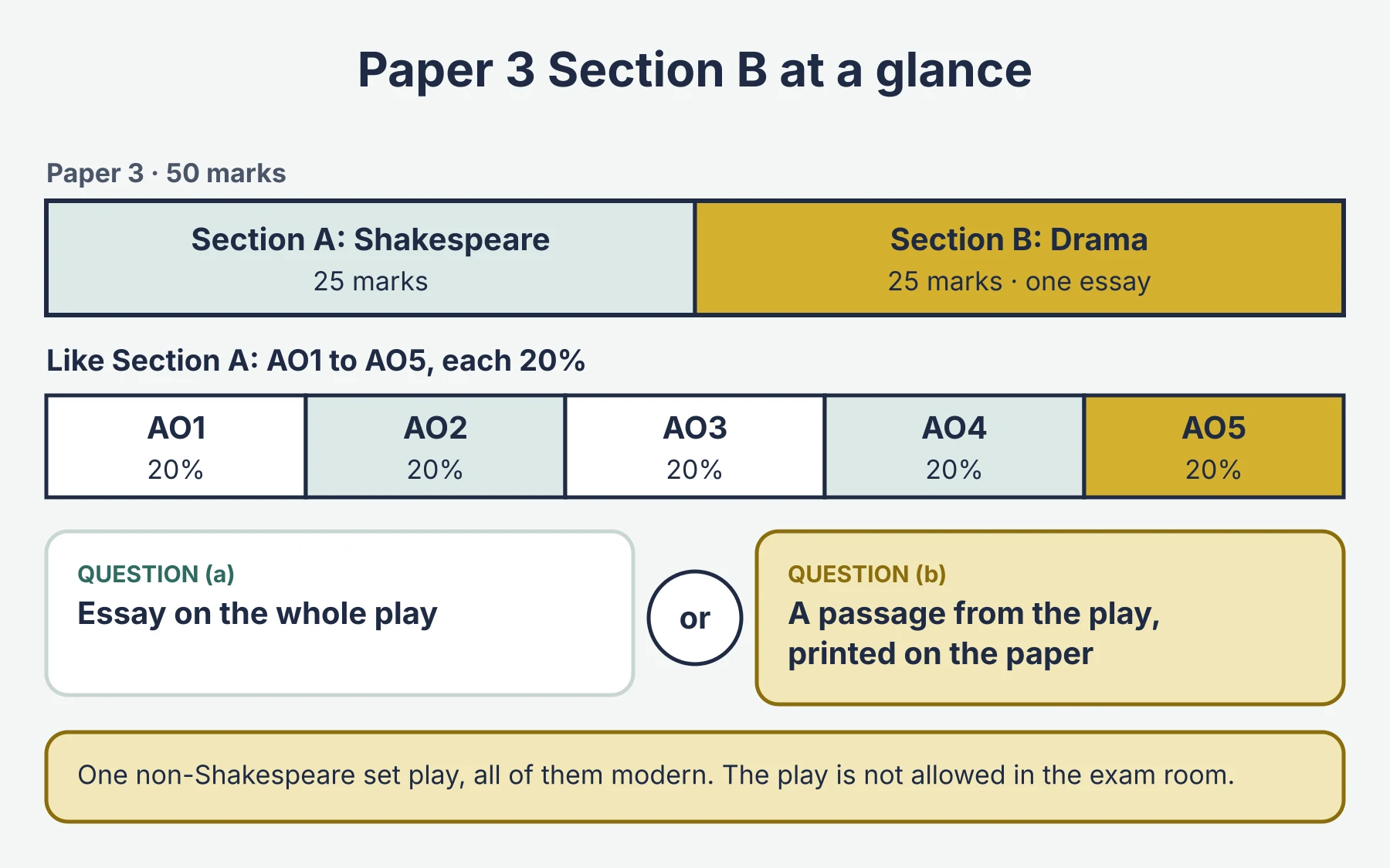
Section B of Paper 3 asks for one essay on a non-Shakespeare set play. It is worth 25 of the paper’s 50 marks and, like Section A, is assessed on AO1 to AO5, each 20%. The set plays here are modern, so this guide concentrates on the theatrical methods of twentieth- and twenty-first-century drama and on how to build AO5 from production choices and critical approaches. For the paper’s format, see the Paper 3 overview.
What the section asks of you
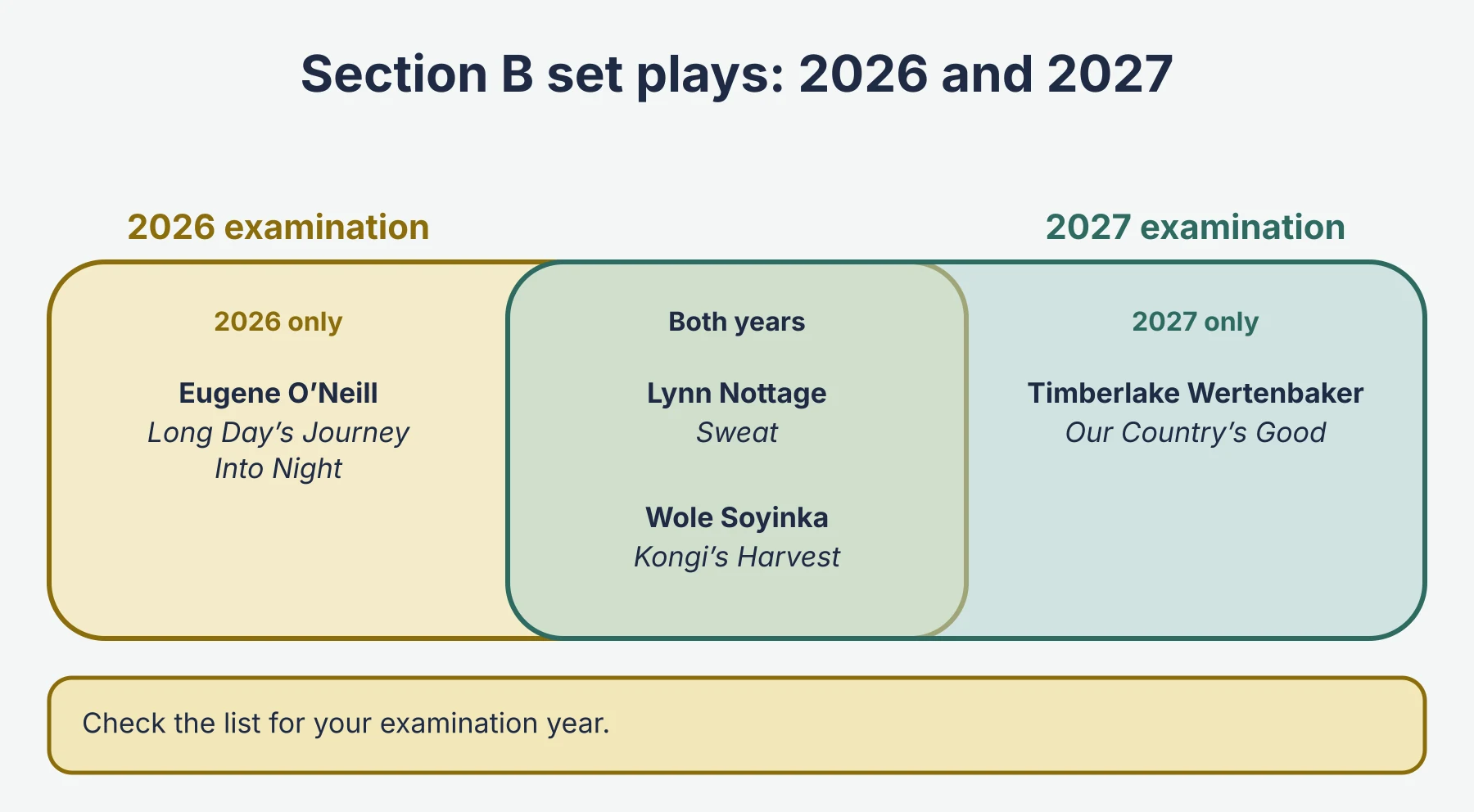
On each play you choose an (a) question, an essay on the whole play, or a (b) question on a passage from the play printed on the paper. The play is not allowed in the exam room. For 2026 the set plays are Lynn Nottage’s Sweat, Eugene O’Neill’s Long Day’s Journey Into Night and Wole Soyinka’s Kongi’s Harvest. For 2027 they are Sweat, Kongi’s Harvest and Timberlake Wertenbaker’s Our Country’s Good. Check the list for your examination year.
How this differs from Paper 1 drama
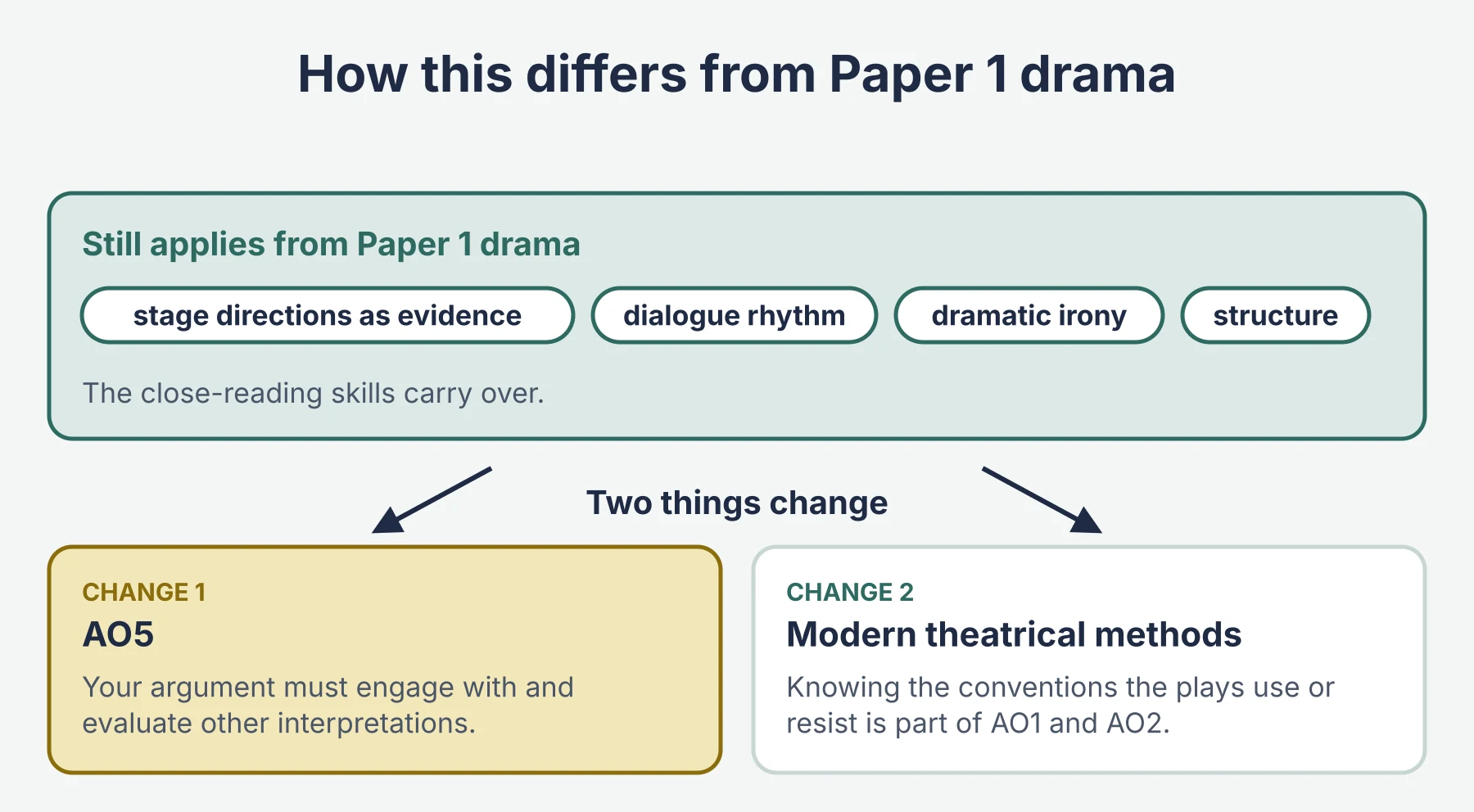
The close-reading skills from Paper 1 still apply: stage directions as evidence, dialogue rhythm, dramatic irony, structure. Two things change. First, AO5 means your argument must engage with and evaluate other interpretations. Second, the set plays here use a wide range of modern theatrical methods, and knowing the conventions they use or resist is part of AO1 and AO2.
Modern theatrical methods
Naturalism and its limits
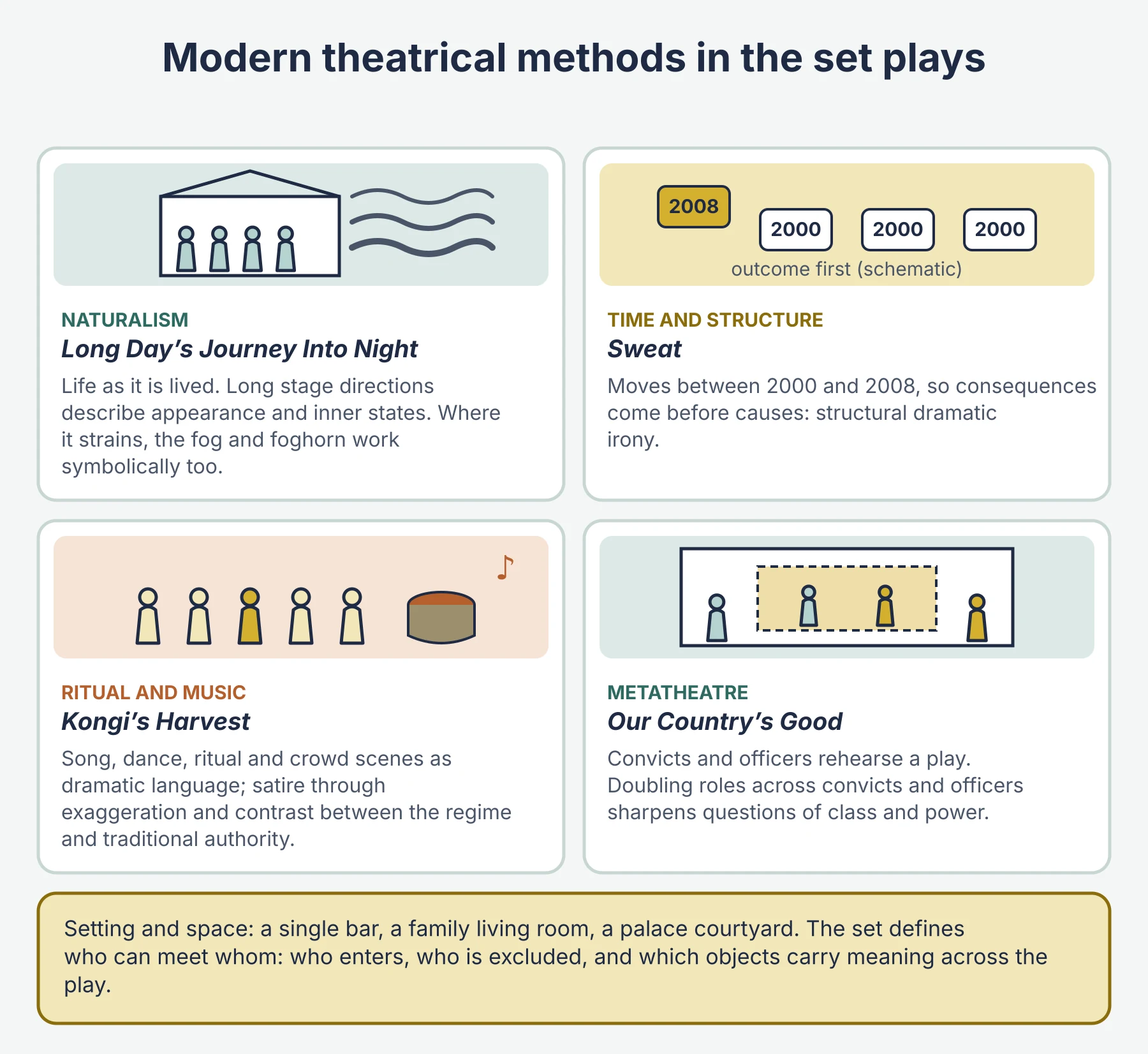
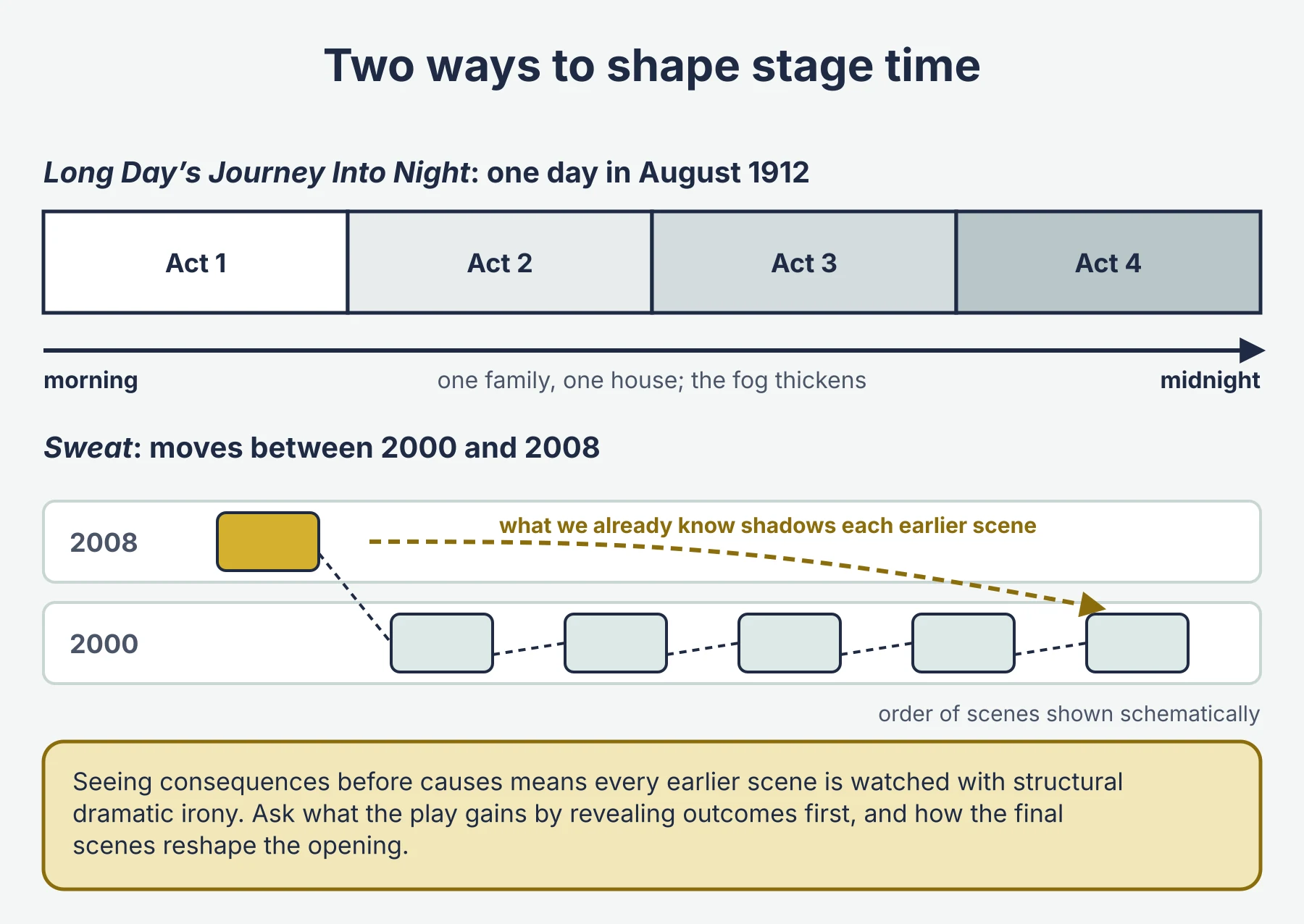
Naturalism aims to present life as it is lived: realistic settings, everyday speech, characters shaped by environment and heredity. Long Day’s Journey Into Night is a landmark of the mode: one day in August 1912, four acts moving from morning to midnight, a single family in a single house. Within it, O’Neill uses long, detailed stage directions that describe characters’ appearance and inner states; ask what these do that dialogue cannot, and how a production can realise them. Notice also where naturalism strains: the fog and foghorn that thicken through the play work symbolically as well as realistically.
Time and structure
Modern dramatists often break chronological order. Sweat moves between 2000 and 2008, so the audience sees consequences before causes, and every earlier scene is watched with structural dramatic irony. Ask what the play gains by revealing outcomes first, and how the final scenes reshape the opening.
Ritual, music and non-naturalistic theatre
Kongi’s Harvest satirises a dictator who seeks to take control of a traditional harvest festival, and it draws on song, dance and ritual. Here the stage is not a realistic room but a space for public performance, so analysis should consider spectacle, music and crowd scenes as dramatic language, and how satire works through exaggeration and contrast between the regime and traditional authority.
Metatheatre
Our Country’s Good follows convicts and officers in the first penal colony in New South Wales as they rehearse a play. Scenes of rehearsal invite the audience to think about theatre itself: what performance can do for people denied a voice. Productions often have actors double roles across convicts and officers, a staging choice that sharpens questions of class and power.
Setting and space
A single bar, a family living room, a palace courtyard: the set defines who can meet whom. Ask who enters the space, who is excluded, and what objects carry meaning across the play.
Context for modern drama
Context is relevant when it explains a dramatic choice: the economic pressures on industrial towns that Sweat stages; the autobiographical family history behind O’Neill’s play; post-independence politics in Soyinka’s satire; the eighteenth-century colony in Wertenbaker’s. Keep it brief and attach it to a scene.
Building AO5 for modern plays
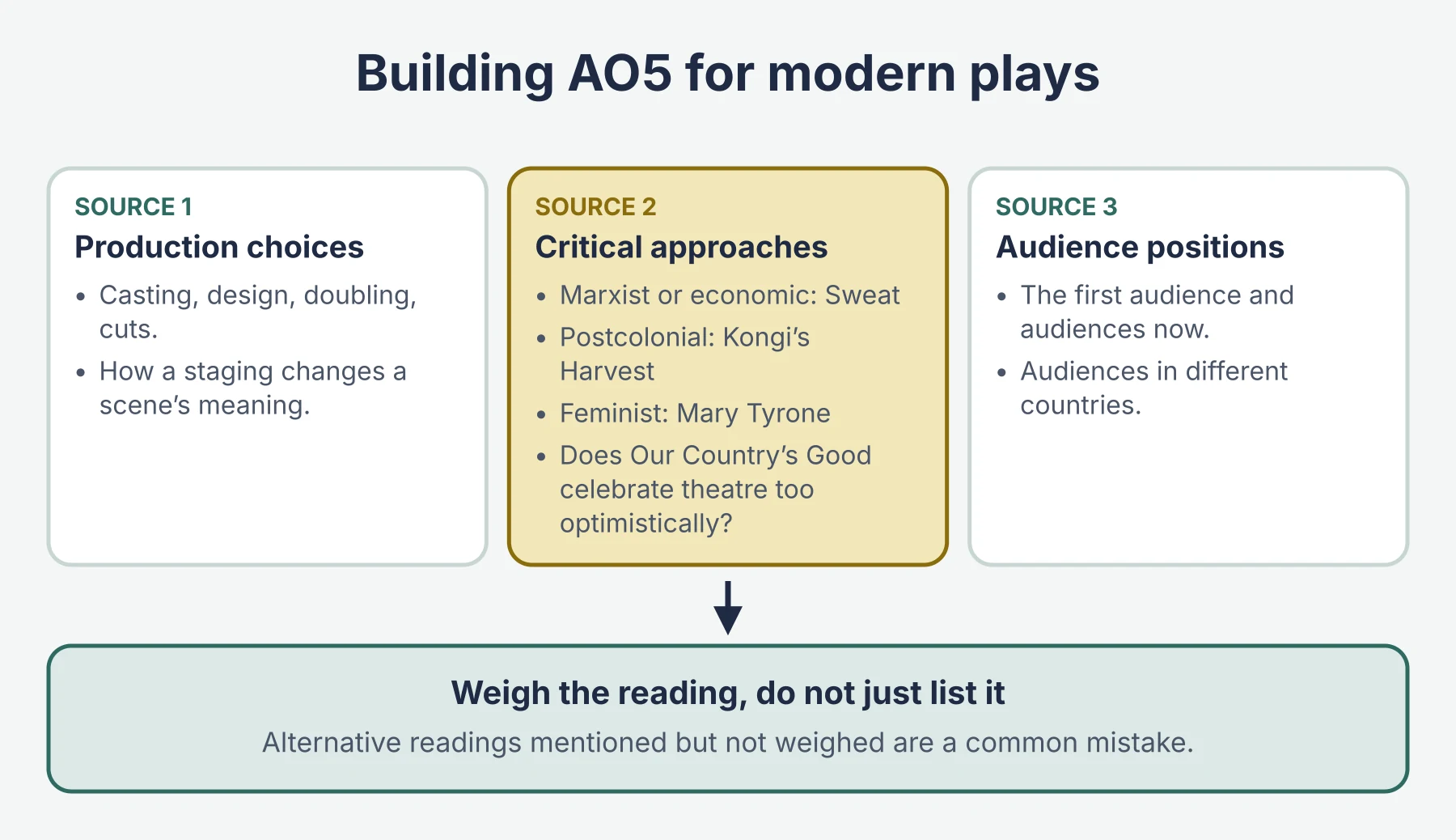
Modern plays have rich production histories, and their critical reception is part of what you revise. Three reliable sources of alternative readings:
- Production choices: casting, design, doubling, cuts, and how a staging changes a scene’s meaning.
- Critical approaches: a Marxist or economic reading of Sweat; a postcolonial reading of Kongi’s Harvest; a feminist reading of Mary Tyrone; a reading of Our Country’s Good that questions whether it celebrates theatre too optimistically.
- Audience positions: how the play might land with its first audience and with audiences now, or in different countries.
Annotated model paragraph
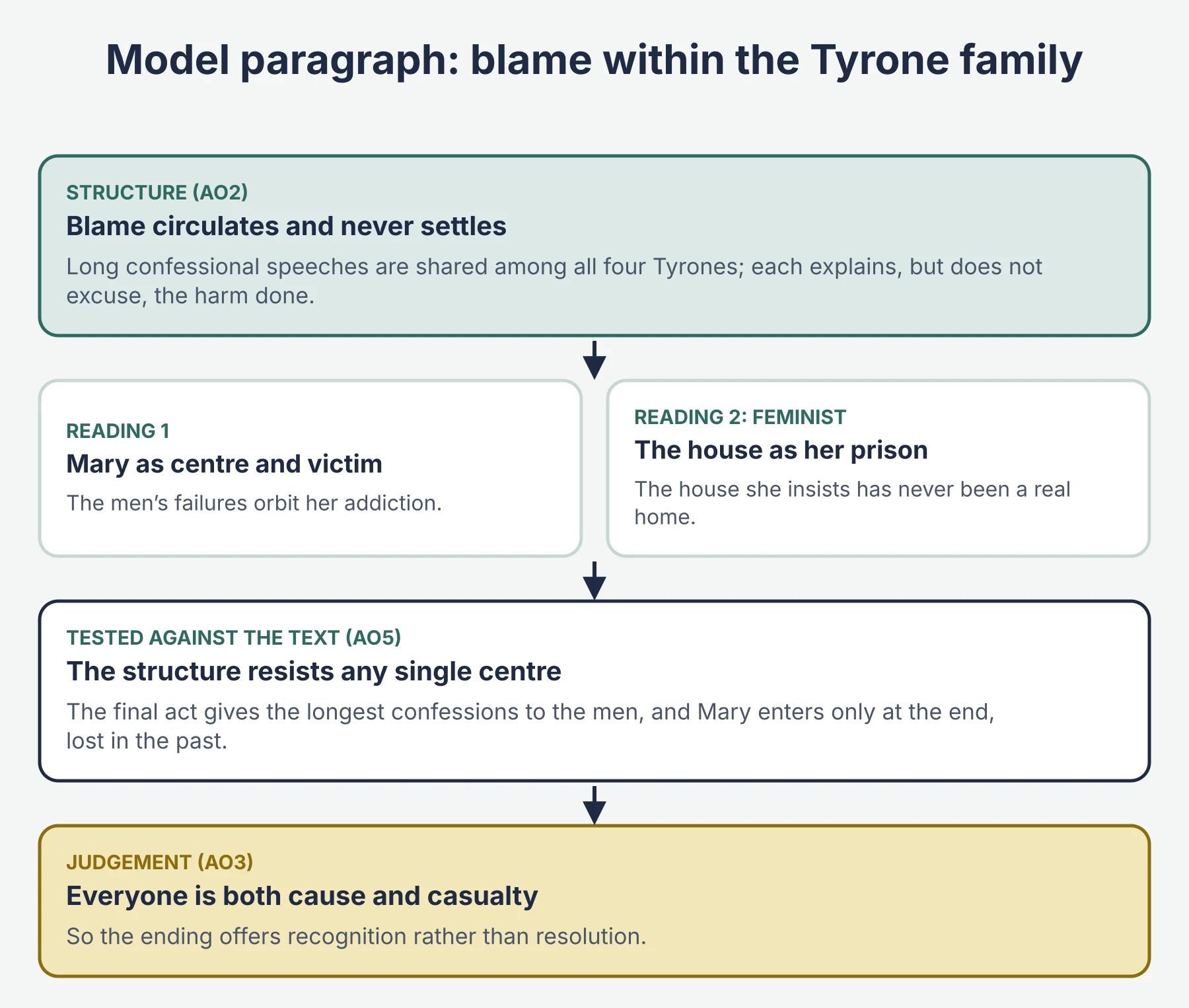
On Long Day’s Journey Into Night, responding to a question on blame within the family:
O’Neill structures the play so that blame circulates and never settles. Its long confessional speeches are shared among all four Tyrones, and each explains, but does not excuse, the harm the speaker has done. One reading treats Mary as the play’s centre and its victim, with the men’s failures orbiting her addiction; a feminist reading might go further, arguing that the house she insists has never been a real home is her prison. Yet the structure resists any single centre: the final act gives the longest confessions to the men, and Mary enters only at the end, lost in the past. The play is stronger read as a study of a family in which everyone is both cause and casualty, which is why its ending offers recognition rather than resolution.
The paragraph uses structure (AO2), presents two readings and tests them against the text (AO5), and ends with a judgement (AO3).
The (b) passage answer
- Locate the passage in the play’s structure and, for non-chronological plays, in its timeline.
- Thesis naming the passage’s dramatic function in the question’s terms.
- Analyse dialogue, stage directions, movement, set and sound.
- Link outward: echoes, contrasts and consequences elsewhere.
- AO5: how a different staging or critical approach would change the passage, evaluated.
The (a) essay
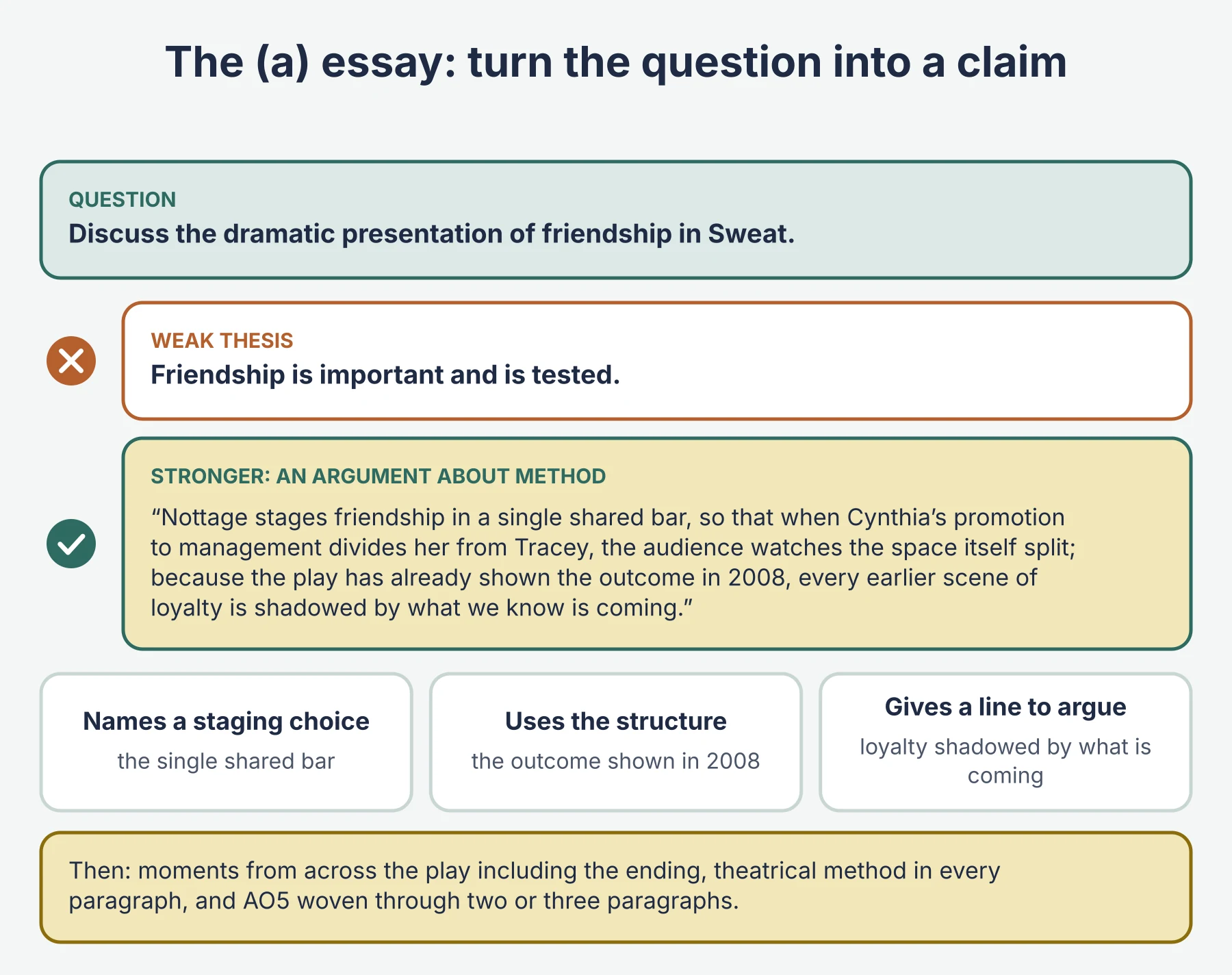
Turn the question into a claim before planning. Asked to discuss the dramatic presentation of friendship in Sweat, a weak thesis says that friendship is important and is tested. A stronger one argues something about method: “Nottage stages friendship in a single shared bar, so that when Cynthia’s promotion to management divides her from Tracey, the audience watches the space itself split; because the play has already shown the outcome in 2008, every earlier scene of loyalty is shadowed by what we know is coming.” It names a staging choice, uses the play’s structure, and gives the essay a line to argue.
- A thesis that takes a position, with a judgement if the question says “How far”.
- Moments from across the play, including the ending.
- Theatrical method in every paragraph, not just character and theme.
- AO5 woven through two or three paragraphs.
Common mistakes
- Reading modern plays as novels: discussing character psychology with no reference to staging.
- Ignoring stage directions in plays that rely heavily on them.
- Flattening structure: discussing a non-chronological play as if it were told in order.
- AO5 as a list: alternative readings mentioned but not weighed.
- Context without a choice: political or biographical background left unconnected.
Practise and revise this section
- Paper 3 Section B Drama revision notes — modern drama terms, AO5 patterns, traps and a self-test.
- Paper 3 Section B Drama practice questions — original extracts and AO5 tasks with full answers.
- Paper 3 Section A Shakespeare study guide — the other half of the paper.
Written against the Cambridge International AS & A Level Literature in English 9695 syllabus for 2024, 2025 and 2026.
Related resources
-
Practice questions
Cambridge A Level Literature in English (9695): Paper 3 Section B – Drama – Practice Questions
Original practice for Cambridge 9695 Paper 3 Section B Drama: modern stagecraft, non-linear structure and AO5 evaluation on new extracts, with full answers.
English Literature · Cambridge · A Level
Try questions -
Revision notes
Cambridge A Level Literature in English (9695): Paper 3 Section B – Drama – Revision Notes
Quick-recall notes for Cambridge 9695 Paper 3 Section B Drama: modern stagecraft terms, structure, AO5 from productions and readings, traps and a self-test.
English Literature · Cambridge · A Level
Revise topic -
Practice questions
A Level Literature in English 9695: Paper 3 Set-Text Essay and Passage Practice
Original Cambridge 9695 Paper 3 essay and passage questions on Hamlet, The Taming of the Shrew, Long Day's Journey Into Night and Sweat, with answer guidance.
English Literature · Cambridge · A Level
Try questions
Get free revision emails (optional)
Occasional emails with practice questions, worked explanations and links to free resources for the qualification and subjects you choose. No spam, and you can unsubscribe from any email. The free tools on this site never need an email.