
Revision Notes
Cambridge A Level Literature in English (9695): Paper 3 Section A – Shakespeare – Revision Notes
Quick-recall notes for Cambridge 9695 Paper 3 Section A Shakespeare: verse terms, soliloquy, structure, AO5 sentence patterns, exam traps and a self-test.
- Subject
- English Literature
- Level
- A LEVEL
- Topic
- Paper 3 – Shakespeare and Drama
- Author
- Marlbridge Academic Team
- Updated
- Reviewed by
- Ammar Bilal (what this means)
Aligned to Cambridge A Level English Literature (9695), 2024-2026. Official specification .
Syllabus page (what it covers and how it is assessed): Cambridge A Level English Literature.
Syllabus points this page covers
9695 (A Level)
- 3.1 Section A: Shakespeare
Found an error? Report a correction.
Need help with this topic? Request a free trial class for A Level English Literature (9695).
Condensed notes for the Shakespeare half of Paper 3. For the full method and an annotated AO5 paragraph, use the Paper 3 Section A Shakespeare study guide.
Section A in five lines
- One essay on one set Shakespeare play, worth 25 marks.
- (a) whole-play essay or (b) essay on a printed passage from the play.
- Assessed on AO1 to AO5, each 20% of the paper.
- Closed book; no dictionaries.
- A Level only: not part of the AS Level.
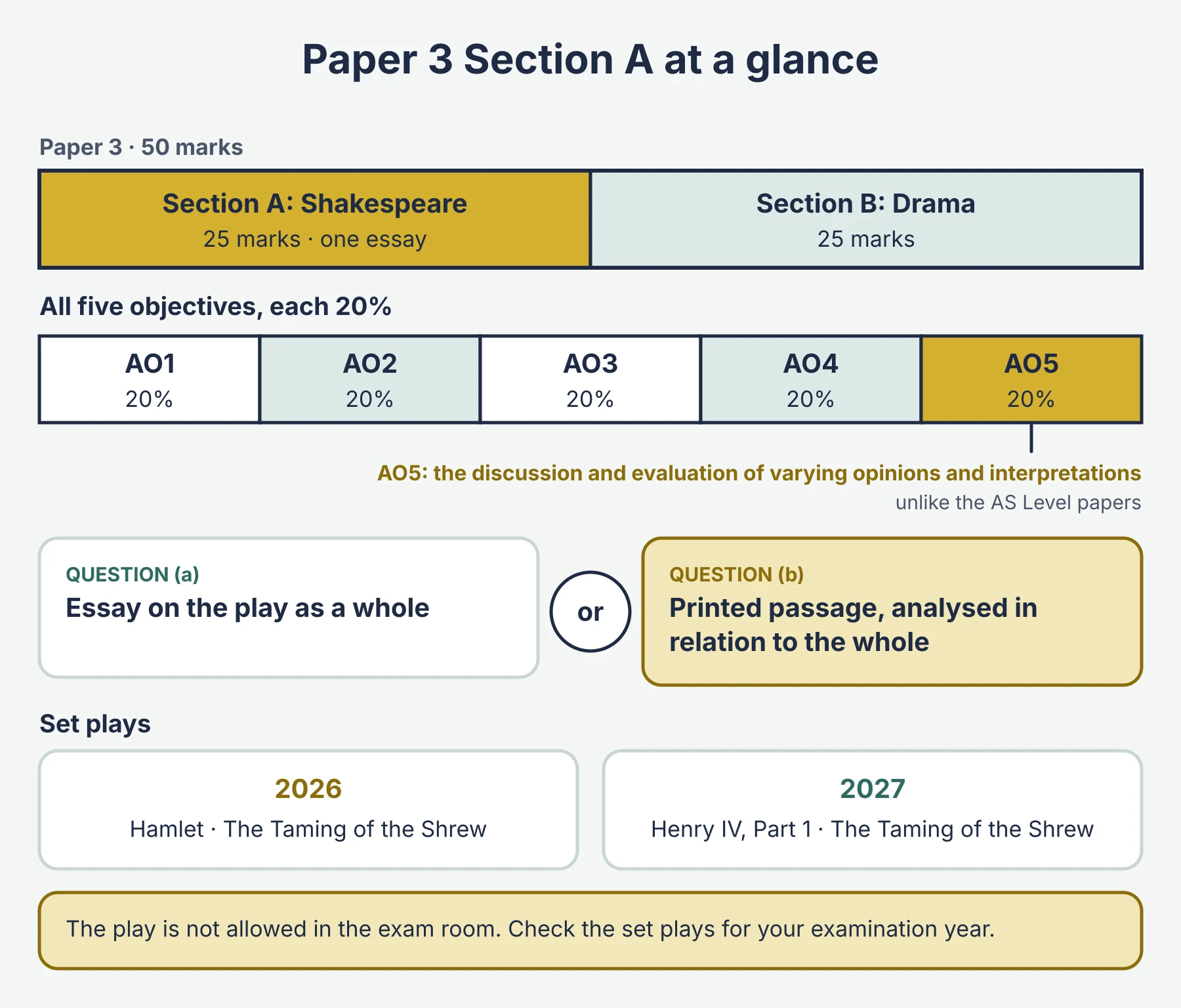
What AO5 adds
| AO3 | AO5 |
|---|---|
| Your own informed, independent interpretation | Discussion and evaluation of other interpretations |
| “I read this as…” | “This could be read as… / staged as…; the text supports… more strongly because…” |
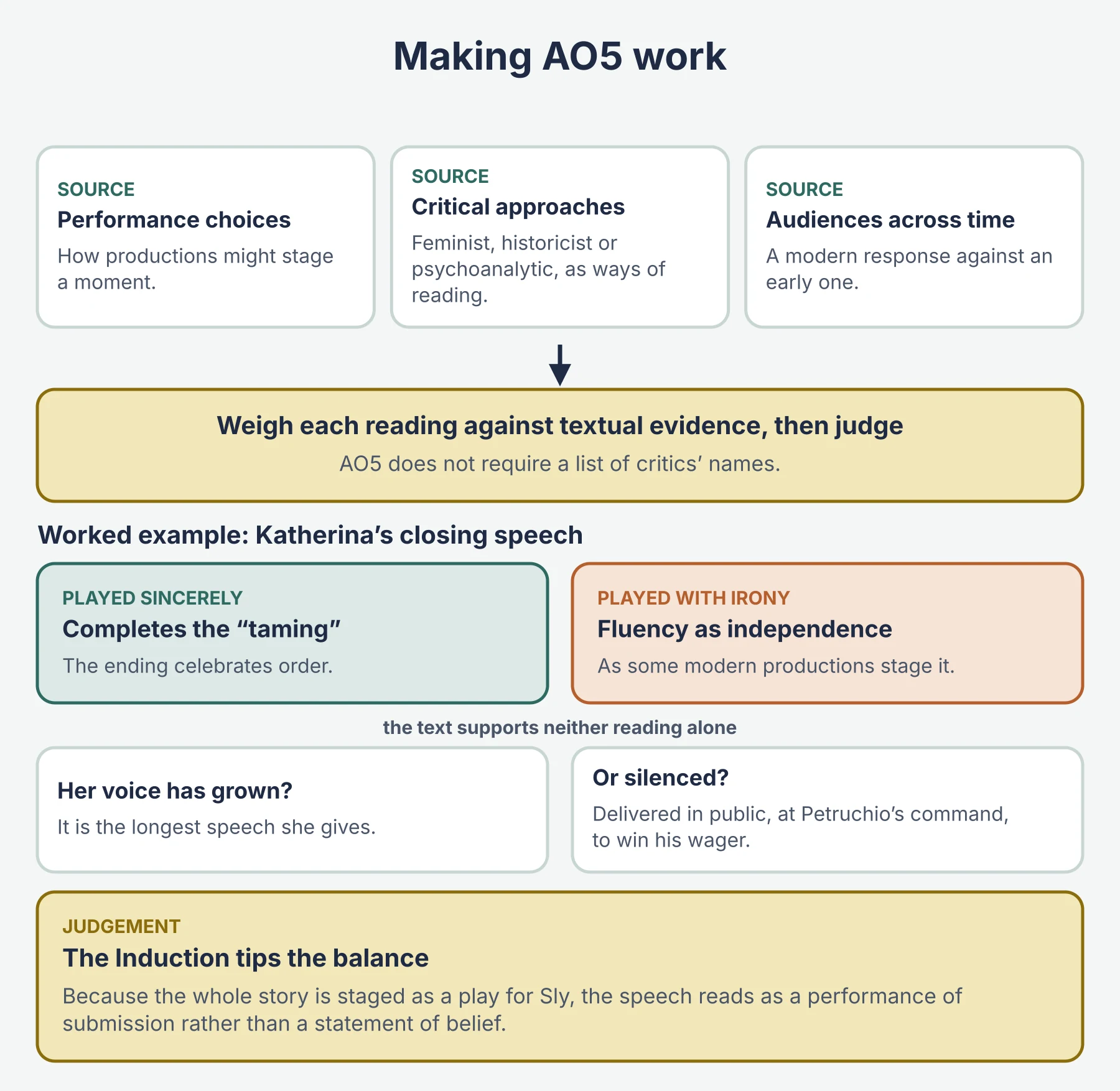
AO5 needs evaluation, not a list of names. Sources: staging choices, critical approaches, audiences across time.
Key terms
| Term | Meaning | Why it matters |
|---|---|---|
| Blank verse | Unrhymed iambic pentameter | The default serious voice; departures signal change |
| Prose | Unmetred speech | Comedy, low status, disorder, letters, feigned madness |
| Rhyming couplet | Two rhymed lines | Scene endings, maxims, closure |
| Shared line | One pentameter split between speakers | Intimacy, haste or conflict |
| Short line | A line with missing feet | An implied pause |
| Feminine ending | An extra unstressed syllable at line end | Hesitation, falling cadence |
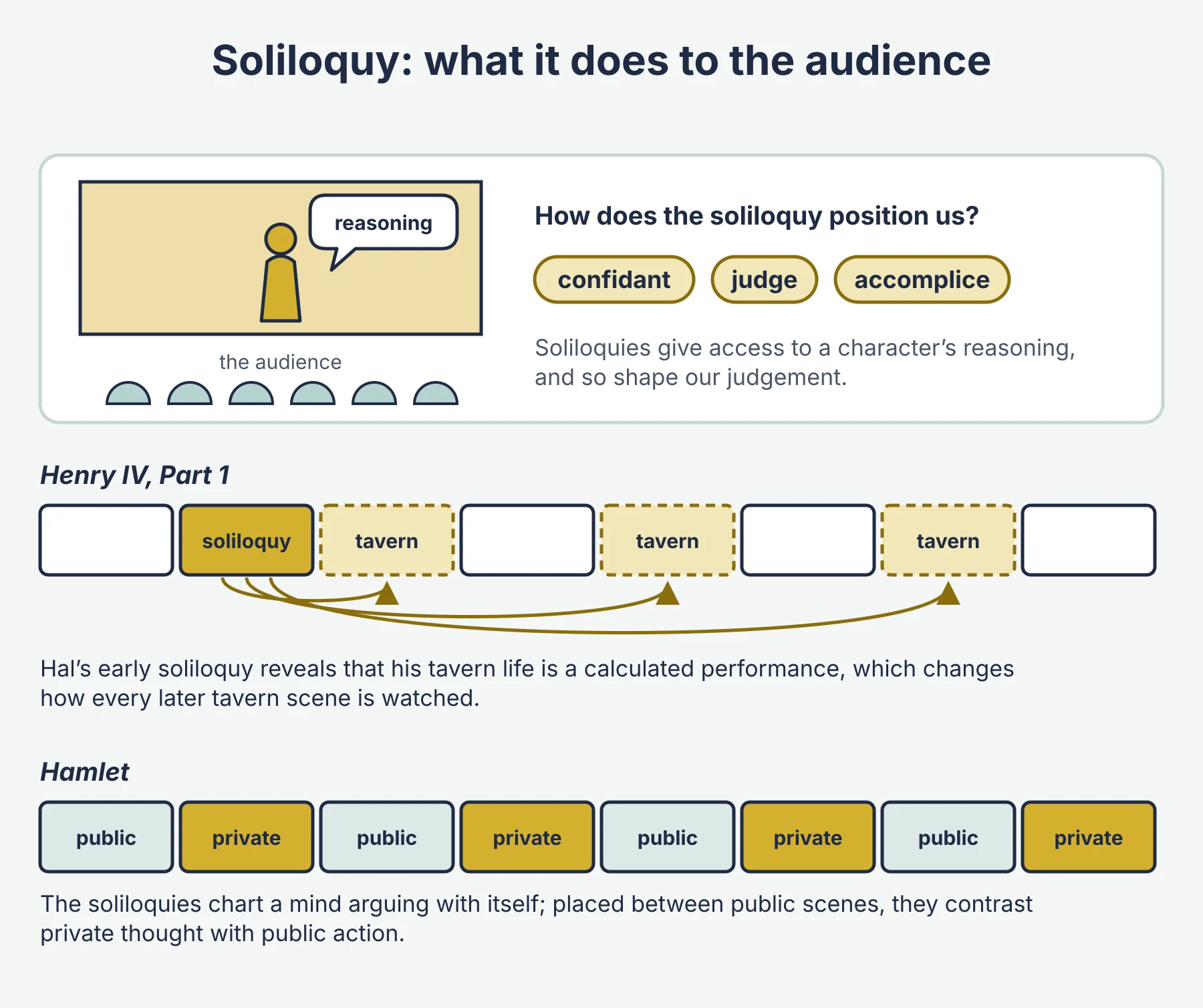
| Soliloquy | Speech alone on stage | Positions the audience as confidant or judge |
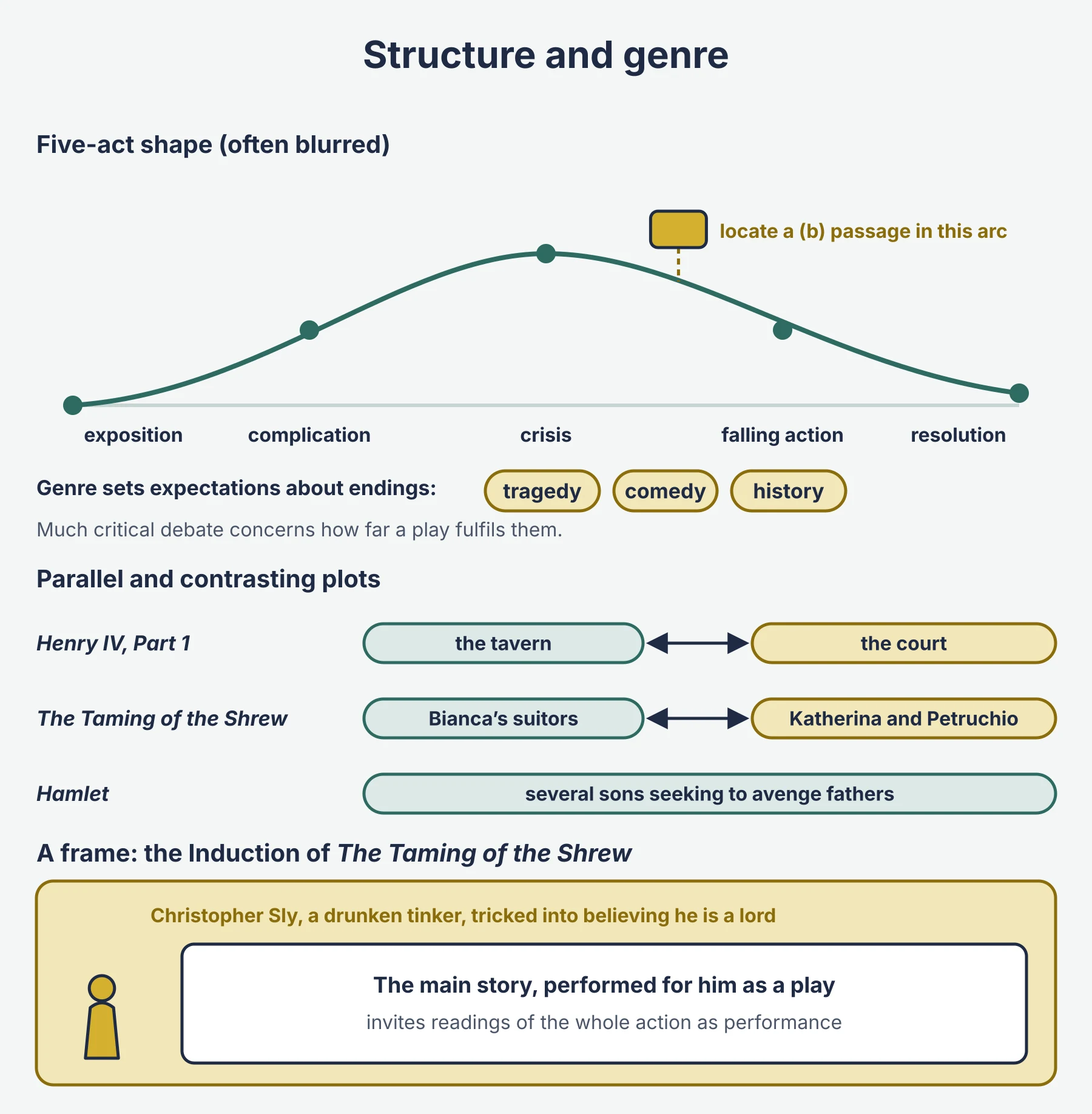
| Induction | A framing opening scene | In The Taming of the Shrew, frames the play as a performance |
| Subplot | A secondary plot | Parallels or contrasts the main action |
| Foil | A character who sharpens another by contrast | Hotspur and Hal; Laertes and Hamlet |
| Hamartia | A tragic error or flaw | Debated, especially in readings of Hamlet’s delay |
| Metatheatre | Drama aware of itself as drama | Plays within plays, characters performing roles |
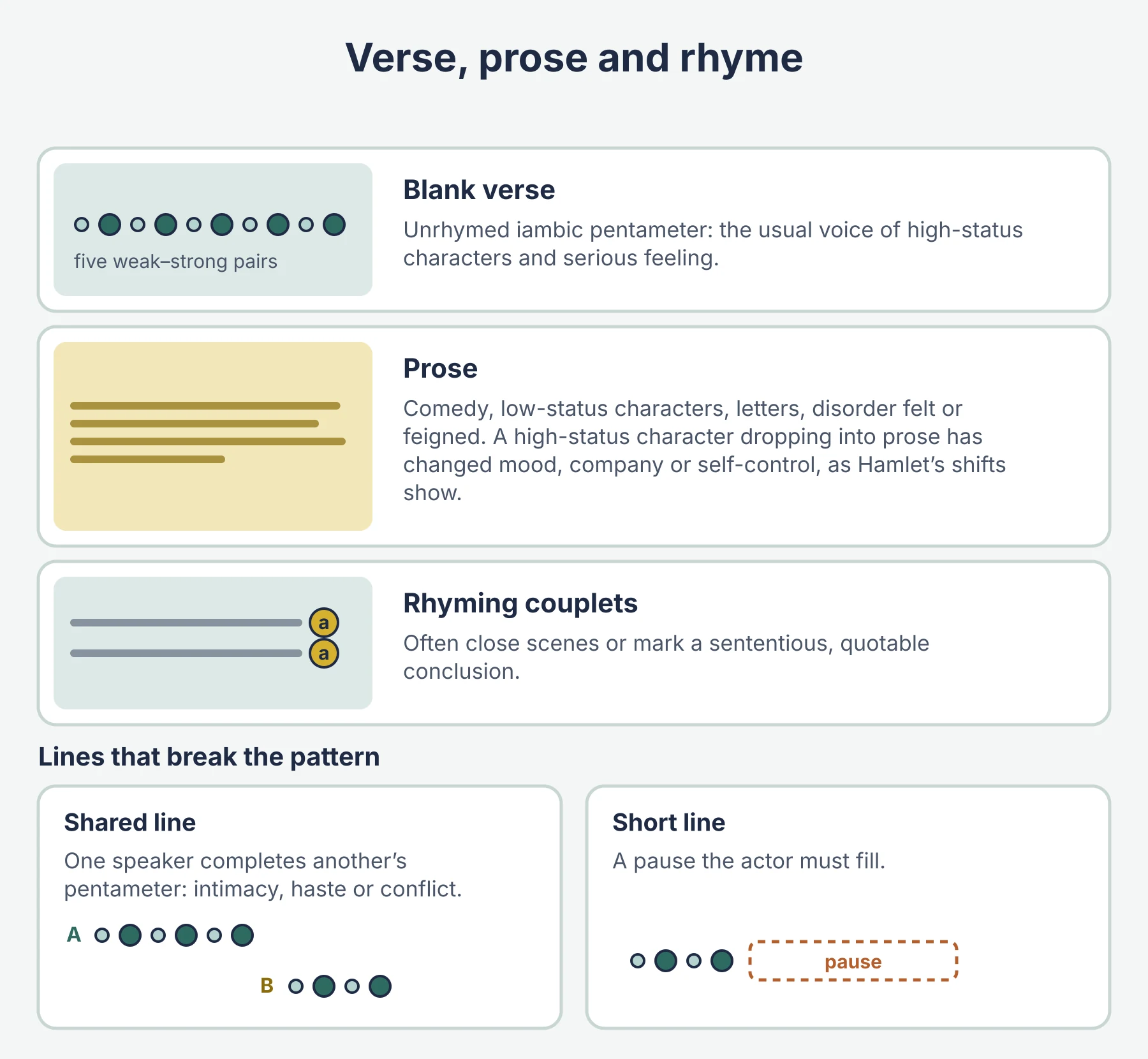
Answer shapes
(b) passage
- Locate the passage in the play’s structure.
- Thesis: its dramatic function, in the question’s terms.
- Close analysis: verse or prose, imagery, implied staging, who is present.
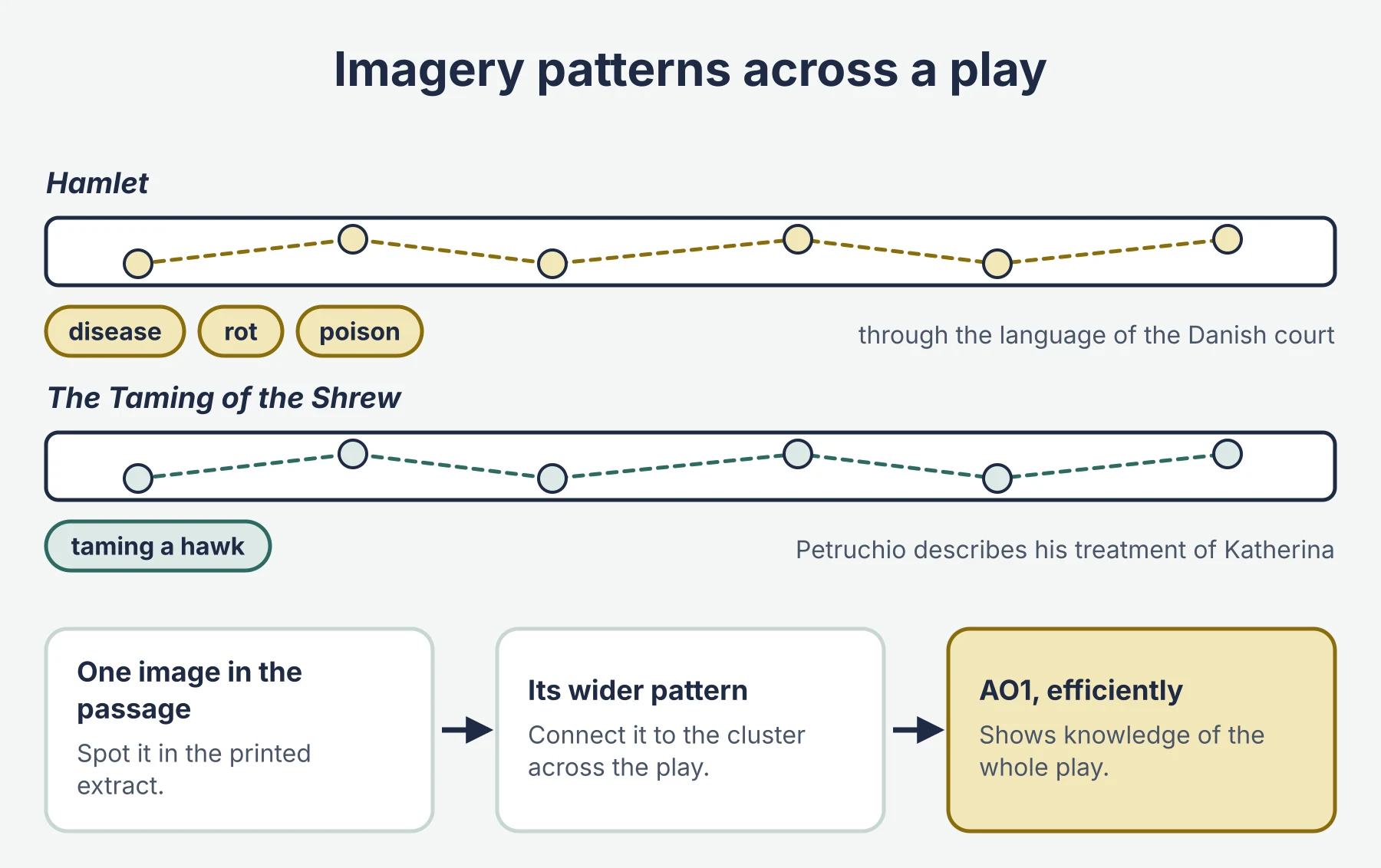
- Link outward through imagery patterns and parallel scenes.
- One or two AO5 points, evaluated.
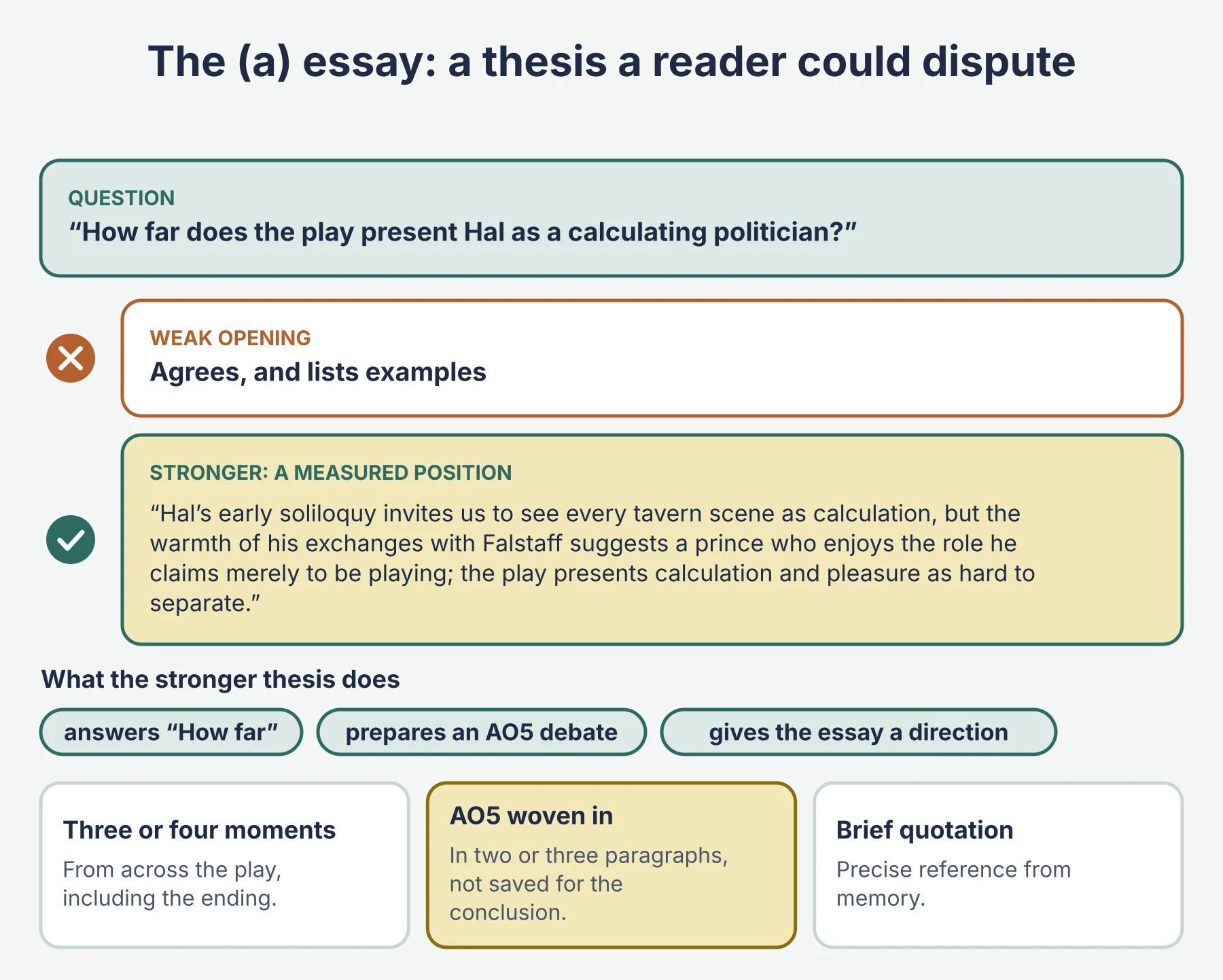
(a) whole play
- Thesis that answers the question; a judgement if it says “How far”.
- Three or four moments, including the ending.
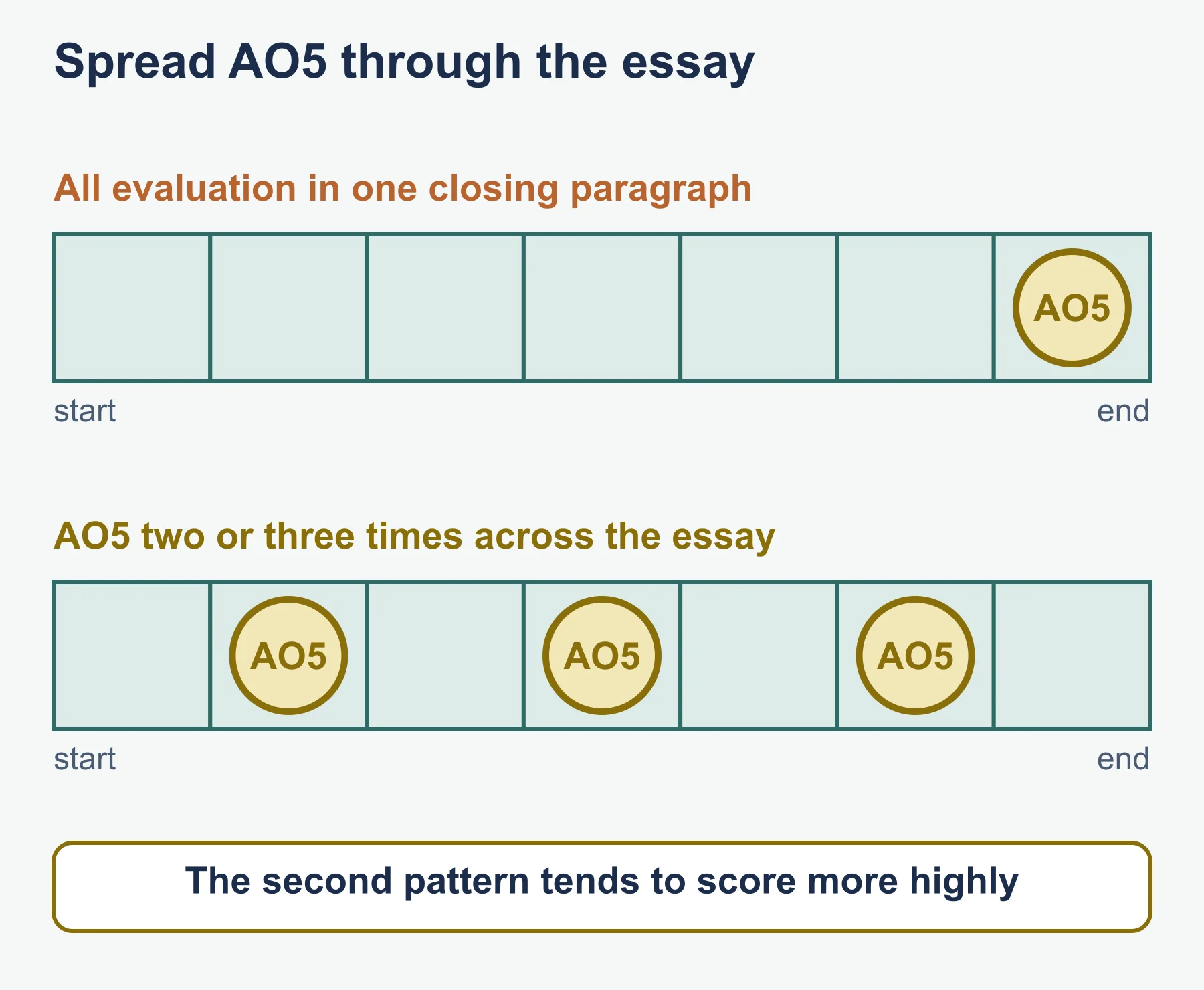
- AO5 woven into two or three paragraphs.
- Brief, precise quotation from memory.
AO5 sentence patterns
- Staging: “A director could play this moment as…, which would make the audience…; but the line break at… suggests… is more convincing.”
- Approach: “A feminist reading sees… as…; this is persuasive in…, though it underplays…”
- Audiences: “An early audience might have heard… as…, whereas a modern audience is likely to…”
- Judgement: always end with which reading the text supports more strongly, and why.
Set-play reminders
- Hamlet (2026): soliloquies placed between public scenes; imagery of disease and corruption; several sons avenging fathers as parallel plots; the long-debated question of delay.
- The Taming of the Shrew (2026 and 2027): the Christopher Sly Induction; Bianca subplot as contrast; falconry language of taming; the staging of Katherina’s final speech.
- Henry IV, Part 1 (2027): tavern and court alternating; Hal’s early soliloquy revealing a calculated plan; Hotspur as foil; honour debated across the play.
Quick metre check for (b) passages
- Count the syllables in a line that looks unusual: ten is regular pentameter.
- Eleven, with a final unstressed syllable, is a feminine ending: often hesitation or a dying fall.
- Fewer than ten is a short line: ask what pause or action fills the gap.
- A line split between speakers is a shared line: who completes it, and why?
- A switch to prose mid-scene: what has changed in mood, company or control?
Comment only on the departures that matter to the question; one well-explained metrical point is worth more than a full scansion.
Context that earns credit
- Open stages with little scenery: language creates place and time.
- Boy actors in women’s roles: relevant to gender and performance.
- Ideas of kingship, honour, marriage and order that the plays test.
Each must be tied to a moment in the play.
Exam traps
- AO5 name-dropping: a critic quoted without evaluation.
- AO5 bolted on: alternative readings in a final paragraph only.
- Verse ignored: no comment on metre, prose shifts or shared lines.
- Plot retelling: especially in (a) essays.
- The sealed passage: a (b) answer that never refers to the rest of the play.
- Context lecture: background with no link to a dramatic choice.
Self-test
- Which assessment objectives are tested in Paper 3 Section A, and at what weighting each?
- What does AO5 require that AO3 does not?
- Name three sources of alternative interpretations for AO5.
- Define blank verse.
- Give two reasons a high-status character might speak in prose.
- What can a shared line suggest?
- What is the Induction in The Taming of the Shrew, and why does it matter for interpretation?
- Give one example of a foil in a set Shakespeare play.
- Why should AO5 be woven through an essay rather than saved for the end?
- What should every AO5 point end with?
- Name one useful theatrical context for Shakespeare’s plays.
- Which set Shakespeare play appears on both the 2026 and 2027 lists?
Answers: 1. AO1 to AO5, 20% each. 2. Discussion and evaluation of other people’s interpretations. 3. Staging choices, critical approaches, audiences across time. 4. Unrhymed iambic pentameter. 5. Any two: comedy, disorder, feigned madness, mixing with low-status characters, a change of mood. 6. Intimacy, haste or conflict. 7. An opening frame in which Christopher Sly is tricked into thinking he is a lord and the main story is performed for him; it invites reading the action as performance. 8. For example Hotspur as a foil to Hal, or Laertes to Hamlet. 9. So that the evaluation shapes the argument rather than sitting apart from it. 10. A judgement on which reading the text supports more strongly. 11. For example open stages with minimal scenery, or boy actors in women’s roles. 12. The Taming of the Shrew.
Related resources
-
Study guides
Cambridge A Level Literature in English (9695): Paper 3 Section B – Drama
Writing on modern set plays for Cambridge 9695 Paper 3 Section B Drama: naturalism, stagecraft, time and ritual, with AO5 drawn from productions and readings.
English Literature · Cambridge · A Level
Read guide -
Practice questions
Cambridge A Level Literature in English (9695): Paper 3 Section B – Drama – Practice Questions
Original practice for Cambridge 9695 Paper 3 Section B Drama: modern stagecraft, non-linear structure and AO5 evaluation on new extracts, with full answers.
English Literature · Cambridge · A Level
Try questions -
Revision notes
Cambridge A Level Literature in English (9695): Paper 3 Section B – Drama – Revision Notes
Quick-recall notes for Cambridge 9695 Paper 3 Section B Drama: modern stagecraft terms, structure, AO5 from productions and readings, traps and a self-test.
English Literature · Cambridge · A Level
Revise topic
Get free revision emails (optional)
Occasional emails with practice questions, worked explanations and links to free resources for the qualification and subjects you choose. No spam, and you can unsubscribe from any email. The free tools on this site never need an email.