
Study Guides
Cambridge A Level Literature in English (9695): Paper 3 Section A – Shakespeare
Writing on a Shakespeare play for Cambridge 9695 Paper 3 Section A: verse and prose, soliloquy, structure, and building AO5 from critical and staged readings.
- Subject
- English Literature
- Level
- A LEVEL
- Topic
- Paper 3 – Shakespeare and Drama
- Author
- Marlbridge Academic Team
- Updated
- Reviewed by
- Ammar Bilal (what this means)
Aligned to Cambridge A Level English Literature (9695), 2024-2026. Official specification .
Syllabus page (what it covers and how it is assessed): Cambridge A Level English Literature.
Syllabus points this page covers
9695 (A Level)
- 3.1 Section A: Shakespeare
Found an error? Report a correction.
Need help with this topic? Request a free trial class for A Level English Literature (9695).
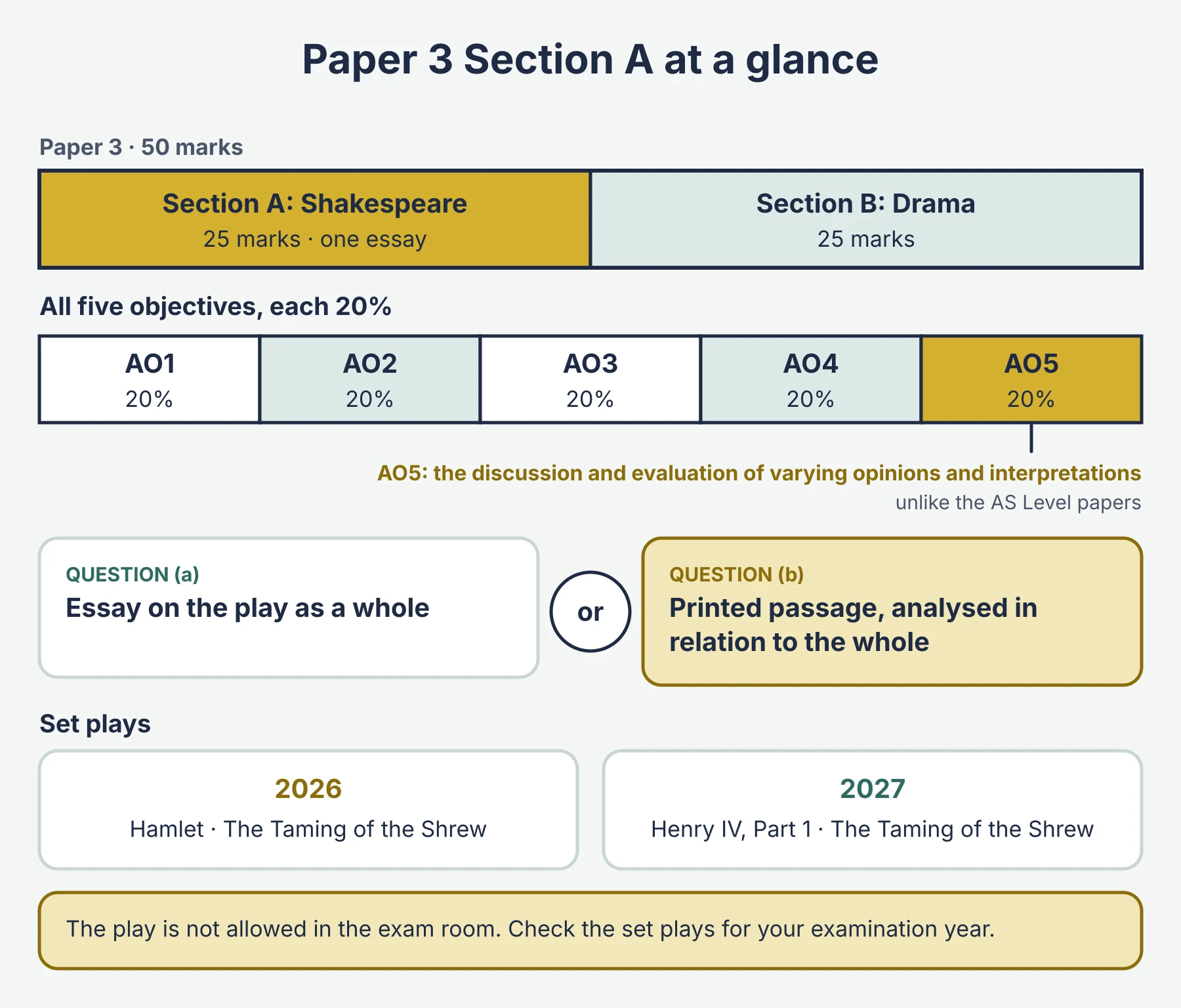
Section A of Paper 3 asks for one essay on a set Shakespeare play. It is worth 25 of the paper’s 50 marks and, unlike the AS Level papers, is assessed on all five objectives, each 20%: AO1 to AO4 plus AO5, the discussion and evaluation of varying opinions and interpretations. This guide focuses on the Shakespeare-specific skills and on making AO5 part of the argument. For the paper’s format and both sections together, see the Paper 3 overview.
What the section asks of you
On each play you choose an (a) question, an essay on the play as a whole, or a (b) question, which prints a passage from the play for close analysis in relation to the whole. The play is not allowed in the exam room. For 2026 the set plays are Hamlet and The Taming of the Shrew; for 2027 they are Henry IV, Part 1 and The Taming of the Shrew. Check the list for your examination year.
Shakespeare’s dramatic language
Verse, prose and rhyme
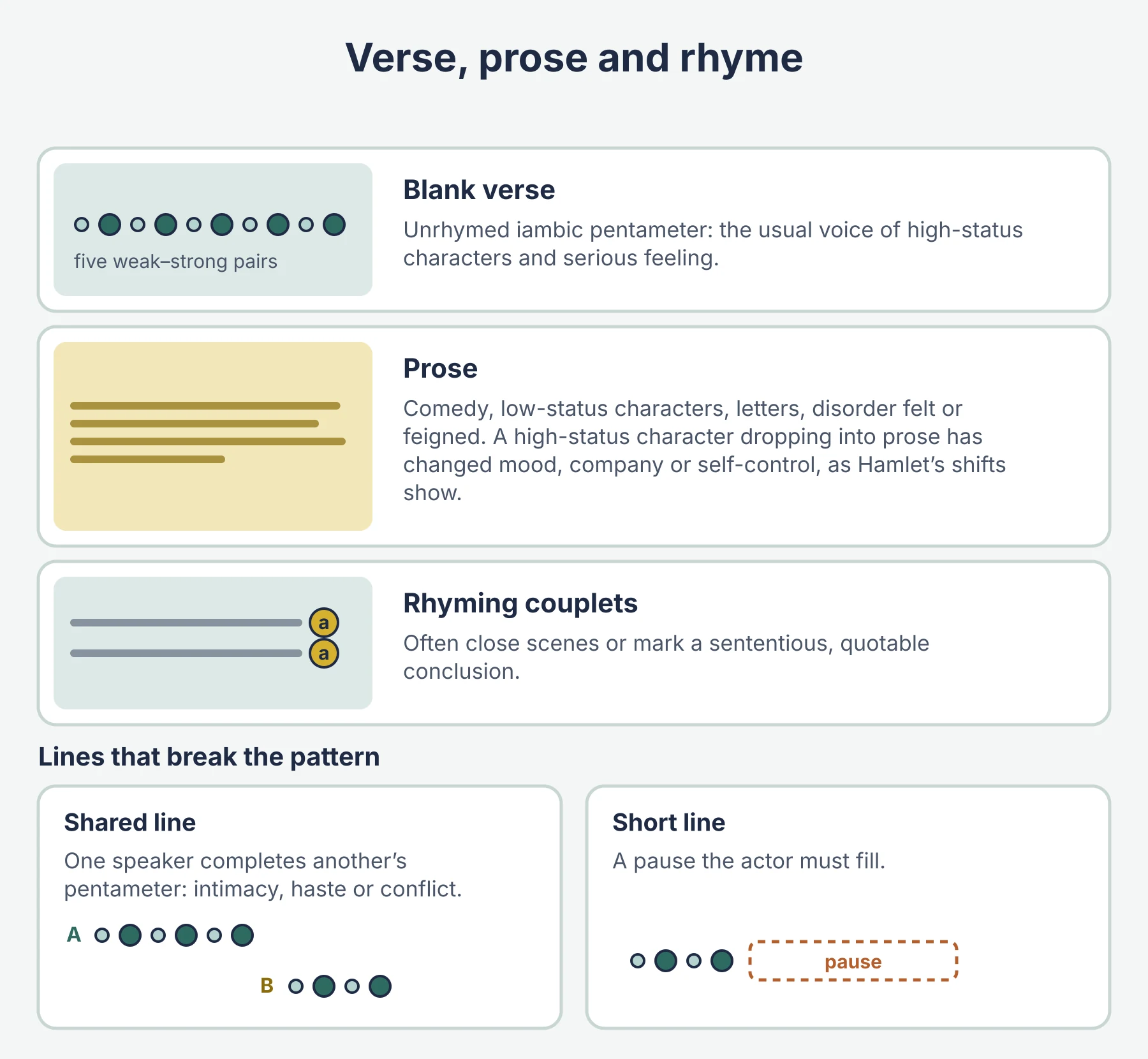
Shakespeare’s characters move between three modes, and the movement is meaningful.
- Blank verse (unrhymed iambic pentameter) is the usual voice of high-status characters and serious feeling. Look for lines that break the pattern: an extra syllable, a short line, a line shared between two speakers.
- Prose is often used for comedy, low-status characters, letters, and characters feigning or experiencing disorder. A high-status character who drops into prose has changed something: mood, company or self-control. Hamlet’s shifts between verse and prose, depending on whom he is with and what he is performing, are an example.
- Rhyming couplets often close scenes or mark a sententious, quotable conclusion.
A shared line, where one speaker completes another’s pentameter, can suggest intimacy, haste or conflict; a short line can mark a pause the actor must fill.
Soliloquy and its effect
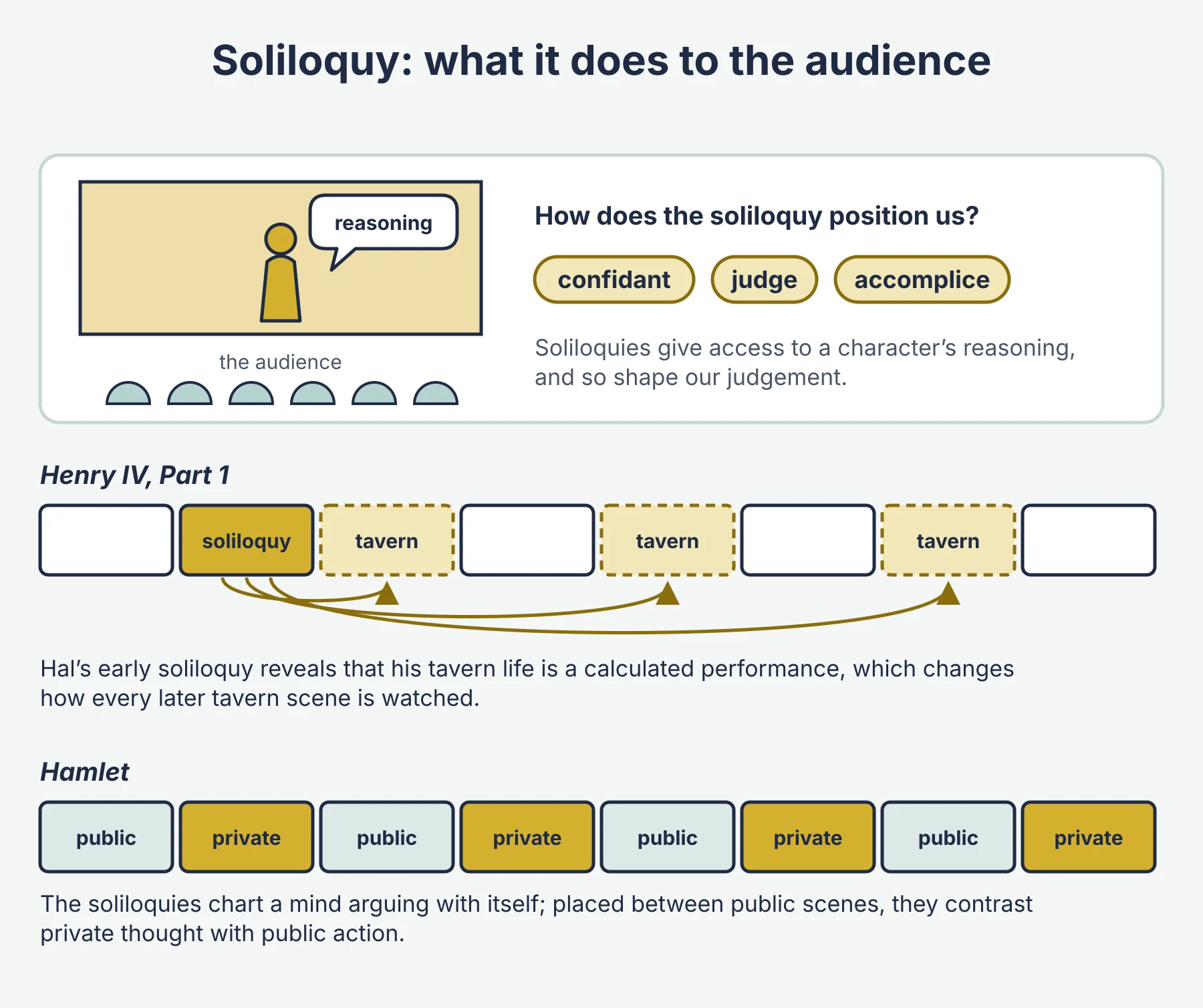
Soliloquies give the audience access to a character’s reasoning, and so shape our judgement. Ask how the soliloquy positions the audience: as confidant, judge or accomplice? In Henry IV, Part 1, Hal’s early soliloquy reveals that his tavern life is a calculated performance, which changes how every later tavern scene is watched. In Hamlet, the soliloquies chart a mind arguing with itself, and their placement between public scenes contrasts private thought with public action.
Imagery patterns
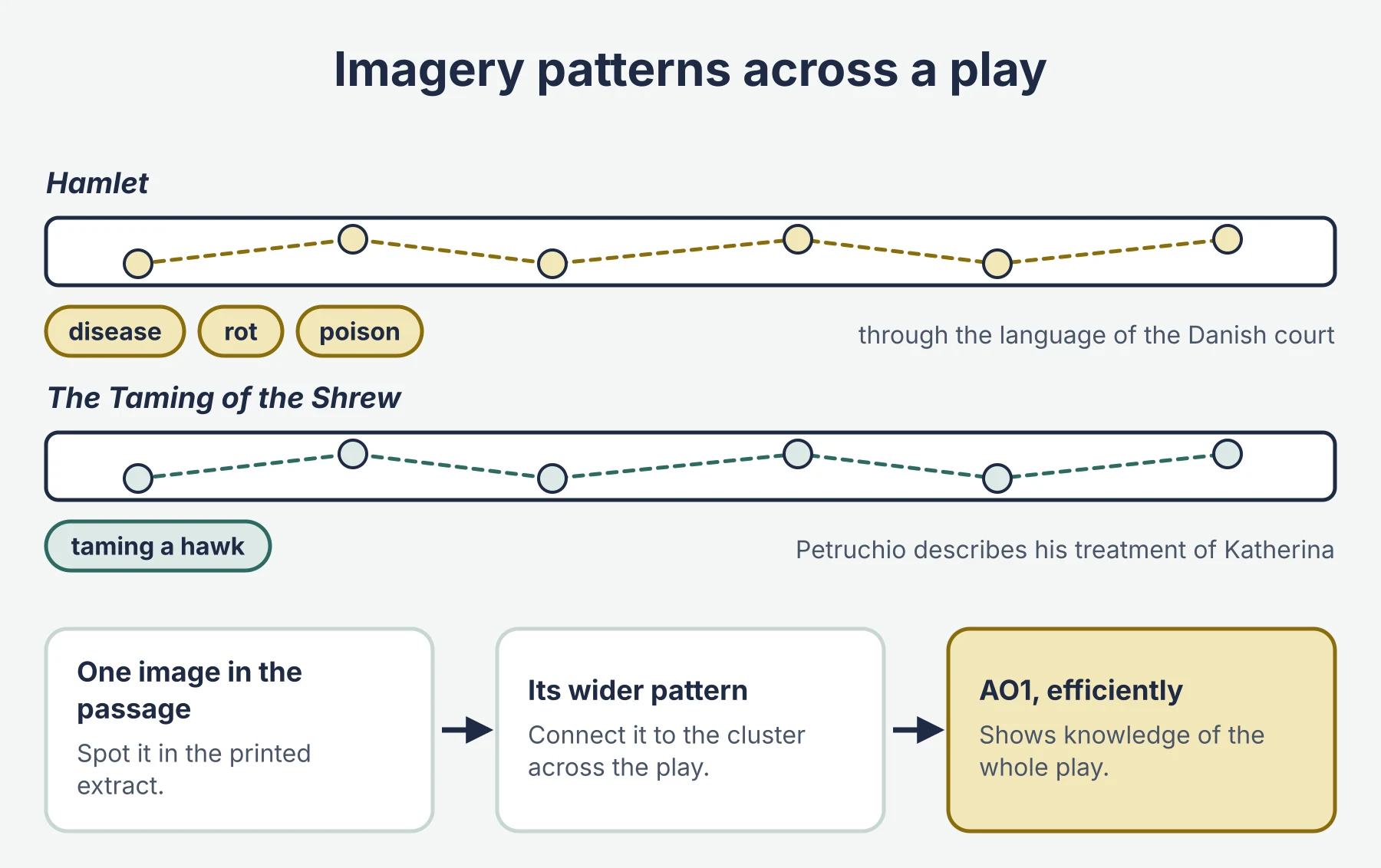
Shakespeare builds clusters of imagery across a play. In Hamlet, images of disease, rot and poison run through the language of the Danish court; in The Taming of the Shrew, Petruchio describes his treatment of Katherina in the language of taming a hawk. A passage answer that connects one image to its wider pattern shows AO1 knowledge of the whole play efficiently.
Structure and genre
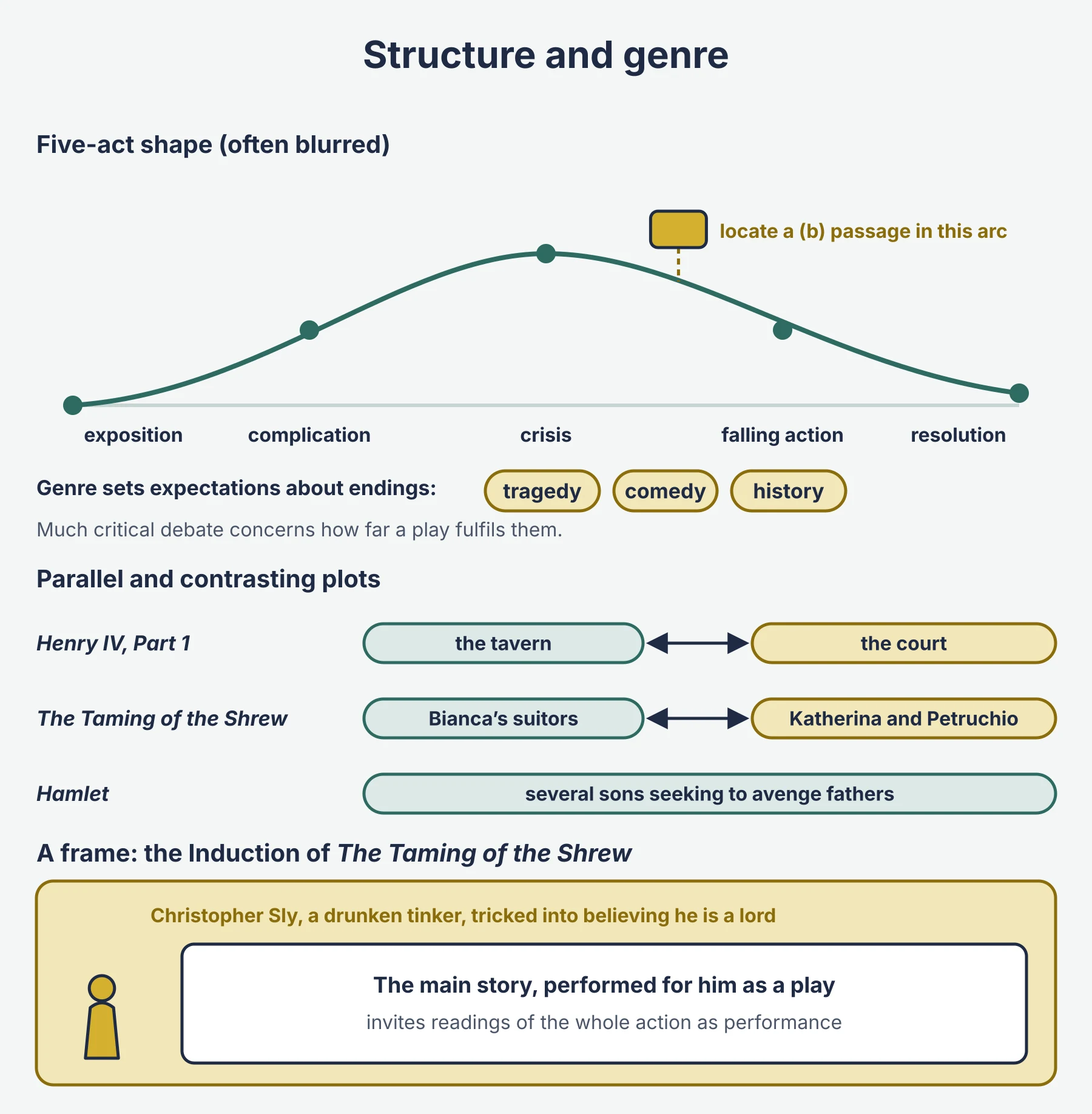
- Five-act shape: exposition, complication, crisis, falling action and resolution, though Shakespeare often blurs it. Locate a (b) passage in this arc.
- Parallel and contrasting plots: the tavern and the court in Henry IV, Part 1; Bianca’s suitors alongside Katherina and Petruchio; the several sons seeking to avenge fathers in Hamlet.
- Frames: The Taming of the Shrew opens with an Induction in which a drunken tinker, Christopher Sly, is tricked into believing he is a lord, and the main story is performed for him as a play. This frame invites readings of the whole action as performance.
- Genre: tragedy, comedy and history set different expectations about endings, and much critical debate concerns how far a play fulfils them.
Context for Shakespeare
Useful contexts are those that explain dramatic choices: the open, daylit stages and minimal scenery that made language carry setting; the convention that women’s roles were played by boy actors; ideas about kingship, honour, marriage and the family that the plays test. Tie any context to a specific moment.
Making AO5 work
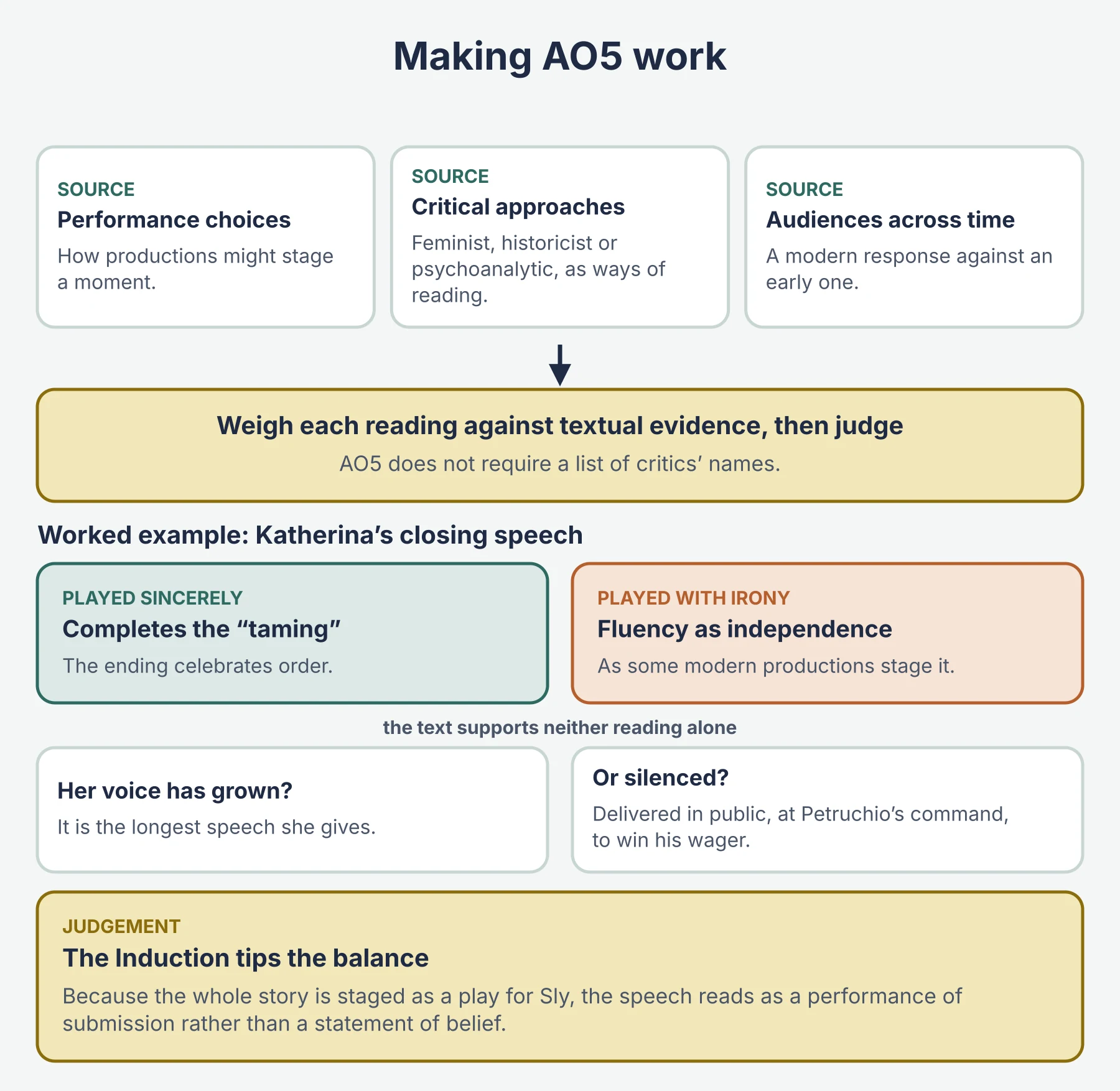
AO5 asks you to discuss and evaluate other interpretations. It does not require a list of critics’ names. Strong sources of alternative readings are:
- Performance choices: how different productions might stage a moment, and how that changes its meaning.
- Critical approaches: for example feminist, historicist or psychoanalytic readings, stated as ways of reading the play.
- Audiences across time: how a modern audience’s response might differ from an early audience’s.
The skill is to weigh a reading against textual evidence, then judge.
Annotated model paragraph
A strong AO5 paragraph on Katherina’s final speech in The Taming of the Shrew might read:
Katherina’s long closing speech on a wife’s duty to obey can be played in more than one way, and the choice shapes the whole comedy. Performed sincerely, it completes Petruchio’s “taming” and makes the ending a celebration of order; some modern productions instead stage it with irony, so that her fluency itself becomes a sign of independence. The text supports neither reading alone: the speech is the longest she gives, which suggests her voice has grown rather than been silenced, yet it is delivered in public, at Petruchio’s command, to win his wager. The Induction tips the balance for me: because the whole story is staged as a play for Sly, the speech reads as a performance of submission rather than a statement of belief.
The paragraph sets out two readings, tests them against structure and dramatic context, and reaches a judgement: that is AO5 working with AO2 and AO3.
The (b) passage answer
- Locate the passage in the play’s structure in one sentence.
- Thesis that answers the question and names the passage’s dramatic function.
- Analyse closely: verse or prose, line breaks and shared lines, imagery, staging implied by the language, who is present.
- Link outward to other moments, especially through imagery patterns or parallel scenes.
- Fold in AO5: one or two points where a different staging or reading would change the passage’s effect, evaluated against the text.
The (a) essay
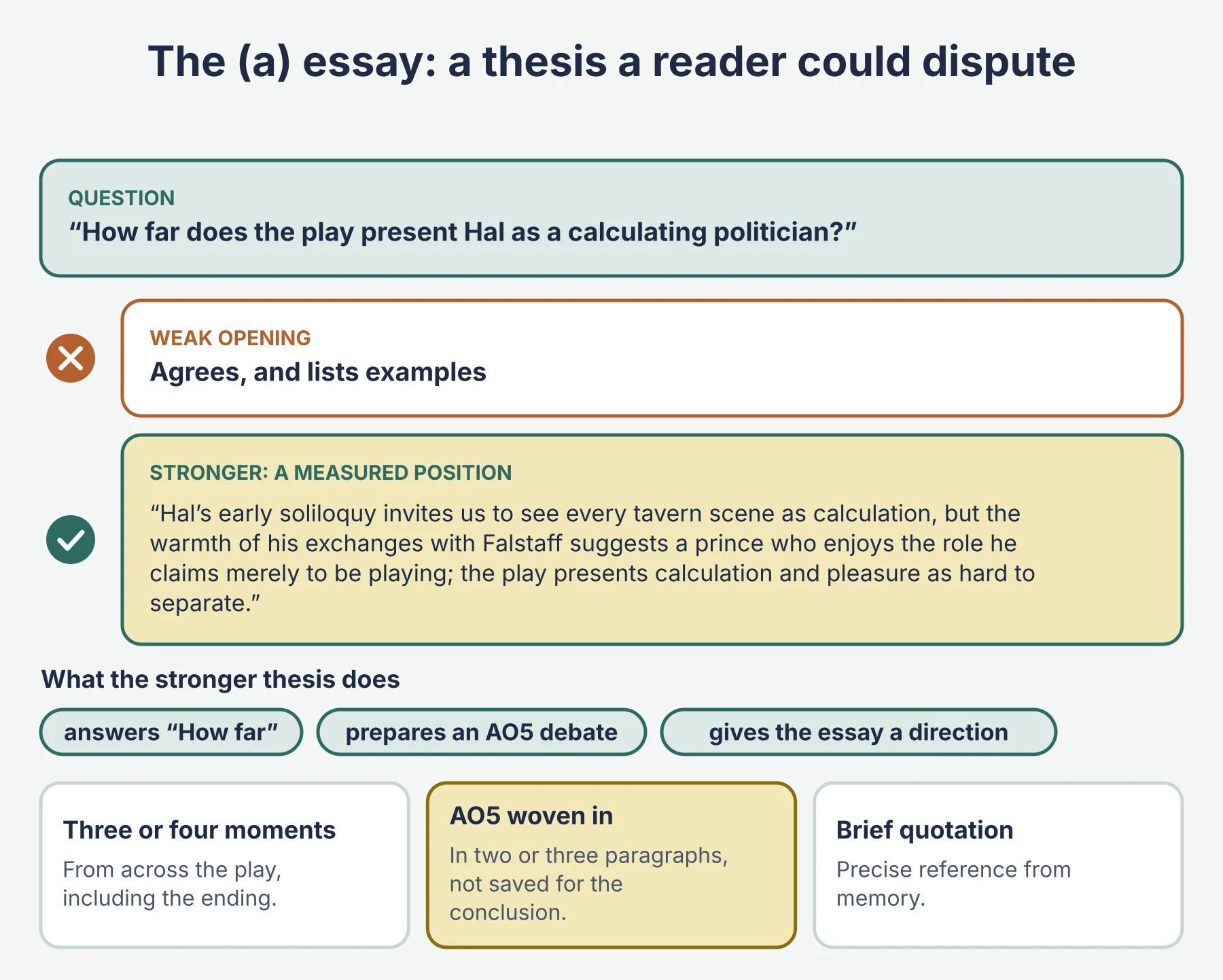
Start with a thesis that a reader could dispute. Asked “How far does the play present Hal as a calculating politician?”, a weak opening agrees and lists examples. A stronger one takes a measured position: “Hal’s early soliloquy invites us to see every tavern scene as calculation, but the warmth of his exchanges with Falstaff suggests a prince who enjoys the role he claims merely to be playing; the play presents calculation and pleasure as hard to separate.” That thesis answers “How far”, prepares an AO5 debate, and gives the essay a direction.
- An arguable thesis that addresses the question’s terms, including “How far” if it appears.
- Three or four moments from across the play, including the ending.
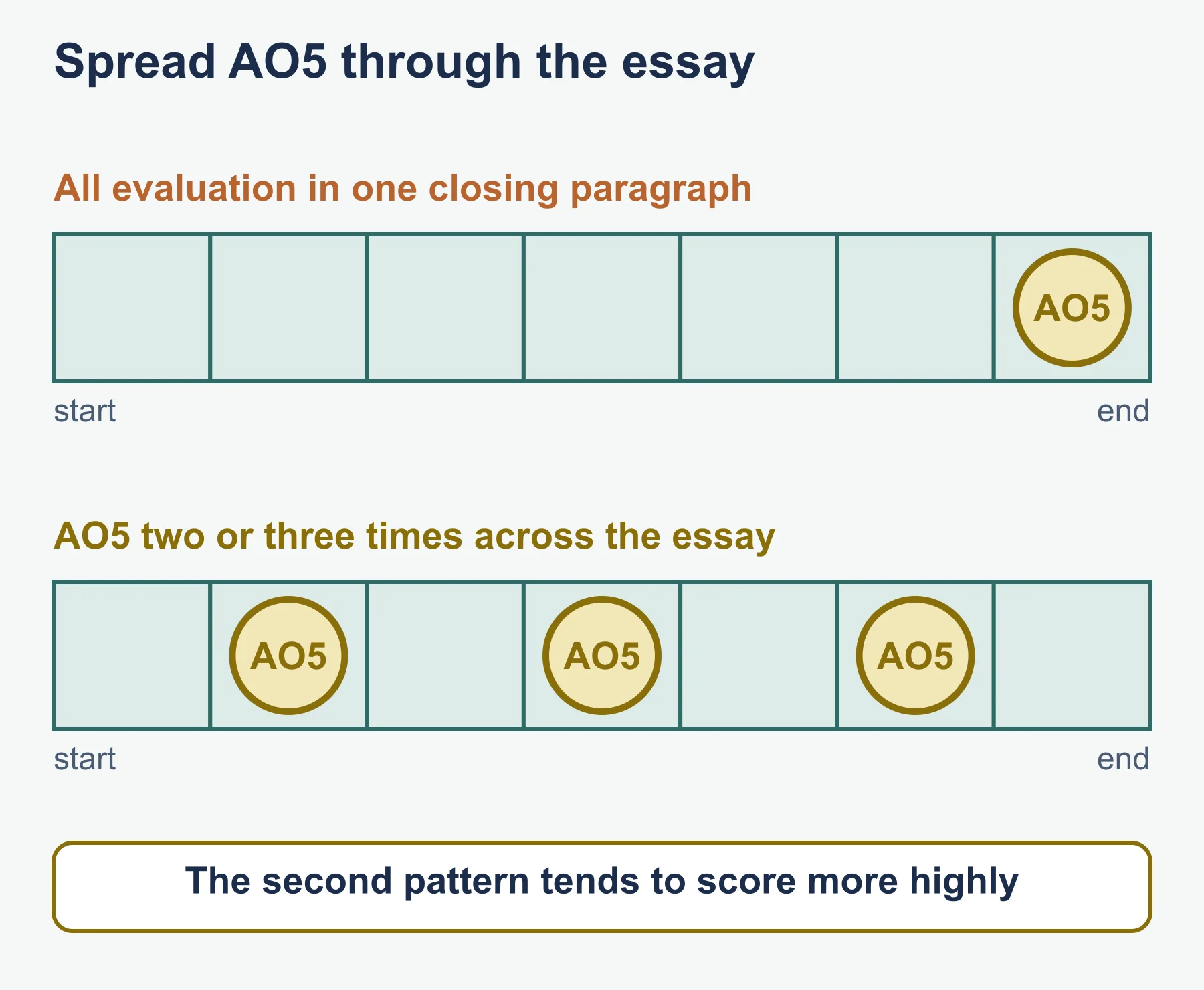
- AO5 woven into two or three paragraphs, not saved for the conclusion.
- Precise, brief quotation and reference from memory.
Common mistakes
- AO5 as name-dropping: a critic’s name with no evaluation earns little.
- A detached AO5 paragraph: alternative readings listed at the end, unconnected to the argument.
- Ignoring verse: never commenting on metre, prose shifts or shared lines.
- Character as person: speculating about off-stage lives rather than dramatic presentation.
- Context as history lesson: Elizabethan background unconnected to a specific moment.
Practise and revise this section
- Paper 3 Section A Shakespeare revision notes — terms, AO5 sentence patterns, traps and a self-test.
- Paper 3 Section A Shakespeare practice questions — structured questions with mark-scheme style answers.
- Paper 3 Section B Drama study guide — the other half of the paper.
Written against the Cambridge International AS & A Level Literature in English 9695 syllabus for 2024, 2025 and 2026.
Related resources
-
Practice questions
Cambridge A Level Literature in English (9695): Paper 3 Section A – Shakespeare – Practice Questions
Original practice for Cambridge 9695 Paper 3 Section A Shakespeare: verse and prose, soliloquy, AO5 evaluation and new verse extracts, with full answers.
English Literature · Cambridge · A Level
Try questions -
Revision notes
Cambridge A Level Literature in English (9695): Paper 3 Section A – Shakespeare – Revision Notes
Quick-recall notes for Cambridge 9695 Paper 3 Section A Shakespeare: verse terms, soliloquy, structure, AO5 sentence patterns, exam traps and a self-test.
English Literature · Cambridge · A Level
Revise topic -
Study guides
Cambridge A Level Literature in English (9695): Paper 3 Section B – Drama
Writing on modern set plays for Cambridge 9695 Paper 3 Section B Drama: naturalism, stagecraft, time and ritual, with AO5 drawn from productions and readings.
English Literature · Cambridge · A Level
Read guide
Get free revision emails (optional)
Occasional emails with practice questions, worked explanations and links to free resources for the qualification and subjects you choose. No spam, and you can unsubscribe from any email. The free tools on this site never need an email.