
Revision Notes
Cambridge A Level Literature in English (9695): Paper 4 Section B – Post-1900 Poetry and Prose – Revision Notes
Quick-recall notes for Cambridge 9695 Paper 4 Section B Post-1900: modern narrative and poetic methods, critical approaches for AO5, traps and a self-test.
- Subject
- English Literature
- Level
- A LEVEL
- Topic
- Paper 4: Pre- and Post-1900 Poetry and Prose
- Author
- Marlbridge Academic Team
- Updated
- Reviewed by
- Ammar Bilal (what this means)
Aligned to Cambridge A Level English Literature (9695), 2024-2026. Official specification .
Syllabus page (what it covers and how it is assessed): Cambridge A Level English Literature.
Syllabus points this page covers
9695 (A Level)
- 4.2 Section B: Post-1900 Poetry and Prose
Found an error? Report a correction.
Need help with this topic? Request a free trial class for A Level English Literature (9695).
Condensed notes for the post-1900 half of Paper 4. For the full method and an annotated AO5 paragraph, use the Paper 4 Section B Post-1900 study guide.
Section B in five lines
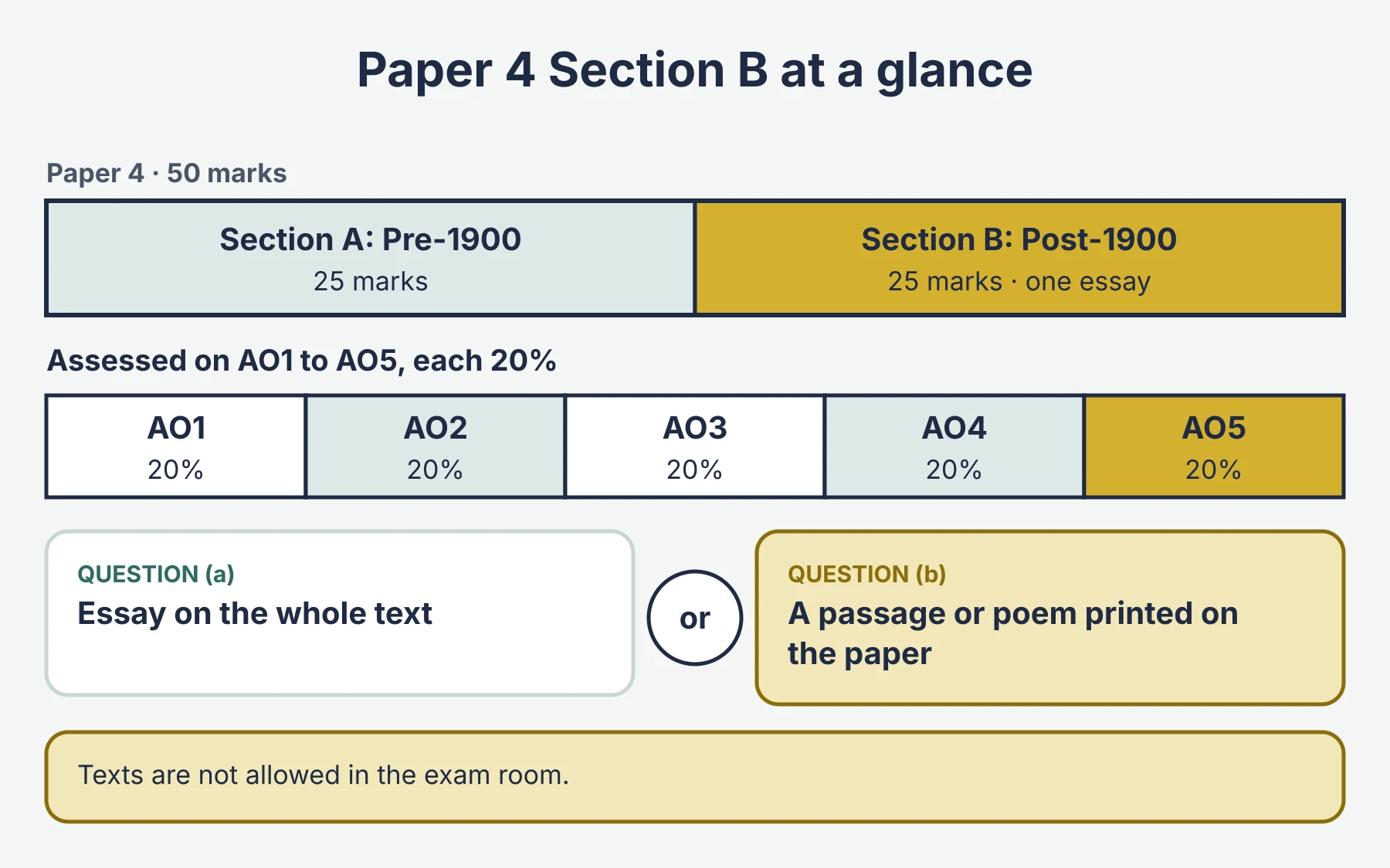
- One essay on one post-1900 set text, worth 25 marks.
- (a) whole-text essay or (b) essay on a printed passage or poem.
- Assessed on AO1 to AO5, each 20%.
- Closed book; no dictionaries.
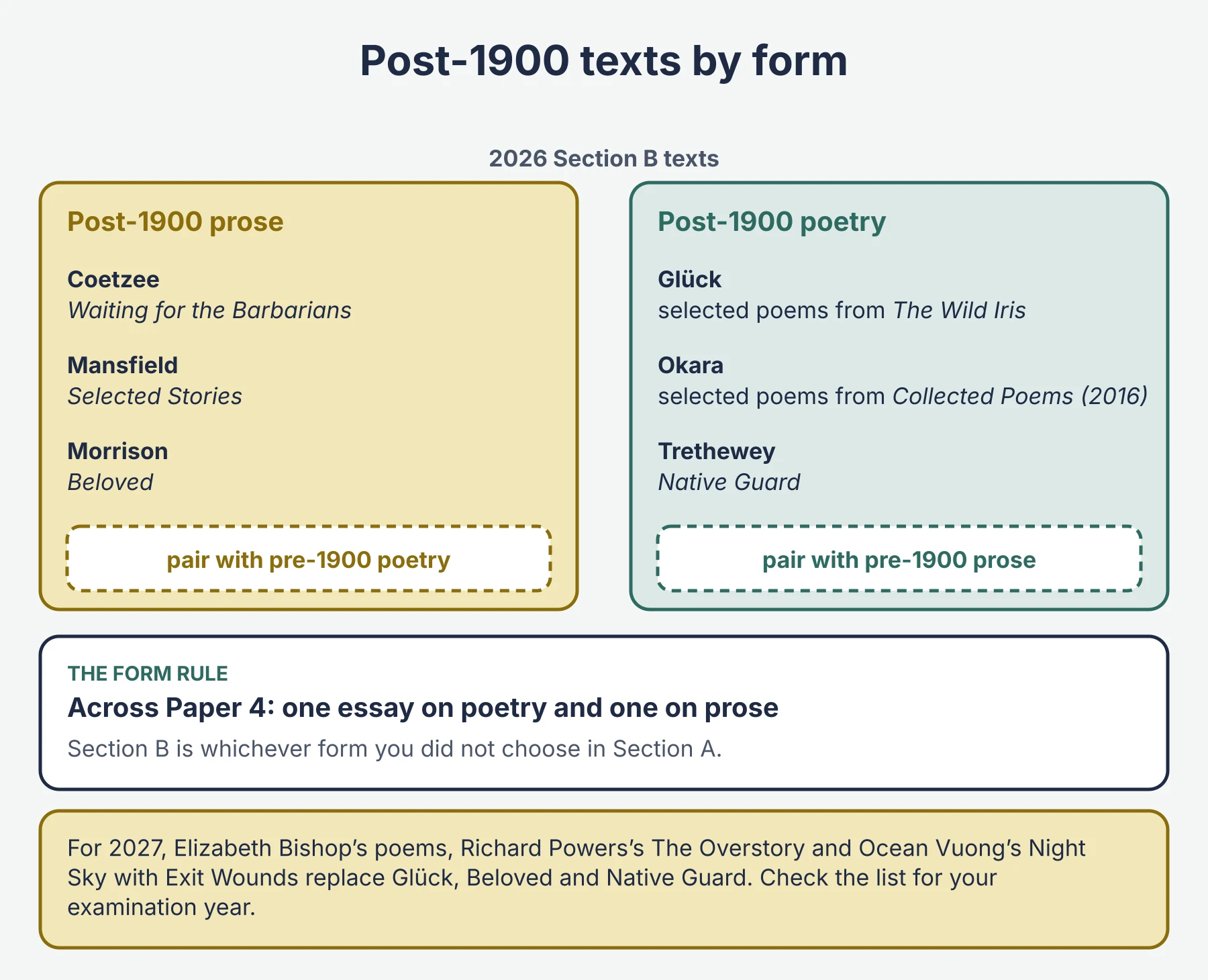
- Form rule: the opposite form to your Section A text.
The one principle
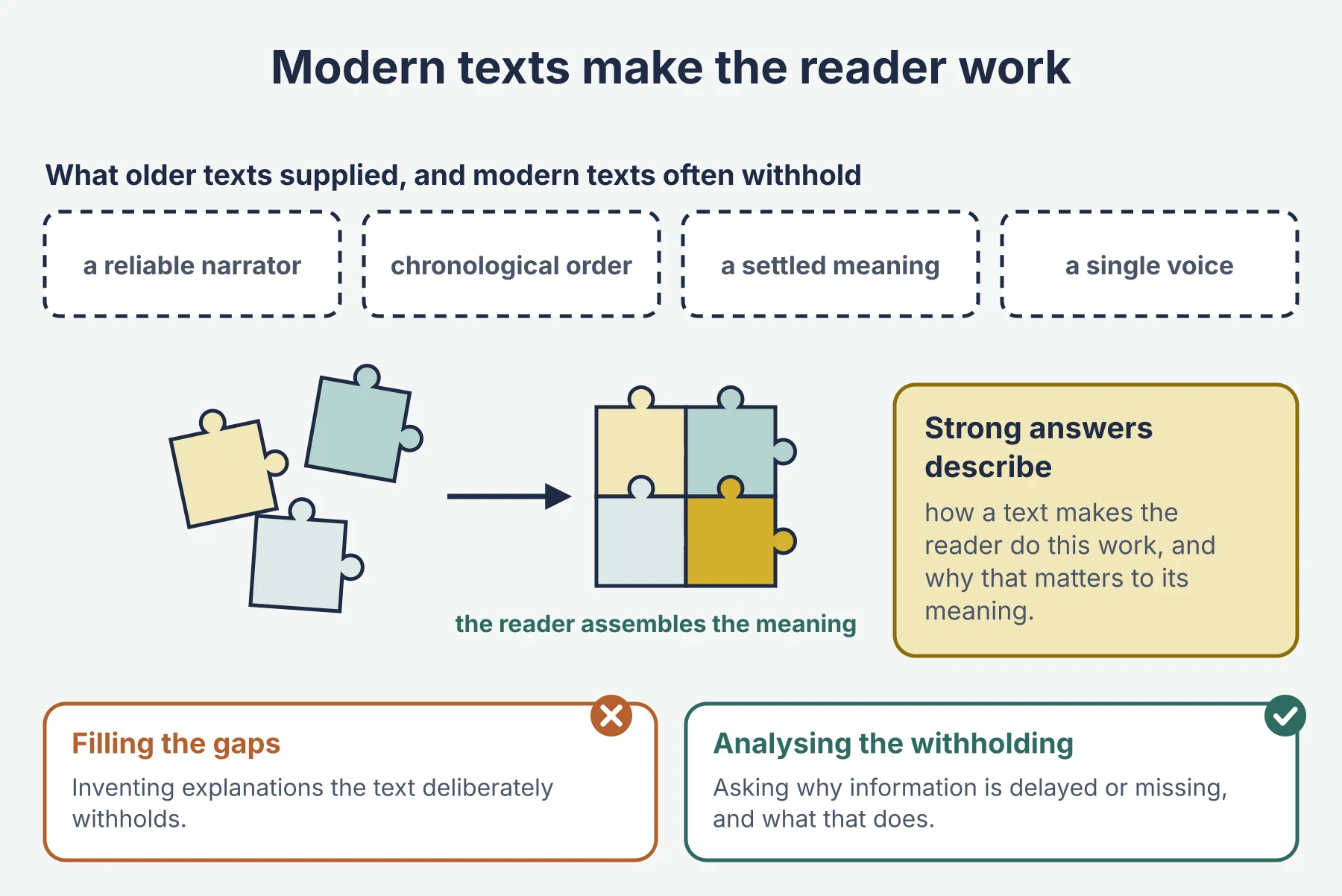
Modern texts often withhold what older texts supply: order, a reliable narrator, a single voice, a settled meaning. Analyse how the text makes the reader assemble meaning, and why.
Key terms: prose
| Term | Meaning | What to say |
|---|---|---|
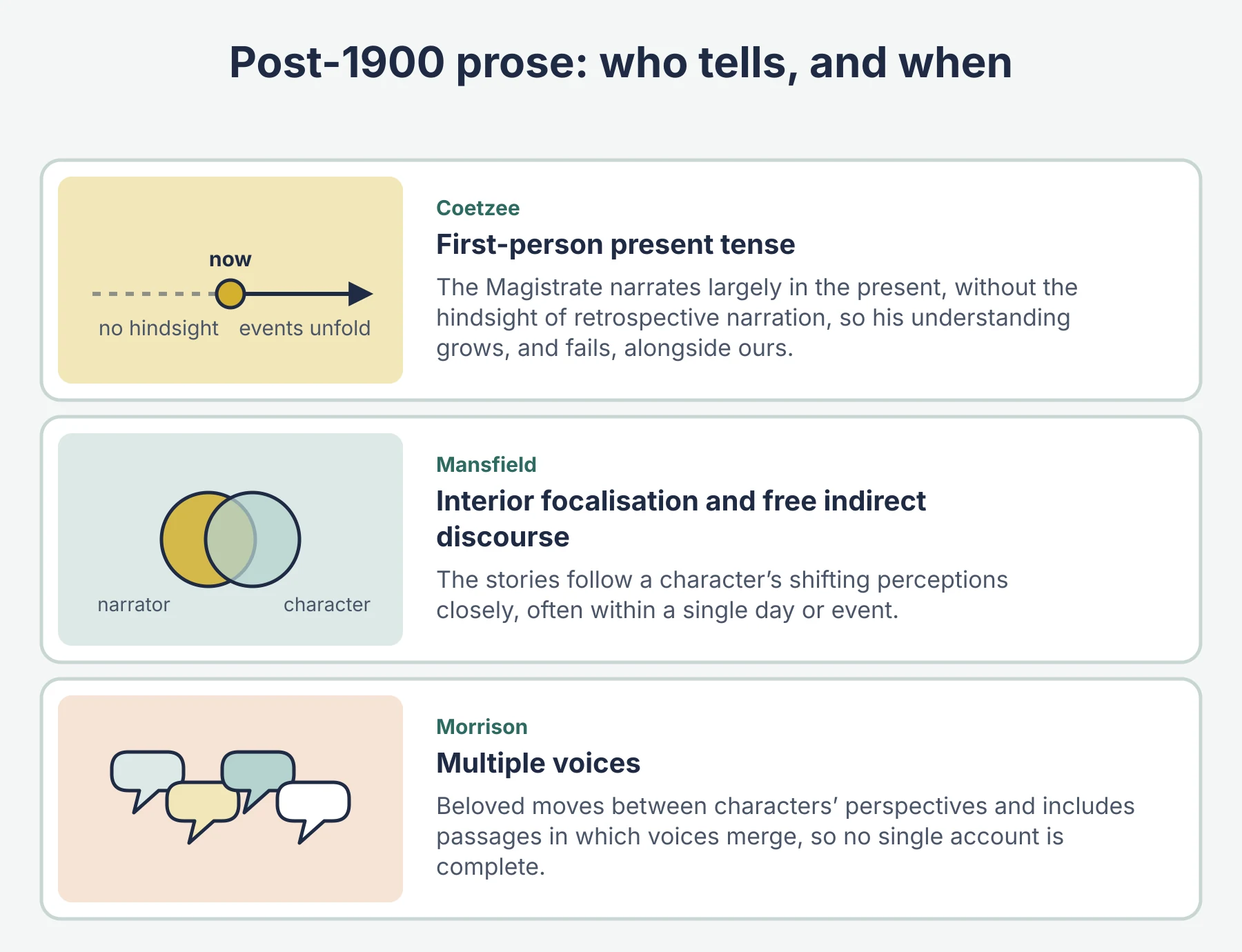
| Present-tense narration | The narrator tells events as they happen | No hindsight; reader shares partial understanding |
| Interior focalisation | Narration filtered through a character’s perceptions | Shifting moods; subjective world |
| Stream of consciousness | Narration imitating the flow of thought | Associative, unpunctuated, fragmented |
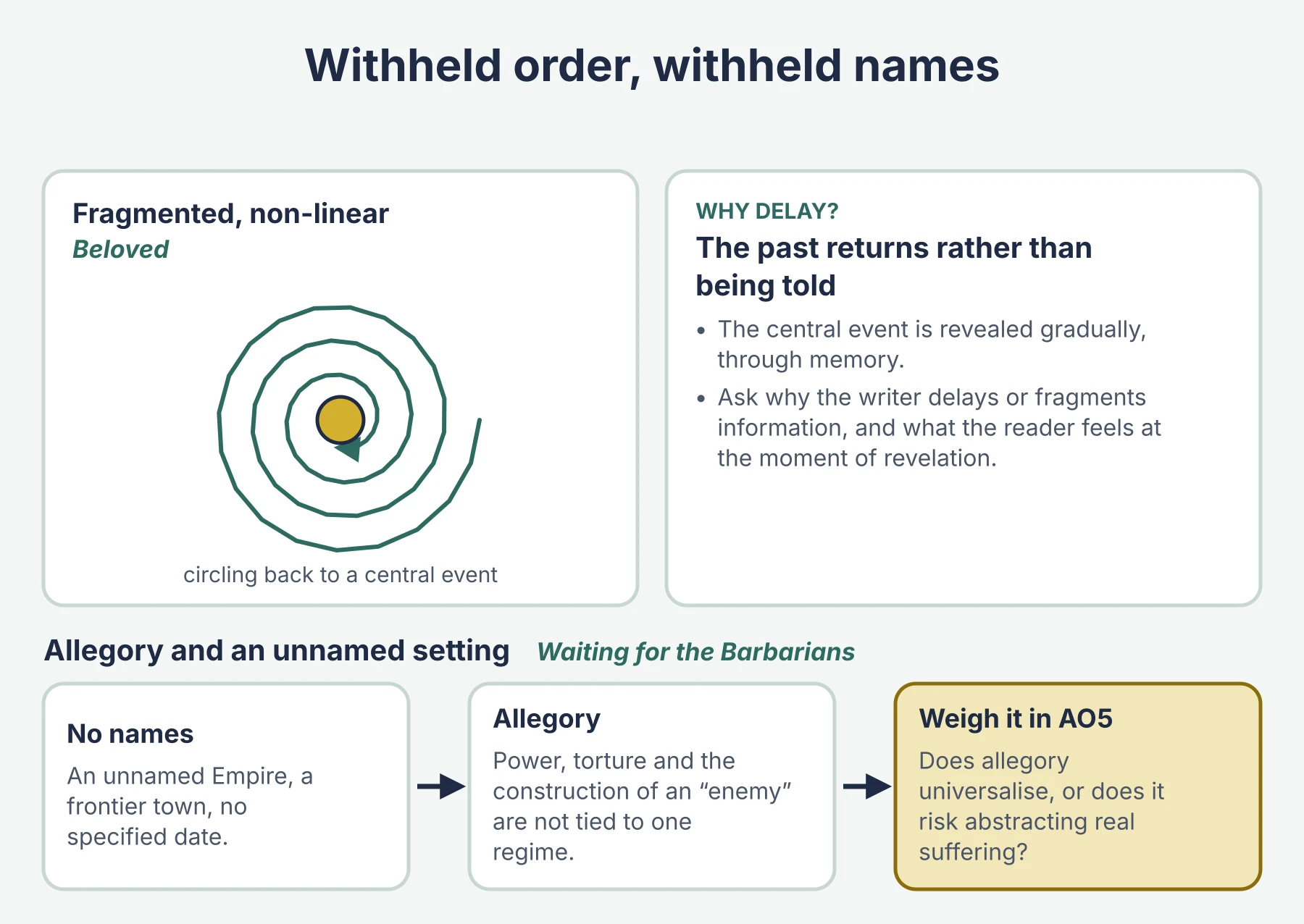
| Non-linear structure | Events out of chronological order | Delay, revelation, memory as return |
| Polyphony | Many voices, none dominant | No single authoritative account |
| Allegory | A story whose elements stand for wider ideas | Unnamed settings universalise |
| Open ending | Conflict left unresolved | Reader completes the meaning |
| Epiphany | A sudden moment of insight | Short-story turning point |
Key terms: poetry
| Term | Meaning | What to say |
|---|---|---|
| Sequence | Poems designed to be read together | Poems answer one another |
| Persona | Constructed speaking voice | Flowers, gods, soldiers; not the poet |
| Elegy | A poem of mourning | Personal grief joined to history |
| Received form | Traditional form such as sonnet, villanelle, ghazal, pantoum | What the form brings, and how it is changed |
| Pantoum | Lines repeated in a fixed pattern across quatrains | Return, obsession, memory |
| Free verse | No fixed metre or rhyme | Line breaks shape meaning |
| White space | Gaps on the page | Pause, silence, isolation |
| Lyric “I” | The speaking self of a short poem | Treat as constructed |
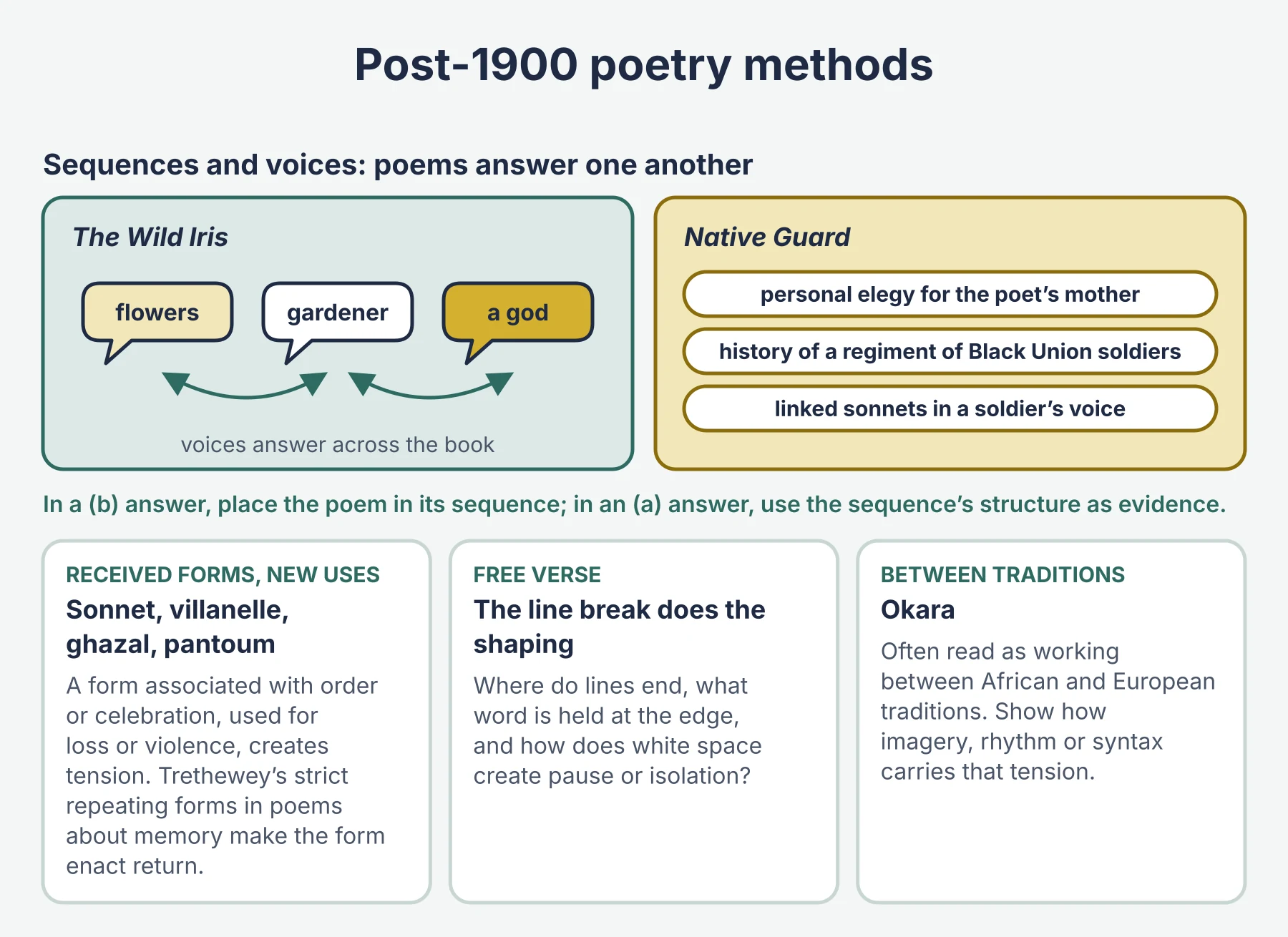
Text reminders (2026)
- Coetzee: Magistrate narrates largely in the present tense; unnamed Empire; allegory of power and the “enemy”.
- Glück: a sequence of voices (flowers, a gardener-speaker, a god) answering one another.
- Mansfield: compressed stories, interior focus, small moments, open endings.
- Morrison: memory returning; delayed revelation; merging voices.
- Okara: imagery and rhythm read between African and European traditions.
- Trethewey: personal elegy and the history of a regiment of Black Union soldiers; received forms.
For 2027, Bishop, Powers and Vuong replace Glück, Morrison and Trethewey.
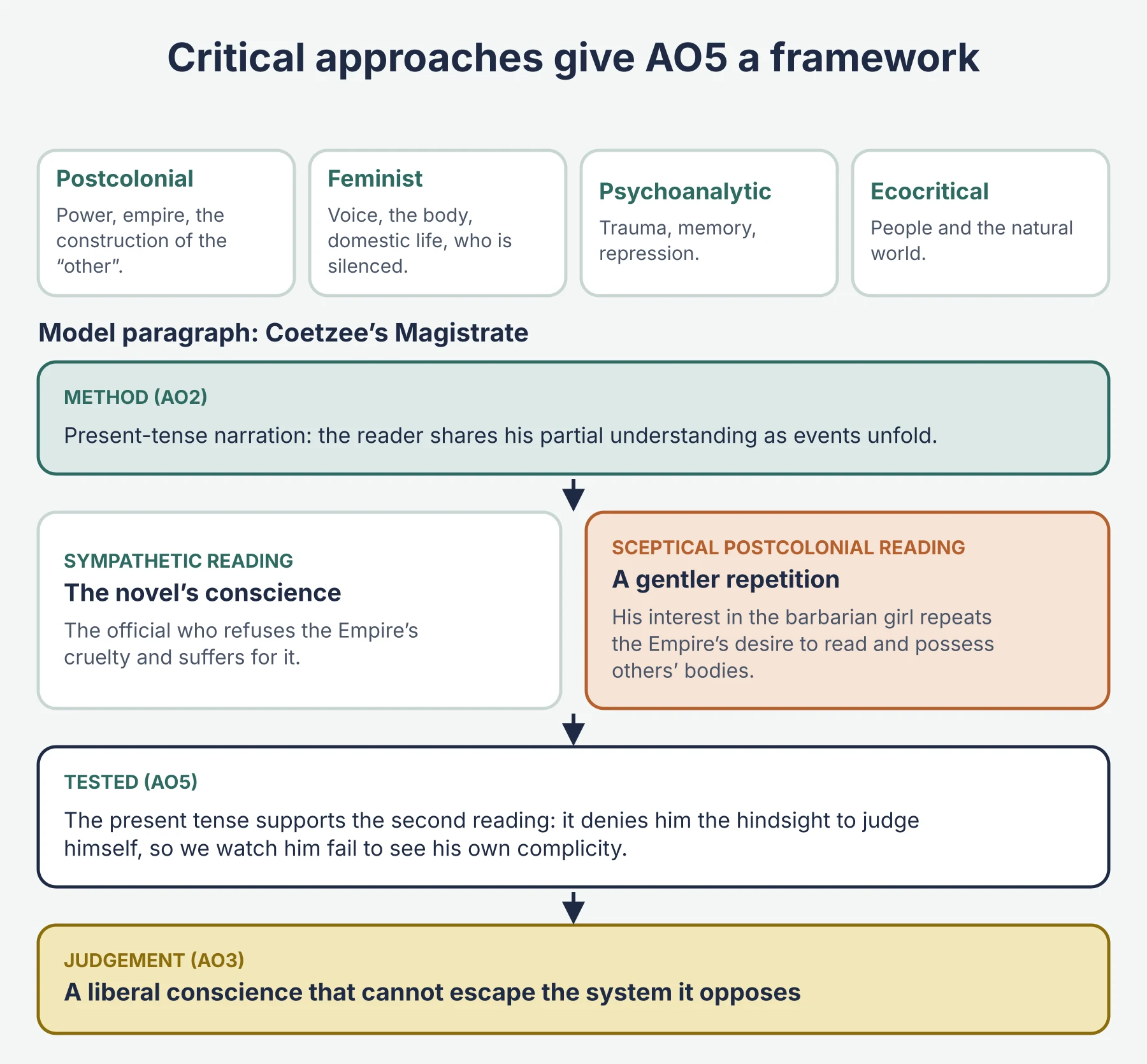
Critical approaches for AO5
| Approach | Key questions |
|---|---|
| Postcolonial | Who holds power? How is the “other” constructed? |
| Feminist | Whose voice is heard? How are bodies and domestic lives presented? |
| Psychoanalytic | How do trauma, memory and repression shape the text? |
| Ecocritical | How are people and the natural world related? |
| Historicist | How does the text engage with the history it represents? |
AO5 pattern: name the reading → test it against specific evidence → judge which is more convincing.
Worked AO5 sentence
“A sympathetic reading treats the narrator as the novel’s conscience; a postcolonial reading notes that his curiosity about others mirrors the power he condemns. The present-tense narration, which denies him hindsight, makes the second reading more persuasive.”
Reading one, reading two, a method used as evidence, a judgement: four moves in three sentences.
Revision card for a poetry sequence
For each poem you might be given in a (b) question:
- its place in the sequence and the voice that speaks it;
- one feature of form (line, stanza, received form) with its effect;
- two short quotations;
- one poem it answers or echoes;
- one critical approach that suits it.
Context that earns credit
Colonialism and its aftermath; slavery and its legacy; war; modernism’s break with Victorian conventions; gender and family; environmental change. One sentence tied to one choice.
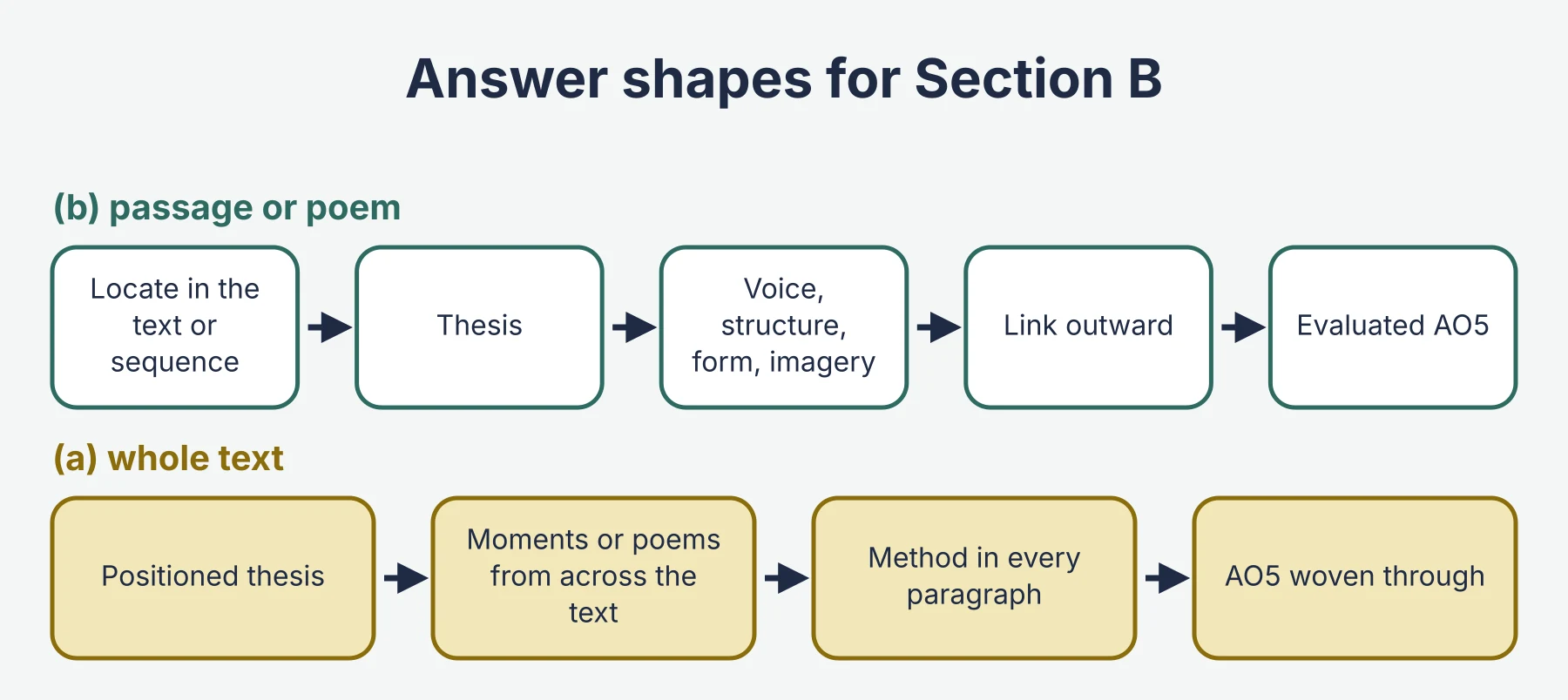
Answer shapes
(b): locate in text or sequence → thesis → voice, structure, form, imagery → link outward → evaluated AO5.
(a): positioned thesis → range across the text → method in every paragraph → AO5 woven through.
Exam traps
- Filling the gaps a fragmented text deliberately leaves.
- Biographical reading: the “I” as the poet.
- Isolated poems: ignoring the sequence.
- Theory without text: an approach named but not tested.
- Plot summary of a non-linear novel in chronological order.
- Form rule broken across the paper.
Self-test
- Which form must your Section B text be if your Section A text is a novel?
- What is printed for a (b) question in this section?
- Which assessment objectives are tested, and at what weighting?
- What effect can present-tense first-person narration have?
- Define polyphony.
- Why might a novel leave its setting unnamed?
- What is a poetic sequence, and why does it matter in a (b) answer?
- Name two received forms that modern poets adapt.
- What does a pantoum’s repetition often enact?
- Name three critical approaches useful for AO5.
- What are the three steps of an AO5 point?
- Why is filling a fragmented text’s gaps a trap?
Answers: 1. Poetry. 2. A passage or a poem from the set text. 3. AO1 to AO5, 20% each. 4. It removes hindsight, so the reader shares the narrator’s partial understanding. 5. Many voices with none dominant. 6. To work as allegory, so its concerns are not tied to one place or regime. 7. Poems designed to be read together; placing the poem in its sequence shows knowledge of the whole text. 8. Any two: sonnet, villanelle, ghazal, pantoum. 9. Return, memory or obsession. 10. Any three: postcolonial, feminist, psychoanalytic, ecocritical, historicist. 11. Name the reading, test it against evidence, judge. 12. The withholding is a deliberate method to analyse, so inventing answers misses the point.
Related resources
-
Study guides
Cambridge A Level English Literature (9695): Paper 4 Pre- and Post-1900 Poetry and Prose – Study Guide
How to read, plan and write about poetry and prose in both halves of Paper 4, with a method for passage and essay questions and short worked examples.
English Literature · Cambridge · A Level
Read guide -
Practice questions
A Level English Literature: Paper 4 – Pre- and Post-1900 Poetry and Prose — Practice Questions
Original Cambridge 9695 Paper 4-style essay and passage questions on 2026 pre- and post-1900 set texts, with AO1–AO5 indicative content and model paragraphs.
English Literature · Cambridge · A Level
Try questions -
Revision notes
A Level English Literature: Paper 4 – Pre- and Post-1900 Poetry and Prose — Revision Notes
Quick-recall notes for Cambridge 9695 Paper 4: format, the one-poetry-one-prose rule, (a) vs (b) questions, AO1–AO5 with AO5 critical views, and 2026 set texts.
English Literature · Cambridge · A Level
Revise topic
Get free revision emails (optional)
Occasional emails with practice questions, worked explanations and links to free resources for the qualification and subjects you choose. No spam, and you can unsubscribe from any email. The free tools on this site never need an email.