
Study Guides
Cambridge A Level Literature in English (9695): Paper 4 Section B – Post-1900 Poetry and Prose
Reading post-1900 set texts for Cambridge 9695 Paper 4 Section B: fragmented narration, sequences and voices, allegory, and AO5 from modern critical approaches.
- Subject
- English Literature
- Level
- A LEVEL
- Topic
- Paper 4: Pre- and Post-1900 Poetry and Prose
- Author
- Marlbridge Academic Team
- Updated
- Reviewed by
- Ammar Bilal (what this means)
Aligned to Cambridge A Level English Literature (9695), 2024-2026. Official specification .
Syllabus page (what it covers and how it is assessed): Cambridge A Level English Literature.
Syllabus points this page covers
9695 (A Level)
- 4.2 Section B: Post-1900 Poetry and Prose
Found an error? Report a correction.
Need help with this topic? Request a free trial class for A Level English Literature (9695).
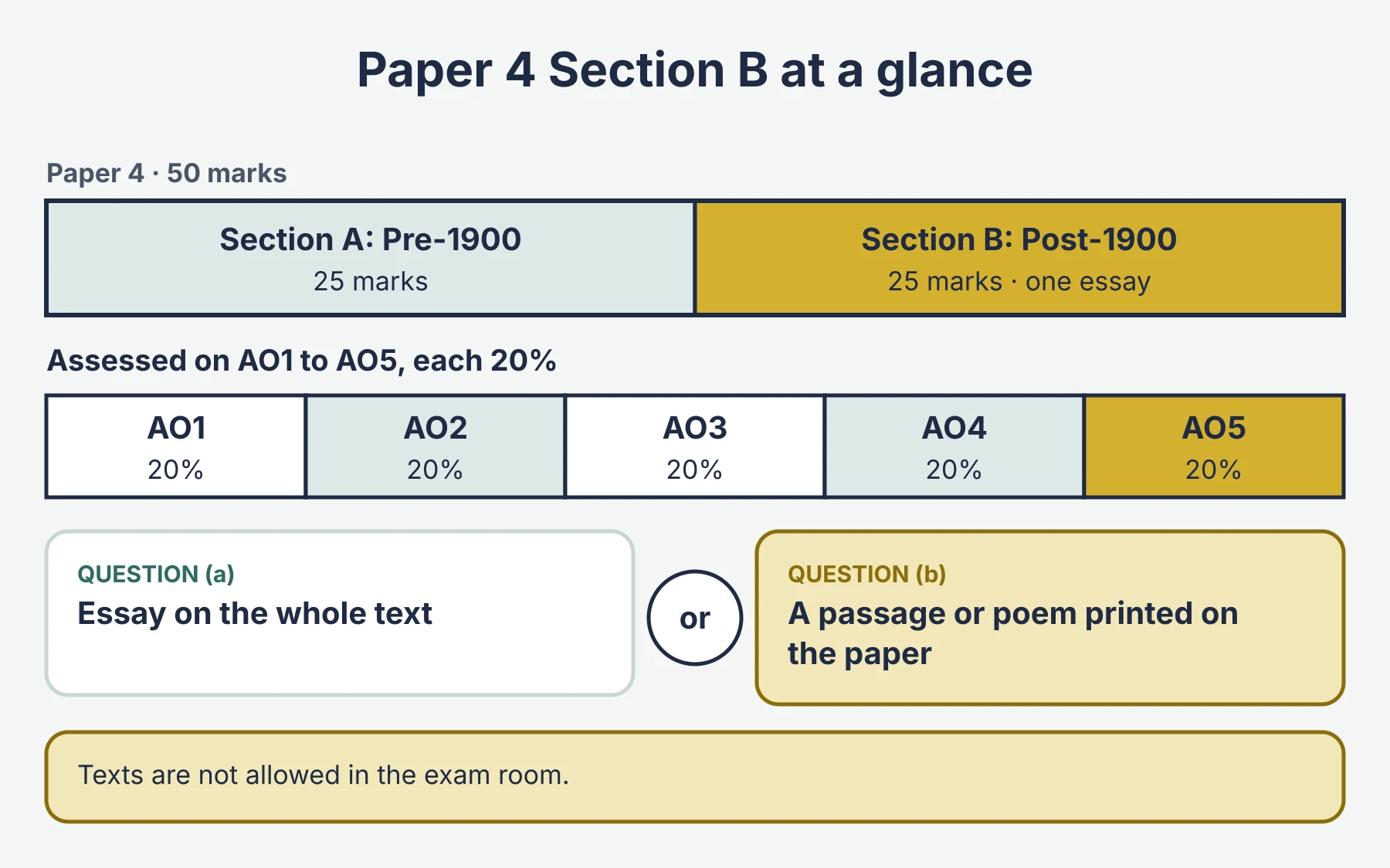
Section B of Paper 4 asks for one essay on a post-1900 set text, poetry or prose, whichever form you did not choose in Section A. It is worth 25 of the paper’s 50 marks and is assessed on AO1 to AO5, each 20%. This guide focuses on the methods typical of modern and contemporary writing, and on building AO5 from the critical approaches these texts invite. For the paper as a whole, see the Paper 4 study guide.
What the section asks of you
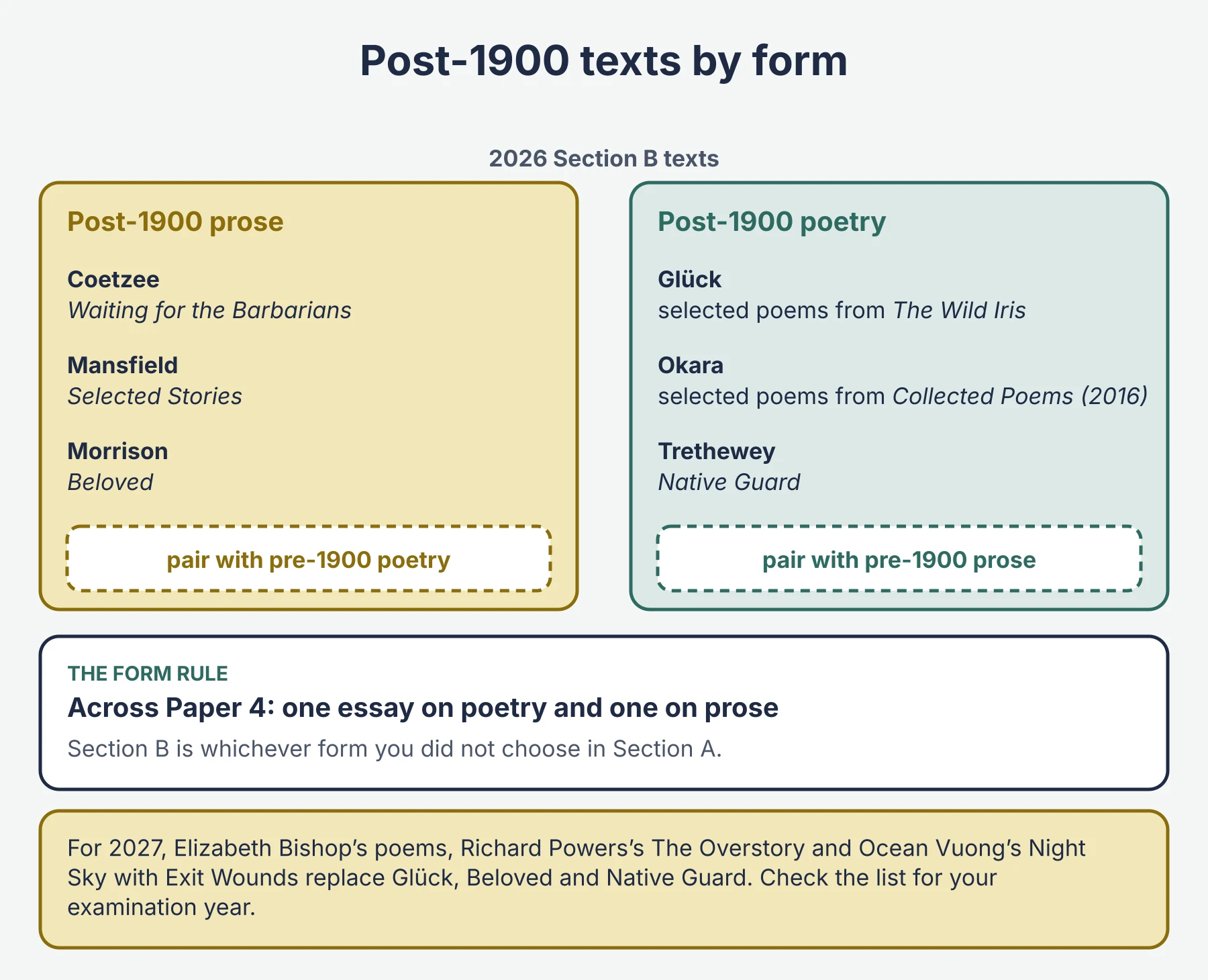
On each set text you choose an (a) question, an essay on the whole text, or a (b) question on a passage or poem printed on the paper. Texts are not allowed in the exam room. Remember the form rule: across Paper 4, one essay on poetry and one on prose.
| 2026 Section B text | Form |
|---|---|
| Coetzee, Waiting for the Barbarians | Prose |
| Glück, selected poems from The Wild Iris | Poetry |
| Mansfield, Selected Stories | Prose |
| Morrison, Beloved | Prose |
| Okara, selected poems from Collected Poems (2016) | Poetry |
| Trethewey, Native Guard | Poetry |
For 2027, Elizabeth Bishop’s poems, Richard Powers’s The Overstory and Ocean Vuong’s Night Sky with Exit Wounds replace Glück, Beloved and Native Guard. Check the list for your examination year.
The key idea: modern texts make the reader work
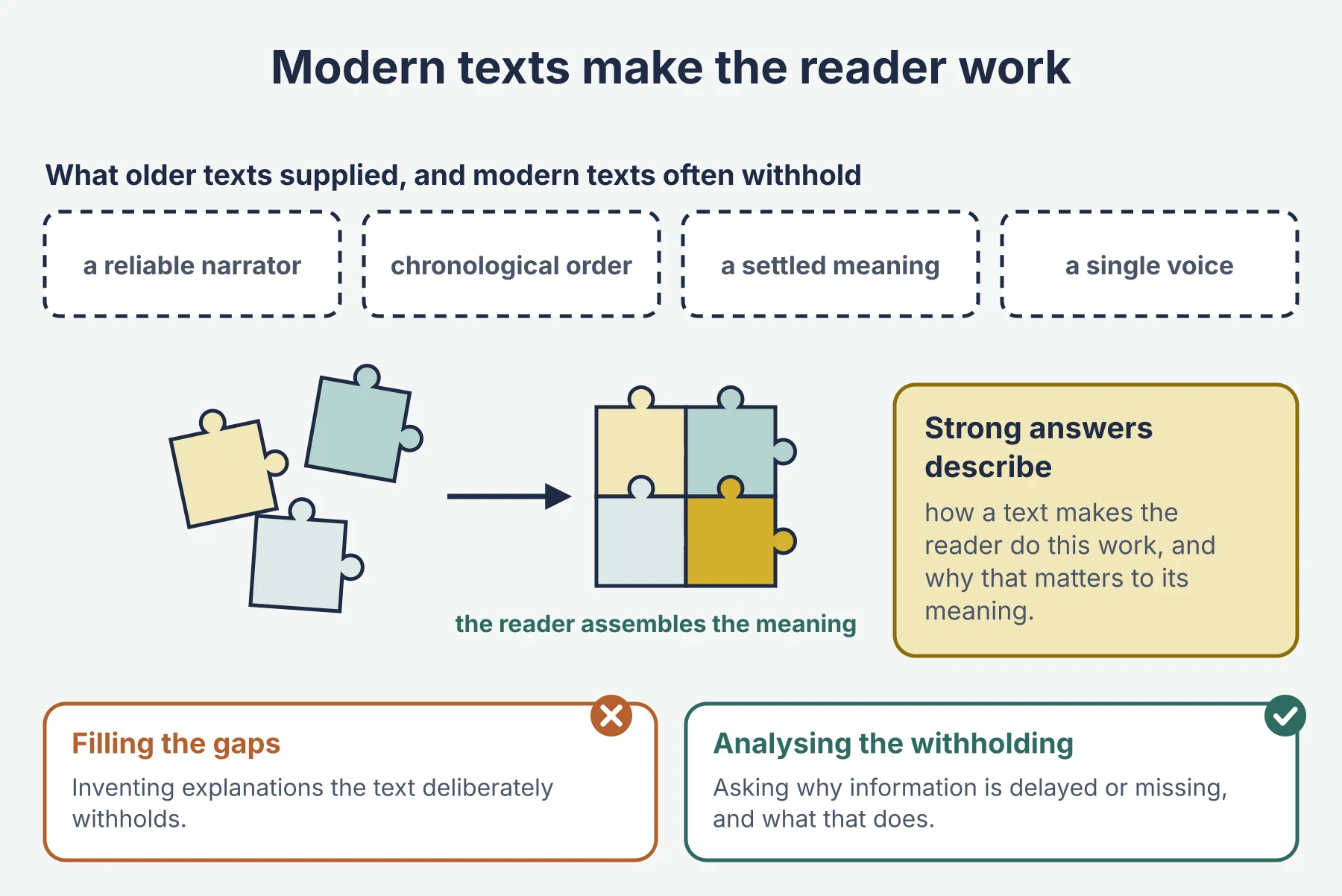
Much post-1900 writing withholds what older texts supplied: a reliable narrator, chronological order, a settled meaning, a single voice. The reader has to assemble the meaning. Strong answers describe how a text makes the reader do this work and why that matters to its meaning.
Post-1900 prose methods
Narrative voice and tense
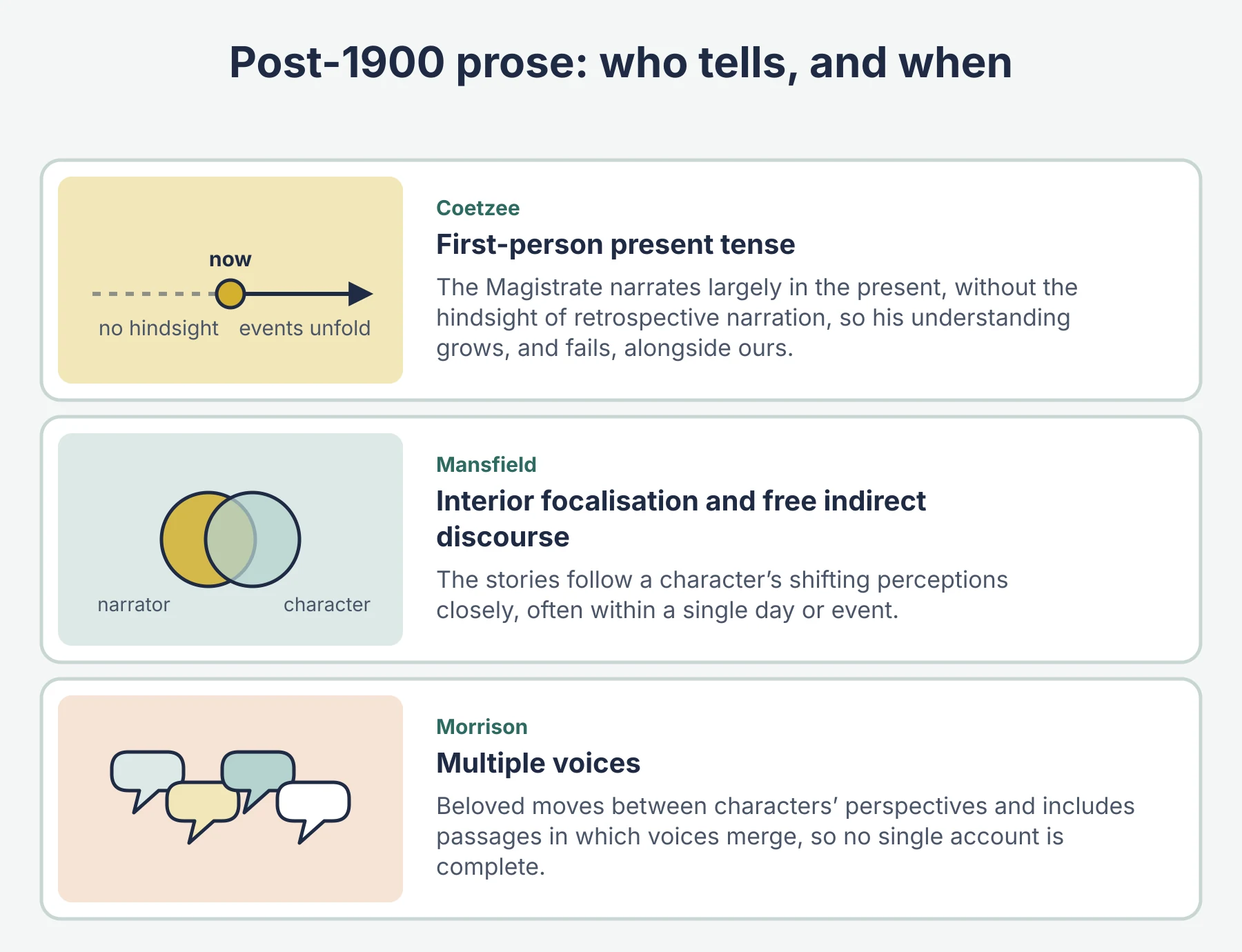
- First-person present tense places the reader inside a narrator’s moment without the hindsight of retrospective narration. Coetzee’s Magistrate narrates largely in the present, so his understanding grows, and fails, alongside ours.
- Interior focalisation and free indirect discourse are central to Mansfield’s stories, which follow a character’s shifting perceptions closely, often within a single day or event.
- Multiple voices: Beloved moves between characters’ perspectives and includes passages in which voices merge, so no single account is complete.
Fragmented and non-linear structure
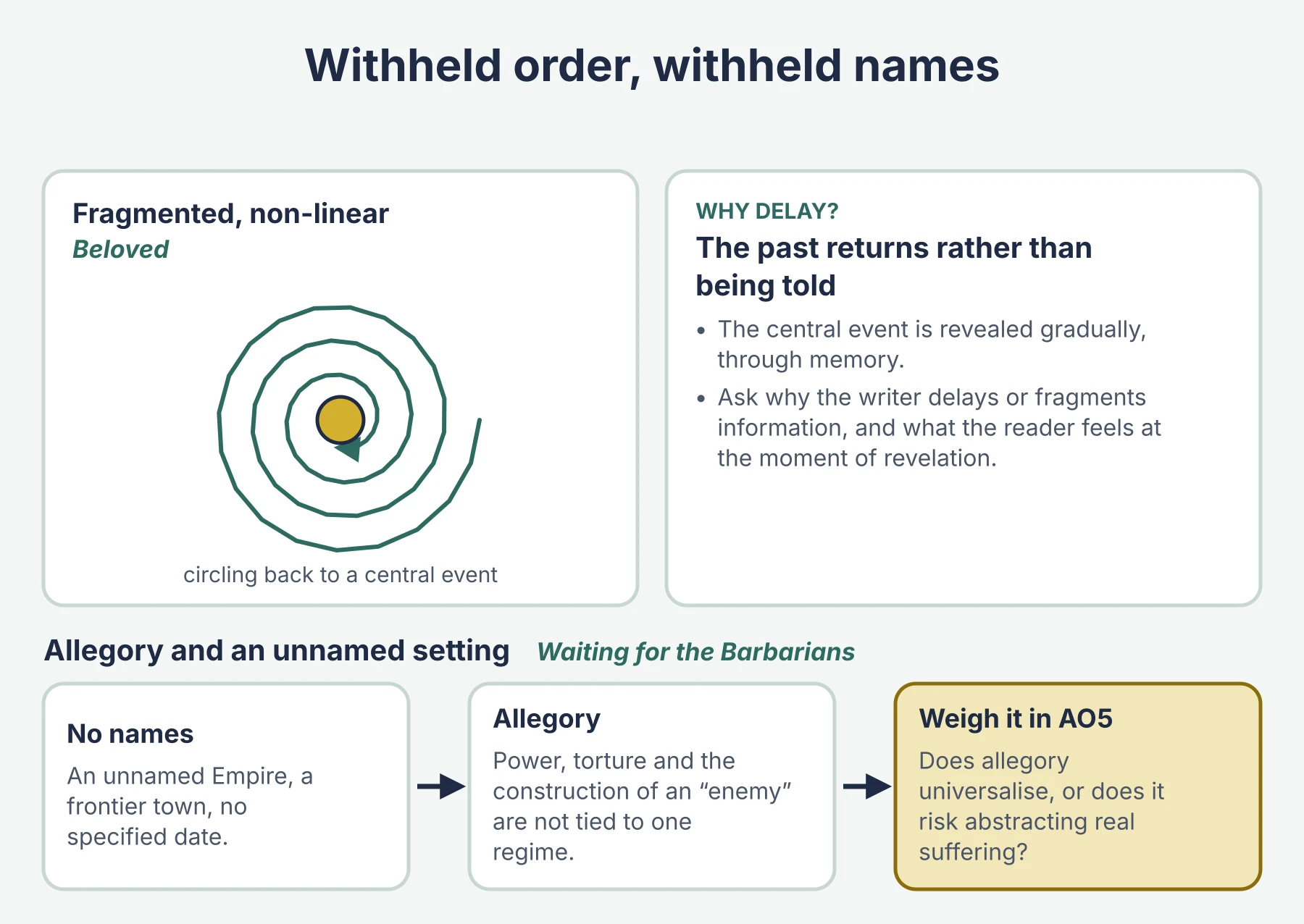
Beloved reveals its central event gradually, circling back to it through memory, so the reader experiences the past as something that returns rather than something that is simply told. Ask why a writer delays or fragments information, and what the reader feels at the moment of revelation.
Allegory and unnamed settings
Waiting for the Barbarians is set in an unnamed Empire and a frontier town at no specified date. The lack of names allows the novel to work as allegory: its concerns with power, torture and the construction of an “enemy” are not tied to one regime. Analyse the effect of this deliberate vagueness, and weigh it in AO5: does allegory universalise, or does it risk abstracting real suffering?
Short-story method
Mansfield’s stories compress meaning into moments: a party, a journey, a conversation. Endings are often open, or turn on a small realisation. For an (a) essay on the selection, choose stories that let you compare methods, and follow the question’s instruction about how many to discuss.
Post-1900 poetry methods
Sequences and voices
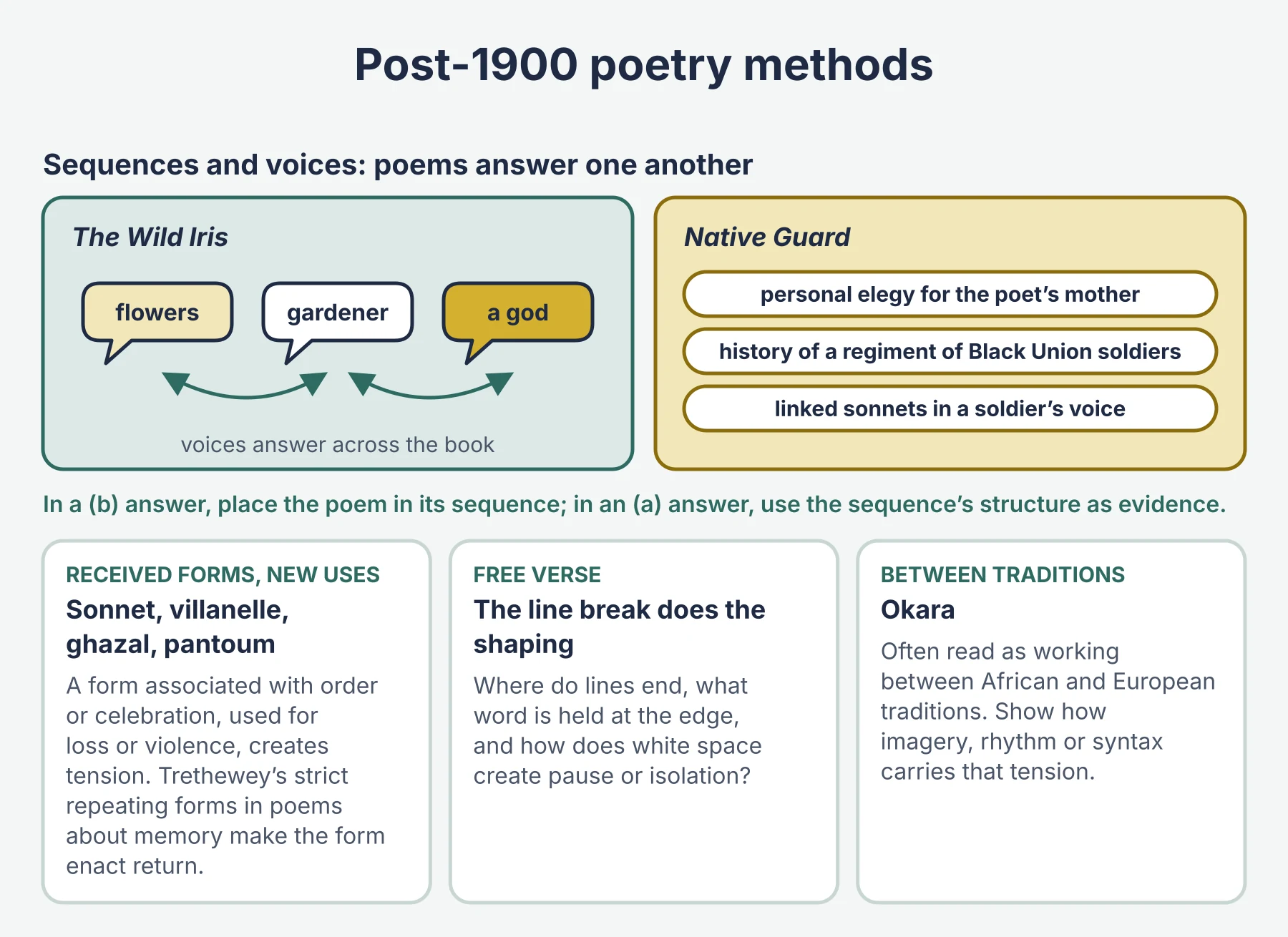
Several set collections are built as sequences, so poems speak to one another. The Wild Iris gives voices to flowers, to a gardener-speaker, and to a god, and the poems answer one another across the book. Native Guard weaves personal elegy for the poet’s mother with the history of a regiment of Black Union soldiers, including a sequence of linked sonnets in the voice of a soldier. In a (b) answer, place the poem in its sequence; in an (a) answer, use the sequence’s structure as evidence.
Traditional forms used in new ways
Modern poets often use received forms (sonnet, villanelle, ghazal, pantoum) while changing their meaning. A form associated with order or celebration used for loss or violence creates tension. Trethewey, for example, uses strict repeating forms in poems about memory, so the form enacts return. Ask what a form brings with it and how the poem uses that inheritance.
Free verse and the line
Where there is no fixed metre, the line break does the shaping work. Analyse where lines end, what word is held at the edge, and how white space on the page creates pause or isolation.
Voice between traditions
Okara’s poetry is often read as working between African and European traditions of language, image and belief. Analyse how imagery, rhythm or syntax carries that tension, rather than describing it in general terms.
Context and AO5 for modern texts
Relevant contexts include colonialism and its aftermath, slavery and its legacy, war, the modernist break with Victorian conventions, gender and family, and environmental change. Use them to explain choices: why a narrative fragments, why a poem gives voice to the silenced, why a setting is unnamed.
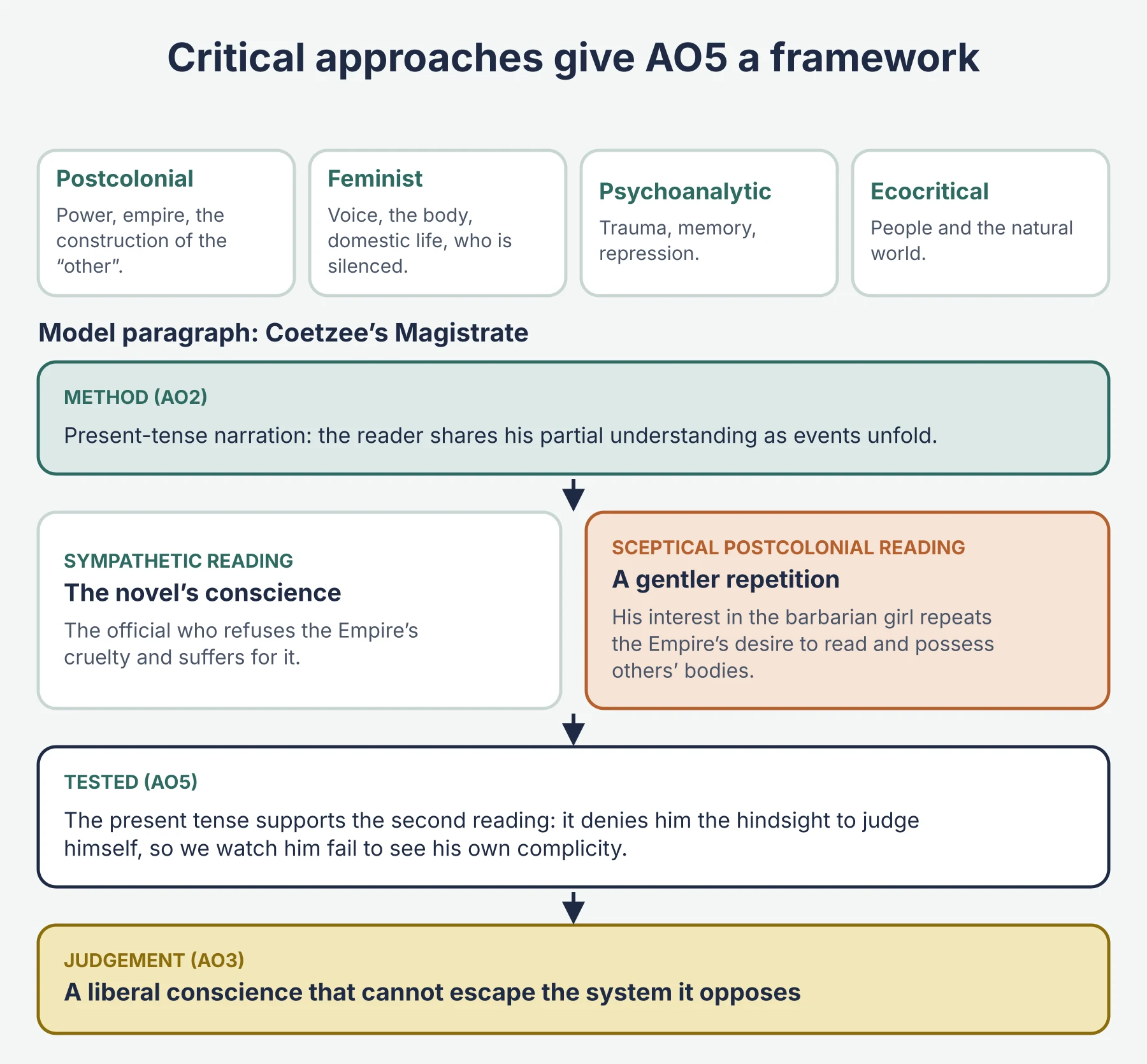
Modern texts invite clearly defined critical approaches, which give AO5 a framework:
- Postcolonial readings: power, empire, the construction of the “other”.
- Feminist readings: voice, the body, domestic life, who is silenced.
- Psychoanalytic readings: trauma, memory, repression.
- Ecocritical readings: the relationship between people and the natural world.
Annotated model paragraph
Coetzee’s Magistrate narrates in the present tense, so the reader shares his partial understanding as events unfold. A sympathetic reading treats him as the novel’s conscience: the official who refuses the Empire’s cruelty and suffers for it. A more sceptical postcolonial reading notes that his interest in the barbarian girl repeats, in a gentler form, the Empire’s desire to read and possess the bodies of others. The present-tense narration supports the second reading more strongly, because it denies him the hindsight to judge himself: we watch him fail to see his own complicity. The novel is most powerful, I would argue, as a portrait of a liberal conscience that cannot escape the system it opposes.
The paragraph uses narrative method (AO2), presents and tests two readings (AO5), and ends with a judgement (AO3).
Answer shapes
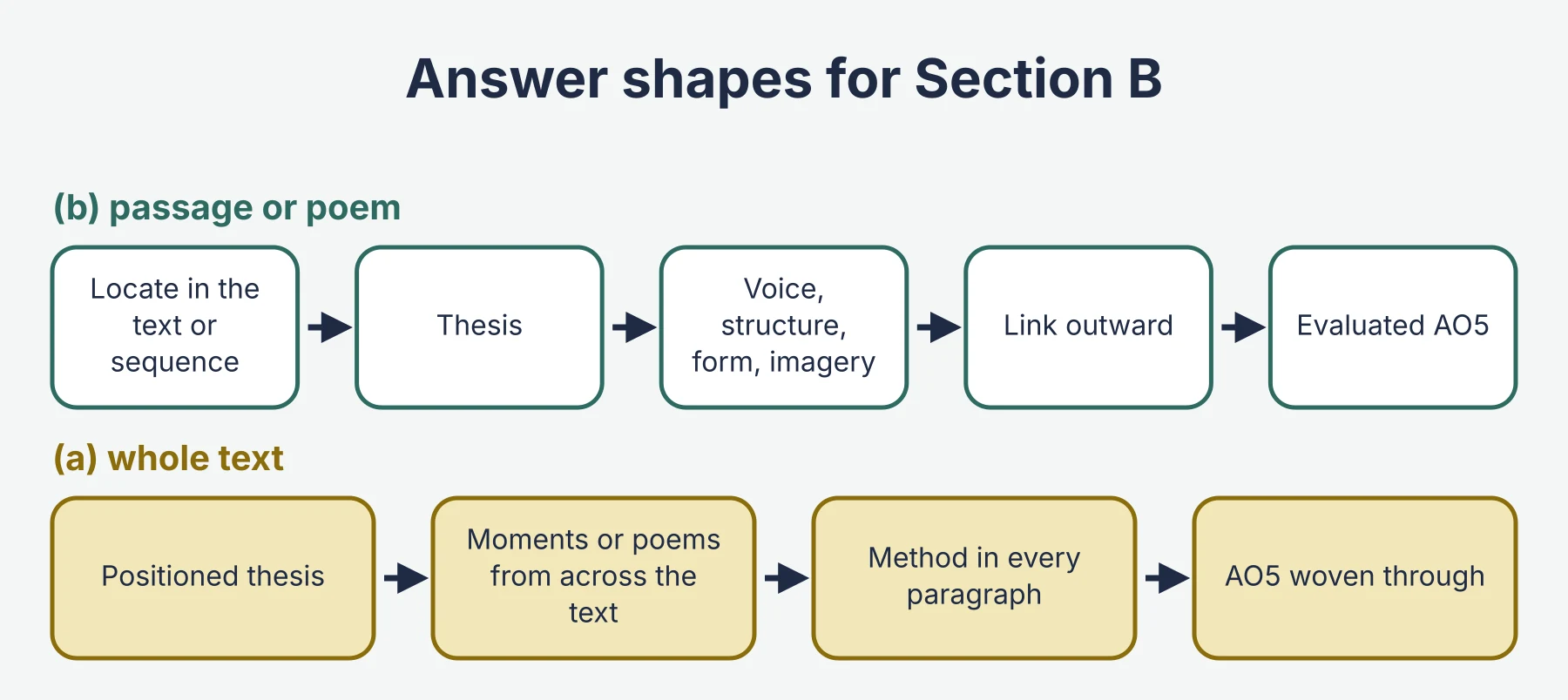
(b) passage or poem: locate in the text or sequence → thesis → close analysis of voice, structure, form and imagery → link outward → evaluated AO5.
(a) whole text: positioned thesis → moments or poems from across the text → method in every paragraph → AO5 woven through.
Common mistakes
- Filling the gaps: inventing explanations a fragmented text deliberately withholds, instead of analysing the withholding.
- Biography as reading: assuming a poem’s “I” is simply the poet.
- Ignoring the sequence: treating a poem from a collection as if it stood alone.
- Approach without evidence: naming a postcolonial or feminist reading without testing it on the text.
- Breaking the form rule across Paper 4.
Practise and revise this section
- Paper 4 Section B Post-1900 revision notes — methods, critical approaches, traps and a self-test.
- Paper 4 Section B Post-1900 practice questions — original passages and AO5 tasks with full answers.
- Paper 4 Section A Pre-1900 study guide — the other half of the paper.
Written against the Cambridge International AS & A Level Literature in English 9695 syllabus for 2024, 2025 and 2026.
Related resources
-
Practice questions
Cambridge A Level Literature in English (9695): Paper 4 Section B – Post-1900 Poetry and Prose – Practice Questions
Original practice for Cambridge 9695 Paper 4 Section B Post-1900: modern narration, poetic sequences and AO5 approaches on new passages, with full answers.
English Literature · Cambridge · A Level
Try questions -
Revision notes
Cambridge A Level Literature in English (9695): Paper 4 Section B – Post-1900 Poetry and Prose – Revision Notes
Quick-recall notes for Cambridge 9695 Paper 4 Section B Post-1900: modern narrative and poetic methods, critical approaches for AO5, traps and a self-test.
English Literature · Cambridge · A Level
Revise topic -
Study guides
Cambridge A Level English Literature (9695): Paper 4 Pre- and Post-1900 Poetry and Prose – Study Guide
How to read, plan and write about poetry and prose in both halves of Paper 4, with a method for passage and essay questions and short worked examples.
English Literature · Cambridge · A Level
Read guide
Get free revision emails (optional)
Occasional emails with practice questions, worked explanations and links to free resources for the qualification and subjects you choose. No spam, and you can unsubscribe from any email. The free tools on this site never need an email.