
Revision Notes
Cambridge A Level Literature in English (9695): Paper 4 Section A – Pre-1900 Poetry and Prose – Revision Notes
Quick-recall notes for Cambridge 9695 Paper 4 Section A Pre-1900: narrator types, verse forms, period conventions, AO5 debates, traps and a self-test.
- Subject
- English Literature
- Level
- A LEVEL
- Topic
- Paper 4: Pre- and Post-1900 Poetry and Prose
- Author
- Marlbridge Academic Team
- Updated
- Reviewed by
- Ammar Bilal (what this means)
Aligned to Cambridge A Level English Literature (9695), 2024-2026. Official specification .
Syllabus page (what it covers and how it is assessed): Cambridge A Level English Literature.
Syllabus points this page covers
9695 (A Level)
- 4.1 Section A: Pre-1900 Poetry and Prose
Found an error? Report a correction.
Need help with this topic? Request a free trial class for A Level English Literature (9695).
Condensed notes for the pre-1900 half of Paper 4. For the full method and an annotated AO5 paragraph, use the Paper 4 Section A Pre-1900 study guide.
Section A in five lines
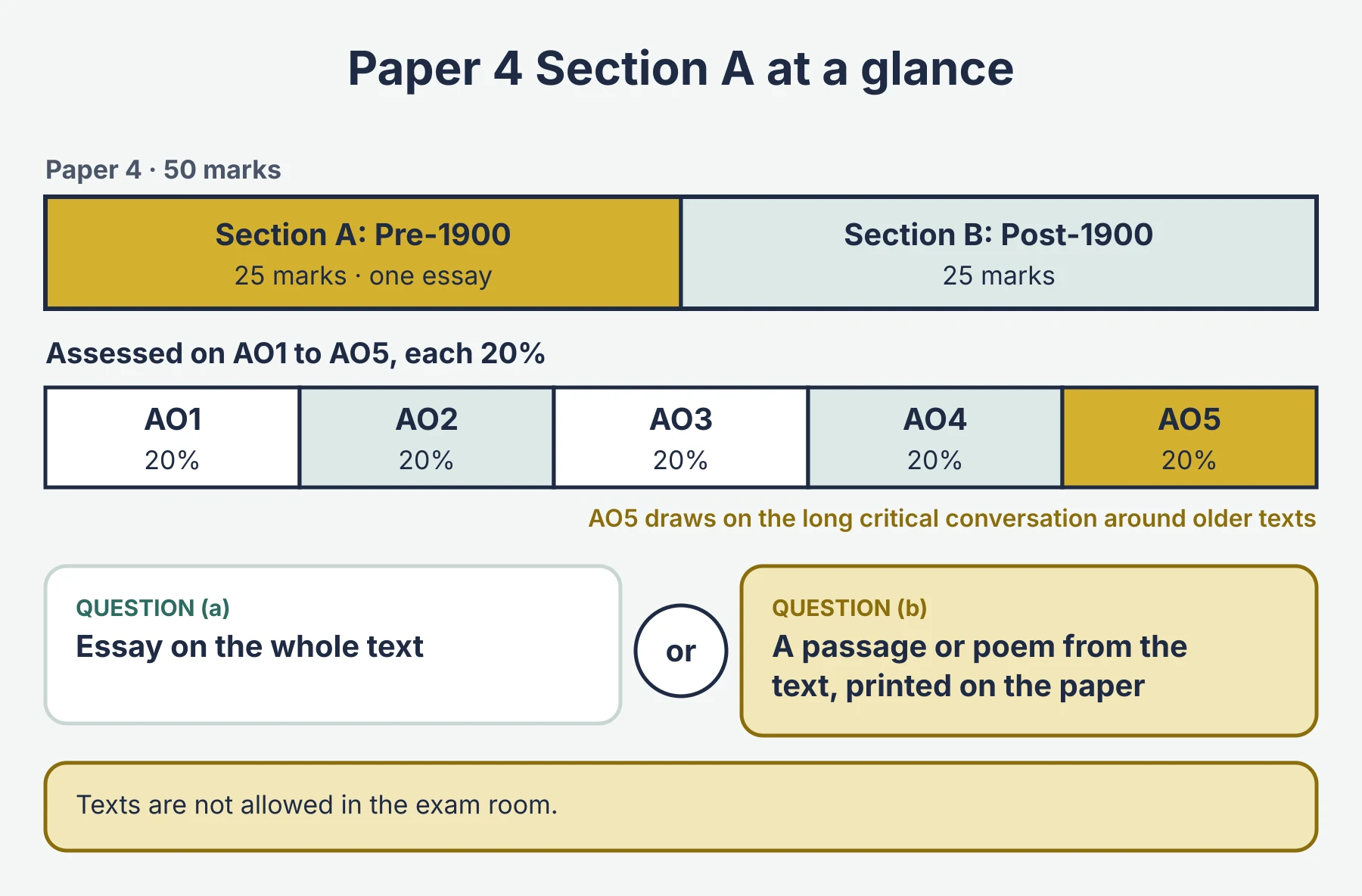
- One essay on one pre-1900 set text, worth 25 marks.
- (a) whole-text essay or (b) essay on a printed passage or poem.
- Assessed on AO1 to AO5, each 20%.
- Closed book; no dictionaries.
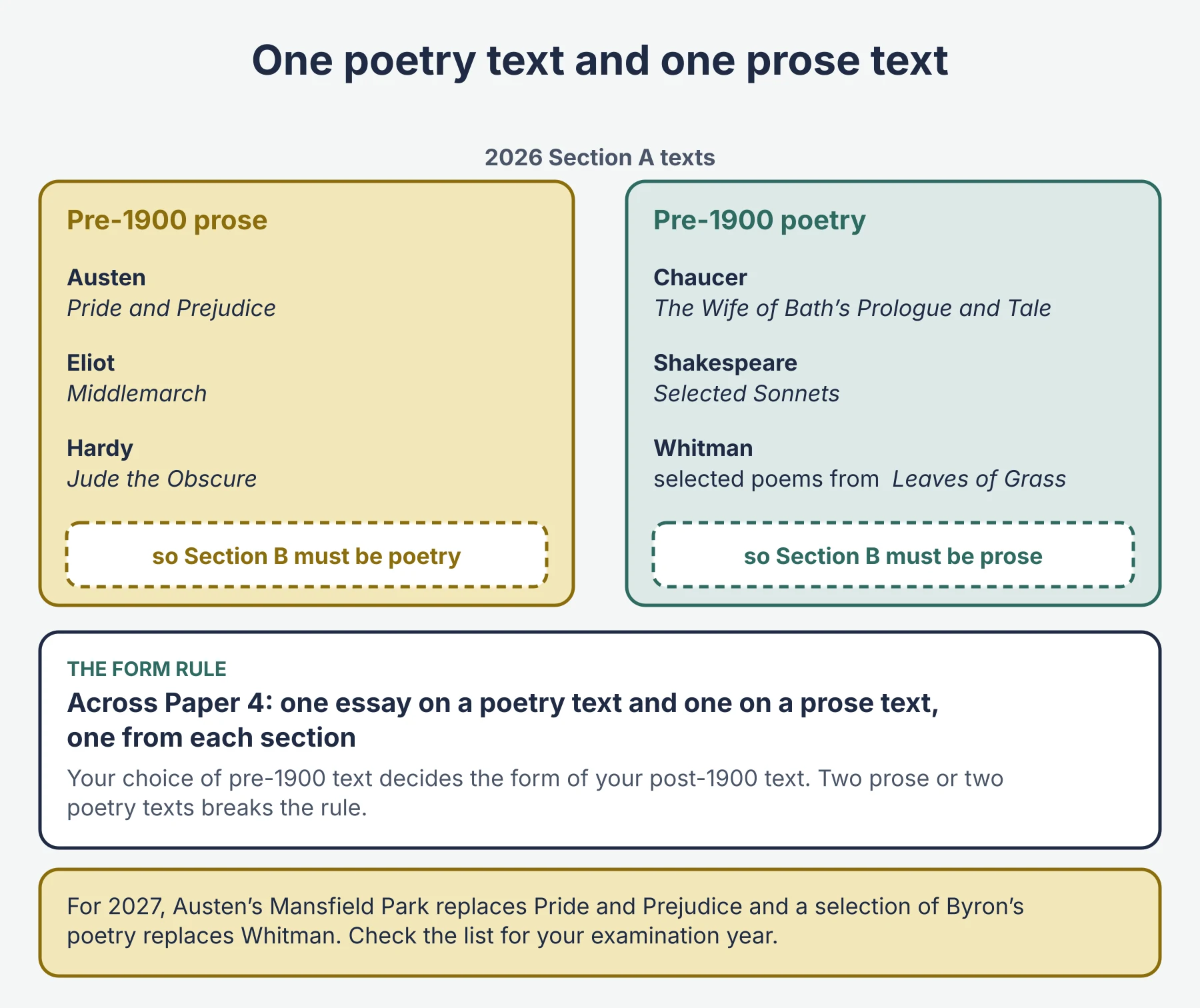
- Form rule: across Paper 4, one poetry essay and one prose essay.
Choosing your pairing
| If your pre-1900 text is… | Your post-1900 text must be… |
|---|---|
| A novel (Austen, Eliot, Hardy) | Poetry |
| Poetry (Chaucer, Shakespeare’s sonnets, Whitman; Byron from 2027) | Prose |
Key terms: prose
| Term | Meaning | Use it when |
|---|---|---|
| Omniscient narrator | Knows all characters’ thoughts | Discussing judgement and overview |
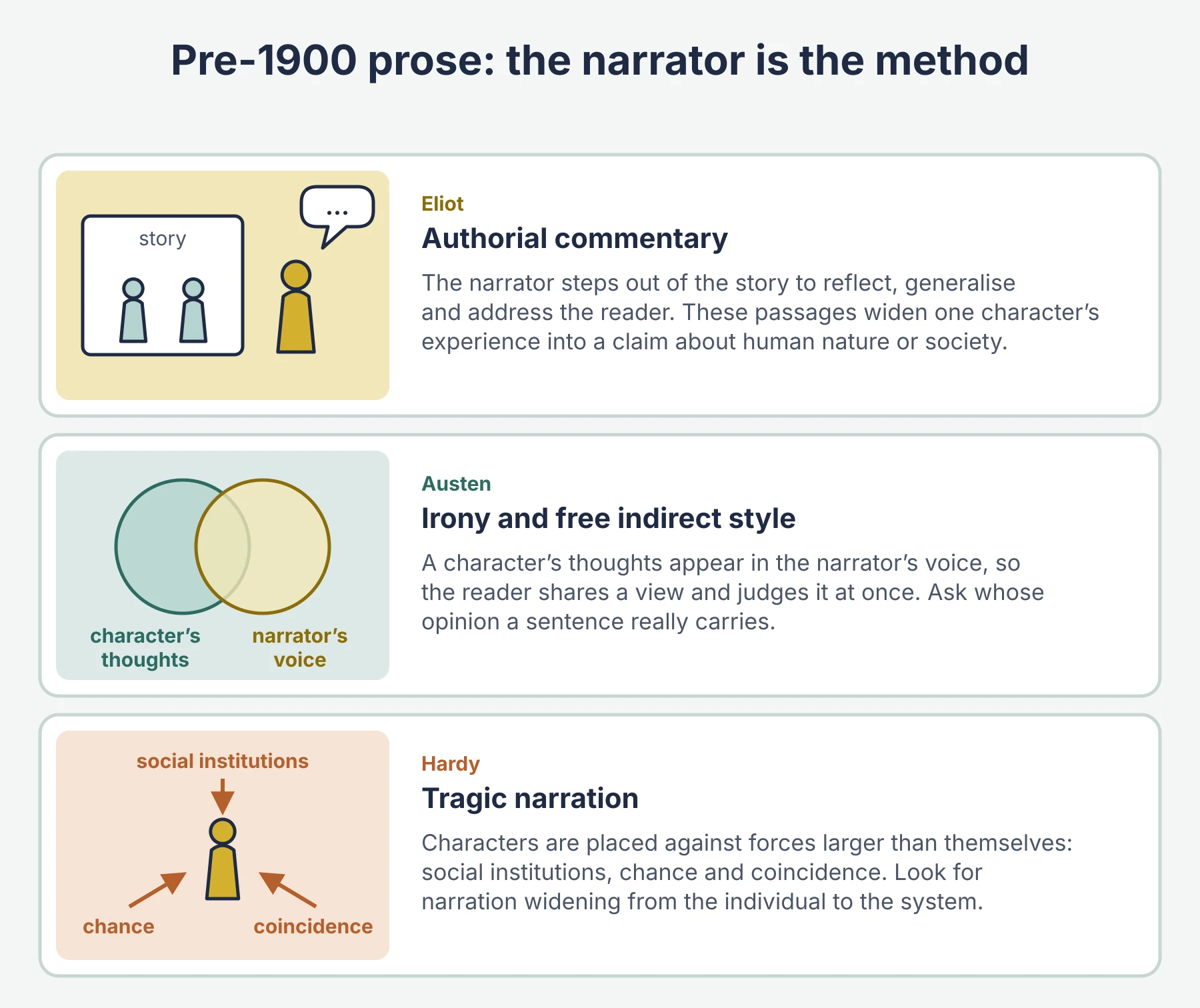
| Intrusive narrator | Comments directly on events, may address the reader | Eliot’s reflective passages |
| Free indirect style | Character’s thought in narrator’s voice | Austen’s irony; whose view is this? |
| Periodic sentence | Main clause delayed to the end | Suspense, balance, formality |
| Marriage plot | Narrative directed towards marriage | Austen; social and economic pressure |
| Parallel plots | Several storylines mirroring each other | Middlemarch’s marriages |
| Determinism | Lives shaped by forces beyond control | Hardy’s institutions, chance, coincidence |
Key terms: poetry
| Term | Meaning | Use it when |
|---|---|---|
| Heroic couplet | Rhymed iambic pentameter pairs | Chaucer’s rhythm; pointed endings |
| Frame narrative | A tale set within a teller’s story | Wife of Bath’s Prologue and Tale |
| Romance | Medieval tale of knights, quests, marvels | The Wife’s Tale |
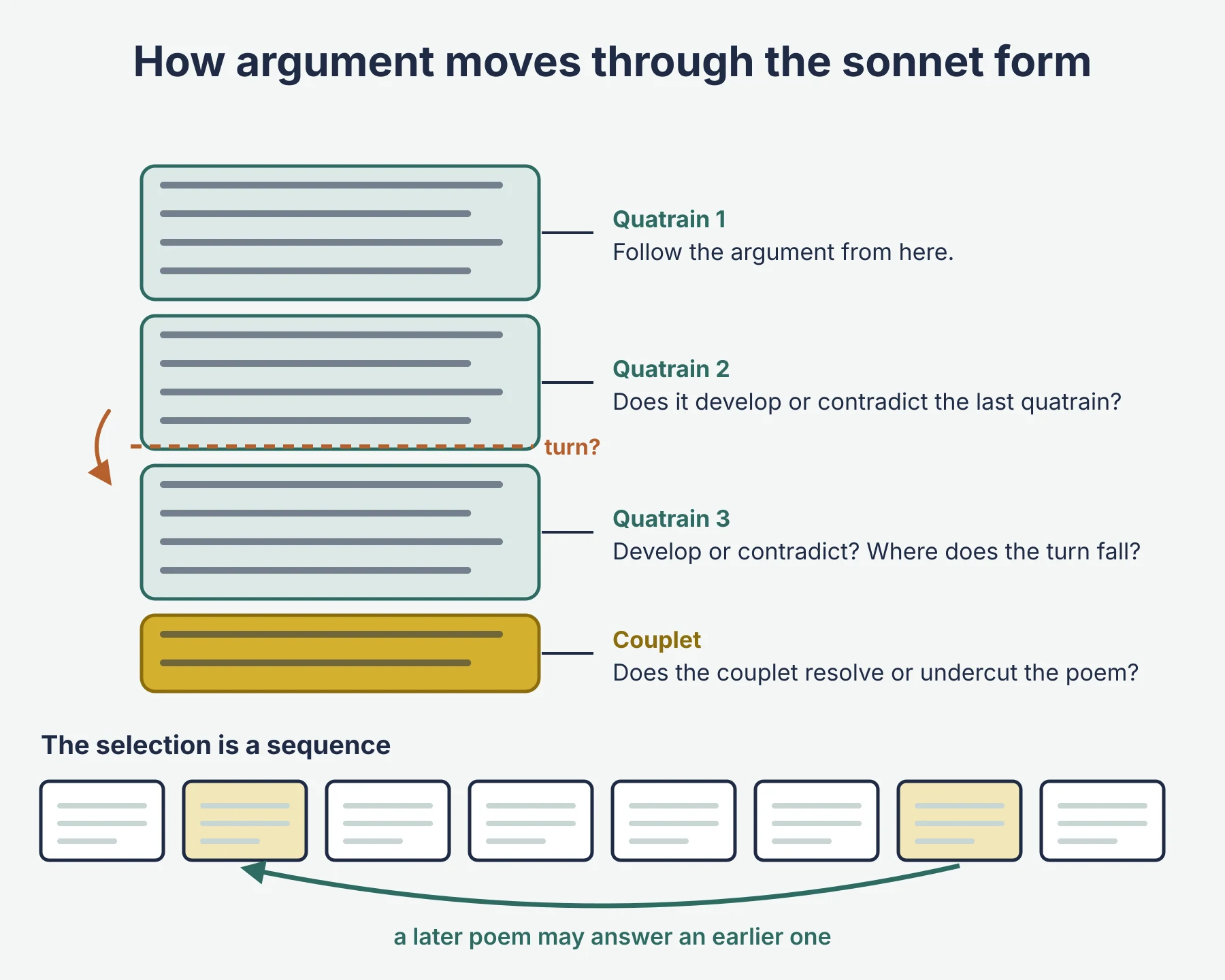
| Shakespearean sonnet | Three quatrains and a couplet | Tracking argument through form |
| Volta | Turn in argument | Where and whether the sonnet turns |
| Sonnet sequence | Linked sonnets read as a series | Poems answering one another |
| Free verse | No fixed metre or rhyme | Whitman; pre-1900 but formally radical |
| Catalogue | Extended list | Whitman’s inclusiveness and energy |
| Anaphora | Repeated opening words | Whitman’s rhetorical momentum |
Text reminders
- Austen: irony through free indirect style; marriage and money as structural pressures.
- Eliot, Middlemarch: intrusive, reflective narrator; parallel marriages; a provincial town as a social web.
- Hardy, Jude the Obscure: aspiration against institutions of class, education, marriage and church; tragic structure.
- Chaucer: Middle English couplets; Prologue sets experience against written authority; the Tale’s quest to learn what women most desire.
- Shakespeare’s sonnets: argument moving through quatrains; the couplet as resolution or twist.
- Whitman: free verse, long lines, catalogues, an all-embracing “I”.
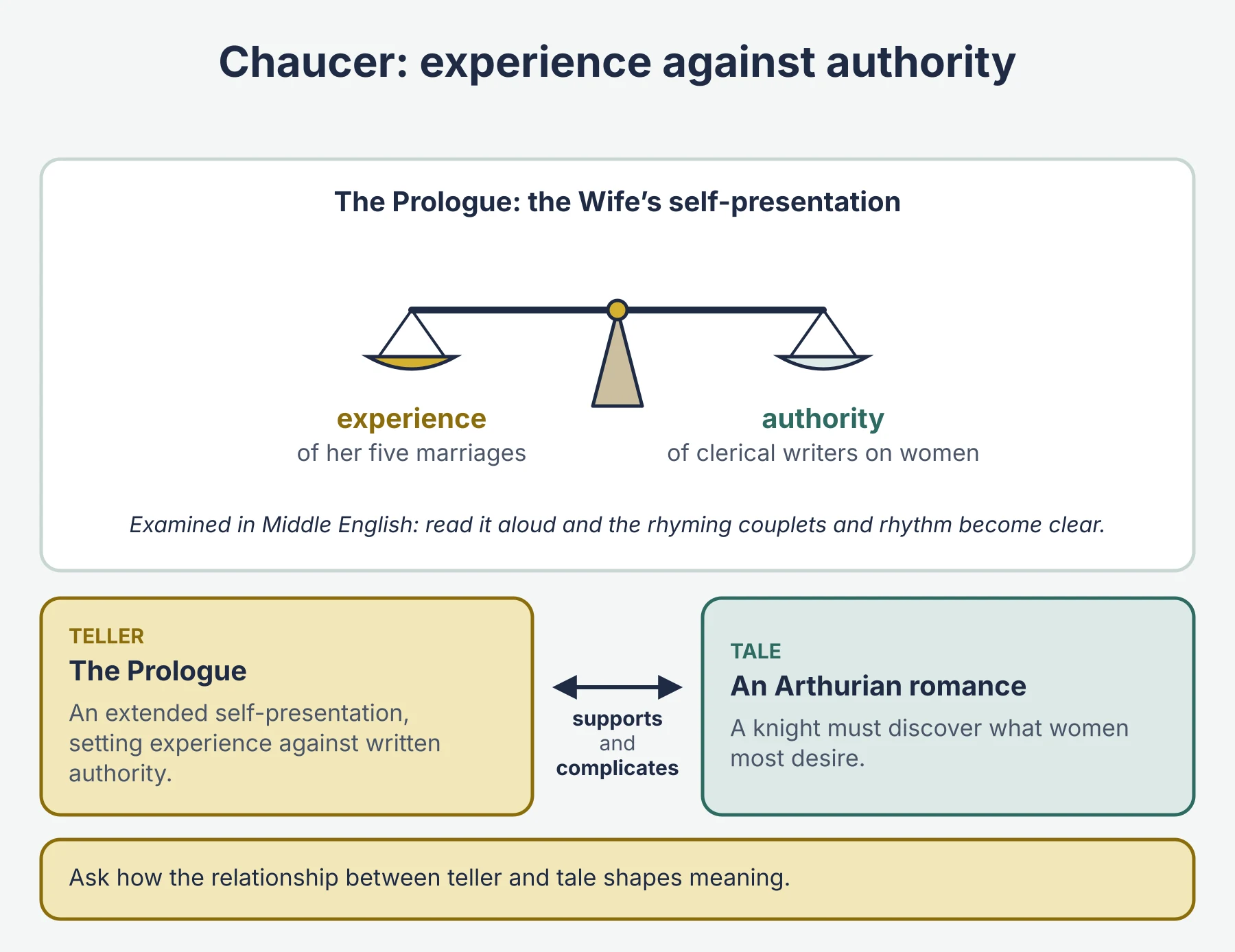
Reading Chaucer’s Middle English quickly
- Read aloud: the rhythm and couplet rhymes become clear, and many words are recognisable by sound.
- Final -e is often pronounced, which helps the metre.
- Common words to know on sight:
| Middle English | Modern sense |
|---|---|
| eek | also |
| swich | such |
| wight | person, creature |
| sith | since |
| ywis | certainly |
| auctoritee | authority |
| housbonde | husband |
| wo | woe, sorrow |
- In a (b) answer, quote the original and analyse it; do not translate whole lines into modern English, which wastes time and loses the effect of the language.
Context: what to use and how
- Marriage, property and inheritance; class and education; religion and doubt; gender roles.
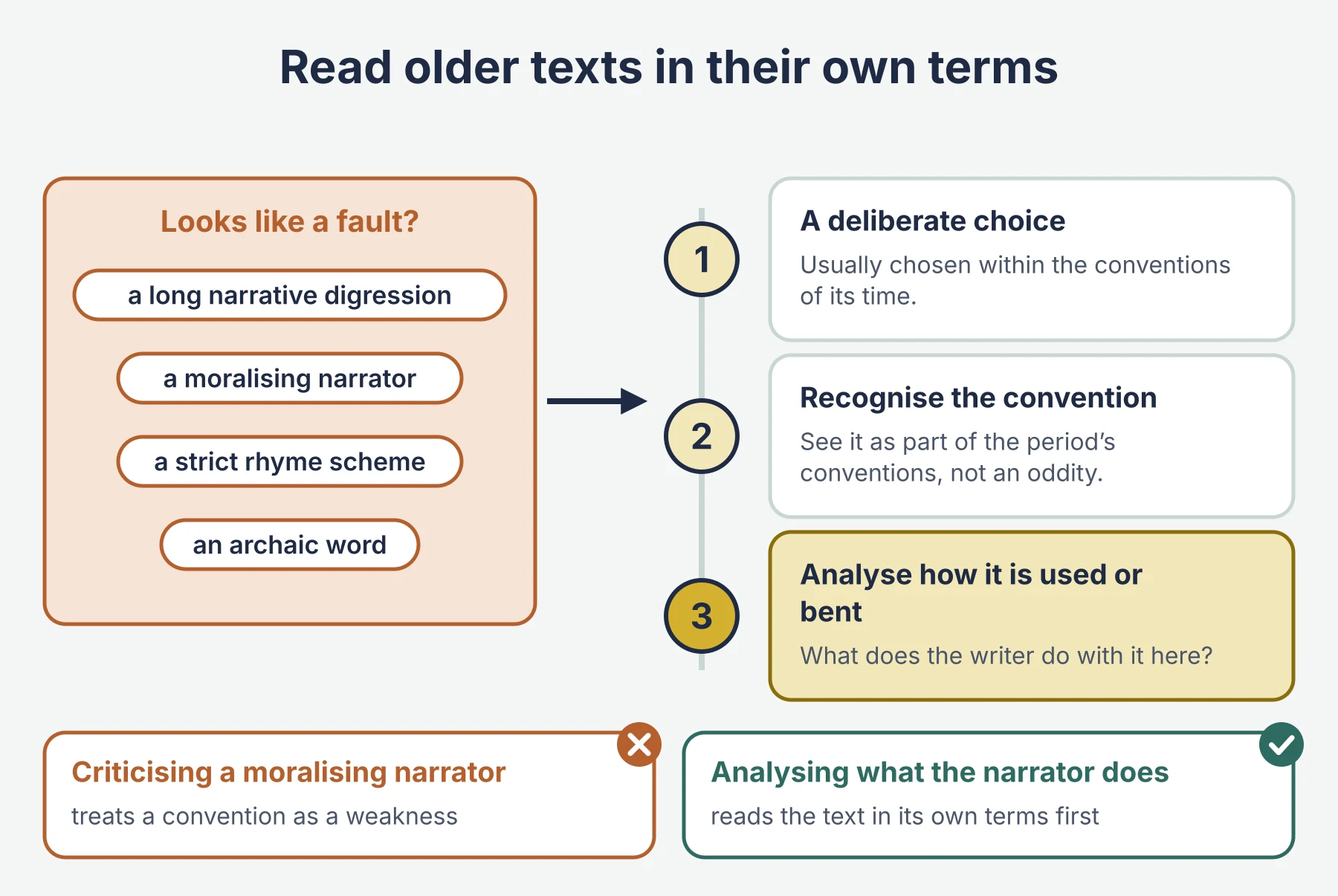
- Literary conventions of the period: the moralising narrator, courtly romance, the sonnet tradition.
- Rule: one sentence of context tied to one choice in the text.
AO5 debates to prepare
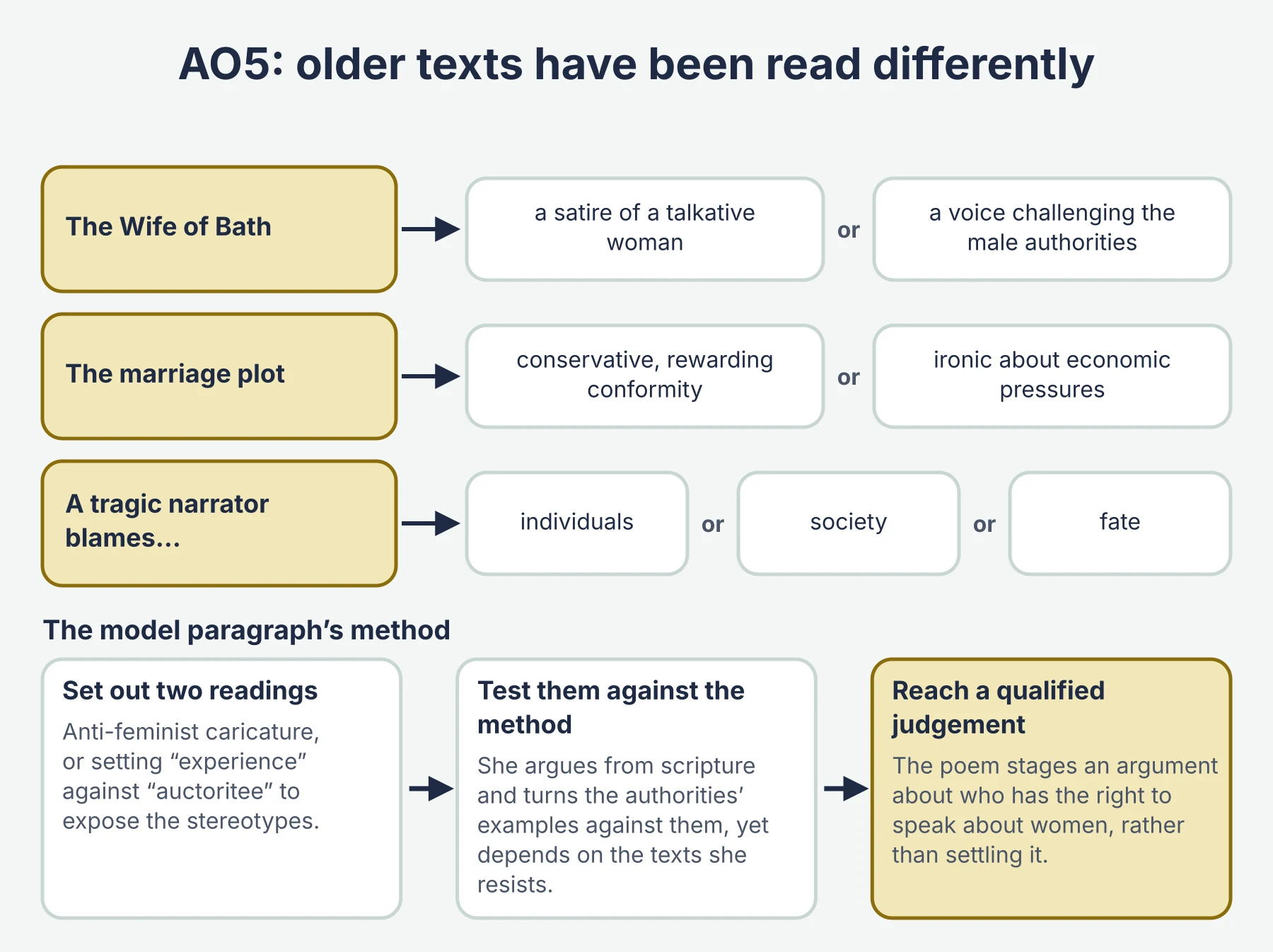
- Wife of Bath: anti-feminist caricature or challenge to male authority?
- The marriage plot: conservative reward or ironic critique?
- Tragic novels: blame on individuals, society or fate?
- Sonnets: sincere feeling or rhetorical performance?
- Whitman: inclusive democratic vision or a self that absorbs others?
AO5 pattern: reading → test against the text → judgement.
Answer shapes
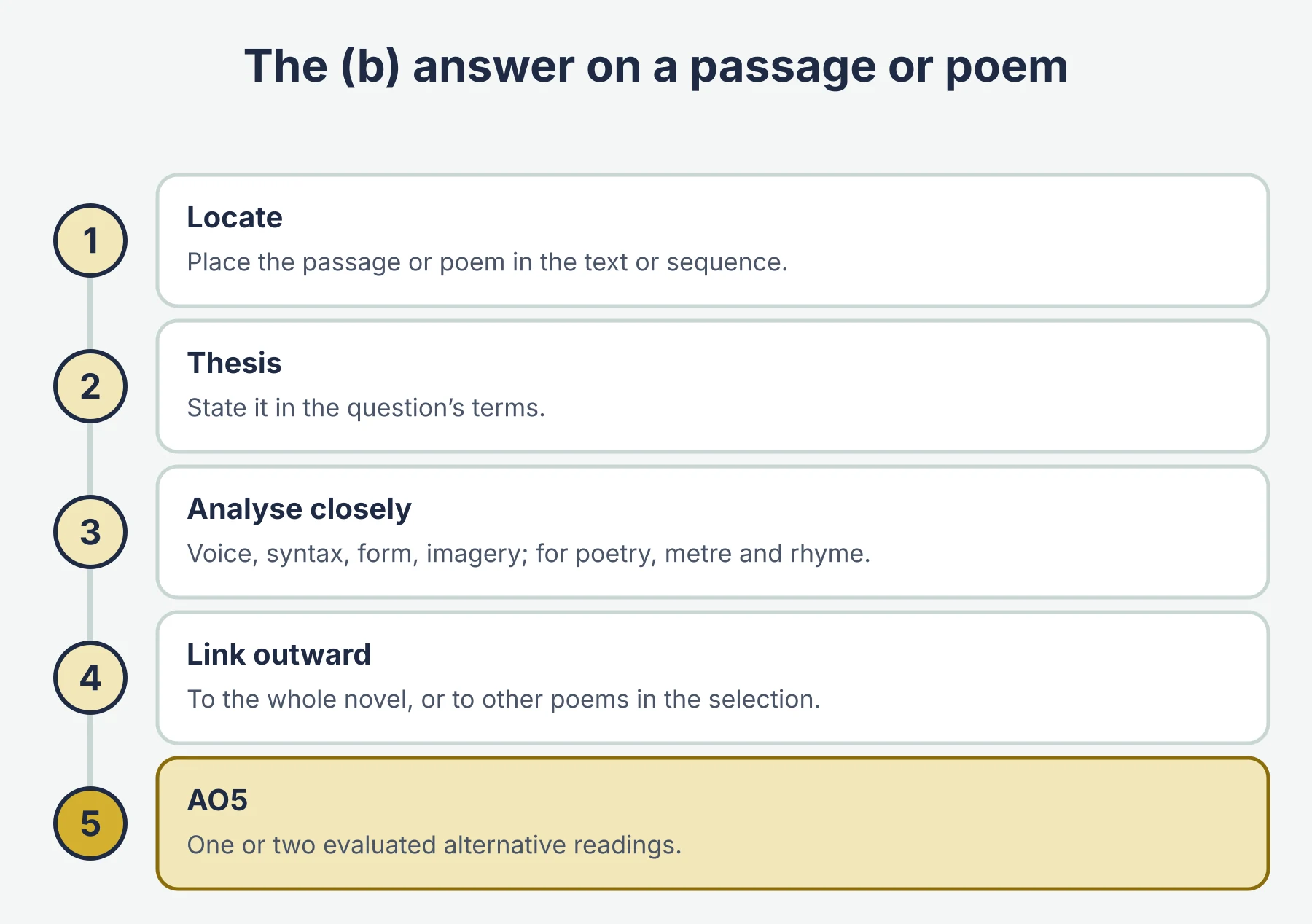
(b) passage or poem: locate → thesis → close analysis (voice, syntax, form, imagery) → link outward → evaluated AO5.
(a) whole text: positioned thesis → moments across the whole text, including the ending → method in every paragraph → AO5 woven through.
Exam traps
- Criticising older conventions instead of analysing them.
- Judging by modern norms with no sense of period.
- Context paragraphs detached from the text.
- Paraphrasing older language rather than analysing it.
- Breaking the poetry-and-prose form rule.
- Discussing only famous scenes from a long novel.
Self-test
- What is the form rule for Paper 4?
- If your Section A text is Middlemarch, what form must your Section B text be?
- What is printed for a (b) question in this section?
- Which assessment objectives are tested, and at what weighting?
- Define free indirect style.
- What is an intrusive narrator?
- In which language is The Wife of Bath’s Prologue and Tale studied?
- What does the Wife set against written authority in her Prologue?
- Describe the structure of a Shakespearean sonnet.
- Name two features of Whitman’s verse.
- Give one AO5 debate about a pre-1900 set text.
- What is the rule for using context?
Answers: 1. One poetry essay and one prose essay, one from each section. 2. Poetry. 3. A passage or a poem from the set text. 4. AO1 to AO5, 20% each. 5. A character’s thoughts presented in the narrator’s voice, blending the two. 6. A narrator who comments directly on events or addresses the reader. 7. Middle English. 8. Her own experience of marriage. 9. Three quatrains and a closing couplet. 10. Any two: free verse, long lines, catalogues, anaphora, an all-embracing “I”. 11. For example whether the Wife of Bath is a caricature or a challenge to male authority. 12. Tie a brief contextual point to a specific choice in the text.
Related resources
-
Study guides
Cambridge A Level Literature in English (9695): Paper 4 Section B – Post-1900 Poetry and Prose
Reading post-1900 set texts for Cambridge 9695 Paper 4 Section B: fragmented narration, sequences and voices, allegory, and AO5 from modern critical approaches.
English Literature · Cambridge · A Level
Read guide -
Practice questions
Cambridge A Level Literature in English (9695): Paper 4 Section B – Post-1900 Poetry and Prose – Practice Questions
Original practice for Cambridge 9695 Paper 4 Section B Post-1900: modern narration, poetic sequences and AO5 approaches on new passages, with full answers.
English Literature · Cambridge · A Level
Try questions -
Revision notes
Cambridge A Level Literature in English (9695): Paper 4 Section B – Post-1900 Poetry and Prose – Revision Notes
Quick-recall notes for Cambridge 9695 Paper 4 Section B Post-1900: modern narrative and poetic methods, critical approaches for AO5, traps and a self-test.
English Literature · Cambridge · A Level
Revise topic
Get free revision emails (optional)
Occasional emails with practice questions, worked explanations and links to free resources for the qualification and subjects you choose. No spam, and you can unsubscribe from any email. The free tools on this site never need an email.