
Study Guides
Cambridge A Level Literature in English (9695): Paper 4 Section A – Pre-1900 Poetry and Prose
Reading pre-1900 set texts for Cambridge 9695 Paper 4 Section A: older language, period conventions, narrators and verse forms, and AO5 from critical history.
- Subject
- English Literature
- Level
- A LEVEL
- Topic
- Paper 4: Pre- and Post-1900 Poetry and Prose
- Author
- Marlbridge Academic Team
- Updated
- Reviewed by
- Ammar Bilal (what this means)
Aligned to Cambridge A Level English Literature (9695), 2024-2026. Official specification .
Syllabus page (what it covers and how it is assessed): Cambridge A Level English Literature.
Syllabus points this page covers
9695 (A Level)
- 4.1 Section A: Pre-1900 Poetry and Prose
Found an error? Report a correction.
Need help with this topic? Request a free trial class for A Level English Literature (9695).
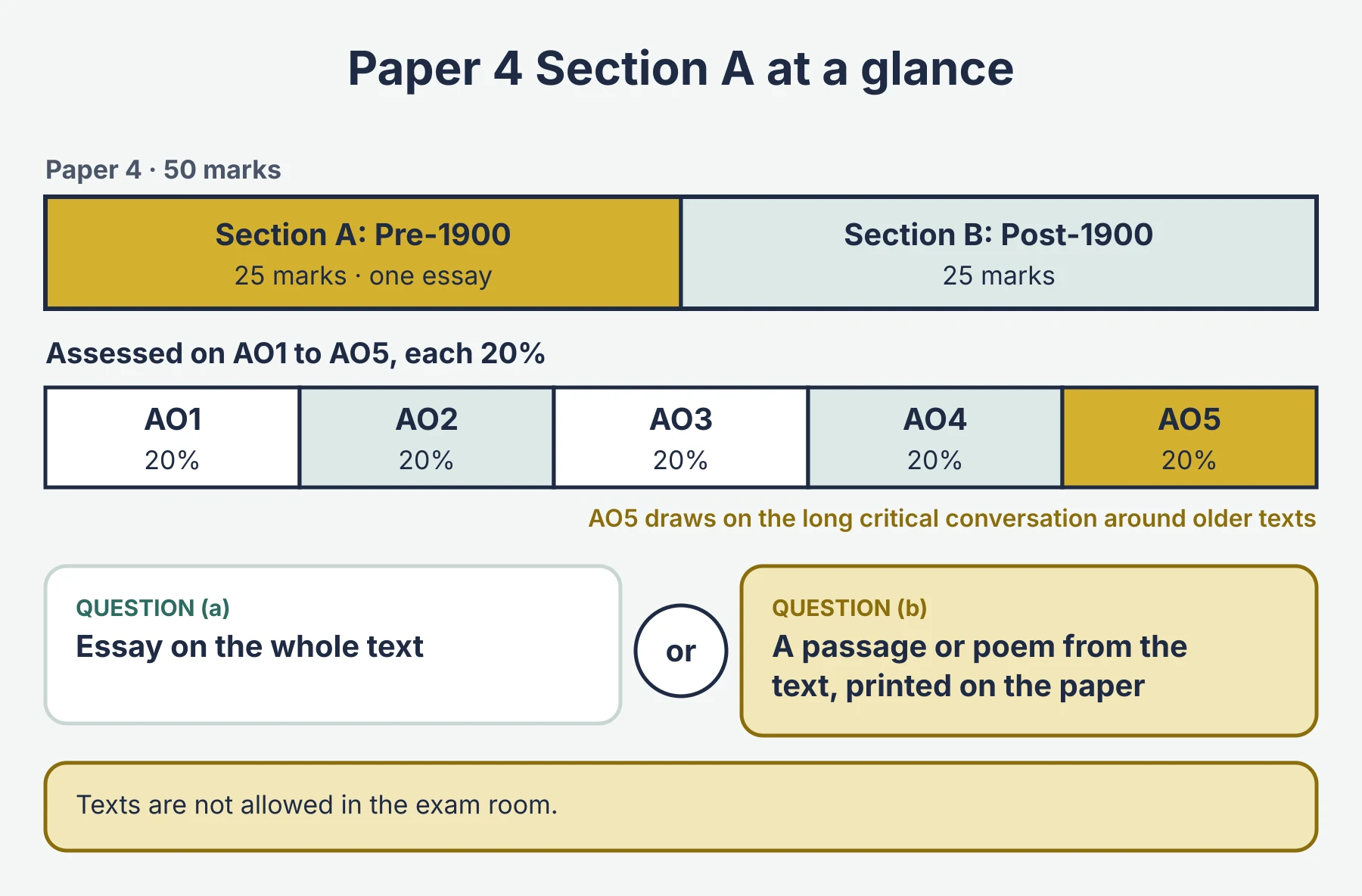
Section A of Paper 4 asks for one essay on a pre-1900 set text, which may be poetry or prose. It is worth 25 of the paper’s 50 marks and is assessed on AO1 to AO5, each 20%. This guide concentrates on what is distinctive about older texts: their language, their conventions, and the long critical conversation around them that feeds AO5. For the paper as a whole, see the Paper 4 study guide.
What the section asks of you
On each set text you choose an (a) question, an essay on the whole text, or a (b) question on a passage or poem from the text printed on the paper. Texts are not allowed in the exam room.
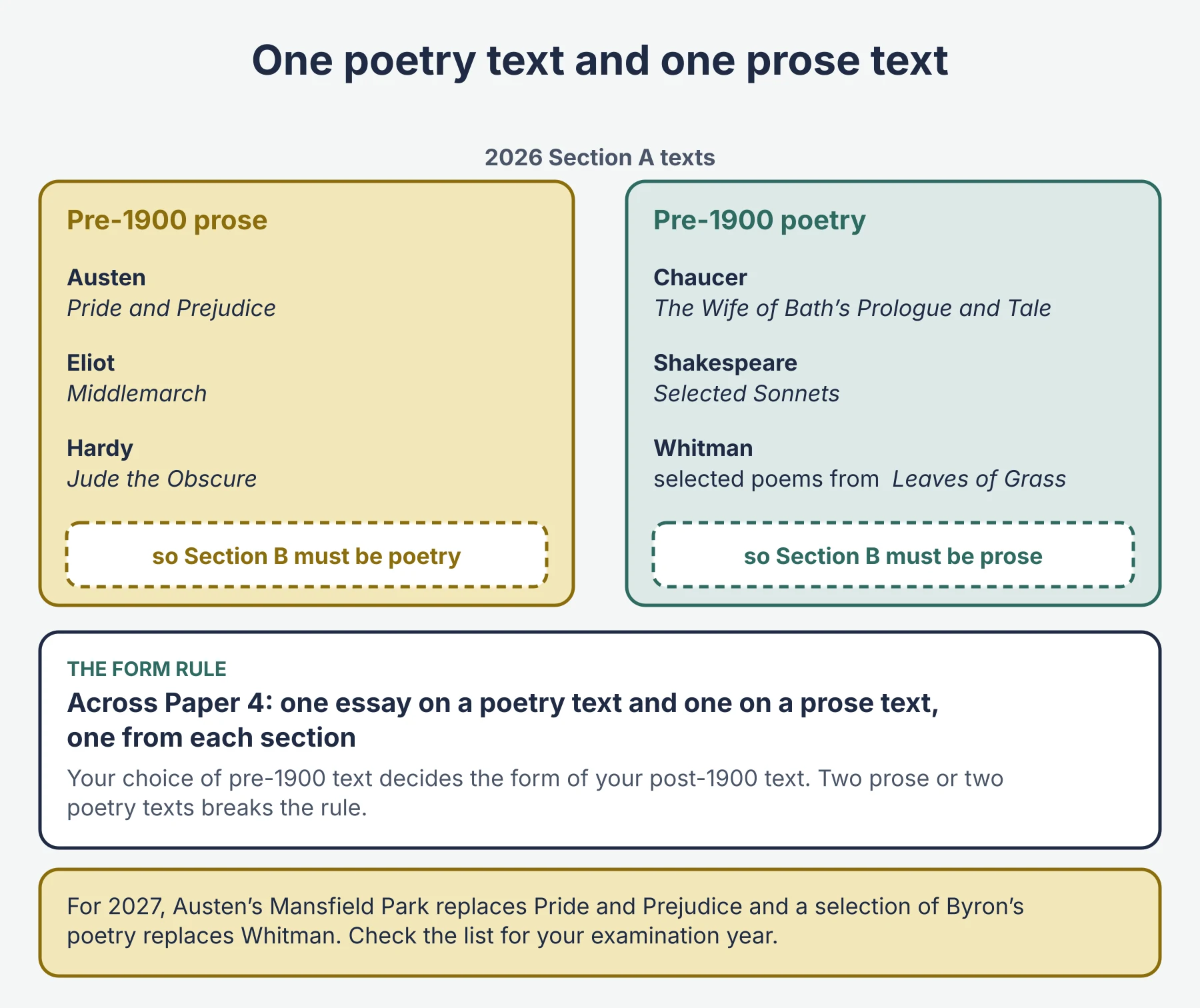
The form rule matters here. Across Paper 4 you must write one essay on a poetry text and one on a prose text, one from each section. Your choice of pre-1900 text therefore decides the form of your post-1900 text.
| 2026 Section A text | Form |
|---|---|
| Austen, Pride and Prejudice | Prose |
| Chaucer, The Wife of Bath’s Prologue and Tale | Poetry |
| Eliot, Middlemarch | Prose |
| Hardy, Jude the Obscure | Prose |
| Shakespeare, Selected Sonnets | Poetry |
| Whitman, selected poems from Leaves of Grass | Poetry |
For 2027, Austen’s Mansfield Park and a selection of Byron’s poetry replace Pride and Prejudice and Whitman. Check the list for your examination year.
The key idea: read the text in its own terms first
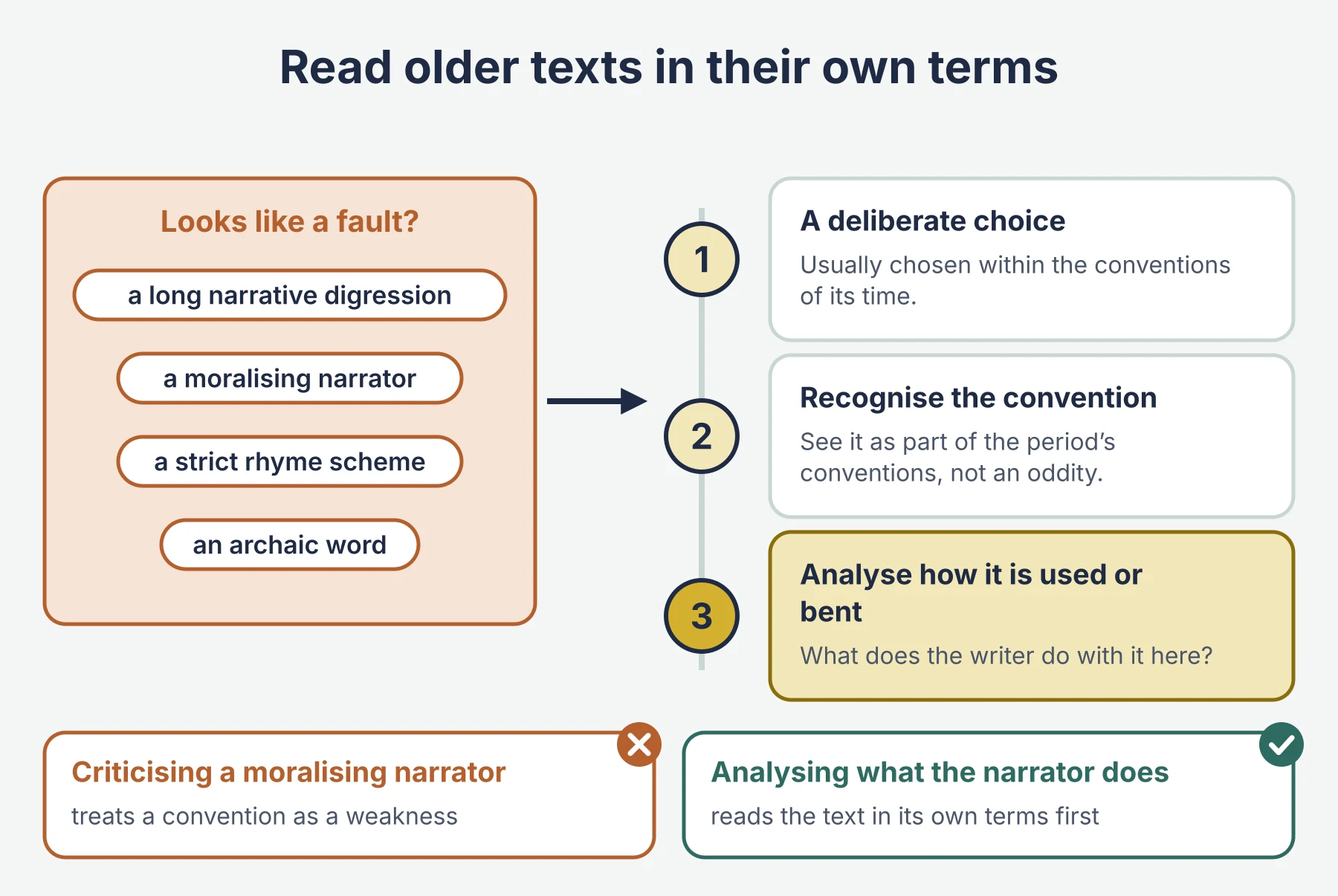
Older texts use conventions that a modern reader may mistake for faults or oddities. A long narrative digression, a moralising narrator, a strict rhyme scheme or an archaic word is usually a deliberate choice within the conventions of its time. Strong answers recognise the convention, then analyse how the writer uses or bends it.
Pre-1900 prose: the narrator is the method
The intrusive and the ironic narrator
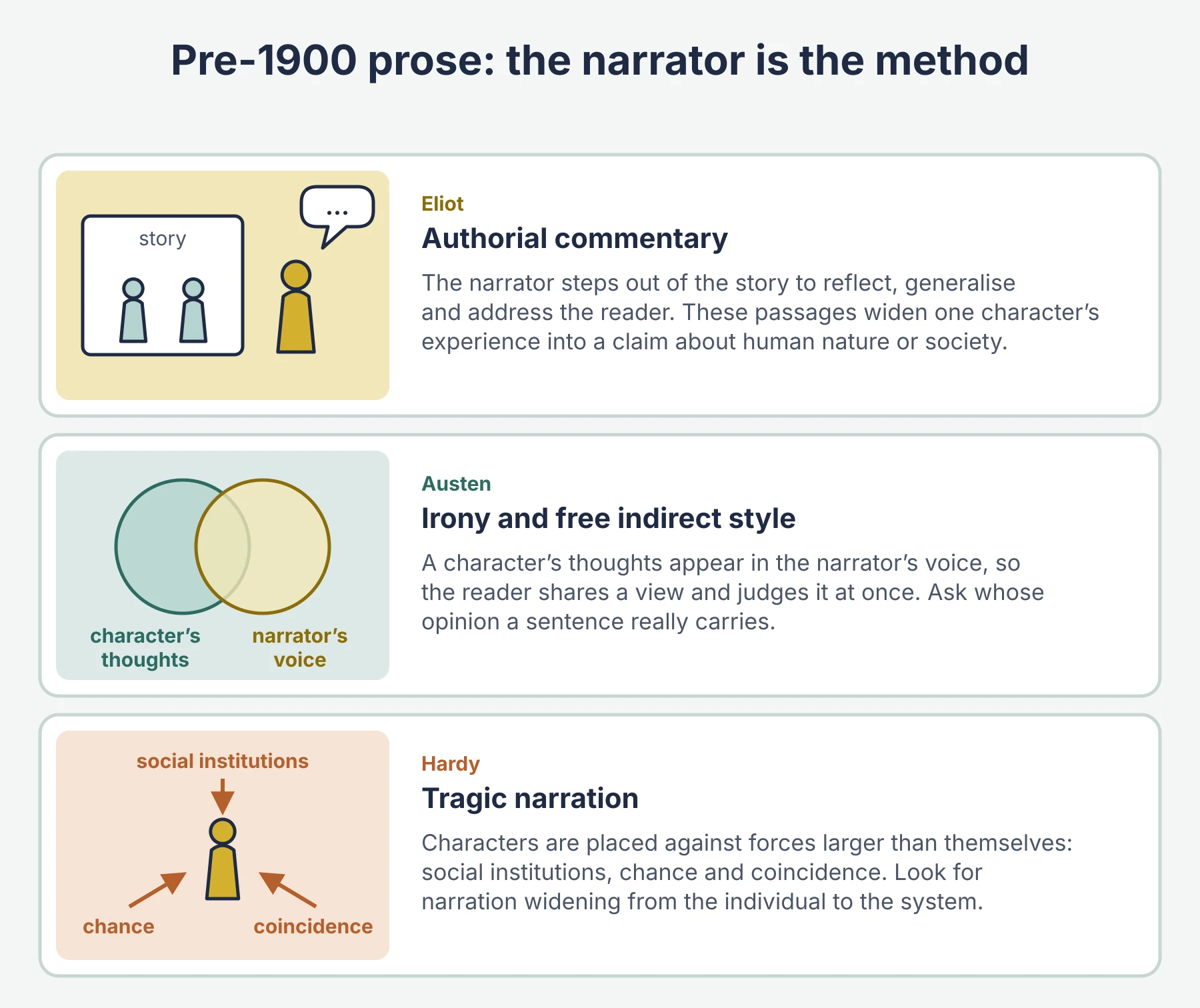
- Authorial commentary. Eliot’s narrator steps out of the story to reflect, generalise and address the reader. Treat these passages as part of the novel’s argument: they widen a single character’s experience into a claim about human nature or society.
- Irony and free indirect style. Austen often presents a character’s thoughts in the narrator’s voice, so the reader shares a view and judges it at once. Ask whose opinion a sentence really carries.
- Tragic narration. Hardy’s narrator frequently places characters against forces larger than themselves: social institutions, chance and coincidence. Look for moments where the narration widens from the individual to the system.
Structure in long novels
These are large books, often first published in parts or volumes. Their structure works through parallel plots (Middlemarch’s several marriages), turning points placed at the centre or end of a volume, and endings that weigh what has been achieved. For an (a) essay, map the focus across the whole book, not only the famous scenes.
Language and register
Pre-1900 prose may use long, periodic sentences that delay their main clause, formal diction, and dialogue that reveals class and education. Notice when a character’s speech differs from the narrator’s: the gap is often where judgement lies.
Pre-1900 poetry: form and voice
Chaucer
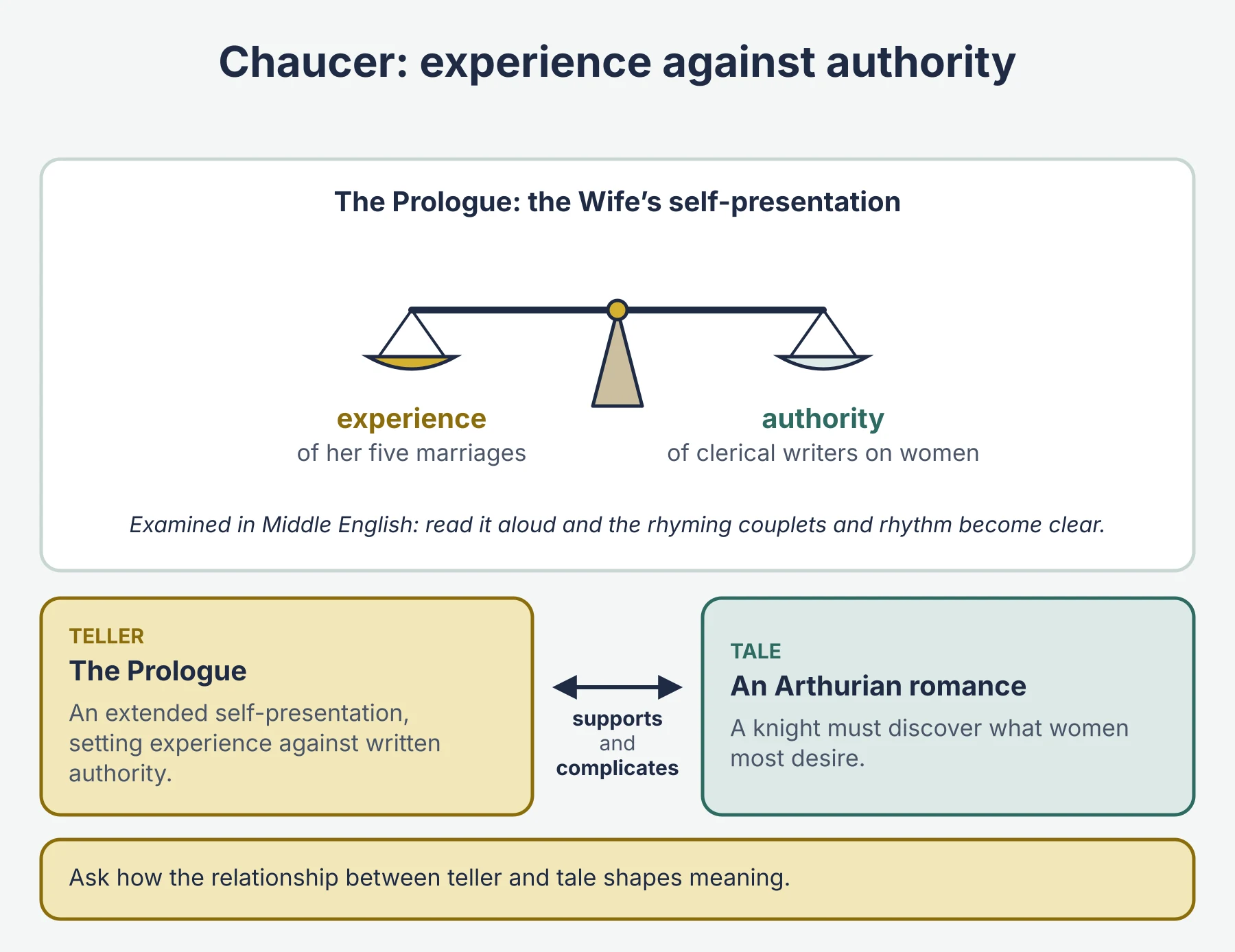
The Wife of Bath’s Prologue and Tale is examined in Middle English, using the edition the syllabus specifies. Learn to read it aloud; the rhyming couplets and rhythm become clear quickly. The Prologue is an extended self-presentation in which the Wife sets her own experience of five marriages against the written authority of clerical writers on women. The Tale, an Arthurian romance about a knight who must discover what women most desire, both supports and complicates her Prologue. Ask how the relationship between teller and tale shapes meaning.
Shakespeare’s sonnets
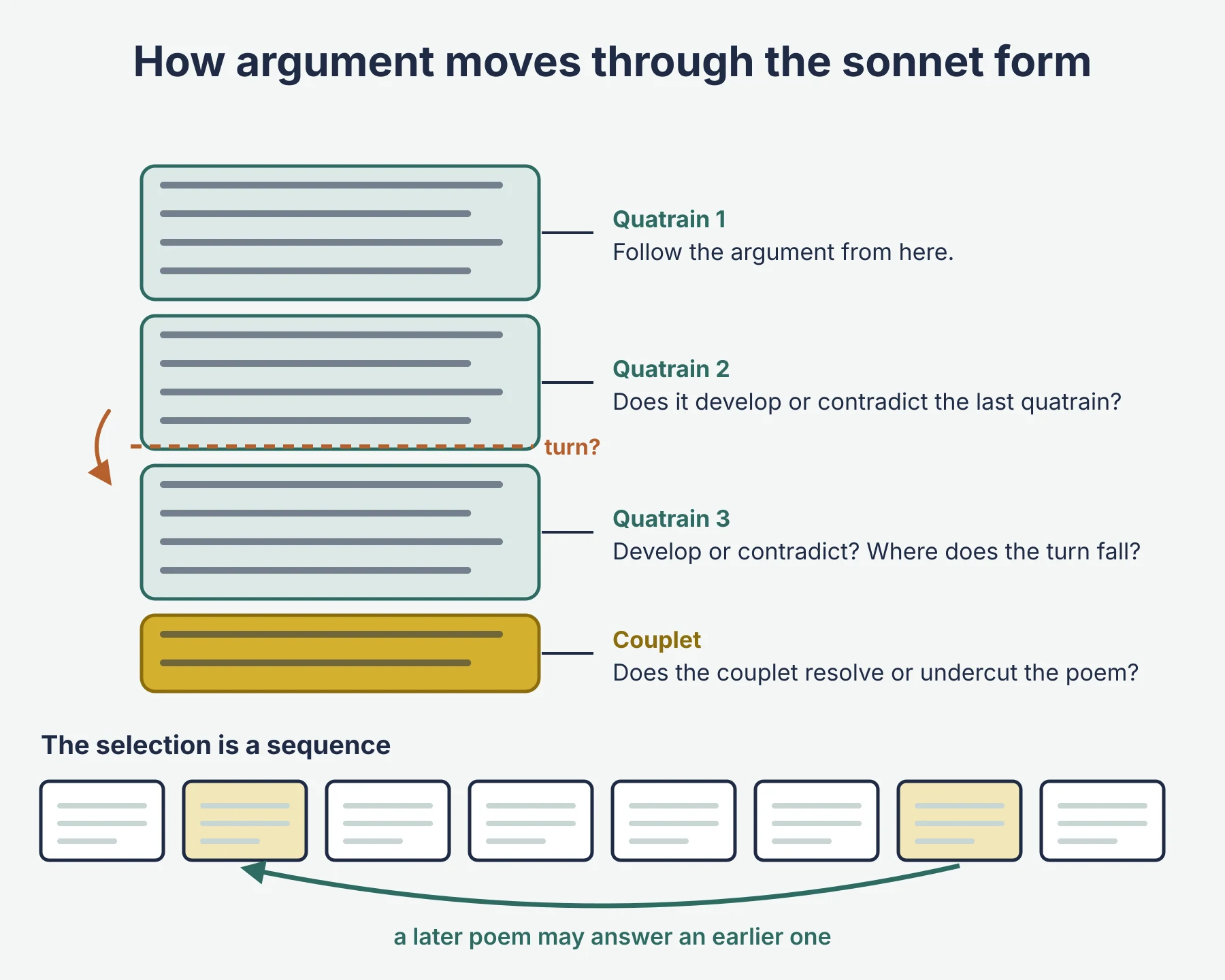
The Shakespearean sonnet has three quatrains and a closing couplet. Analyse how argument moves through the form: where the turn falls, how each quatrain develops or contradicts the last, and whether the couplet resolves or undercuts the poem. Because the selection is a sequence, poems can be read in relation to one another: a later poem may answer an earlier one.
Whitman
Whitman’s poetry is pre-1900 but formally radical: free verse, long lines, catalogues (lists of people, places and activities) and anaphora. The speaking “I” often claims to contain or speak for others. Analyse what the cataloguing does: how it builds inclusiveness, energy and a democratic vision, and where it strains.
Context and AO5 for older texts
Context is especially useful for pre-1900 texts, because conventions of marriage, property, religion, class and gender may differ sharply from the reader’s own. Use context to explain a choice: why marriage is the structural goal of a novel, why a narrator addresses the reader, why a speaker defends herself against written authority.
AO5 draws naturally on critical history. Older texts have been read differently over time:
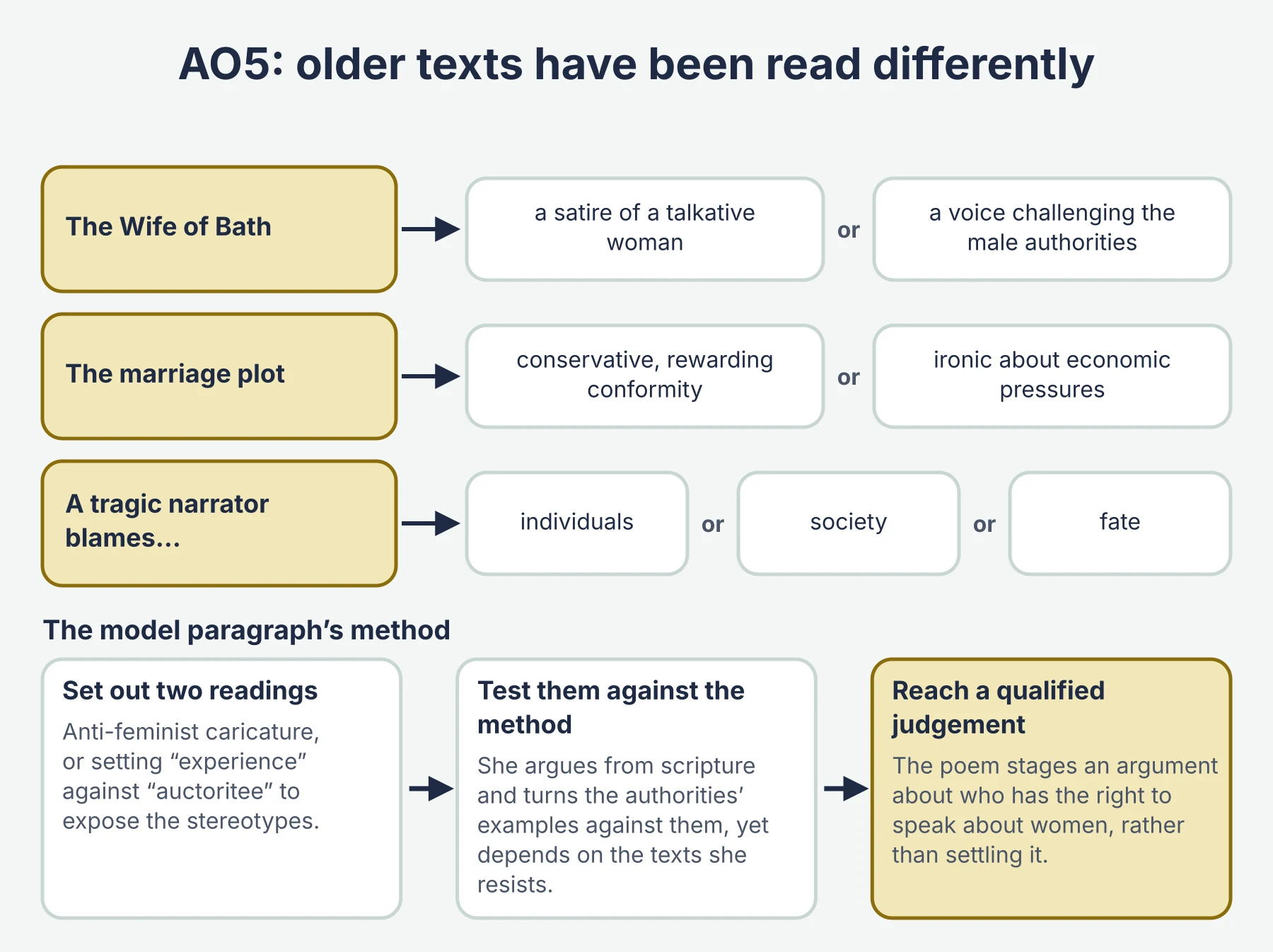
- Is the Wife of Bath a satire of a talkative woman, or a voice challenging the male authorities who wrote about women?
- Is the marriage plot conservative, rewarding conformity, or ironic about the economic pressures behind it?
- Does a tragic narrator blame individuals, society or fate?
Annotated model paragraph
The Wife of Bath’s Prologue has been read in two opposed ways, and the poem’s structure keeps both in play. One reading treats her as an anti-feminist caricature: a woman whose talk confirms the clerical stereotypes she quotes. Feminist readings instead see her setting “experience” against “auctoritee” to expose those stereotypes as one-sided. The second reading is stronger because the Prologue lets her occupy the authorities’ own territory: she argues from scripture and turns their examples against them. Yet Chaucer never lets her escape their terms entirely, since her defence depends on the texts she resists. The poem is most convincingly read as staging an argument about who has the right to speak about women, rather than settling it.
The paragraph sets out two readings, tests them against the poem’s method, and reaches a qualified judgement.
The (b) answer on a passage or poem
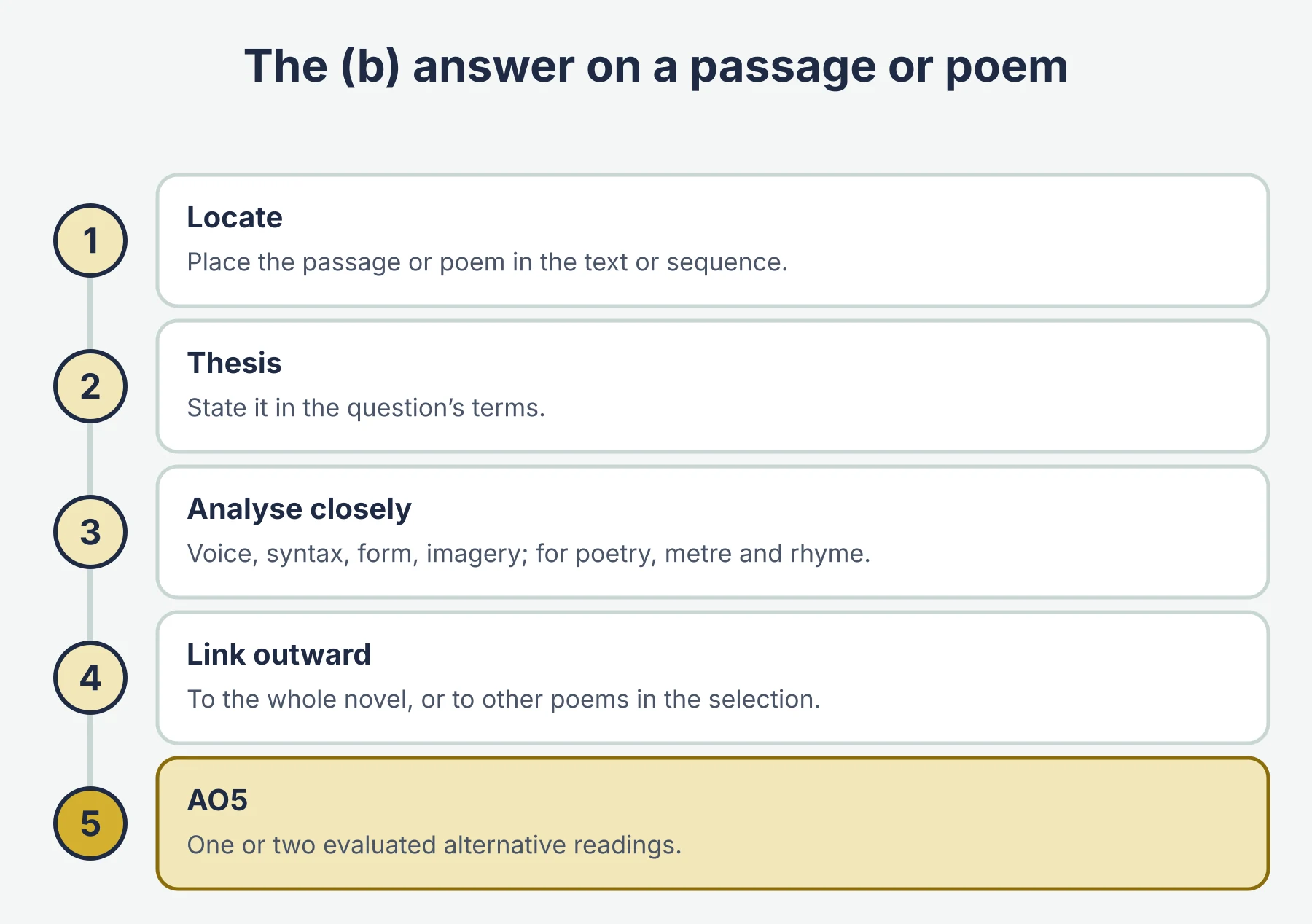
- Locate the passage or poem in the text or sequence.
- Thesis in the question’s terms.
- Analyse closely: voice, syntax, form, imagery; for poetry, metre and rhyme.
- Link outward to the whole novel or to other poems in the selection.
- AO5: one or two evaluated alternative readings.
Common mistakes
- Mistaking convention for weakness: criticising a moralising narrator instead of analysing what it does.
- Modern assumptions: judging characters by present-day norms without considering the period.
- Context as history essay: background with no link to a passage or choice.
- Avoiding the language: paraphrasing Middle English or older syntax rather than analysing it.
- Breaking the form rule: choosing two prose or two poetry texts across Paper 4.
Practise and revise this section
- Paper 4 Section A Pre-1900 revision notes — conventions, terms, traps and a self-test.
- Paper 4 Section A Pre-1900 practice questions — structured tasks with mark-scheme style answers.
- Paper 4 Section B Post-1900 study guide — the other half of the paper.
Written against the Cambridge International AS & A Level Literature in English 9695 syllabus for 2024, 2025 and 2026.
Related resources
-
Practice questions
Cambridge A Level Literature in English (9695): Paper 4 Section A – Pre-1900 Poetry and Prose – Practice Questions
Original practice for Cambridge 9695 Paper 4 Section A Pre-1900: the form rule, narrators, sonnet form and AO5, using new period-style passages, with answers.
English Literature · Cambridge · A Level
Try questions -
Revision notes
Cambridge A Level Literature in English (9695): Paper 4 Section A – Pre-1900 Poetry and Prose – Revision Notes
Quick-recall notes for Cambridge 9695 Paper 4 Section A Pre-1900: narrator types, verse forms, period conventions, AO5 debates, traps and a self-test.
English Literature · Cambridge · A Level
Revise topic -
Study guides
Cambridge A Level Literature in English (9695): Paper 4 Section B – Post-1900 Poetry and Prose
Reading post-1900 set texts for Cambridge 9695 Paper 4 Section B: fragmented narration, sequences and voices, allegory, and AO5 from modern critical approaches.
English Literature · Cambridge · A Level
Read guide
Get free revision emails (optional)
Occasional emails with practice questions, worked explanations and links to free resources for the qualification and subjects you choose. No spam, and you can unsubscribe from any email. The free tools on this site never need an email.