
Revision Notes
Cambridge A Level Literature in English (9695): Paper 2 Section B – Unseen – Revision Notes
Quick-recall notes for Cambridge 9695 Paper 2 Section B Unseen: the syllabus rules, a one-hour method, form checklists, key terms, traps and a self-test.
- Subject
- English Literature
- Level
- AS LEVEL
- Topic
- Paper 2 – Prose and Unseen
- Author
- Marlbridge Academic Team
- Updated
- Reviewed by
- Ammar Bilal (what this means)
Aligned to Cambridge A Level English Literature (9695), 2024-2026. Official specification .
Syllabus page (what it covers and how it is assessed): Cambridge A Level English Literature.
Syllabus points this page covers
9695 (AS Level)
- 2.2 Section B: Unseen
Found an error? Report a correction.
Need help with this topic? Request a free trial class for A Level English Literature (9695).
Condensed notes for the unseen half of Paper 2. For the full method and a worked annotation, use the Paper 2 Section B Unseen study guide.
The rules
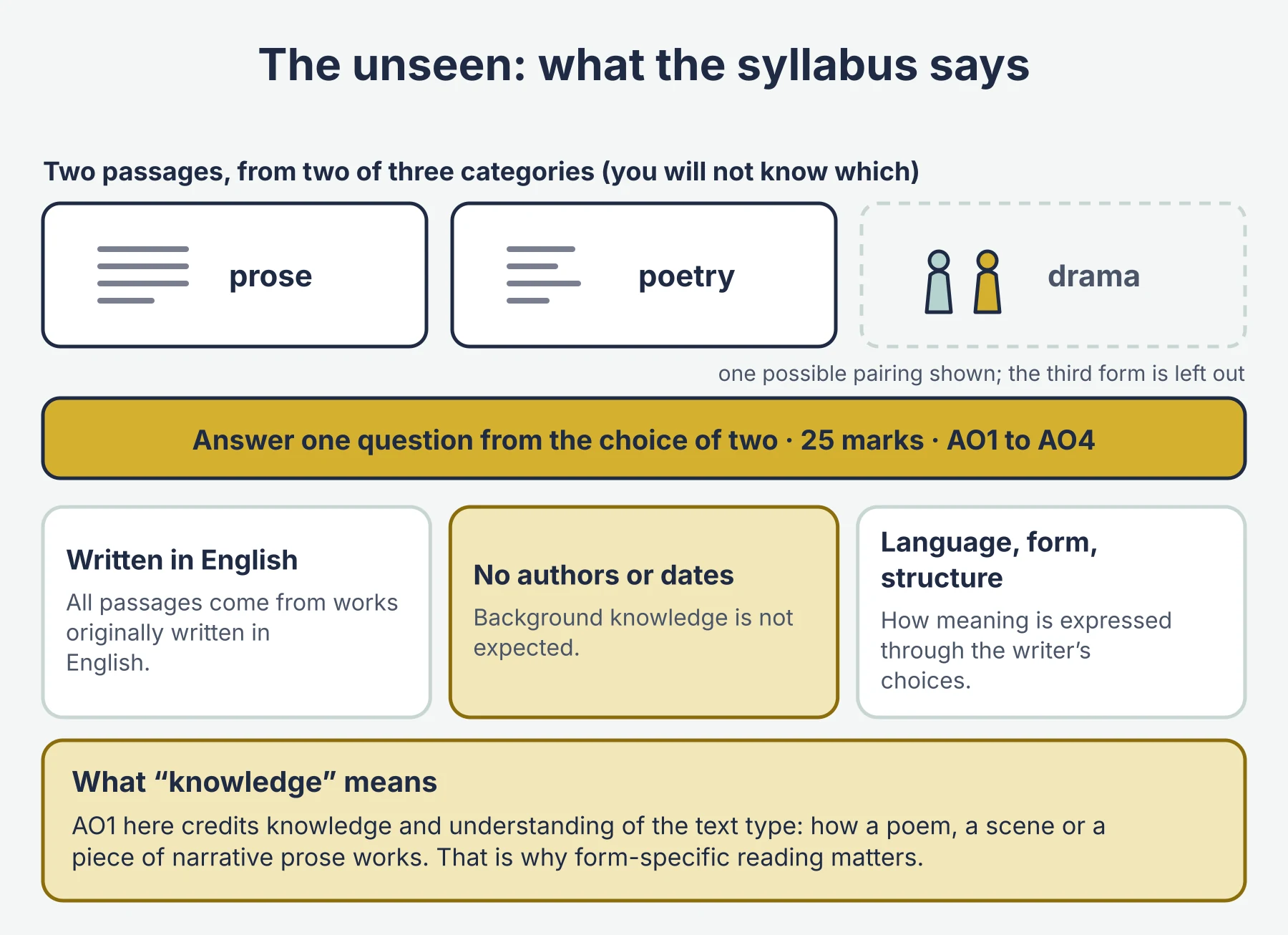
| Rule | Detail |
|---|---|
| Choice | One question from two |
| Forms | The two passages cover two of prose, poetry and drama |
| Language | All passages originally written in English |
| Information given | No authors or dates |
| Background | Literary or historical background not expected |
| Marks | 25, half of Paper 2 |
| AOs | AO1 to AO4; AO1 here means knowledge of the text type |
| Materials | No dictionaries |
The one-hour method
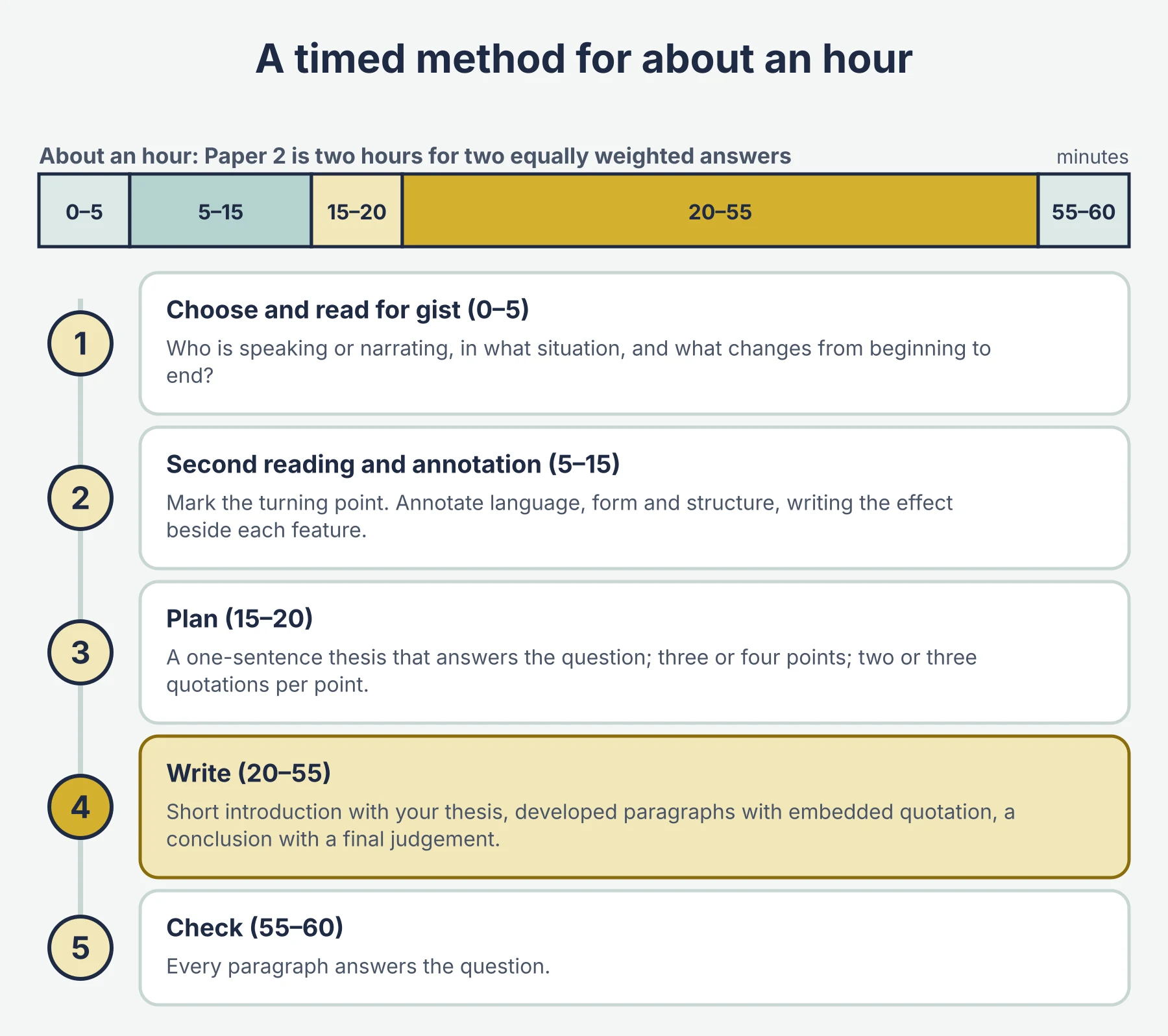
| Minutes | Step | Output |
|---|---|---|
| 0–5 | Read both questions, skim both passages, choose | A decision you keep |
| 5–15 | Second read, annotate | Turning point marked; effects written beside features |
| 15–20 | Plan | One-sentence thesis; three or four points; quotations |
| 20–55 | Write | Introduction, developed paragraphs, conclusion |
| 55–60 | Check | Every paragraph answers the question |
How to choose
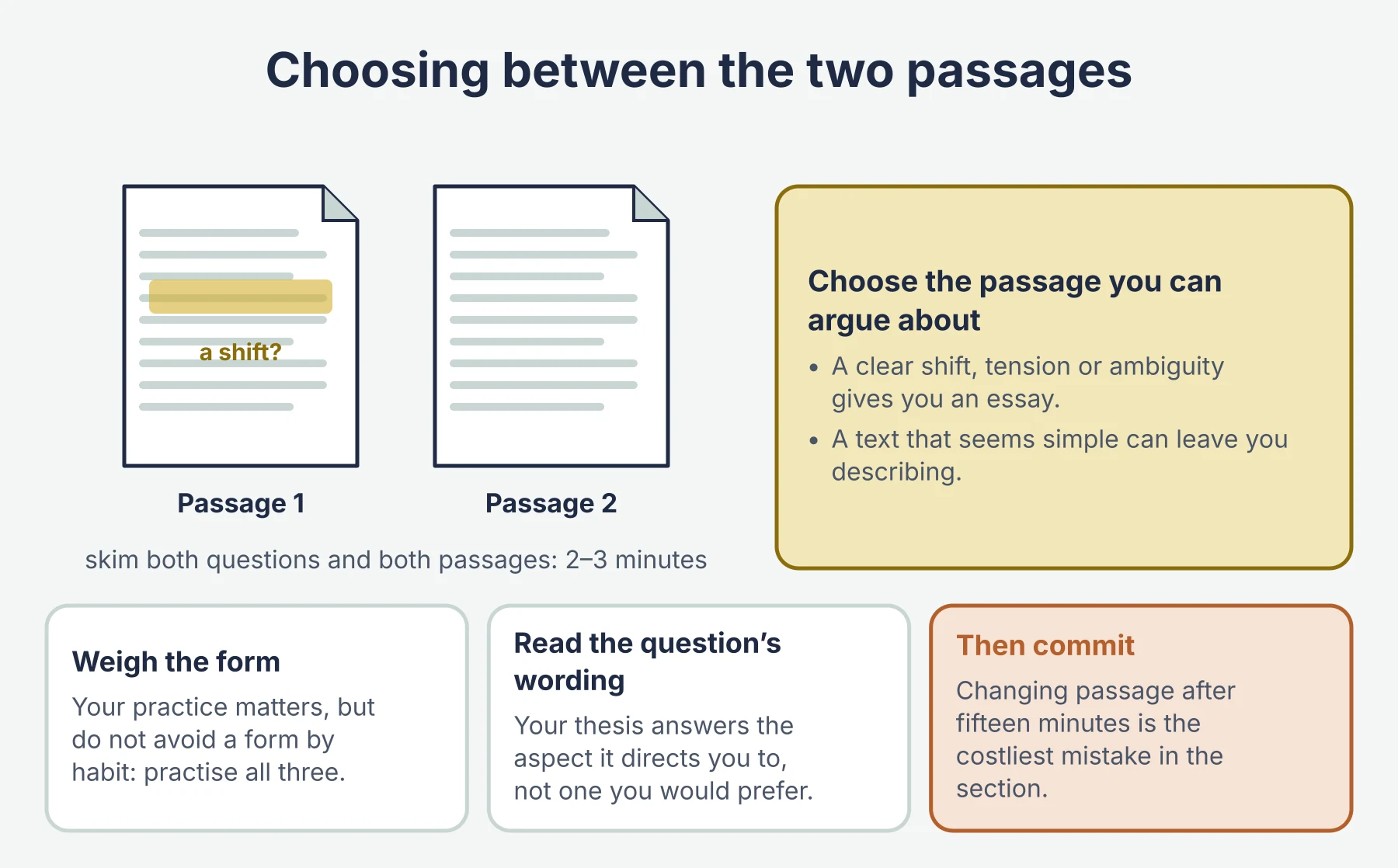
- Pick the passage you can argue about, not the one that seems easiest.
- Look for a shift, tension or ambiguity: these give an essay direction.
- Read the question’s focus before deciding: can you answer that, specifically?
- Practise all three forms so the choice is genuine.
Form checklists
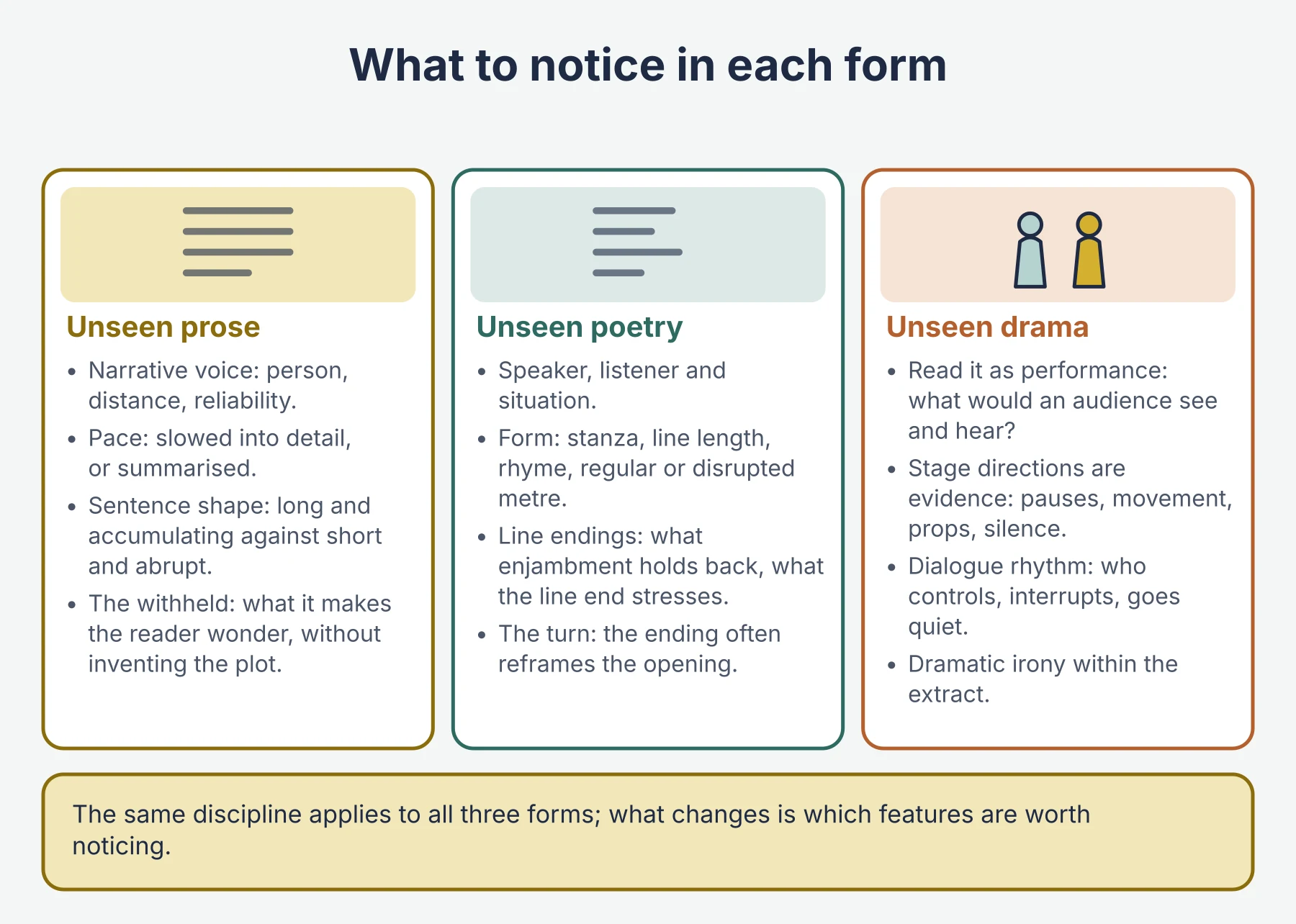
Prose
- Voice: who narrates, from how close, how reliably?
- Pace: summary versus detailed scene.
- Sentence shape: long and accumulating, or short and abrupt.
- The withheld: what the extract leaves unexplained.
Poetry
- Speaker, listener, situation.
- Stanza, line length, rhyme, metre and their disruption.
- Line endings and enjambment.
- The turn, and how the ending reframes the opening.
Drama
- Audience view: what is seen and heard.
- Stage directions as evidence.
- Dialogue rhythm: control, interruption, silence.
- Dramatic irony inside the extract.
Key terms
| Term | Meaning |
|---|---|
| Thesis | Your one-sentence answer to the question |
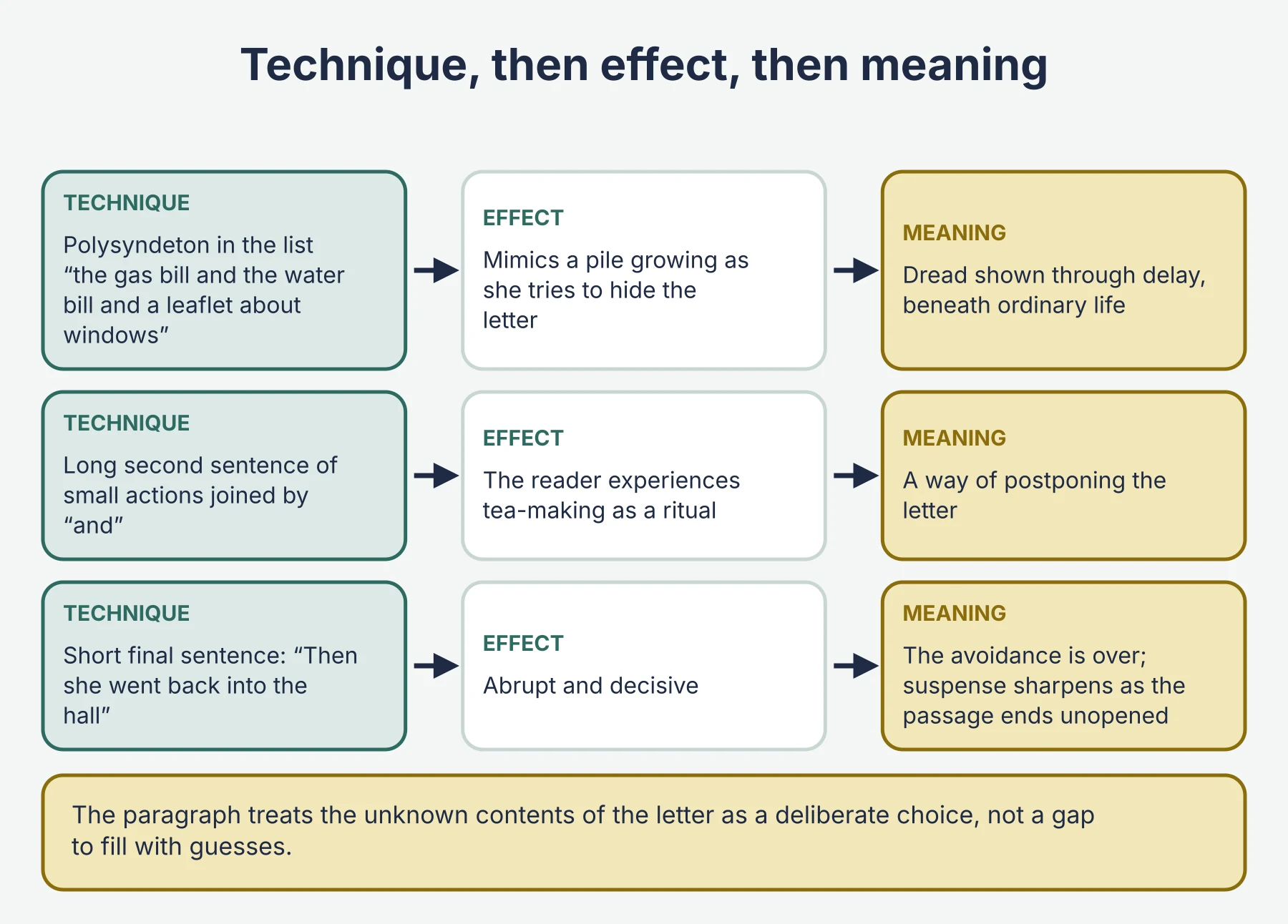
| Polysyndeton | Repeated conjunctions (“and… and… and”) slowing or accumulating |
| Asyndeton | Omitted conjunctions, creating speed or fragmentation |
| Tricolon | A group of three for emphasis or rhythm |
| Pathetic fallacy | Setting or weather reflecting feeling |
| Register | Level of formality or type of vocabulary |
| Tone | The attitude conveyed by the writing |
| Ambiguity | More than one valid meaning held open |
| In medias res | Beginning in the middle of action |
| Foreshadowing | Hints of what is to come |
Paragraph formula
Point that answers the question → short embedded quotation → technique → effect on the reader or audience → link to the passage’s overall meaning or movement.
Example shape: “The writer presents [focus] through [technique]: ‘[quotation]’ [does what], so the reader [understands or feels what], which prepares for [later shift].”
Introductions: weak versus strong
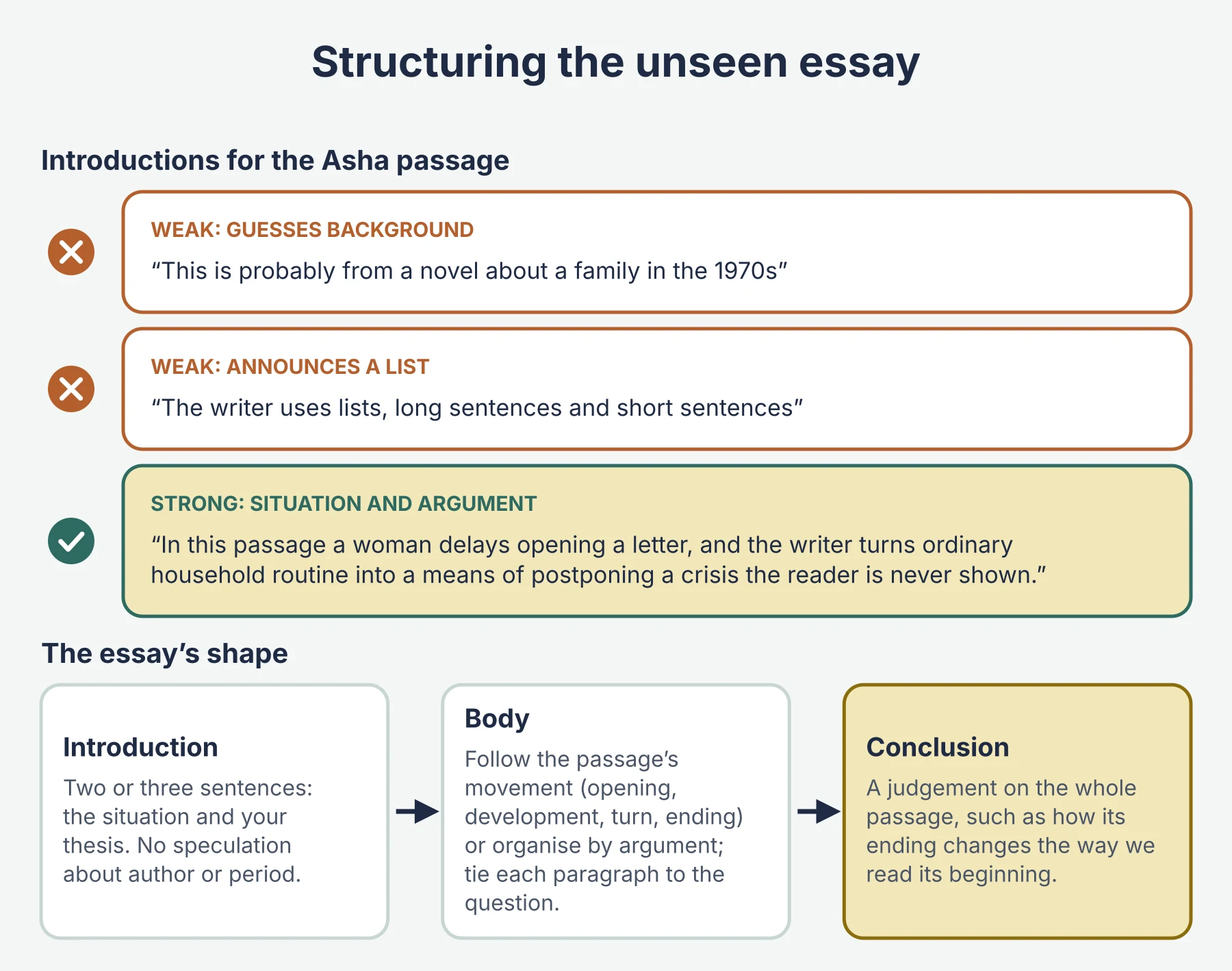
| Weak | Why | Strong |
|---|---|---|
| “This passage was probably written long ago.” | Guesses at a date that is deliberately withheld | “In this passage a woman delays opening a letter, and routine becomes a way of postponing a crisis.” |
| “The writer uses lists, imagery and short sentences.” | A device list with no argument | “The writer builds dread through what is not said, so the reader’s suspense grows as the letter stays closed.” |
Mini-annotation drill
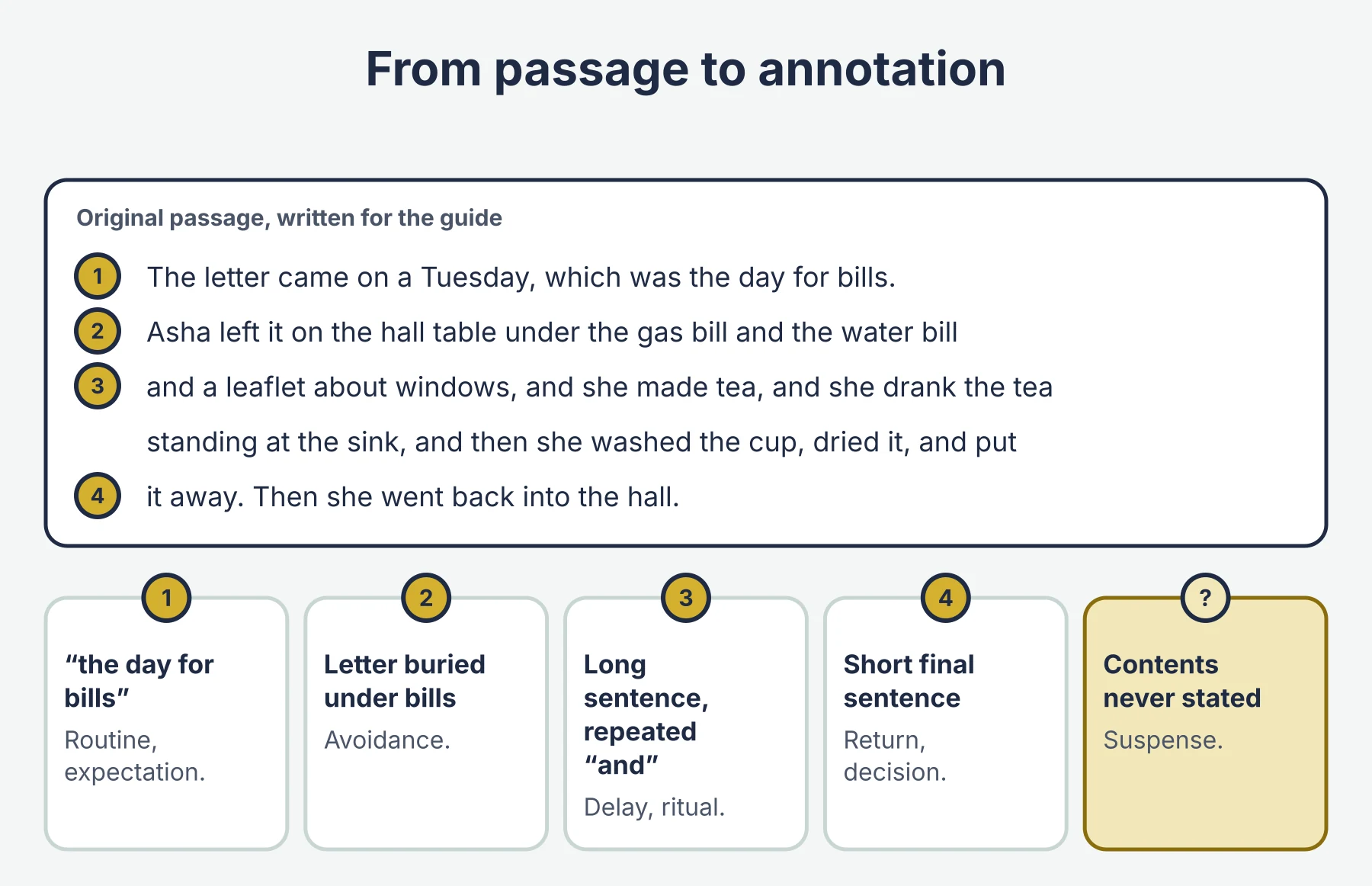
Original line for practice: “The house was quiet in the way houses are quiet when someone has just left them.”
- Simile-like generalisation (“in the way houses are”): turns one moment into a shared experience.
- Repetition of “quiet”: lingers on absence.
- Withheld information: who left, and why?
- Effect: loneliness implied rather than stated; the reader fills the silence.
Practise this drill on a single sentence a day: feature, effect, question it raises.
Exam traps
- Context guesses: dating or attributing the passage earns nothing.
- Invented plot: discussing events outside the extract.
- Device lists: features without a thesis.
- Paraphrase: retelling, not analysing.
- Form-blindness: treating a poem or a scene as if it were prose narrative.
- Switching passage: changing choice mid-answer wastes time you cannot recover.
- Ignoring the ending: many passages turn in their final lines.
How to practise
- Use passages you have not read before: anthologies of unfamiliar writers, newspapers’ published short fiction, playscripts from libraries.
- Rotate forms in a fixed cycle: prose, poem, drama.
- Time the full hour, including choosing between two passages.
- After each attempt, check every paragraph: technique, effect, link to the question.
Self-test
- How many passages are printed, and how many do you answer on?
- Which categories can the passages come from, and how many of them appear?
- Are authors and dates given?
- Is knowledge of historical background expected?
- What does AO1 credit on this section?
- Roughly how long should you spend on Section B?
- What should you look for in deciding which passage to choose?
- What should you annotate beside each feature you mark?
- Define polysyndeton.
- Give one feature to analyse in an unseen drama extract that does not apply to prose.
- Why is switching passages mid-answer so costly?
- What should a conclusion do?
Answers: 1. Two printed; you answer on one. 2. Prose, poetry and drama; two of the three. 3. No. 4. No. 5. Knowledge and understanding of the text type. 6. About an hour of the two-hour paper. 7. A shift, tension or ambiguity you can argue about, and a question focus you can answer. 8. Its effect, not just its name. 9. The repeated use of conjunctions such as “and”. 10. Stage directions (also: what the audience sees, dialogue rhythm in performance). 11. Planning time is lost and the second attempt is rushed. 12. Make a judgement on the passage as a whole, such as how the ending reframes the opening.
Related resources
-
Study guides
A Level English Literature: Paper 2 - Prose and Unseen (Cambridge 9695)
The format and structure of Paper 2 Prose and Unseen – an AS Level paper for Cambridge International A Level English Literature 9695, 2024-2026 series.
English Literature · Cambridge · AS Level
Read guide -
Practice questions
A Level English Literature: Paper 2 - Prose and Unseen — Practice Questions
Original practice on Cambridge 9695 Paper 2 Prose and Unseen: set-text preparation, unseen reading method and timing, with full mark-scheme style answers.
English Literature · Cambridge · AS Level
Try questions -
Revision notes
A Level English Literature: Paper 2 - Prose and Unseen — Revision Notes (Cambridge 9695)
Quick-recall notes on Cambridge 9695 Paper 2 Prose and Unseen: format, set-text preparation, a repeatable unseen method, timing and exam traps.
English Literature · Cambridge · AS Level
Revise topic
Get free revision emails (optional)
Occasional emails with practice questions, worked explanations and links to free resources for the qualification and subjects you choose. No spam, and you can unsubscribe from any email. The free tools on this site never need an email.