
Study Guides
Cambridge A Level Literature in English (9695): Paper 2 Section B – Unseen
A timed method for Cambridge 9695 Paper 2 Section B Unseen: choosing the passage, reading prose, poetry or drama cold, and planning a critical essay.
- Subject
- English Literature
- Level
- AS LEVEL
- Topic
- Paper 2 – Prose and Unseen
- Author
- Marlbridge Academic Team
- Updated
- Reviewed by
- Ammar Bilal (what this means)
Aligned to Cambridge A Level English Literature (9695), 2024-2026. Official specification .
Syllabus page (what it covers and how it is assessed): Cambridge A Level English Literature.
Syllabus points this page covers
9695 (AS Level)
- 2.2 Section B: Unseen
Found an error? Report a correction.
Need help with this topic? Request a free trial class for A Level English Literature (9695).
Section B of Paper 2 is the only part of the AS Level with no set text. You write one critical essay on a passage you have never seen, chosen from two printed on the paper. It is worth 25 marks, half of Paper 2, and assessed on AO1 to AO4. This guide sets out a complete timed method. The Paper 2 overview covers the paper’s wider structure.
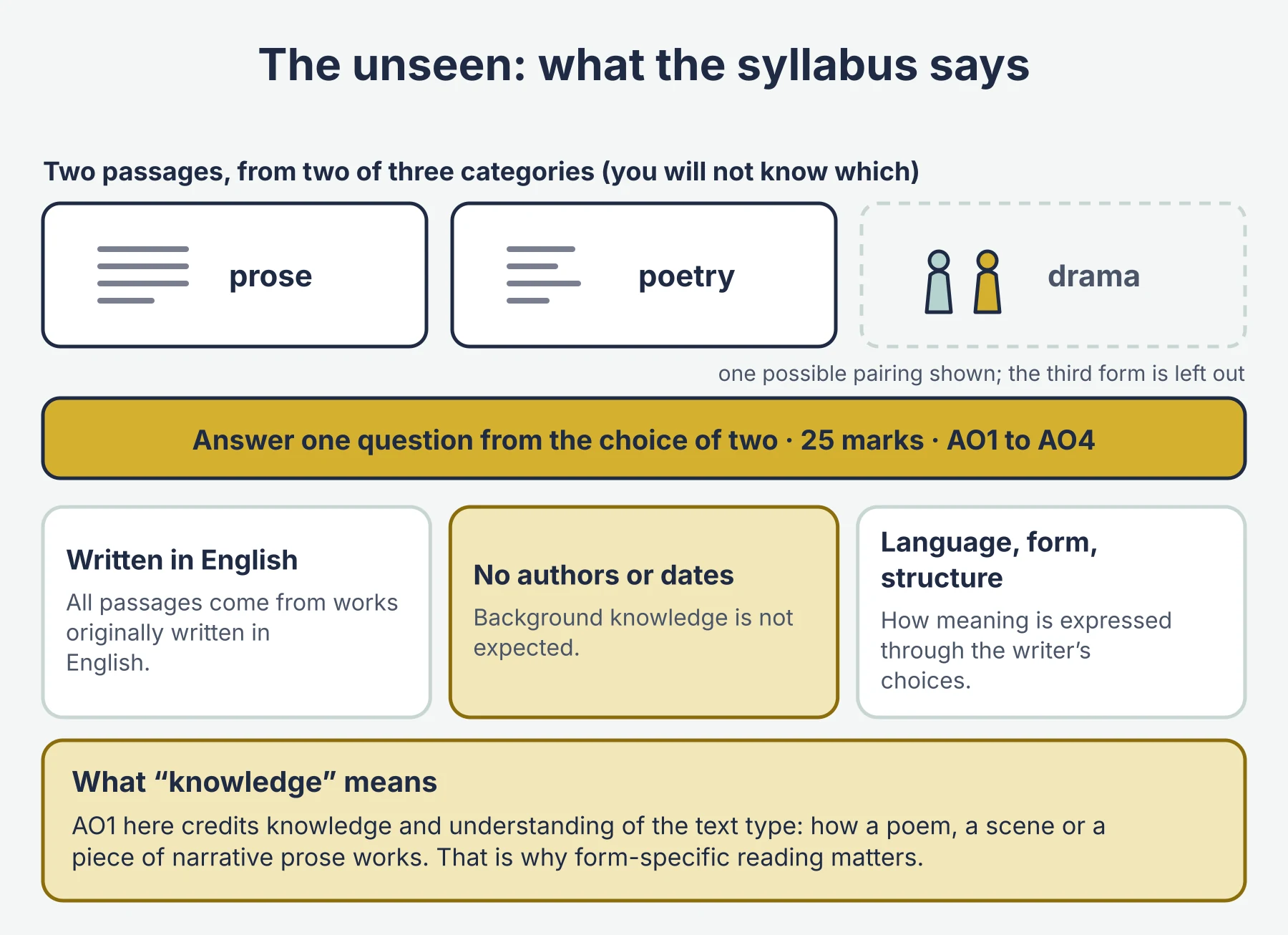
What the syllabus says about the unseen
The 9695 syllabus sets out the rules clearly:
- You answer one question from a choice of two.
- The two passages cover two of three categories: prose, poetry and drama. You will not know in advance which two.
- All passages come from works originally written in English.
- Authors and dates are not given, and knowledge of literary or historical background is not expected.
- Questions test your ability to read critically and show, through informed discussion and opinion, how meaning is expressed through a writer’s choices of language, form and structure.
For AO1 on this section, the “knowledge” credited is knowledge and understanding of the text type: what you know about how a poem, a scene or a piece of narrative prose works. That is why form-specific reading matters so much.
Choosing between the two passages
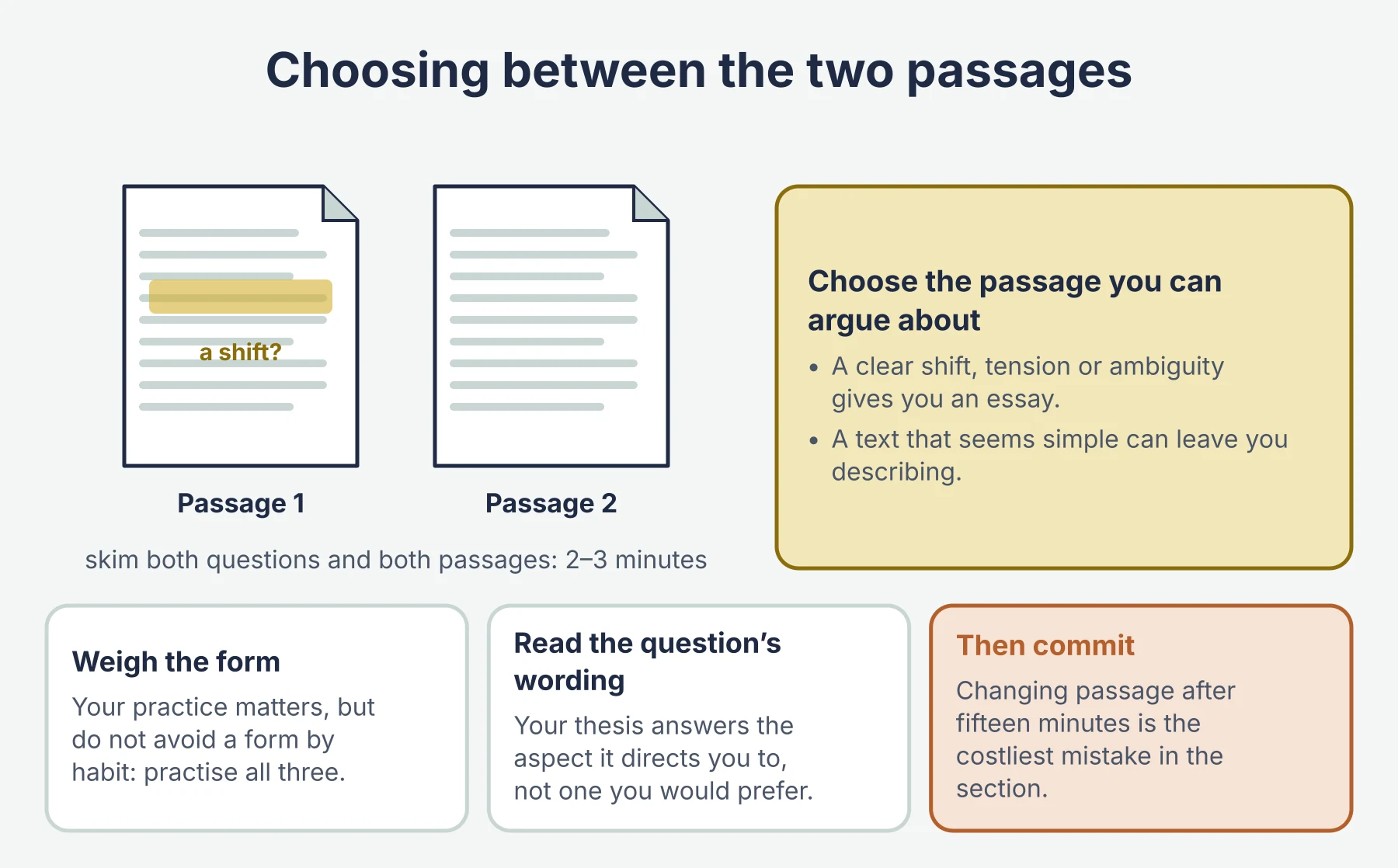
Spend two or three minutes reading both questions and skimming both passages before choosing.
- Choose the passage you can argue about, not the one you merely understand. A text with a clear shift, tension or ambiguity gives you an essay; a text that seems simple can leave you describing.
- Weigh the form. If you have practised unseen poetry more than drama, that matters, but do not avoid a form by habit; practise all three.
- Read the question’s wording. It will usually direct you to an aspect of the passage. Your thesis must answer that, not a question you would prefer.
Once you choose, commit. Changing passage after fifteen minutes is the costliest mistake in the section.
A timed method (about an hour)
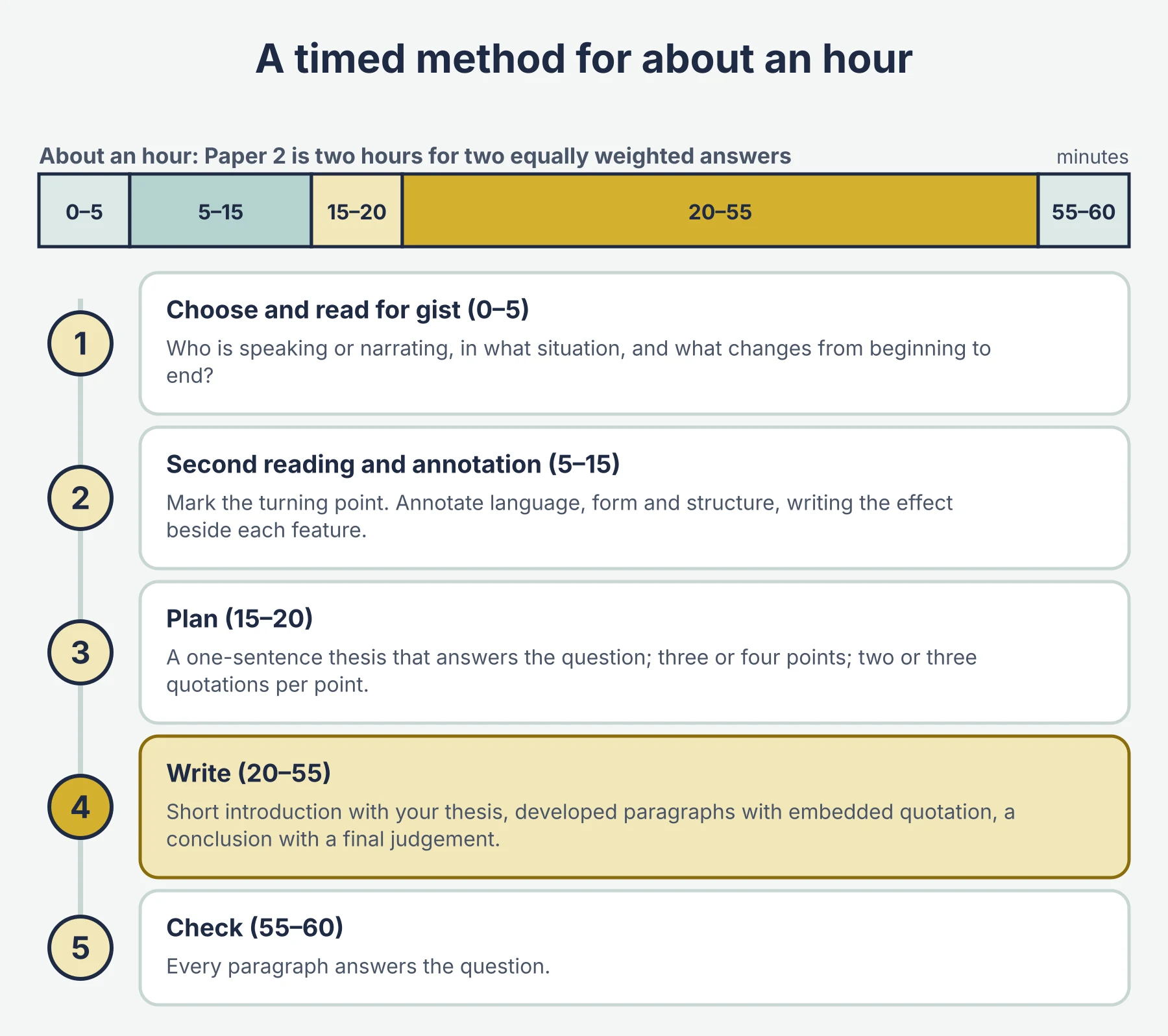
The paper is two hours for two equally weighted answers, so give this section about an hour.
Minutes 0–5: choose and read for gist. Who is speaking or narrating, in what situation, and what changes from beginning to end?
Minutes 5–15: second reading and annotation. Mark the passage’s turning point. Annotate language, form and structure, writing the effect beside each feature, not just the label.
Minutes 15–20: plan. Write a one-sentence thesis that answers the question. Choose three or four points that follow the passage’s movement or build an argument. Note two or three quotations per point.
Minutes 20–55: write. A short introduction with your thesis; developed paragraphs with embedded quotation; a conclusion that makes a final judgement.
Minutes 55–60: check that every paragraph answers the question.
Reading by form
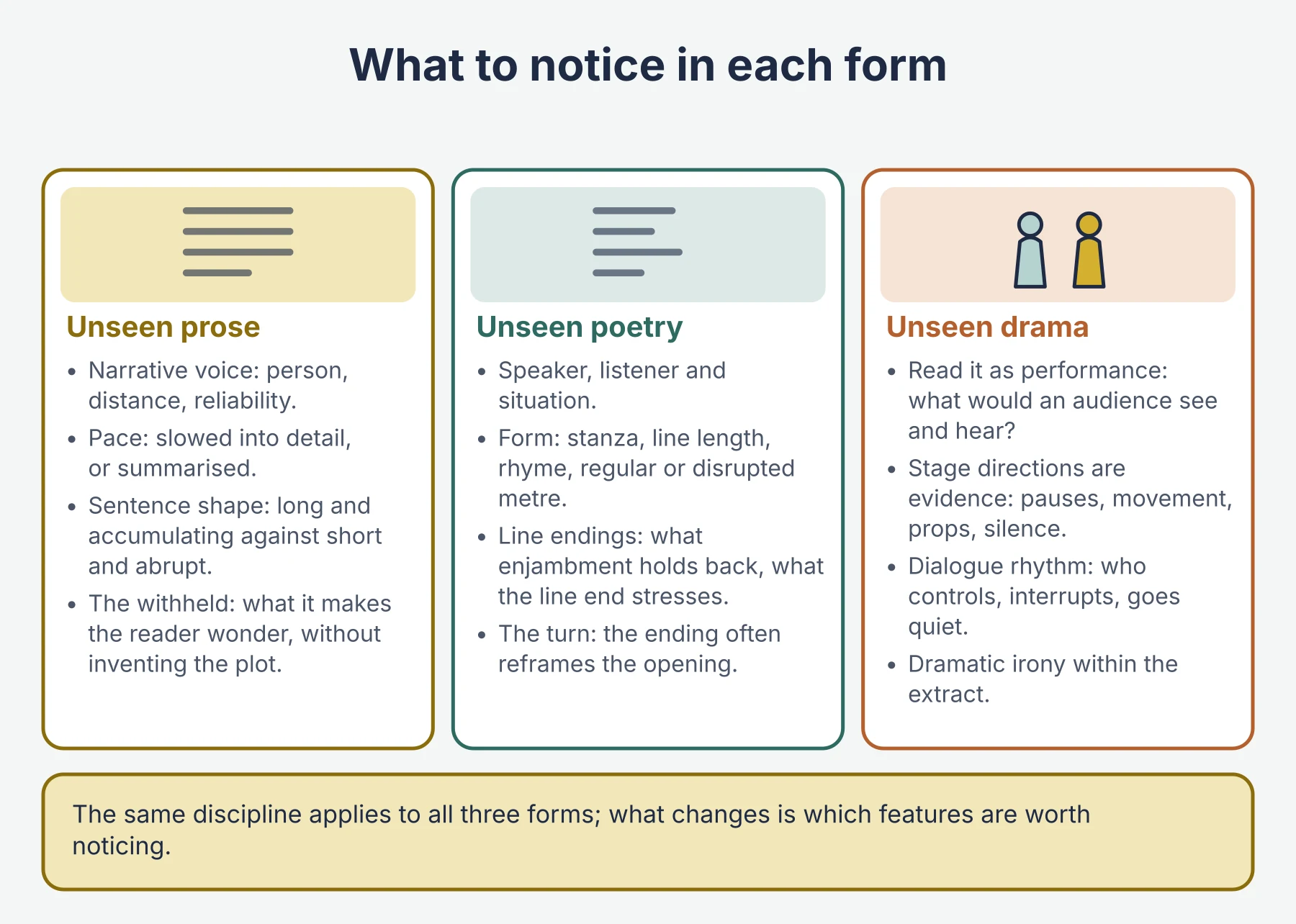
The same discipline applies to all three forms, but the features worth noticing change.
Unseen prose
- Narrative voice: first or third person, distance from the characters, reliability.
- Pace: where the writing slows down into detail, and where it summarises.
- Sentence shape: long, accumulating sentences against short, abrupt ones.
- The withheld: what the passage does not explain. An extract is often the opening of a story or a moment in a longer work; analyse what it makes the reader wonder, but do not invent the plot.
Unseen poetry
- Speaker, listener and situation.
- Form: stanza shape, line length, rhyme or its absence, regular or disrupted metre.
- Line endings: what is held back by enjambment, what is emphasised at the end of a line.
- The turn: most poems change direction; the ending often reframes the opening.
Unseen drama
- Read it as performance: what would an audience see and hear?
- Stage directions are evidence: pauses, movement, props, silence.
- Dialogue rhythm: who controls the conversation, who interrupts, who goes quiet.
- Dramatic irony within the extract: what does the audience grasp before a character does?
Worked example: from annotation to paragraph
The passage below is original, written for this guide.
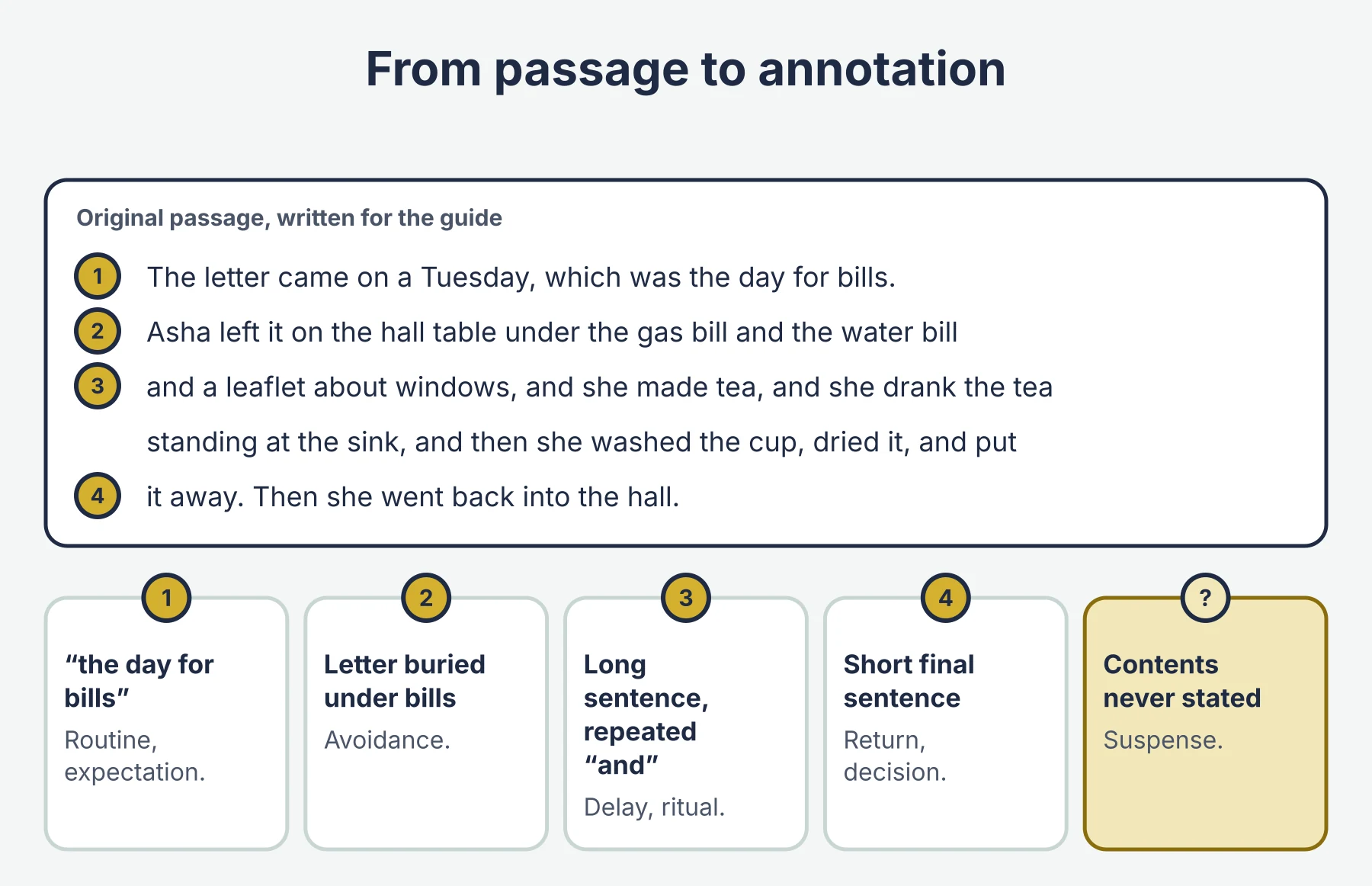
The letter came on a Tuesday, which was the day for bills. Asha left it on the hall table under the gas bill and the water bill and a leaflet about windows, and she made tea, and she drank the tea standing at the sink, and then she washed the cup, dried it, and put it away. Then she went back into the hall.
Annotation notes: Tuesday as “the day for bills”: routine, expectation. Letter buried under bills: avoidance. Long sentence with repeated “and”: delay, ritual. Short final sentence: return, decision. Letter’s contents never stated: suspense.
Paragraph:
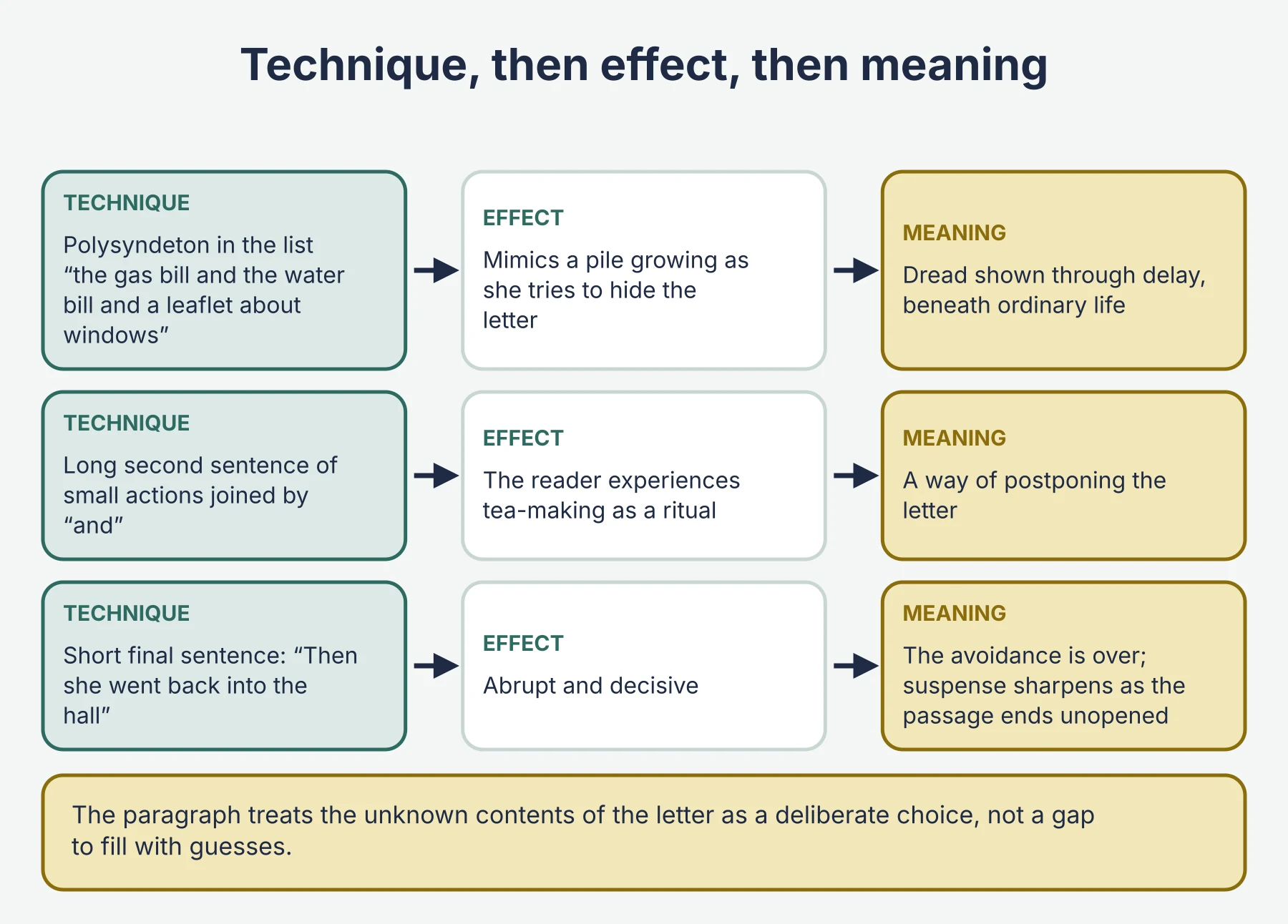
The writer presents Asha’s dread through delay rather than statement. The letter is never described; instead it is buried “under the gas bill and the water bill and a leaflet about windows”, and the polysyndeton of the list mimics a pile growing as she tries to hide it beneath ordinary life. The long second sentence then strings together small actions with repeated “and”, so the reader experiences the ritual of tea-making as a way of postponing the letter. Against this, the short final sentence, “Then she went back into the hall”, is abrupt and decisive: the avoidance is over, and the reader’s suspense is sharpened because the passage ends before the letter is opened.
The paragraph moves from technique to effect to meaning, and it treats the unknown contents of the letter as a deliberate choice, not a gap to fill with guesses.
Structuring the essay
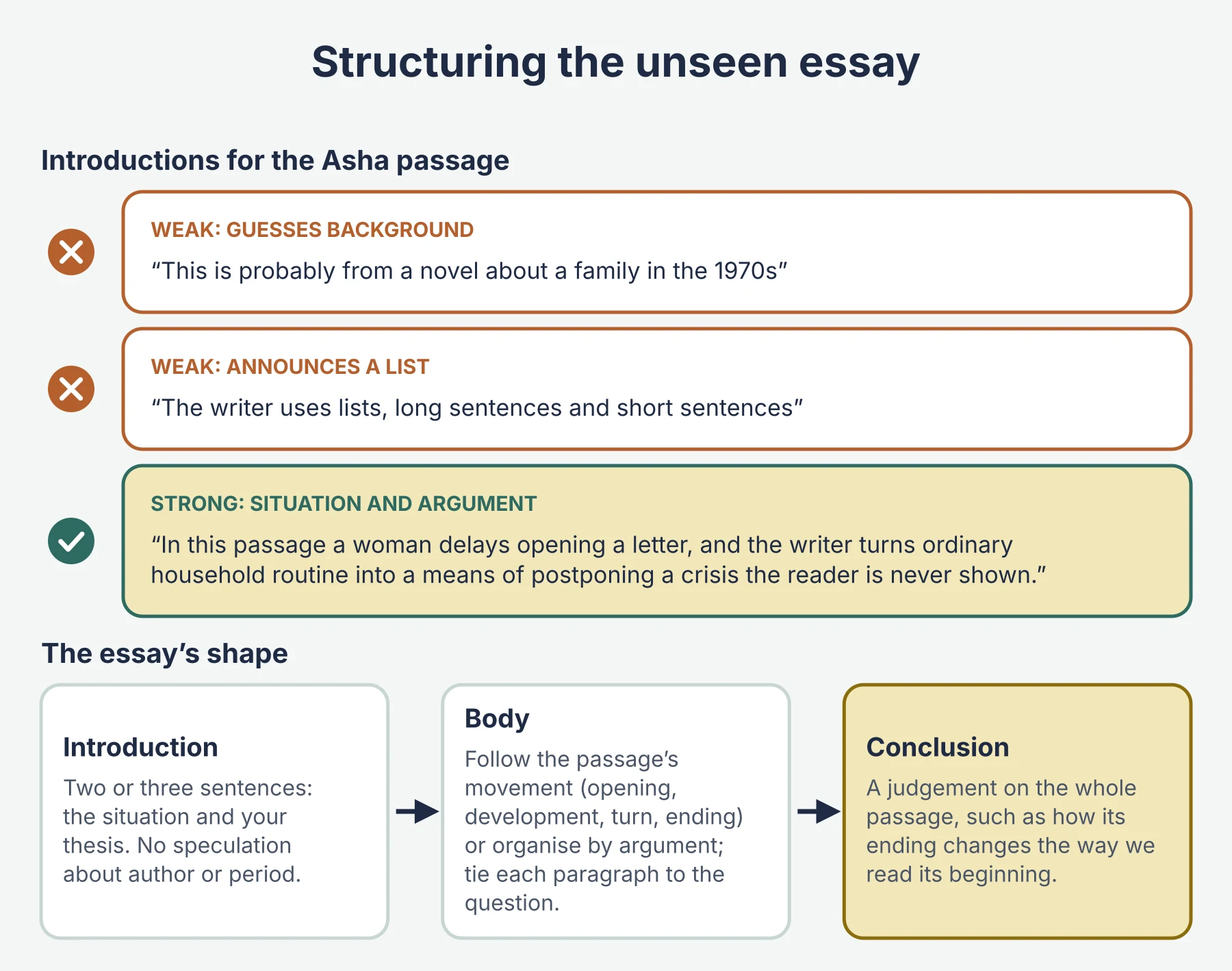
An introduction for the passage above might go wrong in two ways. A weak one guesses at background (“This is probably from a novel about a family in the 1970s”) or announces a list (“The writer uses lists, long sentences and short sentences”). A strong one gives the situation and an argument: “In this passage a woman delays opening a letter, and the writer turns ordinary household routine into a means of postponing a crisis the reader is never shown.” It names the focus, implies the method, and gives every later paragraph something to prove.
- Introduction: two or three sentences giving the passage’s situation and your thesis. No speculation about the author or period.
- Body: follow the passage’s movement (opening, development, turn, ending) or organise by argument, but keep each paragraph tied to the question.
- Conclusion: a judgement on the passage as a whole, such as how its ending changes the way we read its beginning.
Common mistakes
- Guessing context. “This was probably written in Victorian times” earns nothing; background is not expected and dates are deliberately withheld.
- Inventing plot. Writing about what happens after the extract instead of what it contains.
- Feature spotting. A list of devices with no thesis.
- Paraphrase. Retelling the passage in your own words.
- Ignoring form. Treating a poem as prose, or a drama extract as a story.
- An unanswered question. A fine general commentary that never addresses the question’s focus.
Practise and revise this section
- Paper 2 Section B Unseen revision notes — the method on one page, form checklists and a self-test.
- Paper 2 Section B Unseen practice questions — original prose, poetry and drama passages with answers.
- Paper 2 Section A Prose study guide — the set-text half of the paper.
Written against the Cambridge International AS & A Level Literature in English 9695 syllabus for 2024, 2025 and 2026.
Related resources
-
Practice questions
Cambridge A Level Literature in English (9695): Paper 2 Section B – Unseen – Practice Questions
Original unseen practice for Cambridge 9695 Paper 2 Section B: new prose, poetry and drama passages with structured questions and mark-scheme answers.
English Literature · Cambridge · AS Level
Try questions -
Revision notes
Cambridge A Level Literature in English (9695): Paper 2 Section B – Unseen – Revision Notes
Quick-recall notes for Cambridge 9695 Paper 2 Section B Unseen: the syllabus rules, a one-hour method, form checklists, key terms, traps and a self-test.
English Literature · Cambridge · AS Level
Revise topic -
Study guides
A Level English Literature: Paper 2 - Prose and Unseen (Cambridge 9695)
The format and structure of Paper 2 Prose and Unseen – an AS Level paper for Cambridge International A Level English Literature 9695, 2024-2026 series.
English Literature · Cambridge · AS Level
Read guide
Get free revision emails (optional)
Occasional emails with practice questions, worked explanations and links to free resources for the qualification and subjects you choose. No spam, and you can unsubscribe from any email. The free tools on this site never need an email.