
Study Guides
Cambridge A Level Literature in English (9695): Paper 2 Section A – Prose
Narrative voice, time and structure for Cambridge 9695 Paper 2 Section A Prose, with methods for (a) essays and (b) passage answers and an annotated paragraph.
- Subject
- English Literature
- Level
- AS LEVEL
- Topic
- Paper 2 – Prose and Unseen
- Author
- Marlbridge Academic Team
- Updated
- Reviewed by
- Ammar Bilal (what this means)
Aligned to Cambridge A Level English Literature (9695), 2024-2026. Official specification .
Syllabus page (what it covers and how it is assessed): Cambridge A Level English Literature.
Syllabus points this page covers
9695 (AS Level)
- 2.1 Section A: Prose
Found an error? Report a correction.
Need help with this topic? Request a free trial class for A Level English Literature (9695).
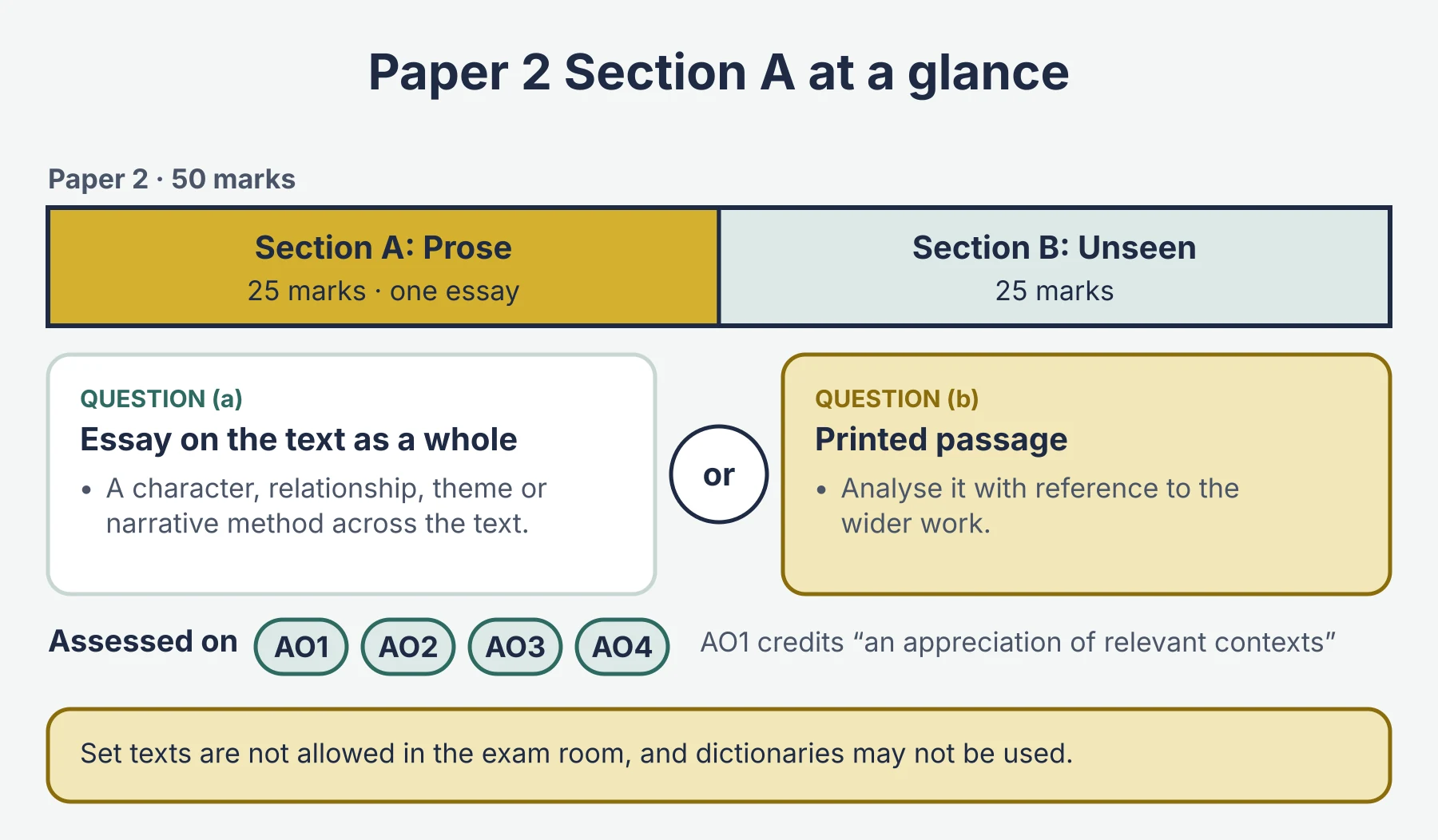
Section A of Paper 2 asks for one essay on a prose set text: a novel or the Stories of Ourselves short-story selection. It is worth 25 of the paper’s 50 marks and is assessed on AO1 to AO4. This guide concentrates on the tools for analysing prose fiction, which differ from those for drama and poetry, and on how to build each type of answer. For the paper as a whole, see the Paper 2 overview.
What the section asks of you
On each set text you choose between an (a) question, an essay on the text as a whole, and a (b) question, which prints a passage from the text and asks you to analyse it with reference to the wider work. Set texts are not allowed in the exam room, and dictionaries may not be used.
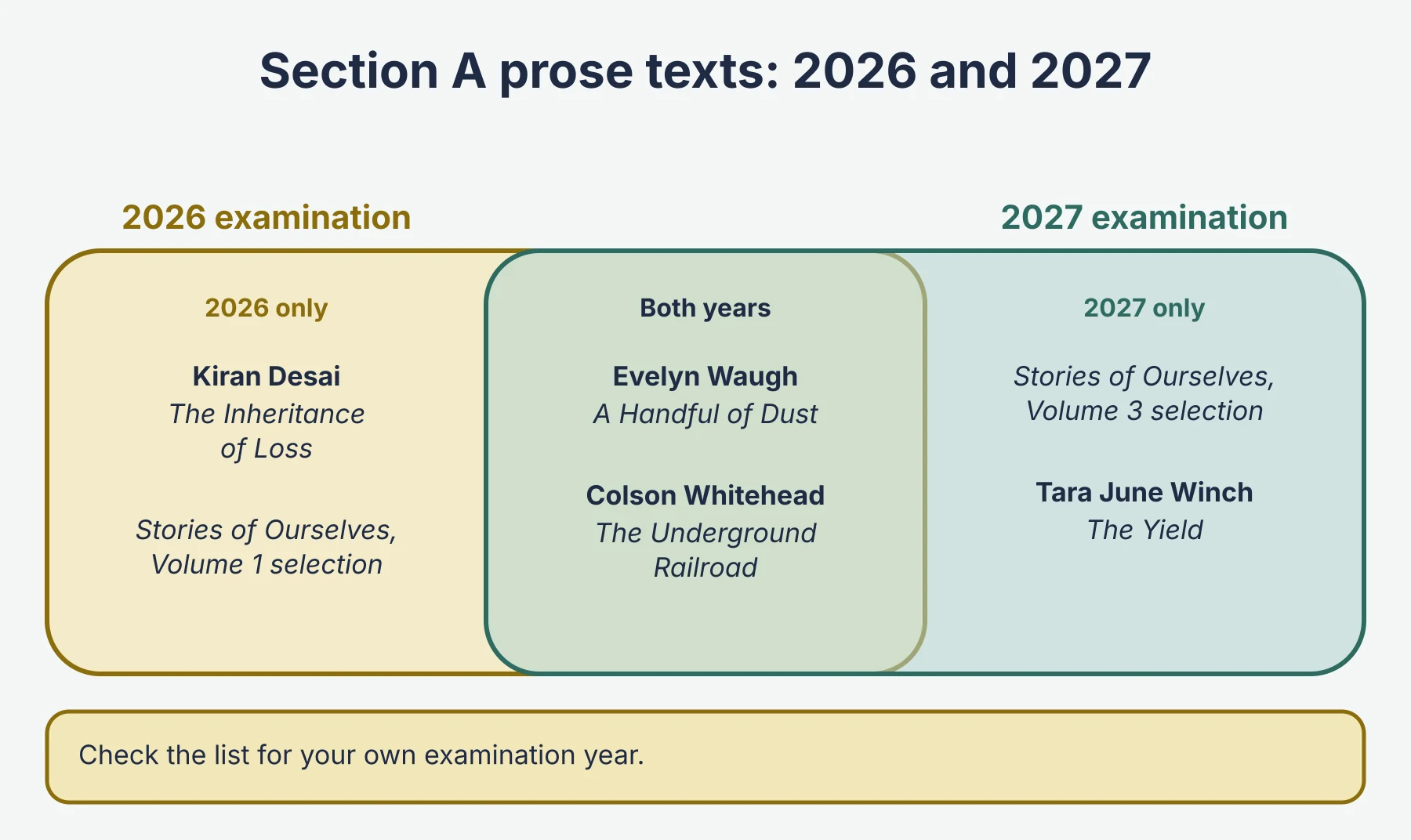
For 2026 the Section A texts are Kiran Desai’s The Inheritance of Loss, the selection from Stories of Ourselves, Volume 1, Evelyn Waugh’s A Handful of Dust and Colson Whitehead’s The Underground Railroad. For 2027 the list is the Stories of Ourselves, Volume 3 selection, A Handful of Dust, The Underground Railroad and Tara June Winch’s The Yield. Check the list for your own examination year.
The key idea: who tells, who sees, and when
Every effect in fiction passes through a narrative voice. Before discussing character or theme, ask how the narration shapes what we know and how we judge it. Three questions unlock most passages and most essays.
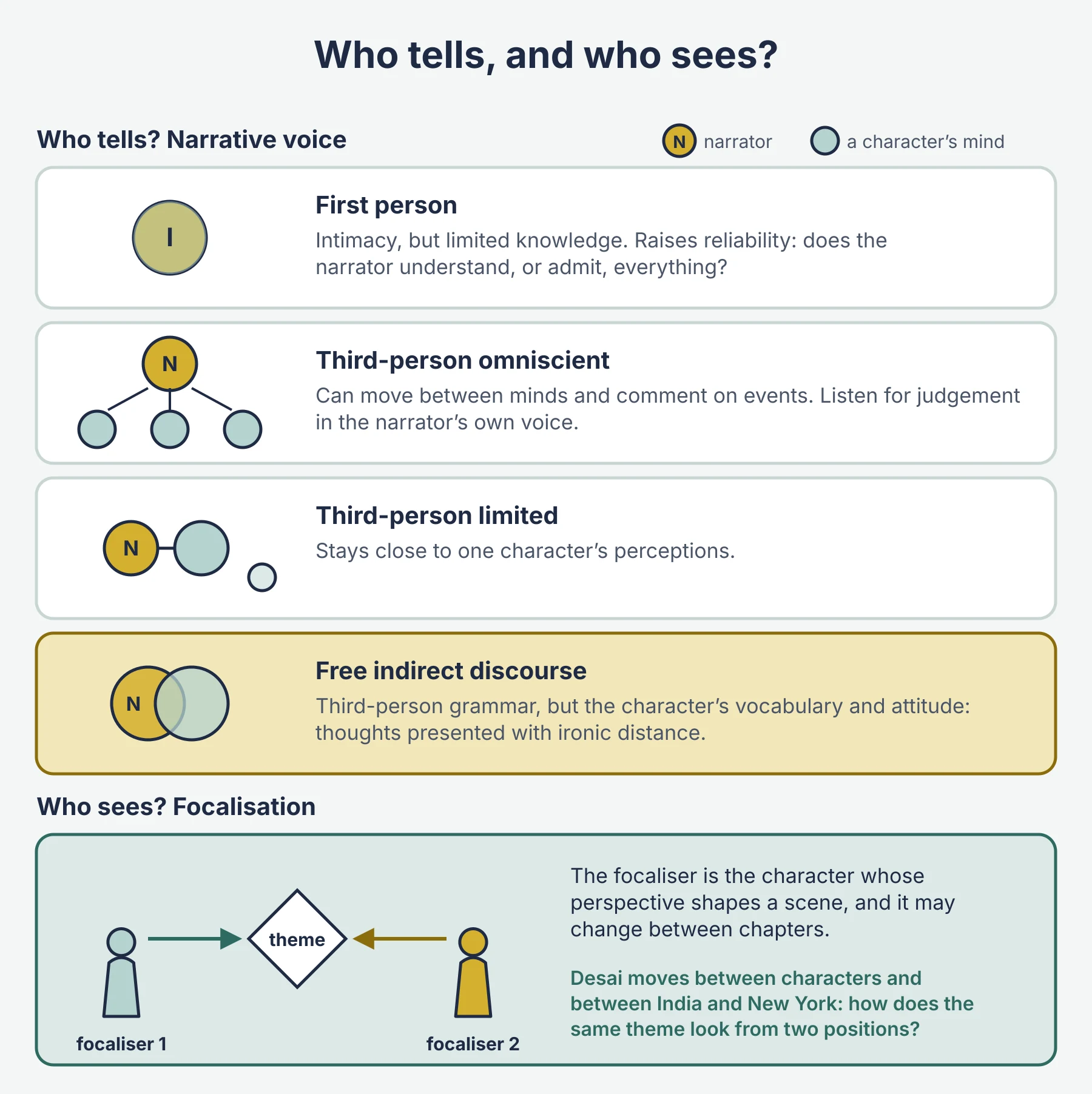
Who tells? Narrative voice
- First-person narration gives intimacy but limits knowledge, and raises the question of reliability: does the narrator understand, or admit, everything?
- Third-person omniscient narration can move between minds and comment on events; listen for judgement in the narrator’s own voice.
- Third-person limited narration stays close to one character’s perceptions.
- Free indirect discourse blends narrator and character: the grammar is third person, but the vocabulary and attitude are the character’s. It lets a writer present a character’s thoughts while keeping ironic distance.
Who sees? Focalisation
The focaliser is the character whose perspective shapes a scene, which may change between chapters. Novels that shift focalisation (such as Desai’s, which moves between characters and between India and New York) invite comparison: how does the same theme look from two positions?
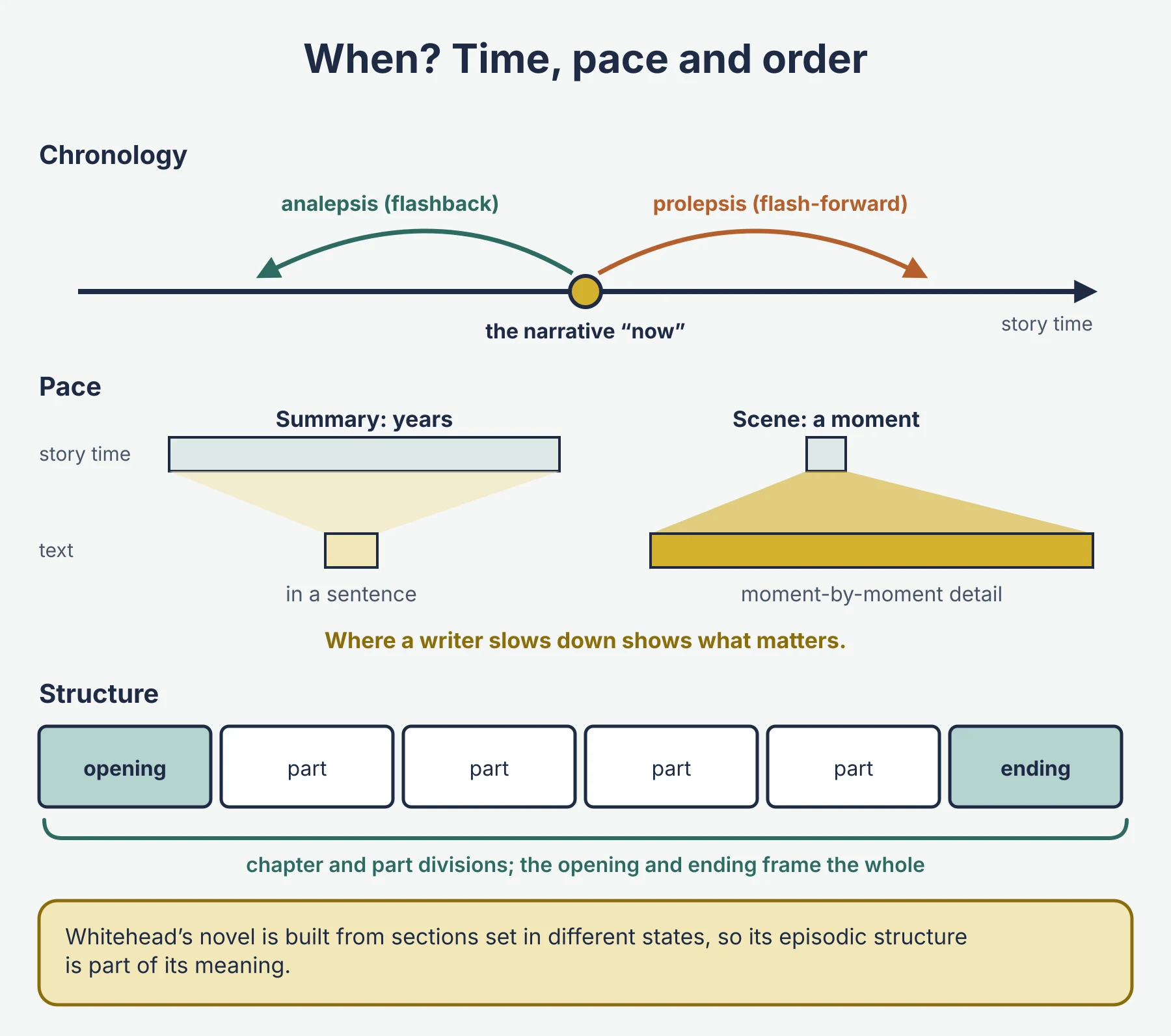
When? Time and order
- Chronology: is the story told in order, or with flashback (analepsis) and flash-forward (prolepsis)?
- Pace: summary covers years in a sentence; scene slows to moment-by-moment detail. Where a writer slows down shows what matters.
- Structure: chapter divisions, parts, and how the opening and ending frame the whole. Whitehead’s novel, for instance, is built from sections set in different states, so episodic structure is part of its meaning.
Other tools
- Dialogue: what characters say, how it is reported, and what the narrator adds around it.
- Setting and symbol: places and objects that gather meaning through repetition.
- Tone and irony: the gap between what is described and how it is described. Waugh’s satire often works through a flat, unemotional narrative voice reporting events that should shock.
Short stories need a slightly different approach
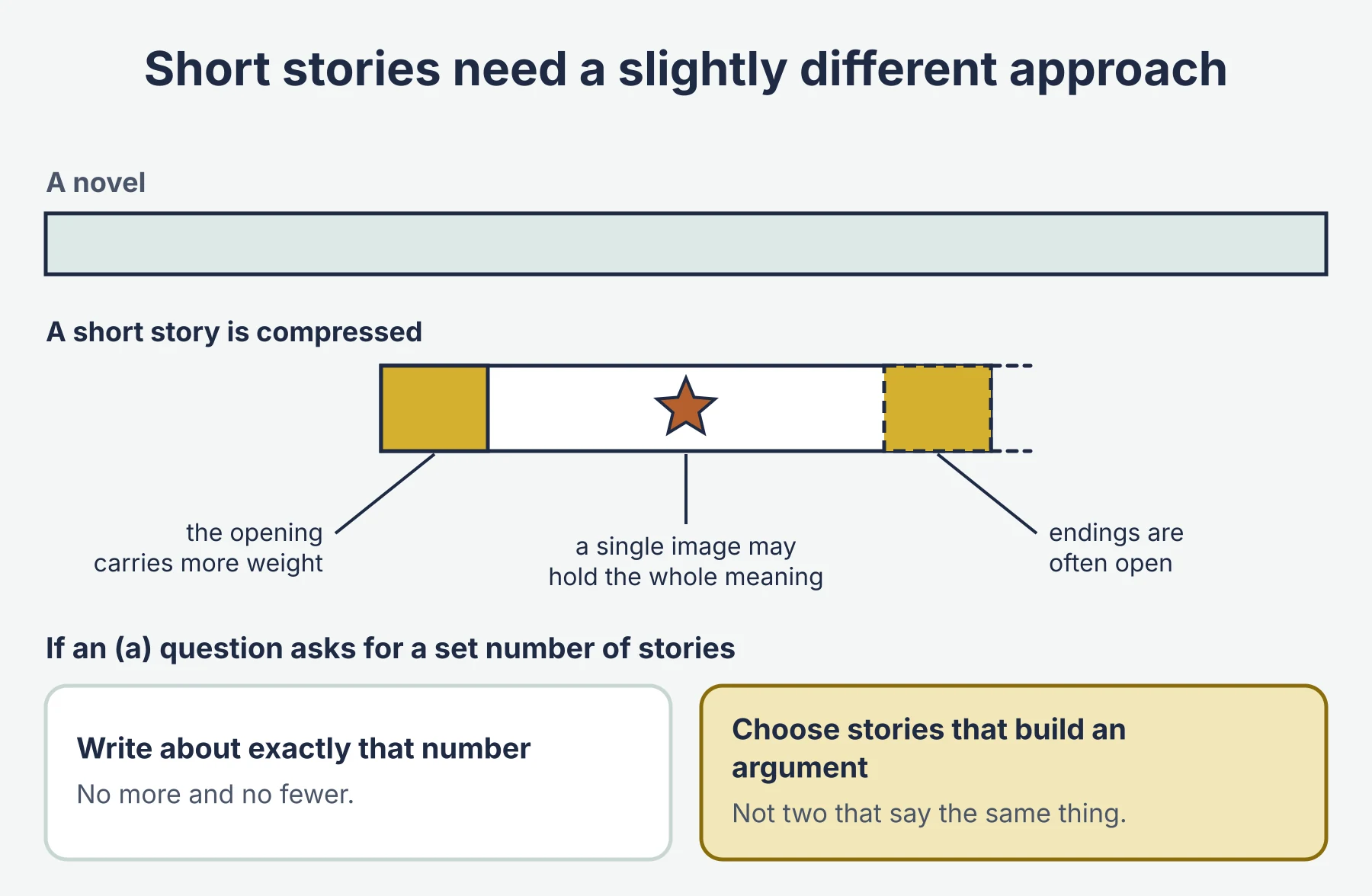
If you study the Stories of Ourselves selection, remember that a short story is compressed. Openings and endings carry more weight; a single image may hold the whole meaning; and endings are often open. If an (a) question asks you to write about a set number of stories, write about exactly that number, and choose stories that let you build an argument rather than two that say the same thing.
Writing the (b) passage answer
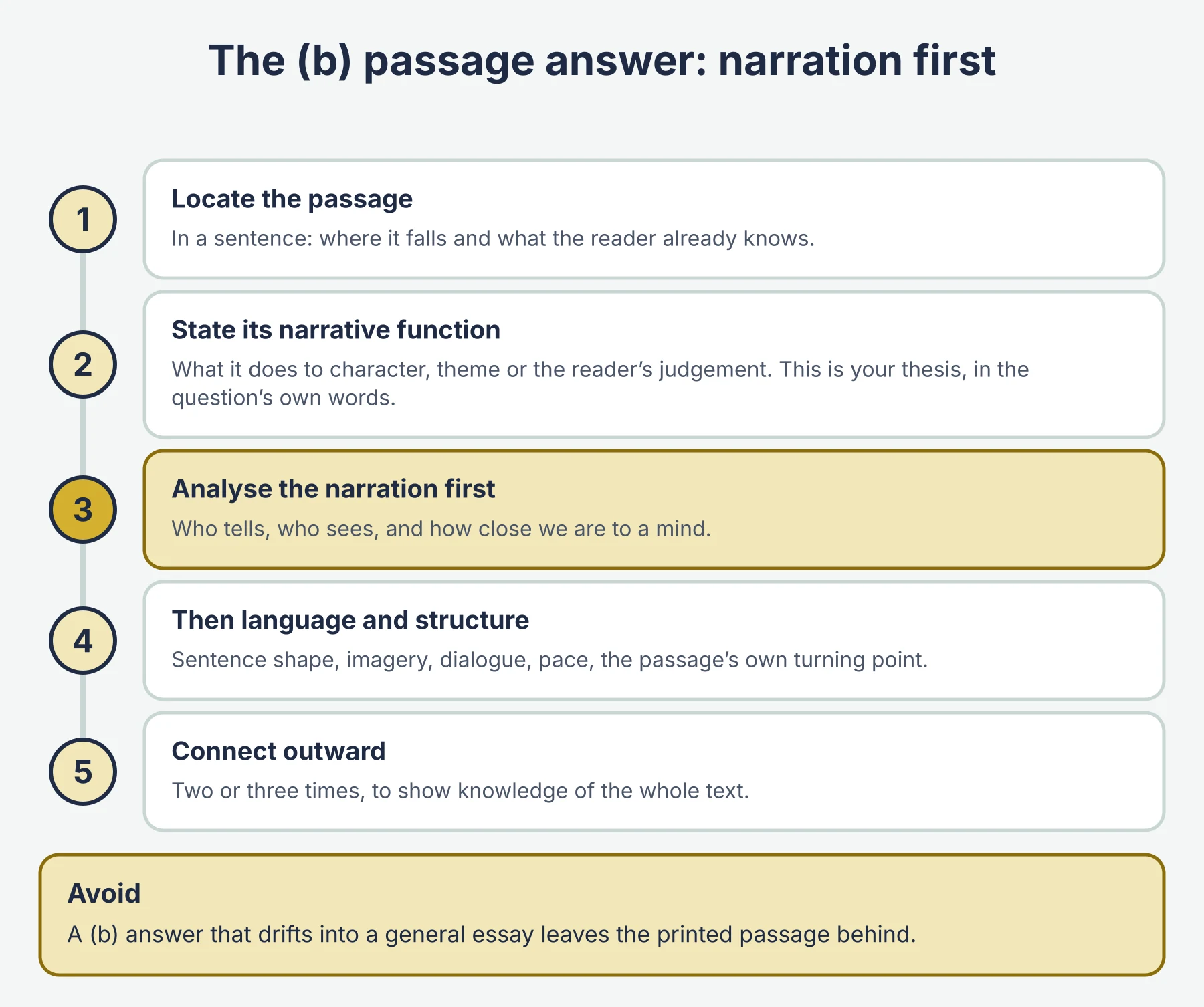
- Locate the passage in a sentence: where it falls and what the reader already knows.
- State its narrative function: what the passage does to character, theme or the reader’s judgement. That is your thesis, and it should use the question’s own words.
- Analyse the narration first: who tells, who sees, and how close we are to a mind.
- Then language and structure: sentence shape, imagery, dialogue, pace, the passage’s own turning point.
- Connect outward two or three times to show knowledge of the whole text.
Annotated model paragraph
The passage below is original, written for this guide.
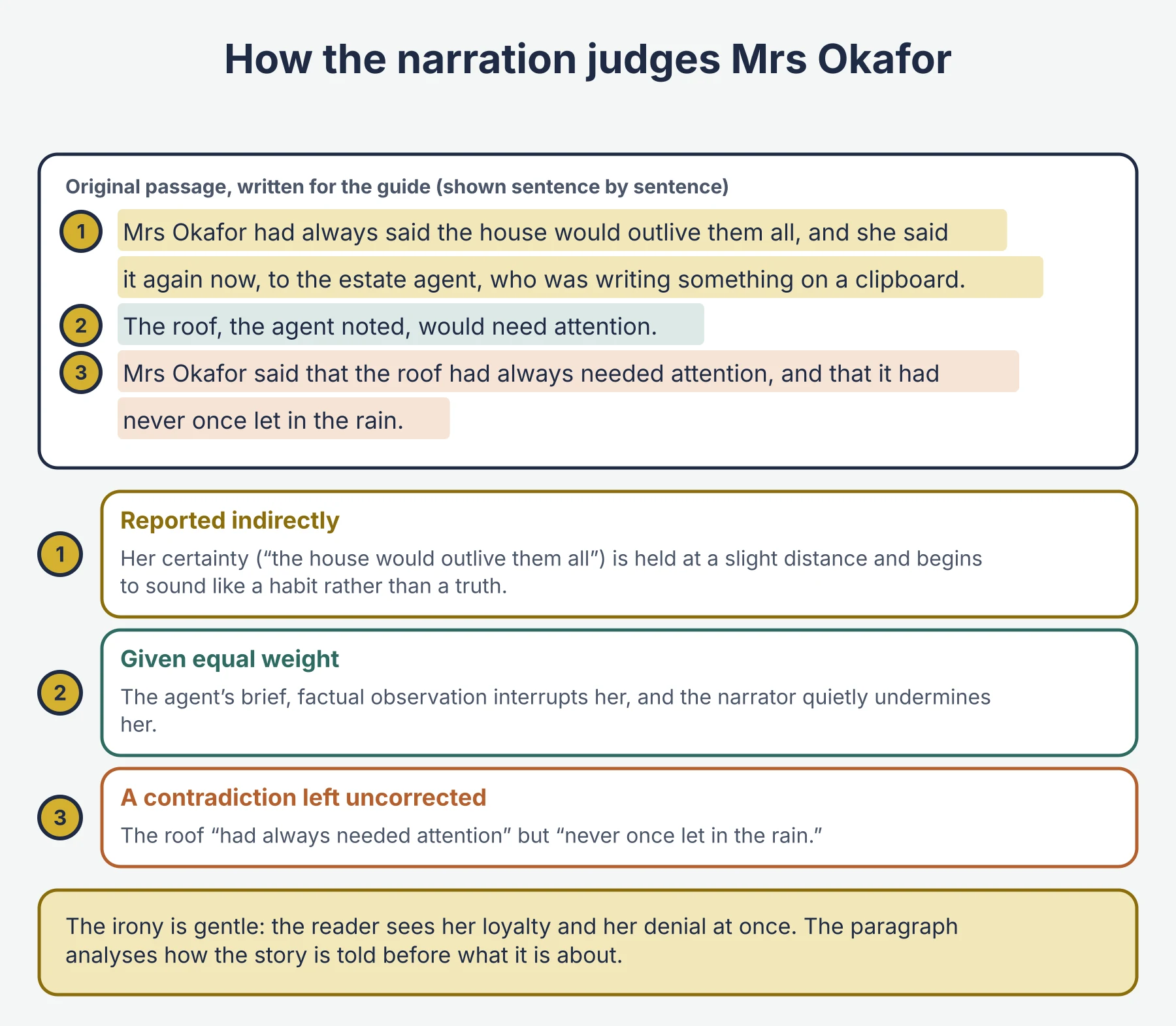
Mrs Okafor had always said the house would outlive them all, and she said it again now, to the estate agent, who was writing something on a clipboard. The roof, the agent noted, would need attention. Mrs Okafor said that the roof had always needed attention, and that it had never once let in the rain.
A strong paragraph might read:
The narrative voice reports Mrs Okafor’s speech indirectly, so her certainty (“the house would outlive them all”) is held at a slight distance and begins to sound like a habit rather than a truth. The agent’s brief, factual observation interrupts her, and the narrator gives it equal weight, quietly undermining her. Her reply defends the house with a contradiction that the narrator does not correct: a roof that “had always needed attention” but “never once let in the rain.” The irony is gentle; the reader sees her loyalty and her denial at once.
The paragraph analyses how the story is told before what it is about, which is what lifts prose answers.
Writing the (a) essay
An (a) question may focus on a character, relationship, theme or narrative method across the text.
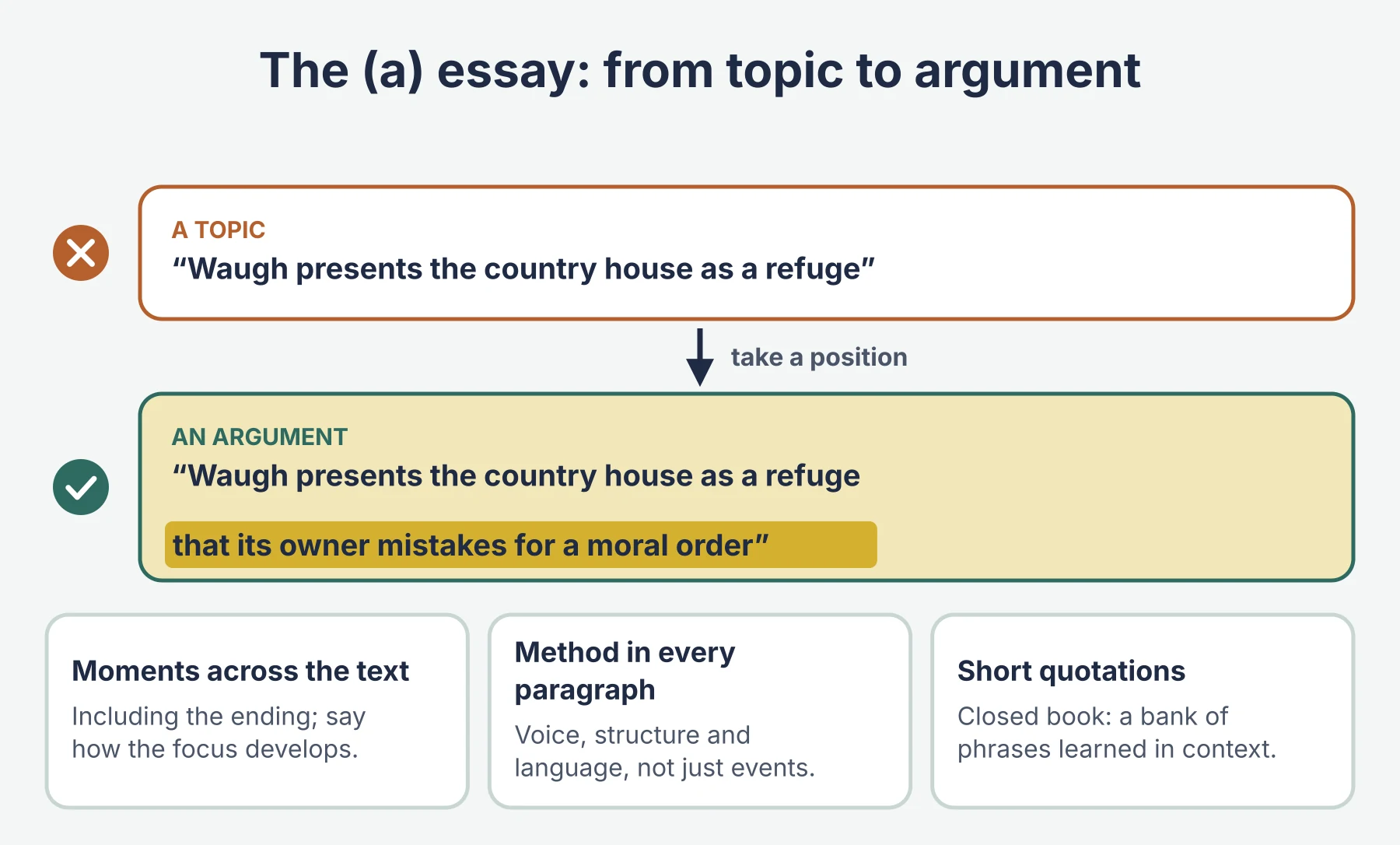
- Write a thesis that takes a position. “Waugh presents the country house as a refuge” is a topic; “Waugh presents the country house as a refuge that its owner mistakes for a moral order” is an argument.
- Select moments from across the text, including the ending, and say how the focus develops.
- Keep narrative method in every paragraph: voice, structure, and language, not just events.
- Use short, precise quotations or close references. Closed book means you need a bank of phrases learned in context, not long passages.
Context in prose answers
AO1 credits “an appreciation of relevant contexts”. For prose, context works when it explains a choice: why a narrator stays detached, why a novel is structured around migration or a journey, why a setting carries social meaning. Keep it brief and tie it to the text.
Command words
Section A questions use command words such as discuss, analyse and comment, and phrases such as “In what ways…?” and “How far, and in what ways…?”. “How far” needs a reasoned judgement; “In what ways” needs a range of methods, so include narration and structure, not just character.
Common mistakes
- Treating characters as real people and ignoring the narrator who presents them.
- Retelling the plot in an (a) answer instead of selecting and arguing.
- Missing irony: taking a narrator’s statement at face value when the voice is distancing it.
- Ignoring structure: never mentioning order, pace, chapter or part divisions, or the ending.
- A (b) answer that drifts into a general essay and leaves the printed passage behind.
Practise and revise this section
- Paper 2 Section A Prose revision notes — narrative terms, traps and a self-test.
- Paper 2 Section A Prose practice questions — original passages with mark-scheme style answers.
- Paper 2 Section B Unseen study guide — the other half of the paper.
Written against the Cambridge International AS & A Level Literature in English 9695 syllabus for 2024, 2025 and 2026.
Related resources
-
Practice questions
Cambridge A Level Literature in English (9695): Paper 2 Section A – Prose – Practice Questions
Original practice for Cambridge 9695 Paper 2 Section A Prose: narrative voice, time and structure, and structured work on new passages, with full answers.
English Literature · Cambridge · AS Level
Try questions -
Revision notes
Cambridge A Level Literature in English (9695): Paper 2 Section A – Prose – Revision Notes
Quick-recall notes for Cambridge 9695 Paper 2 Section A Prose: narrative voice and structure terms, answer shapes, exam traps and a 12-question self-test.
English Literature · Cambridge · AS Level
Revise topic -
Study guides
Cambridge A Level Literature in English (9695): Paper 2 Section B – Unseen
A timed method for Cambridge 9695 Paper 2 Section B Unseen: choosing the passage, reading prose, poetry or drama cold, and planning a critical essay.
English Literature · Cambridge · AS Level
Read guide
Get free revision emails (optional)
Occasional emails with practice questions, worked explanations and links to free resources for the qualification and subjects you choose. No spam, and you can unsubscribe from any email. The free tools on this site never need an email.