
Revision Notes
Cambridge A Level Literature in English (9695): Paper 2 Section A – Prose – Revision Notes
Quick-recall notes for Cambridge 9695 Paper 2 Section A Prose: narrative voice and structure terms, answer shapes, exam traps and a 12-question self-test.
- Subject
- English Literature
- Level
- AS LEVEL
- Topic
- Paper 2 – Prose and Unseen
- Author
- Marlbridge Academic Team
- Updated
- Reviewed by
- Ammar Bilal (what this means)
Aligned to Cambridge A Level English Literature (9695), 2024-2026. Official specification .
Syllabus page (what it covers and how it is assessed): Cambridge A Level English Literature.
Syllabus points this page covers
9695 (AS Level)
- 2.1 Section A: Prose
Found an error? Report a correction.
Need help with this topic? Request a free trial class for A Level English Literature (9695).
Condensed notes for the set-text half of Paper 2. For the full method and an annotated model paragraph, use the Paper 2 Section A Prose study guide.
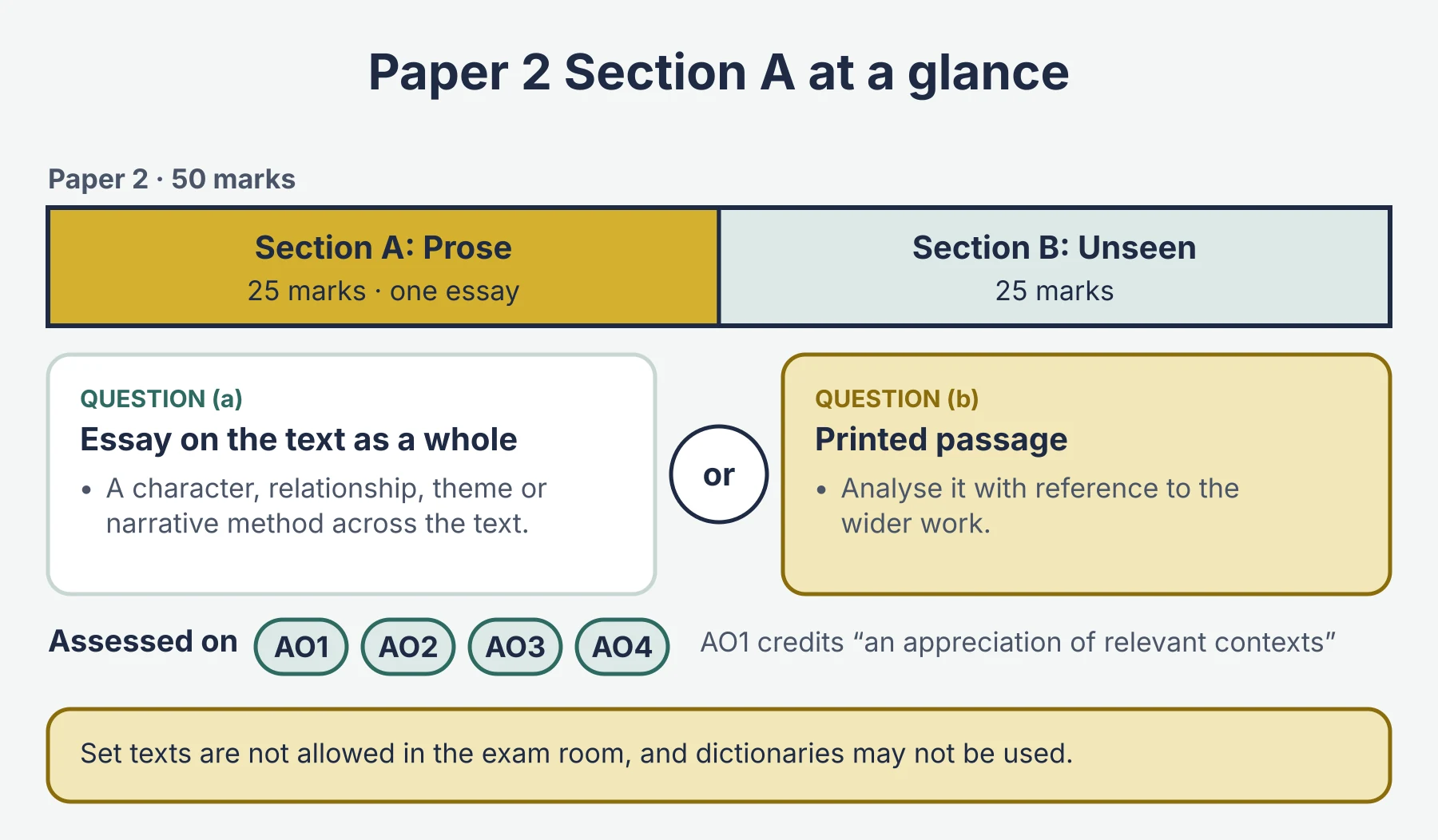
Section A in five lines
- One essay on one prose set text (a novel or the short-story selection), worth 25 marks.
- (a): essay on the whole text. (b): essay on a printed passage, related to the whole text.
- Assessed on AO1 to AO4, each 25% of the paper.
- Closed book; no dictionaries.
- Shares the two hours with Section B Unseen, so plan for roughly an hour.
The three prose questions
Ask these of every passage and every essay focus:
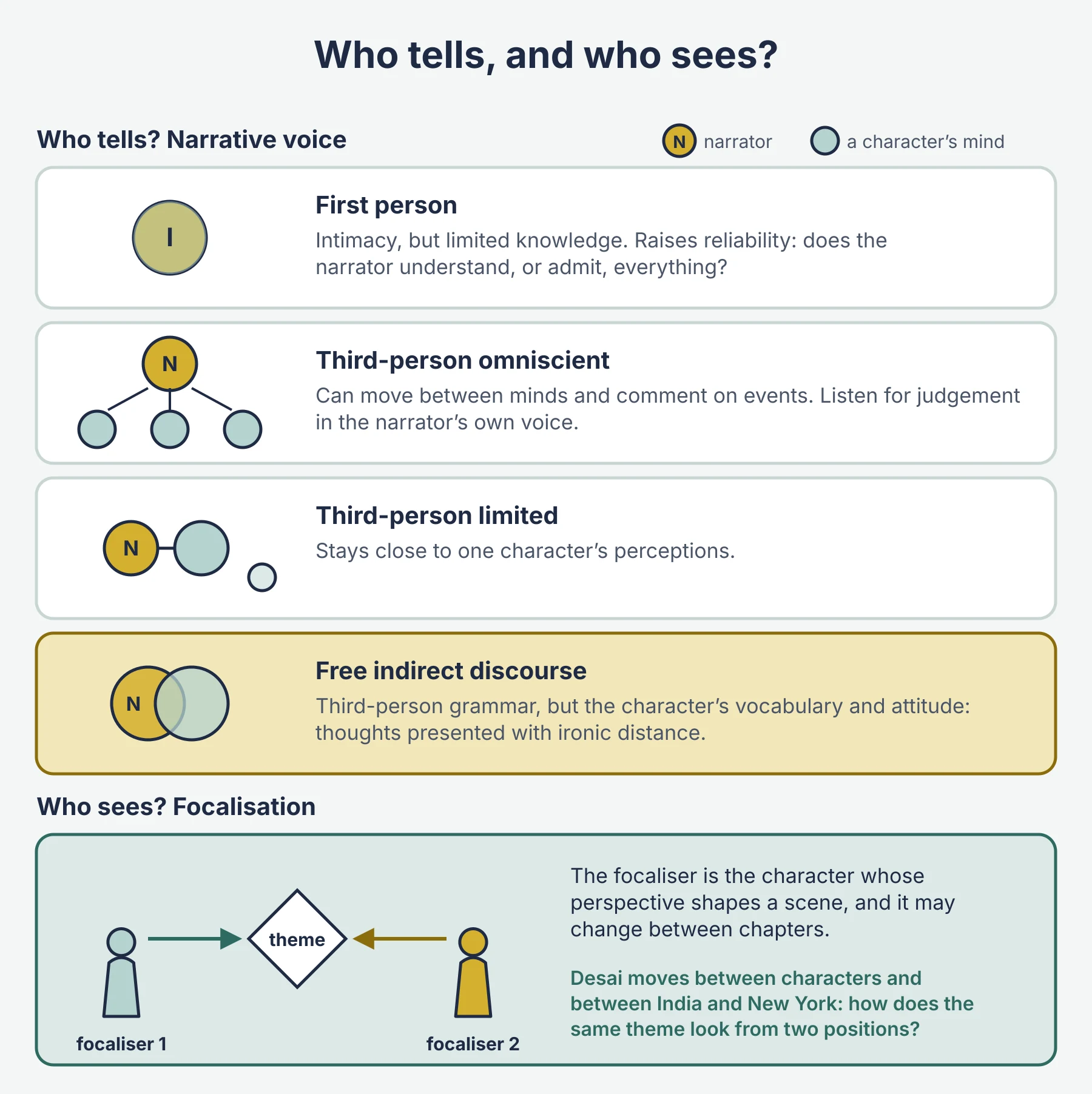
- Who tells? Narrative voice and its reliability.
- Who sees? Focalisation: whose perceptions shape the scene.
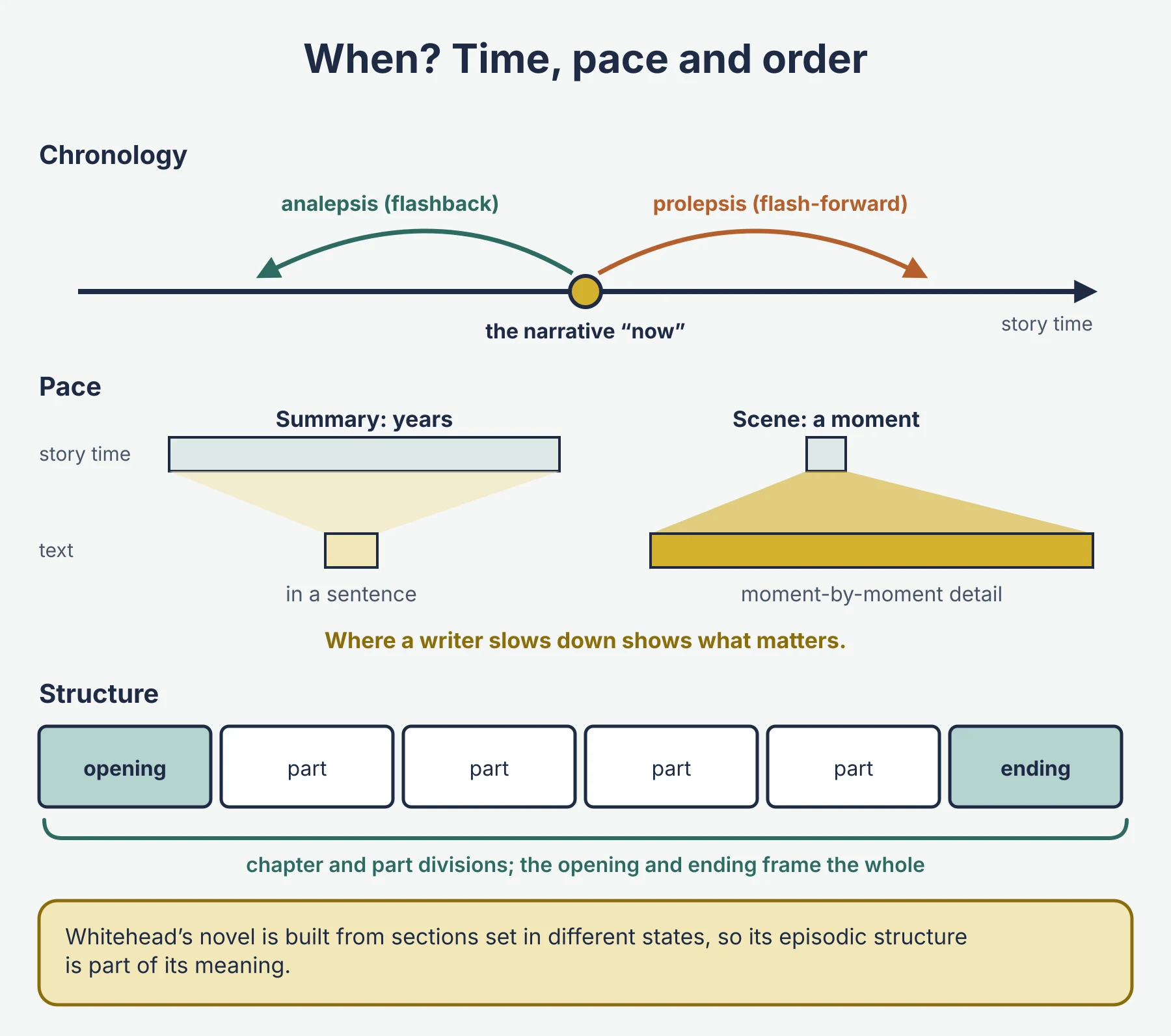
- When? Order, pace and structure.
Key terms
| Term | Definition | What to say about it |
|---|---|---|
| First-person narrator | A character tells the story as “I” | Intimacy; limited or biased knowledge |
| Unreliable narrator | A narrator whose account the reader cannot fully trust | Gap between what is told and what is shown |
| Omniscient narrator | Third-person voice with access to many minds | Judgement, overview, ironic commentary |
| Limited third person | Third person tied to one character’s perspective | Sympathy; restricted knowledge |
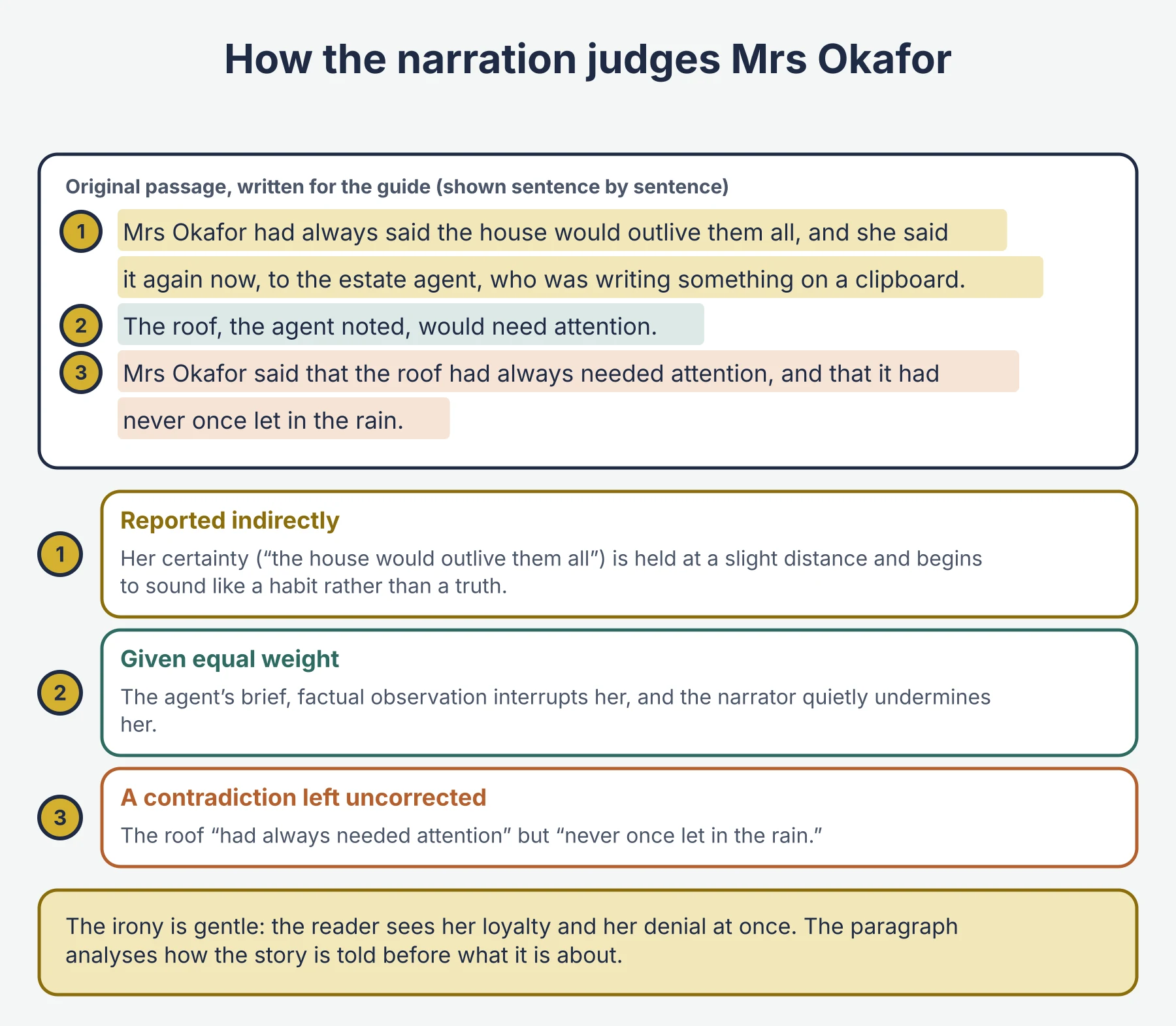
| Free indirect discourse | Third-person grammar with a character’s own words and attitudes | Inner thought with ironic distance |
| Focalisation | The perspective through which events are perceived | Shifts invite comparison |
| Analepsis | Flashback | Explains the present; delays revelation |
| Prolepsis | Flash-forward | Creates foreboding or dramatic irony |
| Summary and scene | Fast narration versus moment-by-moment narration | Slowing down signals importance |
| Frame narrative | A story set inside another story | Raises questions of who is telling and why |
| Motif | A recurring image, object or idea | Links passage to whole text |
| Epiphany | A sudden moment of insight | Common turning point in short stories |
| Satire | Exposing folly or vice through irony or ridicule | Tone often detached; target is social |
Answer shapes
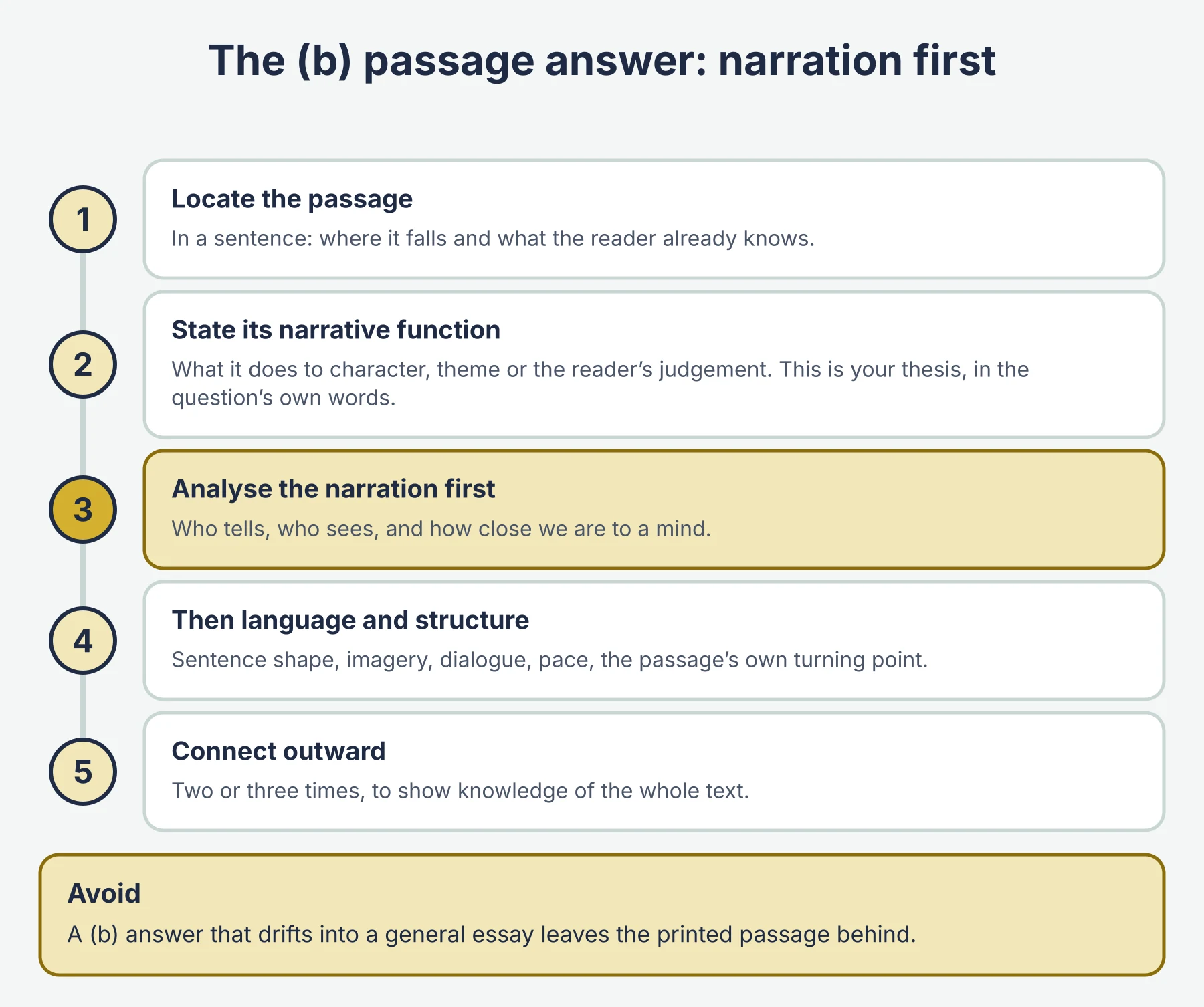
(b) passage
- Locate the passage in the text (one sentence).
- State its narrative function as your thesis.
- Analyse narration first, then language and structure.
- Follow the passage’s own turning point.
- Link outward two or three times.
(a) whole text
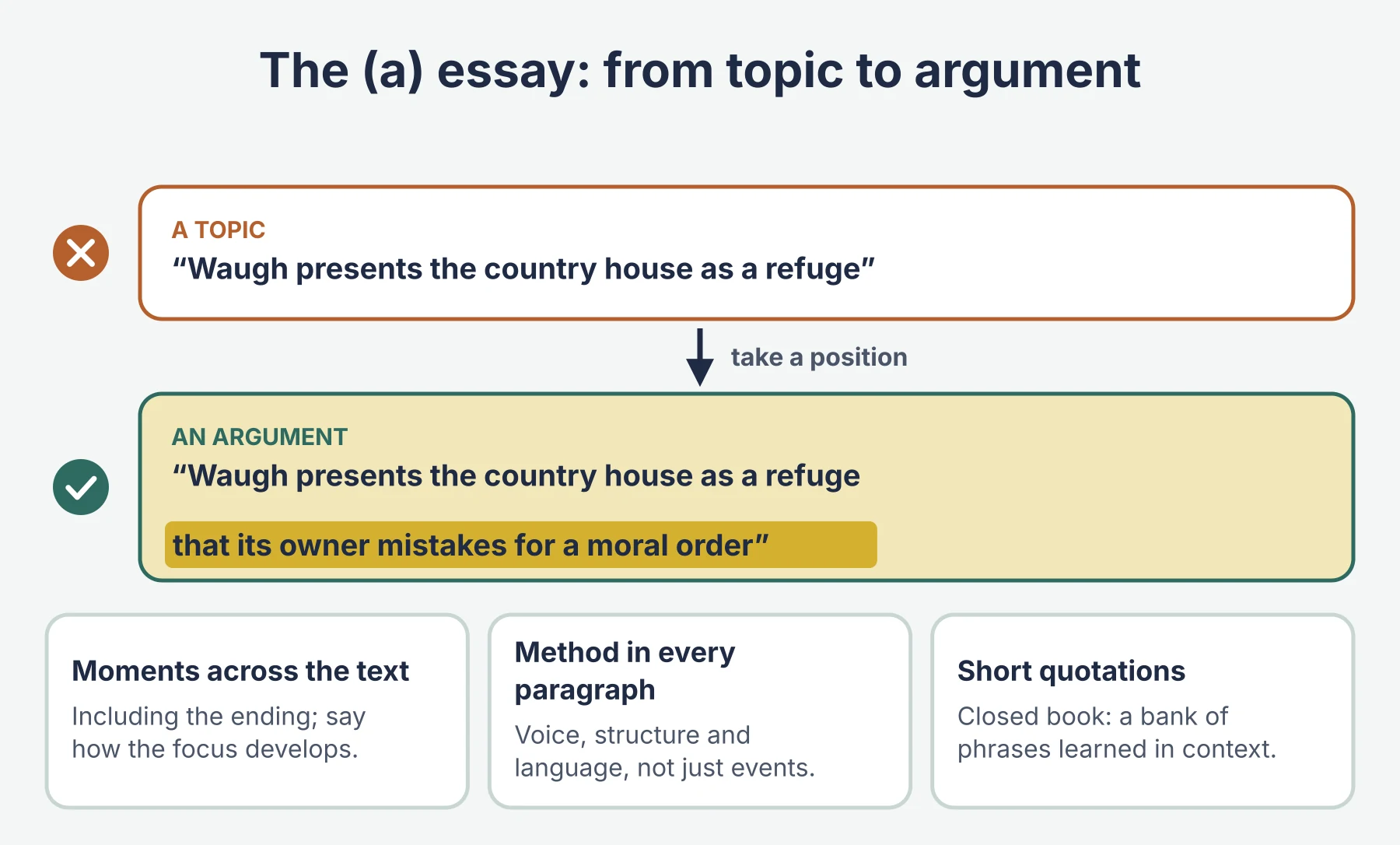
- An arguable thesis, not a topic label.
- Moments selected from across the text, including the ending.
- Narrative method in every paragraph.
- Show development, not a list.
Thesis: topic label versus argument
| Weak (topic label) | Strong (argument) |
|---|---|
| “The novel presents isolation.” | “The novel presents isolation as something characters choose to protect themselves, which the narrator treats with sympathy and irony at once.” |
| “The ending is sad.” | “The ending denies the reader the resolution the opening promised, so the novel’s hope is shown to be misplaced.” |
A strong thesis takes a position, names a method or effect, and could be disputed.
Five-minute plan
- Underline the question’s key terms.
- Write the thesis in one sentence.
- Pick three or four moments (for (b): the passage’s opening, turn and ending).
- Note one narrative method for each.
- Note one outward link per paragraph.
Short-story selection: extra points
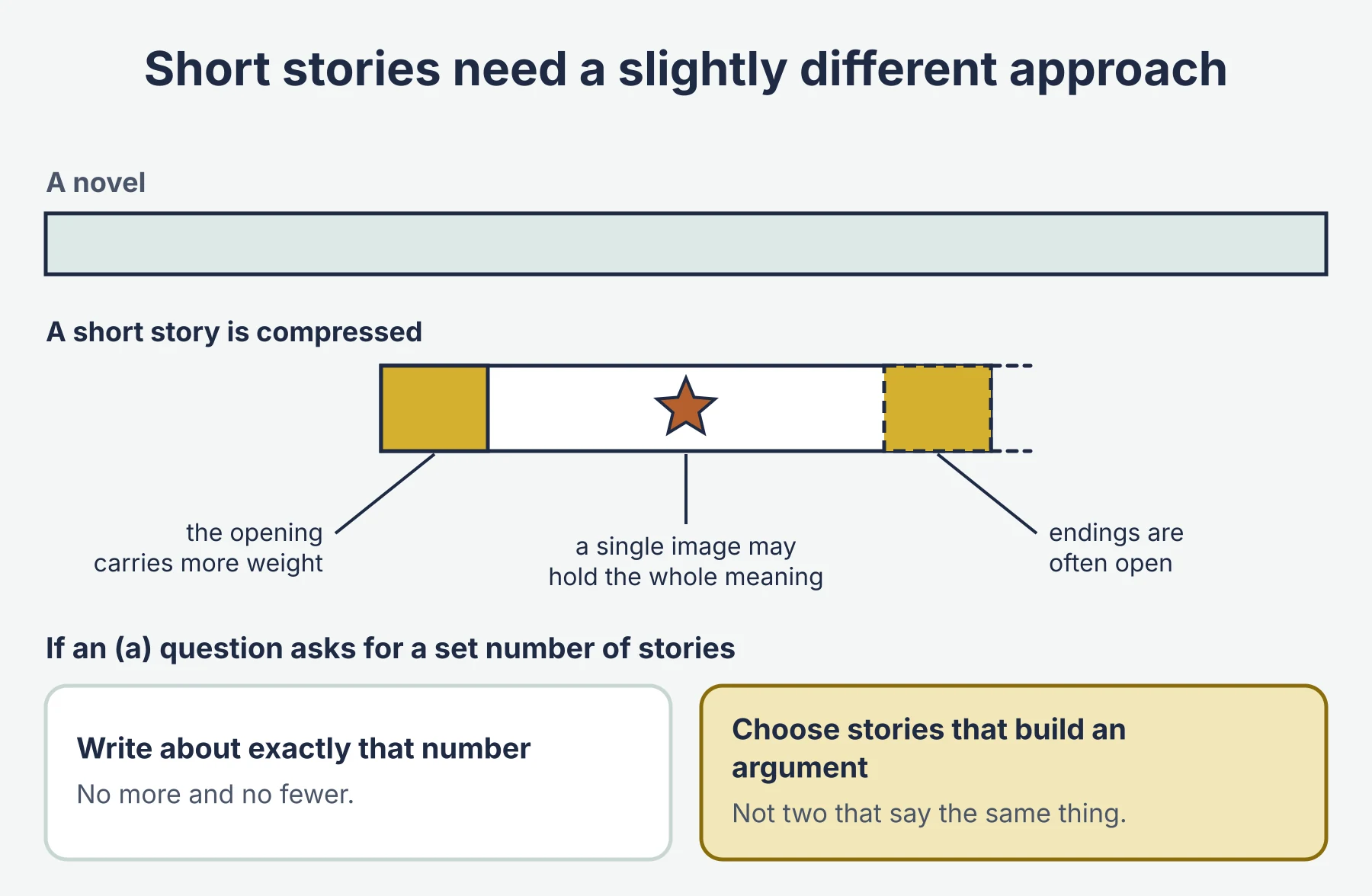
- Openings and endings carry more weight than in a novel.
- A single image or object may hold the story’s meaning.
- If a question names a number of stories, write on exactly that number.
- Choose stories that contrast, so the essay has an argument.
Building a closed-book quotation bank
- Learn short phrases (three to eight words), each linked to a character, theme and method.
- Group them by part or chapter, so you can show development across the text.
- Include the opening and ending, which are useful for almost any question.
- Learn key narrative facts: who narrates which section, where time jumps occur.
Exam traps
- Characters as people: discussing them without the narrator who presents them.
- Plot retelling: in (a), narrating events in order rather than arguing.
- Missed irony: taking a detached narrator’s statement at face value.
- Structure ignored: no reference to order, pace, parts or the ending.
- Drifting (b): leaving the printed passage for a general essay.
- Context dump: history or biography that never explains a narrative choice.
- Wrong number of stories in a short-story (a) question.
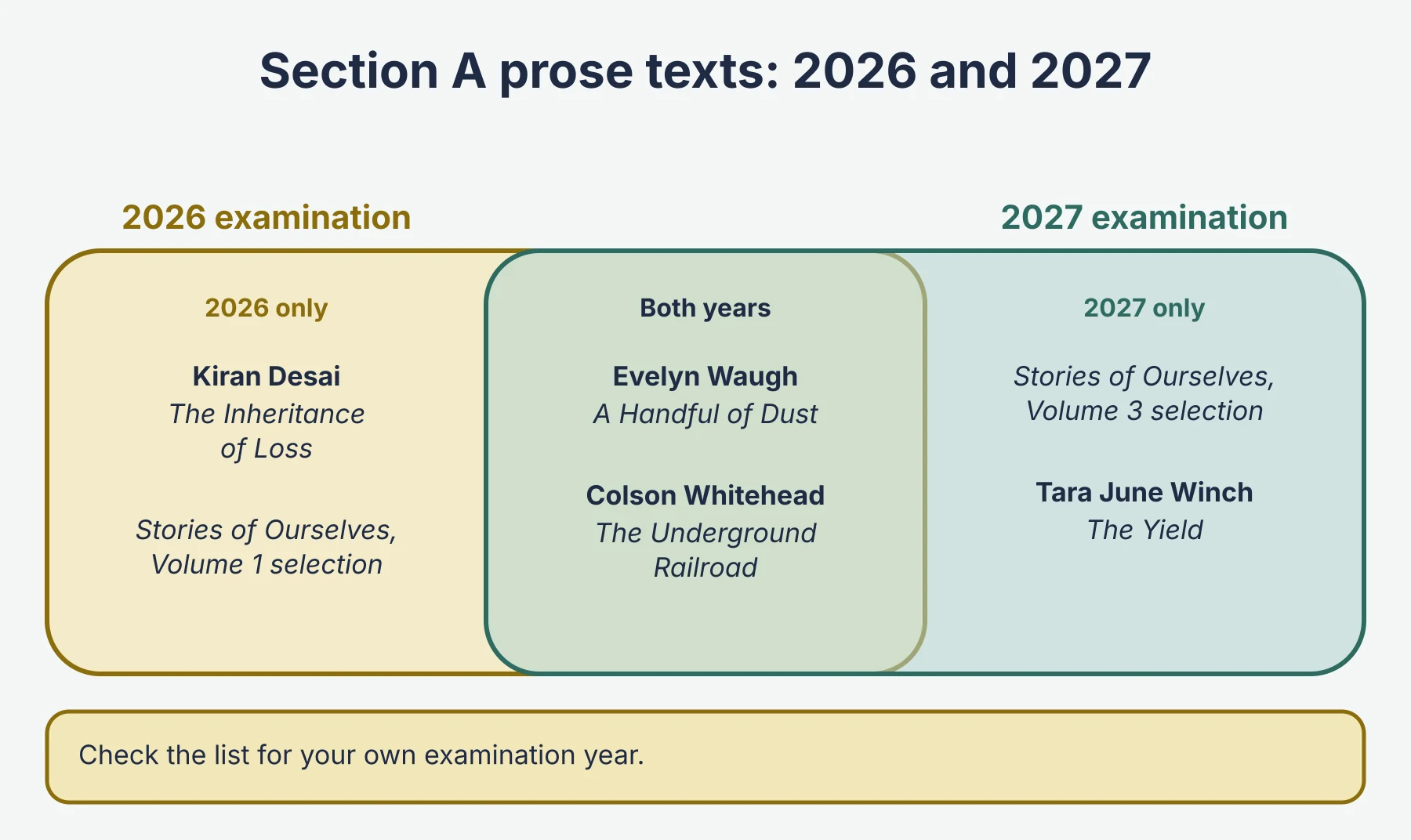
Set prose texts
For 2026: The Inheritance of Loss; Stories of Ourselves, Volume 1 selection; A Handful of Dust; The Underground Railroad. For 2027: Stories of Ourselves, Volume 3 selection; A Handful of Dust; The Underground Railroad; The Yield. Check the syllabus for your examination year and for the named stories in any selection.
Self-test
- What is printed for a Section A (b) question?
- Which assessment objectives does Section A test?
- What are the three questions to ask of any prose passage?
- Define free indirect discourse.
- Why can first-person narration raise questions of reliability?
- What is focalisation?
- Give the technical terms for flashback and flash-forward.
- What does it usually suggest when a writer slows from summary into scene?
- What should the first sentence of a (b) answer do?
- What makes a thesis arguable rather than a topic label?
- Why do openings and endings matter more in short stories?
- When is context useful in a prose answer?
Answers: 1. A passage from the set text. 2. AO1, AO2, AO3 and AO4. 3. Who tells, who sees, and when (order, pace, structure). 4. Third-person narration that takes on a character’s own words and attitudes, blending narrator and character. 5. The narrator may lack knowledge, misunderstand, or hide things, so the reader may see more than they say. 6. The perspective through which events are perceived. 7. Analepsis and prolepsis. 8. That the moment matters and invites close attention. 9. Locate the passage in the text. 10. It takes a position that could be disputed and says how or why. 11. Compression means a short story’s opening and ending carry a greater share of its meaning. 12. When it explains a choice the writer has made.
Related resources
-
Study guides
Cambridge A Level Literature in English (9695): Paper 2 Section B – Unseen
A timed method for Cambridge 9695 Paper 2 Section B Unseen: choosing the passage, reading prose, poetry or drama cold, and planning a critical essay.
English Literature · Cambridge · AS Level
Read guide -
Practice questions
Cambridge A Level Literature in English (9695): Paper 2 Section B – Unseen – Practice Questions
Original unseen practice for Cambridge 9695 Paper 2 Section B: new prose, poetry and drama passages with structured questions and mark-scheme answers.
English Literature · Cambridge · AS Level
Try questions -
Revision notes
Cambridge A Level Literature in English (9695): Paper 2 Section B – Unseen – Revision Notes
Quick-recall notes for Cambridge 9695 Paper 2 Section B Unseen: the syllabus rules, a one-hour method, form checklists, key terms, traps and a self-test.
English Literature · Cambridge · AS Level
Revise topic
Get free revision emails (optional)
Occasional emails with practice questions, worked explanations and links to free resources for the qualification and subjects you choose. No spam, and you can unsubscribe from any email. The free tools on this site never need an email.