
Revision Notes
Cambridge International AS & A Level Global Perspectives & Research (9239): Research Report – The Research Log – Revision Notes
Recall notes on the 9239 research log: syllabus rules, record-plan-reflect, what to log at each stage, entry types, habits, traps and a self-test.
- Subject
- Global Perspectives
- Level
- A LEVEL
- Topic
- Component 4 – Cambridge Research Report
- Author
- Marlbridge Academic Team
- Updated
- Reviewed by
- Ammar Bilal (what this means)
Aligned to Cambridge A Level Global Perspectives (9239), 2026-2028. Official specification .
Syllabus page (what it covers and how it is assessed): Cambridge A Level Global Perspectives.
Syllabus points this page covers
9239 (A Level)
- 4.4 Research log
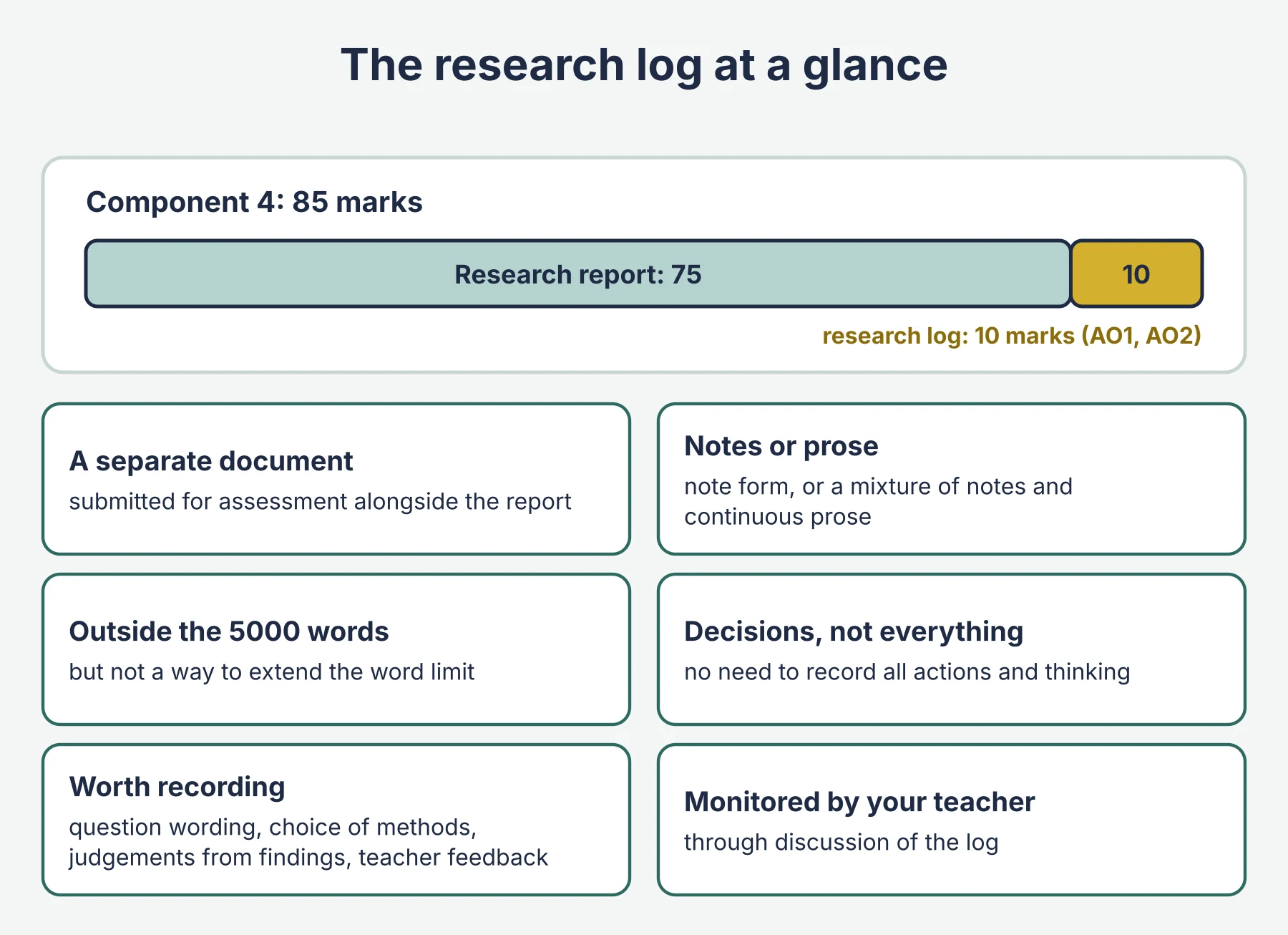
These notes cover the “Research log” section of Component 4, the Cambridge Research Report, in Cambridge International AS & A Level Global Perspectives & Research (9239), 2026-2028: “Candidates must use a research log throughout the research process to record information, plan actions and reflect on research findings and decisions.” For the component as a whole, see the Cambridge Research Report study guide; for model entries at every stage, read the research log study guide.
Syllabus rules
| Rule | Syllabus wording |
|---|---|
| Marks | Research log: 10 of the component’s 85 |
| Assessed on | “use a research log to record, plan and reflect on research (AO1, AO2)”; “reflect on research findings and decisions (AO2)” |
| Timing | Used “throughout the research process” |
| Separate | “must be a separate document to the report” |
| Format | “note form or a mixture of notes and continuous prose” |
| Word limit | “not included in the 5000 word limit … should not be seen as a way to extend that word limit” |
| Completeness | “Candidates do not need to record all their actions and thinking” |
| Decisions | “the wording of their research question, their choice of methods, and judgements made during the research based on their findings” |
| Other contents | “reminders of things to check, ongoing evaluation of the research, and reflections on how their thinking or their research question may have changed as a result of feedback from the teacher” |
| Teacher’s use | Teachers “should monitor candidates’ progress by discussion of their research log” |
Length and format guidance is in the Teacher Guide and School Support Hub; your teacher will confirm it.
Record, plan, reflect
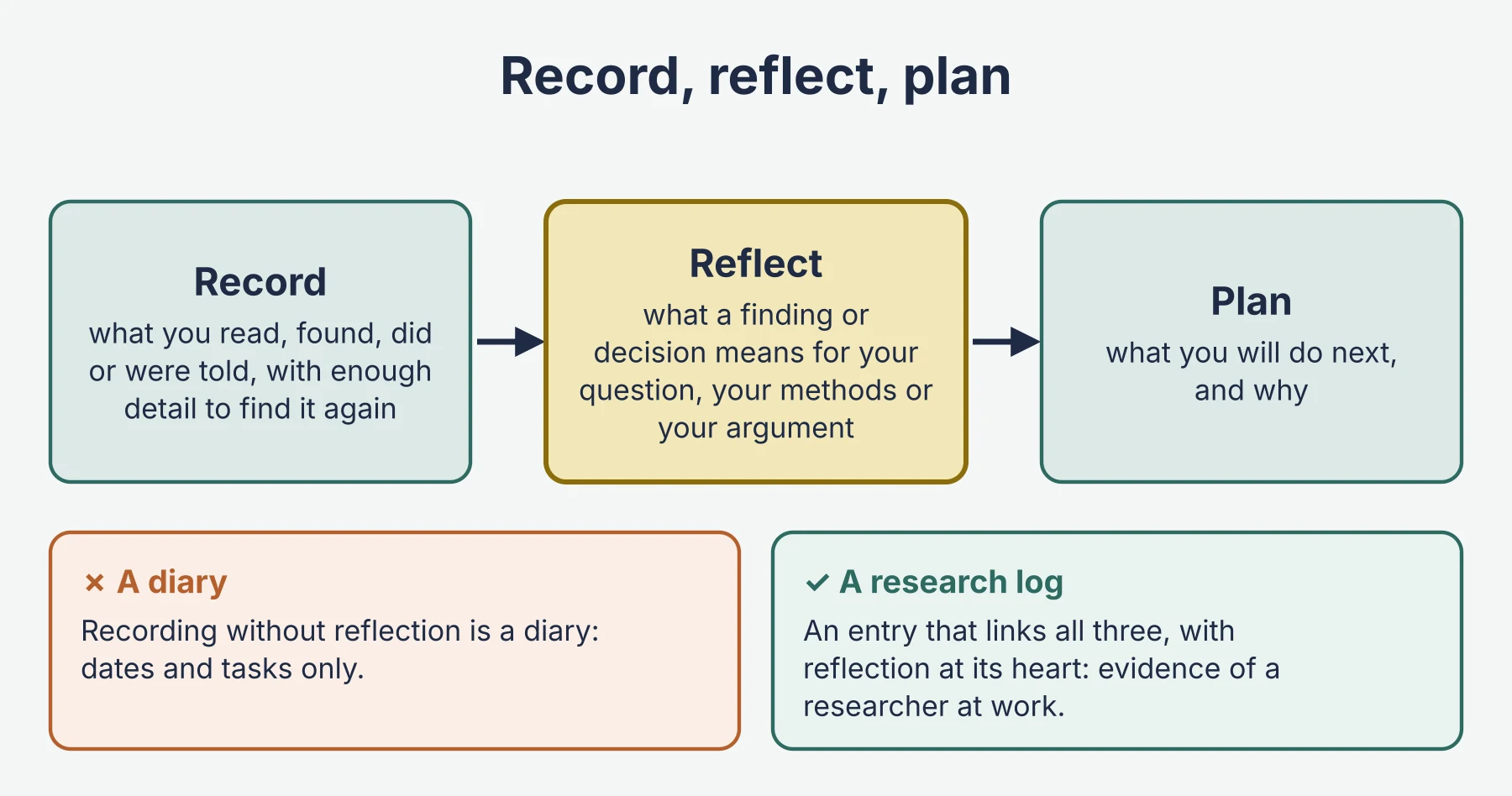
| Verb | In an entry |
|---|---|
| Record | What you read, found, did or were told, findable again |
| Plan | What you will do next, and why |
| Reflect | What it means for your question, methods or argument |
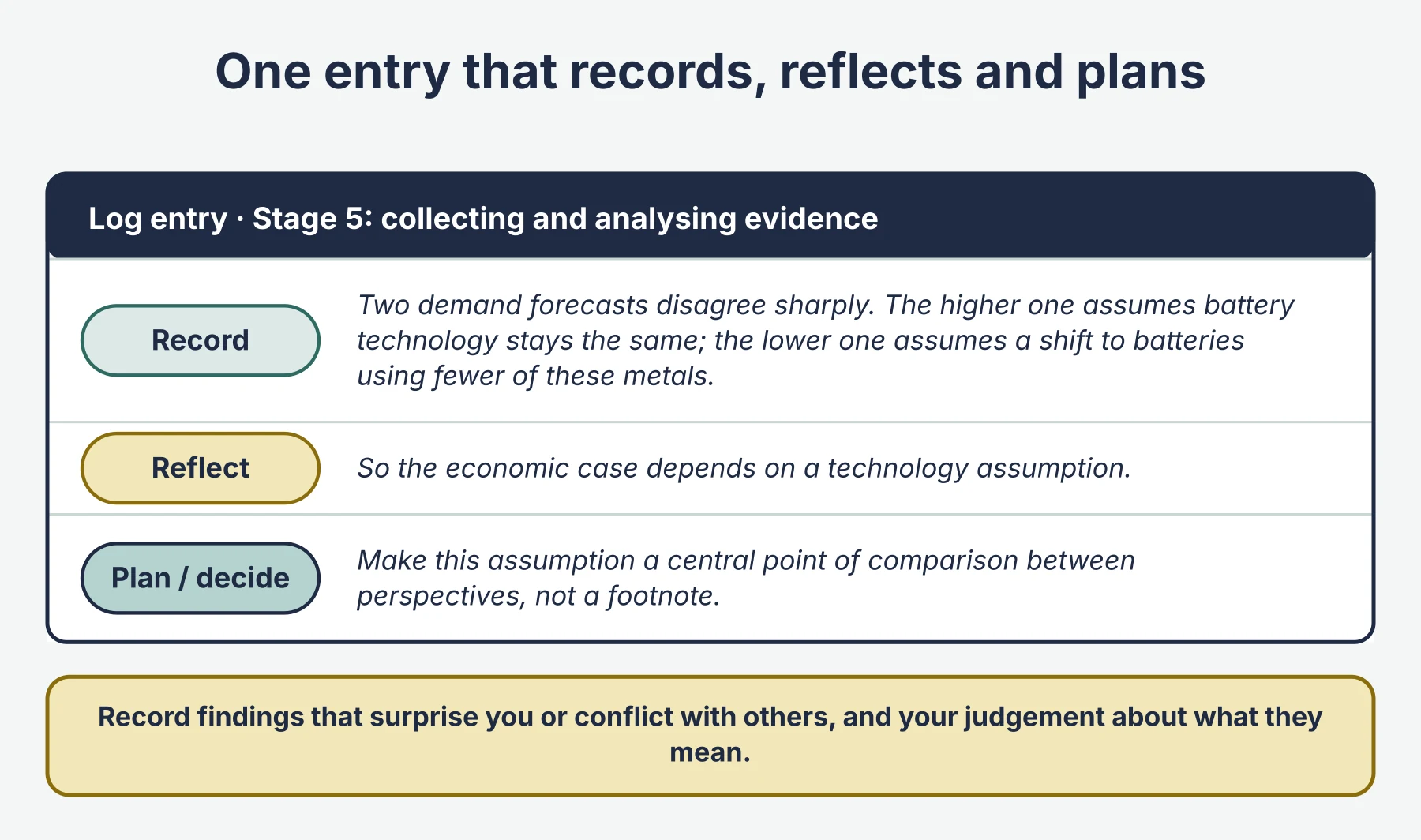
Best entries link all three: “Found … (record). This means … (reflect). Next I will … (plan).”
Key terms
| Term | Meaning |
|---|---|
| Research log | A separate, dated record of information, plans, decisions and reflection |
| Decision entry | Records a choice, the options and the reason |
| Feedback entry | Records teacher feedback in your words and what you did about it |
| Source entry | Records a source’s reference and an early evaluation |
| Finding entry | Records a result, especially a surprising or conflicting one, and its meaning |
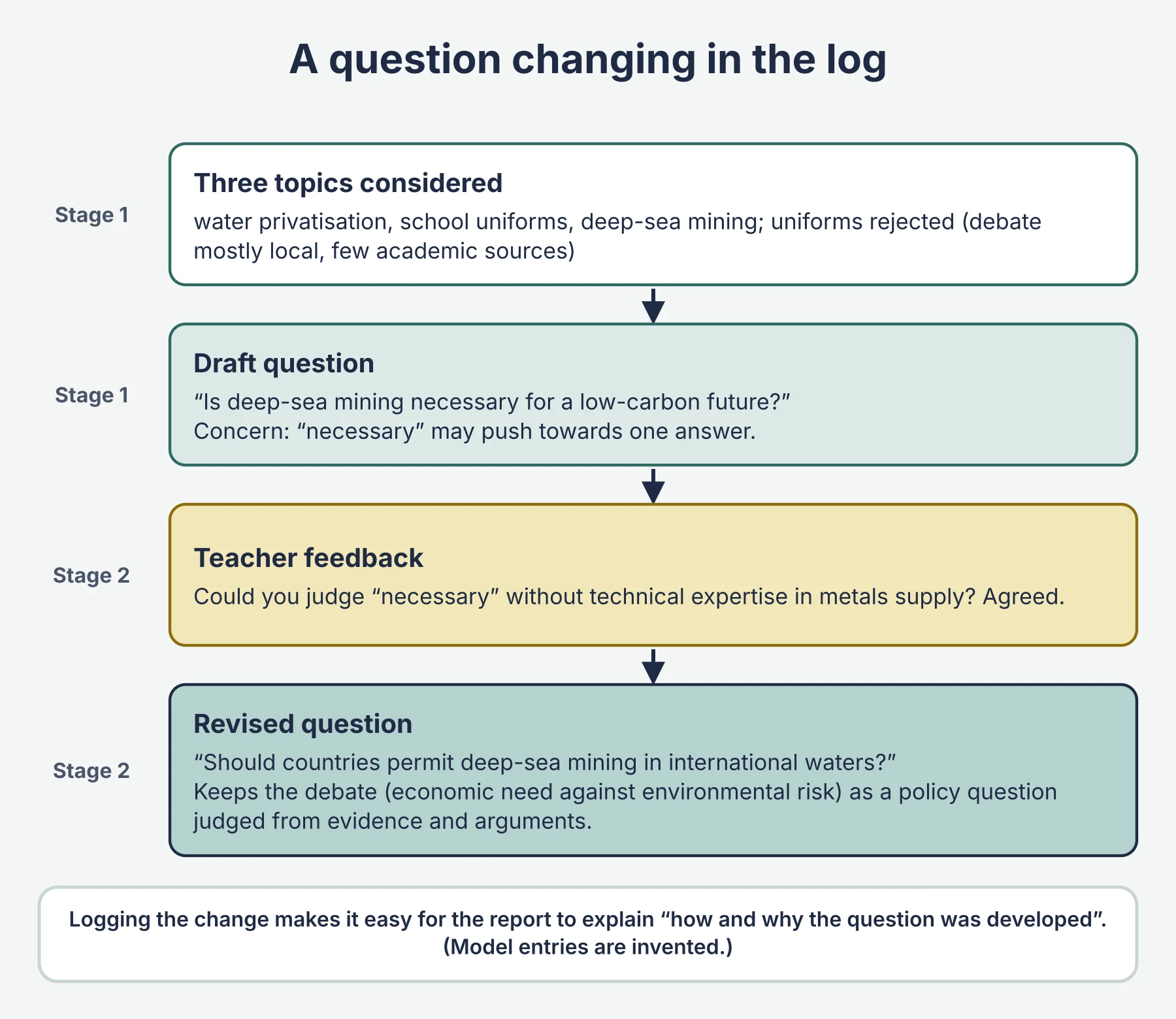
| Question development | How and why the wording of the research question changed |
| Reflection | Interpreting what a finding or decision means for the research |
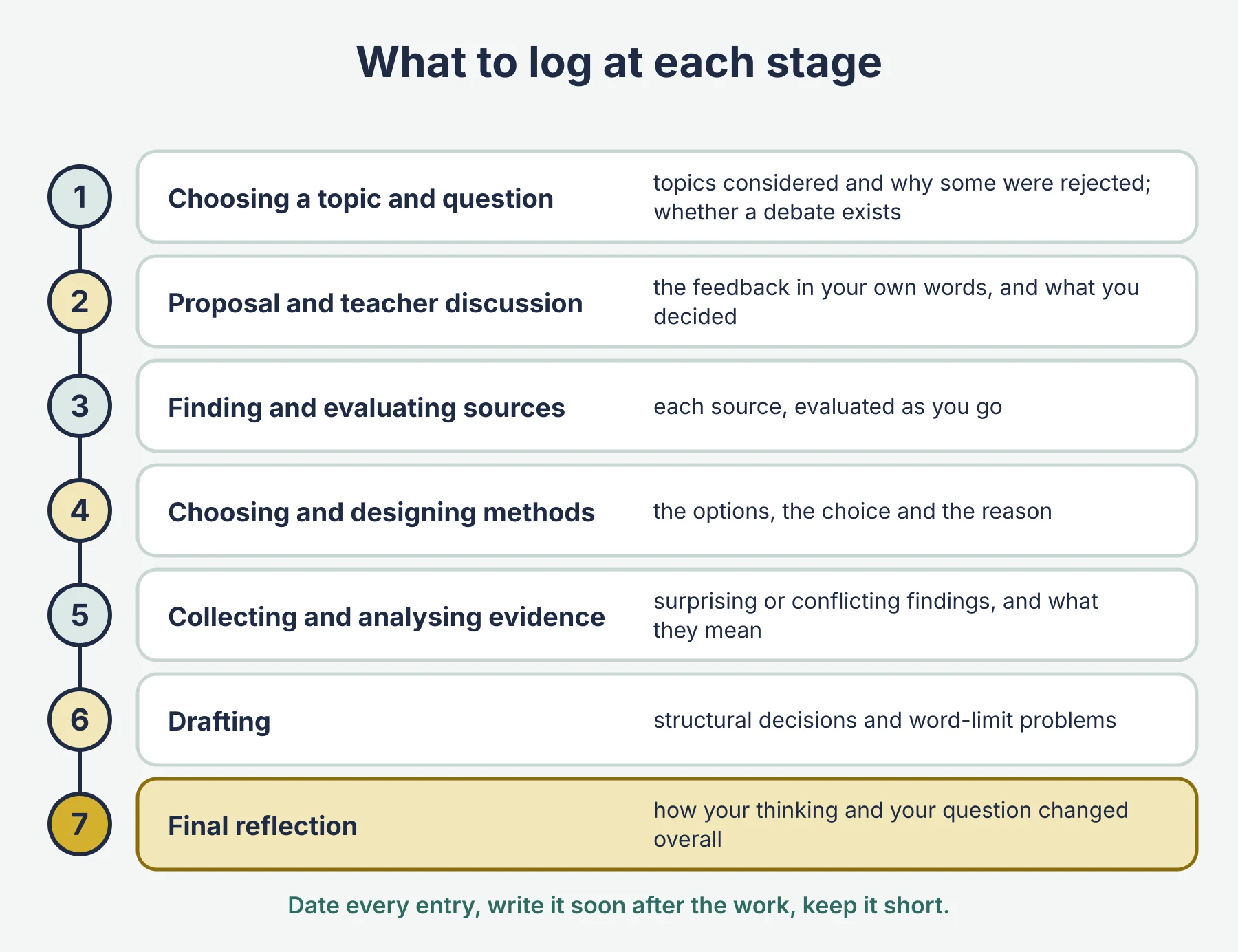
What to log at each stage
- Topic and question: options considered, reasons for rejection, whether a debate exists.
- Proposal and feedback: the teacher’s points and your response.
- Sources: references with evaluation as you read.
- Methods: options, choice, reason, methodology note.
- Evidence: surprising or conflicting findings and what they mean.
- Drafting: structural decisions, cuts, things to check.
- Final reflection: how your view and question changed; main limits.
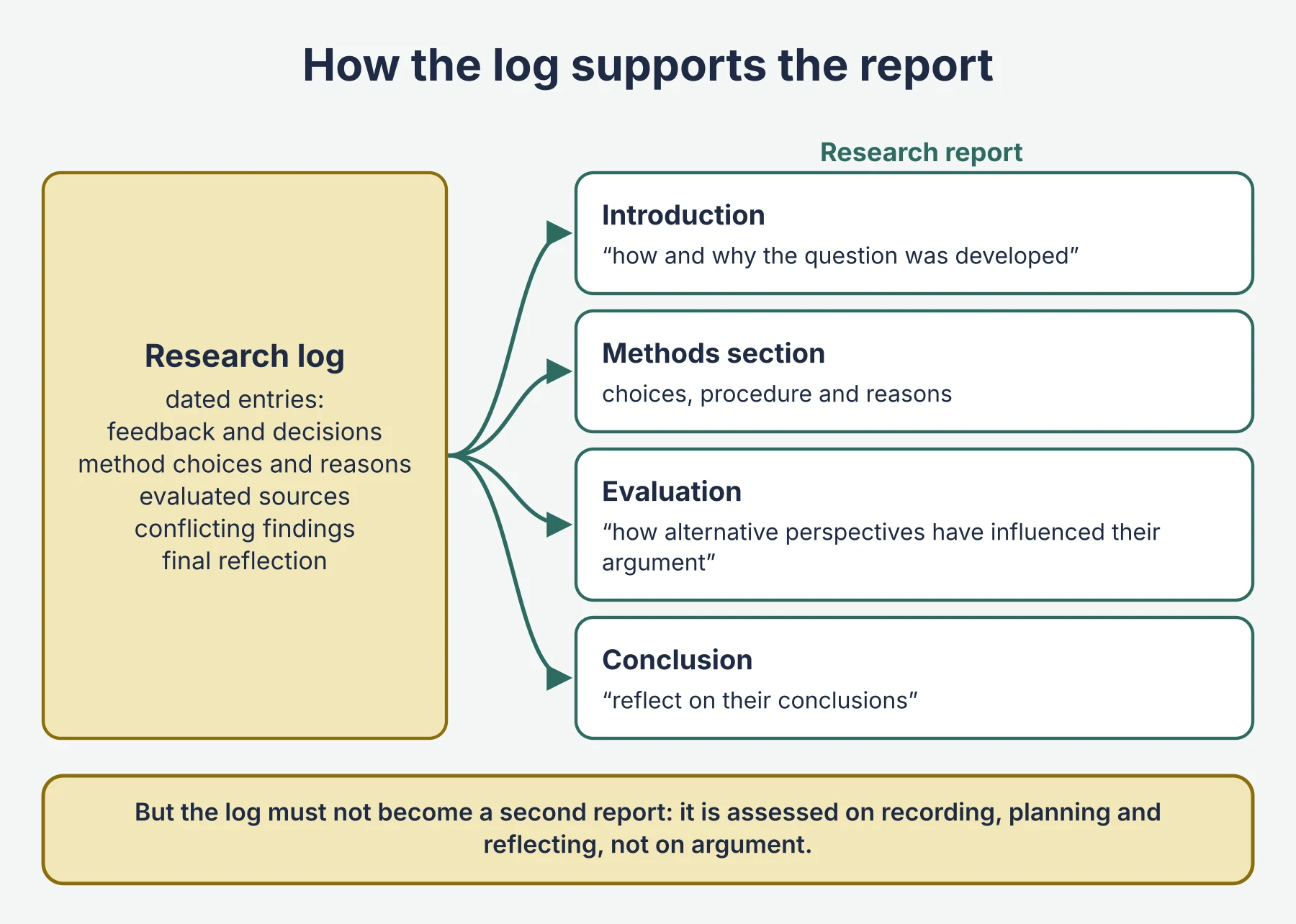
How the log feeds the report
- Introduction: explains “how and why the question was developed”.
- Methods section: reasons for choices.
- Conclusion: how alternative perspectives influenced your argument; reflection on conclusions and limits.
Good habits
Date every entry; write soon after the work; keep notes brief; log decisions, not every action; note full references at first use; bring the log to teacher discussions.
Condensed example
Weak entry: “Tuesday: read three articles about water prices. Thursday: started plan.” Strong entry: “Tuesday: two articles on water pricing agree that metering cuts use, but both study wealthy suburbs (record). My question is about fairness for low-income households, so these may not answer it (reflect). Next: find studies of metering in lower-income areas and ask my teacher whether the question needs narrowing (plan).”
Exam traps
- Dates and tasks with no reflection.
- Entries reconstructed at the end of the project.
- Feedback noted with no response.
- Sources listed without evaluation.
- Report paragraphs moved into the log to dodge the word limit.
- No record of how the question changed.
Self-test
- How many marks is the log worth?
- Quote the two assessment points that involve the log.
- Does the log count towards the 5000-word limit? What warning does the syllabus give?
- What formats does the syllabus allow for the log?
- Name the three kinds of decision the syllabus says could be recorded.
- Must every action be logged?
- What three verbs should a strong entry link?
- What should a feedback entry include?
- How does the log help with the report’s introduction?
- Why are entries written at the end of the project weak?
- Who monitors progress through the log?
- Turn this into a strong entry: “Read a report on cycling.”
Answers
- 10 marks of 85.
- “Use a research log to record, plan and reflect on research” and “reflect on research findings and decisions”.
- No; it “should not be seen as a way to extend that word limit”.
- “Note form or a mixture of notes and continuous prose”.
- The wording of the research question, the choice of methods, and judgements made during the research based on findings.
- No: “Candidates do not need to record all their actions and thinking.”
- Record, plan, reflect.
- The teacher’s point in your own words and what you decided to do about it.
- It provides dated evidence of how and why the question developed, which the report must explain.
- They lack the detail of real decisions as they happened and read as reconstruction.
- The teacher, “by discussion of their research log”.
- For example: “Read a city transport report on cycling lanes (record). It shows rising use but was written by the department that built them (reflect). Next: look for independent counts to check the figures (plan).”
Practise with the research log practice questions.
Related resources
-
Study guides
Cambridge International AS & A Level Global Perspectives & Research (9239): Research Report – Structuring and Presenting the Cambridge Research Report
How to organise the 9239 Cambridge Research Report: introduction, body, conclusion, word count, terminology, citation and referencing, and academic honesty.
Global Perspectives · Cambridge · A Level
Read guide -
Practice questions
Cambridge International AS & A Level Global Perspectives & Research (9239): Research Report – Structuring and Presenting the Cambridge Research Report – Practice Questions
Original practice on structuring the 9239 Research Report: word limit, introduction and conclusion, referencing, plagiarism and presentation for a non-specialist reader.
Global Perspectives · Cambridge · A Level
Try questions -
Study guides
Cambridge A Level Global Perspectives & Research (9239): Component 4 – Cambridge Research Report – Study Guide
How to plan, research and write the 9239 Cambridge Research Report: question, proposal, log, methods, perspectives, judgement and referencing.
Global Perspectives · Cambridge · A Level
Read guide
Studying Global Perspectives?
This page is free and stays free. Marlbridge is not offering Global Perspectives classes at the moment, so there is no tuition to book for it. The free study resources stay open to everyone.
Get free revision emails (optional)
Occasional emails with practice questions, worked explanations and links to free resources for the qualification and subjects you choose. No spam, and you can unsubscribe from any email. The free tools on this site never need an email.