
Study Guides
Cambridge International AS & A Level Global Perspectives & Research (9239): Research Report – The Research Log
How to keep the 10-mark research log for the 9239 Cambridge Research Report: what to record, plan and reflect on at each stage, with model entries.
- Subject
- Global Perspectives
- Level
- A LEVEL
- Topic
- Component 4 – Cambridge Research Report
- Author
- Marlbridge Academic Team
- Updated
- Reviewed by
- Ammar Bilal (what this means)
Aligned to Cambridge A Level Global Perspectives (9239), 2026-2028. Official specification .
Syllabus page (what it covers and how it is assessed): Cambridge A Level Global Perspectives.
Syllabus points this page covers
9239 (A Level)
- 4.4 Research log
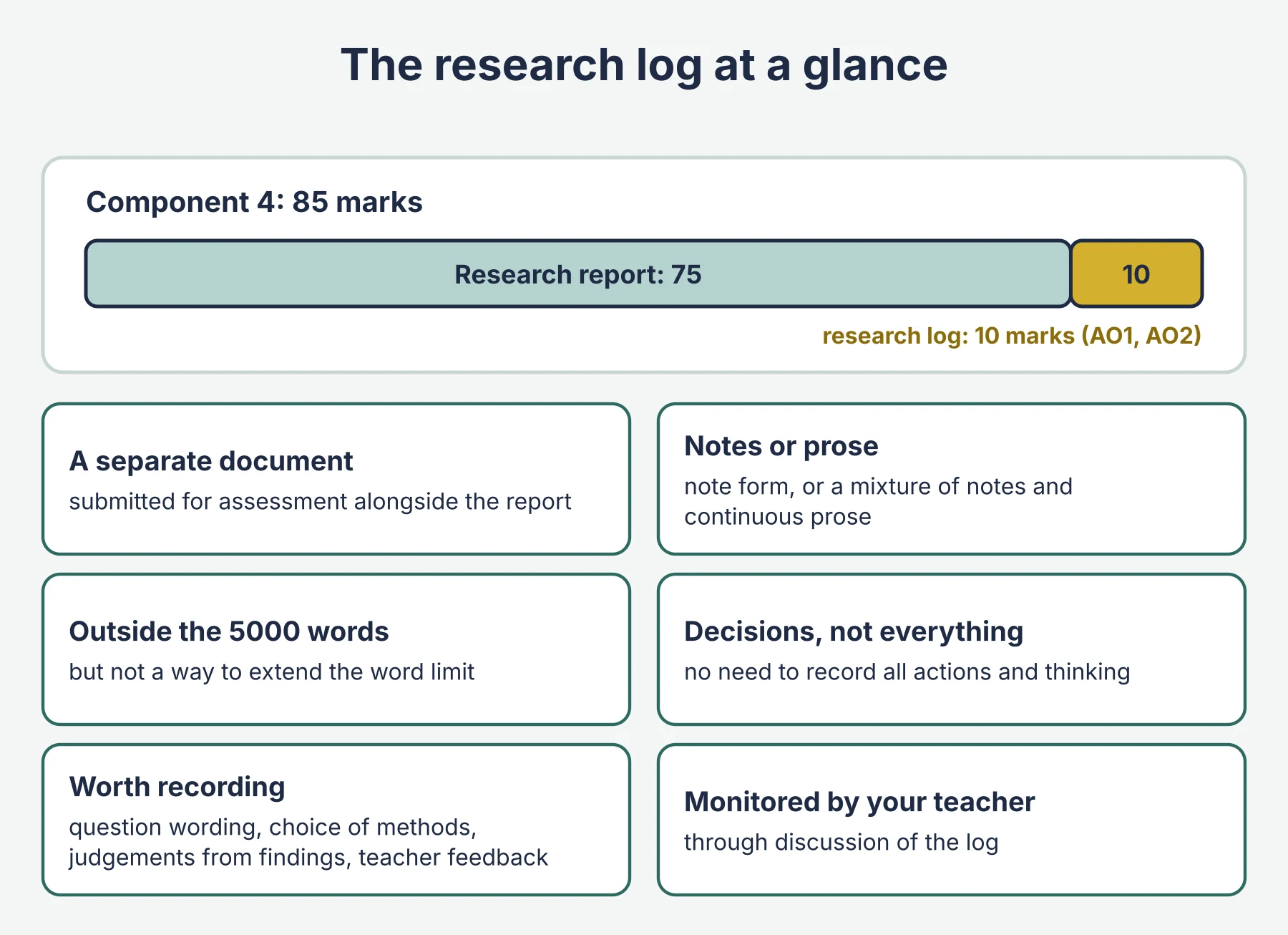
This guide covers the “Research log” section of Component 4, the Cambridge Research Report, in the Cambridge International AS & A Level Global Perspectives & Research (9239) syllabus for 2026-2028: “Candidates must use a research log throughout the research process to record information, plan actions and reflect on research findings and decisions.” The log carries 10 of the component’s 85 marks and is assessed on two points: “use a research log to record, plan and reflect on research (AO1, AO2)” and “reflect on research findings and decisions (AO2)”. For the component as a whole, read the Cambridge Research Report study guide first.
The rules in the syllabus
- The log “must be submitted for assessment and must be a separate document to the report”.
- It “can be written in note form or a mixture of notes and continuous prose”.
- It “is not included in the 5000 word limit of the report but it should not be seen as a way to extend that word limit”.
- “Candidates do not need to record all their actions and thinking in their log.”
- Decisions worth recording “could include the wording of their research question, their choice of methods, and judgements made during the research based on their findings”.
- The log “could contain reminders of things to check, ongoing evaluation of the research, and reflections on how their thinking or their research question may have changed as a result of feedback from the teacher”.
- Teachers “should monitor candidates’ progress by discussion of their research log”.
The syllabus also points to the Teacher Guide and further guidance on the School Support Hub for the log’s length and format, so your teacher will confirm the expectations your centre follows.
Three verbs: record, plan, reflect
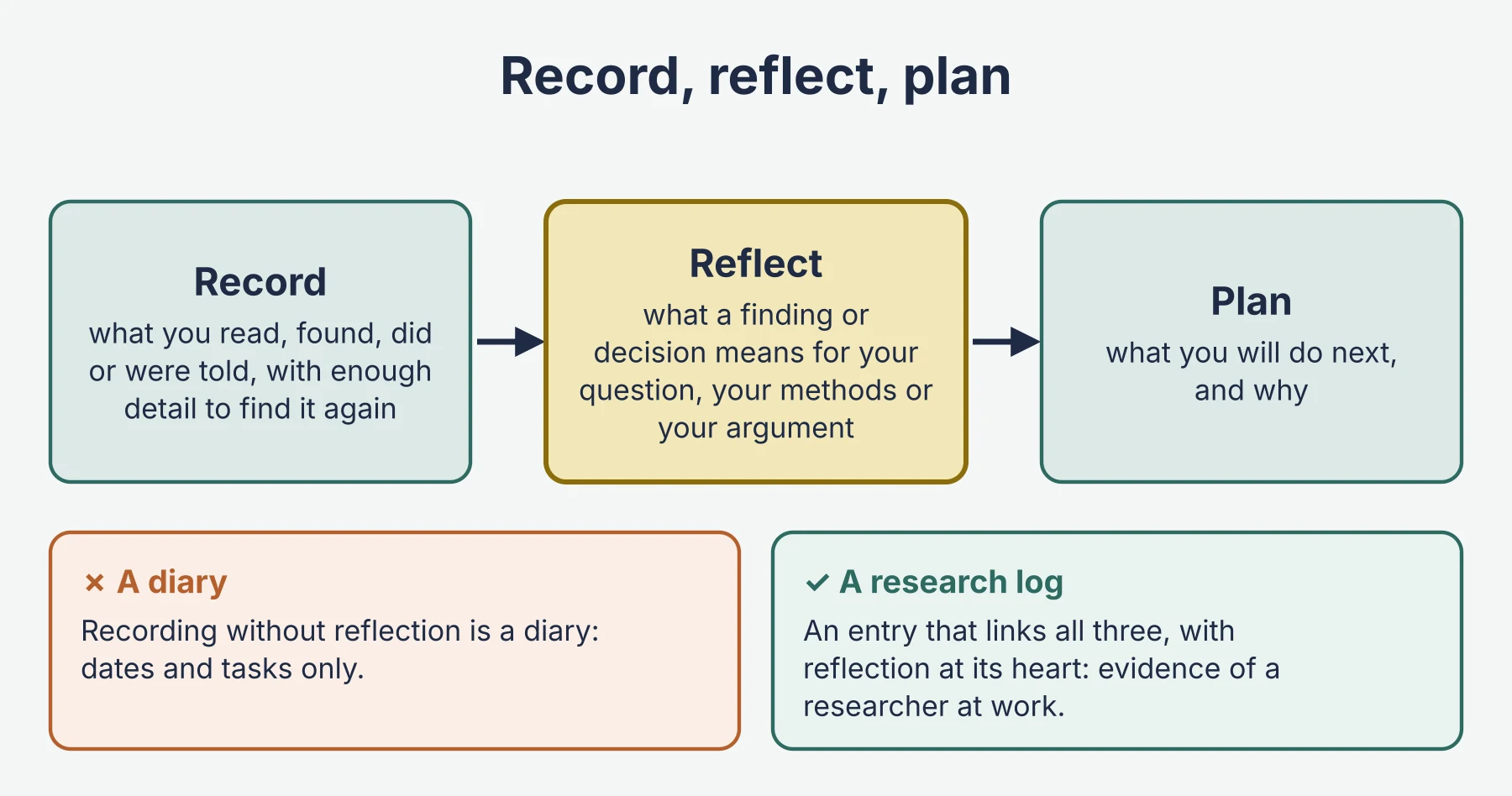
The first assessment point names three activities. A log entry that does only one of them is weaker than one that links all three.
| Verb | What it looks like in an entry |
|---|---|
| Record | What you read, found, did or were told, with enough detail to find it again |
| Plan | What you will do next, and why |
| Reflect | What a finding or decision means for your question, your methods or your argument |
The second assessment point, “reflect on research findings and decisions”, makes reflection the heart of the log. Recording without reflection is a diary; reflection is what turns it into evidence of a researcher at work.
What to log at each stage
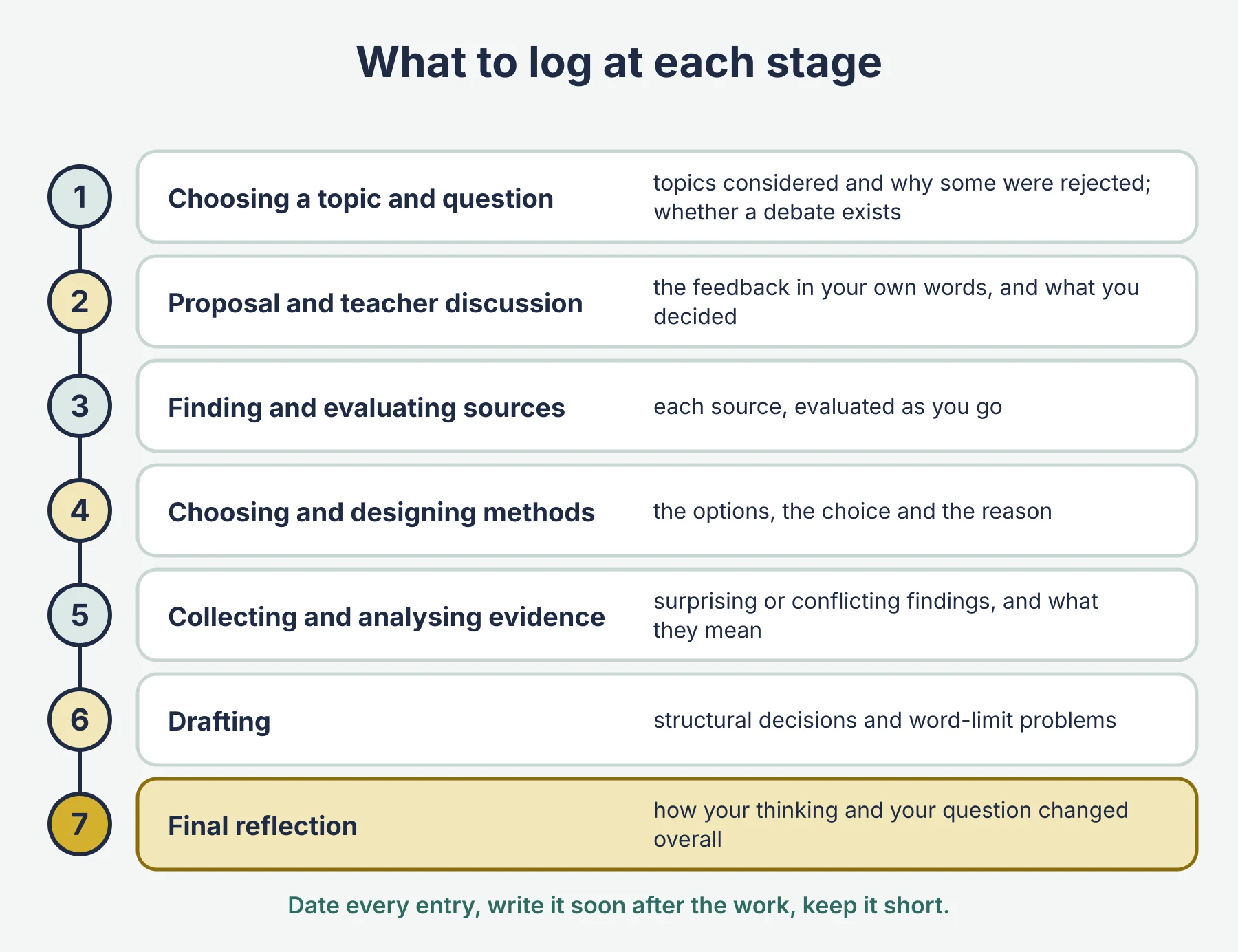
The stages below follow the order most projects take. The model entries are invented and short, to show what a useful entry contains; your own entries will reflect your own project.
1. Choosing a topic and question
Record the topics you considered and why you rejected some. Reflect on whether a debate exists.
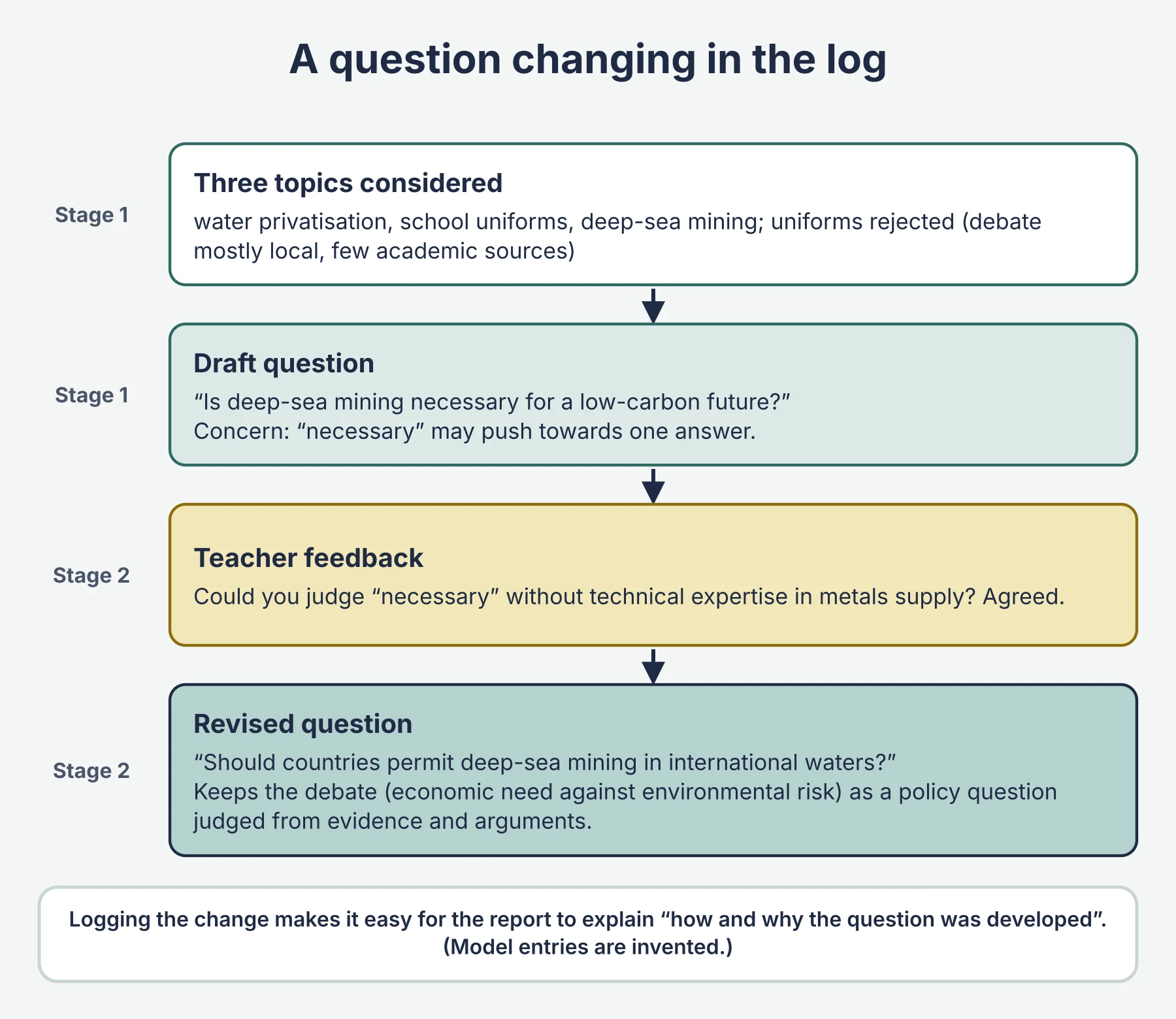
Entry. Considered three topics: water privatisation, school uniforms, deep-sea mining. Rejected uniforms (debate mostly local, few academic sources). Deep-sea mining has scientists, industry and governments disagreeing. Draft question: “Is deep-sea mining necessary for a low-carbon future?” Concern: “necessary” may push towards one answer. Next: find two sources on each side before the proposal meeting.
2. The proposal and teacher discussion
The syllabus mentions reflections on how thinking “may have changed as a result of feedback from the teacher”. Record the feedback in your own words and what you decided.
Entry. Proposal discussion. Teacher asked whether I could judge “necessary” without technical expertise in metals supply. Agreed. Changed to “Should countries permit deep-sea mining in international waters?” This keeps the debate (economic need against environmental risk) but makes it a policy question I can judge from evidence and arguments.
3. Finding and evaluating sources
Record the sources, and evaluate them as you go, so that the evaluation is ready when you draft.
Entry. Read a marine biology review article (university authors, peer-reviewed): stresses how little is known about deep-sea species. Strong on uncertainty, not on economics. Read a mining company briefing: claims minimal impact. Interest in the outcome; cites its own surveys. Use both, but treat the briefing as the industry perspective, not as neutral evidence. Next: look for an independent economic assessment of metal demand.
4. Choosing and designing methods
The syllabus names “their choice of methods” as a decision worth recording. Record the options, the choice and the reason.
Entry. Thought about interviewing people from a fishing community. Decided against: no safe or realistic way to reach those most affected, and a few interviews would not answer a question about international policy. Method: literature review grouped by perspective, plus analysis of published estimates of future metal demand. Note for methods section: policy questions in this area are usually argued from scientific evidence and economic forecasts.
5. Collecting and analysing evidence
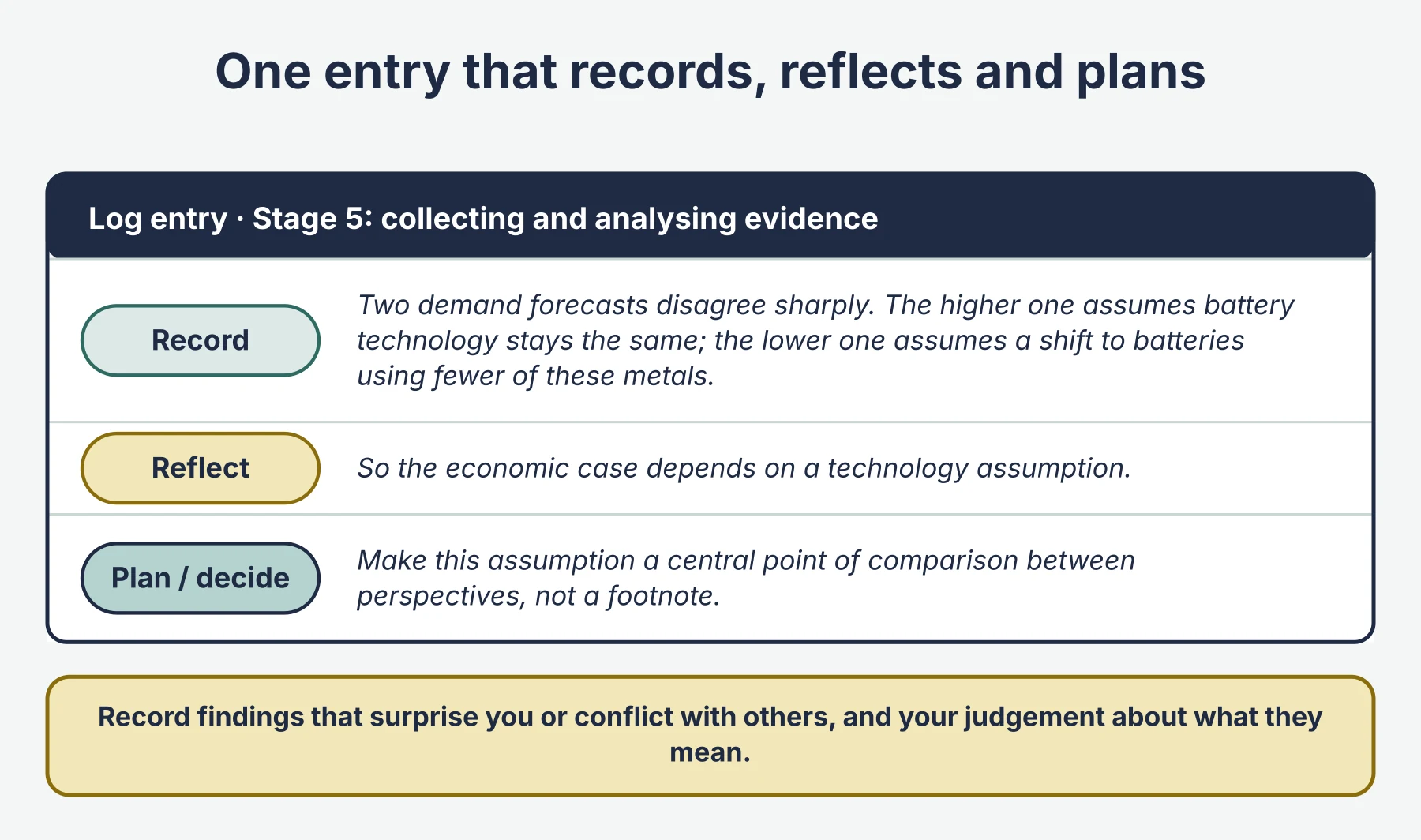
Record findings that surprise you or conflict with others, and your judgement about what they mean.
Entry. Two demand forecasts disagree sharply. The higher one assumes battery technology stays the same; the lower one assumes a shift to batteries using fewer of these metals. So the economic case depends on a technology assumption. Decision: make this assumption a central point of comparison between perspectives, not a footnote.
6. Drafting
Record structural decisions and problems with the word limit.
Entry. First draft 5,900 words. Cut the history of ocean law to one paragraph; it is background, not argument. Moved the technology assumption into the main evaluation. Reminder: check that every quotation has a page number.
7. Final reflection
Reflect on how your thinking and your question changed overall. This links directly to the report’s conclusion.
Entry. Started fairly sure mining should be banned. The demand forecasts made me take the economic case seriously, but the uncertainty in the biology review still seems decisive. Final view: permit only after independent baseline surveys. Biggest limit: I relied on English-language sources, mostly from Europe and North America.
How the log supports the report
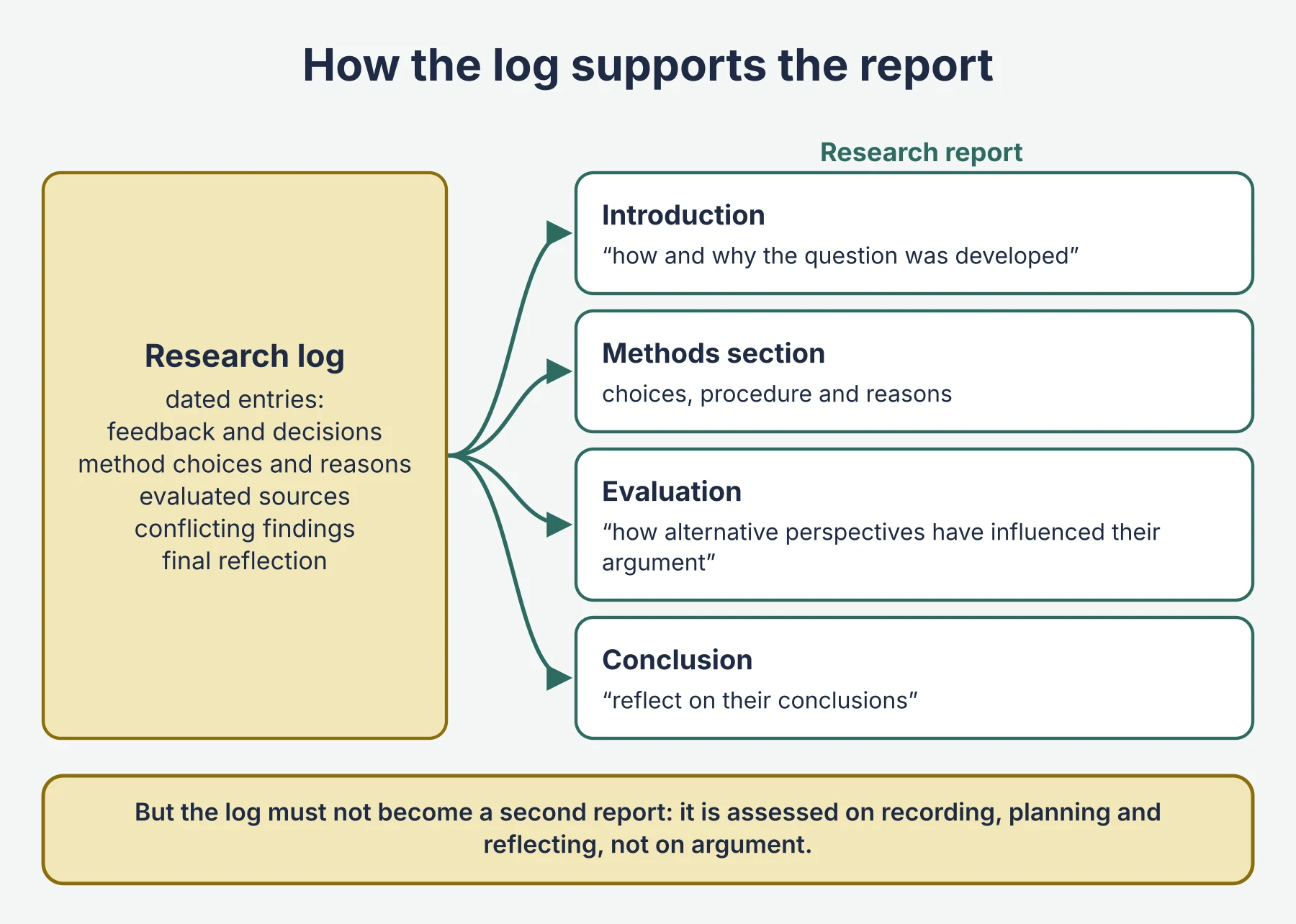
The report itself must explain “how and why the question was developed”, and the syllabus’s assessment points include “reflect on how alternative perspectives have influenced their argument” and “reflect on their conclusions”. A good log makes each of these easy to write, because the evidence is already recorded with dates and reasons. When you draft the introduction, the conclusion or the methods section, go back to the log.
The log must not become a second report. It is assessed on recording, planning and reflecting, not on argument, and the syllabus warns against using it to extend the word limit.
Practical habits
- Date every entry, so the development of your thinking is visible.
- Write entries soon after the work, while your reasons are fresh.
- Keep entries short: notes are acceptable.
- Log decisions, not every action; the syllabus says you do not need to record everything.
- Note the full reference of each source the first time you use it.
- Bring the log to teacher discussions, since teachers monitor progress through it.
Common mistakes
- A list of dates and tasks with no reflection or plans.
- Entries written at the end to reconstruct a process, which reads as invented and lacks the detail of real decisions.
- Recording feedback without saying what you did about it.
- Source lists without evaluation.
- Drafts of report paragraphs pasted into the log to get round the word limit.
- No record of how the question changed, so the report cannot explain its development.
Condense this with the research log revision notes and practise it with the research log practice questions. For the method decisions your log will record, see research methods and methodology.
Frequently asked questions
How long should the research log be? The syllabus does not set a length here; it refers to the Teacher Guide and further guidance for length and format. Ask your teacher for your centre’s expectations.
Can the log be handwritten notes? The syllabus allows “note form or a mixture of notes and continuous prose”. Work must be submitted electronically, so check with your teacher how a handwritten log should be prepared for submission.
Do I need an entry for every day? No. “Candidates do not need to record all their actions and thinking in their log.” Record what matters: findings, decisions, plans and reflection.
Related resources
-
Practice questions
Cambridge International AS & A Level Global Perspectives & Research (9239): Research Report – The Research Log – Practice Questions
Original practice on the 9239 research log: labelling record, plan and reflect, writing source, feedback, decision and finding entries, and judging logs.
Global Perspectives · Cambridge · A Level
Try questions -
Revision notes
Cambridge International AS & A Level Global Perspectives & Research (9239): Research Report – The Research Log – Revision Notes
Recall notes on the 9239 research log: syllabus rules, record-plan-reflect, what to log at each stage, entry types, habits, traps and a self-test.
Global Perspectives · Cambridge · A Level
Revise topic -
Study guides
Cambridge International AS & A Level Global Perspectives & Research (9239): Research Report – Structuring and Presenting the Cambridge Research Report
How to organise the 9239 Cambridge Research Report: introduction, body, conclusion, word count, terminology, citation and referencing, and academic honesty.
Global Perspectives · Cambridge · A Level
Read guide
Studying Global Perspectives?
This page is free and stays free. Marlbridge is not offering Global Perspectives classes at the moment, so there is no tuition to book for it. The free study resources stay open to everyone.
Get free revision emails (optional)
Occasional emails with practice questions, worked explanations and links to free resources for the qualification and subjects you choose. No spam, and you can unsubscribe from any email. The free tools on this site never need an email.