
Revision Notes
Cambridge International AS & A Level Global Perspectives & Research (9239): Research Report – Research Methods and Methodology – Revision Notes
Recall notes on methods in the 9239 Research Report: question types, design decisions for each method, ethics, the methods section and its limits.
- Subject
- Global Perspectives
- Level
- A LEVEL
- Topic
- Component 4 – Cambridge Research Report
- Author
- Marlbridge Academic Team
- Updated
- Reviewed by
- Ammar Bilal (what this means)
Aligned to Cambridge A Level Global Perspectives (9239), 2026-2028. Official specification .
Syllabus page (what it covers and how it is assessed): Cambridge A Level Global Perspectives.
Syllabus points this page covers
9239 (A Level)
- 4.3 Research methods and methodology
These notes cover the “Research methods and methodology” section of Component 4, the Cambridge Research Report, in Cambridge International AS & A Level Global Perspectives & Research (9239), 2026-2028: candidates “must explain their choice and use of appropriate research methods, and consider the methodology which has informed this”. For the component as a whole, see the Cambridge Research Report study guide; for full explanations and a model methods paragraph, read the research methods study guide.
What the syllabus says
- “Candidates should select research methods that are appropriate for their chosen topic.”
- Research “can be based on primary and/or secondary evidence, depending on the subject matter and the approach”.
- Methods listed: reviewing the secondary literature; close analysis of texts; other qualitative methods (ethnography, interviews, focus groups); analysis and evaluation of statistical or other numerical data; other quantitative methods (surveys, experiments); a mixture.
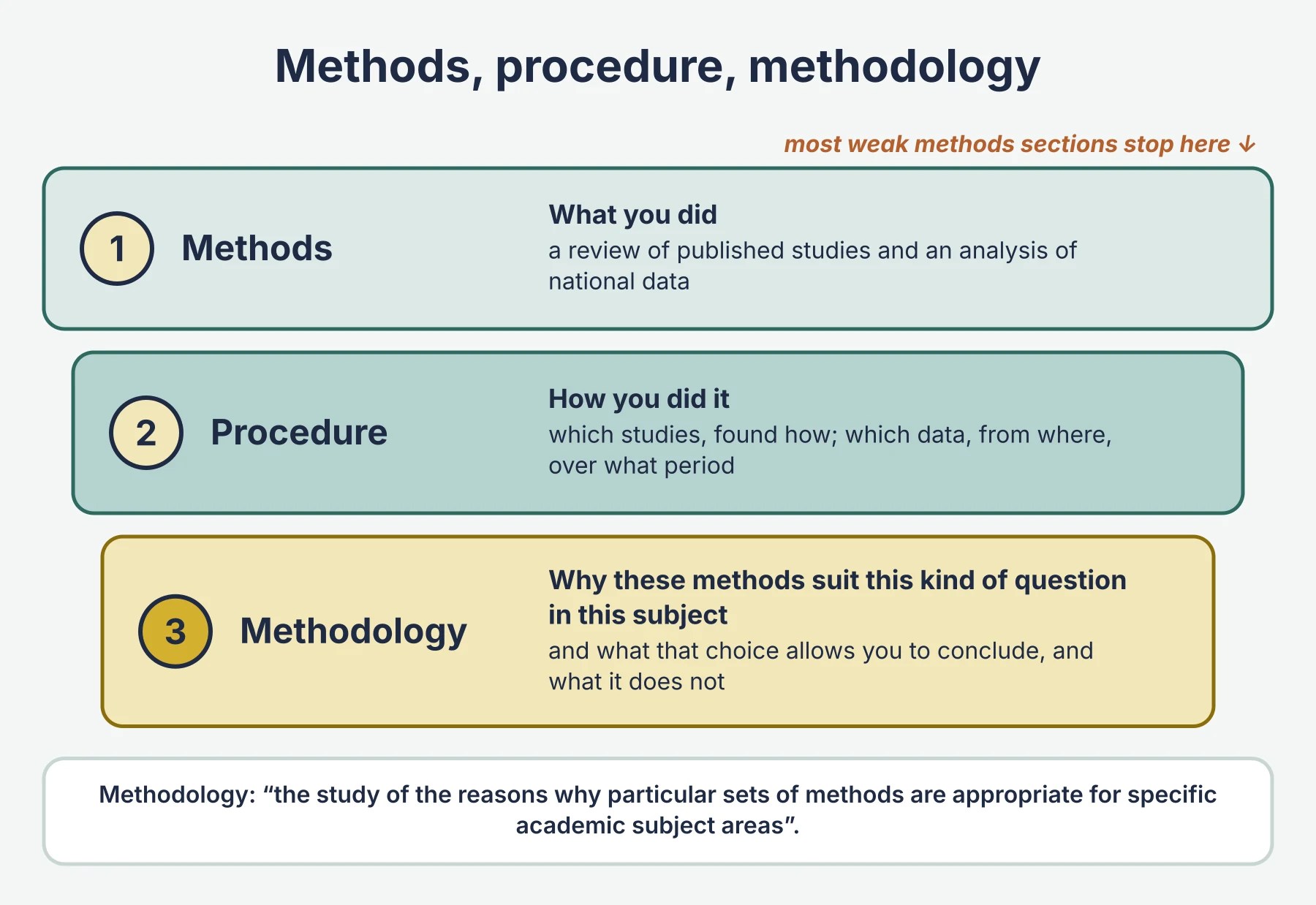
- Methodology: “the study of the reasons why particular sets of methods are appropriate for specific academic subject areas”.
- Candidates must “consider the impact of their choice on their report” and “explain how they carried out the research”.
- Assessment point: “use appropriate research methods (AO1)”.
Three layers of a methods section
- Methods: what you did.
- Procedure: how exactly.
- Methodology: why it suits the question and subject, and what it allows you to conclude.
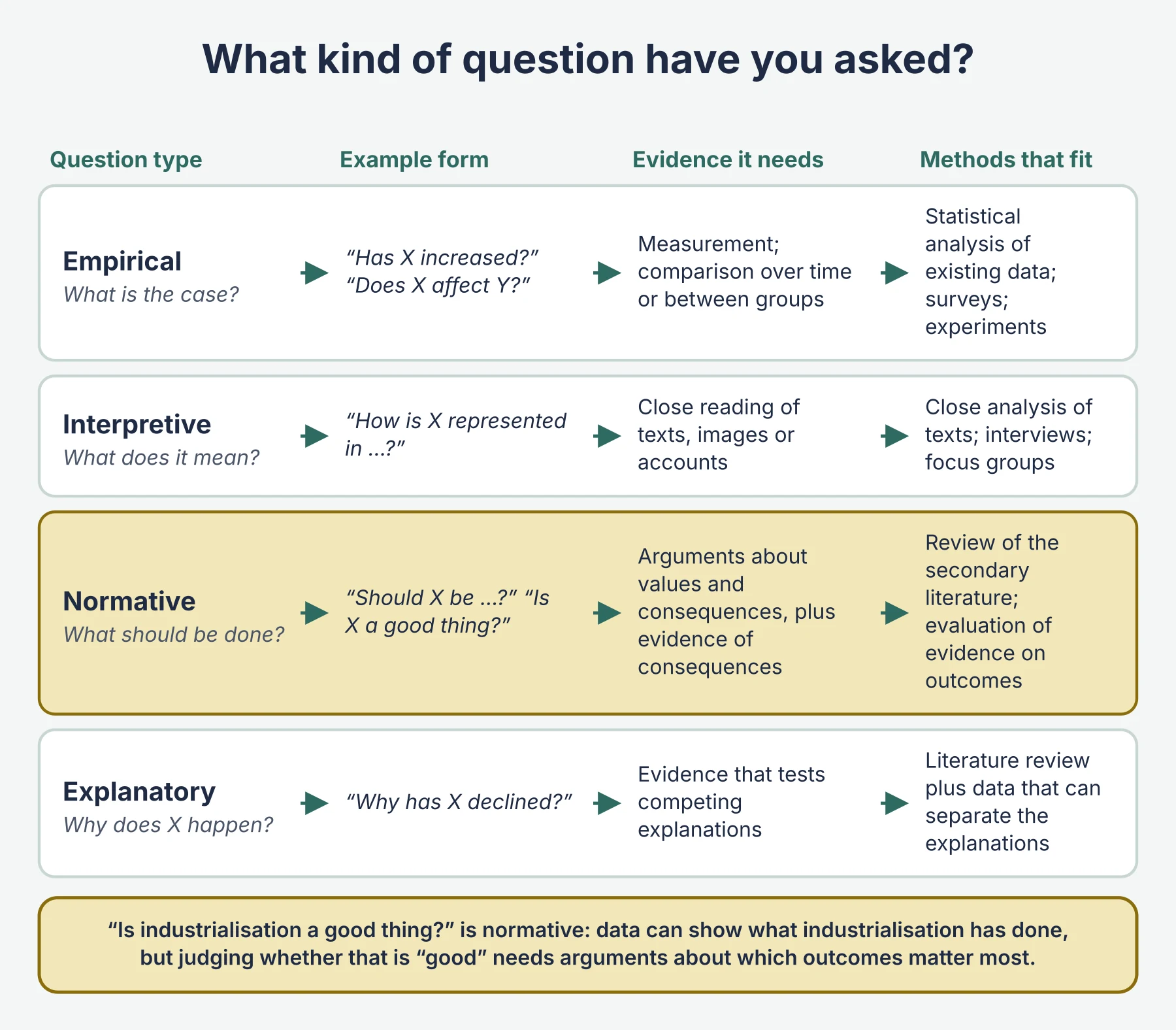
Question types and fitting methods
| Type | Asks | Usual methods |
|---|---|---|
| Empirical | What is the case? | Statistical data, surveys, experiments |
| Interpretive | What does it mean? | Close analysis of texts, interviews, focus groups |
| Normative | What should be done? | Literature review of arguments plus evidence on outcomes |
| Explanatory | Why does it happen? | Literature review plus data that tests rival explanations |
Normative questions need reasoning about values; data alone cannot answer them.
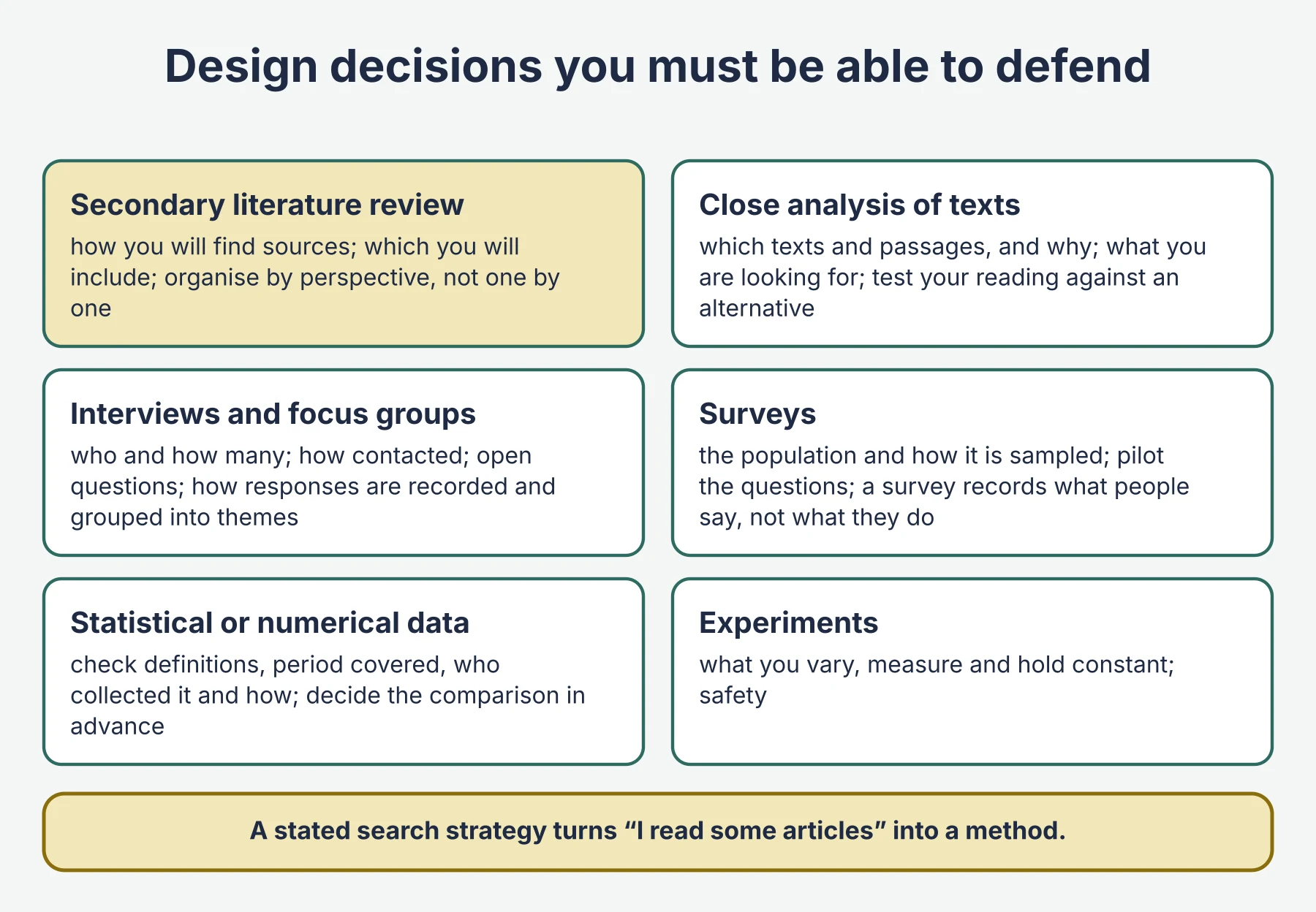
Design decisions for each method
| Method | Decisions to state |
|---|---|
| Literature review | Search terms and places; inclusion criteria; grouping by perspective |
| Close analysis of texts | Which texts and passages, and why; what features you analyse; an alternative reading |
| Interviews and focus groups | Who, how many, how contacted; open questions; recording; grouping answers into themes |
| Survey | Population; sampling; piloted, neutral questions; says versus does |
| Statistical data | Definitions; period; producer and collection method; the comparison that answers the question |
| Experiment | What is varied, measured, held constant; safety |
Key terms
| Term | Meaning |
|---|---|
| Research method | A way of gathering and analysing evidence |
| Methodology | Why particular methods suit a subject area, and what that implies |
| Procedure | The specific steps taken to carry out a method |
| Search strategy | How sources for a literature review were found and selected |
| Pilot | A small trial of a survey or interview to test the questions |
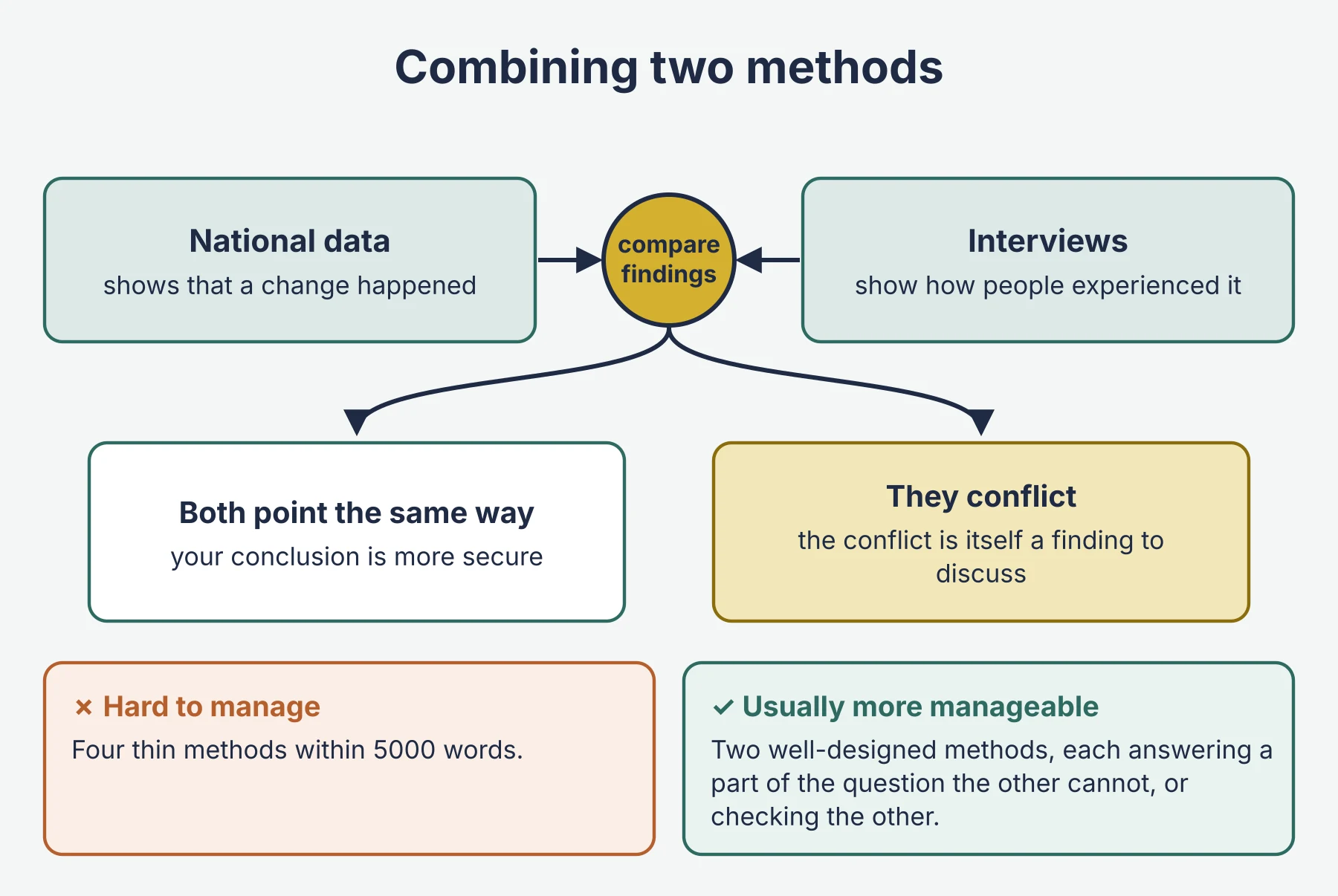
| Mixed methods | Using more than one method so each answers or checks a part of the question |
| Informed consent | Participants understand the research and agree to take part |
| Anonymity | Participants cannot be identified from the report |
| Scope | What the research covers, and therefore what it can claim |
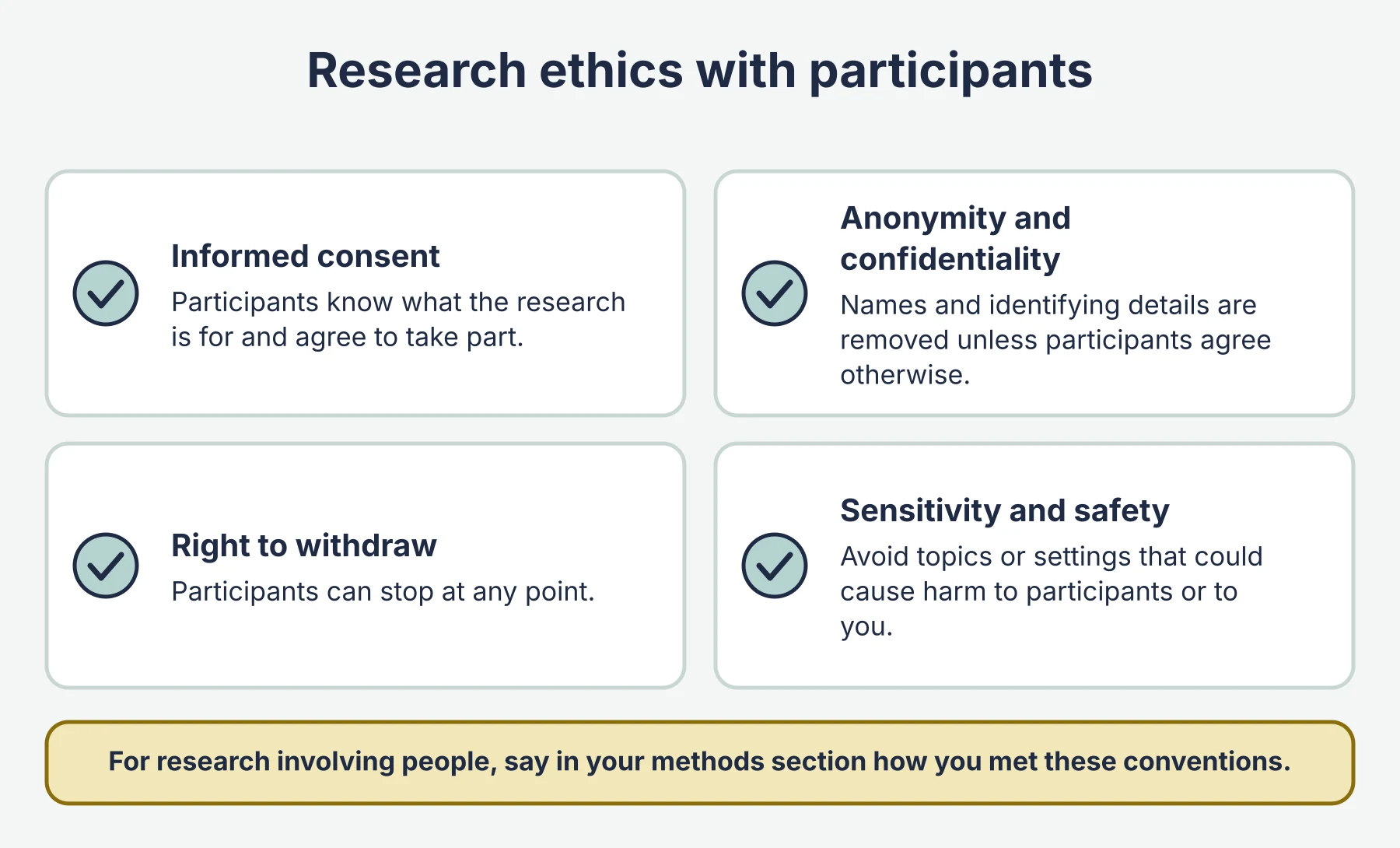
Ethics checklist (research with people)
Informed consent; anonymity and confidentiality; right to withdraw; sensitivity and safety. The syllabus asks teachers to help candidates “consider research ethics and conventions” and to be satisfied the research “does not raise safety issues”.
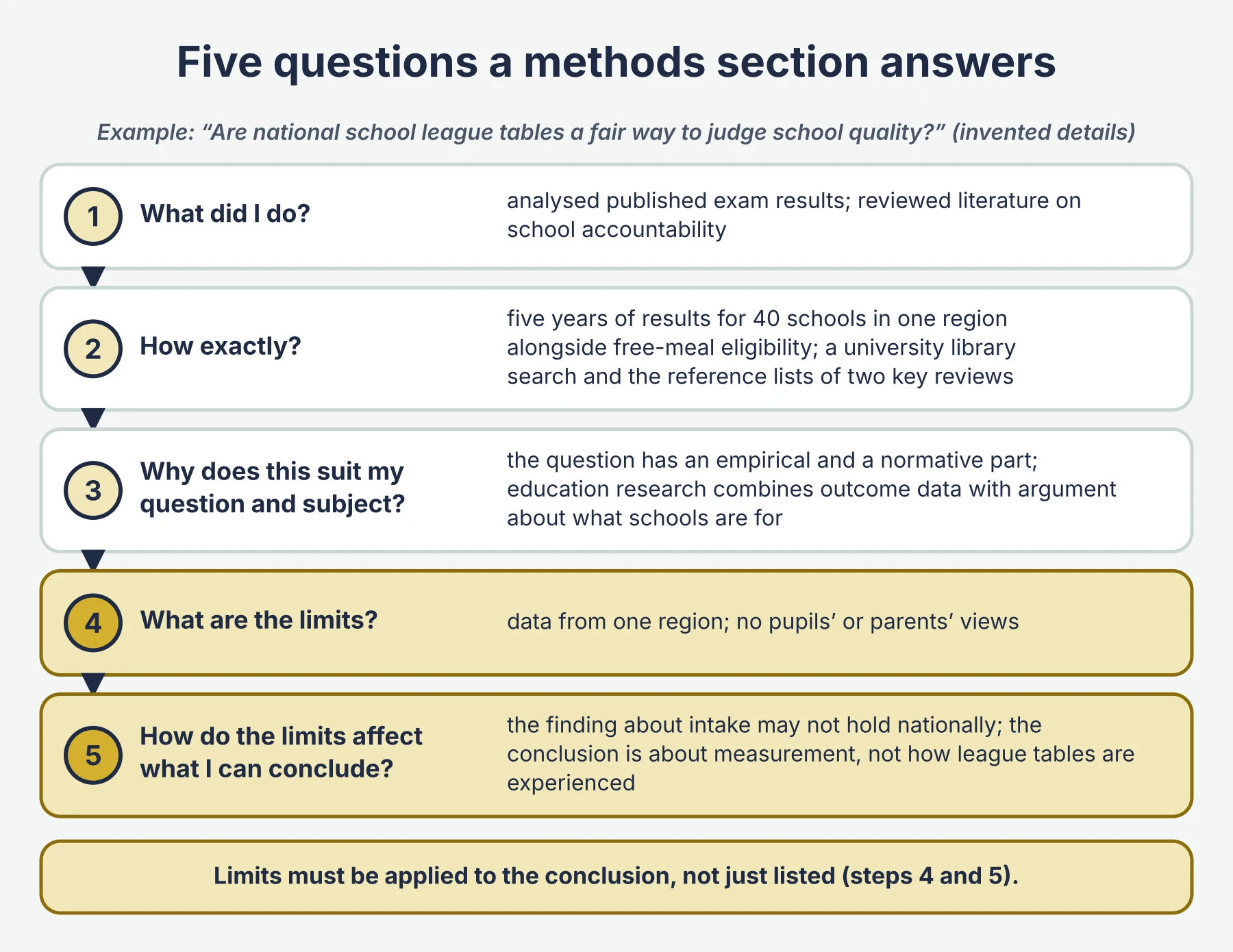
The five questions a methods section answers
What did I do? How exactly? Why does it suit my question and subject? What are its limits? How do the limits affect what I can conclude?
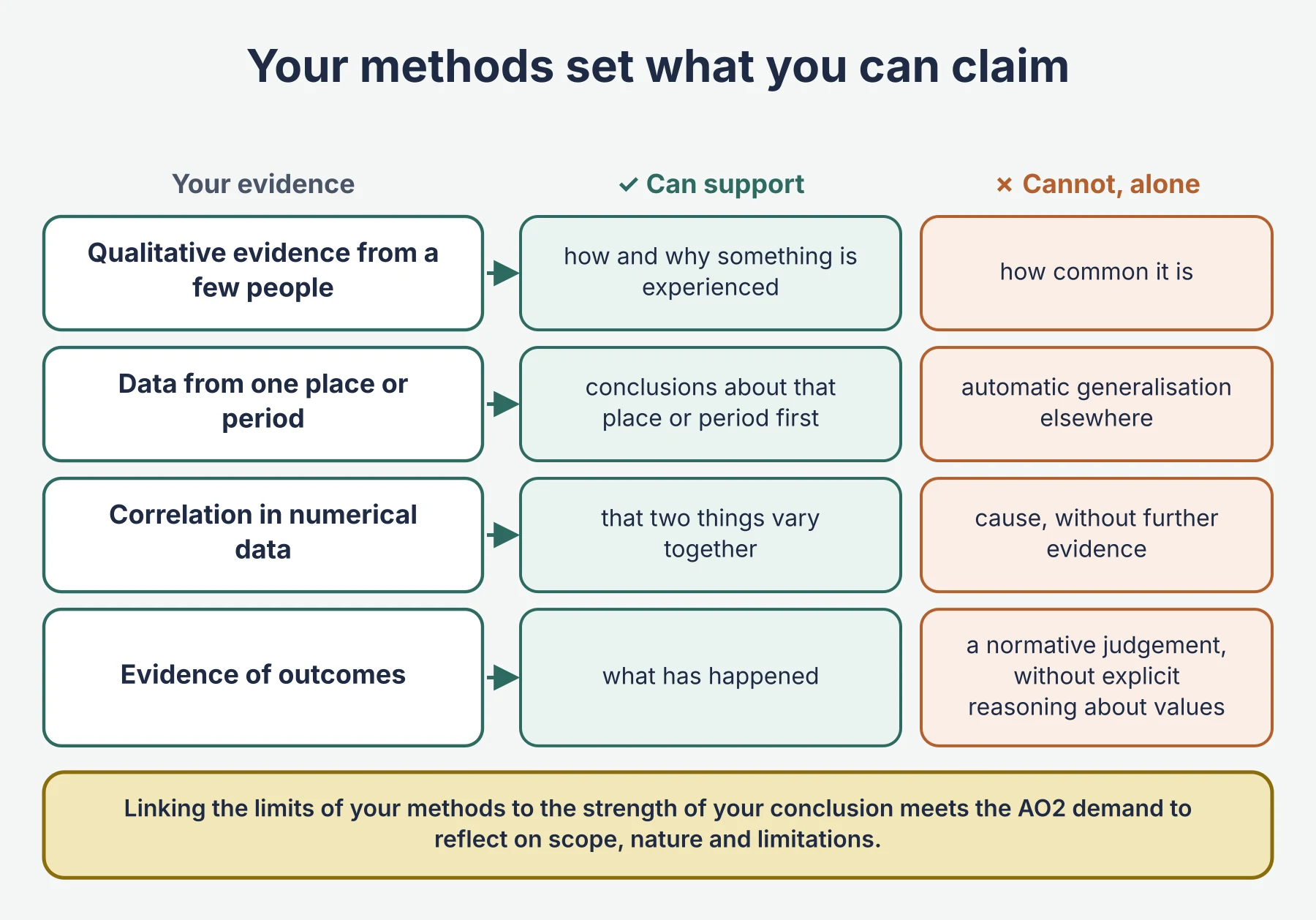
Boundaries methods set on conclusions
- A few interviews: how and why, not how common.
- One place or period: conclusions about that place or period first.
- Correlation: not cause without further evidence.
- Normative question: needs explicit value reasoning.
Exam traps
- Naming methods with no procedure.
- A method that cannot answer the question asked.
- Methodology copied as a definition rather than applied.
- Limits listed but not connected to the conclusion.
- No mention of ethics when people take part.
- Four thin methods instead of two well-designed ones.
Self-test
- Give the syllabus definition of methodology.
- What three layers should a methods section contain?
- Name the six method options the syllabus lists (counting “a mixture”).
- What kind of question is “Should cities ban advertising for high-sugar foods?”, and why does that matter for methods?
- What should a literature review’s procedure state?
- Why pilot a survey?
- What is one limit of using a survey to study behaviour?
- Why check definitions when comparing statistics from different countries?
- Give two ethical conventions for interviews.
- What can a small number of interviews show, and what can they not?
- When does mixing methods strengthen a report?
- What must a candidate explain about how the research was done, according to the syllabus?
Answers
- “The study of the reasons why particular sets of methods are appropriate for specific academic subject areas”.
- Methods, procedure, methodology.
- Reviewing the secondary literature; close analysis of texts; other qualitative methods; analysis of statistical or numerical data; other quantitative methods; a mixture.
- Normative. Data on effects can inform it, but the judgement also needs reasoning about values, such as health against freedom of commerce.
- Search terms and places searched, inclusion criteria and how sources were grouped.
- To find ambiguous or leading questions before the main survey.
- It records what people say they do, which may differ from what they actually do.
- The same term may be measured differently, so comparisons could be misleading.
- Any two: informed consent; anonymity; confidentiality; right to withdraw; avoiding harm.
- How and why people experience something; not how common that experience is.
- When each method answers a part of the question the other cannot, or when one checks the other.
- “How they carried out the research”, along with their choice and use of methods and the methodology behind them.
Practise with the research methods practice questions.
Related resources
-
Study guides
Cambridge International AS & A Level Global Perspectives & Research (9239): Research Report – The Research Log
How to keep the 10-mark research log for the 9239 Cambridge Research Report: what to record, plan and reflect on at each stage, with model entries.
Global Perspectives · Cambridge · A Level
Read guide -
Practice questions
Cambridge International AS & A Level Global Perspectives & Research (9239): Research Report – The Research Log – Practice Questions
Original practice on the 9239 research log: labelling record, plan and reflect, writing source, feedback, decision and finding entries, and judging logs.
Global Perspectives · Cambridge · A Level
Try questions -
Revision notes
Cambridge International AS & A Level Global Perspectives & Research (9239): Research Report – The Research Log – Revision Notes
Recall notes on the 9239 research log: syllabus rules, record-plan-reflect, what to log at each stage, entry types, habits, traps and a self-test.
Global Perspectives · Cambridge · A Level
Revise topic
Studying Global Perspectives?
This page is free and stays free. Marlbridge is not offering Global Perspectives classes at the moment, so there is no tuition to book for it. The free study resources stay open to everyone.
Get free revision emails (optional)
Occasional emails with practice questions, worked explanations and links to free resources for the qualification and subjects you choose. No spam, and you can unsubscribe from any email. The free tools on this site never need an email.